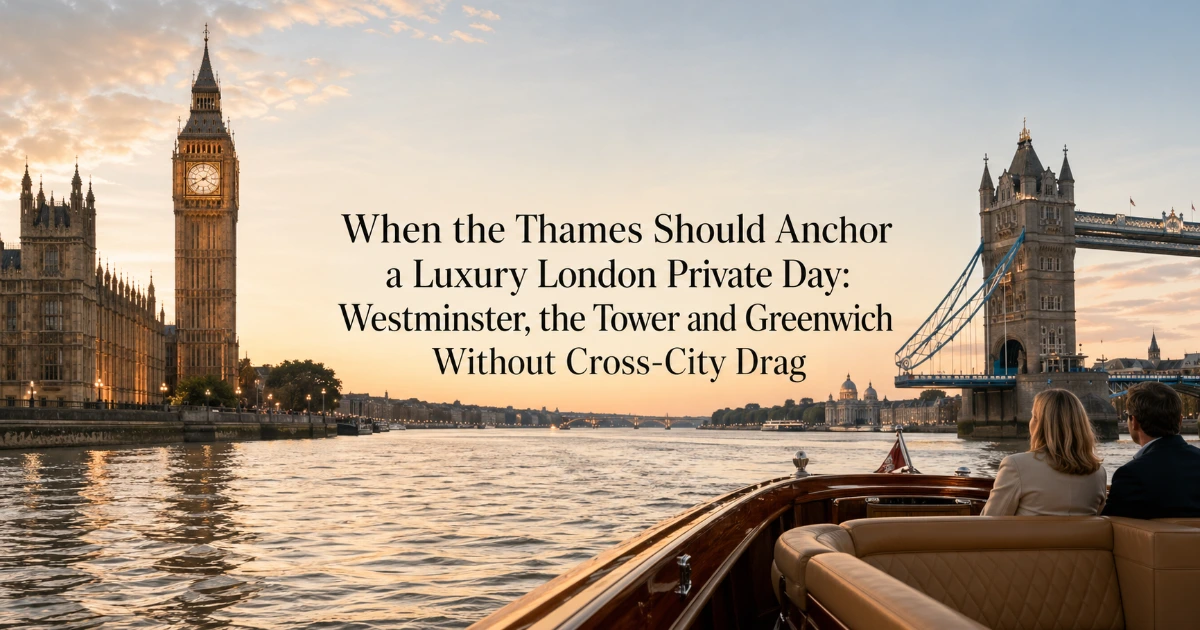
When the Thames Should Anchor a Luxury London Private Day: Westminster, the Tower and Greenwich Without Cross-City Drag
Updated
Make the Thames the spine of a private London sightseeing day when Westminster and the Tower of London are both firm priorities and Greenwich is only included if the eastward arc adds meaning, not just mileage. It works because the Westminster Pier-to-Tower Pier route hinge replaces one of central London’s most irritating cross-city hops with seated movement, a clearer story line and a useful pause between two guide-heavy sections. The clearest exception is a first London day built around Westminster Abbey, the Churchill War Rooms, St James’s and a West End evening; that day should stay mostly on foot and by car, with the river as a short addition or not at all.
The thesis is specific to London: the Thames should anchor the day only when it connects interpretation, physical relief and an east-west route that the roads would otherwise make feel heavier than the map suggests. Westminster Pier sits below Westminster Bridge rather than up by Parliament Square, and Tower Pier lands close to the Tower’s river edge, so the route avoids the temptation to crawl a car through Whitehall, Trafalgar Square, Aldwych, Fleet Street or the City approaches simply to reach a destination that already faces the river.
A Thames-led day is not the right default for every first London visit. It is the right move when the river is doing planning work: moving the party between Westminster and the Tower, giving the guide a natural bridge between monarchy, Parliament, trade and defense, and creating a calm middle act before the Tower’s stones, stairs and crowds ask for focus again. If the river is only being added because London “should have a cruise,” keep it separate and build a tighter private day instead. For a route where the water genuinely carries the plan, Orange Donut Tours can fold a private Thames cruise into the day without letting it swallow the sightseeing.
The Thames routing matrix: river spine, walking core or chauffeur day?
The Thames should lead when it removes cross-city strain; it should not lead when it adds a scenic detour to an already coherent walking route. Use the matrix below before adding Greenwich, changing lunch plans or upgrading transport.
- River spine wins: Westminster and the Tower of London are both must-sees, the group wants one coherent historical arc, and the day can tolerate a seated transfer by water between two dense guided sections. This is the best fit for couples, families with older children, multi-generational groups who can handle some Tower walking, and celebration travelers who want the day to feel considered rather than squeezed.
- Walking core wins: Westminster Abbey, Parliament Square, Whitehall, the Churchill War Rooms, St James’s Park and a West End evening are the real priorities. In this plan, the river becomes a distraction because it pulls you away from a compact cluster where guide-led walking gives better value than repeated transfers.
- Chauffeur day wins: The group is staying far west, has limited walking tolerance, needs controlled hotel returns, or wants to combine Westminster with St Paul’s, Mayfair, South Kensington or a fixed lunch. A car earns its cost at the edges of the day, not necessarily between every sight.
- Greenwich extension wins: The party has already accepted that the day will move beyond the central monuments. Greenwich belongs when maritime London, royal observatories, river trade, architecture and a softer afternoon are part of the reason for going, not when it is a last-minute “while we are on the boat” addition.
- Cut first: Greenwich is the first piece to remove if the morning runs long, the Tower becomes the main event, the weather turns unpleasant, or dinner and theatre plans matter. Do not cut the river hinge between Westminster and the Tower before cutting an under-motivated Greenwich extension.
The counterintuitive correction is that a chauffeur is often overvalued precisely between Westminster and the Tower. A polished car can improve hotel pick-up, luggage handling, controlled returns and outlying neighborhood moves, but it cannot make central London’s junctions feel elegant when the river already gives you a cleaner line. Premium spend does not help much on the Westminster Pier-to-Tower Pier leg itself: a chauffeur can make hotel pick-up more comfortable, but it does not materially improve dense Westminster walking time or a short river-linked segment that is already better solved by pier choice.
That is why a private route should not begin with the question “car or boat?” It should begin with what the day is trying to carry. If the purpose is a strong first encounter with royal, parliamentary and defensive London, a Westminster-to-Tower river spine can do the heavy lifting. If the purpose is a full city sampler with flexible pacing, a Best of London private tour may be the better base, with the Thames used only where it clarifies the route.
The Westminster Pier-to-Tower Pier route hinge is where the river earns its keep
The river earns its place most clearly between Westminster Pier and Tower Pier because it changes the cost of the transfer, not just the view. Westminster is compact but mentally dense: Parliament, the Abbey precinct, Whitehall, Downing Street’s guarded edge, Horse Guards and the Churchill War Rooms all compete for attention in a relatively small area. The Tower is another concentrated environment, with layers of Norman power, royal prison stories, regalia, walls, courtyards and river defense. Putting a normal road transfer between those two interpretive blocks can flatten the day just when guests need a pause.
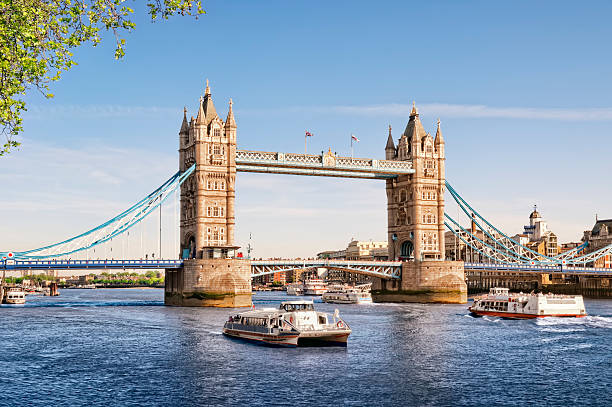
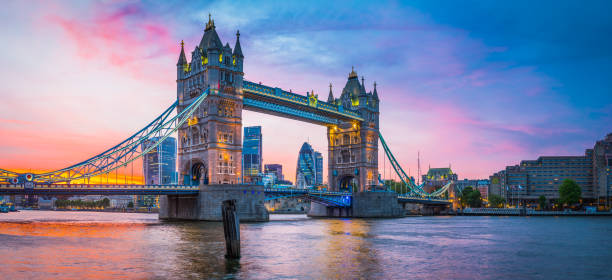
The Thames solves that by turning the middle of the day into movement with context. From Westminster Pier, the river lets the guide continue the story eastward through bridges, riverfront government, the City’s edge, St Paul’s in the skyline, the South Bank, London Bridge and the approach to Tower Bridge without asking the group to sit silently in traffic. Tower Pier then lands the party close enough to the Tower of London that the next section feels like a continuation rather than a restart. This is the exact value of the Westminster Pier-to-Tower Pier route hinge: it makes the transfer itself belong to the day.
There is also a body consequence. London is not a mountain city, but it wears people down through junctions, station stairs, security edges, uneven historic paving, repeated bag checks and the stop-start rhythm of moving between districts. A car transfer can feel restful at first, then oddly tiring when everyone has to reload, reorient, step out at a crowded kerb and rebuild attention. A river transfer keeps the party seated without making the guide abandon the narrative. It also reduces the number of moments when the group is split by pavements, crossings or traffic noise.
This is where private planning has a real advantage. A guide-led Westminster segment can end at the pier at the right moment, rather than after one more “nearby” stop that pushes the whole day late. The Tower segment can begin with purpose, not with a scramble from a taxi drop-off. For guests who care about the Tower as more than a photo stop, the handoff is especially valuable; a dedicated Tower of London private tour deserves arrival energy, not the mood of a group that has already fought the city twice.
For current visitor details, check the official Tower of London (https://www.hrp.org.uk/tower-of-london/) information before finalizing the day. Timed entry patterns, special closures and internal routing can change, and the private itinerary should respect the venue’s current operating reality rather than rely on stale assumptions.
Sequence Westminster and the Tower around attention, not just the map
The strongest Thames-led day usually treats Westminster and the Tower as two demanding chapters with the river between them, not as three sightseeing stops plus a cruise. That distinction matters. Westminster asks guests to absorb constitutional history, royal ceremony, wartime memory and live government geography. The Tower asks for a different kind of attention: fortress, palace, prison, treasury, river defense and national myth all compressed into one site. The Thames should separate those chapters just enough for the group to arrive ready for the second one.
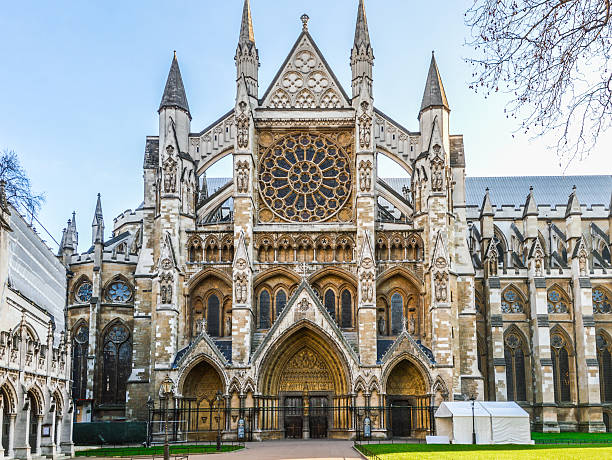
For many private groups, Westminster first works because the morning gives structure to Parliament Square, the Abbey precinct and Whitehall before the city feels too scattered. The route can then descend toward Westminster Pier instead of drifting west or north into unrelated additions. The river leg becomes a deliberate turn from ceremonial and political London to defensive and mercantile London. That is a stronger editorial move than trying to “cover” Westminster, then forcing a car east, then pretending the Tower is simply the next attraction.
Tower first can work when the Tower is the emotional anchor, when timed access or family energy makes an earlier start sensible, or when the group wants to finish closer to Westminster, St James’s, Mayfair or the West End. The tradeoff is that the day loses the cleanest west-to-east story line. It can still be excellent, but the river is then a connector rather than the governing spine. This is not a failure; it is simply a different day. The mistake is to label both versions as the same Thames day and ignore how differently they feel.
The walking inside Westminster should not be underestimated. Parliament Square to Westminster Abbey, the Abbey precinct to Whitehall, Whitehall to Horse Guards or St James’s Park, and the return toward the pier are all short on paper but full of stopping, explaining, looking and navigating. A chauffeur is least useful inside this dense zone. The right private guide matters more than the right vehicle because the guide controls what gets cut, when the group crosses, and which details receive attention before the party becomes overloaded.
The Tower has a different physical pattern. It is not merely a building beside the river; it is a layered complex with stone surfaces, internal stairs in some routes, exposed courtyards, bottlenecks and the need to choose between depth and breadth. A private guide helps by deciding when to dwell, when to move, and when not to chase every possible corner. Guests who arrive by river often have a better second wind because the transfer did not consume them with street noise and traffic vigilance.
For travelers comparing this plan with a broader City-and-St Paul’s route, the useful distinction is this: a river spine from Westminster to the Tower is about reducing drag between two central monuments, while a broader east-central day uses the river as one element in a wider City story. Orange Donut Tours’ white-glove London day beyond Westminster is the better reference when St Paul’s, the City and a river cruise are the real subject. This article’s narrower answer is for the day when Westminster, the Tower and possible Greenwich routing are the planning problem.
When Greenwich is worth the extra arc
Greenwich is worth adding when it changes the meaning of the afternoon; it is not worth adding merely because the boat can continue east. The extension works when guests are interested in maritime London, navigation, royal architecture, the river as an imperial and commercial artery, or a calmer finish after the Tower. It is weaker when the group mainly wants first-time London recognition points and has not yet earned the extra distance with a clear reason.
The route-friction is real. Greenwich moves the day beyond the central tourist band. Once you continue east from Tower Pier toward Greenwich Pier, the plan becomes a time-and-energy extension, not a casual flourish. On arrival, the district can feel deceptively gentle because the riverfront opens up around the Cutty Sark, the Old Royal Naval College and the approach into the town center. But the visitor still has decisions to make: remain around the riverfront and architecture, walk toward the Queen’s House and park edge, climb toward the Royal Observatory, or keep the afternoon flatter and more conversational.
The Royal Observatory is the point where many overstuffed plans break. The slope through Greenwich Park is part of the experience, but it changes the body cost of the day after Westminster walking and Tower exploration. For some groups, that climb is exactly the right shift: air, space, a broader view and a sense that London has opened out. For others, it becomes the moment when a polished private day starts to feel like endurance. Official information from Royal Museums Greenwich (https://www.rmg.co.uk/royal-observatory) is worth checking if the Observatory or related museum sites are important to the plan, because the final route should reflect current visitor guidance.
The best reason to keep Greenwich is narrative. Westminster gives you ceremony and state power. The Tower gives you defense, monarchy and control of the river. Greenwich extends the story into navigation, naval power, trade, scientific time and the eastward imagination of London. When those themes matter, the extra arc feels earned. When they do not, Greenwich can become a handsome but expensive way to make the day longer.
For families, Greenwich can be excellent when children or teens need space after dense monuments. The Cutty Sark area, the riverfront and the park edge give the afternoon a different texture. For older parents or guests managing stamina, Greenwich needs restraint: choose the riverfront and one focused museum or viewpoint, not a full district sweep. For celebration travelers, Greenwich works best when the day has no hard evening pressure. If there is a theatre curtain, a formal dinner or a late hotel transfer, the Greenwich add-on can steal the grace from the end of the day.
The firm editorial call is this: do Westminster, the Tower and Greenwich in one private day only if the river is the framework and the afternoon has permission to be selective. Do not do it as Westminster plus Tower plus “also Greenwich” plus a major dinner plus a West End return. The cut-first rule remains Greenwich, then any extra Tower interior depth, then optional Westminster add-ons. Keep the route’s main promise intact before adding another district.
Where a chauffeur, a walking route or the Tube still beats the boat
The boat is not automatically the most comfortable answer in London; it is the best answer only on the river-linked segments that suit it. A chauffeur still wins for controlled hotel departures, late-day returns, multi-generational groups with limited walking tolerance, wet-weather pivots, and routes that begin or end far from the river. Walking wins inside Westminster. The Tube can win for speed on certain point-to-point moves, although many luxury travelers prefer not to make it the emotional center of the day.
A chauffeur is especially useful before the guided day begins. From Mayfair, Belgravia, South Kensington, Chelsea or Marylebone, a private car can deliver the group to the Westminster area in a controlled way, especially if the party includes older relatives, children, mobility concerns or celebration attire. The vehicle can also be useful after Greenwich if the final destination is a West End hotel, a Mayfair dinner or a theatre. A reverse river ride late in the day can be pleasant, but it is not always the smartest return when everyone is tired and the evening has a fixed start.
Walking beats both car and boat inside Westminster because the key places are close enough to read as one political and ceremonial landscape. Moving by vehicle between Parliament Square, Whitehall, St James’s Park and nearby wartime sites can create more interruption than relief. The guide’s judgment is the upgrade: choosing the order, deciding what to omit, keeping the group out of unnecessary loops, and ending at Westminster Pier without an awkward backtrack.
The Tube or Docklands Light Railway can be useful in specific circumstances, particularly around Greenwich returns, but it rarely feels like the premium centerpiece for travelers who have built a private day around pacing and conversation. It can be a practical fallback; it should not be the plan’s personality. The same is true of taxis. They are helpful tools, not always elegant solutions.
For a broader discussion of where cars do and do not earn their keep in London, the chauffeured London day guide is the better companion piece. For this particular Thames-led route, the judgment is narrower: pay for the vehicle where it controls the edges, not where the river already gives a cleaner answer.
How London changes the body and the mood of this day
A Thames-led route is partly a physical decision. London tires visitors less through dramatic climbs than through accumulation: security checks, crowded crossings, station decisions, kerbs, road noise, rain management, wind at exposed river edges, museum-like concentration inside historic sites and the subtle effort of staying together as a private group. Westminster can feel compact but busy. The Tower can feel contained but demanding. Greenwich can feel open but longer than expected once the Observatory slope or return journey enters the plan.
The river helps the body by creating seated continuity without sealing guests inside a car. It gives shoulders and feet a pause while still allowing the guide to keep the story alive. It also reduces the number of micro-decisions: which kerb, which crossing, which taxi rank, which side of the street, which arrival edge. Those small choices are rarely visible in a brochure itinerary, but they are exactly what separates a graceful private day from a day that looks good only in outline.
The mood consequence is just as important. A day that moves by road from Westminster to the Tower can feel like two unrelated tours stitched together by traffic. A day that uses the river well feels shorter because the middle belongs to the story. Guests can look outward, ask questions, absorb scale and arrive at the Tower with curiosity still intact. That makes the evening better, too. Not because the Thames is inherently relaxing, but because the day has fewer moments of friction that later show up as silence at dinner, impatience with children or a rushed hotel turnaround.
This is why the river spine suits certain travelers particularly well. Couples often appreciate the sense of continuity. Families benefit from a seated break that is still active enough not to feel like dead time. Small private groups avoid the awkwardness of splitting into multiple cars for a short cross-city transfer. Celebration travelers get a day that feels intentionally composed rather than assembled from famous names. Comfort-first visitors get fewer abrupt transitions, which is often more valuable than adding another landmark.
A private Thames spine that works without turning the day into a cruise
The best version of this day keeps the cruise subordinate to the route. The river is the organizing line, not the whole performance. A practical private version might begin with Westminster interpretation, descend to Westminster Pier when the group has enough context, use the river to carry the story east, enter the Tower with time and attention, and then decide whether Greenwich belongs based on energy, weather, interests and evening plans.
- Morning: Begin in Westminster with a guide-led route that does not chase every nearby sight. Prioritize the Abbey precinct, Parliament Square, Whitehall and the specific political or wartime context that matters to the group. Avoid drifting toward St James’s, Buckingham Palace or the West End unless those are deliberate replacements for later content.
- Midday river leg: Move from Westminster Pier to Tower Pier as the day’s hinge. This is where the guide connects the river to power, trade, bridges, the City and the Tower’s defensive position. The point is not to maximize boat time; it is to make the transfer do intellectual and physical work.
- Tower chapter: Give the Tower of London enough focus to justify the arrival. Choose depth over completion. A private guide should decide how much time to spend on the walls, courtyards, regalia, prison narratives and river-facing defenses according to the group’s stamina and interests.
- Greenwich decision: Continue east only if the group wants the maritime and timekeeping arc. If the Tower has absorbed more attention than expected, keep the day central and end with a controlled return or a nearby lunch, tea or hotel break.
- Evening handoff: Use a chauffeur or direct transfer if dinner, theatre or a hotel refresh matters. The late-day return is not the moment to prove loyalty to the boat if a car will make the evening calmer.
This is also the natural planning handoff for a private tour. The value is not simply that someone books a boat; it is that the guide, route, pier timing, Tower depth and possible Greenwich extension are designed as one day. If you want Westminster, the Tower and perhaps Greenwich to feel connected rather than dragged across London, Orange Donut Tours can shape the sequence around your stamina, interests and evening plans. Inquire now
For guests who want the route tailored beyond a standard first-time plan, a tailor-made London private tour is often the cleaner request than asking for a “Thames cruise day.” The former lets the planner decide whether the water should lead, support or disappear. The latter can accidentally make the boat more important than the day.
What to stop forcing into a Thames-led day
Stop forcing Greenwich, a destination lunch and a full Westminster interior program into the same day unless something else comes out. The Thames can make a route smoother, but it cannot create unlimited attention. The most common planning mistake is to treat the boat as a time-saving device and then spend the saved energy on too many extras.
Lunch is the easiest place to lose the plot. A refined lunch can belong beautifully in a London day, but it should govern the route honestly rather than sit awkwardly between monuments. If the meal is the point, plan the day around the meal and keep the river secondary. If the monuments are the point, choose a lunch that does not pull the group away from the route. For a separate food-and-wine priority, current restaurant pages such as Ikoyi menu & reservations (https://www.ikoyilondon.com/) or See the current three‑course lunch menu (https://www.theritzlondon.com/restaurant-three-course-lunch-menu) are useful precisely because they remind travelers that menus, sittings and dining rhythm should be confirmed before a sightseeing structure is built around them.
Do not force a major museum after the Tower if Greenwich is still in play. The British Museum, National Gallery, Churchill War Rooms and St Paul’s can all be excellent in the right London plan, but not as casual add-ons to a Thames day that already asks for Westminster, the Tower and perhaps Greenwich. A museum deserves its own pacing logic. When it is added late, the day becomes a chain of interiors and transfers rather than a coherent route.
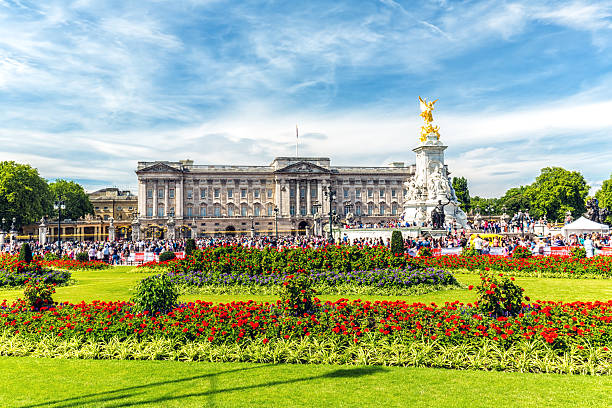
Do not force Buckingham Palace into this route unless it replaces part of Westminster or changes the starting point. The palace area can complicate the morning by pulling the group west, away from the clean descent to Westminster Pier. It may be worthwhile for certain travelers, but it is not free. The river spine depends on ending the Westminster chapter at the water with energy still available for the Tower.
Do not force a West End theatre night after a full Greenwich extension unless the group has unusually strong stamina or the evening is intentionally light. London theatre timing is unforgiving. A late return from Greenwich, a hotel refresh, dinner and a curtain can turn a well-designed private day into a race. If theatre is non-negotiable, keep Greenwich out or make the Tower afternoon tighter.
Planning notes that keep the Thames useful rather than ornamental
Confirm the boat choice after the route is designed, not before. Public river services, shared sightseeing boats and private vessels create different days. A public river transfer can be efficient and atmospheric when the goal is the Westminster-to-Tower hinge. A private vessel can be worthwhile for privacy, celebration pacing, family control or a more tailored commentary rhythm. A generic sightseeing loop is the weakest fit for this article’s problem because it often adds duration without solving the cross-city drag.
Choose piers for their relationship to the route. Westminster Pier works because it sits at the end of a Westminster chapter. Tower Pier works because it feeds directly into the Tower environment. Greenwich Pier works because it places the group near the riverfront, Cutty Sark and the town’s main visitor flow. Do not choose a pier merely because it sounds famous. The wrong pier can add the same walking and reorientation that the river was supposed to remove.
Plan for weather without overreacting to it. London rain rarely means the day fails, but wind, cold or heavy rain can change how comfortable the exposed river feels. A private plan should have a car fallback at the edges, not panic substitutions in the middle. In warmer months, the river can also be a relief from dense pavements, but sun, glare and standing time at piers still matter for older travelers and children.
Give the guide permission to cut. This is the hidden luxury in a private London day. If Westminster is taking longer because the group is engaged, the guide should not force every downstream piece. If the Tower becomes the emotional center, Greenwich can become optional. If Greenwich is the reason for the day, Westminster should be tightened rather than allowed to consume the morning. The route should respond to the group in front of it.
Keep the hotel return honest. Mayfair, Covent Garden, South Kensington and the City all create different end-of-day decisions. A return from Tower Hill is not the same as a return from Greenwich. A theatre night near Covent Garden is not the same as a quiet dinner in Mayfair. The river can make the middle of the day better, but the final transfer still needs its own logic.
FAQ
Should the Thames be the main route for a first private day in London?
The Thames should be the main route only if Westminster and the Tower of London are both priorities and the river removes a real cross-city transfer. It should not be the default for every first London visit.
Is Westminster Pier to Tower Pier better than taking a car?
Often, yes. The Westminster Pier-to-Tower Pier route hinge can avoid a slow central road transfer and turn the move between Westminster and the Tower into part of the guided story.
When should Greenwich be included in the same day?
Include Greenwich when the group wants maritime London, river trade, royal architecture, navigation or a softer eastward afternoon. Cut it if the day already includes a deep Tower visit, a major evening plan or limited stamina.
Is a private boat necessary for this route?
A private boat is not always necessary. It earns its cost when privacy, celebration pacing, family control or tailored commentary matter; otherwise, the route decision is more important than the vessel category.
Where does a chauffeur still help on a Thames-led London day?
A chauffeur helps at the edges: hotel pick-up, late-day return, Greenwich-to-West-End transfers, weather pivots and mobility-sensitive groups. It is less valuable inside dense Westminster or on the short river-linked Westminster-to-Tower segment.
Can Westminster, the Tower and Greenwich fit comfortably in one private day?
They can fit if the day is designed around the Thames, the Tower visit is selective and the evening is not overloaded. They do not fit comfortably when Greenwich is treated as an extra after a full Westminster and Tower program.
What should be cut first if the day starts running long?
Cut Greenwich first. If the Tower or Westminster is the real priority, preserving those chapters matters more than extending the route east for a less focused afternoon.
Is the Thames route good for families or older parents?
It can be good for families and older parents because it creates a seated break between demanding sites. The plan still needs careful limits, especially around Tower walking and the Greenwich Park slope.
If you’re interested in any private tours of London, please reach out to us.














 So if you are looking for the absolute best in London & surroundings with authentic local fully-licensed native guides whose English you can actually understand and with an exclusive and amazingly fun itinerary