How to Build a White-Glove London Day Beyond Westminster: St Paul’s, the City and a Thames Cruise
Updated
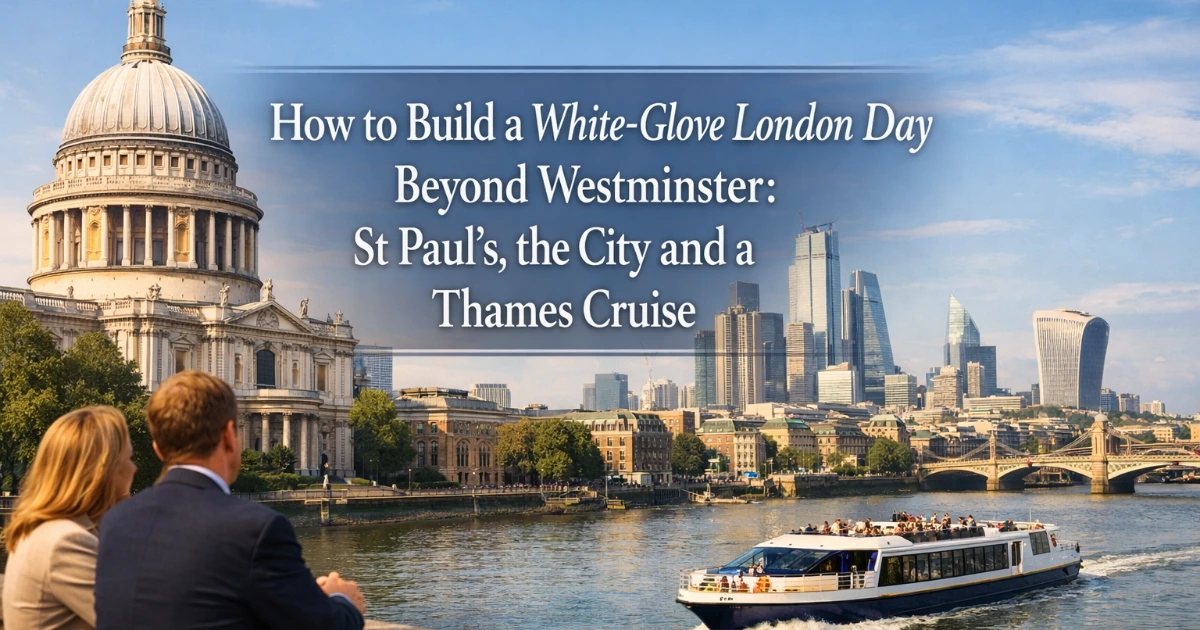
The best version of a London day beyond Westminster is a river-first St Paul’s plan: approach St Paul’s Cathedral from the south by crossing Millennium Bridge, keep your walking inside a disciplined Bank-to-St Paul’s band, and use a Thames leg only if it genuinely delivers you to the next part of your day. That shape works because this part of London appears compact on a map but behaves differently in real city conditions; one wrong pier, one extra detour east, or one badly timed river leg can turn a graceful route into repeated starts, uphill returns, and dead minutes between highlights. If this is your first short London trip and Westminster, the Tower, or the British Museum are still undone, this is not the right use of a full prime day.
In this cluster, elegance comes from one reveal, one walking band, and one exit. The counterintuitive move is to avoid a Tube-first start at St Paul’s station and use the Millennium Bridge approach to St Paul’s instead. That one decision changes both the visual payoff and the direction of the day: the cathedral rises properly in front of you, and the walk then flows uphill into the City of London instead of stumbling back toward the river later. If you are still deciding where this belongs inside a broader stay, it usually fits day two or day three rather than the first precious slot, which is the same wider logic behind how many days to give London.
The route matrix: which version of this London day actually works?
The right answer depends less on how many names you can stack into the day and more on what job the river is doing for you.
Best full-day shape: river-first cathedral reveal, tight City walk, then a deliberate handoff. This suits couples, celebration travelers, small groups, and adults who have already spent proper time on royal London. Start with the Millennium Bridge approach to St Paul’s, give St Paul’s Cathedral real weight, keep the City of London within a tight band, and let the Thames either open the day or deliver the evening.
Best half-day shape: cathedral plus one City band, with no cruise unless it replaces your exit transfer. This suits shorter first trips, museum-heavy itineraries, travelers protecting dinner plans, and families with mixed stamina. The river is optional here; the cathedral reveal is not.
Best river-led shape: admit that the Thames is the point, then let St Paul’s be one featured stop rather than the spine. This suits guests staying farther west, travelers who want motion and skyline over interiors, and families who need the boat itself to carry part of the entertainment value.
The mistake to avoid is trying to make St Paul’s, a substantial City walk, Borough Market, and a central sightseeing cruise all serve the same day. That looks efficient in a draft itinerary because the map is crowded with famous names. In practice, it creates three separate rhythms instead of one coherent one: river movement, cathedral entry, and lane wandering. The day feels busy without feeling complete.
Start from the Millennium Bridge approach to St Paul’s, not the Tube exit
This day works best when St Paul’s Cathedral is revealed from the river side.
The Millennium Bridge approach to St Paul’s is not just photogenic; it fixes the route. Emerging from the south, you cross the river with the cathedral directly ahead, rise into the churchyard, and arrive with a sense of culmination before you have even entered. Starting at St Paul’s station sounds logical because it is close by, but it robs the cathedral of its reveal and usually leaves you improvising afterward. You end up seeing the building in fragments, then trying to decide whether to walk back downhill for the river you should have used first.
That matters for discerning travelers because the opening minutes of a day set the tone for everything after. A south-side arrival makes the day feel authored. A Tube-first arrival makes it feel assembled. This is one of those London decisions that looks cosmetic and turns out to be structural. The bridge crossing gives you orientation, the view gives you anticipation, and the slight rise into the cathedral tells your body that you are arriving somewhere significant rather than merely ticking off the next stop.
There is also a practical comfort point here. The physical load in this part of London hides in layers: an exposed river crossing, a mild climb toward the cathedral, security and entry procedures, hard paving underfoot, and then the temptation to add the dome climb on top of a longer City walk. That combination is where the route can go wrong for families, slower walkers, and anyone who started with a long breakfast or poor sleep. If you want the galleries or dome, shorten the post-cathedral City wandering. If you want a longer City walk, be restrained inside the cathedral. London is not punishing here in the way some hill cities are, but it can still wear down the calves and flatten the afternoon if you keep saying yes to every small extra.
A few micro-locations sharpen this further. Paternoster Square is useful immediately after the cathedral because it gives groups level ground and breathing room before the lanes tighten again. Ludgate Hill and Queen Victoria Street are where the route quietly becomes more physical than it looked on the map. And if you emerge from the bridge onto the cathedral side with a guide who knows when to pause on St Paul’s Churchyard and when to move on, the whole opening feels measured instead of congested.
For current entry details, temporary closures, and visit-planning basics, use the official St Paul’s planning page (https://www.stpauls.co.uk/planning-your-visit). For travelers who want the cathedral to carry real narrative weight rather than serve as a quick interior stop, this is the part of the day where a guide matters most, which is why a St. Paul’s Cathedral private tour makes more sense here than on a scattershot highlights itinerary.
There is one clear exception. If the weather is poor enough that the bridge will feel more punishing than atmospheric, start on the cathedral side instead and protect the rest of the route. The point is not to perform a scenic crossing at all costs. The point is to give the day shape. On a windy or wet London morning, forcing the bridge just because it is the “good” start is exactly how elegant planning turns stiff and irritable.
The city also changes emotionally at this moment. When you arrive from the river, St Paul’s Cathedral feels like a destination and the City of London feels like its natural aftermath. When you start with a station exit, the cathedral can feel like a building inserted into a transport problem. That difference sounds subtle until evening arrives. The better opening tends to leave travelers energized for dinner, theatre, or one more stroll. The poorer opening often makes the whole cluster feel oddly administrative, as though the day kept needing to be restarted.
Is a Thames cruise worth it for a St Paul’s and City of London day?
Yes, but only when the river changes the handoff rather than merely decorating the middle.
The Thames does not rescue weak sequencing. It only makes strong sequencing feel cinematic. That is why some visitors rave about the river on this route while others feel they spent too much time queuing, boarding, sitting down, and disembarking for very little practical gain. If the boat is your arrival into the cathedral zone, or your exit toward the Strand, theatre, Covent Garden, Mayfair, or another westbound evening, it can be excellent. If it sits in the middle simply because a London day “should” include a cruise, it often interrupts the better rhythm of bridge, cathedral, City, and clean finish.
Blackfriars vs Embankment river access is the key comparison. Blackfriars is the working pier for this cluster. It sits near the cathedral zone, beside the bridge logic, and close enough to make the Thames feel integrated rather than ornamental. Embankment is the handoff pier. It is the right choice when the point of the river is to deliver you west for a later lunch, tea, cocktails, theatre, or dinner. The common mistake is assuming Embankment is always “more central” and therefore better. For a St Paul’s and City of London day, Embankment is only better when your next chapter is west. Otherwise, it creates backtracking that the river view does not justify.
If you want to confirm current access details before relying on the boat as a transfer, check the official Blackfriars Pier page (https://www.thamesclippers.com/plan-your-journey/find-your-pier/blackfriars-pier) and Embankment Pier page (https://www.thamesclippers.com/plan-your-journey/find-your-pier/embankment-pier). The point is not that the official operator will tell you how to plan the day for you. The point is that pier position matters enough here that a bad assumption can distort the whole afternoon.
For comfort-first travelers, the river helps most in three cases. First, when it replaces a messy cross-city transfer and gives you a cleaner arrival or exit. Second, when it gives younger travelers or multigenerational groups a seated interval after the cathedral. Third, when the river itself is part of the occasion: an anniversary, a celebratory family day, a photography-heavy route, or an afternoon where the skyline is meant to be part of the pleasure rather than mere transit.
There is a real route hinge here that many travelers only notice after the fact. Blackfriars works because it belongs to the cathedral side of the day; you can feel the river and still stay inside the St Paul’s logic. Embankment works because it belongs to the next chapter of the day; it is a handoff point into the West End, not the natural heart of this cluster. When visitors reverse those jobs, they often end up boarding and disembarking efficiently while somehow still feeling they have spent too long in transit.
On the body level, the river can be relief or drag. Used well, it gives you a seated interval after stone floors, queueing, and the mild climb back from the cathedral. Used badly, it adds more standing, more waiting, and one more transfer reset at exactly the moment your attention is thinning. That is why comfort-first planning here is not about avoiding effort altogether. It is about putting effort in the right sequence.
It helps least when you are only moving between two very central points and could just as easily take a short taxi, a simpler walk, or a direct onward transfer after the cathedral. A private Thames cruise does not materially improve the route if you only want a short central connector between Blackfriars and Embankment. In that situation, you are paying for ceremony rather than solving a real problem.
That does not mean better spend never belongs on the river. A private boat can be worth it when privacy, hosting, or the boat itself is the event: birthday groups, families who want control of seating and pace, or travelers who want the City skyline and river atmosphere to feel like part of a celebration rather than a commute. But that is a different reason from using the Thames as a connector. If the Thames is the event, admit that clearly and let the rest of the route shrink around it. If it is merely connective tissue, be unsentimental.
This is also where guided planning earns its value. The right river move makes the day feel as though London is unfolding in one clean line. The wrong river move makes it feel chopped into episodes. If the boat is genuinely part of your ideal version, a Boat Cruise on the Thames should be chosen because it supports the day’s geometry, not because the word “cruise” sounds luxurious on paper.
Keep the City of London inside the Bank-to-St Paul’s walking band
The City of London only stays comfort-first when you keep the radius tight.
That is the boundary many travelers miss. The useful walking band runs between St Paul’s and Bank, with optional texture around Guildhall or the lanes that stitch the cathedral side to the financial core. Once you start pushing meaningfully beyond Bank toward Leadenhall, the Tower, or a second eastward cluster, you are no longer refining this day; you are creating a different day and pretending it is still the same one. The map lets you think those additions are small. London punishes that optimism with one-way streets, stop-start crossings, and a mood shift from purposeful wandering to quiet overreach.
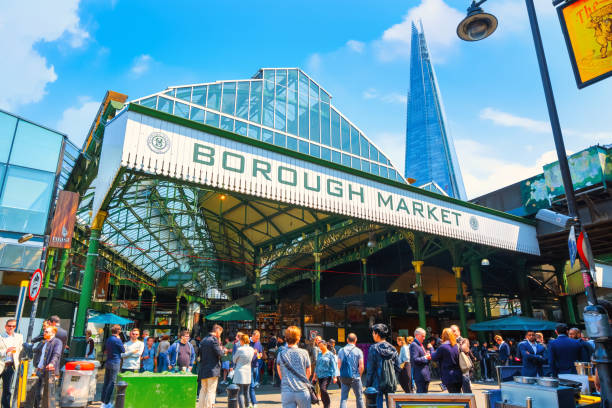
The first thing to stop forcing is the eastward drift. If you want the Tower, give it its own logic. If you want Leadenhall, admit that you are extending the City beyond the band that keeps this route polished. The same goes for a spontaneous swing down to Borough Market after the cathedral simply because the Millennium Bridge is there. Borough has its own appetite, crowds, and lunch-time pull. Once you hand the day over to that energy, St Paul’s and the City stop being the spine and become prelude.
The right way to use the City here is as a controlled extension of the cathedral. That means looking for contrast rather than accumulation: the movement from river openness to churchyard grandeur, then from St Paul’s Churchyard into smaller streets, then into the broader stone spaces nearer Bank. One or two of those transitions are enough to make the City of London leg feel textured and specific. You do not need a dozen named stops. In fact, the more names you try to “cover,” the less memorable the City becomes.
A few place choices are enough. One sensible version is cathedral, then the quieter lane texture around St Paul’s Churchyard and toward Guildhall, then the broader ceremonial space around Bank or the Royal Exchange. Another is cathedral, then a shorter drift to Mansion House or Bank before stopping while the route still feels taut. What rarely helps is trying to prove you have “done” the City by pushing onward until the walk becomes a chain of intersections and office-front façades.
The City also changes character by time of day in a way that matters for traveler fit. On office-heavy weekday stretches, the area can feel purposeful and brisk. Outside that pulse, especially on quieter periods, the City of London can feel almost curated in its calm. Some travelers love that hush because it makes the architecture legible. Others read it as emptiness. Knowing which response you are likely to have is more useful than memorizing another list of sights.
This is why the area suits some travelers better than others. Couples and thoughtful small groups often love the hush, the architectural seriousness, and the way the district can feel almost ceremonially spacious outside rush-hour office intensity. Families with younger children or teens who want color, buskers, and constant stimulation may find the City too formal unless the river is doing a lot of the emotional work. Food-and-wine travelers usually enjoy it when the day is headed toward a serious table afterward; shoppers and market-seekers often find it too restrained if the whole day is centered here.
The physical consequences are real too. A disciplined Bank-to-St Paul’s walking band feels measured. Stretch it too far and the route becomes heavy in ways that are easy to underestimate: more curb cuts, more pauses at crossings, more navigation through streets that are individually interesting but collectively draining, and more time spent deciding whether to continue than actually enjoying what is in front of you. This is not a neighborhood that rewards greedy routing. It rewards editing.
The mood consequences are even more important. When the band stays tight, the City feels composed. The day reads as bridge, cathedral, lanes, squares, then a deliberate finish. That sequence can make London feel calmer and more intelligent than a royal-icons day, especially for repeat visitors who want atmosphere without pageantry. Stretch the band too far, and the mood changes. The route begins to feel like administration by foot. You arrive at dinner not satisfied but relieved, and those are not the same thing.
If what you want from this part of London is more texture than checklist, less cathedral intensity and more neighborhood reading, this cluster starts to resemble a London like a Londoner walk more than a conventional monument run. That is a good thing, but only if you protect the radius that makes the City readable rather than diffuse.
If you only have half a day left for this side of London
Keep the cathedral reveal and one short City section, and cut the river first unless it doubles as your exit.
That is the cleanest rule for a compressed itinerary. Travelers often do the opposite: they keep the boat because it feels special and cut the walking because it feels expandable. In this cluster, that usually weakens the day. The river is memorable when it frames the route. The cathedral reveal and the tight City band are what give the route its actual identity.
- If you have about three hours: start on the south side, use the Millennium Bridge approach to St Paul’s, visit the cathedral, then take a short City walk on the cathedral side before leaving by taxi or onward transfer. Do not add a decorative river segment afterward.
- If you have four to five hours: keep the same opening, give St Paul’s Cathedral real time, then extend the walk toward Bank or Guildhall before exiting. Add a Thames leg only if it replaces your onward move toward a westbound evening or another riverside neighborhood.
- If you have already seen the cathedral interior on another trip: keep the Millennium Bridge approach to St Paul’s, read the exterior and churchyard properly, then use the City band as the main texture of the half day. In that version, the river can reappear at the end if it is serving a later handoff.
The cut order matters. First cut the decorative cruise. Then cut any drift beyond Bank. Then cut the temptation to turn lunch into a separate neighborhood mission. What you should not cut first is the opening approach. The Millennium Bridge approach to St Paul’s is the move that makes this cluster legible even in abbreviated form.
This is also where the honest editorial warning belongs. If you only have half a day because your first London trip is already too crowded, this can still be a beautiful use of time, but only if you are consciously choosing it over a second-tier royal add-on rather than instead of London’s major first-timer essentials. St Paul’s and the City reward attention. They do not reward guilt-planning.
What better spend changes on this route, and what it does not
Spend on decisions that remove uncertainty, not on upgrades that merely sound elevated.
The part worth paying for is guidance, timing, and the outer-edge logistics. Timed cathedral entry, a guide who can read both the church and the surrounding City, and hotel-to-start or finish-to-hotel handling can genuinely change the quality of the day. This is particularly true for celebration travelers, families who do not want to keep regrouping, and small groups where energy levels vary. The better result does not come from adding more. It comes from removing the moments where everyone stops and asks, “What now?”
The spend that rarely pays off is transport inside the core itself. Premium transport between Bank and St Paul’s does not earn its cost. The walking band is too short, the streets are too interrupted, and a waiting car can introduce more faff than relief. The same judgment applies to a private river connector on a tiny central segment. Once you are inside the cluster, the intelligence of the route matters more than the category of the vehicle.
A chauffeured car can still belong at the edges. If you are staying in Mayfair, South Kensington, or another hotel base that is not naturally glued to this part of London, a car can make the opening or ending feel clean and effortless. It can also help travelers with mobility concerns avoid an unnecessary transport puzzle. But this is not the kind of London day where an all-day car is automatically the premium answer. If you are still deciding whether a vehicle belongs in the broader plan, it is worth comparing this route with whether a chauffeured London day is worth it.
The same principle applies to private guiding. A guide earns their fee here by editing, not by adding. The value is in knowing how long the cathedral should really take for your group, whether the City should end at Bank or earlier, whether Blackfriars or Embankment fits the next handoff, and when to stop trying to force more London into the same block of hours. That is why this cluster works so well as a privately paced day: the gain is not flash. The gain is continuity.
For a genuine white-glove version, the luxury is not maximalism. It is arriving at the river without scrambling for the right pier, entering St Paul’s Cathedral without uncertainty, and finishing the City walk at exactly the point where the district still feels poised. That distinction is why some privately arranged days feel superb while others merely feel expensive.
Choose your finish before you choose your pier
The smartest finish is determined by your table, your theatre curtain, or your hotel return, not by whichever river segment looks prettiest on a postcard.
This matters more than travelers expect. A westbound river handoff toward the Strand can turn this whole route into a poised lead-in to the evening. An eastward or overly central finish can leave you with one more awkward hop before dinner, which is exactly how an otherwise elegant day loses momentum at the end. If dinner is part of the occasion, the pier should serve the table. If the river is the occasion, the table should adapt to the river. Mixing those priorities is where the day starts to fray.
That is why a westbound finish makes more sense if you are eyeing Ikoyi menu & reservations (https://www.ikoyilondon.com/) than if your dinner is somewhere back in the City. The restaurant example matters less as a dining recommendation than as proof of the routing principle: once the day is naturally delivering you toward Strand-side or West End plans, Embankment begins to justify itself. Without that later handoff, Blackfriars usually remains the more intelligent river anchor for the St Paul’s Cathedral and City of London cluster.
The same discipline applies at lunch. If a ceremonial lunch is the centerpiece, reverse-engineer the route around the meal instead of pretending it can simply be inserted into the middle. Travelers considering a more formal lunch-led variation can See the current three‑course lunch menu (https://www.theritzlondon.com/restaurant-three-course-lunch-menu) before deciding whether the day should move west after the cathedral rather than pressing deeper into the City. Again, the lesson is not “go here.” The lesson is that a serious table should control the geography, not be treated as a footnote to it.
This is the point at which the private-planning value becomes obvious. Orange Donut Tours can make this cluster feel continuous because cathedral entry, walking radius, pier choice, and the evening handoff are really one problem, not four separate bookings. If you want the day stitched into a single smooth arc, a tailor-made London day is the natural next step. Inquire now
FAQ
Is St Paul’s, the City and a Thames cruise worth a full day in London?
It is worth a full day when you have already given London’s royal and first-timer heavyweights their due, or when you actively want a more architectural, river-shaped, less ceremonial London day. If Westminster, the Tower, or the British Museum are still missing from a short first trip, this cluster is usually better as a half day.
Should I start at St Paul’s station or from Millennium Bridge?
Start from Millennium Bridge when conditions allow. The Millennium Bridge approach to St Paul’s gives the cathedral its reveal and gives the route direction immediately. A station start is workable in bad weather or when mobility needs require it, but it is usually the weaker opening.
Is a Thames cruise actually worth it for this route?
Yes when it is either the opening reveal or the clean handoff to your next neighborhood. No when it is just a scenic extra placed in the middle because London has a river and the itinerary feels incomplete without a boat.
Blackfriars or Embankment: which pier is better?
Blackfriars is usually better for the St Paul’s Cathedral and City of London cluster itself because it sits closer to the day’s working core. Embankment is better when the point of the boat is to land you west for theatre, dinner, or a later evening around the Strand, Covent Garden, or Mayfair.
What should I cut first if I only have half a day?
Cut the decorative cruise first, then cut any drift beyond Bank, and then cut lunch detours that pull you into another neighborhood. Keep the cathedral reveal and one short City band.
Does a chauffeur help on this particular London day?
At the edges, yes. Inside the core, usually not. A car can make hotel pickup and the final return feel effortless, especially for celebration travelers or guests with mobility concerns, but it does not improve the short walking logic between St Paul’s and Bank once you are already inside the cluster.
Is this a good route for families or mixed-stamina groups?
It can be, provided you edit hard. Families tend to do best with the bridge reveal, a measured cathedral visit, a short City walk, and either a seated river leg or a clean finish. The route becomes much harder when you try to combine the dome climb, a long City extension, and a decorative cruise in the same outing.
Can this day end with a celebratory lunch or dinner without feeling rushed?
Yes, but choose the meal first and then let that determine the finish. A westbound handoff supports West End or Strand dining well; a more City-focused finish supports nearby returns. The mistake is choosing the pier for scenery and only afterward realizing your table is in the opposite direction.
If you’re interested in any private tours of London, please reach out to us.















 So if you are looking for the absolute best in London & surroundings with authentic local fully-licensed native guides whose English you can actually understand and with an exclusive and amazingly fun itinerary













