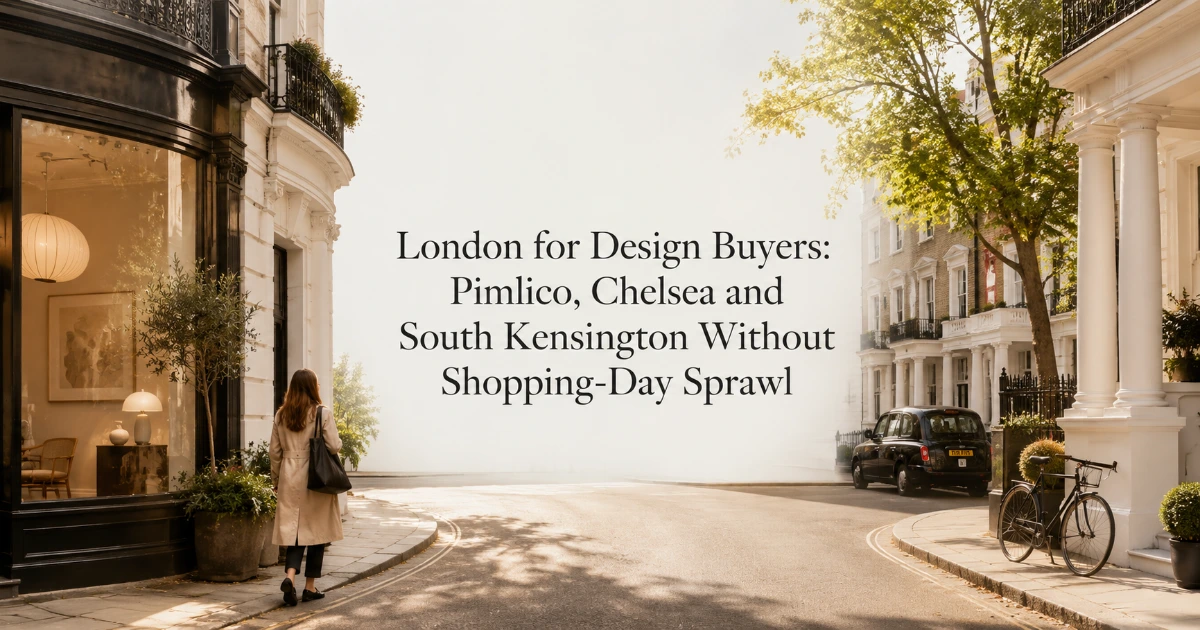
London for Design Buyers: Pimlico, Chelsea and South Kensington Without Shopping-Day Sprawl
Updated
The best London design-buying day should concentrate on Pimlico, Chelsea and South Kensington, not bolt them onto Bond Street. The route works because Pimlico Road to Sloane Square is compact enough to compare materials, scale and condition without turning the day into a taxi relay, while South Kensington adds one museum stop that sharpens taste rather than distracts from buying. The clearest exception is a traveler whose real priority is fashion houses, watches or department-store gifting; that person should skip this route and use a central luxury-shopping plan instead. London rewards the design buyer who treats the day as a disciplined west-London arc, not a luxury shopping list with prettier streets.
The non-obvious hinge is the short stretch from Pimlico Road to Sloane Square. It looks modest on a map beside Mayfair and Knightsbridge, yet for furniture, lighting, textiles, antiques, decorative arts and interior-led collecting, it can carry the serious part of the day. The correction is counterintuitive: Bond Street is often the overvalued base for this specific brief. It has undeniable glamour, but it pulls the day north and east just when a design buyer needs slower looking, appointment buffers and enough mental space to remember why one finish, chair, textile or object is better than another.
This guide solves one planning question: how should a design buyer sequence Pimlico, Chelsea and South Kensington without losing half the day to showroom drift, museum overreach or cross-town transfers? For broader shopping support, Orange Donut Tours can build a focused private route around London shopping private tours, but the point here is narrower: keep the day west, make the V&A useful, and leave enough time for decisions, notes and shipping conversations.
The buying-day matrix: what each district should do
Use Pimlico for serious looking, Chelsea for lifestyle context and South Kensington for judgment calibration. The three districts are close enough to belong together, but they should not be asked to do the same job. A good route gives each one a role, then cuts anything that competes with that role.
Pimlico: Best for the buyer who wants furniture, lighting, antiques, textiles, decorative objects and interior reference points. The consequence is slower movement and deeper conversation. Pimlico Road and the streets around it reward prepared looking, not casual browsing.
Chelsea: Best for translating what you have seen into livable style, scale and mood. Around Sloane Square, King’s Road and nearby residential streets, the question becomes less “Is this impressive?” and more “Does this belong in the life I am designing?”
South Kensington: Best for one targeted museum stop, usually the V&A, when you need historic pattern, material intelligence and visual context before or after buying. The consequence is better judgment, provided the museum visit is edited hard.
What to cut first: central department stores. A design-shopping day should skip them entirely when the brief is furniture, interiors, decorative arts, textiles or collection-building. They flatten the day into general luxury retail and steal the exact hours needed for appointments and shipping decisions.
The matrix matters because the wrong sequence changes the quality of the purchase. If you begin in South Kensington and let the V&A become a full museum day, you may arrive at Pimlico with tired eyes and no patience for condition, dimensions or finish. If you start in Chelsea with lifestyle browsing, you may enjoy the morning but dilute the more serious design work. If you add Bond Street, Marylebone or Knightsbridge “because they are nearby enough,” the day stops being a design route and becomes a private-car shopping sampler. That is a different product, covered more naturally in this London luxury shopping-day comparison.
Why Pimlico should lead when buying judgment matters
Pimlico should usually come first because it asks for the clearest eyes and the least performative energy. This is where a design buyer is most likely to slow down, compare pieces across periods, ask practical questions and distinguish between a beautiful object and a useful acquisition. The point is not to rank individual showrooms. The point is to protect the part of the day where expertise, patience and memory matter most.
Starting near Pimlico Road also avoids a common London mistake: letting the day begin with the most famous address rather than the most demanding decision. Bond Street gives instant reassurance to a luxury traveler, but that reassurance is not the same as usefulness for interiors. It tilts attention toward brands, windows and recognizable names. Pimlico tilts attention toward scale, surface, provenance, upholstery, patina, lampshade proportion, joinery, ceramic weight and whether the thing will still make sense after it leaves London.
The route consequence is practical. If the first part of the day is Pimlico Road to Sloane Square, you can move with fewer full resets. A taxi or chauffeured car can help with weather, parcels, older parents or celebration-day polish, but the most important saving is not just walking distance. It is continuity. You can hold one object in mind while seeing the next, compare a textile against a chair, and keep a conversation alive rather than restarting your attention at every new district.
This is also where a private guide or route designer earns relevance without pretending to be a salesperson. The value is in shaping the day around the buyer’s brief: contemporary interior, English antiques, lighting, textiles, garden-facing pieces, family home, pied-à-terre, collection addition or one statement object. A specialist route prevents showroom drift by deciding in advance what not to see, where to leave a buffer, and when the buyer needs silence rather than commentary. For a fully bespoke version, tailor-made London private touring is the better frame than a generic sightseeing day.
The wrong fit is the traveler who wants a fast prestige hit. Pimlico can feel too understated if your idea of a successful shopping day is visible brand density, glossy packaging and immediate gratification. It is also not ideal for a group where only one person cares about design and everyone else wants London landmarks. In that case, a shorter design insert may work, but a full Pimlico-led day will feel narrow to the rest of the party.
How Chelsea changes the day without turning it into a boutique crawl
Chelsea should be used as a context shift, not as an excuse to keep shopping until everyone is numb. After Pimlico, Chelsea gives the buyer a more lived-in reading of west London design culture: residential scale, social polish, garden squares, cafés, galleries and the practical question of how taste operates outside a showroom. That is useful, but only if the route stays edited.
The strongest Chelsea move is to let Sloane Square act as a hinge. It connects the Pimlico work to Chelsea without making the day feel like a new expedition. From there, King’s Road can be useful in selective doses, but the mistake is to treat the entire road as mandatory. It is too easy to burn an hour on agreeable browsing that produces no better decision. For buyers with limited energy, the Chelsea section should answer one question: did the morning’s strongest pieces still feel right once you left the specialist setting?
This is where the city affects the body. London’s west side is not a mountain, but repeated showroom thresholds, kerbs, steps, narrow pavements, traffic pauses, umbrellas, coat-handling, bag checks and taxi in-and-out moments create fatigue that does not show on a map. A design buyer also stands more than expected: standing to inspect a sideboard, standing while someone checks stock, standing over a textile, standing while a group debates a lamp. By mid-afternoon, the body has absorbed the day as a series of small interruptions. That is why a compact route matters more here than a long list of beautiful places.
Chelsea is also where group dynamics can either improve or spoil the buying. Couples may need a pause between serious decisions. Families may need a short cultural or food break so teenagers do not become silent saboteurs of the afternoon. Celebration travelers may want the day to feel stylish without turning every stop into a transaction. The guide’s job is not to push more stores; it is to read the group and know when Chelsea should become a soft landing rather than a second buying sprint.
Premium spend helps when it buys route control, appointment coordination, a comfortable car at the right moments and a guide who can keep the party aligned. Premium spend does not help if appointments, shipping time and district order are ignored. A more expensive car cannot rescue a day that starts in the wrong district, overbooks the middle and leaves practical questions until everyone wants to leave.
Where the V&A helps a design buyer, and where it gets in the way
The V&A helps when it is used as a lens for buying judgment, not as a general museum obligation. For design buyers in South Kensington, the museum’s value is pattern memory, material context, historic reference and a chance to compare contemporary taste against deeper decorative traditions. The official V&A site is the safest place to confirm current visit details before setting the day: V&A (https://www.vam.ac.uk/).
The best use of the V&A is short and intentional. A buyer considering textiles may benefit from looking at pattern, color relationships and historic technique before returning to contemporary options. A buyer considering furniture may use the museum to recalibrate proportion and ornament. A buyer who feels visually overwhelmed can use the museum not to see more, but to understand what they are already responding to. The museum stop should improve the purchase conversation, not compete with it.
The biggest error is over-respecting the museum. The V&A can easily absorb a full day, and for a different trip that may be the right choice. On this route, however, it should not become a survey course. South Kensington’s museum geography is seductive: the V&A, the Natural History Museum and the Science Museum sit close enough to tempt a planner into adding “just one more.” For this article’s purpose, that is a trap. A design buyer does not need museum sprawl; they need one carefully framed encounter that sends them back into the buying day sharper than before.
Timing is the key decision. A morning V&A stop works when the buyer needs inspiration before purchasing and when appointments are later. It can be especially useful for travelers who do not yet know whether their taste is leaning classical, modern, craft-led or eclectic. A midday or early-afternoon V&A stop works when Pimlico has already produced options and the buyer needs a reset before confirming priorities. A late V&A stop is weaker unless the day is deliberately light; by then, the museum risks becoming a beautiful blur.
There is also a mood consequence. A tightly edited V&A visit can make the day feel more intelligent and less transactional. It gives couples something to discuss besides purchase logistics, gives families a cultural anchor, and gives collectors a calmer vocabulary for why one object has staying power. But an overlong museum visit flattens the afternoon. It turns a buyer’s day into a museum day with shopping attached, which is exactly the sprawl this route is meant to avoid.
Why this should not be bolted onto Bond Street
Pimlico and Chelsea should not be bolted onto Bond Street because the two days run on different rhythms. Bond Street is fast to understand and easy to admire; Pimlico is slower to read. Chelsea sits between those modes. Combining all three with South Kensington usually means the buyer sees more names and remembers fewer decisions.
The geography is the first problem. On a London map, Mayfair, Knightsbridge, Pimlico, Chelsea and South Kensington appear temptingly close. In lived travel time, each transfer can break concentration. A taxi from Mayfair to Pimlico may look simple, but traffic, drop-off points, one-way systems and the mental act of reorienting all take their share. The Underground can be efficient, yet for a design-buying group it is rarely ideal if people are dressed for appointments, carrying lookbooks, managing parcels or traveling with older relatives. The route becomes not one elegant arc but a sequence of interruptions.
The second problem is category confusion. Bond Street and nearby luxury retail districts excel at fashion, jewelry, watches, leather goods and high-recognition purchases. Pimlico and parts of Chelsea are better for interiors, decorative arts and pieces that require spatial imagination. South Kensington, through the V&A, is a judgment stop. When all of those are placed in one day, the buyer has to switch decision systems too often. A watch decision is not a textile decision. A handbag decision is not a lighting decision. A museum decision is not a shipping decision.
The third problem is emotional. A mixed luxury-shopping day often begins with adrenaline and ends with compliance. Everyone keeps moving because the plan says so. By late afternoon, even strong travelers stop noticing details. The most expensive mistake in a design day is not buying the wrong thing; it is losing the clarity that would have told you what not to buy.
There are exceptions. If the trip has only one free day and the buyer wants one interior stop plus fashion retail, then a hybrid can be designed. But it should be admitted as a compromise, not sold as the ideal. A better approach is to separate the design-buying day from a central luxury-shopping day, or to let the central day be shorter and more targeted. The route in this guide exists because west London can carry the design brief without needing Bond Street’s brand gravity.
Appointment time and shipping time change the route more than lunch does
Appointment and shipping time should be treated as core itinerary architecture, not admin squeezed into the end. Serious design buying often involves questions that cannot be answered while the group is already halfway into the next district: dimensions, condition, lead times, upholstery options, export paperwork, delivery addresses, insurance, photography permissions, invoices and whether an item needs a second look.
This is why the day should not be planned as a list of stops with lunch in the middle. The better model is a decision route with buffers. A first appointment may need space after it so the buyer can process. A second appointment may need to move earlier if it involves a piece that could anchor the rest of the day. A shipping conversation may be better before the museum, not after, because the buyer will otherwise carry unresolved practical anxiety through the V&A.
For comfort-first travelers, this is where private planning becomes more than a luxury flourish. A route designer can cluster compatible stops, protect quiet time between decisions and prevent the common “we will deal with shipping later” mistake. Later often means late afternoon, when the buyer is tired, the group is hungry, and the person who knows the most about the piece is no longer free. The result is not just inconvenience; it can change what the buyer feels confident purchasing.
Lunch should support the rhythm rather than dominate it. A long formal lunch can be wonderful on another London day, but in the middle of a design-buying route it can soften focus too much. A shorter, well-placed lunch near the route often works better. If the evening is built around a serious reservation, the daytime should be even cleaner. For example, a traveler considering Ikoyi menu & reservations (https://www.ikoyilondon.com/) for dinner should not turn the afternoon into an overextended showroom chase; the day needs enough margin for a hotel return, change of clothes and a calm transfer.
The same principle applies to classic fine dining. A lunch or dinner such as See the current three-course lunch menu (https://www.theritzlondon.com/restaurant-three-course-lunch-menu) may be a highlight of the trip, but it should be placed deliberately around buying energy. Food-and-wine travelers often underestimate how mentally demanding design shopping can be. Looking carefully, deciding carefully and asking practical questions is not the same as drifting between shops. If dinner matters, protect the late afternoon.
A practical sequence for Pimlico, Chelsea and South Kensington
The strongest sequence is Pimlico first, Chelsea second and South Kensington as a targeted judgment stop either before confirmation or after the main buying work. The exact order can flip when appointments require it, but the principle remains: put the most decision-heavy work when the buyer is fresh, and use the museum to clarify rather than consume.
Morning: Pimlico Road to Sloane Square
Begin with the serious design brief. This is when the buyer should compare categories, ask questions and narrow the field. The morning should not be crowded with too many stops; it should allow enough time for one or two places to become genuinely useful. If the buyer is sourcing for a specific room, carry measurements, images and non-negotiables. If the buyer is collecting more instinctively, define the boundaries in advance: period, material, scale, budget comfort, shipping tolerance and whether the trip is about acquisition or education.
The shortness of Pimlico Road to Sloane Square is the advantage. It lets the buyer stay in one mental world. It also gives the guide room to adjust the route if one appointment becomes more productive than expected. A rigid schedule is often the enemy of serious buying; a loose schedule is worse. The right plan is structured enough to prevent sprawl and flexible enough to follow a strong lead.
Late morning or lunch: Sloane Square as the hinge
Use Sloane Square as a pause point, not merely a geographic marker. It is where the morning can be reviewed before the day turns toward Chelsea or South Kensington. The buyer can decide what deserves a second look, what has been eliminated and whether the afternoon should emphasize context, museum reference or practical follow-up.
This is also the moment to check group energy. If one traveler is deeply engaged and others are fading, forcing another long run of showrooms will damage the day. A short Chelsea interlude, a seated pause or a lighter cultural frame may keep the group intact. For multigenerational travelers, this hinge is often the difference between a day that feels composed and a day that becomes a private errand with witnesses.
Afternoon: Chelsea for livability, V&A for reference
In the afternoon, choose between Chelsea-first and V&A-first based on what the morning produced. If there are real purchase candidates, Chelsea can test whether the buyer still likes the mood outside the specialist environment. If the morning raised bigger questions about period, pattern or material, go to the V&A with a narrow assignment. Do not attempt both Chelsea browsing and a broad museum visit.
A route that ends in South Kensington can work well for travelers staying nearby or planning a quieter evening. It also pairs naturally with hotel logistics for those based in South Kensington or Knightsbridge. Travelers staying in Mayfair, Covent Garden or the West End should be more careful. The late return can feel longer than expected once the group has spent the day standing, deciding and crossing in and out of traffic.
For a wider stay-planning context, especially if you are deciding whether South Kensington should be your base rather than just a day-route district, see where to stay in London for a premium first visit. It matters here because a South Kensington hotel can make the V&A portion elegant, while a distant hotel may turn the same stop into the final transfer of an already full day.
Who should choose this route, and who should not
This route is best for travelers whose shopping intention is specific enough to benefit from judgment. Collectors, interior-design enthusiasts, couples furnishing a home, families buying one meaningful piece, and celebration travelers who want a stylish but calm London day can all do well here. It is especially strong for people who dislike wasting time in obvious retail zones and prefer a guide who can connect neighborhoods, taste and logistics.
It is less suitable for first-time visitors who have not yet seen London’s major landmarks and would feel deprived by a day focused on interiors. It is also wrong for travelers whose primary goal is fashion, beauty, watches or department stores. Those categories deserve a different geography. Forcing them into Pimlico, Chelsea and South Kensington makes the route weaker for everyone.
The route can work for families, but only with boundaries. Teenagers who like design, architecture or fashion-adjacent culture may enjoy the day if the V&A is framed well and the Chelsea portion does not overrun. Younger children usually need a more varied private day, unless the design stops are brief and the family has a very specific buying errand. Older parents may appreciate the compact geography, but they need careful drop-offs, seated pauses and fewer standing conversations.
For private groups, the key is not simply adding a larger vehicle. The route needs a decision-maker, a clear brief and agreement on what counts as success. Without that, the group becomes democratic in the worst way: everyone gets a little of what they want, and no one gets the focused buying day the title promises. Executive or celebration groups should be especially careful about agenda drift; the same discipline that shapes business touring applies to a design route, as discussed in bespoke London day planning for private groups.
What to upgrade, what to skip and what to leave unresolved
Upgrade guidance and logistics before you upgrade the number of stops. A private car may be useful in rain, for older travelers, for parcels or for a polished celebration day, but it should not become an excuse to stretch the map. In this part of London, the better upgrade is a route that prevents needless transfers, protects appointment time and keeps the buyer from seeing too much too shallowly.
Skip central department stores entirely when the day is about interiors, decorative arts or design buying. They are efficient for gifts, beauty, fashion edits and broad luxury browsing, but they do not earn their time in this route. They pull attention away from the west-London design arc and replace specialist comparison with general retail convenience. If a department store is genuinely needed, put it on a separate central shopping window, not inside this day.
Leave some decisions unresolved on purpose. That may sound strange in a buying guide, but serious design travelers often make better choices when they identify a shortlist, confirm logistics and allow one evening or overnight before final approval. The route should create clarity, not pressure. If a piece is important enough to ship internationally, it is important enough to review dimensions, photographs and placement calmly.
The day’s mood depends on restraint. A well-built route feels shorter than it is because each stop answers a different question. A badly built route feels long even when the distances are small because every stop asks the same tired question: should we keep looking? The best design-buying days end with a buyer who can remember the top contenders clearly, explain why they matter and still enjoy the evening.
That is the planning handoff Orange Donut Tours is built for: not more stops, but a cleaner route, better sequencing and fewer wasted transfers between districts that should never have been forced together. Inquire now to design a private Pimlico, Chelsea and South Kensington route around your buying brief, museum appetite, appointment needs and evening plans.
FAQ
Is Pimlico or Chelsea better for a London design-shopping day?
Pimlico is usually better for serious design buying, while Chelsea is better for lifestyle context and a softer second act. The strongest day uses Pimlico first, then Chelsea selectively, rather than treating both as equal browsing zones.
Should I add Bond Street to a Pimlico and Chelsea design route?
Usually no. Bond Street is better for fashion, jewelry, watches and luxury-brand shopping. Adding it to a Pimlico, Chelsea and South Kensington design day creates transfer waste and changes the rhythm from focused buying to general luxury retail.
Where does the V&A belong in a design-buying day?
The V&A belongs as one edited South Kensington stop when it improves buying judgment through pattern, material, furniture or decorative-arts context. It should not become a full museum day unless the buying brief is secondary.
Can this route work as a half day?
Yes, but a half day should usually choose Pimlico plus either Chelsea or a short V&A lens, not all three. Trying to compress Pimlico, Chelsea and South Kensington into a half day often removes the decision time that makes the route valuable.
Do I need appointments for a London design-buying day?
Appointments are not always required, but they often change the quality of the day. If you are sourcing seriously, appointments, shipping questions and follow-up time should shape the route before lunch plans or extra stops are added.
Is a chauffeur useful for Pimlico, Chelsea and South Kensington?
A chauffeur can help with weather, comfort, parcels and older travelers, but the route still needs discipline. A car does not fix a day that ignores appointment order, shipping time or the difference between design buying and general shopping.
Should a design-shopping day include central department stores?
No, not when the main brief is interiors, furniture, decorative arts or collecting. Central department stores are better saved for a separate gifting or fashion window because they dilute the focus of a west-London design route.
Is South Kensington a good hotel base for this kind of day?
South Kensington can be an excellent base if the V&A and west-London design districts are priorities. It makes the museum stop and end-of-day return easier, though travelers focused on Mayfair dining or West End theatre may prefer a different base.
If you’re interested in any private tours of London, please reach out to us.

















 So if you are looking for the absolute best in London & surroundings with authentic local fully-licensed native guides whose English you can actually understand and with an exclusive and amazingly fun itinerary













