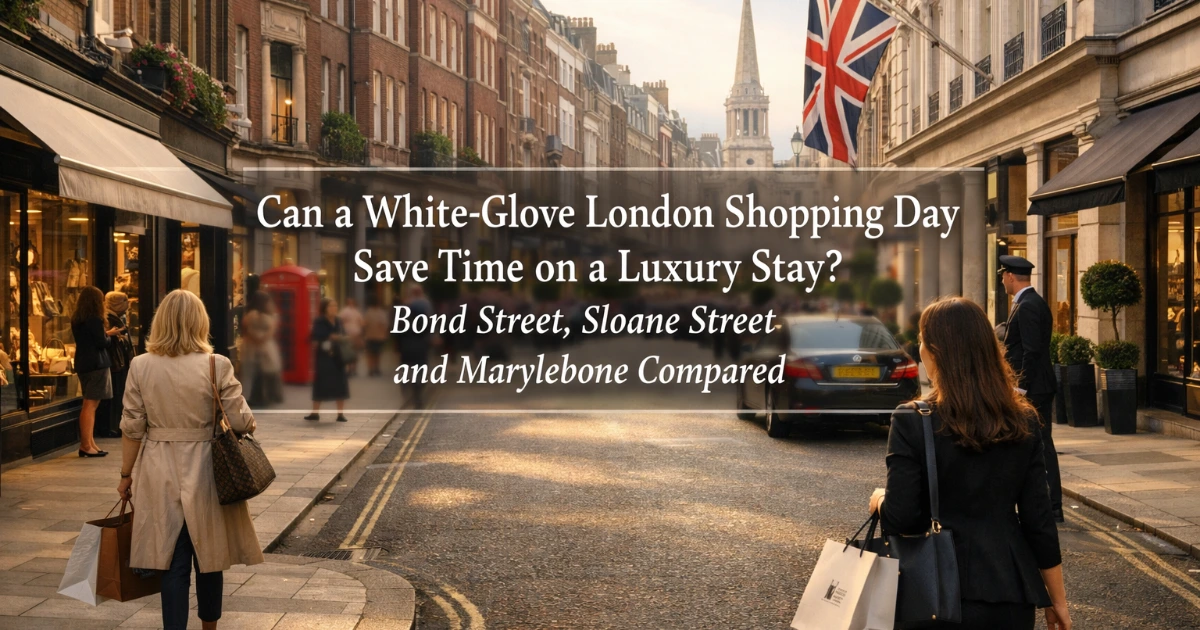
Can a White-Glove London Shopping Day Save Time on a Luxury Stay? Bond Street, Sloane Street and Marylebone Compared
Updated
Yes, a white-glove London shopping day can save real time on a luxury stay, but only when the plan includes fixed appointments, meaningful purchases, or a hotel-to-store route that breaks across districts. London’s elite shopping is close enough to look easy on a map and fragmented enough to waste a surprising amount of the day once bags, curbs, traffic and lunch are added. The Bond Street-to-Sloane Street handoff is the hinge: it can work brilliantly when the second district is purpose-built, and it can quietly burn the middle of the day when you are only browsing. The clearest exception is simple. If you are staying in Mayfair or Marylebone and want one concentrated street cluster on foot, London shopping does not need a private guide or driver.
In London, shopping support is less about access than about protecting the middle of the day from short transfers that feel trivial on a map and expensive in real life. A Mayfair hotel can make Bond Street feel like an extension of the stay; a Chelsea or Belgravia base can do the same for Sloane Street. Even Bond Street station matters. The Elizabeth line can make Mayfair much easier to fold into an arrival-heavy itinerary than a Chelsea hotel followed by a cross-city hop, which is one reason the city’s most glamorous mistake is trying to “do” Bond Street and Sloane Street in one leisurely browse. Unless the second district contains a real appointment, a real purchase strategy, or a real hotel-return need, it is usually the first thing to cut.
This guide is for the traveler whose stay is already premium and time-sensitive: perhaps a couple fitting shopping around dinner, a family trying to avoid a late-afternoon collapse, or a celebration traveler who wants the day to feel polished without turning it into an endurance test. Used properly, shopping support in London is not about making a simple browse feel more elaborate. It is about deciding when to walk, when to load purchases into a car, when a guide should steer the sequence, and when Marylebone will outperform the better-known names because it leaves the rest of the trip intact.
Three London shopping clusters, compared by time rather than glamour
The cleanest verdict is this: Bond Street wins from a Mayfair hotel, Sloane Street wins from a Chelsea or Knightsbridge hotel, and Marylebone wins when a lighter, better-paced day will lead to better decisions. For most luxury stays, the right district is the one that matches your hotel base and the kind of buying you are actually doing, not the one with the brightest name recognition.
Bond Street
- Best when: you are staying in Mayfair, St James’s, or just off Park Lane, and you already know the houses, categories, or appointments that matter.
- What the day feels like: an elegant walk-out from the hotel, a morning of focused boutique service, lunch nearby, and an easy return before the next obligation.
- Best upgrade: call-ahead appointments, a guide for sequencing, or a car only if the afternoon will move elsewhere.
- Weak point: it is less efficient for exploratory, all-category shopping when no one has narrowed the brief.
Sloane Street
- Best when: you are staying in Chelsea, Belgravia, or Knightsbridge, or you want boutiques plus the compression power of major department stores nearby.
- What the day feels like: a sharper, more retail-driven route that can pivot from one flagship to one building that solves multiple categories at once.
- Best upgrade: a chauffeur once purchases become substantial or the plan jumps back toward Mayfair.
- Weak point: from a Mayfair hotel, it is easy to overvalue as a casual add-on when it is really a separate half-day.
Marylebone
- Best when: you want an edited, design-minded browse, a softer walking rhythm, or a day that must still leave room for dinner, theatre, or family patience later.
- What the day feels like: a calmer loop around Marylebone High Street, Chiltern Street, and the quieter streets between them.
- Signature advantage: the Marylebone lunch-and-browse reset, which often leaves more energy for the evening than a harder Mayfair or Chelsea push.
- Weak point: it is not a substitute for Bond Street if the brief is major jewelry, watches, couture, or a one-building department-store sweep.
Is a guided London shopping day worth it if you stay in Mayfair, Chelsea or Marylebone?
Your hotel base matters more than the shopping street’s status because London shopping time is won or lost between the lobby door and the first changing room. If your hotel choice is still open, where to stay for a premium first visit gives the broader neighborhood picture. For shopping alone, the answer is more exacting.
Mayfair, St James’s and Park Lane
Mayfair makes Bond Street the most efficient luxury-shopping district in London. From hotels around Grosvenor Square, Park Lane, Mount Street, or the lanes that fold toward Berkeley Square, the district behaves like a natural extension of the stay rather than a separate outing. You do not spend the first part of the day deciding between Tube, taxi, or a long walk. You simply start. That sounds minor, but in London it changes the quality of the first hour, because the first hour becomes decision time inside stores rather than navigation time at the curb.
That matters most when the shopping brief is brand-led. Bond Street works brilliantly for a traveler who already knows the categories that matter: a watch consultation, a handbag decision, a jewelry appointment, a ready-to-wear fitting, or a polished gift mission that deserves quiet service. The nearby Mayfair grid gives you multiple side-street adjustments without breaking the day. Mount Street can soften the mood. South Molton Street can widen the browse. A lunch in St James’s, on Piccadilly, or back toward Park Lane can break the day cleanly. The practical result is that a Mayfair guest can start later, shop better, and still regain the hotel before dinner or a theatre transfer.
The non-obvious advantage is that Mayfair also gives you the easiest retreat. If the morning goes exceptionally well, you can send bags back, pause in the room, and return for one more appointment. Very few shopping districts in large cities feel that forgiving. London can, but mostly from this base. That is why Bond Street is the editorial winner for travelers staying in Mayfair-side luxury hotels: it asks the least of the body for the highest-value shopping.
The correction is equally important. From a Mayfair base, Sloane Street is not the automatic second act just because it belongs to the same luxury conversation. The Bond Street-to-Sloane Street handoff crosses one of London’s awkward middle zones. On paper it is a short move. In reality it usually involves Park Lane, Knightsbridge congestion, loading purchases, and restarting the day after the browsing rhythm has already formed. Unless you are going for a named appointment, a department-store sweep, or a very deliberate afternoon plan, that handoff burns more time than it returns.
Marylebone, by contrast, can be a believable second move from Mayfair because it serves a different emotional job. If the morning is intense and the afternoon should feel edited rather than maximal, Marylebone gives relief without reading as retreat. The traveler consequence is subtle but real: couples tend to make better decisions there late in the day, family members who are not equally interested in luxury labels stay engaged for longer, and the evening arrives with less irritation in the shoulders and far less sense that the day has been over-programmed.
Chelsea, Belgravia and Knightsbridge
Chelsea-side hotels reverse the calculation. When your stay is around Sloane Square, Belgravia, Cadogan Place, or Knightsbridge, Sloane Street stops feeling like a destination and starts feeling practical. You can walk into the shopping day without making transport the opening argument. That is where Sloane Street becomes strong: not because it is inherently “better” than Bond Street, but because its boutiques and nearby department-store firepower are being reached from the correct side of the city.
For these bases, Sloane Street is especially good if your shopping brief is mixed. One traveler may want fashion appointments; another may need beauty, gifts, accessories, menswear, or children’s shopping solved with less wandering. This is where the nearby Knightsbridge department stores outperform a pure boutique route. Harrods and Harvey Nichols can compress uncertainty better than a sequence of individual brand visits, particularly when sizes, gift categories, or last-minute additions are still unknown. Boutique browsing remains valuable here, but the local advantage is that you can combine it with one-building consolidation without making the day feel stitched together.
The practical line to draw is this: from Chelsea, Belgravia, or Knightsbridge, Bond Street should usually be treated as a purpose trip rather than a casual browse. Go if the brand list is specific. Go if a jeweler or watch house has made an appointment. Go if you want the service environment Bond Street still does best. Do not go just because it sounds like the “proper” luxury address. That is the overvalued choice from this base. The time penalty tends to show up late, when you least want it: after lunch, with bags, when everyone is deciding whether the afternoon should continue or collapse.
Marylebone from Chelsea is not impossible, but it is rarely the same-day winner unless the tone of the day needs to change. If the trip is already heavy on polished, high-service moments and you want one neighborhood that feels more breathable, Marylebone can work beautifully on a separate day. As a bolt-on to Sloane Street, though, it is usually too diffuse to justify unless lunch, design shopping, or a softer family tempo is the point.
Marylebone and the north-west side of the West End
A Marylebone base changes the question entirely. Here, the smartest shopping day is often the one that resists Mayfair’s gravitational pull until there is a specific reason to cross over. Marylebone High Street, Chiltern Street, and the surrounding grid deliver a different kind of luxury value: less ceremonial, more edited; less about flagship status, more about quality of browse. If your buying is likely to include homeware, eyewear, gifts, children’s pieces, design-led fashion, or simply a more varied lifestyle mix, the district can outperform the better-known addresses because the day feels coherent instead of segmented.
The great advantage of a Marylebone stay is not only time but judgment. Travelers often shop better when the district offers enough choice without over-amplifying every decision. Marylebone does that. You can browse, have a serious lunch, continue browsing, and end without the strange, spent feeling that sometimes follows Bond Street or Knightsbridge after several hours of high-service interactions. That makes it especially good for couples who want shopping folded into a wider day rather than elevated into a mission, and for small groups in which only one person is deeply invested in every stop.
Bond Street can still be the right second act from a Marylebone hotel, but only when the purchase brief becomes specific. Treat it as an appointment move, not as a full second neighborhood to “cover.” Sloane Street, meanwhile, is the least convincing same-day addition from this base unless there is a named boutique or department-store objective. The farther your hotel sits from Chelsea, the more Sloane Street should earn its place with purpose rather than prestige.
When a white-glove shopping day truly saves time
A guided or chauffeured shopping day earns its keep when it removes sequencing problems and carrying friction, not when it simply replaces an easy walk. London’s luxury districts are full of moments where the city quietly taxes the traveler: waiting for a taxi after a fitting, standing with bags while one more stop is debated, descending into a station that suddenly feels far less elegant with purchases in hand, or realizing too late that the day has ended in the wrong district for dinner.
- It is worth it when appointments sit in two different clusters. A Bond Street morning followed by a Sloane Street fitting, or a Mayfair jeweler followed by Knightsbridge department-store consolidation, is exactly the kind of day that benefits from guidance and transport.
- It is worth it when purchases are likely to become physically annoying. Shoes, fragile items, gifts, beauty, and multiple family buys can turn a stylish browse into a bag-management problem by noon.
- It is worth it when the hotel return matters. If you need to change for dinner, a celebration, portraits, or theatre, the value of a clean reset becomes much greater than the value of one extra store.
- It is worth it when people in the group want different things. One person may care about a fitting, another about lunch, another about pace. A guided plan can keep the shared day intact without dragging everyone through every stop.
- It is worth it when the day combines shopping with another high-value element. That might be a refined lunch, a celebratory toast, a compact museum visit, or a polished arrival-day outing where wasted time feels especially costly.
London shopping does not need a private guide or driver if you are walking out of a Mayfair hotel to Bond Street, spending two or three focused hours there, and taking lunch nearby. A private guide is not necessary for a single-street browse. Paying for a chauffeur adds little because the best browsing is already concentrated on foot between Bond Street, Mount Street and South Molton Street, or between Marylebone High Street and Chiltern Street.
Where extra spend changes the day is in the moments that are easiest to underestimate. A car means purchases disappear from your hands without forcing a hotel return. A guide means the second district is added only when it deserves to be added. A driver and guide together can also protect the emotional shape of the day by deciding, in real time, when a boutique stop should be skipped, when lunch should move earlier, or when the city has already taken enough out of the group. That is where a chauffeured London day begins to make sense.
Orange Donut Tours should only be earning the day when it is solving these exact frictions. If the shopping brief needs to be woven into a broader city plan instead of treated as a standalone mission, a tailor-made London plan is usually the cleaner format. It lets shopping remain one strong act inside the stay rather than forcing the whole day to orbit retail for too long.
What Bond Street, Sloane Street and Marylebone actually do to the day
Each district changes not only what you can buy, but how the rest of the trip feels afterward. That is the practical comparison most guides miss.
Bond Street is best when the brief is decisive and the hotel is already on its side of town
Bond Street rewards certainty. It is at its best when the traveler is not asking, “What kind of shopping should we do?” but rather, “Which of these three high-value decisions should we settle well?” That might mean luxury fashion, accessories, watches, jewelry, or a gift purchase that benefits from flagship-level service. Because the district sits so cleanly inside the Mayfair shopping web, it can absorb several serious visits without making the day feel sprawling.
There is also a formality to Bond Street that suits celebration travelers and couples who want the shopping to feel worthy of the stay. The route can hold a polished lunch. It can tolerate a return to the hotel. It can sit inside a day that ends with dinner in Mayfair or the West End without the transit back becoming the final memory. That is one reason Bond Street often wins for luxury stays even when Sloane Street or Knightsbridge may offer more raw retail volume. The question is not volume. It is whether the day still feels composed at six o’clock.
Where Bond Street underperforms is when the brief is too open. If no one knows whether the answer is fashion, beauty, gifts, or “something for later in the trip,” then boutique-by-boutique browsing can become a refined way of wasting time. Single-brand service is wonderful when the choice set has been narrowed. It is slower when it has not. That is why nearby department-store options such as Selfridges or Liberty can still be the better first move for uncertain shoppers even from a Mayfair base: one building can answer the category question before Bond Street answers the premium question.
Bond Street is also the district most likely to flatter over-ambition. Because it feels elegant and central, travelers convince themselves that one more neighborhood can be added after lunch. Usually that is the wrong call. If the Mayfair morning has already worked, the next best move is often either a calmer second district such as Marylebone or a return to the hotel before the evening. The second luxury cluster is often the point where quality of decision drops and fatigue begins to show.
Sloane Street is strongest when Chelsea is your base and the brief is mixed
Sloane Street is not simply “Bond Street, but in Chelsea.” It performs a different job. The district is strongest when the shopping brief is mixed enough to benefit from both boutiques and department stores, and when the hotel base makes that combination easy rather than costly. From Cadogan or Knightsbridge addresses, the neighborhood can hold a tightly managed day with genuine flexibility: a boutique appointment, a stop for beauty or gifts, a decisive department-store hour, and a civilized lunch without crossing half the city.
This is why Sloane Street can be the best answer for families, small groups, or couples with unequal shopping appetites. One person may want a serious fashion stop; another may want to solve presents, accessories, and a few practical purchases quickly. Knightsbridge can accommodate that asymmetry better than Bond Street, because the day does not have to be one long sequence of individual-brand environments. There is more room to compress choices when patience is uneven.
The Bond Street-to-Sloane Street handoff, however, should be judged very coldly. It belongs in the plan only when the second district is doing something that the first cannot. A department-store sweep for multiple categories qualifies. A named Chelsea boutique qualifies. A deliberate hotel-side landing point qualifies if you are staying near Sloane Square and want to finish close to home. “Because we may as well” does not qualify. That is the sentence that turns London shopping from smooth to scattered.
There is another reason Sloane Street can frustrate the wrong traveler: it gives the illusion that everything is near enough to keep adding stops. In practice, the day can start to fray around Knightsbridge and the edges of Brompton Road if the plan becomes too ambitious. This is especially true when purchases accumulate. At that point, a chauffeur stops feeling indulgent and starts feeling strategic, because the city’s short distances no longer behave like short distances once the physical load increases.
Marylebone is the district that often saves the evening
Marylebone is the district many luxury travelers underrate before arrival and appreciate most once they have actually spent a few London days in motion. It is not trying to beat Bond Street at marquee prestige or Sloane Street at retail muscle. It wins on rhythm. The streets around Marylebone High Street, Chiltern Street, and New Cavendish Street let the day breathe. That matters far more than it sounds, especially on a trip already crowded with museums, reservations, and transfers.
The Marylebone lunch-and-browse reset is the district’s decisive advantage. In practical terms, it means you can shop seriously, sit down well, continue shopping, and still feel that the afternoon belongs to the same day. In Mayfair or Knightsbridge, lunch can sometimes feel like a tactical stop between two rounds. In Marylebone, lunch can be the thing that changes the tone of the entire plan for the better. That is why the district so often suits style-led travelers who care about quality but do not want every purchase to come wrapped in maximal ceremony.
Marylebone also serves families and mixed-interest groups unusually well. One person can browse fashion or homeware while another finds the streets more livable, less performative, and easier to enjoy without full commitment to the shopping mission. The district can also rescue a trip that is becoming too “Mayfair” in mood: too dressed, too booked, too dependent on the next formal thing going right. Marylebone can still feel high-quality while easing that pressure.
Its limits should be stated plainly. Marylebone is not where you go to replicate Bond Street’s high-jewelry and watch concentration, and it is not where department stores will solve a long list in one stroke. If that is the real brief, do not romanticize Marylebone into the wrong answer. What it offers is a better day shape for travelers whose buying is edited, design-conscious, or secondary to the larger purpose of preserving the trip’s energy.
Department stores versus boutique routes: where London really saves time
Department stores save time when the trip still has category uncertainty. Boutiques save time when the trip already has category clarity. That is the simplest way to decide where London shopping becomes efficient.
If you still need to answer open questions—Which gift feels right? Do we need beauty, accessories, children’s pieces, or home items as well as fashion? Are we shopping for more than one person?—department stores usually outperform a boutique route. That is especially true around Knightsbridge, where one building can remove a surprising amount of indecision in a single stop. For Chelsea-side stays, this is a major reason Sloane Street often beats Bond Street as a full day. The nearby department-store network can finish the unresolved part of the brief instead of leaving it trailing into the next neighborhood.
From a Mayfair base, department stores are still valuable, but they often work best as a rescue move rather than the emotional center of the day. Selfridges and Liberty are especially useful when the brief has not yet sharpened enough for Bond Street to perform at its best. Bond Street’s advantage is not consolidation; it is refinement. If the brand list is already narrowed, boutique appointments beat a one-building sweep because they reduce noise, improve service quality, and let the day stay elegant. If the brand list is not narrowed, the reverse is true. The wise move is to solve uncertainty first and polish second.
Marylebone sits outside this department-store-versus-flagship duel. Its strength is the edited browse: stores that invite discovery without forcing the sheer scale of a Knightsbridge sweep or the ceremonial intensity of Bond Street. That makes it the best district for travelers who want shopping to feel like part of London rather than a sealed-off luxury exercise. It also explains why premium spend does not always help there. A chauffeur or heavy orchestration can add less than expected because the district’s value comes precisely from walking it calmly and allowing the day to unfold at a more human speed.
Weather and body load also influence this choice more than many travelers expect. Department stores are a relief when rain, wind, or carrying fatigue start to erode enthusiasm. Boutiques are better when everyone is fresh, the hotel is close, and the goal is one or two strong decisions made well. London does not usually exhaust the feet first. It exhausts the shoulders, patience, and decision-making bandwidth. The right retail format should be chosen accordingly.
What to cut first when the day starts to overpack
When a London shopping day becomes too ambitious, cut the second district first. Do not cut lunch first, and do not cut the hotel reset first. The fantasy of “just one more luxury neighborhood” is the mistake that most often damages the rest of the stay.
This matters because of what London does to the body. The city’s shopping fatigue is not dramatic. It arrives as stop-start carrying, pavement crowding, repeated doorway decisions, warm fitting rooms, and the low-grade irritation of reopening the plan after each small transfer. A single extra district hop can mean another curbside wait, another set of bags lifted into and out of a car, another debate about whether the next store is worth it, and another stretch where one member of the group is merely enduring the itinerary. By late afternoon, that kind of friction shows up in the shoulders and mood before it shows up in the step count.
It also matters because of what London does to the trip mood. What preserves the evening is ending the shopping day with one clean return to the hotel, enough time to change, and the sense that the city has not taken more from you than it gave. What flattens the day is finishing in the wrong district with bags, traffic ahead, and dinner or theatre still to come. A Mayfair-based traveler with a West End dinner often feels this acutely. A Chelsea-based traveler dining locally may not. The correct district is often the one that makes the evening simplest, not the one that looks most exciting at noon.
Lunch is usually the wrong thing to sacrifice. In fact, lunch is often the device that makes the shopping better by restoring judgment. If you want the middle of the day to feel celebratory rather than purely tactical, choose the lunch first and let it discipline the route. Mayfair remains especially strong for this because the district can support a polished pause without blowing up the geography. If that style appeals, you can See the current three‑course lunch menu (https://www.theritzlondon.com/restaurant-three-course-lunch-menu) before planning, or review another formal option and See the official Harmonie tasting menu (https://www.alainducasse-dorchester.com/menus/Harmonie-Menu-October-2025.pdf) before booking. Menus change, so check the official site before you go. If lunch is meant to carry more of the day’s emotional weight than the shopping itself, our Mayfair versus Marylebone food-and-wine guide is the better next read.
The clearest planning handoff comes when the answer is already obvious: you need appointments, you expect purchases to multiply, you care about a smooth hotel return, and you want one of London’s awkward short transfers handled before it can fracture the day. That is the point at which a guide or car stops being decorative and starts being useful. Inquire now
FAQ
Is Bond Street or Sloane Street better if I am staying in Mayfair?
Bond Street is usually better from a Mayfair stay because it keeps the day on foot, preserves a cleaner lunch break, and makes a hotel reset far easier. Sloane Street only beats it if you have a specific boutique, a Knightsbridge department-store mission, or a reason to finish the day on the Chelsea side.
Is Marylebone too understated for a luxury London shopping day?
No. Marylebone is not a lesser version of Bond Street; it is a different answer. It is better for travelers who want an edited browse, design-minded shopping, and a day that still leaves room for dinner or theatre without feeling wrung out. It is the wrong answer only when the brief depends on Bond Street-level jewelry, watches, couture, or large department-store consolidation.
When does a chauffeur make sense for London shopping?
A chauffeur makes sense when the day includes two districts, significant purchases, a planned hotel return, or a group whose energy and interests are not perfectly aligned. It is far less useful for a simple Mayfair walk around Bond Street or an easy Marylebone browse, where walking remains the smarter and more time-efficient choice.
Are department stores better than boutique appointments for a luxury stay?
They are better when the shopping list is still open, when several people need different things, or when weather and carrying fatigue are starting to matter. Boutique appointments are better when the brand list is already clear and service quality matters more than category compression. In London, the faster format depends on how much uncertainty is still in the brief.
Can I do Bond Street and Sloane Street in one day?
Yes, but only when the second district is justified by a real need. The Bond Street-to-Sloane Street handoff works when one side of the day is appointment-led and the other solves a different problem, such as department-store consolidation or a hotel-side finish in Chelsea. It is poor value as a browse-only pairing because the middle of the day disappears into transfer friction.
Is a private guide worth it for a single-street browse?
Usually not. If you are staying near the district you want, and the plan is simply to walk Bond Street or Marylebone for a few hours, the city is already giving you the efficient version. A guide becomes worthwhile when the challenge is sequence, carrying, or cross-city movement rather than finding the shops themselves.
Which district is best if I want shopping to feel like part of the trip rather than the whole trip?
Marylebone is the strongest answer for that. It allows shopping to sit inside a broader London day without demanding that every hour be dedicated to retail. Bond Street can also do this from a Mayfair hotel when the brief is focused, but Marylebone is the district most likely to keep the day feeling spacious.
If you’re interested in any private tours of London, please reach out to us.



















 So if you are looking for the absolute best in London & surroundings with authentic local fully-licensed native guides whose English you can actually understand and with an exclusive and amazingly fun itinerary













