Start High in Alfama: A Lisbon Castle-and-View Day That Descends Smarter
Updated
The Lisbon Alfama verdict: begin at the castle, then let gravity do the work
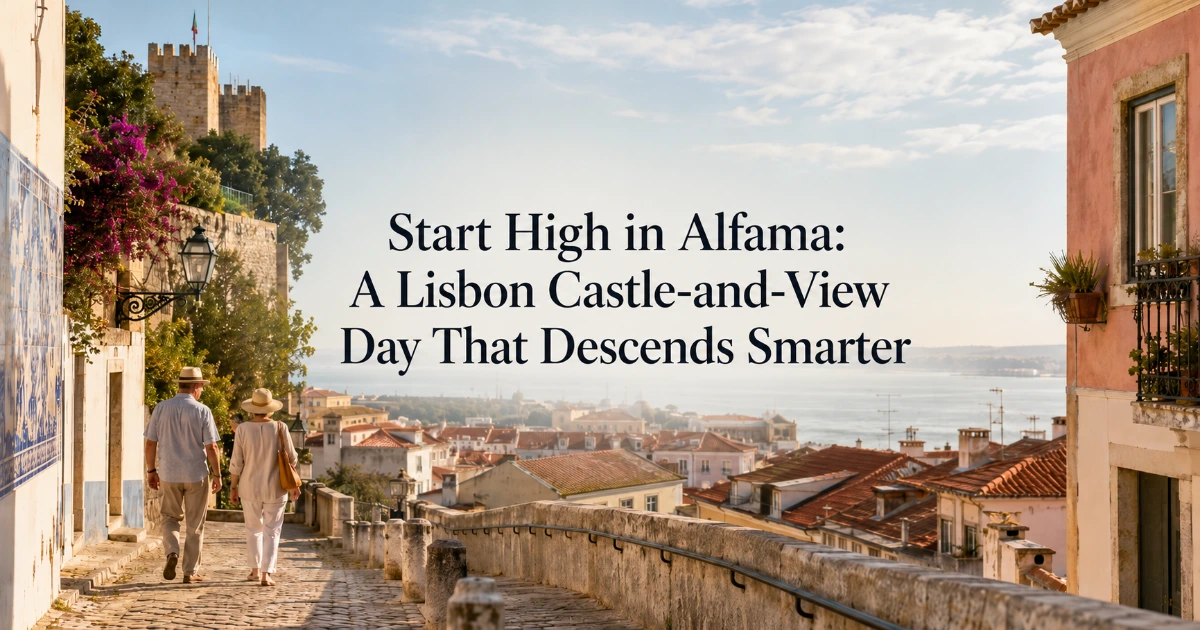
The best way to see Alfama without turning the day into a hill fight is to start high at São Jorge Castle, use one or two Miradouro stops, and descend through the neighborhood toward Baixa or the riverfront. That order works because Lisbon’s old eastern hill is not a neat walking grid; it is a stack of lanes, staircases, tiled drops, tram pinch points, and cobbled surfaces where every accidental climb costs more than it looks on a map. The clearest exception is a traveler with serious mobility limits: in that case, shorten Alfama to a castle-and-view route only, then transfer down rather than forcing the full descent.
In Alfama, route direction is the experience design: the same sights feel generous from above and punishing from below. Largo das Portas do Sol is the hinge many visitors miss. From that small terrace area, a guide can either keep the group descending toward Sé and Baixa, or let the walk drift sideways into a staircase loop that looks charming for five minutes and tiring for the next forty.
This is why a private Lisbon castle-and-view day should be planned as a descending route, not as a checklist of Alfama landmarks. Orange Donut Tours’ São Jorge Castle and Alfama Private Tour is strongest when it treats the castle as the high opening, not as a middle stop that leaves everyone climbing back into the old quarter after lunch.
The counterintuitive correction is simple: Baixa is an excellent finish for Alfama, but it is an overvalued starting point for a castle-and-view route. Starting low feels tidy because Baixa’s streets are straight, flat, and easy to read. The problem arrives when the day asks you to climb from that flat order into Alfama’s older, tighter terrain. By the time you reach the view you came for, the group is often managing heat, calves, cobbles, and impatience rather than listening well.
The ranked descent ladder: what to include, trim, and refuse
The smartest Alfama day is a ladder, not a sprawl: begin with the most important high-value stop, then descend through only the views and lanes that improve the day. This ranked order is especially useful for couples, older travelers, families, and small celebration groups because it gives the guide permission to cut gracefully when energy, weather, or dinner timing starts to matter.
- 1. São Jorge Castle as the high anchor. Start at or near the castle because it gives the route its logic. The official Castelo de São Jorge site places the castle at Rua de Santa Cruz do Castelo, a practical detail that matters because this is not a casual “wander up from anywhere” location. Use the official site to confirm visit information before you go: Castelo de São Jorge official site (https://castelodesaojorge.pt/en/). The castle should not be treated only as a photo stop; it is the place that makes the rest of the route descend instead of climb.
- 2. One primary Miradouro for the view, not three for repetition. Miradouro das Portas do Sol is usually the clearer sightseeing hinge because it looks over Alfama’s roofs and the Tagus, while Miradouro de Santa Luzia adds a more intimate tiled terrace feel nearby. Do both only when the group is fresh and unhurried. The first thing to remove from an overpacked plan is the third viewpoint, not the castle or the downhill finish.
- 3. A guided Alfama descent through lanes that still lead somewhere. Alfama rewards interpretation, but it punishes aimless curiosity. A private guide should choose lanes because they connect the castle, viewpoints, Sé, Baixa, or the riverfront in a sensible sequence. Pretty detours that end in another climb are not neutral; they spend the group’s legs and often flatten attention just before the most atmospheric part of the walk.
- 4. Sé and the lower city edge as the orientation reset. Lisbon Cathedral, the slope near Largo da Sé, and the route toward Rua da Madalena or Praça do Comércio give travelers a mental reset after the old hill. This matters because Alfama can feel maze-like even when the walking distance is not huge. A recognizable lower-city edge lets the day end with confidence rather than a phone-map debate.
- 5. Baixa or the riverfront as the finish, never an afterthought. The finish determines whether the day feels elegant or stranded uphill. A São Jorge Castle to Baixa descent works when it lands the group on flatter streets near Rua Augusta, Praça do Comércio, or the Terreiro do Paço riverfront, where lunch, transfers, taxis, shops, and hotel returns are easier to manage.
The ladder also makes the day commercially honest. A private guide adds value not by adding more stops, but by protecting the sequence from the small wrong turns that make Lisbon’s old hills feel twice as long. That is the difference between “we saw Alfama” and “we understood Alfama without paying for it physically.”
Where to start high in Alfama
The best high start is São Jorge Castle or the castle district immediately around it; Portas do Sol is the shorter alternative when the group wants views without a full castle visit. The decision should be based on the day’s purpose, not just on attraction fame.
Start at São Jorge Castle when the castle is the point of the morning
Begin at São Jorge Castle when the travelers want history, views, and a structured opening that feels substantial. This works well for first-time visitors because the castle gives Lisbon a visible shape: river, red roofs, Baixa grid, western hills, and the older eastern slope below. It also works for private groups because the guide can frame the city before taking the group down into Alfama’s lanes, where context is harder to assemble in a crowd or on a phone.
The practical consequence is that the group spends its strongest attention at the top, when feet are fresh and the day still has margin. That matters more than many visitors expect. Alfama’s lanes do not require mountaineering, but cobbles, uneven edges, polished stones, steps, and heat reflection change the walk. A high start means the group descends from the castle into the neighborhood, rather than burning energy on a climb before the main visit begins.
Start near Portas do Sol when views matter more than the castle interior
Begin near Miradouro das Portas do Sol when the group wants the Alfama view, a graceful old-quarter walk, and a shorter route. This version suits travelers who already visited the castle, families with younger children, older guests who enjoy walking but dislike uneven stamina tests, or couples preserving energy for a serious dinner. It can also be the smarter choice after an overnight flight, when a full castle visit may be more ambitious than the body admits.
Portas do Sol is not just a viewpoint; it is a route control point. From here, the guide can move toward Santa Luzia, thread into Alfama’s lower lanes, or descend toward Sé without asking the group to regain the height they just enjoyed. Used well, this starting point turns the walk into a controlled release downhill. Used poorly, it becomes another scenic pause before a confusing set of side streets.
Use a transfer-supported set-down when the group includes older travelers or a celebration schedule
A transfer-supported start is useful when the day has comfort stakes: older parents, a multigenerational family, guests in dressier shoes, a birthday lunch, or a dinner reservation that should not be compromised by fatigue. The vehicle does not need to follow the group through every lane. Its job is to get travelers high enough at the beginning and be available at a lower finish if the day calls for it.
This is where the route differs from a generic chauffeur day. The vehicle is not the star; the set-down logic is. A car that deposits guests below the hill and waits while they climb has not solved the Alfama problem. A car and guide working together can place the group at the high anchor, then let the walk descend with cleaner options at the end.
Which Alfama viewpoints are worth the effort?
The best Alfama viewpoint plan is one strong view plus one nearby texture stop; anything beyond that should earn its place by improving the route, not by adding another photo. Viewpoints are seductive in Lisbon because they look close together on a map, but the cost is paid in stairs, crowd pinch points, and repeated pauses that interrupt the flow.
Miradouro das Portas do Sol is the main route hinge
Miradouro das Portas do Sol is the viewpoint that most directly supports a descending Alfama day. It gives the broad postcard view over the neighborhood and river, but its greater value is directional. From this terrace, a guide can keep the group moving down toward Alfama’s lower lanes, Sé, and Baixa. For a private day, that route utility is more important than squeezing out another angle of the skyline.
It is also a place to make a decision. A fresh group can pause, absorb the view, and continue through Alfama. A tired group can use it as the final high moment before shortening the route. The judgment happens here, not after the group has already committed to a deeper lane sequence.
Miradouro de Santa Luzia is beautiful, but it is not a substitute for route discipline
Miradouro de Santa Luzia is often worth a short stop because it adds a tiled, intimate Lisbon texture close to Portas do Sol. The correction is that it should not become a reason to linger until the day loses momentum. For many discerning travelers, Santa Luzia works best as a nearby pause that deepens the sense of Alfama without turning the morning into viewpoint collecting.
The consequence is especially clear with families and older travelers. A few minutes at Santa Luzia can feel lovely; a slow sequence of lingering, re-grouping, photographing, and re-starting can make a modest walk feel strangely long. The goal is not to rush the view, but to keep the descent alive.
The castle view is the one to keep when the plan tightens
When time or energy shrinks, keep the castle view and reduce the neighborhood wandering. The castle’s height gives the clearest city orientation, and it makes the later descent make sense. Cutting the castle while keeping several lower viewpoint pauses often leaves travelers with the fatigue of Alfama but less understanding of why the hill mattered.
This is the firm editorial call: a castle-and-one-Miradouro route beats a castle-free viewpoint crawl for a premium first Alfama day. The first version has a beginning, context, and a clean descent. The second can become a pretty but repetitive set of terraces and lanes that blur together by lunchtime.
Do not build a premium morning around Tram 28
Tram 28 is famous, but it is not a dependable centerpiece for a polished Alfama castle-and-view day. It can be charming when it fits naturally, yet waiting for a crowded tram is a poor use of a private morning, especially for travelers who paid for better judgment and smoother logistics. In this route, the overhyped add-on is not another monument; it is letting a tram idea dictate the order.
Use the tram as atmosphere when it passes, not as the engine of the day. Lisbon’s small yellow trams look irresistible in photographs, but a private route should not depend on the least private part of the old-city experience. A guide who knows when not to chase the tram is often giving the group a better Lisbon day.
The São Jorge Castle to Baixa descent: the route that changes the finish
The São Jorge Castle to Baixa descent works because it turns Alfama from a hill puzzle into a one-way release toward Lisbon’s flatter center. The details of the descent matter: the route should keep a downward bias, avoid decorative dead ends, and end where the next part of the day becomes easier.
Castle to Portas do Sol: spend attention before spending energy
The first segment should move from São Jorge Castle toward Portas do Sol with the group still fresh enough to listen. This is where a guide can connect castle, river, hill, and neighborhood before the lanes narrow. It is also where the day’s physical rhythm is set. Too much lingering at the top can push the old-quarter walk into hotter, busier, or hungrier territory. Too little context makes Alfama feel like a string of pretty surfaces.
The balance is to give the castle its due, then leave before the group’s energy starts to pool in the first stop. A private route can do this without feeling rushed because the guide controls the transition: when to pause, when to keep walking, when to take the clearer lane, and when to skip the scenic detour that would require a climb back.
Portas do Sol to Sé: choose lanes that still descend
The Portas do Sol to Sé portion is where many self-guided days unravel. The wrong lane may still be beautiful, but it can lead sideways, down-then-up, or into a route that forces the group to reorient repeatedly. For travelers with limited stamina, that uncertainty feels more tiring than the distance itself.
A good descent does not need to expose every alley. It should include enough Alfama texture to feel real: tiled facades, laundry lines, small squares, sudden glimpses of the river, and the old-city compression that makes Lisbon feel older than the Baixa grid below. But each choice should still serve the finish. When a lane adds only atmosphere and no route value, it is a candidate for cutting.
Sé to Baixa or the riverfront: finish where the city opens
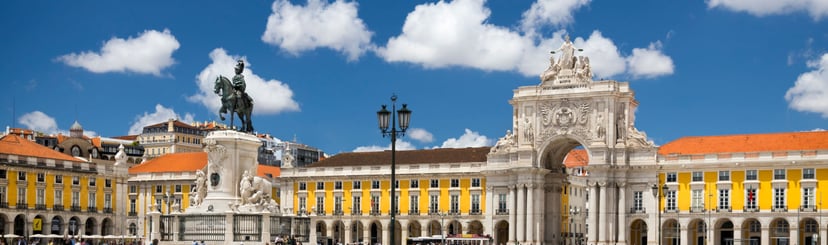
The lower section should release the group near Baixa, Praça do Comércio, or the riverfront rather than strand them below a new climb. Sé is a natural orientation point because the city starts to open from there. From the cathedral area, the guide can steer toward Rua da Madalena and Baixa, or angle toward the Praça do Comércio and Cais das Colunas riverfront if the day wants air, photos, or a calmer transfer point.
This finish changes the mood of the day. Ending in Baixa gives shoppers, café seekers, and hotel-return guests a practical flat zone. Ending at the riverfront gives celebration travelers a cleaner emotional close: the hill behind them, the Tagus ahead, and no need to climb back into Alfama for the next appointment. For guests comparing a broader first-day route, the separate chauffeur-led Lisbon day for first-timers is a better frame; this article’s route is narrower and more hill-specific.
How to end in Baixa or on the riverfront without backtracking
The cleanest ending is to decide the finish before the walk begins: Baixa for flat logistics, the riverfront for air and atmosphere, or a transfer-supported exit for dinner timing. Alfama punishes vague endings because the old quarter tempts travelers to “just keep going” until someone realizes the hotel, lunch, or car is no longer conveniently placed.
End in Baixa when the next move is lunch, shopping, or a hotel return
Baixa is the right finish when the group wants a practical handoff. Its grid, wider streets, and clearer orientation make it easier to meet a driver, choose lunch, continue to Chiado, or return to hotels near Avenida da Liberdade or Baixa-Chiado. The emotional benefit is subtle but important: after Alfama’s compression, Baixa feels readable.
This finish is especially useful for older travelers and families. The group does not need to negotiate another uphill walk, and no one has to pretend they are still delighted by cobbles after the interesting part is done. A good guide can end the route before patience turns into politeness.
End at the riverfront when the day needs a graceful exhale
The riverfront finish suits couples, celebration travelers, and guests who want the day to feel visually complete. Praça do Comércio and the Cais das Colunas area offer a broad, open contrast to Alfama’s lanes. That contrast matters because it tells the body and the mood that the descent is over.
Lisbon does something specific to the body: it turns small route mistakes into cumulative load. Extra climbing, polished cobblestones, heat bouncing off pale stone, narrow pauses behind slower walkers, and repeated map checks all feel minor in isolation. Together they make a two-and-a-half-hour old-quarter walk feel like a longer day. A riverfront ending gives the body a flatter surface and the mind a simpler next step.
End with a transfer when the evening has a high-value reservation
A transfer-supported finish is wise when the evening matters: a private dinner, a fado plan, a family celebration, or a food-and-wine reservation that deserves guests who are still alert. For example, travelers building a dinner-forward day may want to confirm restaurant details directly, including Marlene, on MICHELIN Guide (https://guide.michelin.com/us/en/lisboa-region/lisboa/restaurant/marlene), rather than letting a late uphill return drain the evening before it begins.
Lisbon also changes the mood of a trip. When a castle-and-view day ends with a scramble for a taxi from the wrong slope, the memory becomes logistical. When it ends downhill in Baixa or beside the Tagus, the day feels shorter, calmer, and more intentional than the same number of sights arranged in the wrong direction. That mood difference is one reason private routing matters for celebrations and multi-generational travel.
When Alfama should be shortened to a castle-and-view route only
Alfama should be shortened to a castle-and-view route only when the traveler’s real priority is the view and context, not the full old-quarter walk. This is not a compromise for everyone; for some groups, it is the better editorial choice.
Shorten the route when older travelers are steady but not eager for uneven surfaces, when a guest has knee or balance concerns, when summer heat is likely to dominate the middle of the day, when children are already tired, or when the morning sits before a long lunch, wine plan, or formal dinner. In these cases, the private guide should not force the full descent just to prove Alfama has been “done.” A high view, clear castle context, and a controlled exit can be more satisfying than a heroic walk through every lane.
Shorten it also after a late arrival or overnight flight. A newly arrived traveler may enjoy Lisbon’s light and views but not yet have the physical patience for cobbles, stairs, and old-city navigation. In that case, choose São Jorge Castle or Portas do Sol, add one nearby Miradouro, and transfer down toward Baixa or the riverfront. That version keeps the first impression strong without letting the hill set a punishing tone for the stay.
The cut-first rule is direct: remove extra lane wandering before removing the high start. A shortened route that begins high still feels designed. A longer route that begins low and climbs because “Alfama is best on foot” often feels like the city made the decisions for you.
Heritage travelers may need a different narrowing principle. A Jewish-history-focused day, for example, should not blur Alfama, Baixa, and Shaaré Tikva into the same old-city walk; that belongs in a more specific plan such as the Jewish Lisbon private day guide. The point here remains terrain: keep Alfama’s hill logic clean before adding another interpretive layer.
Premium support should remove hill waste, not decorate it
Premium support earns its place when it sets the group high, keeps the walking sequence downhill, and gives the finish a clean next step. It does not earn its place by adding a luxury car to a route that is still physically careless.
A luxury car does not replace a hill-smart walking sequence inside narrow streets. Inside Alfama, many of the most meaningful moments are pedestrian: the turn from a terrace into a lane, the sudden river view between buildings, the difference between the castle’s high exposure and the neighborhood’s compressed shade. A vehicle cannot make those lanes flat, and it cannot follow every useful passage. Premium spend does not help when it merely waits while the group climbs the wrong way.
Where spend does change the day is in the edges: the high set-down, the timing of the castle arrival, the decision to skip a crowded tram idea, the ability to end at Baixa or the riverfront without anxiety, and the guide’s authority to adjust the route when a guest’s energy changes. For some travelers, a dedicated vehicle is most valuable for the start and finish rather than the middle.
This is the distinction between a chauffeured day and a terrain-led private route. A chauffeur can smooth hotel logistics, but a guide must still design the descent. Travelers considering the broader vehicle question can compare the route-specific choice here with Orange Donut Tours’ Luxury Chauffeured Lisbon Private Tour and the deeper chauffeured Lisbon day guide. For Alfama itself, the vehicle is support; the sequence is the upgrade.
For private travelers, the most natural moment to involve Orange Donut Tours is when the day has an evening to preserve: a dinner reservation, fado, a family gathering, or a celebration plan that should not be reached in recovery mode. A guide and transfer-supported start can make the castle-and-view route feel graceful rather than effortful, then finish the group low where the next part of the day is easy. Inquire now
The dinner-forward version: keep Alfama early, then let the evening belong elsewhere
A castle-and-view Alfama day pairs best with an evening that does not require another old-hill climb. This is where many elegant Lisbon plans go wrong: the morning is scenic, the afternoon drifts, and the evening asks everyone to return uphill because the itinerary was built attraction by attraction rather than by energy.
For couples and celebration travelers, the better day often begins high in Alfama, descends to Baixa or the riverfront, then leaves dinner to a calmer part of the city or a transfer-supported plan. That does not mean avoiding Alfama after dark entirely. It means being honest about what the group will feel like after castle stones, viewpoints, cobbles, and a downhill walk. A late uphill return can turn a romantic plan into a negotiation about shoes and taxis.
When Alfama is the evening itself, keep the daytime version shorter. When the evening belongs to Bairro Alto, Chiado, Avenida da Liberdade, or a destination dinner, make the Alfama route a morning or early afternoon piece with a clean finish. The separate Alfama after dark planning guide is the better place to compare evening neighborhoods; this route is about using the hill once and using it well.
Food-and-wine travelers should be especially disciplined. The appetite you bring to dinner is shaped by the route you walked earlier. A day that descends cleanly leaves the evening available. A day that adds two extra viewpoints, a tram wait, and a late climb back to the hotel often turns even a superb reservation into a test of stamina.
FAQ
Is Alfama better to visit uphill or downhill?
Alfama is better visited downhill for most private castle-and-view days. Start at São Jorge Castle or near Portas do Sol, then descend through selected lanes toward Sé, Baixa, or the riverfront so the route uses Lisbon’s terrain instead of fighting it.
Where should a private Alfama tour start?
A private Alfama tour should usually start at São Jorge Castle when the castle is part of the plan, or near Miradouro das Portas do Sol when the group wants a shorter view-led route. Starting low in Baixa is usually less comfortable because it turns the beginning into a climb.
Which Miradouro should be prioritized in Alfama?
Miradouro das Portas do Sol should usually be prioritized because it gives a strong view and works as a practical route hinge. Miradouro de Santa Luzia is a worthwhile nearby addition when the group is fresh, but it should not turn the morning into viewpoint collecting.
How do you end an Alfama walk in Baixa without backtracking?
Plan the finish before the walk starts: descend from São Jorge Castle toward Portas do Sol, continue through Alfama toward Sé, then release into Baixa near Rua da Madalena, Rua Augusta, or Praça do Comércio. The key is to avoid side lanes that require climbing back to the same height.
Is São Jorge Castle worth including for older travelers?
São Jorge Castle can be worth including for older travelers when the route starts high and the walk is shortened or carefully paced afterward. It is not worth forcing when the guest has serious balance, knee, or stamina concerns; in that case, use a castle-and-view route only and transfer down.
Can a luxury car solve the Alfama hill problem?
A luxury car can improve the start and finish, but it cannot solve the walking sequence inside Alfama’s narrow streets. The real solution is a high set-down, a downhill route, a guide who avoids wasteful detours, and a low finish in Baixa or by the riverfront.
Should Tram 28 be part of a premium Alfama day?
Tram 28 should not be the centerpiece of a premium Alfama day. It can be enjoyed as atmosphere when it appears naturally, but waiting for a crowded tram often uses time and patience that are better spent on the castle, one Miradouro, and a controlled descent.
How long should a castle-and-view Alfama route take?
A focused castle-and-view Alfama route should feel like a substantial half-day rather than a full-day endurance walk. The exact duration depends on castle time, pauses, weather, and traveler mobility, but the route should end before the group starts treating cobbles and stairs as the main memory.
If you’re interested in any private tours of Lisbon, please reach out to us.


 So if you are looking for the absolute best in Lisbon & surroundings with authentic local fully-licensed native guides whose English you can actually understand and with an exclusive and amazingly fun itinerary













