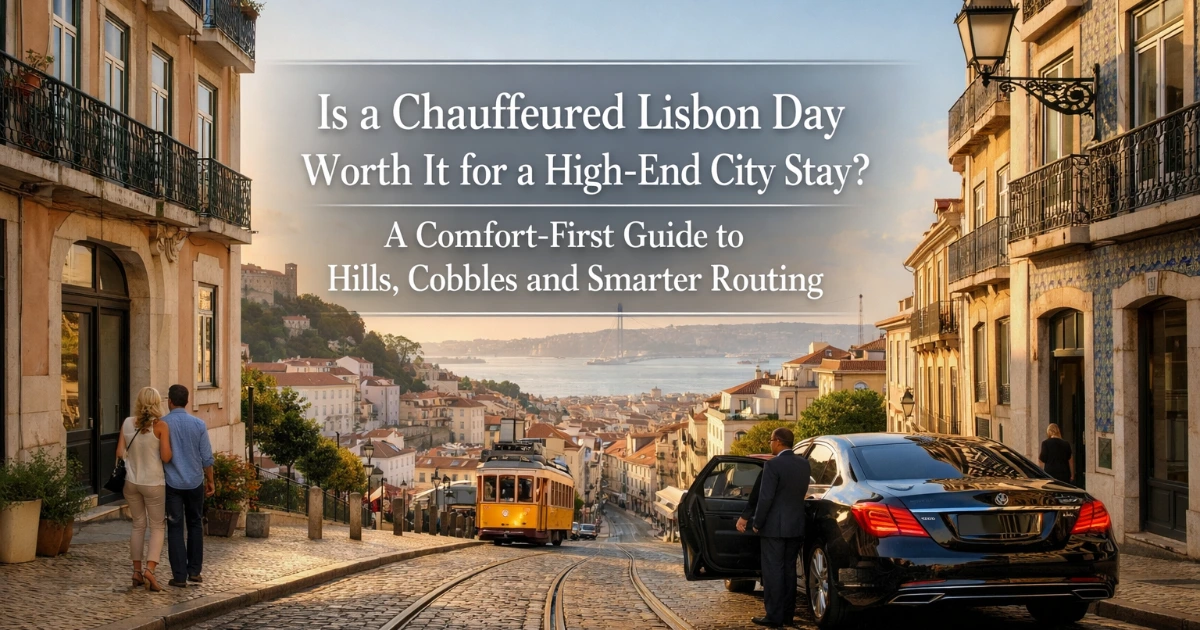
Is a Chauffeured Lisbon Day Worth It for a High-End City Stay? A Comfort-First Guide to Hills, Cobbles and Smarter Routing
Updated
The verdict for a high-end city stay: usually hybrid, sometimes full-day, occasionally neither
Yes, a chauffeured Lisbon day can be worth it, but for a high-end city stay the strongest answer is usually hybrid rather than full-day: let a driver handle Belém, hill-heavy hotel returns, and awkward quarter-to-quarter transfers, then walk the parts of Lisbon that only make sense on foot. That works because Lisbon hides effort inside short-looking distances, slow cobbles, and repeated climbs. The clearest exception is a central Chiado stay with a narrow plan; if you only want Chiado, Baixa, and one old-quarter wander, a full chauffeur day is excessive and a few short taxi hops can do enough.
The city-specific proof arrives quickly once you look at an actual handoff. A driver saves real energy between Belém and Chiado, between a hotel on Avenida da Liberdade and a late-afternoon old-quarter visit, and between a viewpoint stop and a dinner return. Yet even a premium vehicle will still leave you walking from places like Largo das Portas do Sol, because the lanes that make Alfama memorable are the same lanes that stop the car from finishing the job. That micro-reality matters more than almost any abstract debate about “luxury travel.”
This article-specific thesis is the key to Lisbon: premium transport earns its keep not by replacing walking, but by removing the city’s least charming effort while leaving the best parts tactile, local, and unhurried. Travelers considering a dedicated service rather than ad hoc rides should compare that logic with a chauffeured Lisbon private tour only after deciding which parts of the day actually need wheels.
The expensive mistake is not “booking too much comfort.” It is paying for the wrong shape of comfort. In Lisbon, the overvalued upgrade is asking a car to shadow you inside quarters that still want your feet, your eyes, and your patience. The better judgment is to buy relief where Lisbon is least graceful: the long reset to Belém, the uphill return to your hotel, the mid-afternoon transfer when the day starts to sag, and the late handoff that protects dinner rather than turning the evening into recovery time.
Is a chauffeured Lisbon day worth it, or is a hybrid plan better?
For most discerning visitors, the decision is best understood as a ranked ladder rather than a yes-or-no purchase. Lisbon does not ask whether you can afford a car; it asks where a car changes the quality of the day. Once you answer that honestly, the options become much easier to rank.
- 1. Hybrid walk-and-drive day. Best for most first-time, comfort-first visitors who want Belém plus a central quarter plus Alfama or a viewpoint. The car handles the long and tiring links; you walk the parts that reward close attention.
- 2. Full chauffeured day. Best for limited-walking travelers, multi-generational groups, families managing energy swings, celebration days with outfit changes, and anyone whose hotel base makes repeated uphill returns annoying rather than charming.
- 3. Walk-only day with ad hoc taxis. Best only when your hotel is already central, your plan stays narrow, and you are willing to accept some friction in exchange for not committing to a driver.
The practical winner is the hybrid plan because Lisbon is neither a compact flat center nor a city where a car can elegantly solve every doorstep problem. Belém sits apart from the central quarters in a way that tempts people into over-walking or underestimating transfer time. Chiado and Baixa often work beautifully on foot once you are there. Alfama is the celebrated quarter that still asks you to walk, even on a high-end trip. The hybrid model respects all three truths at once, which is why it tends to outperform both extremes.
The full-day chauffeur option rises to first place only when your day is broader, your walking tolerance is lower, or the mood stakes are higher. A couple celebrating, changing for a serious dinner, and wanting Belém, a scenic pass through the city, a curated Alfama finish, and a calm return to the hotel may feel the value immediately. So might a family with grandparents, or a small group where one person loves hills and another person hates them. In those cases, paying for continuity, not just transportation, is the real purchase.
The walk-only option is not wrong; it is simply narrower than it sounds. It works best when you stop pretending Lisbon owes you easy crossings between every quarter. Keep the plan small, accept that one or two neighborhoods are enough, and do not make the day prove a point. The traveler who insists on squeezing Belém, Chiado, São Jorge, and a late dinner into a mostly walk-based day usually experiences Lisbon as effort first and elegance second.
Why Lisbon exposes bad routing faster than flatter capitals
Lisbon makes poor planning felt in the legs before it makes it visible on the clock. That is why the “worth it” question here is so different from the same question in flatter, more linear cities. You are not just moving laterally between museums and viewpoints. You are repeatedly climbing, descending, re-climbing, stepping over cobbles that are pretty but energy-hungry, and restarting your rhythm every time a quarter shifts under your feet. The day can look elegant on paper and still feel strangely punishing by mid-afternoon.
This is what the city does to the body: small climbs accumulate, cobbles subtly slow the stride, and every transition asks for a fresh burst of concentration. Even travelers who are generally fit notice it after a westward excursion, a viewpoint stop, and one old-quarter detour. Add sun, shopping bags, a stroller, or a lunch that runs a little longer than planned, and the margin disappears. The issue is not dramatic hardship; it is the drip-drip effect of effort that makes people unexpectedly tired before the best part of the day arrives.
This is also where a common Lisbon planning myth needs correcting. Public transport and heritage trams are part of the city’s charm, but they are not a universal comfort solution for premium travelers. They can be delightful as part of the texture of a trip; they are less reliable as the backbone of a carefully paced day. A chauffeured day becomes valuable when it prevents transfer resets, not when it tries to outperform every local mode on every street. That is why paying for a car to “follow” you in the old quarters is often the wrong spend, while paying for the approach, retreat, and between-quarter glide can feel transformative.
The mood consequence is just as important as the physical one. A badly routed Lisbon day feels longer in the wrong way: not richer, but more interrupted. The city starts to feel like a sequence of tiny recoveries rather than one coherent experience. A well-routed day, by contrast, feels calmer than the number of stops would suggest because the ugly parts of movement have been edited out. That is the real luxury effect here. It is less about avoiding all walking and more about avoiding the kind of walking that arrives at the wrong moment, on the wrong slope, for no reward.
One firm editorial call follows from this: if you are already tempted to measure the day by attraction count, cut one hillside transfer before you cut lunch, guide time, or your evening reservation. Lisbon punishes overpacking faster than many first-time visitors expect. The city is generous when the plan breathes and oddly draining when every district is treated like a quick check-box.
Where the car changes the day, and where it leaves you walking anyway
A car materially helps in Lisbon when neighborhoods are separated by effort that brings little pleasure. Belém is the clearest example because it sits outside the historic core and is easy to misjudge from central hotel districts. The drive west and the return east are not merely distance problems; they are momentum problems. A driver keeps the day intact, gives you a secure place for extra layers or purchases, and prevents the feeling that the morning excursion has consumed the whole day before the center even begins.
A car also helps on hotel logistics more than many travelers expect. It is one thing to stroll between Baixa and Chiado when you are fresh. It is another to return uphill to a hotel on or above Avenida da Liberdade, change for dinner, then head out again after hours on your feet. The bowl of Baixa and Rossio can feel deceptively close to everything until that final climb is the one you do tired. Chauffeur time becomes disproportionately valuable when it compresses those awkward resets: pickup, hotel return, freshen up, next destination. Those are the moments where premium service changes the trip from “manageable” to smooth.
Where the car stops helping is equally important. Chiado itself is usually better absorbed on foot once you arrive, especially if your interest is urban texture, shops, cafés, and the connective tissue between Chiado and Baixa. The same is true for the lanes and miradouros that make Alfama memorable. Premium spend does not help inside Alfama itself. A vehicle can deliver you close, but not into the essence of the quarter. If anything, trying to over-mechanize that part of Lisbon often makes the day feel more fragmented, because you keep re-entering a place that wants continuity.
The question, then, is not “Can a car reach this neighborhood?” but “Does arriving by car meaningfully improve the day before the walking begins?” In Belém, yes. In a late uphill return to your hotel, often yes. In a cross-city handoff from a riverfront stop to a reservation, very often yes. Dropping at Praça do Comércio, for example, does not remove the climb that still waits if upper Alfama is the real goal. In the narrow folds of Alfama, usually no. In the short weave across Chiado, not much. That distinction is where trust lives in any honest recommendation.
Another useful correction: not every viewpoint stop deserves vehicle support. If you are already spending a concentrated afternoon in one quarter, repeatedly calling the car for scenic micro-hops can break the day into pieces. The car earns its keep on meaningful transfers, not on every photogenic impulse. Lisbon is at its best when the transport strategy serves the rhythm rather than becoming the rhythm.
How your hotel base changes the value of chauffeur time
Your hotel location is one of the strongest predictors of whether a chauffeur-led Lisbon day feels essential, merely pleasant, or slightly excessive. Travelers sometimes evaluate the decision in abstraction, as if the city begins from a neutral center. It does not. Lisbon begins from your front door, from the slope outside it, and from the direction of your first return. The same itinerary feels entirely different from Avenida da Liberdade than it does from Chiado.
If you are staying on or around Avenida da Liberdade, chauffeur time is easier to justify from the first pickup. That district is elegant, comfortable, and strategically strong for many upscale stays, but it sits in a way that makes repeated up-and-down movement noticeable over a full sightseeing day. You can absolutely walk parts of it, of course. The issue is accumulation. A morning departure west to Belém, a midday return toward Chiado, and an evening reset back to the hotel can become a day defined by gradient. From that base, a driver often improves not only the sightseeing hours but also the edges of the day.
If you are staying in Chiado, the calculation changes. Chiado is already close to some of the easiest and most satisfying urban wandering in Lisbon. That proximity lowers the value of full-day chauffeur coverage unless your plan deliberately stretches west to Belém and then east again to Alfama, or unless mobility in your group is limited. Travelers choosing between central bases should think through this carefully; the logic is explored in more depth in where to stay in Lisbon for a comfort-first trip. In plain terms, Chiado reduces the need for all-day driving because one of Lisbon’s most rewarding walking zones is already on your doorstep.
Príncipe Real often sits somewhere between those two answers. It can be a lovely base, but it does not erase the city’s slopes, and it still benefits from selective driving when the day stretches beyond the immediate hilltop environment. A riverside or highly central base can lower the need further for travelers keeping their day tight. A more elevated or edge-positioned hotel raises the value of having one person responsible for the transitions.
This is why “we have a nice hotel” is not enough of a planning statement in Lisbon. Ask a better question: after Belém, where will your body be relative to your hotel? After Alfama, how do you want to get to dinner? After a midday break, do you want to spend your energy re-climbing to restart the afternoon? If the honest answers all point toward repeated uphill resets or quarter-to-quarter hops, chauffeur time becomes easy to defend. If not, keep the spend narrow and targeted.
There is also a quiet service advantage here for celebration travelers and families. The farther your hotel sits from the day’s walking core, the more valuable a dependable return becomes for wardrobe changes, rest, child resets, or simply the dignity of not arriving late and winded to your own plans. Lisbon punishes the assumption that “we can always just figure it out later.” A good chauffeur strategy is really a good retrieval strategy.
The Belém to Chiado handoff is the hinge where premium transport buys the most relief
If there is one route in Lisbon that best explains why chauffeur service can be worth real money, it is the Belém to Chiado handoff. Belém is important for many first visits, and it sits just far enough from the central core to distort the day when handled casually. The traveler who reaches Belém, enjoys the morning, and then tries to improvise the return often loses more than time. They lose sequence, appetite, and the relaxed feeling that the central city is still available afterward.
This is where a driver earns the fee in an unusually concrete way. The transfer back from Belém can become a clean hinge instead of a morale leak. You finish the riverside segment, return toward Chiado or Baixa without standing around reassembling the day, and arrive ready for the walkable heart of Lisbon rather than annoyed by the process of getting there. For visitors with children, older relatives, or limited walking tolerance, this is often the difference between “we did Belém” and “Belém fit elegantly into a city day.”
The same logic applies whether you are doing a broad overview or a more focused westward morning. Travelers considering a structured west-side visit can compare the shape of a Belém and Jerónimos private tour with their own energy profile, but the larger planning point stands even if you design the day privately: Belém is not difficult because it is remote in some dramatic sense. It is difficult because it interrupts central Lisbon unless you manage the handoff cleanly.
Chiado is the right landing zone more often than people think because it lets the rest of the day soften rather than harden. Once you are back in Chiado, the city becomes legible again. Coffee, shops, short cultural detours, and gentle wandering make sense there in a way they do not if you have been dropped somewhere that requires immediate further climbing. This is one reason the existing route-focused guide on a first-timers’ chauffeur-led Lisbon day complements this article rather than replaces it: the routing only pays off once you have decided what level of vehicle support you actually need.
The editorial judgment here is firm. If your Lisbon day includes Belém and then continues into the center, do not be casual about the return. That is the handoff most likely to justify a driver, even for travelers who otherwise do not need one all day. It is where paid logistics save the largest amount of low-value effort.
Alfama is the famous exception: beautiful, essential, and still mostly on foot
Alfama is still best explored mostly on foot, even on a high-end trip. That sentence needs to be stated plainly because it is the point where many polished Lisbon plans become overdesigned. The narrow lanes, irregular steps, abrupt viewpoints, and intuitive wandering that make Alfama special are precisely what make it resistant to vehicle-based touring. You can arrive well; you cannot outsource the quarter itself.
Largo das Portas do Sol is the perfect proof cue. It is one of the clearest drop-off and orientation points for a premium day because it gives you a strong reveal and a manageable handoff into the neighborhood. But it also demonstrates the limit of chauffeur value. From Largo das Portas do Sol, the real experience still unfolds on foot: into lanes that bend, toward miradouros that invite lingering, up or down toward São Jorge or lower Alfama depending on your route. The car solved the approach. It did not replace the walk.
This is why paying to have a vehicle “cover” Alfama in the same way it covers a broad avenue district is usually the wrong idea. Premium spend does not help inside Alfama itself. What it does help with is the setup and the exit: arriving without having already climbed half the city, and leaving without turning the end of the day into a punishing descent followed by another uphill return somewhere else. That distinction is the difference between a chauffeur day that feels intelligent and one that feels like theater.
For travelers who want this quarter to feel curated rather than chaotic, the stronger move is often to pair the drop-off with a committed walking segment, such as a São Jorge Castle and Alfama private tour, and to think carefully about where the day goes afterward. If Alfama is your last major neighborhood before a hotel break or dinner, the chauffeur value rises because the exit matters. If Alfama is your only major focus and you are staying nearby, the all-day vehicle value falls sharply.
One practical mistake to avoid: do not force both the highest and lowest parts of Alfama just because the map suggests they are connected. Choose the upper entry well, enjoy the quarter with intention, and let the route descend or drift naturally. Lisbon rewards surrender to the grain of the neighborhood here. Fighting that grain is tiring no matter how beautiful the view looks in photographs.
When a full chauffeur day truly earns its cost
A full chauffeur day earns its cost in Lisbon when continuity is the real luxury purchase. That usually means one of four things: your group has limited walking tolerance; your hotel base creates repeated uphill returns; your day spans Belém, central Lisbon, and an old quarter with no appetite for improvising the handoffs; or the day includes mood-sensitive elements such as shopping, family coordination, or a serious evening reservation. In those cases, the benefit is not only physical relief. It is the calm of having one person responsible for transitions that would otherwise keep intruding into the experience.
Multi-generational families are a classic good fit. So are couples on an anniversary day who want to avoid the feel of managing a city rather than enjoying it. So are travelers who know they like context from a guide but do not want the hidden logistics work of finding pickup points, storing purchases, or deciding on the fly when to abandon one more climb. A guide-and-driver combination removes Lisbon’s worst hill and handoff friction without forcing the day into a rigid parade of stops. That is the point where premium service starts to feel less like an indulgence and more like a design choice.
It also earns its cost when the day must absorb a hotel break without breaking in half. This is very common on high-end stays and oddly under-discussed in generic planning advice. Perhaps you want an hour off your feet before dinner, need time to change, or want to reset children before the evening. In Lisbon, that hotel return can be the moment when a coherent day either stays coherent or unravels. The driver who is already part of the plan keeps that seam almost invisible.
The strongest full-day case is not “we want to see everything.” It is “we want a wide-ranging day to feel calm.” That is a very different mindset. If that is your goal, you are close to the point where tailored support becomes worth considering seriously, and a custom brief may be more useful than forcing a standard route. Inquire now.
Still, honesty matters here. A full chauffeur day is not automatically the best answer just because the budget allows it. If most of your pleasure will come from one compact walking zone and one meal, the all-day car can feel like too much machinery around a simple day. Lisbon rewards fit more than maximalism.
When a hybrid half-day plan is smarter than paying for the whole day
A hybrid half-day plan is smarter than a full chauffeur day when you need help with Lisbon’s hard edges, not with every hour. This is the most common sweet spot for first-time visitors staying well, especially those based in Chiado or nearby. Use the car for the long reach to Belém or the cross-city reset, then let the central quarters unfold on foot. You still remove the exhausting parts, but you avoid paying to keep a vehicle attached to hours that do not benefit much from it.
Here is the plain version of the spend judgment the city keeps forcing on people: paying for a full chauffeur day is excessive when you are staying in Chiado or Baixa, want Belém plus one central quarter, and can handle moderate walking once dropped in the right place. In that scenario, a hybrid half-day plan already does the hard work. What remains after the transfer is not a logistics problem; it is the enjoyable part of Lisbon.
This is also the right move for travelers who like autonomy but dislike inefficiency. A hybrid plan preserves some wandering, some spontaneity, and some sense of discovery, while still protecting you from the worst route mistakes. It lets you keep the tactile charm of Chiado, the riverfront, or a measured Alfama walk without pretending that every leg of the day should be solved by local taxis or every slope should be worn as a badge of honor.
The cut-first rule is simple: if the day starts feeling too ambitious, cut the second major hill quarter before you cut the transfer support. In practice, that often means choosing between an extended Alfama finish and another uphill district rather than trying to prove you can do both. Transport support is most valuable when it protects the shape of the day you actually want, not when it encourages one more neighborhood than the trip needs.
Hybrid planning also suits food-and-wine travelers especially well. If lunch matters, if you want a measured afternoon rather than a rushed one, or if you want to arrive at dinner with appetite intact, the half-day vehicle can be the exact amount of assistance that keeps Lisbon pleasurable. It is often the most adult answer in a city that can tempt people into overperforming their own stamina.
How to protect the evening instead of spending it recovering
The best reason to organize Lisbon well is not what it does for the morning. It is what it preserves for the evening. A day that looked technically successful can still damage the night if it leaves you heat-tired, grimy, late, or quietly unwilling to cross one more hill for a reservation you were excited about a week earlier. The most convincing case for chauffeur time in Lisbon often appears after 5 p.m., when the city starts collecting the energy debt it has been building all day.
This is especially true for travelers who care about dinner as part of the trip rather than an afterthought. If you have a reservation at Marlene, on MICHELIN Guide (https://guide.michelin.com/us/en/lisboa-region/lisboa/restaurant/marlene), or another meal that matters, the day should be arranged backward from that commitment. You want enough margin to return to the hotel, change, and arrive composed. You do not want your last Lisbon memory before dinner to be an unnecessary climb, a delayed ride, or the realization that the scenic detour was not worth the fatigue.
The same logic applies if your evening revolves around another reservation-led splurge confirmed directly through a restaurant’s official site (https://www.fiftysecondsexperience.com/en/reservations/). Lisbon works best when the day tapers neatly into dinner rather than trying to squeeze one more scenic hill between the hotel reset and the table.
This is where a guide-and-driver pairing can feel beautifully proportional rather than overengineered. The driver takes care of the rough transitions and the hotel reset; the guide makes the walking hours count. The result is not just less effort. It is a different emotional tone to the day. Lisbon feels shorter, more coherent, and more generous when the evening is protected. It feels harsher when the final third of the day becomes a negotiation with tiredness.
For travelers shaping a broader stay, it can also be useful to think of one city day in relation to the rest of the trip. A demanding walk-heavy day before a fine-dining night or a day trip can flatten more than one calendar square. If you are curating the overall stay, related planning around dinner and overall trip shape can help sequence meals and city energy more intelligently. The principle remains the same: do not ask your evening to absorb the cost of a badly routed afternoon.
The emotional reward of getting this right is understated but real. You remember Lisbon differently when the city leaves you animated rather than depleted. The hills still exist, the cobbles still slow you down, and Alfama still asks for a walk. But the day feels held together. That is usually the moment when comfort-first travelers decide the right chauffeur support was worth it, even if they did not need a car for every hour.
What to stop forcing on a first Lisbon city day
The smartest way to decide whether chauffeur time is worth it is to stop forcing the wrong combinations. Lisbon punishes over-eager mixing more than it rewards sheer coverage. Travelers often pair Belém, a full central walk, the castle zone, and an ambitious dinner as if the city were flatter and more linear than it is. Then they wonder whether they needed a driver. Often the better question is whether they needed a smaller day.
Stop forcing the idea that every celebrated quarter belongs in the same outing. Belém plus Chiado plus Alfama can work, but only if the transport logic is clean and the walking expectations are honest. Add too much wandering in each, or bolt on one more hill district, and the day becomes a series of unfinished experiences. Lisbon is not a city that rewards grazing everywhere. It rewards committing to a few quarters and linking them elegantly.
Stop forcing the car to solve what only editing can solve. A vehicle can reduce strain, save the handoffs, and simplify returns. It cannot turn every lane into a drop-off, flatten every ascent, or make every stop feel equally worthwhile on the same day. That is why the answer is sometimes “book the driver” and sometimes “cut a neighborhood.” The two are not opposites. They are often part of the same good plan.
Stop forcing the idea that a first day has to be your biggest day. Lisbon can be kinder when one city day is shaped around Belém and the center, while another handles Alfama more patiently or takes you outside the city altogether. Travelers thinking beyond one day may want to compare that rhythm with their overall stay length and with any day-trip ambitions before trying to make one city day do everything.
That is the final editorial correction. Chauffeur support is not a badge of seriousness, and walk-only bravado is not authenticity. Lisbon responds best when you buy help for the ugly parts, walk the rewarding parts, and leave a little room for appetite, conversation, and the river light that makes the city memorable in the first place.
FAQ
Is Lisbon better on foot or with a driver?
Lisbon is best handled with both, not as a compromise but as the correct reading of the city. The walkable parts are genuinely worth walking, especially Chiado, Baixa, and the lanes of Alfama. The tiring parts are the long handoffs, uphill returns, and cross-city resets. That is why a hybrid walk-and-drive plan beats a pure answer for many high-end stays.
Is a full-day chauffeur in Lisbon overkill?
Sometimes, yes. It is overkill when your hotel is central, your plan is narrow, and you mostly want one or two neighboring quarters. It is not overkill when your base is less convenient, your day spans Belém and the old quarters, your group includes limited-walking travelers, or the evening matters enough that you want the whole day held together cleanly.
Which Lisbon neighborhood is still best explored on foot, even on a high-end trip?
Alfama. A car can improve the approach and the exit, but the quarter itself still works best on foot. Largo das Portas do Sol is a useful handoff point, not the end of the job. The lanes, steps, viewpoints, and intuitive turns are the experience.
Does a chauffeur save much time in Lisbon, or mostly energy?
Mostly energy, and that is exactly why it can still be worth it. In some places, especially the Belém to Chiado handoff and hotel returns to Avenida da Liberdade or other elevated bases, it can also save meaningful time. But the bigger gain is usually continuity: fewer transfer decisions, less accumulated fatigue, and a day that still feels coherent by late afternoon.
When is a hybrid half-day plan enough?
A hybrid half-day plan is enough when you need help with Lisbon’s hard edges rather than all-day coverage. A classic example is a westward outing to Belém followed by a return to Chiado or Baixa for a walkable afternoon. Another is a guided drop into Alfama with support for the hotel return later. If the car is solving the ugly links and not the rewarding wandering, you are often in the right zone.
How does staying on Avenida da Liberdade change the answer?
It usually increases the value of chauffeur time because the day begins and ends with more vertical effort than many visitors expect. A hotel there is comfortable and convenient in many ways, but repeated returns after walking-heavy sightseeing can feel more draining than the map suggests. From that base, a driver often improves both the sightseeing segments and the reset periods between them.
Can you do Belém, Chiado, and Alfama in one day without a chauffeur?
You can, but it is usually the wrong test. The better question is whether you can do them without making the day feel chopped up or tiring. For many first-time, comfort-first visitors, that combination is exactly where selective vehicle support earns its keep. Without it, one of the transfers tends to absorb more energy than the map implies.
What is the strongest reason to book a chauffeur in Lisbon?
The strongest reason is not status or even speed. It is preserving the quality of the whole day, especially the transition from sightseeing into the evening. If the right support means you reach dinner with energy, arrive back at the hotel without one last punishing climb, and keep Belém from swallowing the central city hours, then the spend has likely done exactly what it should.
If you’re interested in any private tours of Lisbon, please reach out to us.


 So if you are looking for the absolute best in Lisbon & surroundings with authentic local fully-licensed native guides whose English you can actually understand and with an exclusive and amazingly fun itinerary













