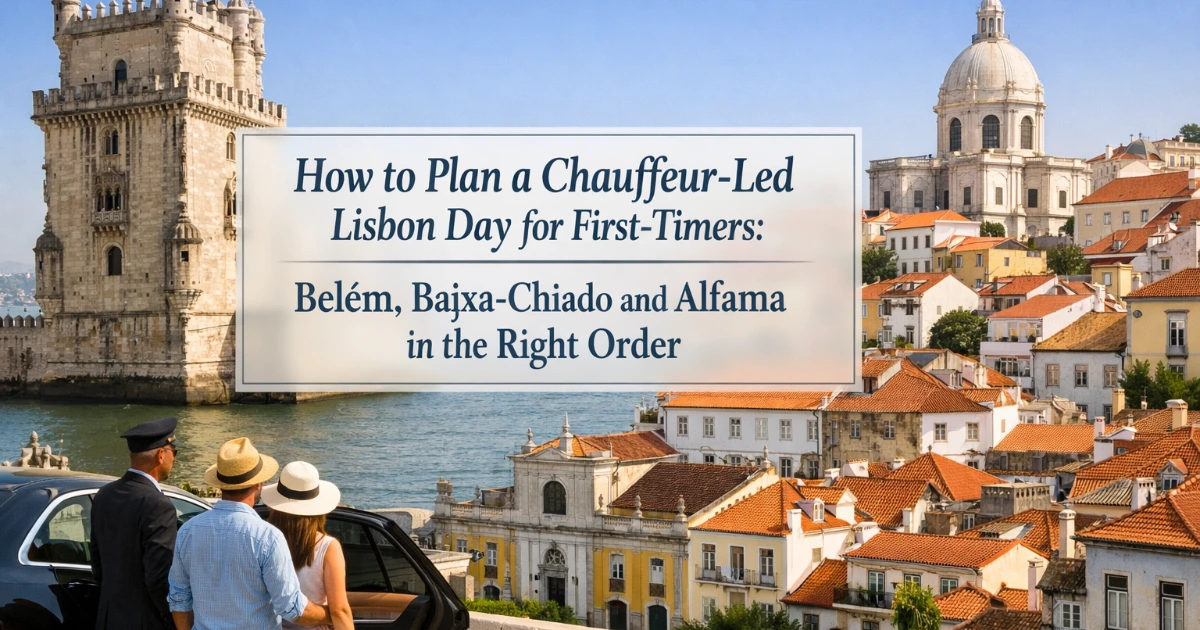
How to Plan a Chauffeur-Led Lisbon Day for First-Timers: Belém, Baixa-Chiado and Alfama in the Right Order
Updated
For a full first Lisbon day, do Belém first, Baixa-Chiado second, and Alfama last. That order works because Lisbon’s two real obstacles are not distance but disjointed geography and vertical effort: Belém sits west on its own riverfront strip, while the city turns physically expensive the moment the Praça do Comércio to Portas do Sol climb begins. If you use your freshest hours for Belém, take your flattest midday stretch through Baixa-Chiado, and reach Alfama when a vehicle can place you high and let you walk down through viewpoints, the day feels coherent instead of chopped up. The clearest exception is a short arrival day, a red-eye landing, or any plan with only half a day in hand; then Belém should move out of the lineup entirely rather than be forced in badly.
Here is the point of view that matters in Lisbon and almost nowhere flatter: the right first-day order is less about what is most famous first and more about where the city makes you spend your legs. What looks compact on a map is not compact once cobbles, heat, monument queues, and the rise above the river begin stacking on top of each other. That is why Alfama, beloved and photogenic as it is, is the wrong first stop for most arrival-day plans. And it is why a chauffeured Lisbon route can feel unusually useful here: it saves effort at the exact moment Lisbon becomes demanding, rather than merely shortening an easy transfer.
That distinction matters for couples trying to keep dinner energy, for families managing strollers or grandparents, for celebration travelers who do not want the day to feel like logistics practice, and for food-and-wine travelers who know that a beautiful city can still flatten the palate if you arrive at the evening tired and overheated. Lisbon rewards better order immediately. Bad order is not a theoretical planning mistake here. You feel it in your calves, in your patience, and in the way the afternoon either opens up or starts negotiating with itself.
What is the best order for Belém, Baixa-Chiado and Alfama on a first Lisbon day?
The best full first-timer order is Belém, then Baixa-Chiado, then Alfama. A shorter or shakier-energy day should become Baixa-Chiado into Alfama, with Belém saved for another block. The romantic-sounding order of Alfama first and Belém last is usually the one that looks best on paper and feels worst by late afternoon.
1. Belém → Baixa-Chiado → Alfama
This is the winning sequence for a real full day because it puts the westward monument cluster where your attention span is strongest, keeps the midday on gentler ground, and saves the steepest old-city textures for a finish that can be handled from above rather than attacked from below. It also respects the fact that Belém behaves like a destination wing of the city, not like a quick stop beside the center.
The hidden advantage is psychological as much as physical. The morning feels purposeful because Belém has clear headline sights and a riverfront setting that suits earlier hours. The middle of the day becomes legible in Baixa-Chiado because lunch, coffee, restrooms, hotel detours, and calmer retail all fit there without breaking momentum. Then Alfama arrives as atmosphere and shape rather than as a punishment climb. If your last strong image is Portas do Sol, Santa Luzia, or a downward drift from São Jorge toward the river, Lisbon feels like it got better as the day went on.
2. Baixa-Chiado → Alfama, with Belém moved to another day
This is the better answer whenever the day is compact, the arrival is uncertain, or you know you are not aiming for a full monument-heavy schedule. It is not a compromise answer. It is the intelligent answer when forcing Belém would create three half-experiences instead of two satisfying ones.
Many first-timers make the mistake of protecting the checklist rather than the day. In Lisbon, that is backward. If you have only half a day, if you landed that morning, or if you want time for a long lunch and a composed evening, cut Belém first. Do not “touch” Belém and call the problem solved. Belém deserves either your morning or a separate city block of its own.
3. Alfama → Baixa-Chiado → Belém
This is the order people choose when they are seduced by old-town romance before they have accounted for the hill. It can work for photographers chasing very early light, for repeat visitors who already know the city, or for travelers staying right on the castle side with a hard reason to begin there. For almost everyone else, it front-loads the slowest terrain and leaves Belém for the part of the day when transitions feel longer, crowds feel thicker, and patience is thinner.
The practical consequence is that you pay for the climb twice: once with your body in the morning and again with a softer afternoon in central Lisbon. By the time you head west to Belém, the city starts feeling discontinuous. That is exactly the sensation first-timers tend to describe as “we saw a lot, but it never quite clicked.”
Belém is a block, not a detour
Belém deserves the morning block, or its own day, because it behaves like a destination cluster rather than a stop you happen to pass through. That is the first planning correction most first-timers need.
On a city map, Belém can look temptingly linear: monastery, tower, riverfront, maybe a pastry stop, then back to the center. In practice, a Belém visit tends to expand. Monument decisions there are not all made on the sidewalk. They involve whether you are entering Jerónimos, how much riverfront strolling you want, whether a museum or memorial is in play, how much time you allow for coffee, and whether you are comfortable making the district your headline morning instead of trying to “fit it in.” That is why a dedicated Belém and Jerónimos private tour makes more sense than pretending Belém is just an add-on to central walking.
If Jerónimos matters to you, treat it as the anchor. Confirm current access on the official site (https://www.museusemonumentos.pt/en/museus-e-monumentos/mosteiro-dos-jeronimos-e-capela-de-sao-jeronimo) before you build lunch, transfers, or a same-day castle visit around it. Access patterns, closures, and monument rhythms can change, and Belém is one of the few Lisbon districts where old screenshots and vague memory can lead to a badly shaped morning. If a venue publishes an official PDF with updated access notes or a visitor map, save it to your phone before you leave the hotel.
The route consequence is the part that matters most for this article. Once you leave Belém, you are not gently flowing into the old center in the way you would in a flatter capital. The Belém riverfront re-entry into Baixa is a reset. Whether you come back through Alcântara, Cais do Sodré, or a central hotel stop, you are starting a new chapter of the day. That break is not bad if Belém was your first chapter. It is bad when Belém is squeezed into the middle, because then the day splits into central walking, a westward excursion, and another central climb after the reset. Lisbon rarely rewards that kind of accordion planning.
This is also where premium service becomes easier to justify with a straight face. A vehicle is not solving a glamorous problem in Belém. It is solving a structural one. It removes the decision fatigue of how to exit the district, where to resume the day, and how to arrive back in central Lisbon with enough appetite for the old city still intact. If you are traveling with older parents, children, or celebration energy rather than museum stamina, that difference is not subtle.
The overvalued move, by contrast, is the “we will just pop out to Belém after lunch” plan. That idea works only when Belém is being treated as scenery, not as a proper visit. If your intention is to understand the district, enter a monument, linger along the water, and still reach Alfama in good shape, Belém belongs first. If you cannot give it first position, the cleaner answer is to move it to another half-day instead of shrinking it into a token stop.
There is a second reason Belém works best early: it absorbs freshness better than fatigue. Monument-focused environments reward alertness, and Belém is where first-timers are still inclined to make thoughtful choices rather than rushed ones. By mid-afternoon, many travelers start bargaining with themselves. They skip interiors they cared about, shorten breaks they actually needed, or push west simply because the checklist says Belém must happen. That is how a fine district turns into transit rather than memory.
For food-and-wine travelers, Belém first also protects the evening better than many expect. You can make a real morning of culture and river light, move back into central Lisbon for lunch, and still arrive to the late afternoon with room for a proper dinner later. Reverse the order, and Belém often becomes the part you rush through before a return transfer, which is exactly when the city feels least generous.
The test is simple. Ask whether you want to remember Belém as one of the day’s main experiences or as evidence that you covered the map. If the answer is the first, give it the first block. If your day cannot accommodate that, Belém should be postponed, not diluted.
Baixa-Chiado belongs in the middle because it keeps the day legible
Baixa-Chiado works best in the middle because it is the hinge, not the climax. That may sound ungenerous to one of Lisbon’s most useful central districts, but it is the precise reason the sequence works.
After Belém, Baixa-Chiado gives the day something Lisbon does not hand out casually: usable ease. The streets broaden, the gradients soften relative to Alfama, lunch becomes simpler, and the practical services of a city center are suddenly on your side. This is where the day can breathe without collapsing. It is also the zone where small hotel detours are least disruptive, especially if you are based in Chiado, Avenida da Liberdade, or nearby central addresses. Travelers choosing their base around easy first-time logistics will see that same logic in our guide to where to stay in Lisbon.
There is an important difference here between sightseeing value and sequencing value. Baixa-Chiado may not be the district that most visitors dream about first, but it is the district that makes the whole route make sense. Praça do Comércio gives you riverfront orientation. Rua Augusta and its parallel lanes give you the option of a ceremonial or practical walk north. Rossio, Restauradores, Largo do Carmo, and Rua Garrett give you multiple ways to shape the middle without committing too early to another climb. In other words, Baixa-Chiado is forgiving. That forgiveness is what you want between Belém and Alfama.
The common mistake is to treat Baixa-Chiado as if it needs to prove itself with one more highlight than it actually does. It does not. You do not need to turn the middle of this route into a competition for viewpoints, lifts, and extra queues. In fact, the Santa Justa queue is one of the first things worth cutting on a full Belém-Baixa-Alfama day unless the lift itself has personal meaning for you. The middle of the day should clarify the route, not burden it with another bottleneck.
This is also the worst point in the day to start “collecting” miradouros. A detour toward São Pedro de Alcântara may look reasonable from Chiado, but it belongs to a different hillside story. If Alfama still lies ahead, your best views are usually still to come. Scattershot viewpoint hunting in the middle creates the exact fatigue that later makes old Lisbon feel harder than it needed to be. In this itinerary, viewpoints are punctuation, not a category to maximize.
Baixa-Chiado is where you make three important choices quietly. First, you decide how much lunch and sitting time the body actually needs before the old city. Second, you decide whether the day continues on foot for a while or whether a vehicle should take over sooner. Third, you decide whether Alfama will be entered from above, as it should be for many first-timers, or approached from below, which is where too many days lose their shape.
Lunch placement is one of the quiet reasons this sequence holds. Eat in Belém only if you genuinely want the district to keep the whole morning and early afternoon. Eat in Baixa-Chiado if you want the day to feel segmented correctly. A central lunch turns the return from west Lisbon into a useful hinge rather than a dead patch, and it stops Alfama from becoming the district you enter hungry, hurried, or already negotiating dinner timing. For visitors with a serious reservation later, that middle lunch also gives the body a steadier landing than a pastry-heavy Belém stop followed by another climb.
The neighborhood also provides a useful mood correction. Belém can feel stately and outward-facing; Alfama can feel intricate and demanding. Baixa-Chiado sits between them as a civilized reset without turning into dead time. Good sequencing in Lisbon is not about stripping out every transfer. It is about placing the right kind of pause between different kinds of city texture. Baixa-Chiado is that pause.
Families often feel this most clearly. Children can tolerate a surprising amount of walking when the terrain is readable and the next stop feels near. They struggle more when the city keeps changing difficulty without warning. Baixa-Chiado gives adults a chance to reorganize snacks, bathrooms, pacing, and expectations before the old-town lanes narrow again. Couples and celebration travelers experience the same thing differently: the middle of the day stays composed rather than harried, which changes the tone of the entire afternoon.
There is one more practical advantage. Because Baixa-Chiado is central and flexible, it is the best place to shorten or lengthen the day intelligently. If Belém ran long, you can simplify the middle and still finish strong in Alfama. If Belém ran efficiently, you can take your time over lunch, shops, or a slower stroll without damaging the old-city finish. Few districts in Lisbon offer that kind of graceful elasticity. That is why it belongs in the middle.
End in Alfama when the city can give you downhill, not demand another climb
Alfama belongs at the end because it is the district most changed by your direction of approach. Finish there from above and it feels textured, cinematic, and generous. Reach it tired from below and it can feel like the city has one more argument left for you.
This is where the map lies most convincingly. From the water, Alfama can appear almost adjacent to everything that came before it. From your legs, it is not. The stretch from Praça do Comércio or lower Baixa into the higher miradouros is where Lisbon stops behaving like a gentle capital and starts behaving like a hill city with no interest in your prior assumptions. The lower approach through Rua da Madalena and on toward Costa do Castelo is exactly the sort of “short walk” that feels very different at 5 p.m. than it did on a planning map. That is why the Praça do Comércio to Portas do Sol climb is not just a topographic note. It is the reason the route order exists.
For most first-timers, the best move is simple: arrive high, walk down. In practice that means placing the vehicle handoff near São Jorge, Portas do Sol, Santa Luzia, or another upper access point that lets you experience Alfama as descent, not conquest. The difference between an Alfama drop-off versus uphill walk after viewpoints is exactly where chauffeur service stops feeling decorative and starts feeling intelligent. One version of the day asks you to spend your last reserves on the hardest climb. The other uses transport to put the city’s best late-afternoon textures in your favor.
That is also why a dedicated São Jorge Castle and Alfama private tour makes so much sense for visitors who want more than a passing taste of the quarter. Alfama is not difficult because it is far. It is difficult because every turn changes gradient, the lanes slow your stride, and pauses at viewpoints make the next ramp feel steeper than the map suggested.
If castle access matters, do not assume every same-day approach works equally well. Check the Castelo de São Jorge official site (https://castelodesaojorge.pt/en/) before the day, especially if you care about arrival logistics, upper access, or how much time you want at the monument itself. What matters for sequencing is not simply whether you visit the castle, but whether the castle is your entry point into Alfama or a goal you try to climb to after the rest of the city has already taken its share.
This is where viewpoints belong too. Not everywhere. Here. Portas do Sol and Santa Luzia cluster naturally into the Alfama finish because they are emotionally legible at this point in the day. They help you read the district you are about to descend into. They should not interrupt the middle of the route, and they should not become a scavenger hunt. One or two late viewpoints in the right cluster are enough. More than that, and the day starts stopping and starting in a way that drains the quarter of its rhythm.
It is also worth being honest about what Lisbon does to the body. Cobblestones shorten stride. Uneven steps ask for more attention than the distance suggests. Heat bounces off pale stone and walls when the day is warm. Queue time stiffens your legs, then the next incline asks them to work again immediately. Short scenic pauses sound restful, but they also cool you down and make the restart sharper. By late afternoon, the city does not feel as long as it feels vertically repetitive. That is why good order matters more here than in flatter capitals with similar headline density.
And Lisbon acts on mood as much as on muscle. End badly, and the city can feel fragmented: one westward district, one practical middle, one punishing old quarter. End well, and the pieces finally make emotional sense. Alfama at the end can give you bells, river light, tiles, terraces, and a softer descent toward the lower city or the evening’s next stop. In route-design terms, it is a finishing move. In traveler terms, it is what keeps Lisbon from feeling like three separate visits jammed into one day.
This is why the cherished fantasy of “we will just wander up when we get there” is often the wrong instinct. Wandering is lovely when your approach has been chosen well. Wandering is exhausting when it is being used to disguise a bad entry. A carefully placed drop-off does not make Alfama less authentic. It makes it more available to the kind of attention the neighborhood actually deserves.
The main exception is worth stating clearly. If you are a strong walker, you are traveling in cool weather, you are staying very close to the hill already, and you genuinely want the sensation of earning Alfama on foot before the rest of the day, then starting there can be satisfying. But that is a specialty preference, not the best default for a first visit. Most first-timers do better when Alfama is the district that gathers the day’s atmosphere, not the district that consumes the day’s best energy before noon.
Where a chauffeur changes the day, and where it does not
A chauffeur matters most when the route combines Belém with upper Alfama on the same day. That is the threshold where private driving changes the trip from a nicer version of public movement into a genuinely better-shaped day.
The value comes from three places. First, it turns Belém into a clean opening block rather than a negotiation about how to fit it in. Second, it handles the west-to-center re-entry without making you think about the mechanics of the city at the least interesting moment. Third, it lets Alfama begin high, which is the single biggest comfort improvement in this route. Those are real gains in Lisbon because they remove friction the city naturally creates.
There are specific traveler types for whom this matters more. Multi-generational families notice it immediately because slopes, toilet timing, snack timing, and patience do not all fail at once when the transitions are cleaner. Couples protecting a celebratory dinner notice it because the day feels designed rather than merely completed. Small groups notice it because the time spent regrouping between zones drops sharply. Food-and-wine travelers notice it because appetite survives the afternoon instead of being spent on the city’s gradients.
But the judgment has to be honest or it is not useful. Hiring a chauffeur for the entire day does not materially improve a compact central-only plan that stays between Baixa-Chiado and lower Alfama. If your hotel is already central, if you are not attempting Belém, and if you are content with a tighter old-town and downtown day, then walking plus short point-to-point transport is often enough. Premium spend does not earn its cost when the city is already compact around you and the biggest hill has been kept under control.
That is the line many generic luxury guides miss. More spend is not automatically better spend. In Lisbon, the car is worth it when it solves topography and district separation. It is not worth it just to avoid ten or fifteen minutes of comfortable central walking. Travelers who understand that distinction usually make calmer decisions and end up happier with whatever level of service they choose.
This is also the place to say something unfashionable but true: chasing tram nostalgia on this particular day usually makes the route worse. A tram is not a premium problem-solver here. It is another variable in a day that already has enough. If the point is to understand Lisbon, save tram curiosity for a different slot. If the point is to sequence Belém, Baixa-Chiado, and Alfama well, then reliability matters more than romance.
There is a privacy dividend as well. When a guide and driver can time a Belém departure to your actual energy instead of the nearest convenient transit connection, the day becomes less performative. You do not feel pushed to keep moving simply because the next leg would be awkward to improvise. Anniversary travelers, parents with tired children, and small groups with different walking speeds often notice that benefit as much as they notice the comfort itself.
When Orange Donut Tours is shaping this day, the advantage is not simply the car. It is the combination of route judgment, stop discipline, and knowing where a few minutes saved are actually meaningful. Lisbon hides that value better than some cities because nothing on the map looks impossibly far. Then the day begins, and the city reveals where distance was never the issue. If you want that routing built around your hotel, your energy, and how much monument time you genuinely want, Inquire now.
What to cut first before the day gets heavy
If the day starts feeling overpacked, cut extra viewpoints and weak middle fillers before you cut the sequence itself. Lisbon is more forgiving when you preserve the order and reduce the clutter than when you keep every stop and scramble the logic.
- Cut token Belém. If Belém cannot have a real opening block, move it. A rushed westward detour is the first thing to abandon, not the last thing to cling to.
- Cut queue-prone middle add-ons. Santa Justa is often the first candidate. The middle of the day should absorb pressure, not create more of it.
- Cut scattered miradouros. Keep one or two clustered late in Alfama. Do not spend the day leapfrogging between viewpoints on different hillsides.
- Cut the idea that all three zones should feel effortless on foot in one sweep. They should feel well sequenced, not magically easy.
There is a broader planning lesson inside that last point. When first-timers try to turn Lisbon into one continuous walking picture, they often end up with a day that proves the city’s difficulty rather than its charm. The better ambition is not effortless coverage. It is deliberate coverage. That is a quieter goal, but it produces a much better memory.
If you find yourself wanting Belém, upper Alfama, a serious lunch, and a relaxed evening in a single day, the real answer may be time rather than harder routing. That is usually the moment to think about overall stay length instead of squeezing one more district into the same clock. Our guide to how many days in Lisbon is the better next step when the city starts asking for more than one carefully built day.
The practical wrap-up is simple. Use Belém while you are fresh. Use Baixa-Chiado to make the day readable. Use Alfama as the atmospheric finish, reached from above whenever possible. Spend more only where Lisbon’s hills and district handoffs are actually the problem. Spend less where the center is already working in your favor. That is the order that turns three famous names into one satisfying Lisbon day instead of one long compromise.
FAQ
Can you do Belém, Baixa-Chiado, and Alfama entirely on foot in one day?
You can cover parts of all three on foot, but that is not the same as enjoying them in one continuous walking sweep. Belém is separated enough from the center that it behaves like its own block, and Alfama becomes physically expensive if you approach it from lower ground late in the day. For a full first-timer day, better sequencing matters more than proving that the map can be walked.
Is Alfama or Belém better first on an arrival day?
On most arrival days, neither should be forced together. If you have only a short window, Baixa-Chiado into a selective Alfama finish is usually the cleaner plan, and Belém should move to another day. If you do have a full day, Belém is the better first stop and Alfama is the better finish.
Where should viewpoints go on this route?
Viewpoints work best late and clustered, especially around Portas do Sol and Santa Luzia as part of the Alfama section. They are least helpful when scattered through the middle of the day, because then they interrupt the route without adding much understanding. In this itinerary, miradouros should confirm the old-city finish, not compete with it.
Should São Jorge Castle come before or after the Alfama walk?
If the castle is important, it usually works best as your high entry into Alfama rather than as a separate climb after you are already tired. That can mean visiting it first within the Alfama block and then walking down through the quarter. What matters is not the castle’s exact minute on the schedule so much as avoiding an uphill approach from the river after the rest of the day.
When does Belém deserve its own half-day or separate day?
Belém deserves its own block when Jerónimos is a priority, when you want more than a quick exterior look, when you are traveling with slower walkers, or when the day is already carrying a serious old-city finish. If you cannot give Belém focused time, postponing it is usually wiser than shrinking it into a symbolic stop.
Does a chauffeur still make sense if I am staying in Chiado or Avenida da Liberdade?
Yes for a Belém-plus-Alfama day, because the value is in the westward transfer and the upper Alfama approach, not in moving around the center. No for a compact central-only day, because the center is already manageable from those bases. Hotel location helps, but it does not erase Belém’s separation or Alfama’s hill logic.
Should I use Tram 28 on the same day?
Usually no. On a day already balancing Belém, Baixa-Chiado, and Alfama, adding a tram ambition often introduces waiting, uncertainty, and another layer of stop-and-start energy. Tram curiosity is better saved for a different slot than used as a structural part of this route.
What if I also want Sintra on the same first trip?
Then you are almost certainly dealing with an overall stay-length question rather than a route-order question. Sintra competes with Belém and Alfama for energy more than for simple clock time. If that tension is showing up in your planning, step back and rethink the overall stay rather than forcing every major piece into the same city day.
If you’re interested in any private tours of Lisbon, please reach out to us.


 So if you are looking for the absolute best in Lisbon & surroundings with authentic local fully-licensed native guides whose English you can actually understand and with an exclusive and amazingly fun itinerary













