Alfama, Bairro Alto or Belém After Dark? A Private Lisbon Evening Plan for a Five-Star Stay Without Hill Fatigue
Updated
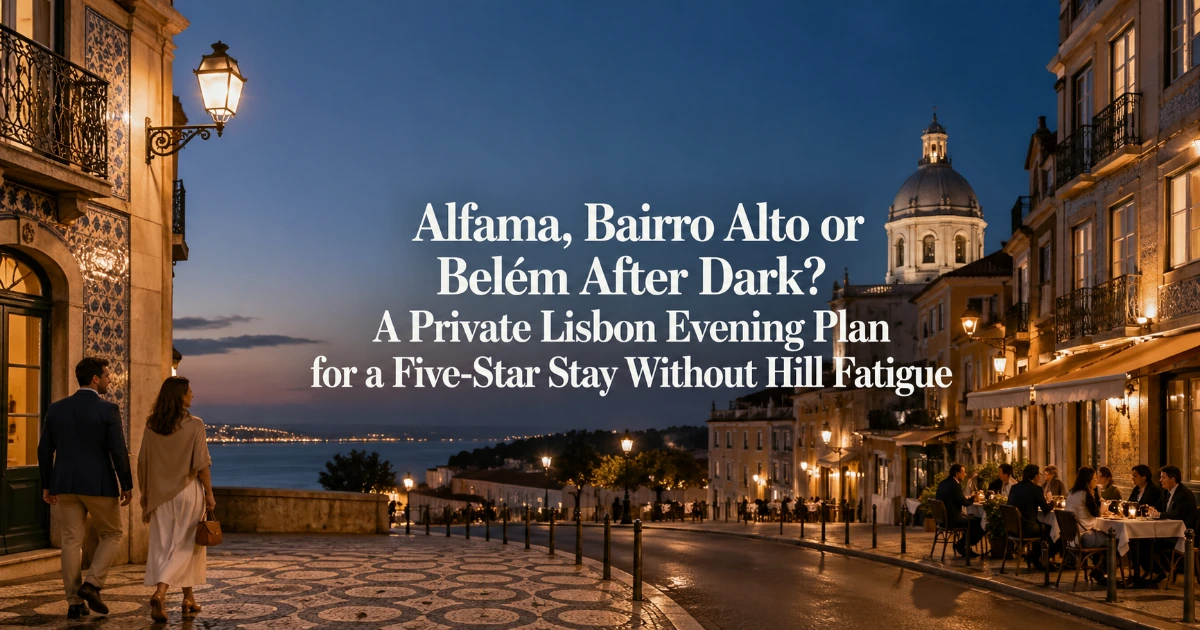
Choose Belém as the safest default for a five-star Lisbon evening after a full private touring day; choose Alfama only when you want a view-led stroll and can begin high at Portas do Sol to a low-stress Alfama descent; choose Bairro Alto when dinner is the evening’s main event and the return to your hotel is already solved. This works because Lisbon after dark is not a flat-city restaurant decision: hills, cobbles, viewpoint edges, and the last transfer back to Avenida da Liberdade change the whole feel of the night. The clearest exception is a first evening when you are fresh, lightly scheduled, and actively want the old-quarter atmosphere before dinner.
In Lisbon after dark, the right neighborhood is not simply the prettiest one; it is the one that turns the last part of the day into a deliberate route instead of a late test of ankles, patience, and group mood. The counterintuitive correction is simple: not every premium Lisbon evening should be spent in the steepest historic quarter. Alfama may be the most evocative, Bairro Alto may sound the most festive, and Belém may look too far west on a map, but after a day that has already included Baixa, Chiado, Jerónimos, Castelo de São Jorge, or a Sintra return, the best evening is often the one with the gentlest exit.
The evening ladder for comfort-first travelers
- 1. Belém, the default winner: best after a hill-heavy day, for couples or families who want river air, a soft walk, dinner without another climb, and a calmer return by car.
- 2. Alfama, the view-led runner-up: best when the route starts high at Portas do Sol, drops slowly through lanes, and ends before the group has to climb again.
- 3. Bairro Alto, the conditional choice: best for a dinner-led night near Chiado, but the wrong fit if the plan depends on wandering steep lanes after everyone is already tired.
The comparison criteria are practical rather than sentimental: walking load, dinner fit, viewpoint payoff, transfer ease, hotel-return risk, and whether the neighborhood improves or flattens the mood after a private touring day. If your day already included substantial climbing, Belém usually wins. If your evening needs a memorable Lisbon view without turning into a second full tour, Alfama can win. If your hotel is near Chiado, Príncipe Real, or Avenida da Liberdade and dinner is the anchor, Bairro Alto can be elegant in a controlled dose; it becomes less rewarding when treated as an open-ended after-dark roam.
For travelers who want a guide-led version of the Alfama and Bairro Alto decision, the most relevant next step is the focused Alfama and Bairro Alto Private Tour. For travelers who know they want the softer western evening, the natural counterpart is Belém and Jerónimos Private Tour. The distinction matters: these are not interchangeable moods with different names. They are different ways of spending the final energy of the day.
Which Lisbon neighborhood is best after dark when you want dinner, views and an easy hotel return?
Belém is best after dark when comfort, conversation, and a smooth return matter more than squeezing one more hilltop into the day. This is the choice for travelers who have already done the visual work of Lisbon during the day and now need the city to feel generous rather than demanding. Belém’s riverfront gives the evening a different texture: wider sightlines, more horizontal movement, and a cleaner separation from the uphill lanes that make Lisbon so beautiful and so tiring. After a daytime route through Alfama or Chiado, that change of surface and scale can feel like the moment the trip exhales.
Alfama is best when the evening is about a viewpoint, old stone, fado atmosphere, and a sense of historic Lisbon, but only if the route is designed downhill. The mistake is starting low near Santa Apolónia or the waterfront and climbing into Alfama after dinner because the map made it look close. The smarter route begins higher, often around Portas do Sol, then lets the evening fall through the district rather than rise against it. The difference is not poetic. It is physical. Downhill cobbles still require attention, but they do not ask the same price from knees, shoes, or a tired group.
Bairro Alto is best when your evening is dinner-led rather than view-led. It suits travelers who want a central meal, a short pre-dinner walk around Chiado or Praça Luís de Camões, and a planned return to a nearby hotel. It is less satisfying as a loose “let’s see what happens” choice for comfort-first visitors, because the district’s energy can feel scattered if no table, route, or end point has been chosen. The real decision is not whether Bairro Alto is interesting. It is whether Bairro Alto back to Avenida da Liberdade is still pleasant after a long day, polished cobbles, and a late meal.
The wrong fit is the evening that tries to combine all three: a Belém sunset, an Alfama viewpoint, and Bairro Alto dinner. That looks ambitious in a planning document and feels oddly inefficient in the street. You spend the night transferring across the city, resetting the group, and asking the last hour to carry too many moods. If the goal is a five-star stay without hill fatigue, the evening should have one main job: riverfront recovery, old-quarter descent, or dinner with a controlled return.
How Lisbon’s hills and cobbles change the evening, not just the walking total
Lisbon’s hills matter more after dark because fatigue, light, footwear, and hotel-return timing all converge at the same moment. During the day, a climb can feel like part of the discovery. In the evening, the same climb can interrupt conversation, slow a family group, or make a couple focus on footing rather than each other. Calçada portuguesa, the patterned stone pavement that gives Lisbon so much of its character, is part of the city’s beauty; it is also the reason the end of the day should not be planned as if every street were a flat hotel corridor.
The body feels Lisbon in layers. First comes the obvious climb from Baixa toward Chiado, Alfama, or Príncipe Real. Then comes the smaller adjustment: uneven stones, narrow pavements, tram edges, kerbs, and the constant awareness that a scenic turn may become a staircase or a slope. Add a daytime private tour, museum floors, photo stops, a late lunch, and perhaps a wine tasting, and the evening becomes less about how many steps you can technically manage and more about how many transitions you can enjoy. The city does not need to be softened beyond recognition; it needs to be sequenced honestly.
The mood changes too. A good Lisbon evening should feel shorter than it is: a view, a meal, a slow walk, and a clean return. A badly sequenced one feels longer than it is: a beautiful viewpoint reached too late, a table that begins after the group has faded, or a hotel return that turns into a search for the least unpleasant uphill option. For couples, the mood-preserving decision is often to choose one neighborhood and let the route breathe. The mood-killing mistake is to keep chasing the “perfect” after-dark Lisbon scene after the day has already delivered enough.
That is why premium private planning earns its value here. It is not about removing walking from Lisbon. It is about choosing the right kind of walking at the right hour, placing the vehicle where it reduces strain rather than interrupting the atmosphere, and deciding in advance which slopes are worth paying attention to. A guide can make Alfama feel gentle by starting high and descending; a chauffeur can make Belém feel like a graceful western reset after a central touring day; a dinner-led Bairro Alto night can be tightened so the group never has to improvise the return when everyone is full and tired.
Alfama after dark: choose it for a view-led stroll, not for a late uphill mission
Alfama is the best evening choice when the route begins with the view and then descends with purpose. The neighborhood’s after-dark appeal is obvious: tile, stone, tight lanes, glimpses of the Tagus, and the sense that Lisbon’s older layers are still close to the surface. But Alfama punishes vague planning more than Belém does. A private evening here should not begin with a low meeting point and a promise to “wander upward.” It should begin with a controlled arrival high enough to make the first moment rewarding, then turn the rest of the evening into a measured descent.
The classic hinge is Portas do Sol. From there, the Tagus, the terracotta roofs, and the slope of Alfama give the group a clear sense of place before the walking begins. A low-stress route might hold the viewpoint, move toward the lanes around São Miguel or Santo Estêvão, then continue gently toward the lower edge near Chafariz de Dentro or back toward the Sé depending on dinner plans. The key is not to chase every lane. It is to keep the direction legible. Once a tired traveler feels that the route is meandering without an end point, the charm starts competing with uncertainty.
This is where private guidance changes the consequence of choosing Alfama. Without a guide, travelers often enter the district through whichever street looks inviting, then discover that scenic turns produce repeated climbs or confusing dead ends. With a guide, the evening can focus on texture and context rather than navigation: why Alfama survived parts of the 1755 earthquake differently from the rebuilt downtown, how small squares connect to parish life, and where to pause without blocking residents or fighting for the same angle as every other visitor. The content matters, but the pacing matters more.
Alfama is also the choice with the strongest old-Lisbon atmosphere for a couple’s evening, yet it is not automatically the most romantic option. Romance in Lisbon is easily ruined by overreach: the wrong shoes, a late climb, an uncertain dinner distance, or the decision to add one more viewpoint after the first good one has already done its job. If the evening is meant to feel intimate, keep Alfama as a contained arc. View first, descent second, dinner or hotel return third. Do not turn it into a scavenger hunt for every photogenic alley.
When should Alfama be avoided? Avoid it after a day that already included Castelo de São Jorge, a long Baixa-Chiado climb, or a Sintra excursion with palace steps and uneven surfaces. Avoid it for guests who need predictable footing or who become frustrated when a beautiful route is physically fussy. Avoid it if the only available dinner plan requires crossing back uphill after the stroll. In those cases, Alfama may still be worth seeing on another day, perhaps through São Jorge Castle and Alfama Private Tour, but it does not need to carry the evening.
Bairro Alto after dark: choose it for a dinner-led night with a controlled return
Bairro Alto works best when the meal is the anchor and the walking around it is deliberately limited. This is the central evening choice for travelers staying near Chiado, Avenida da Liberdade, or Príncipe Real who want the night to revolve around a reservation, not a long sightseeing route. The district’s practical advantage is proximity to central hotels and dining areas; its practical risk is that it can tempt visitors into an open-ended evening when the group would be better served by a clear pre-dinner walk and a clean exit.
Think of Bairro Alto as a dinner neighborhood, not as a full touring substitute for Alfama or Belém. A comfortable sequence might begin around Largo do Chiado or Rua Garrett, pause near Praça Luís de Camões, then edge toward dinner without pushing deep into every lane. If a viewpoint is needed, the Miradouro de São Pedro de Alcântara can make sense before the meal, but it should not become the pretext for extending the route again and again. The goal is to arrive at the table composed, not triumphant.
The return is the deciding factor. Bairro Alto back to Avenida da Liberdade can be simple when planned and irritating when improvised. After dinner, the group may not want to descend to Baixa only to climb or transfer again. A driver placement, a guide-managed route toward a practical pickup point, or a hotel within an easy corridor can make the difference between a polished finish and a night that ends with everyone scanning streets for transport. The luxury here is not more spectacle. It is fewer end-of-night decisions.
This is also where food-and-wine travelers should be honest about priorities. If the table is the reason for the evening, build the route around the table. Do not ask a serious dinner to follow an ambitious hill walk, and do not use a formal reservation as proof that the evening is well planned. A high-end dinner reservation does not fix a badly sequenced hill-heavy evening. It may make the meal memorable, but it cannot restore the conversation after a rushed climb, a windy viewpoint that ran long, or an unclear return route across polished stone.
For formal dining nights near Chiado or Bairro Alto, use direct restaurant information for practical policies rather than relying on summaries; Belcanto’s official PDF (https://belcanto.pt/uploads/Belcanto_FAQ_EN_Abr25.pdf) is an example of the sort of primary source worth checking before you build the evening around one booking. The point is not that every Lisbon evening needs a famous restaurant. The point is that once a meal has strict timing, the neighborhood route must serve the reservation, not compete with it.
Bairro Alto is the wrong fit for families who need space, travelers who dislike dense evening streets, or couples hoping for quiet continuity after a long day. It can be excellent for a celebration dinner, but only when the evening has boundaries: one approach, one meal, one return. If the plan says “we’ll see where the night takes us,” that is usually a sign to move the evening west to Belém or reshape it as a shorter Chiado-led dinner walk through Lisbon Food Private Tour planning rather than an unstructured after-dark route.
When Belém is better as a soft evening than a packed daytime add-on
Belém is often better in the evening when the day has already asked too much of your legs. Many first-time Lisbon plans treat Belém as a daytime checklist: Jerónimos, Belém Tower, Monument to the Discoveries, Pastéis de Belém, a museum if time allows, then back across the city for more hills. That can work when the day is built around Belém from the beginning. It becomes less persuasive when Belém is squeezed between central sights and dinner. For comfort-first travelers, the more elegant move is sometimes to let Belém become the soft evening: riverfront air, horizontal walking, and a western reset after the steep historic center.
The Belém riverfront after a daytime hill-heavy route changes the body’s relationship to Lisbon. The eye still gets landmarks: the Tagus, the 25 de Abril Bridge in the distance, the line of the river, the profile of the Padrão dos Descobrimentos, and the broad setting around Jerónimos. But the legs are not being asked to keep solving slopes. The group can walk in a straighter rhythm, pause without blocking a narrow lane, and let the evening feel open rather than compressed. After Alfama or Chiado, that openness is not bland; it is relief with a view.
Belém also suits the traveler who wants Lisbon to feel premium without feeling overmanaged. A car can place you near the riverfront, the route can hold one or two visual anchors, and dinner can be arranged either in the area or back closer to the hotel depending on appetite and timing. The transfer west is not wasted if it prevents the evening from becoming a second hill session. In a private plan, the drive itself can become part of the reset: leaving the dense center, following the river, and returning only when the group is ready.
The exception is the traveler who has not yet felt historic Lisbon. If this is your only evening and your daytime route was mostly museums, shopping, or arrival recovery, Belém may feel too gentle as the first after-dark impression. In that case, choose Alfama with a guide and a descent plan. But if the day already included narrow lanes, viewpoints, or monastery floors, Belém gives you a different Lisbon rather than more of the same. It is the best choice when the evening’s job is to keep the trip feeling spacious.
Belém is especially strong for families, older parents, and couples who have a celebration dinner later in the trip. It avoids the end-of-day negotiation that happens when one person wants one more viewpoint and another wants to sit down. It also works when the hotel is on Avenida da Liberdade and the group would rather return by car than thread through the city on tired feet. In those conditions, premium spend is useful if it buys better sequencing, a smoother vehicle plan, and a guide who knows when not to add one more stop.
How to sequence a private Lisbon evening without hill fatigue
The best Lisbon evening sequence starts by deciding what the night is for, then removing the neighborhood that asks the wrong kind of energy. If the goal is a relaxed dinner-led night, cut the viewpoint chase and choose Bairro Alto or Chiado with a planned return. If the goal is a view-led stroll, choose Alfama and begin high. If the goal is an elegant decompression after a demanding day, choose Belém and let the riverfront carry the mood. The mistake is beginning with a list of attractive neighborhoods instead of the energy you actually have left.
For a first-time couple after a central touring day, the most reliable sequence is hotel pause, Belém riverfront, dinner, return. The hotel pause matters because Lisbon days often include more surface variation than travelers expect. Even twenty minutes to change shoes, drink water, and decide whether dinner should be early or later can make the evening feel chosen rather than endured. Belém then gives the night a broad opening. Dinner can happen west or back near the hotel, but the route should not require the group to climb again after the meal.
For travelers who specifically want Alfama, reverse the instinct to “save the view for later.” Put the view first. Arrive near Portas do Sol while the group still has attention, then descend. A private guide can shape the route so the story follows the slope: viewpoint, neighborhood texture, a small square, a lower exit, then dinner or pickup. This is the route that makes Alfama feel graceful. Starting low and earning the view at the end may sound satisfying, but after a full day it often creates the wrong emotional finish.
For a dinner-led Bairro Alto night, keep the pre-dinner route shorter than you think. Begin near Chiado, use the area around Largo do Chiado and Praça Luís de Camões as the social warm-up, then go to the table. If you add São Pedro de Alcântara, do it before dinner and decide the return plan before you sit down. This is where a chauffeur can be worth it, not because Lisbon is impossible without one, but because the final transfer is when many otherwise careful evenings lose polish. For a broader look at when cars are worth the spend in this city, see the comfort-first Lisbon chauffeur guide.
The cut-first rule is firm: cut the second hilltop before you cut dinner quality, conversation, or the hotel return. One Lisbon viewpoint at the right time is memorable. Two viewpoints after a long touring day can turn the evening into a logistics exercise. If you are trying to add Portas do Sol, São Pedro de Alcântara, and a late Bairro Alto dinner, remove one. If the group is staying on Avenida da Liberdade, do not force a late uphill return because the map says the distance is short. Lisbon’s short distances often hide vertical work.
Private planning can turn Lisbon’s hills from friction into a deliberate, gentle route. It can also stop you from spending money in the wrong place. Spend on a guide when the neighborhood is dense, sloped, or context-rich. Spend on a chauffeur when the evening includes a cross-city move, an older guest, formal footwear, or a late return. Spend on dinner when the meal is genuinely the reason for the night. Do not spend on another transfer, another view, or another add-on just because the evening still has empty space. Empty space is often the luxury Lisbon needed you to leave.
If you want Orange Donut Tours to shape the evening around your hotel, dinner timing, energy level, and the hills you do or do not want to take on, Inquire now. A custom plan can combine a guide, a chauffeur, or a lighter self-led finish without making the night feel like a second full sightseeing day.
The hotel base changes the answer more than most travelers expect
Your hotel base can flip the evening choice because Lisbon’s last mile is part of the experience. A traveler staying on Avenida da Liberdade can enjoy all three neighborhoods, but the return logic differs. Belém usually means a clean chauffeured return along the western corridor. Alfama needs a planned descent and pickup or a carefully chosen dinner endpoint. Bairro Alto can be closest in spirit and distance, yet still awkward if the route ends on the wrong side of the hill or the group has to descend and climb again after dinner.
Chiado-based travelers have the easiest dinner-led option because Bairro Alto and central dining sit nearby, but that does not mean Bairro Alto should automatically win. If the day was steep, Chiado’s convenience is useful for dinner, not necessarily for wandering. If the day was gentle, an Alfama descent may give the evening more sense of place. If the day was dense or hot, Belém may be the better way to keep the final hours calm. For a broader hotel-base comparison, the adjacent planning guide on Chiado, Avenida da Liberdade or Príncipe Real is the more complete place to solve the stay question; this article is only solving the evening routing question.
Príncipe Real can make Bairro Alto tempting because it is nearby, but proximity can be deceptive. The area is elegant for a pre-dinner drift, especially if shopping, gardens, or a quieter afternoon already placed you there. But after dinner, even a short return can feel longer if the route crosses uneven stone, traffic edges, or a slope no one wants to discuss out loud. Couples often underestimate this because the distance looks romantic before dinner and merely practical afterward. The premium move is to decide the ending while everyone is still fresh.
Waterfront or Baixa hotels change the calculation again. From Baixa, Alfama looks close, but close is not the same as gentle. A route from the lower grid toward Alfama can become uphill very quickly. Belém may look farther but feel smoother if there is a car and a riverfront plan. Bairro Alto may be manageable if dinner is central, but it should not be followed by a vague uphill wander. The hotel base is not just where you sleep. At night, it is the place every decision eventually has to return to.
The upgrade that actually changes the night
The most valuable upgrade is not always the most expensive dinner; it is the route design that prevents the evening from fraying. In Lisbon, premium spend earns its keep when it reduces the wrong kind of effort. A private guide in Alfama prevents navigation from consuming the night. A chauffeur for Belém turns a westward transfer into a calm reset rather than a negotiation. A carefully timed food plan around Chiado or Bairro Alto lets dinner feel like the center of the evening instead of a reward for surviving too much walking.
Where premium spend does not help: it does not make a poorly chosen neighborhood fit a tired group. If the day included Sintra, Castelo de São Jorge, and a late lunch, paying more for a famous dinner near a steep district will not make everyone want a long after-dark stroll. If a traveler needs secure footing, a higher room category will not change the texture of Alfama’s lanes. If a family has already reached its limit, a more ambitious guide cannot create fresh attention by adding more stops. The best luxury decision is often subtraction.
A chauffeured element is particularly useful when the evening crosses from the historic center to Belém, or when guests are dressed for dinner and do not want the night defined by shoes. It is less useful if the whole plan sits comfortably around Chiado and the hotel is nearby. The same restraint applies to guiding. Hire a guide for Alfama when context and routing matter. Use a lighter, host-style plan for Bairro Alto when the main need is sequencing around dinner. Use a chauffeur-led structure when the night’s comfort depends on the final pickup. The relevant service is not the grandest one; it is the one that removes the actual friction.
For travelers designing a full private stay, Tailor-Made Private Tours of Lisbon is the better next step than forcing an off-the-shelf evening. A couple celebrating an anniversary, a family traveling with older parents, and a food-and-wine pair with a formal dinner all need different pacing. The city is the same. The comfortable route is not.
Final verdict: the evening should spend the energy you actually have left
Choose Belém for the softest five-star evening, Alfama for a controlled view-led descent, and Bairro Alto for a dinner-led night with a planned return. That is the narrow answer. The broader discipline is to stop treating Lisbon after dark as a chance to rescue everything you did not fit into the day. The city will always offer another miradouro, another lane, another district, and another reason to keep moving. Premium travel judgment means knowing which of those reasons improves the night and which one only adds strain.
For comfort-first travelers, the most reliable pattern is to let the evening contrast with the day. If the day was vertical, go horizontal in Belém. If the day was gentle, use Alfama for atmosphere. If the day was food-focused, keep Bairro Alto or Chiado tight and let the table carry the evening. If the hotel is on Avenida da Liberdade, take the return route seriously before you commit to the neighborhood. A beautiful Lisbon night is not the one with the most districts. It is the one that ends as well as it begins.
FAQ
Is Alfama, Bairro Alto or Belém best after dark for a first trip to Lisbon?
Belém is the best default after a full first-time touring day because it gives you riverfront air, easier movement, and a smoother hotel return. Alfama is better if you still have energy and want a view-led historic stroll. Bairro Alto is better when dinner is the main purpose of the evening.
Is Alfama too steep for an evening walk?
Alfama can be too steep if you start low and climb after dinner. It works much better when you begin high near Portas do Sol and descend through the neighborhood with a clear end point.
Is Bairro Alto a good choice for a luxury Lisbon evening?
Bairro Alto can be a good luxury evening choice when it is dinner-led, bounded, and close to your hotel or pickup point. It is a weaker choice if the plan depends on extended wandering after a long day.
When is Belém better in the evening than during the day?
Belém is better in the evening when your daytime plan has already included hills, cobbles, or dense central neighborhoods. The riverfront gives the group a calmer finish and avoids turning Belém into a rushed daytime checklist.
Should couples choose Alfama or Belém after dark?
Couples should choose Alfama when they want atmosphere, a viewpoint, and a short guided descent. They should choose Belém when they want a calmer, more spacious evening after a demanding day.
Does a chauffeur make sense for a Lisbon evening?
A chauffeur makes sense when the evening crosses from the historic center to Belém, includes formal footwear, involves older guests, or requires a reliable late return. It is less necessary when dinner and hotel are both comfortably within the same central area.
What should I cut first if my Lisbon evening plan feels too full?
Cut the second viewpoint first. One well-timed view plus dinner and an easy return will usually feel better than multiple hilltop stops squeezed into the end of the day.
Can I combine Alfama and Bairro Alto in one evening?
You can combine them only if the route is short, guided, and built around one clear dinner or pickup point. For most comfort-focused evenings, it is better to choose either Alfama for the view-led descent or Bairro Alto for dinner.
If you’re interested in any private tours of Lisbon, please reach out to us.


 So if you are looking for the absolute best in Lisbon & surroundings with authentic local fully-licensed native guides whose English you can actually understand and with an exclusive and amazingly fun itinerary













