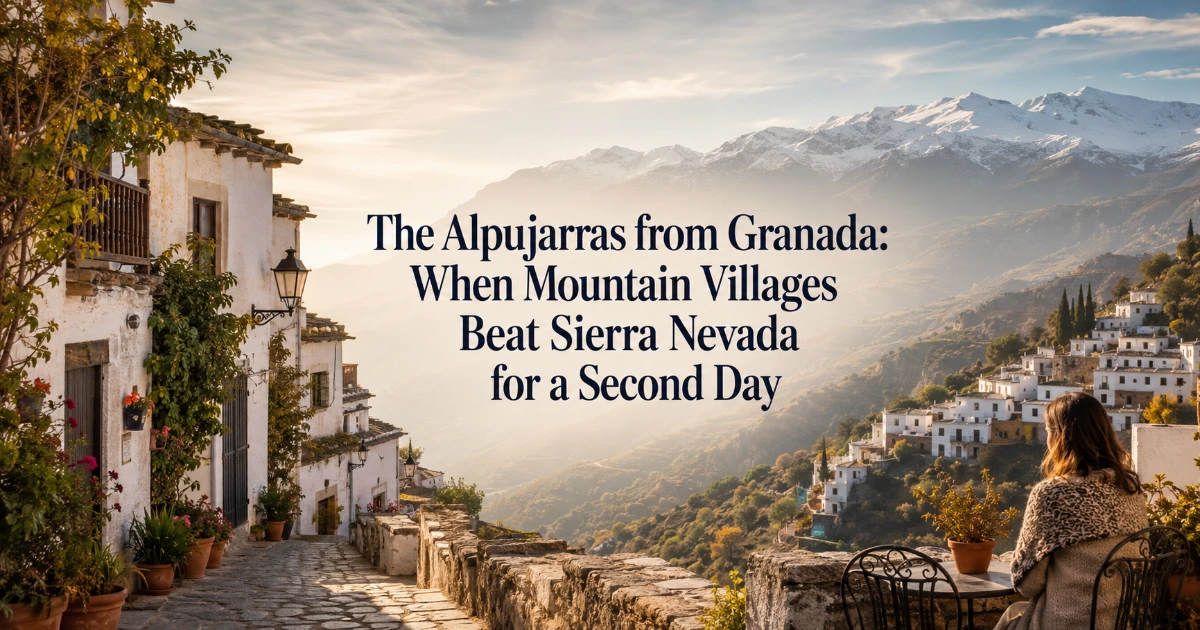
The Alpujarras from Granada: When Mountain Villages Beat Sierra Nevada for a Second Day
Updated
The Alpujarras beat Sierra Nevada for a second day from Granada when you want mountain air with village texture, a serious lunch, and a calmer human scale after the Alhambra. That verdict works because Granada already asks a lot of the body: timed Nasrid Palaces access, steep Realejo and Albayzín edges, taxi-dependent lanes, and evenings that are better when nobody returns flattened. The clearest exception is simple: choose Sierra Nevada instead when the point of the day is high-mountain scale itself, especially if your group wants snow, big views, altitude, or a more elemental landscape rather than village culture.
This is not a guide to ranking villages, packing in viewpoints, or turning the Alpujarras into a hiking plan. The narrow question is whether a second Granada day should leave the city for mountain villages or for Sierra Nevada. Our editorial answer is that the Alpujarras are often the better second-day choice for couples, families, repeat visitors, food-and-wine travelers, and comfort-first guests who want the day to feel lived in rather than merely scenic. The route begins before the mountains: a hotel pickup around Realejo or the Cathedral quarter that avoids the Plaza Nueva pinch and the Darro-side foot traffic can change the whole morning’s mood.
Alpujarras or Sierra Nevada from Granada for a second day?
Choose the Alpujarras when your second day needs conversation, lunch, village craft, and a softer landing back in Granada; choose Sierra Nevada when you want dramatic mountain scale and are willing to let the landscape, not village life, carry the day. The two choices are not different versions of the same excursion. The Alpujarras are a cultural mountain day. Sierra Nevada is a high-mountain day. That distinction matters after the Alhambra because the previous day has probably been controlled by ticket timing, palace pacing, uphill approaches, and a lot of looking carefully at detail.
- Choose the Alpujarras if you want white villages, mountain lunch, gentle browsing, domestic architecture, artisan texture, and a day that can flex around grandparents, children, or a celebration meal.
- Choose Sierra Nevada if your group wants altitude, snow-season atmosphere, open mountain roads, big horizons, or a shorter mountain escape with less emphasis on lunch and village wandering.
- Keep the day in Granada if your Alhambra slot is late, your first day was physically heavy, your group has not yet seen the Albayzín or Realejo properly, or dinner is the anchor event of the trip.
- Cut first the idea that every named village must be included. The Alpujarras are diluted by stop-counting faster than almost any Granada day trip.
The counterintuitive correction is that the more famous mountain scale is not automatically the more rewarding premium day. Sierra Nevada can be magnificent, but if nobody in the group has a reason to be at altitude, the day may become a scenic transfer with a brief payoff. The Alpujarras can turn the same appetite for air into architecture, food, light, craft, and village-to-village pacing that feels purposeful. For a broader comparison of day trips outside the city, see private day trips outside Granada; for the specific high-mountain option, compare it with a Sierra Nevada Mountains Private Tour.
The real planning hinge is not whether the mountains are beautiful. Both are. The hinge is what kind of second day your Granada stay needs. After the Alhambra, many travelers do not need another monumental target. They need a day that changes texture without demanding another timed interior, another queue, or another steep old-town climb. That is where the Alpujarras often win: the day is organized around rhythm rather than conquest.
Why mountain villages can beat high mountain after the Alhambra
The Alpujarras work especially well after the Alhambra because they change the scale of attention. The Alhambra asks you to absorb dynasty, geometry, water, gardens, military edge, and timed access in one concentrated visit. The Alpujarras ask you to notice how houses meet a slope, how a lane narrows under a tinao, how lunch slows the day, and how a village square changes when the coach-tour pulse passes through. That contrast is more restful than it sounds, because the mind moves from monument-reading to place-reading.
Granada does something specific to the body. A good Alhambra day can still involve uphill approaches, stone underfoot, long standing, security pauses, palace interiors, garden distances, and the extra mental pressure of being on time for the Nasrid Palaces. If your hotel is in the lower Realejo, Centro, or near the Cathedral, the return can feel easy; if your evening then pulls you toward the Albayzín, Sacromonte, or the Carrera del Darro, the city starts adding slopes and river-edge bottlenecks just when everyone is supposed to be relaxed. The next day should not automatically add another physically demanding target.
That is why the Alpujarras often beat a high Sierra Nevada day for comfort-first travelers. The mountains are still there, but the stops are smaller, the interpretation is more intimate, and the day can build toward lunch rather than a summit-feeling endpoint. You are not asking the group to admire scale for hours. You are giving them changes of scene that are close enough to understand: Lanjarón as the first mountain threshold, Órgiva as a route hinge, and the Barranco de Poqueira as the village landscape where Pampaneira, Bubión, and Capileira make sense together rather than as a checklist.
There is a mood consequence, too. A second day that returns from the Alpujarras at a civilized pace can leave the evening in Granada intact: a short hotel pause, a drink near Realejo, tapas without a forced march, or a dinner you actually enjoy. A day that is treated as a mountain achievement can flatten the evening; people return with photos, but not enough appetite or patience for the city’s late rhythm. The better choice is the one that lets Granada still feel good at night.
For Alhambra-dependent planning, always confirm your ticket logic through the official Alhambra ticket site (https://tickets.alhambra-patronato.es/en/), because the second day is partly shaped by what the first day demanded. If your first day was a late Nasrid Palaces slot plus Generalife plus an Albayzín dinner, the Alpujarras should be slow and selective. If your first day was a short, well-paced morning at the Alhambra and an easy afternoon, Sierra Nevada may still have enough space in the trip.
The route should be a mountain conversation, not a village collection
The best Alpujarras day from Granada is built around village-to-village pacing, not village accumulation. This is the mistake that turns a promising day into a blur: Lanjarón, Órgiva, Pampaneira, Bubión, Capileira, maybe Trevélez, maybe another viewpoint, maybe one more shop. On paper it looks generous. In the car, it becomes repeated arrivals, short walks, shallow context, and lunch that gets pushed into the tired part of the day.
Village-to-village pacing means each stop has a job. One stop can introduce the architecture: flat roofs, white walls, steep lanes, tinaos, and the way houses seem to brace themselves against the mountain. One stop can give the group time to browse textiles, ceramics, food products, or small workshops without making shopping the whole purpose. One stop can carry lunch. One stop can give the view back into the ravine. The day becomes coherent because every stop changes the conversation rather than repeating it.
Pampaneira is a useful anchor because it is accessible, recognizably Alpujarra in texture, and officially framed by its own tourism office as part of the Barranco del Poqueira on the southern slope of Sierra Nevada, with traditional features such as tinaos, launa roofs, and capped chimneys; the Pampaneira Turismo (https://turismo.pampaneira.es/en/) page is a good direct reference for that architectural vocabulary. The point is not that Pampaneira is “best.” The point is that a first village should be legible enough to teach the eye what to notice.
From there, Bubión and Capileira should not be treated as automatic trophies. They can deepen the day if your group has the appetite for another short climb, a quieter lane, a view over the Poqueira ravine, or a more settled lunch. They can weaken the day if everyone is already warm, hungry, or starting to compare every white street with the previous one. A private route earns its value by knowing when a village adds meaning and when it merely adds a receipt of attendance.
Lanjarón and Órgiva also matter, but not in the same way. Lanjarón is often experienced as the threshold into the Alpujarras rather than the emotional center of the day. Órgiva is a practical route hinge, useful for orientation and sometimes for a pause, but it should not be allowed to consume the village time that belongs higher up. Naming those places is not about creating another list; it is about understanding why the day should not be sold as “as many villages as possible.”
The stop to be most careful with is the farthest “just one more” add-on. Trevélez has a strong mountain identity and can be meaningful in the right plan, especially for travelers with a specific food interest or a longer day in mind. But making it automatic often stretches the route past the point where lunch, conversation, and return comfort still feel elegant. The Alpujarras are not improved by exhausting the map.
Who should choose the Alpujarras from Granada?
The Alpujarras suit travelers who want the second day to feel slower, more textured, and more personal than another major sightseeing push. This is the better choice for repeat visitors who have already done the classic Granada essentials, for first-time visitors whose Alhambra day was intense, and for groups that include different energy levels. It is also the better mountain choice when lunch is part of the point rather than an interruption.
- Couples should choose the Alpujarras when they want a day with enough structure to feel curated, but enough air to talk, wander, pause, and let lunch become the center of gravity.
- Families should choose the Alpujarras when children or teenagers need shorter bursts of attention, not a long lecture day. The villages provide texture without requiring everyone to admire one vast landscape for too long.
- Older parents or multigenerational groups should choose the Alpujarras when the route can be shaped around shorter walks, careful drop-offs, shaded pauses, and a lunch stop that prevents the day from becoming endurance travel.
- Food-and-wine travelers should choose the Alpujarras when they want a mountain meal with place-sense, then a lighter Granada evening rather than two formal meals competing with each other.
- Celebration travelers should choose the Alpujarras when the day needs to feel intimate and unforced: a birthday lunch, an anniversary route, or a small-group escape that does not ask everyone to perform enthusiasm at every viewpoint.
The Alpujarras also suit travelers who like cultural texture but not over-explanation. A good guide can connect the mountain villages to Granada’s wider story without turning the day into a lecture: settlement patterns, water, the afterlife of Nasrid Granada, the practical intelligence of building on slopes, and the difference between looking at a white village and understanding how it works. That is a very different intellectual pleasure from looking up at Sierra Nevada from the city and deciding to chase the snowline.
The wrong Alpujarras traveler is the one who secretly wants a hiking day, a peak day, or a dramatic mountain-road day and is using villages as a polite compromise. The Alpujarras can include short walks, but this article is not a hiking guide, and the best private village day should not depend on trail ambition. If your group measures success by altitude, silence, snow, or the sense of being above the city, Sierra Nevada is the more honest answer.
Another wrong fit is the traveler who wants a village ranking. Pampaneira, Bubión, Capileira, Lanjarón, Órgiva, and Trevélez are not contestants in a beauty pageant for this purpose. The planning question is not “Which village is prettiest?” It is “Which sequence lets the day breathe, lunch land well, and Granada still feel good when we return?” That is the question a private route should answer.
Who should choose Sierra Nevada instead?
Choose Sierra Nevada instead when the mountain itself is the destination, not the villages. The high-mountain day is stronger for travelers who want open scale, snow-season atmosphere, exposed views, sharper air, and a clearer break from city texture. It is also the better fit when the group wants fewer cultural stops and more landscape, or when there is a specific seasonal reason to be in the mountains.
Sierra Nevada is not a lesser choice; it is a narrower one. The official Spanish tourism page frames Sierra Nevada National Park (https://www.spain.info/en/nature/sierra-nevada-national-park/) as a protected mountain landscape in the provinces of Granada and Almería, and that scale is the point. The traveler consequence is that the day feels more elemental and less socially textured. There is less need to discuss which village comes next; there is more need to decide how much mountain exposure, vehicle time, and weather contingency your group actually wants.
Pradollano, the ski-area base, can be useful when winter logistics or snow atmosphere are part of the goal, but it is not automatically the most interesting choice for a non-skiing second day. That is another counterintuitive planning point: the obvious high-mountain base may make the day feel more like an infrastructure visit if the group is not skiing, walking with purpose, or deeply motivated by altitude. In that case, the Alpujarras may offer more varied returns for the same emotional need to leave the city.
Sierra Nevada also makes sense when the Granada stay is short and the group wants a mountain impression without spending the whole middle of the day in villages. A carefully kept Sierra Nevada route can be cleaner than a rushed Alpujarras route. If you are not going to give the Alpujarras enough time for lunch and real stops, do not force them. A compressed village day is worse than a focused mountain drive.
For travelers already leaning toward the high-mountain option, our existing Sierra Nevada guide gives a more specific frame for keeping that day from becoming overplanned: read the Sierra Nevada reset guide. The distinction here is that Sierra Nevada wins on scale, while the Alpujarras win on human texture. Neither should borrow the other’s logic.
How village-to-village pacing affects lunch
In the Alpujarras, lunch should be treated as the hinge of the day, not as a break between villages. This is where many routes lose their polish. If the morning tries to “cover” too many stops, lunch drifts late, the best table becomes whatever is available, and the afternoon turns into a warm, sleepy return with one guilty final stop. A better plan lets lunch decide the route’s shape before the day begins.
That does not mean the day has to be formal. In fact, the Alpujarras often work best when lunch is relaxed, local in feeling, and long enough to make the trip feel different from a city day. The point is to avoid the false luxury of endless options. A mountain lunch that is chosen for setting, pacing, group comfort, and return logic will usually beat a more ambitious lunch that forces the route to stretch. The best lunch is the one that makes the afternoon calmer, not the one that looks most impressive in isolation.
For food-and-wine travelers, the decision is especially important. If lunch in the Alpujarras is the day’s real meal, dinner in Granada should probably be lighter, later, and close to the hotel. If dinner is the important reservation, the mountain lunch should be shorter and simpler. Travelers building the trip around a serious Granada dining evening can use the MICHELIN Guide selection (https://guide.michelin.com/us/en/andalucia/granada/restaurants) as a narrow reference point for the city’s fine-dining landscape, then decide whether the mountain day should return earlier.
Village pacing also affects what people remember. A rushed route produces fragments: a fountain, a street, a shop, a view, a car door, another bend in the road. A lunch-centered route produces a story: the climb out of Granada, the first white village, the architectural vocabulary, a table, a slower conversation, a last view, and a return that does not punish the evening. The difference is not abstract. It shows up in appetite, patience, and whether anyone wants to leave the hotel again.
There is one firm rule: do not add a far village after lunch just because it is famous. The post-lunch add-on is where many comfort-first mountain days lose their grace. If the route has already taught the group how the Alpujarras work, one more stop often adds less than a clean descent back toward Granada. The cut-first move is to remove the least purposeful village, not to shorten lunch.
What a better-routed private mountain day actually buys
A private driver-guide changes the Alpujarras day by choosing the right mountain scale, controlling stop discipline, and protecting the return, not by making the route longer. The value is not simply door-to-door comfort. It is judgment: whether this group should go village-first or view-first, whether lunch belongs higher in the Poqueira villages or lower on the route, whether a short browse is enough, and whether the day should turn back before the last possible stop.
A private driver does not make too many mountain villages feel meaningful. That sentence matters because premium spend can create a false sense that overpacking is now safe. It is not. More comfort helps with the transfer, drop-offs, flexible timing, and the ability to adjust for heat, appetite, mobility, or a child’s attention span. It does not turn repetitive stops into depth. If the plan is poorly chosen, a better vehicle simply delivers you more smoothly to the wrong rhythm.
Where the spend does earn its cost is in small decisions that travelers rarely notice until they go wrong. A guide can prevent the day from beginning with a long walk across Granada’s old-town edges before the drive has even started. A driver can reduce the friction of steep village approaches and avoid asking older parents to climb back to a remote parking point. A planner can choose a lunch arc that does not collide with a dinner reservation, or adjust when the group’s energy changes. Those are not cosmetic upgrades. They are the mechanics of a day that still feels good at 7 p.m.
The same logic applies to Sierra Nevada. A private day helps most when it clarifies whether you are going for snow atmosphere, high views, a mountain lunch, or a short escape from the city. Without that clarity, the route can become an expensive drive into a broad landscape that nobody knows how to use. With clarity, it can be spare and memorable. This is why the first question should not be “Which mountains?” but “What kind of mountain day will make the rest of Granada better?”
If you want the mountain day designed around your group’s energy, lunch rhythm, hotel location, and the right level of altitude or village texture, Orange Donut Tours can shape it as part of tailor-made private tours of Granada. For a planning handoff that starts with the right mountain scale rather than a village checklist, Inquire now.
When neither mountain day belongs and Granada should keep the second day
Neither the Alpujarras nor Sierra Nevada belongs in the plan when Granada itself has not yet been given enough room. This happens more often than travelers expect. The Alhambra takes the headline, then the itinerary tries to escape to the mountains before the city has had a proper second act. If you have not yet walked the lower Realejo with context, seen the Cathedral and Royal Chapel area at a civilized pace, or looked across to the Alhambra from the Albayzín without rushing up and down slopes, the second day may belong inside Granada.
The city-stay version is not a consolation prize. It can be the smarter plan when the first day involved a late arrival, a demanding Alhambra slot, or an evening that crossed the Darro toward the Albayzín and back. Granada’s old-town geography is compact on a map but not neutral underfoot. The climb toward San Nicolás, the lanes above Carrera del Darro, the Realejo slopes below the Alhambra woods, and the taxi logic around restricted or narrow streets all add friction. A second city day can reduce that friction rather than exporting it to the mountains.
Keep the day in Granada when dinner is the emotional anchor. Celebration travelers often underestimate how much a mountain return can affect a serious evening. If the night is built around a tasting menu, a special tapas route, a hammam, flamenco context, or a family gathering, the day should probably stay lower, shorter, and closer to the hotel. The correct luxury move may be not to leave at all.
Keep the day in Granada when your group includes someone who found the Alhambra beautiful but physically demanding. That does not only mean older travelers. Children, teenagers, pregnant travelers, anyone recovering from a long transfer, and anyone who dislikes repeated car exits can all feel the cost of a mountain day. A second day around the Cathedral quarter, Realejo, a carefully limited Albayzín viewpoint, or gardens can produce more pleasure with less resistance.
For travelers still arranging the Alhambra around the rest of the stay, the better first planning step is how to plan Granada around the Alhambra. If that guide reveals that the city already needs another half day, do not force the mountains. A well-paced Granada second day will beat a rushed Alpujarras day and a vague Sierra Nevada day.
A second-day shape that avoids overpacking
The cleanest Alpujarras day has three movements: leave Granada without adding city friction, spend the middle of the day in a limited village arc, and return before the evening is lost. This shape is deliberately restrained. It gives the guide enough room to explain the landscape, the driver enough flexibility to manage village approaches, and the group enough time to feel that lunch belongs to the day rather than interrupts it.
The village-culture version
This is the best Alpujarras version for most repeat visitors and culture-minded couples. The route uses Lanjarón and Órgiva as orientation rather than as long stops, then gives the real attention to the Poqueira villages. The guide’s job is to make the architecture legible: why the rooflines look the way they do, how streets manage slope and shade, why the village feels both Andalusian and distinct from Granada, and why one well-read village can be more satisfying than three shallow stops.
The main cut is the distant add-on. Once the group has understood the village architecture, browsed a little, and eaten well, the day should not chase another name. The mood to protect is the feeling that the mountains gave the trip oxygen. That feeling disappears when the afternoon turns into “just one more.”
The family or multigenerational version
This version should be built around short walks, clear meeting points, snack logic, and a lunch that arrives before patience collapses. The Alpujarras are better than Sierra Nevada for many families because the day breaks naturally into smaller chapters. Children do not have to stare at scenery for hours; older parents do not have to commit to a long walk to justify the drive; teenagers can browse, photograph, or simply enjoy a village that feels different from the city.
The main cut is excessive explanation. A private guide should not unload every historical thread at the first stop. Context should arrive in pieces: Granada’s relationship to the mountains, the village fabric, the food, the return view. With mixed ages, the best route is not the one with the most facts. It is the one that prevents anyone from becoming the reason the day slows down.
The celebration-lunch version
This version makes lunch the emotional center. It suits anniversaries, birthdays, small groups of friends, and travelers whose Granada stay is as much about meals and mood as monuments. The morning should be scenic but not overactive, the lunch should have enough time to feel like an occasion, and the return should be clean enough that the evening can stay light.
The main cut is a formal dinner that competes with the mountain meal. Two big meals can sound indulgent and feel punishing. A better celebration day may be mountain lunch, hotel pause, and a gentle Granada evening in Realejo or near the Cathedral quarter. The day should end with people still liking the trip, not negotiating who is too tired to go back out.
The final call: let the second day answer what the first day used up
The Alpujarras beat Sierra Nevada when the Alhambra has used up your appetite for monumentality and your group needs a day with air, lunch, domestic scale, and human texture. Sierra Nevada beats the Alpujarras when the group wants altitude, snow-season atmosphere, open landscape, or a mountain day that is intentionally about scale. Granada beats both when the city itself has not yet had enough space, or when dinner, mobility, or recovery would make a mountain day cost more mood than it returns.
That is the cleanest decision frame. Do not start by asking which mountain is more beautiful. Ask what kind of day will make the whole Granada stay feel better. If the answer is village culture and a lunch-led rhythm, choose the Alpujarras and stop counting villages. If the answer is high mountain, choose Sierra Nevada and keep the route honest. If the answer is recovery, stay in Granada and let the city do the quieter work.
FAQ
Are the Alpujarras worth visiting from Granada for a second day?
Yes, the Alpujarras are worth visiting from Granada when the second day needs village culture, mountain air, a meaningful lunch, and a softer pace after the Alhambra. They are less convincing if you only want dramatic altitude or a hiking-focused day.
Should I choose the Alpujarras or Sierra Nevada after the Alhambra?
Choose the Alpujarras after the Alhambra if you want human scale, food, craft, and village-to-village pacing. Choose Sierra Nevada if the goal is high-mountain scale, snow-season atmosphere, or a more elemental landscape day.
Who should avoid an Alpujarras day trip from Granada?
Avoid the Alpujarras if your group wants a serious hike, a peak-focused mountain day, or a fast scenic drive with minimal stops. Also avoid it if you are unwilling to give lunch and village pacing enough time.
How many Alpujarras villages should a private day include?
A private Alpujarras day should usually include a limited village arc rather than as many villages as possible. One village can teach the architecture, one can support browsing or a view, and one can anchor lunch; beyond that, the day can become repetitive.
Is Sierra Nevada better than the Alpujarras in winter?
Sierra Nevada can be the better winter choice when snow atmosphere or high-mountain landscape is the point of the day. The Alpujarras can still be the better choice when you want village culture, lunch, and a more social rhythm; confirm seasonal logistics when booking.
Can you combine the Alpujarras and Sierra Nevada in one day?
It is usually not a good comfort-first plan to combine the Alpujarras and Sierra Nevada in one day. The two areas answer different travel desires, and combining them often creates a long scenic drive with too little time for either village culture or high-mountain atmosphere.
When should the second day stay in Granada instead?
The second day should stay in Granada when your Alhambra visit was physically demanding, your group has not yet seen the Albayzín or Realejo properly, a special dinner anchors the evening, or the trip needs recovery more than another excursion.
Does a private driver make the Alpujarras day better?
A private driver can make the Alpujarras day smoother by improving hotel pickup, village approaches, lunch timing, and the return to Granada. It does not make an overpacked village checklist more meaningful, so the route still needs disciplined planning.
If you’re interested in any private tours of Granada, please reach out to us.



 So if you are looking for the absolute best in Granada & surroundings with authentic local fully-licensed native guides whose English you can actually understand and with an exclusive and amazingly fun itinerary













