Three Granadas in One Stay: Nasrid Alhambra, Renaissance Centro and Baroque Cartuja

Updated
See Granada in this order: Nasrid Alhambra, Renaissance Centro, then Baroque Cartuja—but give Cartuja a separate second-day chapter rather than forcing all three into one crowded monument day. The order works because the Alhambra establishes how Nasrid power was expressed through thresholds, water, inscription and controlled views; the compressed lower-city geography of the Cathedral-Royal Chapel-Madraza axis then makes the political and architectural transition after 1492 visible within a few paces; and Cartuja supplies a deliberately different Baroque climax. The clearest exception is a one-day first visit, a family with limited interior stamina, or anyone already carrying church fatigue: in those cases, the Alhambra and lower city are enough, and Cartuja should be omitted.
Granada’s most revealing architectural story is not “Islamic beauty followed by Christian monuments.” It is a change in how authority occupies space: inward and courtly at the Nasrid Palaces, public and dynastic in Centro, then intensely theatrical inside Cartuja. That is the thesis that keeps the Alhambra from swallowing the rest of the stay. A well-paced private Alhambra and Generalife tour should therefore be treated as the first chapter of a larger argument, not as the entire argument.
The three Granadas, in planning terms:
- Nasrid Alhambra: power by sequence. Prioritize it for spatial intelligence, court culture and the city’s defining architectural vocabulary.
- Renaissance Centro: power made urban. Use the Royal Chapel, Cathedral and Madraza together to understand conquest, continuity and the construction of a new civic center.
- Baroque Cartuja: faith made sensory. Add it when you have enough time and attention to appreciate a monastic complex whose final rooms transform restraint into calculated visual intensity.
The first counterintuitive correction is important: the lower-city chapter is not uniformly Renaissance. The Royal Chapel is fundamentally late Gothic, the Madraza is Nasrid in origin, and the Cathedral carries the major Renaissance proposition. Their proximity is precisely why Centro works so well after the Alhambra. You are not ticking off three harmonious buildings; you are watching one regime’s institutions, another regime’s burial politics and a new architectural language collide on Calle Oficios and around Plaza de las Pasiegas.
A three-era argument, not a three-monument list
The best version of this stay compares the three eras by four questions: what kind of power each place represents, how the architecture directs the body, how much energy the visit costs, and what the next site adds that the previous one could not. This prevents the day from becoming a blur of carved surfaces, chapels and dates.
At the Alhambra, movement is part of the meaning. You approach, wait, pass through modest or defensive exteriors, enter courts, turn, pause, and discover framed space in stages. In Centro, the opposite tendency becomes legible: royal burial, cathedral scale and civic institutions claim the dense public city. At Cartuja, the decisive movement is from monastic sobriety toward rooms where marble, stucco, painting, sculpture and light converge. The comparison is strongest when each stop is allowed to perform a different job.
Choose the sequence by scenario:
- One full day and a first Granada visit: Alhambra first, then the Cathedral-Royal Chapel-Madraza axis. End there. Cartuja is the cut.
- Two cultural days: Alhambra on day one; Centro and Cartuja on day two, with a real pause between the urban core and the monastery.
- An architecture-led return visit: Keep the Alhambra focused, slow down in Centro, and give Cartuja enough attention to read the transition from austere common rooms to the Sagrario and sacristy.
This is also why a viewpoint is not the automatic “something extra” after the Alhambra. The famous instinct is to cross immediately into the Albayzín for another angle on the palace. That can be beautiful, but it repeats the Alhambra’s visual dominance and adds slope. For travelers trying to understand three Granadas, the lower city is the more productive contrast. The Cathedral-Royal Chapel-Madraza axis is flatter, denser and historically more argumentative than another mirador.
The city makes this decision physical. The Alhambra occupies the Sabika hill; Plaza Nueva and the lower city sit below; Cartuja lies north of the compact center near Paseo de Cartuja and the university campus. These are not three doors on one pedestrian circuit. The hill descent, the close-grained Centro walk and the later transfer to Cartuja each change the body’s rhythm. Treating those changes as part of the design makes the stay feel coherent rather than overfilled.
Nasrid Alhambra: start with a court designed around controlled revelation
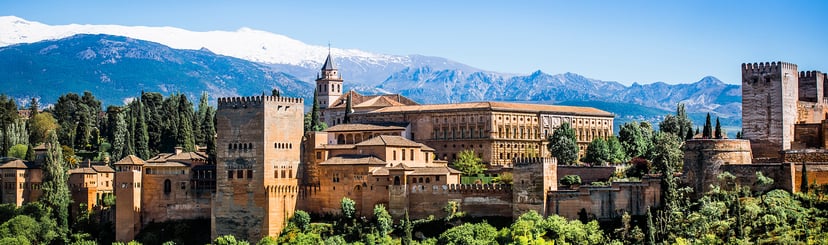
The Alhambra should come first because it gives you the vocabulary against which the other two Granadas become intelligible. The Nasrid complex was not conceived as a single showpiece facade. It was a palatial city, citadel and fortress whose courtly spaces reached their most celebrated development under Yusuf I and Muhammad V in the fourteenth century. The Mexuar, Comares Palace and Palace of the Lions are connected, but each regulates approach, hierarchy and attention differently. The official Patronato’s history of the Alhambra and Generalife (https://www.alhambra-patronato.es/en/discover/alhambra-y-generalife/history) is the appropriate primary source for that broad chronology.
For the traveler, the practical consequence is that rushing damages understanding before it damages sightseeing. The Nasrid Palaces are not improved by collecting more rooms per minute. A guide should help you notice how a plain passage can prepare an ornate court, how water both divides and extends space, how inscriptions operate as architecture rather than caption, and how a view toward the Albaicín is framed as a possession of the court. Those distinctions create memory. Without them, plasterwork becomes a continuous decorative surface.
The Alhambra also consumes more physical attention than its map suggests. There are long internal distances, hard surfaces, standing time, changes of level and the cognitive pressure of a fixed Nasrid Palaces entry. The sensible comfort move is usually to arrive at the hill without spending your best legs on Cuesta de Gomérez. Walking up from Plaza Nueva can be atmospheric, but it is not a prize if it leaves an older parent, a child or a celebration group tired before the palaces. Save the descent for later only when knees, footwear and weather make it a pleasure rather than an obligation.
Do not let the Palace of Charles V persuade you that you have already “done” Renaissance Granada. Its circular court and monumental Romanizing language are a potent intervention inside the conquered citadel, and its location was symbolically charged. Yet it remains an imperial insertion on the Alhambra hill, not a substitute for the post-conquest city below. Centro shows how the new order reorganized burial, worship, civic memory and public scale. The official Alhambra account itself separates the Nasrid development from the sixteenth-century royal works, including Charles V’s palace.
The best exit depends on what follows. If Centro is the same day, avoid turning the descent into a second tour. A direct transfer to a proper break is often wiser than adding every gate, garden and lane between the hill and lunch. If the Alhambra occupies day one of a two-day plan, an easy Realejo return can preserve enough appetite for dinner without demanding another major interpretive chapter. The point is not to finish early; it is to finish with the Nasrid logic still distinct in your mind.
A common mistake is to attach the Albayzín, Sacromonte and Centro to the same Alhambra day because they appear close on a map. The map hides slope and surface. A route from the Alhambra down to Plaza Nueva, up into the Albayzín, across viewpoints and back to Centro repeatedly spends the same reserve of feet and attention. By late afternoon, the Royal Chapel becomes “another interior” and the Cathedral becomes “the big church,” which is exactly the flattening this three-era plan is designed to prevent.
What to see after the Alhambra: Renaissance Centro, not another viewpoint
After the Alhambra, the strongest next chapter is the lower-city axis formed by the Madraza, Royal Chapel and Cathedral. The physical compression is the advantage: within the area around Calle Oficios, Gran Vía de Colón and Plaza de las Pasiegas, the traveler can compare a Nasrid institution, a dynastic funerary foundation and a Renaissance cathedral without a transfer reset. This is one of Granada’s rare moments when historical density also reduces walking friction.
Start with the Madraza as context, even when the visit is brief. Founded under Yusuf I in 1349, it represented learned institutional life in Nasrid Granada. Its later transformations mean that the building is not a pristine medieval time capsule, which is precisely the useful point. The Madraza allows a guide to explain survival, appropriation, alteration and the difficulty of reading a conquered city only through buildings that remained visually “pure.” The University of Granada still identifies the Madrasah Yusufiyya as the medieval foundation in its institutional chronology.
Move next to the Royal Chapel, but do not call it Renaissance simply because it belongs to the post-1492 story. The Catholic Monarchs chose Granada as their burial place in 1504, and the chapel was built in the late Gothic mode between 1505 and 1517. Its sobriety, funerary purpose, royal mausoleums and collection make it a statement about dynastic memory before the Cathedral’s more expansive Renaissance language takes over. The chapel’s official history (https://capillarealgranada.com/en/the-history/) is unusually useful because it explicitly frames the building as both an institution and a political symbol.
Then enter the Cathedral. Here the scale changes from royal burial to metropolitan and imperial ambition. Diego de Siloé’s “Roman” Renaissance project reorganized the earlier conception into a great head and basilican body, with a spatial logic meant to feel ordered, legible and public. The traveler consequence is immediate: after the Alhambra’s oblique thresholds and intimate courts, the Cathedral’s height, repeated supports and luminous central volume feel less like a stylistic label than a different claim about community and authority. Granada Cathedral’s official account describes the building as one of the major works of the Spanish Renaissance and connects Siloé’s plan to both reform and imperial intention.
The sequence can be reversed when current access arrangements require it, but the argument should not be lost. The guide’s task is to keep three distinctions visible: the Madraza is the memory of Nasrid institutional Granada; the Royal Chapel is the Gothic dynastic hinge; the Cathedral is the mature Renaissance proposition. Calling the whole area “Christian Granada” is too coarse. It erases the very transition that makes the lower city worth seeing after the Alhambra.
This is where a Historical City Center private tour can add more than entry handling. The value lies in crossing the few meters between sites without resetting the story. A specialist can point out why the Royal Chapel is attached to, yet architecturally distinct from, the Cathedral; why the Madraza’s position matters; and how the small urban interval around Calle Oficios compresses a much larger political change.
Do not expand Centro indiscriminately. The Alcaicería may add texture, and Corral del Carbón can supply another surviving Nasrid commercial reference, but neither should become a compulsory sub-tour when the group is already carrying the Alhambra. Use them as evidence, not as another checklist. A five-minute exterior explanation that sharpens the contrast is often more valuable than an extra interior that arrives after attention has thinned.
Centro also changes the trip mood in a way a viewpoint does not. The palace hill can feel self-contained and almost suspended above the modern city. Dropping into the market streets, cathedral squares and active lower-city grid restores urban life around the history. Done at a measured pace, that transition makes Granada feel larger and more contemporary. Done without a pause, it feels like leaving one queue for another. Lunch, a seated coffee or a hotel interval is not dead time here; it is the hinge that allows the second era to register.
Why Cartuja is not merely another church
Cartuja earns its place only when you treat it as the Baroque conclusion to the argument, not as a fourth sacred interior after the Royal Chapel and Cathedral. Its significance lies in progression. The monastery’s common spaces preserve an atmosphere of Carthusian austerity; the refectory and chapter rooms establish restraint; the church, Sagrario and sacristy then intensify material, light and movement until the visual language becomes almost total. That controlled escalation is what distinguishes Cartuja from “another church.”
The label “Baroque Cartuja” is useful but incomplete. Construction began in the early sixteenth century and continued over a very long period, so Gothic, Renaissance and Baroque elements coexist. The Baroque is the climax rather than the whole biography. This matters because the traveler should not enter expecting immediate excess. The quieter rooms are not preliminaries to hurry through; they create the contrast that makes the Sagrario and sacristy legible.
In the Sagrario, architecture, sculpture and painting are deliberately fused around the tabernacle; colored marbles, gilding and ascending forms direct the gaze. In the sacristy, white stucco, marbles, carpentry, painting and carefully managed light produce a room whose scale exceeds the practical expectation of a sacristy. Cartuja’s official monument account of the sacristy (https://cartujadegranada.com/el-monumento/la-sacristia/), together with its pages on the Sagrario and common rooms, makes this progression clear.
The on-the-ground complication is geography. Cartuja sits north of the Cathedral quarter, near Paseo de Cartuja and the university campus. It is not the natural final door on the Cathedral-Royal Chapel-Madraza axis. Walking all the way from Centro can be reasonable for a fit traveler who wants the city between monuments, but it is a poor default for a group that has already toured the Alhambra. The transfer should be explicit: taxi or chauffeured pickup, a clear meeting point, and no invented “short stroll” language.
That transfer can either help or harm the day. Used well, it creates a mental gap between Renaissance Centro and the Baroque monastery. Used badly, it becomes dead time followed by one more admission desk. The difference is whether the group has eaten, sat down and understood why it is going north. Cartuja works best when the answer is specific: “We are going to see how a culture of monastic restraint produces one of Granada’s most theatrical interiors.” It works poorly when the answer is simply: “It is famous and nearby enough.”
Cartuja particularly suits architecture-focused couples, art-history travelers, small adult groups and repeat visitors who have already learned how much of Granada lies beyond the Alhambra. It can also work for older travelers when the transfer is direct and the visit remains focused. It is a weak choice for young children after a long palace morning, for guests who describe every sacred interior as interchangeable, or for anyone saving energy for a significant dinner. In those cases, more service does not create more appetite.
The bodily consequence is cumulative rather than dramatic. The Alhambra has already asked for distance, hard paving and concentration. Centro adds standing and close interior attention. Cartuja then demands another arrival, another orientation and another dense visual field. Add the Albayzín or Sacromonte afterward and the city begins to work against the traveler: more climbing, more uneven footing and a late return just when the group should be recovering. The body does not experience “three eras”; it experiences hours on its feet unless the plan inserts real stops.
The mood consequence is equally important. Cartuja should feel like a crescendo, not punishment. When it follows a calm interval, the transition from white stucco to colored marble and gilded movement can be exhilarating. When it follows an overlong lunch, rushed transfer and anxiety about dinner, even extraordinary rooms flatten into ornament. Travelers then remember that the day was “a lot of churches,” which is an itinerary failure, not a judgment on the monument.
Readers who want Cartuja compared with San Jerónimo and the Royal Chapel as sacred-art choices will find that narrower decision in Granada’s monastery-day guide. In this article, Cartuja has a different job: it is the third architectural and political register after the Nasrid court and Renaissance city.
One day or two days: the sequence that keeps the Alhambra from swallowing Granada
For most first-time visitors, two cultural days produce the best three-era reading; one day should stop after Centro. The issue is not whether a car can physically connect the sites. It can. The issue is whether each era remains distinct in memory and whether the group still has an evening worth having.
The one-day plan: Alhambra plus Centro, with Cartuja omitted
Begin with the Alhambra at the time dictated by the Nasrid Palaces entry. Keep the palace visit complete enough to understand the Mexuar, Comares and Lions sequence, but do not add every optional detour on the hill. Descend or transfer to a proper seated break. Continue in the lower city with the Madraza as context, the Royal Chapel as dynastic hinge and the Cathedral as the Renaissance culmination. End the cultural program there.
This is the firm editorial judgment: trying to add Cartuja to a first-time one-day visit is usually an overvalued use of the final hours. It can be done, but the cost is commonly paid in a rushed Cathedral, a token lunch, a tired Cartuja visit or a dinner approached without pleasure. The Alhambra and lower city are enough when Granada has only one full day, when the group includes children or mobility-sensitive guests, when a celebration meal matters, or when the rest of the Andalusia itinerary already contains several major churches and monasteries.
If the Nasrid Palaces slot falls late, do not reverse-engineer an exhausting monument marathon. Use the lower city selectively before the hill, preserve a meal and let the Alhambra own the second half. The practical logic is developed further in our guide to planning around a Nasrid Palaces time slot. The slot is a constraint; it should not become an excuse to eliminate every margin in the day.
The two-day plan: Alhambra first, Centro and Cartuja second
On day one, give the Alhambra the fresher attention. Pair it only with a low-demand descent, a Realejo pause or an easy evening. Do not spend the night “making up” for monuments left for tomorrow. The value of two days is that the palace remains a complete experience rather than the opening act of a race.
On day two, begin with the Cathedral-Royal Chapel-Madraza axis while the group can still compare architecture actively. Place the Royal Chapel and Cathedral according to confirmed access, but keep the interpretive order clear even if the physical order shifts. Break before Cartuja. Then use a direct vehicle transfer north and let the monastery be the last major interior of the day. Return to the hotel or a quiet café rather than adding an Albayzín climb by reflex.
This sequence preserves the evening because the second day finishes with a clear endpoint. A serious dinner should not be treated as the reward for surviving the route. It is a separate experience that needs appetite, time to change and a calm arrival. A MICHELIN Guide selection can help verify dining options, but no restaurant list can repair an architectural day that runs until everyone is late, overheated or visually saturated.
The rare all-three-in-one-day plan
All three can share one day only under narrow conditions: the group is adult, genuinely architecture-led, physically comfortable, willing to keep lunch concise, and not committed to a formal evening. The Alhambra timing must be favorable, the Centro visit must remain disciplined, and Cartuja must be reached by direct transfer. Even then, this should be presented as a concentrated seminar day, not the universally “best” Granada itinerary.
For a family, the better adaptation is not to shorten every stop equally. Keep one memorable Alhambra narrative, choose either the Royal Chapel or Cathedral interior according to the children’s interests, use the Madraza and surrounding axis as exterior context, and omit Cartuja. For older parents, preserve seating and transfers; do not ask a vehicle to compensate for an itinerary that still contains too many long standing interiors. For a small celebration group, protect the hotel interval before dinner and let Cartuja move to another morning or disappear.
What to cut, and what premium service genuinely changes
The first thing to cut is Cartuja when all three eras are being forced into one day; the next thing to cut is an additional viewpoint, not the interpretive core of the Alhambra or Centro. This rule may sound severe in an article that praises Cartuja, but it is the difference between valuing a monument and using it as inventory. Cartuja deserves enough attention to justify the transfer. If the schedule cannot supply that attention, omission is the more respectful choice.
Within Centro, cut minor add-ons before cutting the contrast. Keep the Madraza-Royal Chapel-Cathedral relationship even if one element is handled mainly from outside because of access or energy. Do not replace that relationship with shopping drift through the Alcaicería or a long photographic stop in Plaza de las Pasiegas. Those can be pleasant, but they do not carry the same historical load.
Premium spend earns its cost when it buys continuity and recovery: one specialist guide who can carry the argument across Islamic court culture, Catholic dynastic politics and Spanish Baroque; a vehicle that avoids an unnecessary hill climb and connects Centro to Cartuja cleanly; private pacing for questions, seating and family needs; and a planned hotel pause before dinner. It is especially valuable when the group includes different walking speeds or when the Nasrid Palaces time forces an awkward day shape.
Premium spend does not help inside the compact Cathedral-Royal Chapel-Madraza axis, where walking a few paces is faster and more revealing than repeatedly locating a vehicle. It does not change the physical length of the Alhambra, erase timed-entry discipline, or make a visually tired traveler newly receptive to Cartuja. A chauffeur cannot prevent period fatigue if the guide does not establish clear contrasts.
The guide is therefore the more important upgrade than the car for the intellectual quality of this particular plan. A chauffeur changes comfort at the hill and the Cartuja transfer; a guide changes whether the three eras become one coherent memory. The strongest pairing uses both selectively rather than keeping a vehicle hovering beside pedestrian streets where it adds no value.
Another place extra spend does not earn its cost is a needlessly elaborate lunch between Centro and Cartuja. The meal should create rest, not become a second event with its own long arc. Save the tasting-menu attention for an evening when the monuments are finished. Midday, comfort comes from reliable seating, hydration, an unhurried table and a departure time the group understands.
The guide’s real job is to carry one argument across three doors
The natural reason to arrange this privately is not to collect privileged-sounding access. It is to prevent three separate monuments and neighborhoods from becoming three disconnected lectures. The same guide can introduce the Alhambra’s grammar of threshold and inscription, recall it beside the Madraza, contrast it with the Royal Chapel’s dynastic purpose, open the Cathedral’s Renaissance spatial claim, and finally show why Cartuja’s Baroque intensity is a different theology of attention rather than simply “more decoration.”
That continuity also allows the plan to be cut intelligently. A guide who knows the group can shorten a secondary Alhambra area without weakening the palace argument, decide whether the Royal Chapel or Cathedral deserves the deeper interior visit, and recognize when Cartuja will land well or arrive one monument too late. This is particularly useful for couples with a serious dinner, multigenerational families, small groups with mixed interests and travelers who know architecture but do not want an academic endurance test.
Orange Donut Tours can build the sequence around the actual Nasrid Palaces entry, hotel geography, mobility, meal priorities and the group’s appetite for sacred art through its tailor-made private tours of Granada. The useful handoff is specific: tell the planner whether the priority is architecture, political history, decorative arts, easier movement or a polished celebration day. Then the three-era thesis can control the route instead of the route being assembled from whatever fits.
When you want one guide to make the Nasrid, Renaissance and Baroque chapters speak to one another—and to say no when the third chapter would flatten the day—Inquire now.
FAQ
Can you visit the Alhambra, Royal Chapel, Cathedral and Cartuja in one day?
You can physically connect them in one long day, but it is not the best first-visit plan. The stronger one-day sequence is the Alhambra followed by the Royal Chapel, Madraza and Cathedral in Centro. Add Cartuja only for an adult, architecture-led group with favorable Alhambra timing, direct transport and no demanding evening commitment.
Is Cartuja worth visiting after the Alhambra?
Yes, when you have a second cultural day or a focused half-day, because Cartuja adds a Baroque language that neither the Nasrid Palaces nor Renaissance Centro supplies. It is not worth adding when it will shorten the Alhambra, rush the Cathedral, eliminate a needed break or turn a special dinner into a tired arrival.
Why include the Royal Chapel in a Renaissance Granada plan if it is Gothic?
Because the value of Centro is the transition, not stylistic purity. The late-Gothic Royal Chapel expresses the burial politics of the Catholic Monarchs, while the adjacent Cathedral develops the major Renaissance spatial statement. The contrast makes post-conquest Granada more intelligible than labeling the whole district “Renaissance.”
Is the Palace of Charles V enough to understand Renaissance Granada?
No. The palace is an important Renaissance intervention within the Alhambra, but it does not replace the lower city. Centro shows how the new political order occupied public urban space through royal burial, cathedral building and the transformation of institutions around the Cathedral-Royal Chapel-Madraza axis.
Should Cartuja come before or after Centro?
Usually after Centro, because the sequence moves from public Renaissance order to interior Baroque intensity and because a direct transfer north can create a useful pause. Current opening arrangements may require the reverse on a particular date, so confirm official access and preserve the interpretive order even when the physical order changes.
Do you need a chauffeur for this three-era Granada plan?
A chauffeur is useful for reaching the Alhambra without an unnecessary climb, returning to the hotel and transferring from Centro to Cartuja. A vehicle adds little inside the Cathedral-Royal Chapel-Madraza axis, where the monuments are close and the street relationship is part of the experience.
How much time should you give the three Granadas?
Give the plan two cultural days when possible: one centered on the Alhambra and one centered on Centro plus Cartuja. With only one full day, keep the Alhambra and lower city, and omit Cartuja. The exact order should follow the confirmed Nasrid Palaces entry and current monument access rather than a rigid clock copied from a generic itinerary.
If you’re interested in any private tours of Granada, please reach out to us.



 So if you are looking for the absolute best in Granada & surroundings with authentic local fully-licensed native guides whose English you can actually understand and with an exclusive and amazingly fun itinerary













