Granada and Sierra Nevada Split Stay: City First or Mountain First Around the Alhambra?

Updated
Choose Granada first and Sierra Nevada second for most split stays. The Alhambra is the harder clock, while the mountain half is usually the more flexible one. In real Granada conditions, city first keeps a fixed palace entry, hill walking and hotel logistics from colliding with the A-395 ascent. The clearest exception is a trip that ends with an early train or flight from Granada: with a later confirmed Alhambra slot and at least two mountain nights, start in Sierra Nevada and finish in the city.
The governing idea is simple but very Granada-specific: let the hardest appointment set the order, not the most cinematic finale. The non-obvious hinge is the Alhambra-to-Albaicín handoff. On a map, the two look like one continuous historic zone. Underfoot, the handoff can mean descending toward Plaza Nueva or Cuesta de Gomérez, crossing the lower city edge, then climbing again into Albaicín lanes. Put luggage, checkout and a mountain transfer around that sequence and a graceful-looking day becomes three separate physical and mental resets.
The overvalued default most readers should reconsider is “mountain first, Alhambra last.” Saving the palace as a grand finale sounds elegant, but it makes the entire mountain stay answer to a later fixed entry and can place the city’s most demanding walking immediately after a hotel move. For a short private trip, the better luxury is not suspense; it is certainty. Fix the Alhambra, give Granada one unfragmented evening, and then let the Sierra feel genuinely open. Travelers building a guided stay can begin with private tours in Granada, but the sequencing principles below remain the same whether every day is hosted or only the key transitions are.
The ranked order: city first, mountain first, or no split
The default winner is city first, the conditional runner-up is mountain first, and the wrong fit is often forcing a split into too few nights. The ranking is based on five criteria: the Alhambra clock, the number of mountain nights, arrival and departure direction, seasonal road margin, and the group’s tolerance for repeated packing and vertical walking.
1. Granada first, then Sierra Nevada: the default winner. Choose this when the Alhambra falls in the first two calendar days, when the trip arrives by rail or air on the Granada side of the mountains, or when the mountain portion is intended as release after the city. It suits first-time visitors, couples who want one polished city dinner, families managing varied energy, and small groups who do not want a fixed monument hanging over the second hotel.
2. Sierra Nevada first, then Granada: the conditional runner-up. Choose this only when the later Alhambra entry is confirmed, the mountain stay has at least two nights, and finishing in Granada simplifies a time-sensitive departure. It also works for travelers arriving after several dense city stops who want outdoor time before another cultural day, provided the arrival transfer does not itself become a rushed mountain activity.
3. Keep one Granada base and visit the Sierra without changing hotels: the answer when the split is the wrong fit. Three total nights are rarely enough for two check-ins, the Alhambra and a meaningful mountain stay. Four nights are borderline. If the mountain allocation is only one night, or if anyone in the party dislikes winding roads, repeated repacking or altitude changes, a private day in the Sierra usually preserves more of the trip than a symbolic second hotel.
This is not a contest between city culture and mountain air. It is a test of what each order does to the body, the clock and the mood. City first removes the fixed-entry anxiety before the flexible half. Mountain first can make the arrival feel expansive, but only if the later city schedule has enough buffer. No split avoids duplicate hotel rituals and can be the most premium choice of all when the stay is short.
Before committing, separate two questions that are often blurred together. First, do you want a true mountain stay, with an evening and morning that belong to the Sierra? Second, do you merely want a mountain day. Only the first justifies changing hotels. For help placing the palace around the rest of Granada, planning around a fixed Alhambra slot is the adjacent decision; this article assumes the split itself is still under consideration.
The priority ladder that decides the order
Work down this ladder in order and stop as soon as one condition gives a decisive answer. The mistake is to begin with hotel aesthetics, a sunset photograph or the idea of “ending on a high.” In Granada, the practical hierarchy is ticket first, nights second, route direction third, season fourth and energy fifth.
1. Let the Alhambra hold the clock
The Alhambra date and the timed Nasrid Palaces entry should be treated as the stay’s immovable center. A private guide can improve context, route discipline and pace, but cannot make a poorly placed entry float freely between two hotel check-ins. That is why city first wins whenever the confirmed visit falls soon after arrival. You settle once, sleep in the city, meet the guide without luggage in play, and allow the palace day to end where your energy actually ends rather than where a transfer schedule says it must.
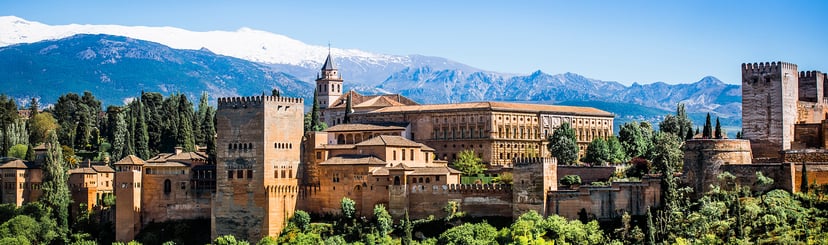
Do not confuse proximity with simplicity. A hotel on the Alhambra hill may reduce one approach, yet it can complicate dinner returns, lower-city time and the later move toward the A-395. Likewise, the palace and Albaicín face one another dramatically across the Darro valley, but they are not a single flat walking zone. Depending on the visit route, you may finish near the Access Pavilion or descend toward Puerta de la Justicia; neither exit automatically delivers you into the Albaicín. The practical sequence still includes a descent, a lower-city hinge and another climb.
A useful rule is that the Alhambra should not share a calendar day with a hotel change. Even a chauffeured luggage handoff rarely improves that sequence; moving the next morning is cleaner. The palace asks for attention as well as walking. When the day is also carrying checkout deadlines, stored bags and a mountain arrival, travelers start rushing the very spaces they came to understand.
City first becomes even more persuasive when the group wants a private Alhambra and Generalife tour. Guided pacing can reduce interpretive overload and help decide where to stop, but its value is highest when the guide is not also negotiating the group’s transfer anxiety. The guide should be shaping the story, not counting down to a vehicle loaded for the Sierra.
2. Count meaningful nights, not hotel names
A true Granada–Sierra Nevada split normally needs at least five total nights, with two of them in the mountains. That threshold is editorial rather than bureaucratic, but it reflects what the move actually costs. A second hotel creates packing, checkout, luggage handling, road time, orientation and another check-in. One mountain night often yields only a late arrival and an early departure, which is the opposite of the spaciousness the split was meant to buy.
With five nights, a three-city, two-mountain pattern is the clean default. With six or more, either order can work because each base can hold a full day without borrowing from transfer time. With four nights, split only when the Sierra is a primary purpose of the journey rather than an accessory to the Alhambra. With three nights or fewer, stay in Granada and treat the mountain as a day rather than a base.
The night count also changes the emotional effect. Two mountain nights allow an arrival evening to be quiet, a full day to be active or scenic, and the departure morning to remain unhurried. One night makes every meal and walk feel like a prelude to repacking. Affluent travelers sometimes assume a finer room will compensate for the brevity. It will not. The value of the Sierra comes from owning a complete rhythm, not from placing a second luxury key card in the wallet.
3. Read the arrival and departure direction before choosing a story
Route direction is the hinge that most often flips the recommendation. Arrivals by Granada airport, Granada rail station, or road from Seville, Córdoba and Málaga naturally encounter the city side before the climb toward Sierra Nevada. Continuing directly to the mountains is possible, but it means passing the logical city stop and adding the ascent to an already mobile day. That routing usually favors Granada first.
The reverse is true at the end of a trip. If the onward train, flight or chauffeured Andalusia leg leaves from Granada at a precise hour, sleeping in the city on the final night is safer and calmer than beginning departure day in Pradollano. Mountain roads may be perfectly straightforward, but a time-sensitive departure should not depend on a descent, city approach and station or airport transfer all in one chain. In that case, mountain first earns its place because it leaves the final night close to the departure infrastructure.
Travelers continuing west or north toward Córdoba, Seville or Madrid also benefit from ending in Granada rather than carrying the mountain descent into a longer road day. Travelers continuing toward the coast may tolerate mountain last more easily when the departure is late and chauffeured, but an early Málaga flight is not the moment to test how many moving parts fit before breakfast. Ending in the city is the cleaner answer.
An eastern-road arrival can make Sierra Nevada first less circuitous, yet direction alone is not enough. The later Alhambra slot must already be secure, and the arrival should reach the mountain hotel with time to check in without pretending that the transfer day is also a full outdoor day. A direct ascent after a long-haul flight, rail connection and road transfer can feel efficient on paper while leaving the first mountain dinner subdued and the next morning underpowered.
4. Let season change the margin, not invent a new itinerary
Season should alter the amount of buffer around the split, not replace the ticket-and-route logic. In winter, road dependence, shorter usable daylight and bulkier clothing make the mountain move a more substantial event. That strengthens city first when the Alhambra is early, but it strengthens mountain first when the trip ends with a precise city departure. The deciding question is not whether snow is forecast months ahead; it is whether your final morning can absorb a road leg before a train or flight.
In high summer, the Sierra may offer welcome altitude and outdoor air after Granada’s warmer lower-city hours. City first still tends to work because it allows the Alhambra and steep neighborhoods to be placed in their best available windows, then moves the trip toward a looser mountain rhythm. Mountain first can be attractive after a long sequence of hot cities, but only when the city days are securely booked later and the direct arrival does not land at the mountain hotel too late to recover.
Spring and autumn give the most freedom, yet they do not remove variability. Mountain activities, road comfort and visibility can change more than the palace appointment. That asymmetry is another reason city first remains the default: complete the fixed cultural anchor, then let the Sierra day expand, contract or change emphasis without threatening the core purpose of Granada.
Use current local advice close to travel rather than building the sequence around a distant conditions guess. A private planner can align activity intensity, vehicle choice and luggage needs through seasonal planning in Granada, but the evergreen rule remains: do not let a flexible mountain program destabilize a fixed Alhambra day.
5. Measure the two hills against the mountain, not separately
Granada makes its claim on the body before the Sierra does. The Alhambra combines distance, irregular surfaces, standing and gradients. Realejo rises from the lower center. Albaicín and Sacromonte add cobbles, steps, narrow lanes and uneven returns. The Sierra then introduces a winding ascent and, depending on the plan, more walking at altitude. Treating each component as “only a few hours” hides the cumulative load.
The Alhambra-to-Albaicín handoff is where that cumulative load becomes visible. A couple may finish the palaces feeling strong, descend through Cuesta de Gomérez, enjoy the Carrera del Darro and then discover that the final climb to a viewpoint or carmen asks for a second reserve of energy. A family may manage the same route until the youngest traveler realizes the hotel is not at the top of the next street. Older parents may be comfortable with either the palace or Albaicín but not both before a luggage move.
This is also a mood question. When Granada first is paced well, the first evening belongs to the city rather than to tomorrow’s ticket, and the mountain arrival feels like a genuine widening of the trip. When mountain first is poorly paced, the second hotel can feel less restful because every meal is shadowed by the descent and the Alhambra clock. Conversely, when mountain first is chosen for a sound departure reason, finishing in Granada creates a satisfying final cadence: one last lower-city dinner, a short transfer the next morning, and no mountain road between bed and departure.
City-first threshold: when Granada should come before Sierra Nevada
Choose city first as soon as any two of the following are true: the Alhambra is booked within the first two days, the total trip is five nights or fewer, arrival is through Granada’s rail or airport side, the mountain stay is only two nights, or the group includes travelers who need a predictable walking load. For most first visits, two conditions are already present, which is why city first wins so often.
The strongest city-first pattern is not a packed “best of Granada” opening. It is a protected arrival, a dedicated Alhambra day and a move after the city’s hardest appointment has passed. Arrival day can hold a hotel reset, a short Realejo or Centro orientation and dinner. The Alhambra day can hold the monument, one carefully chosen continuation and an uncomplicated return. The move day can then begin after breakfast, with bags handled once and no ticket clock.
The continuation after the Alhambra should be selected by legs, not ambition. If the visit finishes with good energy, descend toward the lower city and choose either a Realejo pause or a short Albaicín approach with a driver strategy. Do not assume that Sacromonte, a sunset mirador and a formal dinner all belong because they are famous. If the mountain transfer is the next morning, the best city evening may be the one that ends earlier.
City first is especially strong for couples planning a celebration. It allows the serious dinner to sit on a night without luggage or a dawn ascent. It also gives the mountain stay a cleaner emotional role: not an emergency recovery from an overbuilt city day, but a deliberate second chapter. For families, it keeps the children’s most fixed entry near the first hotel and reduces the chance that a winding-road arrival is followed immediately by a highly structured monument day.
For small groups, city first simplifies coordination. Everyone meets the guide from one settled base, luggage remains out of the vehicle, and the group can split after the Alhambra without jeopardizing a shared mountain departure. One pair may return to the hotel, another may take a short lower-city walk, and the group can reconvene for dinner. On a move day, that flexibility disappears because every divergence affects the bags, vehicle and second check-in.
The city-first threshold is crossed decisively when the alternative would place the Alhambra on the morning after a late mountain arrival. That sequence looks efficient because the road distance is not enormous, but it compresses sleep, descent, check-in or bag drop, city access and a fixed palace entry. It leaves no room for a slow breakfast, road discomfort or a traveler who needs longer to adjust. Book the city first and remove the entire chain.
Mountain-first threshold: when the exception becomes the better plan
Choose mountain first only when four conditions align: the later Alhambra entry is already confirmed, the Sierra has at least two nights, the arrival can reach the mountain hotel without a same-day activity agenda, and finishing in Granada materially simplifies the final departure. When all four are true, mountain first is not a romantic flourish; it is the more rational route.
The clearest example is a traveler arriving by private vehicle after several urban stops, spending two or three nights in Sierra Nevada, then descending to Granada for a settled city stay before an early train or flight. The mountain portion breaks the museum-and-monument rhythm, while the city finish protects the final logistics. The Alhambra is no longer being “saved for last” for theatrical effect; it is being placed where the departure network and fixed ticket make sense.
Mountain first can also suit outdoors-focused travelers whose priority is a full mountain day and who would be disappointed if it were reduced to an excursion. Starting there protects the outdoor allocation from city creep. Granada then becomes a defined second base rather than a place that keeps borrowing hours from the Sierra. This works best when the group is comfortable arriving, dining and sleeping without demanding a major first-day experience.
The sequence breaks down when the first mountain night is merely a transit night. Arriving late, waking early, checking out and descending to an Alhambra appointment is not a mountain stay; it is a hotel change on a slope. It also breaks down for travelers prone to road discomfort, for parties carrying elaborate celebration luggage, and for groups whose members arrive on different flights or trains. Consolidate the arrivals in Granada before asking everyone to move uphill.
Mountain first is also a poor choice when the city hotel is in Albaicín and the arrival day already involves a complex last-mile transfer. A mountain checkout, descent, city traffic, luggage handoff and narrow-lane approach can consume the calm you hoped to preserve. In that case, finish the mountain segment one day earlier than instinct suggests, give the city arrival its own afternoon, and place the Alhambra after a full city night.
There is one more honest counterpoint: travelers who want the Sierra mainly for a view, a lunch or a few hours of fresh air should not use mountain first or city first as a hotel-order question at all. They should stay in Granada and design a private mountain day. The split earns its cost only when the mountain evening and morning have independent value.
Transfer-day limits: how to keep the move from consuming the stay
A successful transfer day carries one meaningful anchor, not two. The road distance tempts travelers to treat the Granada–Sierra move as a spare half-day, but packing, checkout, vehicle loading, the A-395 climb, orientation in Pradollano and a second check-in create more fragmentation than the map suggests. The answer is to protect one coherent block and let everything else support it.
The city-to-mountain move
The strongest city-to-mountain transfer begins with no monument ticket. Have breakfast, check out once, and let the luggage leave with the chauffeur. For a final Granada element, choose one low-complexity anchor: a short Realejo walk, a relaxed lunch, or a focused lower-city visit that ends near an accessible pickup. Do not climb into Albaicín for a last viewpoint while the vehicle waits below and the mountain check-in clock advances.
Campo del Príncipe can work as a gentler Realejo pause because it keeps the group on the city side of the next transfer, but adding Carmen de los Mártires or another hill climb changes the physical equation. Plaza Nueva is useful as a handoff point, yet the surrounding Cuesta de Gomérez and Darro routes can still pull the group uphill or into pedestrian lanes. The final city stop should shorten the day, not reopen it.
After lunch, the driver can collect the group and take the A-395 toward the Sierra while the bags remain in one chain of custody. The goal is to arrive with enough day left to orient, walk briefly and dine without feeling that the mountain hotel is merely a bed after Granada. A private route through Sierra Nevada from Granada is most valuable here when it combines luggage handling, a sensible ascent and an activity level matched to the arrival, rather than trying to prove how much can fit.
The mountain-to-city move
The strongest mountain-to-city transfer uses the morning for one light mountain element, then descends before the city portion becomes a race. Check out, keep the luggage with the chauffeur, and arrive in Granada early enough for a real hotel reset. A guided Realejo or historic-center orientation can follow later, but the Alhambra should wait until after a city night unless the entry is unusually forgiving and the entire day has been designed around it.
Pradollano is not a flat village where every hotel, vehicle and activity meets at one effortless point. The resort core is vertical, and the last movement between lodging, equipment, parking and pickup can take more energy than expected. That is another reason not to schedule a fixed city monument immediately after checkout. Give the mountain departure room to be a departure.
The three non-negotiable limits
- No Alhambra plus hotel move. The palace should be the day’s anchor, not an item between checkout and check-in.
- No two-hill finale. Do not combine the Alhambra-to-Albaicín handoff, a sunset climb and the Sierra transfer simply because each looks nearby on a map.
- No second major reservation. A long tasting menu, fixed spa treatment or celebration event should sit on a settled night, not at the end of a transfer chain.
A chauffeur-led move changes the day because it can keep luggage out of sight, protect a single pickup sequence and adapt the final city stop to the group’s actual energy. A private guide changes it because the walk can end where the vehicle can realistically meet, not where a generic route happens to finish. Together, they turn the transfer into protected time rather than dead time. For a short stay where one fragmented afternoon would be a meaningful loss, Inquire now about aligning the guide, luggage handoff, hotel geography and mountain transfer around the confirmed Alhambra slot.
Where dinner, guide time and premium spend belong
Put the most ambitious city dinner on a night with no hotel move and no early mountain departure. This is a sequencing decision, not a restaurant ranking. Granada’s later dining rhythm can be a pleasure, but a long menu after the Alhambra and before an early ascent turns pleasure into endurance. The meal should be allowed to be the evening’s event.
For a current shortlist, use the MICHELIN Guide selection (https://guide.michelin.com/us/en/andalucia/granada/restaurants), then read the restaurant’s own format rather than relying on a generic “fine dining” label. Arriaga – Menú (https://www.restaurantearriaga.com/en/the-menu/) presents substantial tasting formats at its Avenida de la Ciencia location, which makes it a separate transfer from the historic core. Faralá – Carta & Menús (https://restaurantefarala.com/carta/) shows tasting structures from its Cuesta de Gomérez address, a route that is geographically close to the Alhambra approach but still sits on a slope between the lower city and the monument. Menus and operating details can change, so confirm when booking; the stable planning point is that either can command a full evening.
That geography matters. Faralá may look like a natural continuation after the Alhambra because Cuesta de Gomérez is the classic connection toward Plaza Nueva. It is less natural after you have already crossed into Albaicín for sunset and then need to descend again. Arriaga can suit a celebration because the transfer is discrete and intentional, but it should not be bolted onto a day already carrying the palace, Sacromonte and packing.
Guide time earns its cost at the points where context and route choices interact: inside the Alhambra, at the Realejo–Alhambra edge, and when deciding how much Albaicín the group should attempt after the palaces. Chauffeur time earns its cost when the group crosses zones, handles luggage or needs a reliable pickup at the edge of steep streets. A car does not improve the experience when it merely waits while travelers climb lanes the vehicle cannot meaningfully shorten.
Premium spend does not help when it is used to turn a one-night mountain detour into a luxury badge; the extra room category cannot repay two check-ins, repacking and a rushed descent. It also does not change the Alhambra clock. Paying more is worthwhile when it removes a luggage reset, protects a final departure, or lets the guide and driver hand the group from one realistic access point to another. It is not worthwhile when it adds a prestige layer to an itinerary that is structurally too short.
The same restraint applies to hotel geography. A beautiful Albaicín property can be right for atmosphere yet wrong for a one-night city finish before an early departure. An Alhambra-hill hotel can be right for the monument yet wrong for repeated lower-city dinners. A lower Realejo or Centro base can be less theatrical on arrival and far more useful across two days. The supporting decision is Granada hotel geography by neighborhood; choose the hotel that supports the sequence, not the photograph that forces extra transfers.
The booking sequence that prevents regret
Book the split in the same order that the trip’s constraints appear: Alhambra entry, travel direction, night allocation, hotels, transfer, then dinners and secondary activities. Reversing that order is how travelers end up defending a mountain room they love against a palace slot that no longer fits.
- First, secure the Alhambra date. Treat the Nasrid Palaces time as fixed and leave enough city buffer before it.
- Second, mark the final time-sensitive departure. If it is early or inflexible, finish in Granada rather than in the Sierra.
- Third, give the mountain at least two nights or remove the hotel change. One night is usually a transfer with scenery, not a stay.
- Fourth, choose hotels for access logic. Consider the last metres on foot, dinner returns, luggage handling and the next morning’s vehicle route.
- Fifth, design the move day around one anchor. Use a guide and chauffeur to preserve continuity, not to multiply stops.
- Last, place the serious dinner. Keep it on a settled city night with no dawn ascent or departure.
Editorial no: do not force the Alhambra, Albaicín sunset and a hotel move into the same day. Cut the sunset first, not the palace buffer. If the trip is still overpacked, cut the second hotel rather than shortening both Granada and the Sierra until neither feels complete. This is the central judgment of the guide: a split stay should create contrast, not merely produce two addresses.
For most five-night first visits, the sequence remains Granada for three nights, then Sierra Nevada for two, provided the onward departure is not early. For a six-night trip ending with a morning train or flight from Granada, two mountain nights followed by four city nights can be the better order. For three nights, keep Granada as the base. The numbers are not formulas; they are guardrails against spending the most valuable hours in hotel lobbies and vehicles.
Once the order is right, the trip can breathe. The city half gains a clear Alhambra day, the mountain half gains a complete evening and morning, and the transfer becomes a deliberate hinge rather than a lost block. That is what a premium split should buy: not more scheduled elements, but fewer moments when the traveler has to think about the schedule.
FAQ
Is it better to stay in Granada or Sierra Nevada first?
Granada first is the better default because the Alhambra is the fixed appointment and the mountain stay is usually more flexible. Start in Sierra Nevada only when you have at least two mountain nights, a confirmed later Alhambra entry and a time-sensitive final departure from Granada that makes ending in the city clearly easier.
How many nights do you need for a Granada and Sierra Nevada split stay?
Five total nights is the practical minimum for a satisfying split, usually three in Granada and two in Sierra Nevada. Four nights can work when the mountain is a primary purpose of the trip, but three nights are better kept in one Granada hotel with a private mountain day rather than divided between two check-ins.
Should the Alhambra be visited before or after Sierra Nevada?
Visit the Alhambra before Sierra Nevada unless finishing in Granada protects an early onward departure. The palace should never be placed on the same day as the hotel move, and it is best scheduled after a full night in the city so road time, luggage and check-in cannot threaten the fixed entry.
Can you visit the Alhambra on the transfer day to Sierra Nevada?
You can, but it is usually a poor use of a premium short stay. The Alhambra demands walking, attention and punctuality, while the transfer adds checkout, luggage, road time and a second check-in. Keep the palace as the day’s only major anchor and move to the Sierra the following morning.
Is one night in Sierra Nevada worth changing hotels for?
Usually not. One night often gives you an arrival, dinner, sleep and departure without a full mountain rhythm. A Granada base with a private Sierra Nevada day is normally calmer and more useful. Change hotels only when the mountain evening and following morning matter independently, not simply to say the trip included a split stay.
Which order is best before an early flight or train from Granada?
Start in Sierra Nevada and finish in Granada, provided the Alhambra is confirmed for the later city stay. Sleeping in the city on the final night removes the mountain descent from departure morning and reduces the number of road, traffic and timing variables between the hotel and the station or airport.
Does a private chauffeur make the Granada–Sierra Nevada move worthwhile?
A chauffeur makes the move more worthwhile when luggage can stay in one chain of custody, the pickup is coordinated with the end of a guided walk and the transfer day carries only one meaningful stop. It does not make an overpacked day sensible, and it cannot erase the walking or fixed timing inside the Alhambra.
What should you cut first if the split stay feels too busy?
Cut the extra viewpoint, second major dinner or one-night mountain hotel before cutting the Alhambra buffer. The first thing to stop forcing is the Alhambra-to-Albaicín handoff on the same day as a transfer. A calmer single-base stay is better than two abbreviated stays joined by rushed logistics.
If you’re interested in any private tours of Granada, please reach out to us.



 So if you are looking for the absolute best in Granada & surroundings with authentic local fully-licensed native guides whose English you can actually understand and with an exclusive and amazingly fun itinerary













