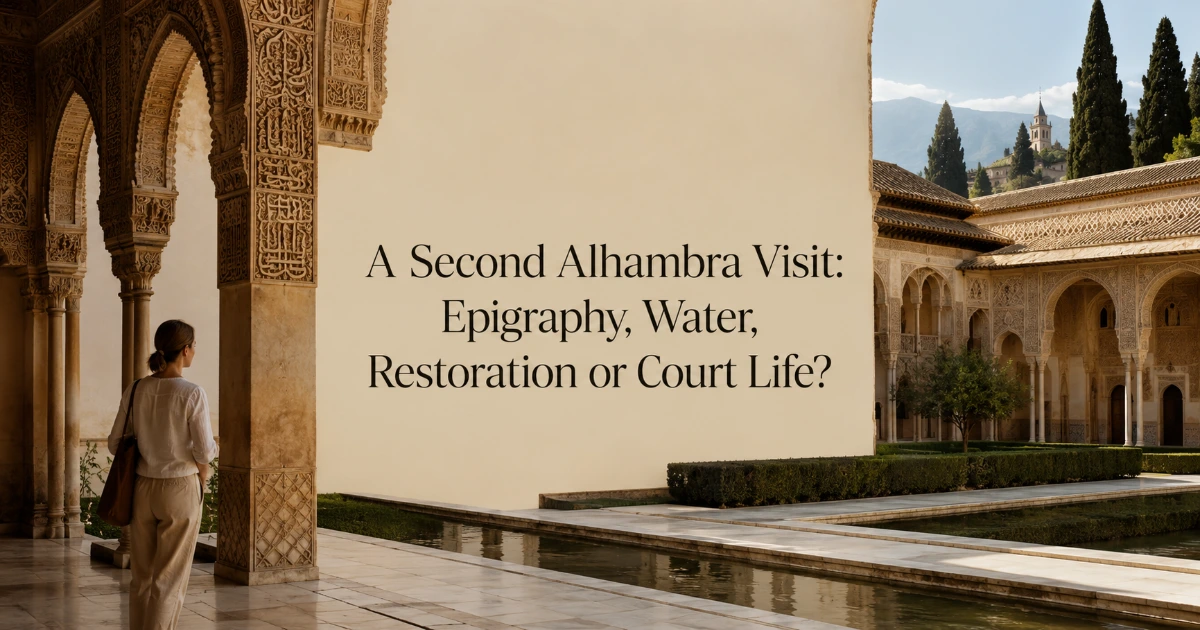
A Second Alhambra Visit: Epigraphy, Water, Restoration or Court Life?
Updated
Choose the question before you choose the route
A second Alhambra visit is most rewarding when it stops trying to be a second version of the first. The useful decision is not whether to see Comares, the Court of the Lions or the Generalife again. It is which question should govern what you notice, where you pause and which apparently minor details become evidence. Four lenses are especially defensible: epigraphy and court poetry, water and garden engineering, restoration and conservation, or court life understood through controlled movement. Each can produce a rigorous return visit, but they ask for different routes and different kinds of attention.
Choose epigraphy when language, calligraphy and the political work of poetry are the main attraction. Choose water when you want to understand the Alhambra and Generalife as a connected, managed landscape rather than a sequence of beautiful courtyards. Choose restoration when the monument’s material afterlives, repairs and conservation choices interest you as much as its Nasrid conception. Choose court life when thresholds, admission, waiting, visibility and room-to-room dependencies feel more revealing than isolated decoration.
- For the closest reading: epigraphy concentrates attention in and around the Palace of Comares, where text, architectural position and courtly praise reinforce one another.
- For the broadest landscape: water extends the inquiry beyond fountains to the Acequia Real, irrigated terrain, productive land and the Generalife’s dependence on hydraulic supply.
- For the strongest material-history lens: restoration uses the Court of the Lions to examine change, diagnosis, repair and the difference between historic fabric and later intervention.
- For the clearest spatial narrative: court life follows controlled passages and functional relationships, asking who could enter, who waited, who recorded decisions and how authority was staged.
The four are not sealed subjects. A poem may describe a fountain; a restored basin retains epigraphy; a controlled doorway shapes court ceremony; a hydraulic channel determines what a garden can become. The decision is about priority. On a specialist second visit, one lens should determine the main sequence, while the others supply supporting evidence. Trying to give all four equal weight usually recreates the familiar highlights circuit, only with denser commentary.
This article assumes that you have already seen the major Nasrid spaces at least once and possess basic orientation: you know the difference between Comares and the Palace of the Lions, and you have some memory of the Generalife. Travelers who need a first-visit framework should begin with how to choose an Alhambra visit when access is constrained. A second reading is not a substitute for that foundation. It is an argument built on it.
Four criteria that actually change the answer
What kind of evidence keeps your attention?
Epigraphy asks you to stay with small, repeated and sometimes visually difficult evidence: letter forms, inscriptions in different registers, the placement of poems and the relation between semantic meaning and ornament. Water asks you to infer systems from visible fragments: channels, basins, gradients, planted ground and the distribution of supply. Restoration asks you to observe surfaces, joints, replaced elements and recorded interventions without pretending that every phase can be identified by eye. Court life asks you to read spatial control: door width, approach, sequence, adjacency, sightline and the division between administrative and ceremonial functions.
The best lens is often the one whose evidence you would still find compelling after the most famous view has appeared. A literary historian may happily spend a substantial portion of the visit around a limited group of Comares inscriptions. A landscape architect may accept fewer palace interiors in exchange for a more coherent account of water, cultivation and terrain. A conservation-minded traveler may prefer one carefully documented fountain to a broad aesthetic survey. A political historian may care less about identifying every decorative motif than about reconstructing how a subject moved toward an audience with the sultan.
How much spatial range do you want?
Epigraphy can be geographically concentrated, although meaningful comparison may extend into the Palace of the Lions. Court life also benefits from concentration because sequence is easier to understand when adjoining spaces are treated as dependencies rather than as separate stops. Water is inherently more expansive. It is not fully explained by a fountain or by the Patio de la Acequia alone; its logic reaches into supply, terrain, irrigated land and the relationship between the palatial city and the Generalife. Restoration can work at either scale: tightly around the Fountain and Court of the Lions, or more broadly through contrasting additions and altered surfaces across the complex.
Range affects fatigue and intellectual continuity. Every transfer between subjects carries a cost: the question has to be re-established, the evidence changes scale and crowded circulation may interrupt an argument. A bespoke sequence is therefore not merely a matter of comfort. It protects the interpretive thread. The water lens justifies more movement because movement is part of the subject. The epigraphic lens often benefits from resisting movement because the payoff lies in sustained comparison.
What did your first visit leave unresolved?
Repeat visitors often remember the Alhambra as a succession of impressions: reflection in the Court of the Myrtles, the dome of the Hall of the Ambassadors, the columns of the Court of the Lions, running water at the Generalife. Those memories are useful diagnostic material. The right second lens should explain something you noticed but did not understand.
- If the walls seemed densely written but the visit treated writing as decoration, choose epigraphy.
- If water felt omnipresent yet almost magical, choose hydraulics and landscape management.
- If the monument appeared timeless and seamless, choose restoration to recover its history of alteration.
- If rooms felt magnificent but their political relationship remained vague, choose court ceremony and controlled movement.
A repeat visit becomes weaker when it is chosen by abstract prestige rather than by a real gap in understanding. Arabic poetry may sound more specialist than water, and conservation science may sound more technical than court life, but the strongest subject is the one that reorganizes your existing memory.
How dependent is the lens on specialist interpretation?
All four benefit from expertise, but not in the same way. Epigraphy requires accurate translation and the ability to distinguish religious formulas, dynastic praise, Nasrid mottos and monumental poetry without flattening them into a single category. Water requires the guide to connect hydraulic infrastructure with topography, land use and maintenance, not merely point to channels. Restoration requires disciplined separation between documented intervention, visible evidence and reasonable inference. Court life requires caution about reconstructing behavior from architecture: a plausible ceremonial sequence is not the same as a fully documented daily script.
This distinction matters for private touring. The value is not the addition of more facts at every stop. It is the selection of evidence and the control of dwell time around one rigorous question. A specialist can decide which inscriptions need translation in situ, which water features demonstrate distribution rather than symbolism, which conservation claims are documented and which thresholds genuinely support an argument about access. Without that selection, a specialist theme can become a list of technical observations attached to the usual route.
Epigraphy and court poetry: read Comares as an authored environment
The epigraphic lens is the most text-led of the four and, for many repeat visitors, the most radical change of pace. It asks you to stop treating inscription as a border around architecture and begin treating it as part of the architecture’s argument. In the Alhambra, writing can carry religious meaning, praise the ruler, repeat the Nasrid motto and transform a wall, niche, arch or fountain into a speaking surface. Calligraphy also participates visually in the decorative field alongside vegetal and geometric forms, so meaning and appearance cannot be cleanly separated.
The Patronato’s account of the Comares program states that the palace originally held twelve epigraphic poems and that seven survive. It locates the sequence from the throne hall and its access niches through the Sala de la Barca, the north and south porticoes and alcoves of the court. It also distinguishes anonymous works, a surviving poem by Ibn al-Khatib and poems by Ibn Zamrak. That distribution is the essential evidence for a second visit because it turns Comares from a room-centered itinerary into a coordinated poetic program. See the Patronato’s study of poetry and architecture in the Palace of Comares.
The interpretive payoff is not simply learning what selected lines say. It is seeing how a poem’s location changes its force. A courtly text in the throne hall operates differently from one set into an entrance niche. A line encountered while approaching power does different work from a line read after crossing a threshold. Poetry may praise a ruler, identify architecture through metaphor, or allow the building to speak in the first person. The room is therefore not a neutral container for verse. Position, scale, direction of approach and the reader’s bodily relation to the inscription all contribute to meaning.
A serious epigraphic visit should distinguish at least four categories rather than calling everything “Arabic writing.” First are religious formulations, whether explicitly Qur’anic or resonant with religious language. Second are royal or laudatory messages directed toward Nasrid sovereignty. Third is the repeatedly deployed dynastic motto, often translated as “There is no victor but God.” Fourth are the court poems that bind language to a particular architectural setting. The categories overlap visually, and many visitors cannot read the script, which is precisely why close interpretation matters.
Comares offers the strongest concentrated route because the surviving program can be followed as an ordered set. The north–south symmetry noted in the official account gives the guide a structural principle: the visit can compare how poems occupy corresponding architectural positions rather than presenting each inscription as an isolated curiosity. The Hall of the Ambassadors, the entrance niches, the Sala de la Barca and the porticoes become chapters in one spatial text. The visitor should expect fewer broad historical digressions and more time spent looking at where words sit.
The main tradeoff is visual accessibility. Some inscriptions are high, partial, weathered, crowded by surrounding ornament or difficult to inspect under normal visitor movement. A repeat visit cannot promise perfect legibility, and it should not depend on reading every word directly from the wall. Good preparation may include translated extracts or a plan of the poetic program, but the on-site task remains architectural: identify where the text is, what kind of surface carries it and why that position matters. The aim is not a seminar detached from place.
Epigraphy is particularly strong for travelers already interested in Islamic art beyond the Alhambra. Granada’s Madraza, Corral del Carbón and surviving Nasrid domestic architecture provide useful comparisons in function and scale; a broader Islamic-art route through Granada can supply that context on another day. The Alhambra visit itself should remain selective. Extending every inscription into a citywide survey would weaken the concentration that makes the second visit distinctive.
Choose this lens when you enjoy textual interpretation, when your first visit left the walls conceptually silent, or when you want the Palace of Comares to become the intellectual center of the return. Avoid making it the sole lens for a mixed group whose members differ sharply in interest or language tolerance. It rewards stillness, repetition and fine distinctions; not everyone experiences those as pleasures.
Water and garden engineering: follow supply, terrain and cultivated life
The water lens changes the scale of the Alhambra. Fountains and reflecting pools remain important, but they are no longer treated as self-contained emblems of refinement. They become endpoints, regulators or visible expressions of a larger hydraulic landscape. The central question is not “What did water symbolize?” but “How was water brought, distributed, maintained and converted into domestic, ceremonial, productive and garden effects?”
The Acequia Real is the anchor. A scholarly study in Cuadernos de la Alhambra records its opening in 1238 and describes the surrounding terrain as a mosaic of irrigated orchards, dry land, pasture, woodland and buildings. It also emphasizes that the system changed over time: it evolved in the Nasrid period, was altered after the Christian conquest of 1492, and later experienced neglect, overuse, a mid-twentieth-century landslide and the construction of a newer channel that contributed to abandonment of the historic course. The article frames current recovery as both infrastructural and cultural-landscape work. See the study of the Acequia Real as historical infrastructure and landscape.
That history matters because it prevents the water system from being romanticized as a single, perfectly preserved Nasrid machine. It is a long-lived infrastructure repeatedly adjusted to changing needs and conditions. A second visit should therefore hold two ideas at once: the original achievement of bringing dependable water to an elevated palatial and agricultural complex, and the subsequent history of regulation, repair, rerouting and recovery. Water is both heritage and continuing management problem.
The Generalife is indispensable to this lens because it makes the connection between water and cultivated terrain easier to grasp. The palace and gardens should be read in relation to productive land, slope and supply rather than as a decorative annex to the Nasrid Palaces. The Patio de la Acequia offers an immediately legible channel, but a rigorous visit should resist making it the entire story. The more important question is how a principal supply line supported a landscape of gardens, orchards and other land uses over time.
At the palace scale, the visitor can compare different water effects: still surfaces that amplify architecture, narrow channels that direct flow, basins that mark centers and fountains whose operation depends on hidden supply and drainage. The contrast between apparent effortlessness and actual engineering is productive. Water seems to arrive with poetic inevitability, yet every flow requires gradient, distribution, maintenance and decisions about quantity. The experience of abundance is created by control.
This lens is especially strong for landscape architects, gardeners, environmental historians and travelers interested in the relationship between aesthetics and infrastructure. It also suits repeat visitors who felt that the Generalife was rushed or treated mainly as a photogenic ending. A water-led route gives the gardens conceptual weight equal to the palaces and makes the movement between them part of the argument.
Its principal tradeoff is spatial spread. More of the visit is outdoors, transitions matter, and the evidence may be less concentrated than a poetic program in Comares. Heat, rain, mobility and crowd movement can affect how much terrain is sensible to cover. As an editorial route judgment, water is a better choice when you can devote a generous block of time and are willing to sacrifice some interior depth. It is weaker when the group needs a compact, low-movement return centered on the Nasrid rooms.
The guide’s task is also unusually demanding because hydraulic interpretation can drift into vague claims. A visible channel does not automatically reveal its date, original function or exact relationship to a wider network. A responsible account should mark the difference between documented infrastructure, later alteration and interpretive reconstruction. It should also avoid suggesting access to restricted stretches or technical areas. The public visit can support a sophisticated landscape reading without implying entry behind conservation barriers.
Travelers who want to extend the landscape discussion beyond the monument can use Granada’s broader garden context as a supporting comparison. Carmen de los Mártires and the city’s carmen tradition raise different questions about hillside cultivation, enclosure and views. They should not be folded into the same Alhambra session unless time is unusually abundant; their value lies in contrast, not accumulation.
Choose water when you want the widest systems view, when the Generalife deserves more than a closing stroll, or when infrastructure is as interesting to you as ornament. Do not choose it merely because you like gardens. The serious version is about dependency: without controlled supply, the aesthetic and productive landscape cannot exist.
Restoration and conservation: study the monument as accumulated decisions
The restoration lens is the best antidote to the idea of the Alhambra as a frozen survival from the fourteenth century. It treats the monument as material evidence that has been repaired, altered, cleaned, reinterpreted and conserved across centuries. The Court of the Lions provides an unusually rich focus because its fountain is both celebrated image and technically complex object: sculpture, hydraulic apparatus, epigraphic surface and exposed stone ensemble.
The Patronato records interventions on the Fountain of the Lions from the sixteenth century onward. Its modern campaign began with the restoration of one lion in 2002; the remaining lions and the basin were restored between 2007 and 2010. A hydraulic-renewal project was prepared in 2009, archaeological intervention followed from 2010 to 2012, and the court was paved with Macael marble in 2012. These dates matter because they reveal conservation as a sequence of research and decisions rather than a single act of making the fountain look new. See the official account of the Fountain of the Lions restoration.
The same source identifies the twelve lions and great basin as white Macael marble, with a limestone support and central jet. It describes environmental pressures including sharp thermal variation, moisture, freeze–thaw action and biodeterioration. It also lists diagnostic methods and the analysis of materials used in conservation. For the visitor, the key lesson is that the appearance of stone is not merely an aesthetic issue. Surface deposits, moisture movement, old metal fixings, incompatible mortars and biological growth can change both legibility and physical stability.
A restoration-led visit should not become a catalogue of laboratory techniques. The better question is how evidence leads to choices. Why remove one later addition but retain another? When does cleaning recover the intended reading of marble, and when might it erase historical patina? How does a conservation team balance hydraulic function, material preservation, archaeological evidence, public access and a claim of historical authenticity? These questions do not always have a single uncontested answer, which is part of the lens’s value.
The Court of the Lions also demonstrates that restoration can change how visitors understand space. Pavement, water flow, the visibility of marble veining and the condition of carved surfaces all influence perception. Yet visible difference should be interpreted cautiously. A lighter or cleaner surface is not automatically original; a joint is not automatically a modern repair; an irregularity is not automatically damage. The guide should use documented interventions as anchors and clearly label any visual inference.
Archival plans add another layer. The Patronato archive identifies a digitized pre-1955 cyanotype general plan of the Nasrid Palaces, conservation-service plan number 633, at approximately 1:333.3 scale. Its indexed spaces include the Court of the Lions, Hall of the Abencerrajes and other key palace areas. The record, available through the Patronato’s plan archive entry, is useful not because a visitor must study a technical drawing in the court, but because it proves that modern understanding and conservation depend on accumulated documentation as well as on the standing building.
This lens benefits travelers who enjoy architectural history, archaeology, material science or the ethics of heritage presentation. It can also be unexpectedly compelling for repeat visitors who remember the Alhambra as visually harmonious. Conservation reveals that harmony as managed: the result of choices about what to stabilize, restore, expose, replace or leave legible as a later phase.
The tradeoff is that restoration rarely supplies a single dramatic narrative. It replaces the romance of untouched survival with a more demanding account of evidence, uncertainty and stewardship. Some visitors find that intellectually liberating; others feel it interrupts aesthetic absorption. A strong guide should not force a conservation lecture onto every surface. The route needs a limited set of case studies, each chosen because a documented intervention changes how the place is read.
The lens should also include at least one contrasting space where later historical layers are openly visible. The Cuarto Dorado, for example, retains a Nasrid origin while its ceiling and decoration were repainted and altered under the Catholic Monarchs. That juxtaposition helps prevent “restoration” from being understood as a return to one pure date. The Alhambra’s significance includes post-Nasrid occupation, adaptation and conservation history, even when the principal subject remains the Nasrid palaces.
Choose restoration when you want to understand why the Alhambra looks the way it does now, when you are comfortable with qualified conclusions, and when material evidence interests you more than a continuous court narrative. Reject any promise of behind-the-scenes workshop or restricted conservation access unless separately and explicitly authorized. The public route contains enough evidence for a substantive visit; the rigor comes from interpretation, not privileged entry.
Where a bespoke private visit materially changes the result
By this point, the practical value of a private specialist is concrete. The four lenses require different evidence, not merely different commentary. An epigraphic route may devote sustained time to Comares and use translated extracts. A water route must preserve enough movement and outdoor time to connect the Generalife with wider hydraulic logic. A restoration route needs documented case studies and disciplined language about what is visible. A court-life route must use plans and thresholds to rebuild spatial dependencies that the public circulation may obscure.
The case for that service is therefore not a promise of exclusivity. It is the need to select evidence, set dwell times and build the visit around one question before arrival. That is especially important for repeat visitors, who lose more from a generic route than first-time visitors do: they already know the famous sequence and need interpretation that changes it. For a tailored discussion of guide expertise and sequencing, explore private Granada touring options, then Inquire now.
Court life and controlled movement: reconstruct authority through thresholds
The court-life lens begins with a different unit of analysis. Instead of asking what a room is called or which ruler built it, ask what had to happen before someone could enter, who controlled the transition, what work occurred nearby and how an encounter with authority was staged. The Alhambra’s political world becomes legible through dependencies between spaces: administration before audience, waiting before admission, narrow passage before open court, service movement behind ceremonial display.
The Cuarto Dorado offers the clearest documented example. The official description notes a small horseshoe-arched doorway designed for one-person passage and for close control of movement into the courtyard where the sultan received subjects. It identifies the Cuarto Dorado as a place used by administrators and secretaries to record and execute the sultan’s judgments, while a guard passage ran below. These details connect architecture, bureaucracy and security in one compact sequence. See the Patronato’s description of the Cuarto Dorado.
The interpretive consequence is substantial. An audience court is not just an attractive open space. Its meaning depends on how a petitioner reached it, how movement was narrowed, where officials worked and how the ruler’s presence was distinguished from ordinary circulation. The single-person doorway makes control physically intelligible. The administrative room prevents court ceremony from being reduced to spectacle; decisions required writing, record keeping and execution. The guard route reminds us that security and service circulation supported the visible scene.
From there, Comares can be read as a sequence of increasing authority rather than as a set of celebrated rooms. The approach to the Hall of the Ambassadors, the relation between court and throne space, and the placement of inscriptions all contribute to a choreography of sovereignty. The epigraphic program becomes supporting evidence: words praise and define power while architecture controls proximity to it. This is an example of productive overlap between lenses, with court movement remaining primary.
The Palace of the Lions raises different questions. Its rooms and court should not be assigned one simple public or private label without qualification. A court-life visit can instead examine degrees of access, residential and ceremonial possibilities, visual connection and the way adjacent halls depend on the central court. Historic plans are useful here because the modern visitor route may compress, reverse or bypass relationships that mattered in earlier occupation. A plan helps restore adjacency even when the original sequence cannot be walked.
That caution is essential. The present-day circulation of visitors is not a reenactment of fourteenth-century court movement. Doors may be closed, routes redirected and spaces viewed from thresholds. Nor do architectural relationships provide a complete script for every ceremony. The responsible approach separates documented function from interpretive reconstruction. “This doorway controlled one-person passage” is a supported claim. “Every petitioner followed exactly this sequence on every occasion” would require much stronger evidence.
Court life is the strongest lens for political historians, theater and performance specialists, and travelers interested in institutions rather than objects alone. It also works well for mixed groups because human movement is easier to visualize than an extended inscriptional analysis. A skilled guide can ask the group to notice compression and release, concealed support routes, changing visibility and the difference between being admitted to a court and being received by the ruler.
This lens also benefits from a lower-city comparison on another day. Dar al-Horra, Casa del Chapiz and other domestic or residential settings show different scales of courtyard life and household organization. A route through domestic Granada beyond the palaces can clarify what is specifically palatial about the Alhambra. The comparison is most useful when kept separate enough that differences in status, period and preservation are not blurred.
Choose court life when you want rooms to become relationships, when bureaucracy and ceremony interest you together, or when your first visit named spaces without explaining their dependencies. It is also the most adaptable lens for a group with varied specialist interests: architecture, politics, poetry and social history can all contribute without displacing the central question of controlled access.
Conditions that should alter your choice
A compact return favors concentration
When time is limited, choose a lens that can reach interpretive depth without depending on broad terrain. Epigraphy and court movement are usually the strongest compact choices because both can be organized around closely related palace spaces. Restoration can also work in a concentrated format if it is built around the Fountain and Court of the Lions plus one contrasting later layer. Water suffers most from compression because its argument depends on connecting visible effects to a wider landscape and supply system.
This is a planning judgment, not an official duration. Current entry conditions, circulation and temporary closures can alter what is realistic. The important principle is proportionality: do not spend half the available time walking between disconnected examples. A compact specialist visit should have one core zone, one supporting comparison and a clear stopping point.
A long return permits causality, not just quantity
Additional time should deepen the chosen explanation rather than add unrelated rooms. For water, it allows a causal sequence from terrain and supply to garden and palace effects. For epigraphy, it allows comparison between Comares and selected poems in the Palace of the Lions without abandoning close reading. For restoration, it allows archival evidence and multiple conservation phases to be compared. For court life, it permits a slower reconstruction of administrative, ceremonial and residential dependencies.
Heat, rain and mobility favor different evidence
Water is the most weather-sensitive lens because it generally asks for more outdoor movement and greater spatial range. In hot conditions, the route may need an earlier start, fewer extensions and longer shaded explanations. Rain can make garden and terrain reading less comfortable even when it makes water physically present. Mobility constraints do not make the subject impossible, but they can reduce the value of a route that relies on extended transitions.
Epigraphy and court life can be more concentrated, though neither eliminates standing, thresholds or the realities of a busy monument. Restoration sits between them: a Court of the Lions focus is spatially compact, but detailed observation may require sustained standing and patience around visitor flow. A good plan should adjust the evidence set, not merely accelerate the same route.
Mixed interests favor court life or a carefully hybridized route
For a couple or small group with sharply different specialist interests, court life often provides the broadest shared structure. One traveler can follow architecture and movement, another politics, another poetry as part of the staging of sovereignty. Water can also bridge design, environment and history. Epigraphy is less forgiving when only one person wants sustained textual analysis; restoration can be similarly polarizing if material process does not engage the whole group.
A hybrid route can work, but it should join subjects through a real dependency. Epigraphy plus court life is coherent because inscriptions participate in the staging of power. Water plus restoration is coherent because functioning hydraulic systems create conservation pressures and require repeated intervention. Water plus court life can work around how gardens, fountains and controlled views shaped elite environments. Epigraphy plus restoration can work around conserved text and the material legibility of carved surfaces. Four equal themes do not make a hybrid; they make an unfocused survey.
Your prior visit may have been partial rather than general
Not every repeat visitor has seen the same Alhambra. A first visit may have rushed the Generalife, emphasized dynastic history, skipped close inscriptional translation or treated conservation only in passing. Some visitors remember the Nasrid Palaces clearly but have little sense of the wider fortified and cultivated complex. Others saw the gardens well but moved too quickly through Comares.
Before choosing the lens, reconstruct the first route as accurately as possible. Which spaces received time? Which were closed or crowded? What explanation do you still remember? The answer may overturn your initial preference. A traveler attracted to court life may discover that the first visit already focused heavily on sultans and audiences, while the hydraulic landscape remains unexplored. The second visit should address the real omission, not simply the most fashionable specialist subject.
Current circulation can change what can be demonstrated
The historical evidence is stable, but the public route is not fixed forever. Conservation needs, crowd management and temporary restrictions can affect visibility or access to particular areas. This guide therefore does not promise a specific doorway, channel section or viewing position on a future date. The interpretive plan should be robust enough to survive a missing example.
That means identifying substitutes in advance. If one Comares inscription is hard to view, another can demonstrate the relation between text and threshold. If a hydraulic feature is inaccessible, the route can shift toward terrain, distribution and the contrast between garden and palace water. If the Fountain of the Lions cannot be examined from the expected angle, archival and material evidence can be relocated to adjacent surfaces. If a controlled passage is closed, a plan can preserve the spatial argument.
Pairings that deepen the visit without diluting it
Epigraphy with court life
This is the most intellectually seamless pairing. The court poems do not float above politics; they praise rulers, describe architecture and help construct the meaning of sovereign space. A route can begin with controlled access and audience in the Cuarto Dorado, then move toward Comares, where inscription, approach and throne space reinforce one another. Court life supplies the institutional question; epigraphy supplies the language through which authority speaks.
The risk is overload. Every doorway does not need a poem, and every poem does not need a full account of ceremony. Select a small number of inscriptions whose placement directly changes the reading of movement or authority. The visit remains coherent only when text and sequence answer the same question.
Water with restoration
This pairing is strongest around the Court of the Lions and the wider problem of maintaining functional water in historic stone. The fountain’s conservation history shows that hydraulic operation, drainage, deposits, moisture and material stability cannot be separated. From there, the visit can broaden to the Acequia Real and Generalife, contrasting the conservation of a celebrated sculptural fountain with the recovery of long infrastructure and landscape.
The tradeoff is range. The Court of the Lions and the Acequia landscape operate at very different scales, so the route needs enough time to make the shift. It also needs precise language: a repaired fountain and a recovered canal are not the same conservation problem. Their value lies in comparison.
What each lens gives up
No second visit can maximize textual depth, landscape range, conservation history and social reconstruction at once. The decision becomes clearer when framed by sacrifice.
- Epigraphy gives up breadth. It may leave less time for the Generalife and can feel slow when inscriptions are difficult to see. In return, it makes Comares newly legible as an authored environment.
- Water gives up compactness. It requires more terrain and accepts that some of the system must be inferred from fragments and documentation. In return, it connects palace beauty to infrastructure and cultivated land.
- Restoration gives up seamlessness. It interrupts the illusion of an untouched medieval monument and often replaces certainty with documented debate. In return, it explains the material Alhambra that exists now.
- Court life gives up object-by-object completeness. It may pass over decorative detail unless that detail changes the reading of movement or authority. In return, it turns rooms into a functioning political sequence.
These sacrifices are not defects. They are evidence that the visit has a point of view. A repeat itinerary that refuses to give anything up usually spends too little time with every kind of evidence.
A practical choice for four common repeat visitors
The reader of Islamic art and literature
Choose epigraphy, with court life as support. Begin from the distinction between religious formulations, dynastic motto and court poetry, then follow the Comares program through its architectural positions. Use the audience and throne sequence to explain why praise appears where it does. Do not dilute the visit with a general survey of every decorative technique.
The landscape or garden specialist
Choose water, with restoration as support. Make the Acequia Real and Generalife landscape conceptually central, then compare the maintenance demands of channels, planted ground and palace fountains. The Court of the Lions becomes a focused example of hydraulic function meeting vulnerable material, not merely an obligatory masterpiece.
The architect, conservator or materially curious traveler
Choose restoration, with water as support. Use the Fountain of the Lions as the main case study, bringing in documented campaigns, environmental pressures and material decisions. Add the Cuarto Dorado or another visibly layered space to show that conservation does not mean erasing later history. Keep any claim about what can be seen distinct from what the records establish.
The political or social historian
Choose court life, with epigraphy as support. Build the route around controlled entry, administrative labor, audience and the increasing concentration of authority in Comares. Use poetry to show how architecture spoke about sovereignty. Plans are particularly valuable because they recover relationships that the modern visitor path may obscure.
The decision in one final view
For the most concentrated and intellectually transformative return, choose epigraphy if you are willing to slow down and read architecture through selected texts. For the most expansive account of how the complex depended on terrain, cultivation and supply, choose water. For the clearest challenge to the idea of timeless authenticity, choose restoration. For the most human and spatial reconstruction of Nasrid power, choose court life.
Then let that choice govern the route. Epigraphy needs Comares, translations and long dwell times. Water needs the Generalife, hydraulic causality and room for movement. Restoration needs documented interventions, close material observation and explicit uncertainty. Court life needs thresholds, plans and a sequence built around admission and authority. The content is inseparable from the order in which it is encountered.
The most successful second Alhambra visit will feel narrower than the first while producing a larger understanding. It will leave some celebrated details untreated because they do not answer the chosen question. That restraint is the point. You are no longer collecting highlights; you are testing an interpretation against named evidence.
If you’re interested in any private tours of Granada, please reach out to us.



 So if you are looking for the absolute best in Granada & surroundings with authentic local fully-licensed native guides whose English you can actually understand and with an exclusive and amazingly fun itinerary