The Alhambra Was Not Beige: Color, Glaze and Painted Plaster Across the Nasrid Palaces
Updated
The surviving palace and the vanished palace
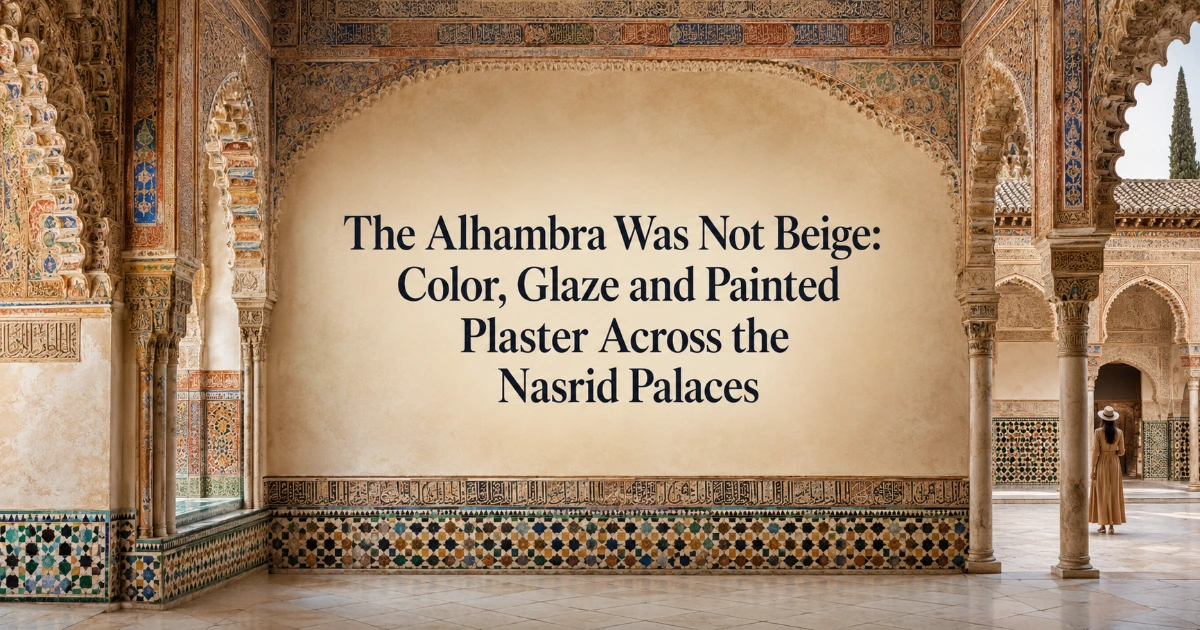
The Alhambra presents a historical tension before anyone begins to interpret it. Its Nasrid interiors are among the most intricate architectural surfaces in Europe, yet much of what a visitor sees today is pale: ivory plaster, warm stone, darkened timber and ceramic panels whose color appears concentrated close to the floor. The eye can therefore mistake survival for intention. It is easy to assume that the carved walls were conceived as the restrained, almost monochrome fields that photography has made familiar.
They were not. Surviving traces, detached fragments and laboratory analysis show that Nasrid plasterwork carried mineral blues, reds, greens and black, with metallic decoration that included gold. Woodwork was also painted, while glazed ceramics supplied color through a different technology: not a thin paint layer on gypsum, but vitrified surfaces designed to reflect light and resist wear. White remained important, sometimes as the ground against which the palette operated. The correction is therefore more precise than saying that the Alhambra was once brightly colored. Its interiors were composed through controlled relationships among white plaster, selected pigments, black outlines, gilded accents, colored glaze and polychrome timber.
The harder question is not whether color existed. It is how far the evidence permits us to reconstruct its placement, intensity and date. A blue particle in a protected recess can identify a pigment. It cannot, by itself, prove that an entire wall was uniformly blue. A surviving strip of red can belong to a Nasrid campaign, a Christian intervention or a later restoration unless its stratigraphy and material composition are understood. A museum fragment may preserve a color system more clearly than a wall, but it has been removed from the light, scale and spatial sequence that once gave it meaning.
This article uses that uncertainty as part of the subject rather than as an inconvenience. The defensible reading is that the Nasrid Palaces were substantially more chromatic than their present appearance suggests, but not that every faded surface can be mentally repainted with confidence. The most useful evidence comes from several kinds of object at once: Comares Palace surfaces that show the vertical organization of tile, plaster and wood; the Court of the Lions, where pigment and gilding survive within especially dense plasterwork; painted wooden ceilings whose hidden construction marks reveal workshop practice; and Alhambra Museum fragments that allow close comparison among ceramic techniques and historical phases.
For travelers deciding whether this degree of material attention justifies another encounter with the monument, compare the strongest themes for a second Alhambra visit. Color is not merely one decorative theme among several. Once noticed, it changes the apparent weight, hierarchy and legibility of almost every Nasrid interior.
What “not beige” actually means
The phrase is useful because it breaks a persistent visual habit, but it can also create a new misunderstanding. The alternative to a beige Alhambra is not a fully saturated fantasy in which every carved leaf, inscription and geometric band receives a separate brilliant hue. Scientific studies identify palettes and local applications; they do not provide a complete color map for every room. The surviving evidence points toward selective polychromy structured by material, motif and architectural function.
Three distinctions keep the interpretation honest.
- Verified material evidence: pigment particles, paint layers, metallic leaf, glaze composition, tool marks, mould joints, wood fragments and documented restoration records can be examined directly. These establish that particular materials and techniques existed in particular sampled places.
- Historical interpretation: scholars compare those findings with chronology, workshop practice and room function. This can support a reasoned account of early and late Nasrid palettes, or distinguish some Christian-era interventions, but attribution may remain provisional.
- Spatial judgment: a visitor or guide connects small traces to the architecture visible at full scale. This is where insight becomes vivid, but it is also where overstatement is most tempting. The responsible language is “this trace helps explain the original system,” not “this is exactly how the whole room looked.”
White itself belongs to the chromatic system. In the principal pigment study of Alhambra plasterwork, both the earlier and later palettes were understood against a white background. That background increased contrast, affected the luminosity of overlying colors and allowed black lines or gilded details to sharpen ornamental boundaries. Pale plaster was therefore not simply an uncolored remainder waiting for paint. Some white zones were intentional, while other areas have become pale through loss, overpainting, cleaning, weathering or later intervention.
The distinction matters because the Nasrid interior was organized by changes in surface behavior as much as by hue. Glazed tile is hard, reflective and visually continuous at a distance even when assembled from many cut pieces. Gypsum plaster is softer and more absorbent, capable of carrying minute relief and thin paint. Timber adds grain, depth and structural span. Gold behaves differently again, flashing in angled light rather than reading as a stable block of yellow. To recover the lost color system is to recover these contrasts among matte, glossy, metallic, carved and assembled surfaces.
How color survives as evidence
The most convincing case for a chromatic Alhambra does not depend on a single restored room. It rests on an evidence chain. First, physical traces survive on architectural surfaces and fragments. Second, microscopy and chemical analysis identify the composition and sequence of layers. Third, the location and construction technique of the plaster or ceramic object are compared with known phases of the palaces. Finally, conservators assess alteration: which colors have faded, darkened, changed chemically, been covered or been replaced.
The Patronato de la Alhambra y Generalife gives the essential technical starting point in its official account of Nasrid plasterwork. Gypsum decoration could be carved on site or made in moulds and then recarved. It was finished with mineral blue, red, black and green pigments, together with metallic additions in gold and silver. The same account points to plasterwork panels associated with the Generalife and the Palace of Comares, reminding us that museum fragments are not secondary illustrations: they can preserve manufacturing and color evidence that is difficult to read on weathered walls.
The major scientific study, Carolina Cardell-Fernández and Carmen Navarrete-Aguilera’s analysis of Nasrid polychromed plasterwork, examined samples from the Mexuar, the gate of the Mexuar, the east pavilion of the Court of the Lions and a Muslim house in the Partal. The researchers combined in-situ visual examination with microscopic and compositional methods. Their results distinguished plaster carved in place from cast plaster, identified pigment layers and metallic decoration, and showed that deterioration can radically change the colors visible to the naked eye.
This kind of analysis often works at a scale far below ordinary vision. A cross-section can reveal a white preparation layer beneath blue, a thin black outline, a sequence of tin and gold leaf, or a later coating above an older surface. Polarized-light microscopy helps characterize mineral particles; scanning electron microscopy with energy-dispersive X-ray analysis can identify elemental composition; comparison of crystal morphology can suggest whether a material is natural, manufactured or associated with a later intervention. None of these methods produces a complete digital reconstruction automatically. They produce local facts from which broader interpretations must be argued.
That local character is crucial. Twenty-four samples from selected areas can establish that specific pigments and techniques were present. They cannot make every room in the palatine city identical. The strength of the research lies precisely in its ability to show variation: between earlier and later Nasrid work, between carved and cast plaster, between architectural functions, and between original layers and subsequent campaigns.
Plaster was a colored architectural skin
Nasrid yesería is often described as lace-like, a comparison that captures its visual delicacy but obscures its material directness. It is gypsum made architectural: mixed, set, moulded or carved, joined into fields and then refined. The pale relief seen today emphasizes shadow, so modern viewers tend to read the decoration sculpturally. Pigment would have changed that balance. Color could separate motifs that now merge, reinforce the rhythm of inscriptions, distinguish foreground from recess and make repeated moulded units read as a coordinated surface rather than as undifferentiated carving.
The plasterwork did not all come from one method. The 2006 study found localized examples of fresh plaster carved in situ in the Partal Palace and at the gate of the Mexuar, while cast plaster was widely identified in the Mexuar and Lions palaces. Mould joints surviving in some rooms show how repeated elements were produced. Recarving after casting could sharpen detail and reduce the mechanical regularity of the mould. Paint then provided another level of articulation, capable of disguising joins, differentiating motifs or imposing a color rhythm across repeated units.
The base was often white gypsum, and that white should be understood as an optical tool. A light ground reflects more illumination through a thin pigment layer than a dark ground, increasing apparent brightness. The study found that green malachite could be applied over white gypsum or over a reddish-orange clay layer; the underlying tone altered the final appearance. This means that naming the top pigment is not enough. The same green material can look different depending on preparation, thickness, binder, surface condition and the color beneath it.
Black had a particularly disciplined role. The researchers observed that few surfaces were painted broadly in black; it was used primarily to outline decorative motifs. Much of it has disappeared after centuries, so the present relief can look softer and less graphically organized than it once did. Restoring black mentally as an edge rather than a field helps explain how inscriptions and vegetal forms could remain legible within highly compressed ornament.
Gold was not merely another warm color. The analysis documented gilding associated especially with muqarnas and described layered systems involving tin sheet, organic layers and gold leaf. Metallic leaf could crack, flake and detach, and the study found evidence of more than one gilding application in some samples. The result in its original state would have depended on movement and illumination: a facet could appear quiet from one angle and flash from another. A surviving dull or violet-tinged patch may therefore be evidence of altered metal and associated products rather than an intended violet paint.
Two palettes, not a single recipe
The sampled sequence belongs to a wider Nasrid chronology. The dynasty ruled Granada from 1238 to 1492. The surviving Partal palace was associated in the study with Muhammad III and the years 1302–1309; Comares with Yusuf I, who ruled from 1333 to 1354; and the Lions Palace with Muhammad V, especially the later fourteenth century. Those dates frame technical development, but they do not turn every surviving layer into a securely dated original.
The 2006 study identified two Nasrid palettes in the sampled plasterwork. In the Muslim house of the Partal, associated with the early fourteenth century and the reign of Muhammad III, the simpler palette included blue azurite, red pigments identified as cinnabar and lead oxide, and carbon black, all used with a white background. In the later sampled areas of the Mexuar and Lions Palace, the palette expanded to red, blue, green, black and gold. The blue there included lapis lazuli; the green was malachite; red included cinnabar and lead compounds; black was carbon; and gold was applied over tin leaf.
This sequence is valuable, but it is not a color chart that can be spread uniformly across the monument. The Partal sample came from a particular domestic context. The later palette was identified in particular yeserías in the Mexuar and Lions Palace. Architectural function also mattered: the study concluded that pigment composition varied with ornamental element and location. Even within one palace, the hierarchy of a reception façade, a muqarnas vault, a lower passage or a private chamber could produce different applications.
Color chronology is complicated by reuse and repainting. Red pigments were employed over long periods, including later Christian and restoration campaigns, so red alone cannot date a layer. The researchers identified Christian interventions partly through pigment morphology and composition, especially in the Lions Courtyard. They also noted undocumented transfers of plasterwork within the Alhambra. A fragment may be authentically old while no longer occupying its first location; a surface may contain Nasrid relief under later paint; a visually coherent panel may be a historical composite.
Why a pigment name does not restore a room
A laboratory identification answers “what is this particle?” more securely than “how did the entire room appear?” Several missing variables separate the two questions. The original binder can affect saturation and gloss. Layer thickness changes opacity. A polished or burnished surface reflects differently from a matte one. Salt alteration can transform a pigment chemically. Later cleaning may remove one layer more aggressively than another. Daylight entering a court is not the same as controlled museum light, and surfaces high in muqarnas receive light at different angles from a flat wall.
There is also the problem of absence. When black survives only in tiny protected lines, the original outlining system may have been extensive, but its exact continuity cannot be assumed. When gilding survives in isolated facets, those traces prove metallic decoration, yet they do not tell us that every adjacent facet was gilded. Conversely, a bare surface does not prove that it was always bare. The interpretive discipline is asymmetrical: surviving evidence can establish presence locally, while loss makes original absence much harder to prove.
This is why controlled reconstruction is most credible when it shows degrees of confidence. A diagram may distinguish sampled color, strongly inferred repetition and hypothetical completion. A conservation treatment may reintegrate a small lacuna to restore legibility without repainting an entire field. A guide may point out the edge of an original layer and then describe the larger scheme as probable rather than certain. The goal is not timidity. It is to let the evidence remain visible inside the interpretation.
Comares: reading color as an architectural sequence
Comares offers the most intelligible place to understand color as an architectural system rather than as scattered decoration. The façade and palace surfaces make visible a basic vertical sequence described in the plasterwork study: ceramic dado below, carved plaster above and timber in doors, eaves or ceilings. Each zone answered a different physical and visual need. Tile protected the lower wall and supplied durable color. Plaster carried inscriptions, vegetal forms and geometric relief at increasing complexity. Wood spanned, framed and shaded the upper parts of the composition.
That sequence is more revealing than trying to imagine one lost wall color. The tiled dado establishes a chromatic base close to the body, where polished glaze can catch reflections from water, paving and moving figures. Above it, painted plaster shifts from hard shine to matte relief. Black lines and colored motifs could organize the ornament at conversational distance, while gilded or painted upper elements would respond to more oblique light. The wooden eaves of the Comares façade, celebrated for their carpentry, formed not a neutral brown cap but part of the same material hierarchy.
The official Patronato account identifies plasterwork panels from the Palace of Comares among the kinds of material that reveal Nasrid technique. Detached or conserved fragments can preserve pigment in recesses that have been abraded on exposed architecture. They also make construction legible: thickness, backing, moulding, recarving and paint sequence can be examined at close range. Yet a fragment should be returned imaginatively to the wall with caution. Scale changes perception. A saturated blue patch that looks dominant in a display case may have functioned as a narrow line within meters of white relief.
Comares also prevents a simplistic equation between color and excess. The palace’s visual authority came from coordination. A limited palette repeated across tile, plaster and wood could produce greater unity than a larger number of unrelated hues. White provided pause. Black supplied graphic definition. Blue and green linked mineral pigment to glazed ceramic without making the two surfaces identical. Gold marked selected zones whose brightness changed with the viewer’s position.
On site, the most productive question is therefore not “Where is the missing paint?” It is “How did the materials divide the wall’s labor?” Once the lower ceramic zone, the middle field of yesería and the upper timber are read together, the pale surviving surface stops looking like the complete aesthetic statement. It becomes the residual framework of a more varied skin.
The Court of the Lions: color inside the densest surface
The Court of the Lions is where the argument becomes visually difficult and historically rewarding. Its plasterwork is so fine, repetitive and abundant that the modern eye can treat whiteness as the condition that makes the carving readable. Color seems as though it would compete with the relief. The sampled evidence suggests the opposite: pigment and gilding were among the tools that ordered that density.
The 2006 research examined material from the east pavilion of the court. It identified a later Nasrid palette of red, blue, green, black and gold on white, while also detecting interventions of later date. Black served principally as outline; gold was associated with selected ornamental zones, including muqarnas; blue layers included lapis lazuli; green malachite appeared in different tonal states depending on its base and alteration. These were not broad modern paint films flattening the carving. They were thin layers working with the relief.
Muqarnas make the interaction particularly clear. Their many small niches and facets break a surface into changing planes. White alone produces shadow. Pigment can group or separate facets; black can sharpen boundaries; gold can make particular planes flash. The result is not comparable to looking at a flat painted wall. It is a kinetic field whose chromatic emphasis changes as the viewer moves beneath it.
Much of that system is now difficult to see because color loss has not been uniform. Red lead and cinnabar can darken or lose intensity. Malachite can alter in the presence of chlorides, moving toward different green appearances. Carbon-black outlines are often fragmentary. Gold leaf cracks and detaches. A visitor may therefore see a green that is not the original green, a violet cast that is an alteration product rather than an intended pigment, or a blank relief where only the most vulnerable layer has vanished.
The consequence is important: present color cannot be read as a faded photograph of the fourteenth century. Deterioration is chemical and selective. Some blue layers may survive relatively well while adjacent red has almost disappeared. Metallic systems can leave tin, adhesive or discoloration after gold is lost. The remaining palette is biased by material durability, exposure, humidity and treatment history.
The west pavilion ceiling and the evidence behind the finished surface
Polychromy was not confined to plaster. During restoration of the fourteenth-century wooden ceiling of the west pavilion, conservators uncovered Nasrid drawings hidden among the beams and behind ceiling pieces. The Patronato’s documentation of the discovery and conservation program describes plant motifs, geometric shapes, animal silhouettes and ornamental designs, as well as carved and painted components.
The ceiling, dated in the official account to around 1380, is approximately 3.3 meters in diameter and composed of 669 elongated pieces, or zafates, organized into geometric wheels and stars around a central octagon. Those numbers matter because they replace the vague impression of “intricate woodwork” with a workshop problem: hundreds of parts had to be designed, cut, fitted, painted and assembled into a coherent hemisphere.
The hidden drawings are not simply an extra decorative layer for visitors to imagine seeing in the finished room. Their position behind components makes them evidence of process. They record how craftsmen planned, marked, tested or communicated during construction. Together with pigment study, fragment cataloguing, detailed plans and analysis of the structural system, they reveal a ceiling as an engineered and painted object rather than as an abstract geometric image.
The restoration program also demonstrates why conservation cannot be reduced to “bringing the color back.” Conservators recorded the ceiling graphically, studied pigments and construction, removed unstable pieces where necessary, restored cracked elements and protected the final assembly. Any reintegration had to respond to documented material, structural safety and the need to distinguish original work from treatment. The visible ceiling is therefore both a Nasrid object and the outcome of a modern conservation methodology.
This wooden evidence broadens the palace palette. Timber now reads primarily as brown because exposed wood, aged coatings and shadow dominate. Yet the documented carved and painted pieces show that wood participated in the chromatic system. Doors, eaves, beams and ceilings should not be treated as neutral frames around colored plaster and tile. They were a third major surface technology, capable of carrying pigment while also providing structure.
Why specialist interpretation changes the visit
A color-focused reading is unusually dependent on scale. The evidence may be a line inside a carved leaf, a darker residue beneath an undercut, a shift from matte repair to original gypsum, a glazed edge that reveals how an alicatado piece was cut, or a small metallic remnant whose meaning is invisible without the surrounding conservation history. These are not features that reward a fast search for the brightest surviving patch.
For an Islamic-art traveler, the material value of a private visit is the ability to connect those small signs without converting them into spectacle. A knowledgeable guide can distinguish verified pigment from discoloration, explain why one blue belongs to plaster and another to glaze, relate a museum fragment to the architecture from which its type came, and state plainly when an attribution remains uncertain. That changes the subject from “lost decoration” to the evidence-based life of surfaces.
Our private touring in Granada can be shaped around that slower, conservation-aware encounter, with the interpretation concentrated where it changes what is visible rather than added as a layer of general description. Inquire now
Glaze changes the logic of color
Plaster pigment and ceramic glaze can share a hue while behaving almost oppositely. Pigment sits in a comparatively thin layer on a porous mineral support. Glaze is produced through firing: its ingredients melt or partly vitrify into a glass-like surface bonded to ceramic. This gives tile color a different depth, gloss and resistance. It also means that a ceramic panel is not simply a painted version of the plaster above it.
A 2026 archaeometric study by researchers at the University of Granada provides the first systematic material data for selected thirteenth- and fourteenth-century Nasrid glazed architectural ceramics from the Alhambra and Generalife. The University of Granada research record identifies mosaics, inlays, relief tiles, rooflights and steles with white, blue, green-turquoise, black and honey-toned surfaces. Most of the analyzed surfaces were inglazes on lead-tin-opacified bases, fired in oxidizing conditions at roughly 950 degrees Celsius.
This evidence adds two corrections to the visual reading of the palaces. First, tile colors were technological recipes, not merely aesthetic choices. Opacifiers, colorants, firing atmosphere and temperature affected whether a surface became white, blue, turquoise, black or honey-toned. Second, appearance alone can misidentify material. One fragment with a black surface in the study proved not to be a glaze at all, but a polished section of metamorphic rock. The eye sees “black”; analysis distinguishes vitrified ceramic from stone.
Alicatado is assembled color
The most characteristic Nasrid wall mosaics use alicatado: small pieces cut from glazed ceramic and assembled into geometric patterns. The design is produced through joining pre-colored units, not by painting every line onto one continuous tile. Color is therefore inseparable from geometry. A blue polygon is both hue and shape; a white star is both interval and structural unit; a black or green piece defines an edge because of its cut profile as well as its color.
This method creates a visual logic different from painted plaster. In yesería, relief may repeat through moulds and then receive color across or within the pattern. In alicatado, the colored piece itself is a module. Joints form part of the drawing. The panel is conceived through tessellation, cutting accuracy and the relationship among glazed surfaces.
The Alhambra Museum’s holdings are especially useful here because “tile” is not one technique. Danielle Dias Martins’s historical and technical study of azulejos and alicatados in the museum collections classifies objects made through painted, relief, metallic-lustre, incrustation, alicatado, cuerda-seca and arista processes. The corpus includes Nasrid and later Christian material, so the diversity should not be compressed into a single medieval palette. It documents continuity, adaptation, replacement and the changing uses of the palatine city.
For the visitor, three comparisons are especially clarifying. Alicatado builds a pattern from cut monochrome glazed pieces. Cuerda seca separates different glaze colors on one object through boundary-making techniques that prevent them from running together during firing. Arista uses raised impressed lines to contain colors. Metallic lustre adds a reflective film through an additional technically demanding process. These methods can coexist within the wider history of the Alhambra without belonging to the same date or decorative campaign.
The point is not to memorize terminology in front of every dado. It is to notice that color has a construction grammar. Some patterns are assembled. Some are painted. Some are moulded in relief. Some depend on metallic reflection. Recognizing the grammar prevents a common error: treating every blue-and-white ceramic surface as equivalent simply because the palette overlaps.
White, blue, green-turquoise, black and honey
The palette identified in the 2026 ceramic study overlaps with the colors known from plaster, but the relationship is not one-to-one. Ceramic white often depends on tin opacification within a lead glaze, whereas plaster white is gypsum or a preparation layer. Ceramic blue and green-turquoise derive their appearance from colorants dispersed in a fired glassy matrix; plaster blue and green are mineral pigment particles bound to a set surface. The shared hue can unify a room, while the difference in gloss keeps the materials legible.
Honey tones are especially important because they complicate the modern opposition between “colorful” and “beige.” A warm amber or honey glaze is an intentional chromatic surface, not evidence of colorlessness. Likewise, black may be a glaze, a painted line, a darkened pigment or polished stone. The palette can only be interpreted through material identification.
Glaze also affects how the lower wall responds to changing light. A visitor walking beside a court does not perceive a tile panel as a fixed color swatch. Reflections shift with angle, daylight and nearby water. A green-turquoise piece may appear cooler in shade and brighter when it catches the sky. White glazed pieces can sparkle in a way matte gypsum cannot. These are physical consequences of surface finish, even when the exact fourteenth-century lighting environment cannot be reconstructed.
The lower ceramic zone therefore did more than protect the wall from contact and moisture. It anchored the room with a durable field of assembled color. Above it, painted plaster could be more delicate and optically complex. The contrast between the two materials helped the eye move from geometric order at the dado to increasingly fine vegetal, epigraphic and muqarnas decoration higher up.
Why the Alhambra Museum matters
The Alhambra Museum fragments are indispensable because the monument’s walls cannot answer every technical question in situ. Detached pieces allow the edges, backs, breaks and layer sequences of objects to be studied. Museum records can preserve provenance, acquisition history and previous attribution. Comparative groups reveal whether a technique is exceptional or repeated across many pieces.
The study’s comparative method matters as much as any individual fragment. Visual examination, documentary research and typological classification allow objects to be grouped by technique and historical phase, so a surface is read against a corpus rather than judged by color alone. That approach is especially important in a collection containing both Nasrid and later Christian material, where formal resemblance does not by itself establish a common date.
In interpretive terms, a fragment can reverse the usual hierarchy. On the wall, the palace overwhelms the object. In a case, a small alicer, rooflight fragment or painted tile can reveal glaze thickness, edge cutting, repair, abrasion or the difference between surface coating and ceramic body. The fragment becomes a technical document. Returning to the palaces afterward, the visitor sees the dado not as a flat pattern but as an assembly of manufactured parts.
What conservation can recover—and what it must leave unresolved
Conservation begins by refusing a false choice between complete restoration and passive decay. The task is to stabilize material, understand its history, improve legibility where justified and preserve the ability of future researchers to distinguish original work from intervention. In a monument as layered as the Alhambra, that means conserving Nasrid fabric alongside evidence of Christian occupation, historic repairs and modern restoration campaigns.
The plasterwork study explains why authenticity is difficult to assign by sight. The palaces were rebuilt and adapted during Islamic and Christian periods. Original deteriorated polychromy was sometimes restyled or covered with white paint. Plasterwork may have been transferred from one place to another. Nineteenth- and twentieth-century interventions added further materials. A surface can therefore contain several legitimate historical moments, even when one of them obscures another.
Scientific sampling helps disentangle those moments. A stratigraphic cross-section can show which layer lies above another. Pigment manufacture can suggest chronology: particle shape, fillers or synthetic products may indicate a later phase. Tool marks and joints can distinguish carved from cast plaster. Ultraviolet examination can reveal repairs made with materials designed to remain visually harmonious under normal light while identifiable to conservators.
The Patronato’s west-pavilion account describes the use of “Alhambra Mortar,” a conservation material with fluorescent properties visible under ultraviolet radiation. Its purpose is instructive. A repair may be made unobtrusive enough not to fracture the visitor’s reading of the ornament, while still remaining detectable during technical examination. This balances two ethical needs: visual continuity and documentary honesty.
Reintegration of color demands the same balance. Filling a small loss where the surrounding pattern makes the missing line certain is different from repainting an entire wall whose scheme is known only from scattered traces. Even when pigment composition is secure, original saturation may not be. Binders age, surfaces soil, glazes weather and metallic leaf changes. A modern reconstruction can illustrate one plausible state, but it should not disguise its own status as interpretation.
Digital reconstruction can make uncertainty more explicit than physical repainting. Separate views can show sampled evidence, repeated pattern inferred from symmetry and hypothetical completion. Colors can be presented in ranges rather than as one definitive tone. Yet digital images have their own authority problem: a seamless rendering looks certain even when built from uneven evidence. The most responsible reconstructions reveal the confidence level of each restored area.
The current pale appearance also carries conservation information. It shows where paint survives in protected recesses, where relief has been abraded, where moisture altered copper pigments and where gilding detached. Whitening those differences into a clean virtual model would erase the history of material change. The aim is not to choose between the fourteenth century and the present. It is to understand how the present contains partial, altered access to the fourteenth century.
A visual grammar for the Nasrid Palaces
The most useful way to carry this material knowledge through the palaces is to ask a sequence of questions. They are not a scavenger hunt for rare surviving color. They help distinguish systems from isolated details.
- Where does the material change? Begin at the boundary between ceramic dado, plaster and timber. Those transitions often explain more than any single pigment trace because they reveal how durability, touch, light and ornament were distributed vertically.
- Is the color intrinsic, applied or assembled? A blue glazed piece, a blue pigment layer on gypsum and a blue-painted wooden element may share a hue but differ in manufacture, aging and visual behavior. Identify the support before interpreting the color.
- Does black form a field or an edge? In the sampled plasterwork, black mainly outlined motifs. A fragmentary dark line can therefore be evidence of a larger graphic system that once clarified the relief.
- Is a warm tone intentional color or alteration? Honey glaze can be original. Brown timber may be aged or coated. Red pigment can darken. A violet cast may relate to altered metallic layers rather than planned violet paint. Surface color is a clue, not a conclusion.
- What is protected by depth? Recesses, undercuts, joins and areas behind architectural elements can preserve layers lost from exposed planes. The least conspicuous part of a carving may hold the strongest evidence.
- Does repetition justify inference? Symmetry and mould repetition can support a probable continuation of a color pattern, but only after an original trace is securely identified. Repetition strengthens an inference; it does not create evidence from nothing.
- Can the intervention be distinguished? Repairs may be designed to harmonize under ordinary light while remaining legible under technical examination. A visually continuous surface can still contain clearly documented modern work.
This grammar changes pacing. The Comares façade benefits from stepping back to read vertical organization and then moving closer to inspect transitions. The Court of the Lions requires attention to undercut relief and muqarnas, where angled planes preserve and transform traces. The museum invites the reverse movement: start close to the fragment, then imagine the repeated object within a larger wall.
The counter-reading: the pale Alhambra is also historically true
There is a risk in correcting the beige myth too aggressively. The Alhambra that survives is not a failed copy of a more authentic colored original. Its pale surfaces document six centuries of use, exposure, intervention, neglect, admiration and conservation. Color loss is historical evidence. So are later white layers, repaired joins and replacement pieces.
The present appearance has also shaped the monument’s modern reception. Romantic travelers, architects, photographers and restorers encountered an Alhambra already transformed. Their drawings and interventions influenced how Europe imagined Islamic architecture and how the complex was conserved. To remove that history conceptually in pursuit of a pure Nasrid state would create another simplification.
White, moreover, was part of the original system. The scientific identification of white backgrounds means that a chromatic reconstruction must preserve intervals of light ground. The decorative force came from contrast, not from covering every visible surface. In some zones, the current pale relief may exaggerate the amount of white but still preserve an essential component of the design.
The more persuasive counter-reading is therefore layered. The Nasrid palaces were chromatic. Their color was selective, materially differentiated and historically changeable. The surfaces visible now are neither the untouched medieval scheme nor a meaningless ruin of it. They are composite documents in which original ground, surviving pigment, chemical alteration, later paint, cleaning, repair and loss coexist.
The open question the walls leave us
The evidence is now strong enough to reject the monochrome assumption. Nasrid plaster was painted; black outlines sharpened relief; blue, red and green mineral pigments survive; gold marked selected areas; ceramic glazes created durable fields of white, blue, green-turquoise, black and honey; wood was carved and painted; later interventions and chemical alteration changed what remains. The Alhambra was not beige.
But the phrase is most valuable when it opens rather than closes interpretation. A complete visual reconstruction can help modern eyes understand that the palace was once more chromatic, yet its seamlessness may conceal the uneven basis of the image. The existing walls preserve less color, but they expose uncertainty, layering and loss. The museum fragment offers material clarity, but not always original position. The laboratory identifies composition, but not every perceptual effect of scale and light.
The unresolved task is to hold two palaces in view at once: the designed Nasrid environment, richer in color and reflective contrast than the surviving rooms, and the historical monument whose altered surfaces carry the evidence of everything that happened afterward. How much reconstruction is needed to recover the first before it begins to overwrite the second?
If you’re interested in any private tours of Granada, please reach out to us.



 So if you are looking for the absolute best in Granada & surroundings with authentic local fully-licensed native guides whose English you can actually understand and with an exclusive and amazingly fun itinerary













