Royal Chapel, Sacromonte or a Sierra Nevada Escape? How to Spend a White-Glove Second Day in Granada After the Alhambra
Updated
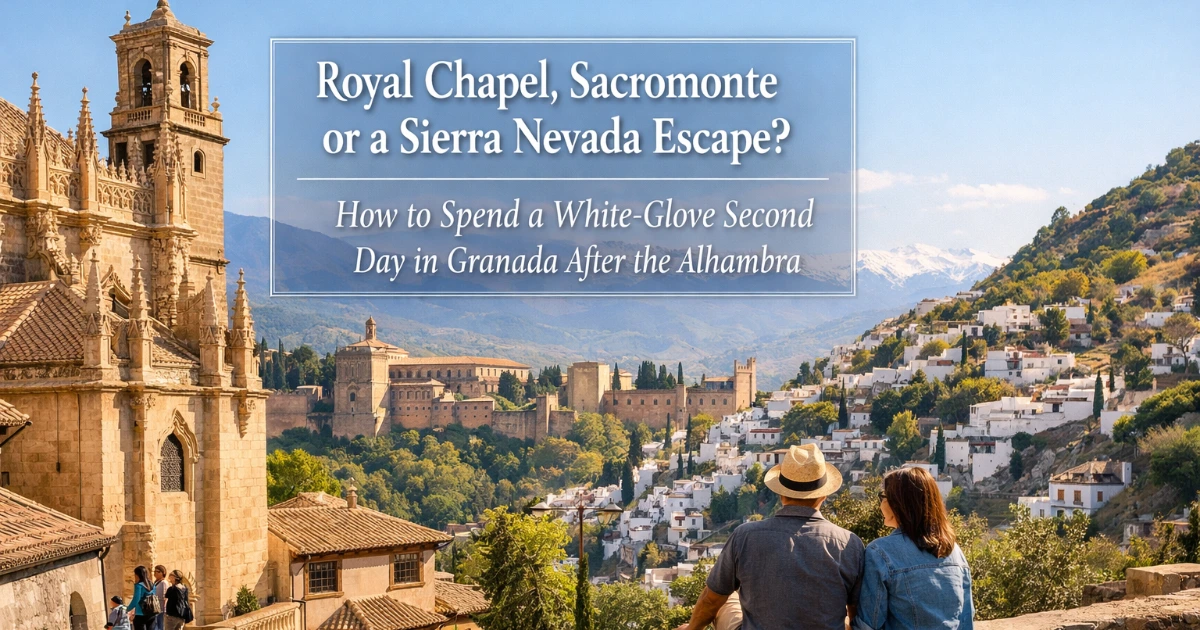
The default second day in Granada is the Royal Chapel and the city core, not another hill. It works because Granada is a city of compressed effort: the Alhambra usually absorbs more walking, stairs, and visual attention than first-time visitors expect, so the smartest follow-up is a day that changes the texture of the trip without flattening the evening. The clearest exception is the traveler who wakes up wanting air, distance, and a completely different horizon; for that person, a restrained Sierra Nevada outing can beat another urban plan. For travelers who already feel visually saturated after the Alhambra, Sacromonte is the least rewarding second-day choice.
Granada rewards contrast more than accumulation. That is the thesis here, and it matters because so many second days go wrong by trying to prove you still have energy for “more Granada” when what the trip actually needs is either city-core ease or a true mountain change. The Plaza Nueva to Carrera del Darro split tells the story in one glance: stay near the cathedral side of town and the day opens into royal history, lunch, and flexible pacing; follow the river and the city quietly starts asking your calves for another round. If you are still deciding whether Granada deserves two or three nights at all, start with how many days in Granada; if you already know you have the second day, this guide is about choosing the right shape for it.
Royal Chapel, Sacromonte or Sierra Nevada after the Alhambra: what actually works?
Read the answer off yesterday’s legs: choose Royal Chapel if yesterday felt bigger than expected, choose Sierra Nevada when emotional contrast matters more than another monument, and choose Sacromonte only if your post-Alhambra hill tolerance is genuinely high.
Default winner: Royal Chapel. This is the best answer for most two- and three-night stays because it delivers a different Granada: dynastic, urban, compact, and easier on the body. It also preserves lunch and dinner ambition.
Runner-up: Sierra Nevada. This wins when the city already feels dense and you want a lower-mountain pullout, a scenic lunch, and a return to Granada with appetite rather than fatigue.
Wrong fit for many: Sacromonte as a full daytime second day. It can be memorable, but after the Alhambra it is often another dose of slopes, views, and fragmented routing rather than the change most first-time visitors need.
- Choose Royal Chapel when new historical substance matters more than another major climb.
- Choose Sacromonte if you care about cave-district texture, long sightlines, and hillside character more than relief from walking.
- Choose Sierra Nevada if you are staying long enough that leaving town will not make Granada feel unfinished.
The comparison only makes sense if you judge it by traveler consequences, not by postcards. The four criteria that matter are how different the day feels from the Alhambra, how much hidden effort it adds, what it does to your evening, and whether leaving town steals time from the Granada you have not yet properly enjoyed. By those criteria, Royal Chapel usually wins because it changes content and pacing at the same time. Sacromonte changes the view lines but not the physical logic enough. Sierra Nevada changes mood more radically, but only earns the drive when you truly want that rupture and have room in the stay for it.
A useful correction early on: many visitors overvalue the idea of “another hillside neighborhood” because Carrera del Darro and Paseo de los Tristes begin so seductively. The problem is that those first flat or nearly flat minutes disguise what comes next. A Sacromonte day often feels easy until it does not, and by then you are committed to more ascent, more transfer decisions, or a tired descent at the very point the trip should be opening into lunch or a relaxed afternoon. That is why the glamorous-sounding answer is not automatically the best one.
Why the Royal Chapel is the best second day for most first-time Granada stays
The Royal Chapel is the best second day because it replaces panoramic overload with narrative depth. After the Alhambra, many travelers do not need another magnificent setting; they need a different register of the city, one that is indoor-friendly, historically dense, and easy to sequence around lunch, shopping, or a hotel pause.
In practical terms, the Chapel-and-centro option works because it keeps the day on a shorter urban spine. From the Cathedral and Capilla Real area, you can move through Bib-Rambla, Alcaicería, Plaza Romanilla, and Gran Vía without the stop-start rhythm that comes from repeatedly climbing and descending. Even travelers who enjoy walking often underestimate how much better this feels on day two. The Alhambra is not only the site itself; it is the approach, the internal rises, the courtyards that tempt you to linger, and the long mental concentration required to take it in. The next day, a compact center route gives you a different kind of attention span. You absorb rather than push.
That matters to the body. Granada does not punish visitors with huge distances so much as with cumulative elevation and transfer resets. A Royal Chapel day cuts both. You are less likely to need tactical taxis, fewer handoffs are required between viewpoints and neighborhoods, and your lunch window stays civilized instead of becoming a recovery stop. For couples, that often means the day feels more elegant. For families, it means fewer negotiations. For celebration travelers, it means you arrive at dinner ready for it.
The Royal Chapel also avoids the common mistake of asking day two to compete with day one. It cannot, and it should not. A strong Granada stay is not one monumental spectacle followed by a weaker imitation; it is one monumental day followed by a day that reveals how the city reorganised itself around different powers, different rituals, and different scales. That is why the Chapel works so well after the Alhambra. It gives the trip historical breadth rather than just more scenic echo.
There is a practical truth here that deserves saying plainly: the value of a private Royal Chapel day is usually not transport. It is sequencing, interpretation, and comfort in the margins. A good guide turns the Chapel from a dutiful stop into the key that unlocks why Granada feels so layered and why the shift from Nasrid to Catholic Granada matters to what you see elsewhere in the center. The clearest next step is Royal Chapel & Cathedral private tour.
But the same honesty cuts the other way. Paying for a driver or private second day does not materially improve the Granada stay when your plan never leaves the flat center around Cathedral, Capilla Real, Bib-Rambla, and nearby lunch streets. In that specific scenario, spend more on a strong guide, a better lunch, or a good dinner reservation rather than on a vehicle that will mostly wait while you walk short distances anyway.
Where Royal Chapel becomes especially strong is with travelers staying in central Granada or anyone who wants the evening to remain one of the trip’s pleasures rather than its casualty. A city-core second day leaves you with options: a longer lunch that does not derail the afternoon, a hotel rest without the feeling of “losing the day,” a late shopping pass, or an ambitious dinner. If dining matters, this is the version of Granada that pairs most naturally with it. A look at the current MICHELIN Guide selection (https://guide.michelin.com/us/en/andalucia/granada/restaurants) shows the level of restaurant planning many visitors now build into a two- or three-night stay, and Arriaga – Menú (https://arriagarestaurante.com/menu/) gives a clear sense of the kind of polished, longer-form meal that is far easier to enjoy after a center-based day than after another steep neighborhood push.
The honest limitation is equally important. Royal Chapel is not the right emotional answer if your whole party is indifferent to dynastic history, church interiors, and the Christian reconstruction of Granada’s story. If you already know you want air, outlook, and space far more than interpretation, then staying in town can feel dutiful. In that narrower case, Sierra Nevada deserves serious consideration. But for most first-time visitors, especially those who came to Granada for more than just views, the Chapel is the option that makes the stay feel complete rather than merely extended.
There is one more reason it wins. A good second day should make day three easier, not harder. If you are leaving Granada after one more night, the Royal Chapel day keeps departure day light. If you still have another full day, it keeps your energy bank intact for a food route, a gentler neighborhood walk, or a short custom plan on day three. The point is not only that it is easier. The point is that it creates room.
When Sacromonte is rewarding, and when it is just more uphill
Sacromonte is rewarding when you actively want hillside texture, cave-settlement context, and a more angular, less monumental Granada. It is just more uphill when you are choosing it as a generic “authentic neighborhood” answer after a day that already gave you slopes, viewpoints, and visual saturation.
This distinction matters because Sacromonte is not bad; it is simply narrower in its ideal audience than its reputation suggests. Travelers who love urban topography, layered vernacular landscapes, and the feeling that a city keeps changing as you climb will often find it memorable. It can also be a strong fit for repeat visitors who have already done the central monuments well, or for travelers whose real goal is a view-driven, neighborhood-based Granada rather than a monument sequence. In those cases, Sacromonte has personality to spare.
But on a second day after the Alhambra, the route realities become decisive. From Plaza Nueva, the pull along Carrera del Darro can feel almost too easy at first, especially with the river at your side and the Alhambra rising above. Then the rhythm changes. Paseo de los Tristes extends the walk; Cuesta del Chapiz or the higher approaches begin separating the group by pace; and once you commit further toward the Camino del Sacromonte side, the day starts depending on who still has spring in the legs and who would rather already be at lunch. That is why Sacromonte so often divides groups: one person is enchanted, another is simply managing effort.
For first-time visitors, this can create an unpleasant kind of repetition. The Alhambra day was already a high-cognition, high-walking, viewpoint-rich experience. Sacromonte gives you another version of hillside Granada rather than a clean contrast. The difference is cultural and atmospheric, yes, but the body often experiences it as “more climbing, more vistas, less reset.” That is exactly why it becomes the least rewarding second-day choice for travelers who leave the Alhambra feeling visually full.
Hotel position makes this even sharper. If you are staying in the upper Albayzín or higher parts of the Realejo, a Sacromonte day can become two different hill problems: getting to a sensible starting point, and then solving the return. In real planning terms, this is where private planning starts to earn itself. Not because Sacromonte is hard in an expedition sense, but because smarter entry and exit points matter. Beginning too low and ending too high, or vice versa, can turn an atmospheric half day into a logistical muddle. That is why a focused Sacromonte private tour can be worthwhile when the neighborhood is genuinely your priority.
Still, the correction remains. Sacromonte is often stronger as part of an evening or partial route than as the spine of your whole second day. The light softens, the payoff of the views feels more deliberate, and the sense of effort competes less with your desire to be done. If your instinct is telling you that Sacromonte appeals more as mood than as mission, trust that instinct. The more natural next read in that case is this Granada evening comparison guide.
The travelers who should actively choose Sacromonte for day two are fewer but real. Choose it if you finished the Alhambra eager for more outdoor time, if your party enjoys uneven urban walking, if long view corridors matter more to you than indoor history, and if you are comfortable accepting that lunch may need more deliberate placement. Choose it too if your idea of a rewarding day is one neighborhood deeply, not three stops cleanly.
Who should avoid it? Anyone with shaky hill tolerance, anyone traveling with older parents who have already worked hard at the Alhambra, anyone with children nearing the edge of patience, and anyone whose real dream for day two involves a polished lunch and a calm lead-in to dinner. Sacromonte can absolutely be special, but it is not the neutral answer. Treating it as the automatic day-two upgrade is one of the easier ways to make Granada feel more strenuous than it needed to.
There is also a sequencing warning worth keeping in mind. Do not pair a full Sacromonte day with the idea that you will “also just quickly do” the Royal Chapel afterward. Those two experiences pull in opposite directions. One asks you to linger in a compact, central register; the other disperses your energy over a hillside route. If the trip is getting overpacked, cut the full Sacromonte daytime plan first. You can always preserve a Sacromonte flavor in one lookout, a transfer-assisted pass, or an evening slot. What you should stop forcing is the idea that a complete Granada stay requires a whole day there immediately after the Alhambra.
Should you stay in town on your second day in Granada or leave for Sierra Nevada?
You should leave town for Sierra Nevada only when you want a genuine mood change and have enough Granada time left that the city will not feel abbreviated. Otherwise, stay in town. The best mountain version is not a heroic outing; it is a carefully edited lower-mountain escape.
Sierra Nevada works because it solves a different problem from Royal Chapel and Sacromonte. The Chapel solves content fatigue by changing historical register. Sacromonte extends Granada’s hillside identity. Sierra Nevada changes the air itself. After stone, courtyards, and compressed urban layers, the mountain road offers distance, silence, and a reset of scale. For some travelers, especially those doing a fuller Andalusia itinerary, that is exactly what makes Granada memorable rather than just admirable.
But leaving town only earns its place if it truly changes the emotional weather of the trip. A restorative mountain day only works when it genuinely changes mood rather than adding transit for its own sake. That is why the phrase that matters here is lower-mountain pullout. You are not trying to “conquer” Sierra Nevada or squeeze every possible altitude meter from the day. You are looking for an elegant arc: an easy departure from Granada, the road beginning to rise after the city’s eastern edge, one or two well-chosen stops, a calm lunch, and a return before the day turns into a transfer marathon.
This is where many do-it-yourself plans misjudge the mountain. Visitors either under-plan it and end up with an unstructured drive, or over-plan it and turn the day into obligation. The sweet spot is somewhere between. Once you are climbing beyond Cenes de la Vega and the city starts falling away, you need fewer stops, not more. The point is the sensation of leaving Granada’s compressed fabric behind, not collecting a string of minor lookouts. A strong Sierra Nevada second day is edited, not exhaustive.
For the right traveler, this can be a better use of day two than Sacromonte. Couples on a celebratory trip often respond well to the sense of space and the cleaner rhythm. Food-and-wine travelers can pair the outing with a mountain lunch and still return to Granada ready for a serious dinner. Small groups that do not all share the same appetite for churches or dense urban walking may find the mountain the easiest consensus answer. And travelers who know they become irritable when one big monument day is followed by another city day often feel visibly better with this choice.
The wrong fit is equally clear. Sierra Nevada is not the right answer if you only have two nights and have barely spent any non-Alhambra time in Granada itself. It is also not the right answer if leaving town is just a way to avoid deciding between the Chapel and Sacromonte. The drive needs purpose. If what you really want is a less tiring day without sacrificing the city, the Royal Chapel already gives you that. Going to the mountain merely to “do something different” can leave Granada feeling oddly unfinished.
This is the option where paying more changes the day most noticeably. A private mountain plan helps because route editing, pickup simplicity, weather judgment, and stopping discipline all affect whether the outing feels refined or wasteful. A strong private version knows when a lower-mountain pullout is enough, when lunch should happen, and when to turn back rather than chase a thinner payoff higher up the road. That is the logic behind a Sierra Nevada private tour that is built for the second day rather than treated like a generic day trip.
There is also a mood dividend here that is easy to miss in planning but obvious in real life. Granada can feel smaller after the Alhambra because so much of the trip’s visual climax has already happened. A mountain day solves that by reopening the horizon. You return with the city re-proportioned, and the evening in Granada often lands better because it feels chosen, not obligatory. This is especially effective for travelers who are staying one more night and want the final dinner to feel like a pleasure, not a recovery project.
Still, restraint matters. Do not turn Sierra Nevada into a seasonal sports piece in your head, and do not imagine that longer automatically means better. The second day should not become a second production. The mountain earns its place only when it is the calmest route to a different feeling.
What Granada does to the body, and what the right second day does to the mood of the trip
Granada tires travelers through accumulation, not spectacle alone. That is why the right second day feels better long before dinner. The city layers climbs, descents, stone paving, interior visits, queue moments, and orientation shifts into a stay that looks compact on a map but lands more fully in the legs than many expect.
The Alhambra concentrates that effect. Even with good pacing, the day usually includes an approach, periods of standing, a sequence of indoor and outdoor spaces, and a descent or transfer that arrives later than people imagine. On day two, the body does not care that Sacromonte and the Alhambra are “different experiences” if both ask for long uphill commitment. Nor does it care that Sierra Nevada is scenic if the drive is overlong. It responds to total load: ascent, time on feet, and the number of times the day asks you to reset your bearings.
This is why center-based Royal Chapel days feel so good in practice. They reduce hidden strain. This is why badly designed Sacromonte days disappoint. They preserve hidden strain. And this is why edited Sierra Nevada days can outperform their mileage. They replace strain with stillness and view rather than with another urban demand. One paragraph explains what Granada does to the body best: the city punishes stacking more hills more than it punishes one longer but cleaner plan.
The mood effect is just as real. A second day after the Alhambra should keep Granada alive for the evening. When travelers choose badly, the city shrinks into logistics. They spend the late afternoon deciding whether to push on, go back, or skip dinner. The stay starts feeling shorter, not because there were too few hours, but because too many of them were spent managing effort. The correct second day has the opposite effect. It gives the night back to you.
Royal Chapel is the strongest evening protector because it finishes neatly. Sierra Nevada is the best mood reset when city density is the problem. Sacromonte can be beautiful, but it most often steals from the later part of the day unless you are exactly the kind of traveler who gains energy from climbing and views. That is why choosing by “what sounds most atmospheric” is not enough. You need to choose by what preserves the version of Granada you still want to enjoy after 5 p.m.
The wrong second day can also distort your memory of the city. Granada is small enough that repeated hill fatigue makes it feel repetitive. Visitors come away saying, in effect, that everything was lovely but a little effortful and somehow all of a piece. Contrast fixes that. A Chapel day gives you dynastic intimacy, urban life, and dinner appetite. A mountain day gives you space, breath, and a return. Both create chapters. A poorly timed Sacromonte day can blur chapters into one long, sloping sentence.
This is also where thoughtful private planning earns trust without needing to announce itself loudly. The real upgrade is not status language; it is avoiding a plan that makes Granada feel like an endurance test in elegant disguise. That can mean choosing Royal Chapel over Sacromonte even when Sacromonte sounds more romantic. It can mean using one transfer at the right moment instead of half-solving the route with tired improvisation. It can mean deciding that the mountain answer is a four- or five-hour arc, not an all-day escape. Those decisions are where smoother travel lives.
What to cut first, where extra spend helps, and how to place day two in a two- or three-night stay
If your Granada plan is starting to feel overstuffed, cut the full daytime Sacromonte plan first. Keep Royal Chapel if you have not yet done it, and keep Sierra Nevada only if a real mountain contrast is the whole point of day two.
That cut-first rule surprises some travelers because Sacromonte sounds more atmospheric than a royal or ecclesiastical interior. But second days are not won by atmosphere alone. They are won by what they do to the stay. Royal Chapel adds a new historical layer with relatively low friction. Sacromonte adds more of the city’s demanding physical logic. When time is tight, you protect difference first and duplication second. That usually means keeping the Chapel and trimming Sacromonte down to a partial route or evening flavor.
There is a similar rule for three-night stays. Do not feel obliged to “graduate” from Royal Chapel to Sacromonte and then to Sierra Nevada, as though the city requires all three to count. Trying to do everything is how Granada becomes repetitive or exhausting. Two well-shaped days beat three dutiful ones. If you have three nights, the strongest pair is often Alhambra plus Royal Chapel, with the third-day choice depending on energy: Sacromonte if you still want urban texture, Sierra Nevada when mountain air is the point. If you only have two nights, Royal Chapel is usually the safer and richer companion to the Alhambra.
Where extra spend helps is specific rather than universal. It helps in Sacromonte when starting point, finish point, or hill management will affect the mood of the group. It helps in Sierra Nevada because route editing and stopping discipline are the difference between serene and pointless. It helps for mixed parties when one person wants history, another wants lunch, and someone else needs shorter walking bursts. It helps when your hotel is uphill enough that every return becomes a decision.
Where it does not help is just as important. Premium spend does not help when you are forcing transport into a day that is already compact, walkable, and centered on the Royal Chapel and nearby streets. Premium spend also does not help when the plan itself is wrong. A driver cannot make an ill-chosen second hill feel restorative. A private guide cannot make a traveler who wants mountain air suddenly love another church interior. Good planning is still upstream of good service.
The best sequencing is simple. If your Alhambra day was long and full, put Royal Chapel next. If your Alhambra visit was unusually light, your hotel is well-placed, and the weather is kind, then Sacromonte can be considered—but only with honesty about effort. If the entire party wants a break from urban density and you have enough nights to absorb it, make day two the mountain day and return to Granada with the evening still intact.
There is one more nuance for comfort-first travelers: lunch location matters more than people think. A good second day should make lunch feel like part of the city, not an emergency pause. Chapel-and-centro routing does this naturally. Sierra Nevada can do it if planned with discipline. Sacromonte often turns lunch into a logistical question because the route pulls you away from the easiest central options just when energy dips. That is not a deal-breaker, but it is a real consequence, and it should influence the choice.
If all of this sounds oddly specific, that is because Granada punishes vague second-day planning. Generic advice like “just see Sacromonte after the Alhambra” misses how often travelers actually want contrast, not continuity. The right private plan avoids the repetitive or exhausting version of Granada by aligning day two with your hotel location, your dinner ambitions, and how yesterday actually felt in the body. That is the point where private tours in Granada stop being a generic add-on and start acting like route design. When that is the issue you want solved rather than improvised, Inquire now.
FAQ
What is the best second day in Granada after the Alhambra?
For most first-time visitors, the best second day is the Royal Chapel and central Granada. It gives you a genuinely different layer of the city, asks less of the body than another hill route, and leaves more energy for lunch, shopping, or dinner.
Is Sacromonte worth it on day two after the Alhambra?
Sacromonte is worth it only if you still want hillside walking, long views, and neighborhood texture after the Alhambra. It is usually not the best choice for travelers who already feel physically or visually full, because it can feel like more ascent rather than a change of pace.
When is Sierra Nevada a better second day than the Royal Chapel?
Sierra Nevada is better when you want a complete mood shift and have enough time in Granada that leaving town will not make the city feel unfinished. It is strongest as a lower-mountain scenic outing with a calm lunch, not as an overlong excursion.
Should I stay in town on my second day in Granada or leave the city?
Stay in town if you still want more of Granada itself and need a smoother, more compact day. Leave for Sierra Nevada only if the whole point is air, distance, and emotional contrast after a dense first day.
What is the least rewarding second-day choice if I already feel saturated after the Alhambra?
The least rewarding choice is usually a full daytime Sacromonte plan. For travelers who are already visually saturated, it often repeats the city’s hillside effort without giving enough contrast in return.
Does a private guide or driver help for all three options?
No. A guide usually helps more than a driver on a Royal Chapel day, especially if you are staying in the center. A driver helps much more for Sierra Nevada and can also help on Sacromonte days where smarter entry and exit points reduce strain.
Can I combine Royal Chapel and Sacromonte on the same second day?
You can, but it is rarely the strongest design after the Alhambra. The cleaner choice is usually one of them as the day’s main shape, with Sacromonte reduced to a partial route or shifted to evening if you still want that atmosphere.
What should families or older parents choose for day two in Granada?
Most families and travelers with older parents will do better with the Royal Chapel and central Granada, because it limits extra climbing and keeps the day easier to adjust. Sacromonte is the riskiest choice for hill fatigue, while Sierra Nevada can work well if everyone wants a calm scenic outing by car.
If you’re interested in any private tours of Granada, please reach out to us.



 So if you are looking for the absolute best in Granada & surroundings with authentic local fully-licensed native guides whose English you can actually understand and with an exclusive and amazingly fun itinerary













