How Many Days in Granada for a Tailor-Made Andalusia Trip? 1, 2 or 3 Nights with the Alhambra in the Right Place

Updated
Two nights is the right default in Granada. It is the shortest stay that lets you put the Alhambra in its proper place, then still keep enough energy for the Albayzín and Sacromonte instead of turning the city into a timed monument with luggage attached. The second night matters because Granada’s value is not only inside the walls of the Alhambra; it is also in the hour when you reach the mirador edge above Carrera del Darro at dusk and the day finally slows down. One night can work, but only when your Alhambra timing cooperates, your hotel is chosen for logistics rather than postcard romance, and you accept that some of Granada’s best value is mood, not one more checklist stop.
That is the key thesis here: Granada earns time by separation, not by quantity. The city works best when the Alhambra is not fighting with uphill lanes, late dinners, station transfers, or the decision of whether to push on to another Andalusian stop. If your trip design still starts with the monument, begin with planning Granada around the Alhambra. The counterintuitive correction comes early: sleeping high in the Albayzín is not the most rewarding move on a short stay just because the views are beautiful. On one or two nights, a romantic address can quietly make the whole city feel shorter.
The answer turns on four things: your Nasrid Palaces slot, whether you want one real hill-neighborhood evening, how much climbing your group actually tolerates, and whether a third night has a named purpose beyond “more time.”
- Choose one night when Granada is a precision stop inside a larger Andalusia route, you can sleep before the Alhambra visit, and you are content with one good evening plus the monument itself. This is the efficient answer, not the generous one.
- Choose two nights when you want Granada to feel like a city rather than a booking challenge. This is the best answer for most first-time, multi-city travelers because it separates the Alhambra from the Albayzín and Sacromonte, protects dinner, and gives your legs a chance to keep liking the trip.
- Choose three nights only when the extra night has a job: a slower family pace, a late arrival that would otherwise eat the stay, a celebration meal, a food-and-wine agenda, or a traveler mix that needs more recovery between climbs and culture. A third night is not automatically the more elevated choice.
Is two nights enough in Granada for a first Andalusia trip?
Yes. Two nights is enough in Granada for most first-time Andalusia travelers, and it is the stay length that most consistently puts the Alhambra in the right place.
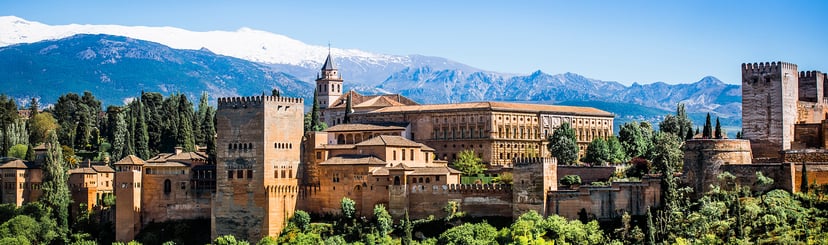
The reason is structural, not sentimental. The official Patronato guidance makes clear that the general daytime visit is valid for the day, while the Nasrid Palaces require entry at the specific time printed on the ticket. That means your stay length should be built around the ticket shape before anything else. A morning Nasrid Palaces slot is the friend of a short stay. An afternoon slot often pushes you toward a Generalife-first plan and makes a two-night stay much more comfortable. Before you lock trains, drivers, or lunch, check the official visit guidance (https://www.alhambra-patronato.es/en/visit/organize-your-visit/time-of-the-visit) and the official ticket portal (https://tickets.alhambra-patronato.es/en/).
In practice, a morning Nasrid slot lets you wake up in Granada, enter the palaces without transfer stress, and then finish the Alcazaba, Generalife, and the rest of the complex before lunch or a late departure. That is why one night can be viable when everything lines up. But an afternoon Nasrid slot changes the minimum viable stay because your day now has an exposed middle. You either drift through the rest of the complex first and wait for the palace entry, or you spend the day measuring time instead of enjoying it. For a private, tailor-made route, this is exactly where disciplined sequencing matters more than adding another sight.
Think of the ticket in stay-length terms. A morning palace entry allows the monument to be the spine of the day. You can move through the palaces at your sharpest hour, continue through the rest of the complex, and still leave Granada feeling that the city held together. An afternoon palace entry does the opposite. It places a time-sensitive appointment in the middle of the day and makes the hours before it feel provisional. For travelers arriving that same morning from another Andalusian city, that difference is often the whole argument for adding a second night.
This is why “can I technically do it?” is the wrong question. Technically, many Granada plans are possible. The useful question is whether the plan still leaves room for the city to feel coherent. Two nights keeps your margin when a transfer runs late, when lunch goes long, when the family needs a pause, or when you simply do not want to spend half the day calculating how far you are from the palace entry. It is the shortest stay that gives you resilience as well as access.
Two nights also lets you be selective. You can make the Alhambra the intellectual center of the stay without letting it consume your only evening. The city below then has room to breathe: a proper dinner, one slow walk, maybe a late start the next morning, and enough margin that a delayed arrival does not knock over the entire plan. Granada is one of the easiest Andalusian cities to under-allocate because the visible headline is one monument, while the real trip effect comes from how the monument sits inside the stay.
My firm editorial call is simple: if you care about both the Alhambra and the experience of Granada itself, protect the second night before you protect the fantasy of a grander third one. The second night changes the shape of the visit. The third only helps when you know why you are buying it.
When one night is enough—and when Granada is being squeezed too tightly
One night in Granada is enough only when it is designed as a deliberate precision stop, not when it is a compromise created by overstuffing Andalusia.
The successful one-night version usually looks like this: arrive with enough daylight to settle in, keep the evening low-friction, sleep in the city, visit the Alhambra the next day with time on both sides of the ticket, then depart after lunch or later. That pattern suits couples, disciplined first-timers, and small groups who already know that Granada’s role on this trip is focused rather than expansive. What it unlocks beyond the Alhambra is not “another day of sightseeing.” It unlocks one good dinner, one atmospheric walk, and one calmer start to the monument visit.
The failed one-night version is different. It tries to stack arrival, baggage, hotel check-in, a token run through Carrera del Darro, a Sacromonte evening, and then a timed Alhambra visit the next morning before departure. That is not a refined short stay. That is Granada being squeezed too tightly inside an Andalusia trip. If the city is reduced to a race between the hotel, the ticket time, and the next transfer, the result is not exclusivity or efficiency; it is friction wearing a premium price tag.
Who should avoid the one-night plan? Families with young children, travelers with limited appetite for repeated hills, celebration travelers who want one real dinner and not a tactical refueling stop, and anyone who cares deeply about the Albayzín and Sacromonte as lived-in evening districts rather than background scenery. One night can also disappoint travelers who arrive emotionally expecting Granada to feel romantic and slow. The city can still be beautiful in twenty-four hours, but it rarely feels generous in that timeframe.
The first thing to cut when the route is getting crowded is the forced stack of Alhambra plus full hill-neighborhood evening plus next-morning departure. Cut that first. Do not cut the breathing room around a timed Alhambra visit and then pretend the problem has been solved.
There is also a practical emotional limit to what one night can carry. The lower city can give you a graceful evening quickly; Plaza Nueva, the first stretch of Carrera del Darro, and the river corridor do not demand much commitment. But the more Granada you try to stack onto that single night, the more the plan starts to punish itself. The city’s beauty can be immediate; its depth is not. One night gives you the surface glow very well. It rarely gives you the full texture.
If you truly only have one night, spend it in a way that respects the city’s natural rhythm. Keep dinner in the lower city or on an easy walk from your hotel. Let the evening be about absorption, not conquest. Watch Carrera del Darro come alive, notice how the light changes on the stone, and stop before the city starts asking too much of your legs. The mistake is not choosing one night. The mistake is choosing one night and still trying to behave as if you had three.
Why the second evening changes the city
The second evening is what turns Granada from a successful booking into a memorable stay.
This is the part many planners miss because it does not show up as a museum pin. After the Alhambra, the most meaningful extra time in Granada is not “more sightseeing hours.” It is the ability to experience the hill neighborhoods without arriving at them already spent. Walk from Plaza Nueva into Carrera del Darro, let the river corridor and the stone facades pull you forward, reach the mirador edge above Carrera del Darro at dusk, and only then decide whether the night belongs to the Albayzín, Sacromonte, or dinner. That sequence is why Granada’s second-night value is emotional, not only logistical.
Separate the Alhambra from that evening and the city feels composed. Combine them and the mood changes. A day that begins with timed palace access, long enclosed viewing sequences, sun exposure, and the scale of the complex can flatten the appetite for one more climb. From Paseo de los Tristes upward, Granada stops being a lazy stroll and becomes a decision about energy. That is especially true for families, older travelers, and mixed-age groups where one person’s “quick uphill walk” is another person’s quiet breaking point.
The Albayzín and Sacromonte do justify extra time when you care about how the trip feels after the monument is done. The Albayzín earns its place because its lanes, carmens, and viewpoints work best when you can wander a little without guarding the clock. Sacromonte earns its place when the evening itself matters to you, whether that means cave-district atmosphere, a longer dinner, or simply the sense that Granada continues after sunset rather than ending at the hotel. If those neighborhoods are central to your idea of the city, one night is often too mean and three nights are often unnecessary. Two is the sweet spot.
This is also the exact point where a private first day in the Alhambra and a second curated hill-neighborhood day start to earn their keep. If your group values context, pacing, and not repeating effort, combine a private Alhambra and Generalife day with a curated Albayzín walk and let the second night absorb the city properly rather than in fragments. That is when the extra night stops being “more hotel” and becomes better sequence design. Inquire now
Sacromonte is especially revealing here. Done in haste, it becomes a checkbox attached to a taxi ride and a late return. Given its own breathing space, it does something different: it lets Granada open outward, away from the monument logic of the day and toward a lived district with its own tempo. The route up from the Darro side or via Cuesta del Chapiz is not hard because it is exotic; it is hard because it is one more climb after many travelers have already spent their best walking hours elsewhere. That is precisely why the extra evening matters.
There is also a social benefit to the second night that planners often underrate. Groups stay kinder to one another when decisions are not compressed. The debate about “one more viewpoint?” lands differently when nobody has a train to catch the next morning. Couples enjoy the city more when dinner is not shadowed by an early alarm and a timed monument. Families do better when the day can end after one lovely thing instead of three. Granada rewards that slack immediately.
For couples and celebration travelers, the gain is obvious: dinner no longer has to compete with a timed monument day, and the city gets one evening that feels chosen rather than salvaged. For families, the gain is often even larger. A slower second evening protects morale. It also lowers the odds that everyone remembers Granada not for the Alhambra, but for the moment someone had to be persuaded up one more slope after already walking all day.
What a third night is really for
A third night in Granada makes sense only when it has a clear assignment.
The strongest case is not “Granada is so beautiful that more must be better.” The strongest case is that your route creates a distinct need: you are arriving late and would otherwise lose one of the two useful city segments; your family or small group needs slower mornings and more recovery; you are building the stay around one serious meal and do not want it pinned to the same day as the Alhambra; or you simply prefer one day of culture and one day of neighborhoods without any departure pressure at all.
A third night can also be justified for food-and-wine travelers when Granada is serving as more than an Alhambra stop. The better version is a city break with one formal lunch or dinner, one relaxed tapas night, and enough slack in the day to enjoy both. That is where Granada’s MICHELIN Guide selection (https://guide.michelin.com/us/en/andalucia/granada/restaurants) becomes relevant: not because you need a star to validate the stay, but because a food-led third night is one of the few truly persuasive reasons to extend beyond two. A celebration couple, an anniversary stay, or a group that wants one serious table and one informal evening can make intelligent use of that extra time.
But this is where restraint matters. A third hotel night without a distinct second full day does not earn its cost over a well-planned two-night stay. Premium spend does not help when it only buys an extra sleep with no new sequence, no recovery value, and no real shift in how the city is experienced. Put differently: paying for three nights in Granada does not automatically create a richer trip than paying for the right Alhambra slot, the right hotel position, and the right neighborhood routing across two.
There is another reason to be selective. Granada is compact in the lower city but tiring in layers. If you already have the Alhambra, one dedicated hill-neighborhood evening, and one good meal, the third night needs to offer more than vague lingering. Otherwise it becomes a soft day with too much drift and not enough reward. That may be fine for some travelers, especially after a hard-moving Andalusia circuit, but it is a recovery choice, not a default recommendation.
For some travelers, the third night is less about adding activity and more about preserving standards. Comfort-first visitors who dislike packing and unpacking every day may decide that an extra Granada night is worth it simply because it allows a late breakfast, a long lunch, a pause in the hotel, and one more evening outside without the friction of immediate departure. That is valid. It is just important to name it honestly as a comfort and recovery decision, not as proof that Granada somehow requires three nights to be “done properly.”
So who genuinely benefits from three nights? Travelers arriving on a late flight or long cross-region transfer. Families or multigenerational groups who move at different speeds. Food-led travelers who want a slower dining rhythm. Celebration visitors who want one formal evening without rushing the rest of the city. And travelers who simply like to finish a city with one unclaimed half day before moving on. Everyone else should feel no guilt at stopping at two.
The hotel address can change the answer
Where you sleep in Granada can add or subtract almost half a day of usable energy, which is why the hotel address can change the stay-length answer more than many first-time planners expect.
The correction is simple but important: on a one- or two-night stay, the most photogenic base is not always the best base. A hotel high in the Albayzín may look like the dream version of Granada, but if every return from dinner starts with stairs, cobbles, or a taxi handoff followed by a final climb on foot, the city contracts. That kind of address can work beautifully on a slower three-night stay. On a short stay, it often steals the very energy you came to preserve. For most quick Granada plans, lower Albayzín edges, practical Centro positions, or the easier reaches of Realejo do more for the trip than a postcard terrace does.
This is the body consequence that changes real itineraries: Granada asks more of the legs than many elegant city guides admit. The climb between Plaza Nueva, Carrera del Darro, the upper Albayzín, and Sacromonte is not impossible, but it accumulates. Add in Alhambra walking, uneven stone, midday heat in warmer months, and the stop-start rhythm of viewpoint hunting, and even confident walkers can find that the city costs more energy than expected. Taxis help, but they do not erase the final staircase, the last sloped lane, or the reset of getting everyone moving again after a stop.
And this is the mood consequence: when your evenings end in effort instead of ease, Granada starts to feel shorter than it is. A dinner that should have been the soft landing of the day becomes a prelude to one more climb. A viewpoint that should feel generous becomes something to “get done” before heading back. The city is still lovely, but the mood tightens. That is why a lower-friction hotel can make two nights feel ample, while the wrong address can make even three nights feel oddly compressed.
Realejo deserves a brief mention because it often solves problems short-stay travelers do not realize they have. It can keep you close enough to the Alhambra side of town to make monument day easier, while still offering a more forgiving return than a high Albayzín address. By contrast, a hotel perched for the view above Carrera del Darro may feel seductive in the browser and exhausting after two full days. Granada is a city where map romance and route reality can diverge quickly.
If you want the fuller neighborhood tradeoff, use where to stay in Granada as the companion decision. The stay-length answer and the hotel answer are connected. A short stay should be designed for exits, returns, and evenings just as much as for morning sightseeing.
This is also a useful place for one more honest judgment about spend. A chauffeur, private transfer, or driver support helps at the route edges in Granada: arrival day, departure day, or a combined multi-stop day. It does not magically transform the steepest central lanes into a drive-up city. Spend more for better placement and better sequencing first. Spend more for extra wheels only when the route truly needs them.
How to place Granada inside a wider Andalusia route
Inside a wider Andalusia trip, Granada should be one night only when the Alhambra is the singular objective, two nights when Granada itself matters, and three nights only when the extra time has a clear use.
That distinction matters because Granada is often the city planners try to compress after giving longer runs to Seville, the coast, or wine country. Some compression is sensible. Granada does not need to dominate the trip to be worthwhile. But it does need enough room that the Alhambra is not forced into the same mental box as baggage, hotel access, and next-day departure. If you want the city rather than just the monument, the second night is usually the line below which quality starts to drop.
Another way to say it: Granada should not inherit whatever time is left after the rest of the route is finished. It should be assigned the stay length that matches the role you actually want it to play. If you want a monument stop, one night may be disciplined enough. If you want Granada’s evening atmosphere, hill neighborhoods, and emotional release after the Alhambra, two nights is the minimum that usually keeps the trip elegant.
For most discerning travelers, the verdict is stable. One night is the precision version. Two nights is the answer. Three nights is the purposeful exception. That is true whether you are traveling as a couple, with older children, as a small private group, or as celebration travelers who want the city to feel composed instead of tactical. Once the stay length is clear, the rest of Granada planning gets easier: where to sleep, where to spend the best evening, how much hill walking to tolerate, and whether guided time should center on the monument, the neighborhoods, or both.
If you want help placing Granada inside the rest of your Andalusia route, coordinating arrivals, and deciding whether the city deserves one precise night or a fuller two-night shape, start with tailor-made Granada planning. The right answer here is not about maximizing nights. It is about putting the Alhambra, the hills, and your energy in the right order.
FAQ
Is one night in Granada enough to see the Alhambra?
Yes, one night can be enough to see the Alhambra if you sleep in Granada before the visit, keep the surrounding logistics simple, and do not expect the city beyond the monument to feel complete. The one-night version works best when Granada is a focused stop rather than a city you are trying to fully absorb.
Is two nights enough in Granada for a first visit?
Yes. Two nights is usually enough for a first visit because it lets you separate the Alhambra from at least one meaningful city evening and one calmer neighborhood block. That is the stay length that most often balances culture, comfort, and recovery without unnecessary filler.
Do the Albayzín and Sacromonte really justify a second night?
Yes, if you care about Granada after the Alhambra. The Albayzín and Sacromonte justify a second night because their best value is in pacing and atmosphere, especially in the evening, not in racing through them as add-ons after a major monument day.
Does an afternoon Alhambra slot change how long I should stay in Granada?
Usually, yes. Because the Alhambra’s general daytime visit can be used across the day while the Nasrid Palaces require entry at the specific time on the ticket, an afternoon palace slot often makes two nights the better answer. It gives you room for a Generalife-first plan without turning the whole day into a countdown.
Is Granada worth three nights on an Andalusia trip?
Granada is worth three nights when the extra night has a purpose: slower family pacing, a late arrival, a food-led stay, or a celebration format with one formal meal and one easier city day. It is not worth three nights merely because more time sounds more luxurious.
Should I stay in the Albayzín if I only have one or two nights?
Usually not high up, unless you already know you enjoy stairs, uneven lanes, and taxi-assisted returns. On shorter stays, a more practical base often gives you a better Granada because it preserves energy for the Alhambra and the evening neighborhoods instead of spending it on repeated climbs back to the hotel.
What should I cut first if the Andalusia route feels too full?
Cut the forced stack of late arrival, full Alhambra day, full hill-neighborhood evening, and next-morning departure. Keep the space around the Alhambra intact. If you must compress, be honest about choosing a focused one-night Granada instead of pretending a rushed plan will somehow feel like two.
Should I add a third night in Granada or improve the first two?
Improve the first two first. In Granada, better sequencing, a better-located hotel, and a calmer split between the Alhambra and the hill neighborhoods usually deliver more value than simply adding another night. Add the third only when it changes the rhythm of the stay in a clear way.
If you’re interested in any private tours of Granada, please reach out to us.



 So if you are looking for the absolute best in Granada & surroundings with authentic local fully-licensed native guides whose English you can actually understand and with an exclusive and amazingly fun itinerary













