Hearing the Alhambra: Water, Poetry and Courtly Sound Across Granada’s Nasrid Palaces

Updated
From the middle of the thirteenth century to the fall of Nasrid Granada in 1492, the Alhambra grew by accumulation rather than by a single, finished design. Rulers added towers, halls, courtyards, gardens and hydraulic works; successors altered what they inherited; later Christian occupants, restorers and conservators changed it again. That long chronology matters to anyone trying to “hear” the palaces. The surviving complex is not an untouched acoustic instrument waiting to replay a fourteenth-century performance. It is a layered building whose dimensions, surfaces, inscriptions and water routes preserve evidence, while many of the bodies, fabrics, doors, furnishings, flow settings and ceremonial habits that once affected sound do not.
The useful question is therefore not, “What did the Alhambra sound like?” in the singular. It is more exacting: how might particular rooms, courts, water elements and poetic texts have organized acts of listening at particular moments? That wording leaves room for evidence without turning possibility into certainty. It also recognizes that the Hall of the Ambassadors, the Court of the Myrtles, the Court of the Lions and the Generalife water courts are different acoustic situations. A voice enclosed beneath the high ceiling of Comares does not behave like a voice under an open portico. A narrow runnel does not sound like a central jet. A poem fixed in plaster is evidence of words placed in space, but not automatically evidence that those words were continually performed there.
A defensible reading begins with four connected kinds of evidence. First comes architecture: dimensions, openings, recesses and sequences of compression and release. Second come materials: tile, marble, plaster, wood, water and, more uncertainly, the lost or movable elements that may once have softened reflections. Third comes hydraulic form: fountains that act as localized sources, channels that extend sound along a route, and pools that can register as broad, often quiet surfaces. Fourth comes textual history: court poems, devotional phrases and dynastic praise, some associated with documented recitation but many surviving primarily as inscription. None of these strands can reproduce a vanished event. Together, however, they can show how the palace made some forms of attention more likely than others.
The central argument of this guide is that the Alhambra’s aural intelligence lies less in a recoverable soundtrack than in controlled relationships: near and far, enclosed and open, centered and peripheral, continuous and intermittent, spoken and written. Water can mark an axis before it becomes visually dominant. An alcove can change the balance between speaker and listener without functioning as a modern auditorium. Repeated verse can make a wall intellectually “vocal” even in silence. Courtly listening, in this sense, was not merely the reception of music. It included the apprehension of speech, recitation, flowing water, footsteps, thresholds and pauses inside an architecture built to regulate approach.
A palace city heard in successive layers
The Alhambra’s political meaning depended on sequence. A visitor did not apprehend the Nasrid court all at once. Gates, passages, administrative rooms, residential suites and ceremonial halls managed access to authority. The acoustic consequence is straightforward but important: every threshold changes the relation between sound source, listener and surrounding surfaces. A narrow passage tends to make nearby steps and voices immediate. An open court releases sound upward and exposes it to wind and competing activity. A deep room gathers reflections and can make even a modest voice feel spatially consequential, though the exact result depends on occupancy and surface condition.
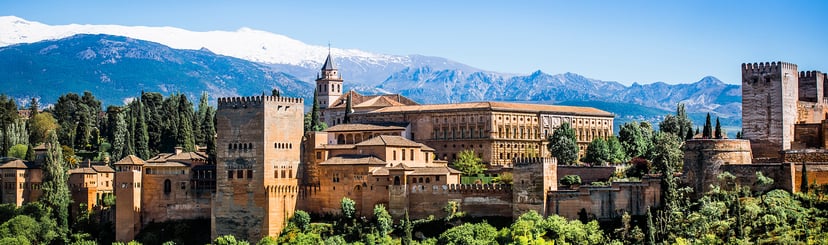
The Palace of Comares and the Palace of the Lions, the principal fourteenth-century ensembles considered here, also embody different courtly emphases. Comares culminates in the tower room usually called the Hall or Chamber of the Ambassadors, a space associated with sovereign presence and dynastic representation. The Lions complex distributes attention among a central court, surrounding galleries and richly articulated halls. The Generalife, physically separate from the principal palace sequence, sets water within a more openly gardened environment. To speak of “the acoustics of the Alhambra” without respecting those distinctions is like describing every inscription as one poem.
Chronology adds another caution. Current surfaces are historical surfaces, but not all are in their original state or combination. Floors have been repaired; hydraulic systems have been interrupted and renewed; plaster and tile have undergone conservation; openings and circulation patterns have changed. The restoration history of the Fountain of the Lions is especially instructive because its documented interventions show that water operation itself has a history. Present-day flow is valuable evidence of spatial disposition, yet it cannot be treated as an unaltered recording from the Nasrid court.
This is why an aural visit works best as an inquiry rather than a theatrical reconstruction. The aim is to notice what the building still makes perceptible, then state clearly where the chain of evidence ends. That approach may feel more restrained than an imagined palace filled with lutes, whispered intrigue and perpetually murmuring fountains. It is also more rewarding. Once fantasy is removed, room geometry, water direction and the placement of poetry become more legible, not less.
What can be known, and what must remain provisional
Historical acoustics often attracts confident claims because sound is easy to imagine and hard to preserve. The Alhambra intensifies that temptation. Its water, ornament and poetry seem to invite synesthetic language: walls that speak, water that composes, architecture that sings. Such metaphors can sharpen attention, but they become misleading when they erase differences between measured conditions, documentary evidence and editorial interpretation.
For this article, the evidence can be sorted into four practical categories:
- Surviving spatial evidence: room volume, court proportions, alcoves, porticoes, openings, channels, basins and the relative position of connected spaces. These features allow cautious statements about possible reflection, diffusion, audibility and direction.
- Surviving and restored material evidence: plasterwork, tile, stone, marble, wood and operational water. These materials do not respond identically to sound, but their current condition is not a perfect proxy for every historical phase.
- Documentary and epigraphic evidence: identified poems, religious and dynastic inscriptions, recorded ceremonial occasions, authorship attributions, and conservation histories. These establish that particular texts and systems existed; they do not always establish how, where or how often they were heard.
- Plausible reconstruction: hypotheses about speaker position, audience arrangement, vocal delivery, furnishings, privacy or masking. These may be reasonable, but they should be labeled as hypotheses and tested against the first three categories rather than narrated as fact.
Josep Cerdà’s sound-cartography study of the Alhambra is useful because it treats sound as located in space rather than as atmospheric decoration. The research records routes with a binaural head and distinguishes the audible roles of fountains, channels and pools through the spatial ideas of point, line and plane. It also emphasizes that plaster, marble, wood and tile create different conditions of absorption and reverberation. That framework does not reconstruct a medieval ceremony. It gives the visitor a disciplined vocabulary for noticing how water and architecture organize a present acoustic field.
The distinction between a measurement and a model also matters. A binaural recording can preserve how sound reached a recording apparatus along a particular route under particular conditions. It cannot by itself tell us what a fourteenth-century courtier heard, because flow rates, ambient noise, room contents, visitor density and even the listener’s position may differ. Likewise, a present clap or spoken phrase demonstrates current response, not an original one. In a protected monument, deliberately producing loud test sounds would also be discourteous and unnecessary. Ordinary speech, a pause at a threshold and attention to naturally occurring water are enough to reveal contrasts.
A responsible interpretation therefore works through a chain: identify the physical feature; describe the present auditory effect cautiously; ask which historical variables could alter it; connect it to a documented text or function where evidence permits; and state the limit. This method is slower than supplying a ready-made soundscape. It prevents the most common error in writing about the Alhambra: turning the sensory richness of the monument into proof of whatever story the writer already wanted to tell.
The Hall of the Ambassadors: volume before voice
The Hall of the Ambassadors offers the clearest place to begin with geometry because its scale is itself part of the historical statement. The Patronato de la Alhambra y Generalife identifies the Hall of Comares as the largest room in the Alhambra structure. It is enclosed within the Tower of Comares and surrounded by nine small chambers opened in the thickness of its walls, with the central recess opposite the entrance more richly treated and associated with the sultan. The official description also records surviving golden floor tiles, probable former marble slabs, an original tiled dado, extensive plaster decoration and a ceiling whose symbolic program supported sovereign legitimacy. These details are summarized in the Patronato’s account of the Chamber of the Ambassadors.
For listening, the important fact is not simply that the room is “grand.” It is a large enclosed volume articulated by recesses, hard lower surfaces, modeled plaster above and a complex wooden ceiling. Each part affects sound differently. Tile and marble tend to return more acoustic energy than thick textiles would. Relief plaster is still hard, but its dense articulation can scatter high-frequency reflections rather than behave like a perfectly flat wall. Wood can absorb and reflect in frequency-dependent ways. The nine recesses interrupt the perimeter and create small zones in which direct sound and reflected sound are balanced differently from the center.
That does not mean the hall necessarily produced a single dramatic echo. Echo, reverberation and resonance are not interchangeable. A distinct echo requires a delayed reflection separated enough from the original sound to be perceived as repetition. Reverberation is the more continuous persistence created by many reflections. Resonance concerns frequencies reinforced by the dimensions and materials of a space. Without period-specific measurements and without knowing the full historical furnishing scheme, it is safer to say that the hall’s size and hard surfaces make reflected sound consequential, while the recesses and ornament complicate that reflection.
The room’s political geometry also changes how one thinks about a voice. The privileged central recess opposite the entrance establishes a visual axis toward the ruler. If a sovereign, envoy or reader occupied that zone, the architecture would have framed the source before any claim about acoustic amplification was needed. Listeners approaching from the Sala de la Barca would encounter the voice through a sequence of threshold, hall and recess. The directivity of a human voice, the speaker’s orientation and the presence of bodies would all matter. A seated audience or standing retinue would absorb sound and break up reflections; an emptier present-day room may feel more sonically exposed.
Three quiet comparisons inside Comares
The hall can be read without staging a performance. At the entrance, notice how sound from the preceding space crosses the threshold: the boundary is both visual and auditory. Near the room’s center, attend to the mixture of voices arriving from several directions and to the persistence of nearby footfall. At the edge, close to one of the recesses, compare how the surrounding surfaces change the apparent nearness of ordinary speech. The point is not to declare one position an ancient “sweet spot.” It is to perceive that authority in Comares was spatially composed through orientation, distance and controlled access.
A further restraint is necessary. The present room is experienced under public-visit conditions, with modern clothing, footwear, conservation barriers and fluctuating visitor numbers. Those sounds are not contaminants to be mentally erased; they are reminders that acoustics is relational. A room does not possess a fixed sound independently of what occupies it. What survives from the Nasrid hall is a set of strong acoustic possibilities, not a complete aural event.
The Court of the Myrtles: a broad water surface and a written portico
Leaving the enclosed hall for the Court of the Myrtles changes almost every acoustic variable at once. The court is open to the sky, elongated by its central pool and bounded at its short ends by porticoes. Sound can escape upward; wind and outdoor activity enter; the long geometry privileges an axis rather than a center enclosed on all sides. The pool dominates the view, yet a pool should not be assumed to dominate the ear. A relatively calm sheet of water may be visually immense and acoustically restrained. Its audible contribution depends on where water enters, how it meets the surface, the flow rate, weather and the listener’s distance.
Cerdà’s point-line-plane framework is especially clarifying here. A jet or spout can be heard as a point because its sound is localized. A runnel can behave as a line because movement is distributed along a narrow course. A pool offers a plane: a broad surface that reflects light and architecture, but may produce little sound unless disturbed or fed audibly. The categories describe spatial perception, not fixed loudness. A small point source can command attention if the background is quiet; a large plane can remain almost silent.
The Court of the Myrtles also joins water to court poetry with unusual documentary specificity. The Patronato records eleven courtly poems in the court, most attributed to Ibn Zamrak. In the north portico, plaster cartouches contain verse associated in part with an eighty-seven-verse sultaniyya qasida recited for the Mawlid al-Nabī in 764 AH, corresponding to 1362. The same official discussion notes that the portico program includes praise of Muhammad V and an allusion to the recovery of Algeciras in 1369. The evidence appears in the Patronato’s study of the Court of the Myrtles plasterwork.
That chronology is more revealing than a simplified claim that “the poem on the wall was recited in this court.” The official account says that some verses correspond to the earlier ceremonial qasida, while the installed program also refers to a later political event. The safest interpretation is that court poetry could be reused, edited or recontextualized as it moved from spoken occasion to architectural inscription. The wall preserves a relationship among poet, ruler, ceremony and place; it does not preserve one uninterrupted performance exactly where a visitor now stands.
This distinction changes the listening exercise. Under the north portico, the significant comparison is not between “silent architecture” and an imagined medieval declamation. It is between three modes of presence. The pool extends the court visually and can supply a low environmental continuity. The portico encloses the listener enough to change the balance of nearby voices. The poem occupies eye level as durable political language. Reading a translation quietly can reactivate the text as speech, but the modern reading should be presented as an interpretive act, not a revival of known delivery.
The court thus demonstrates that visual scale and acoustic force do not always coincide. The pool is the largest single visual object, while the most intelligible human sound may come from close conversation beneath the portico. Nasrid design could place these registers together: reflected façade, measured water, framed approach and dynastic verse. Listening helps separate them before interpretation reconnects them.
The Court of the Lions: sound drawn as points and lines
In the Court of the Lions, water is less a single plane than a network. The central fountain creates an obvious point of attention. Narrow channels extend from the center along the court’s axes and connect the fountain to surrounding rooms and secondary water elements. Colonnaded galleries repeatedly interrupt sight and sound between the open court and its edges. Instead of the long reflective calm of the Myrtles pool, the Lions ensemble distributes water through localized outlets and linear paths.
This arrangement makes the court valuable for testing direction. Near the center, the principal fountain and converging visitor sound compete for attention. Along a channel, the eye can follow water farther than the ear can necessarily trace it; shallow flow may be audible only at irregularities, outlets or changes in level. Beneath a gallery, the ceiling and columns alter the openness of the court, and nearby speech can become more prominent than the central source. At a hall threshold, the listener receives both the court and the more enclosed room, a mixed condition that is architecturally more interesting than either zone alone.
The hydraulic system must nevertheless be read historically. A conservation study of the Fountain of the Lions reports that the 2009 restoration project pursued both functional recovery and in-situ conservation. Its documentary research found repeated interventions and periods of interrupted operation; inherited twentieth-century conduits were obstructed, and earlier repairs had affected the ensemble. The project introduced a renewed circuit using potable, recycled and treated water. The study is available through Cuadernos de la Alhambra’s account of the hydraulic rehabilitation.
The interpretive consequence is decisive. The current system helps a visitor understand the geometry of distribution and the intended prominence of water. It does not authorize the statement that today’s volume, pressure, jet profile or tonal balance exactly reproduces a Nasrid setting. Even the fact of interrupted operation matters: there were historical moments when parts of the court’s water sound would have been reduced or absent. “The sound of the Fountain of the Lions” is therefore not one timeless artifact. It is the audible outcome of a hydraulic work that has required maintenance, modification and conservation.
The court’s architecture encourages another useful comparison. The central basin is a concentrated source, but the surrounding halls give water a distributed reach. A listener moving toward the Hall of the Abencerrajes or the Hall of the Two Sisters crosses from open court to vaulted enclosure while remaining aligned with a channel. The water line acts as a visual and potentially audible connector across a threshold. It may help orient attention even when it is not the loudest sound. That is a more precise claim than saying water “guides everyone through the palace.” It guides the reading of the axis; actual audibility changes step by step.
The Court of the Lions also warns against equating ornament with acoustic treatment in the modern engineering sense. Slender columns, carved plaster and muqarnas create complex surfaces and cavities, so they can scatter and color reflections. Yet they were not necessarily designed as calculated absorbers or diffusers according to contemporary acoustic criteria. Their ceremonial, structural, visual and symbolic functions are documented more securely. Acoustic effects belong to the architecture’s performance, but intention should not be inferred merely because an effect is perceptible.
Why specialist interpretation matters at this point
By the Court of the Lions, the evidence has become subtle enough that a knowledgeable guide can materially change the visit. The value is not theatrical narration. It is the ability to compare specific positions, identify which water elements are original in concept but restored in operation, bring a reliable translation to the correct inscription, and stop a plausible acoustic observation from hardening into an unsupported story. For music and architecture travelers, that coordination turns several fleeting sensations into one evidence-based argument. To arrange a private Alhambra visit built around those comparisons, Inquire now.
Poetry between voice, wall and political memory
Poetry complicates the aural history because it has a double life. It can be an event in time, carried by breath and heard by an audience. It can also become an architectural object, fixed in plaster, tile, wood or stone and encountered through reading. The Alhambra preserves extraordinary evidence of the second condition and selective evidence of the first. Confusing the two makes the palace seem more completely audible than the record allows.
The poets most closely associated with Nasrid court culture include Ibn al-Jayyab, Ibn al-Khatib and Ibn Zamrak. Their work participated in praise, commemoration, political self-presentation and the intellectual life of the court. The Patronato’s epigraphic corpus, produced with the Escuela de Estudios Árabes of the CSIC, records the location and description of inscriptions through topographic, philological, artistic, bibliographic and content analysis. Its volumes address the Comares Palace, the Palace of the Lions, and the Mexuar and Partal. The project’s scope is described in the Patronato’s account of the Corpus epigráfico de la Alhambra.
That scholarship gives the visitor something more reliable than the romantic idea of “walls whispering poems.” It establishes where texts are, how they have been identified and how they relate to authors, patrons and architectural programs. The phrase “written walls” is still useful, provided writing is not treated as frozen sound. An inscription requires literacy, translation or mediation. Its position controls who can see it, from what distance and in what sequence. Its script may also carry visual force before its verbal meaning becomes accessible.
When a poem has a documented recitation context, the evidence becomes richer but not limitless. The 1362 Mawlid association for part of the Myrtles material demonstrates that verse connected with the palace could circulate orally in ceremony. It does not tell us the exact vocal register, tempo, melodic contour, number of reciters, audience placement or room response. “Recited” should not be silently converted into “sung,” and a court poem should not be surrounded with invented instruments simply because music is culturally plausible.
One productive modern act is to compare the same short translated passage in three states: read silently while looking at its placement; spoken quietly beneath the relevant portico; and remembered later in the Hall of the Ambassadors or Court of the Lions. The exercise does not recover a period performance. It demonstrates how text changes when it is visual, vocal and recollected, and how architecture affects attention in each state. The palace becomes not a soundtrack but a system for storing and reactivating language.
Political verse also changes the ethical tone of the visit. Praise of Muhammad V, military allusion and assertions of divine or dynastic legitimacy were not neutral decoration. They helped present rule as victorious, ordered and sanctioned. Hearing a translation aloud can make that rhetoric more immediate, but the listener should resist letting beauty dissolve power. Courtly sound could enchant and persuade at the same time.
The Generalife: when the water route opens into a garden
The Generalife changes the scale of the argument. Its water courts and gardens are more exposed to weather, vegetation and the broader environmental field than the principal palace interiors. The Patio de la Acequia, or Court of the Water Channel, organizes the view around a long central course. In its present form, jets punctuate that line, while pavilions and galleries create partial enclosure at its ends and sides. The audible result is not simply “more natural” than the palaces. It is a different mixture of hydraulic source, architectural reflection, leaves, wind, birds, distant voices and open-air dissipation.
A long channel can be visually continuous while acoustically segmented. Where water flows smoothly, sound may be slight. Where it falls, strikes an edge or emerges under pressure, a localized source appears. A listener at one end may perceive a chain of points superimposed on the line of the channel rather than one uniform stream. Moving beside it alters the relative level of each point. This is why the point-line-plane model is more than descriptive elegance: it explains how one hydraulic system can keep changing its apparent shape in the ear.
Vegetation introduces another variable often overlooked in palace-centered accounts. Leaves can generate their own sound and, in sufficient density, scatter or absorb some high-frequency energy. Soft ground and planted beds do not return sound like marble paving. Yet no single statement about “garden acoustics” fits all conditions. Moisture, wind, foliage, maintenance and visitor activity change the balance. The Generalife should therefore be used for comparison, not for a claim that the Nasrid garden always sounded tranquil.
The most revealing position is often a pavilion threshold. From there, one ear attends to the bounded architectural zone and the other to the length of the garden court. Ordinary conversation may feel close under cover while water remains distributed beyond it. Turning the body changes the result because ears, head and voice are directional. The architecture is not only a container; it is a sequence of listening orientations.
Current jets and water levels must also be treated with the same caution applied to the Fountain of the Lions. Hydraulic landscapes are maintained systems, not self-renewing relics. The durable evidence lies in the channel’s spatial authority, the relation between pavilions and water, and the contrast between enclosure and exposure. Exact loudness and flow character belong to the conditions of the visit unless period documentation supports something more specific.
An on-site listening sequence that does not stage a lost court
A focused listening route can fit within a conventional palace visit, but it depends on restraint. There is no need to clap, play recordings or occupy circulation space. Brief pauses, low speech and comparison across thresholds are enough. The following sequence is interpretive rather than operational; actual access and the ability to pause depend on the monument’s current visitor management.
- Approach to the Court of the Myrtles: before concentrating on water, notice the transition from passage to open court. Ask which sounds broaden, which disappear upward and which remain localized under the portico. This establishes the difference between enclosure and exposure.
- Edge of the Myrtles pool: separate what is seen from what is heard. Locate the audible water source rather than assuming the full surface produces it. Notice whether reflections of architecture are visually stronger than the water’s acoustic presence.
- North portico of the Court of the Myrtles: look at the position of the poetic cartouches and read a concise translation quietly. Attend to the intimacy of near speech under the portico, then state the limit: the modern reading demonstrates placement, not known fourteenth-century delivery.
- Threshold and center of the Hall of the Ambassadors: compare the room before and after entry. In the center, notice the aggregate field; near a recess, notice how local surfaces and proximity change intelligibility. Do not name an “acoustic throne” unless measurement and historical evidence justify it.
- Center and gallery of the Court of the Lions: identify the main fountain as a point, the channels as lines and the court as an open field. Move mentally, rather than dramatically, from the central source to the more sheltered edge. Ask where water or nearby speech dominates.
- A channel-aligned hall threshold: observe how a water axis crosses from open court toward enclosure. The channel is a spatial connector even when its flow is quiet. This is the place to discuss direction without claiming that sound controlled every movement.
- Generalife channel and pavilion: compare the long water course from beside it and from a sheltered threshold. Listen for punctuated sources, environmental sound and the difference between architectural and vegetated surroundings.
The sequence works because every stop poses one limited question. It does not ask the visitor to suppress the present and enter an imaginary medieval bubble. Contemporary voices, shoes, maintenance and outdoor noise reveal how dependent listening is on circumstance. The historical task is to distinguish durable relationships from temporary conditions.
For travelers who want to prepare the visual side of the same inquiry, the companion study of muqarnas, geometry and dynastic staging explains why the intricate ceilings and transition zones should be read as more than decorative spectacle. The two subjects meet at surfaces: muqarnas shape light and hierarchy, while their cavities also complicate the path of reflected sound.
Four seductive claims that the evidence does not support
“The fountains were designed to hide every private conversation”
Water can mask speech when its level, spectrum and location reduce the listener’s ability to distinguish words. That acoustic principle makes privacy a plausible topic. It does not make every fountain a documented privacy device. A small, distant trickle may have little effect on close conversation; a stronger jet may mask speech only for some listeners and positions. Openings, background voices and the orientation of speakers matter as much as the presence of water. At the Alhambra, one may reasonably ask whether water contributed to zones of discretion. One should not present universal masking as established court practice without period testimony or targeted acoustic analysis.
“The current fountain sound is the medieval sound”
The restoration history of the Lions system rules out that shortcut. Conduits were altered, obstructed, repaired and renewed, and operation was interrupted over time. Present water makes the court’s hydraulic diagram perceptible and restores an essential sensory dimension, but exact pressure and loudness are current conditions. The same caution applies elsewhere in the complex. The supporting guide on how changing water operation affects an Alhambra visit is the useful next read when the practical state of fountains matters as much as their interpretation.
“Poetry on the wall proves continuous recitation in that location”
An inscription proves selection, placement and durable display. A source that associates verses with a ceremonial recitation proves an oral history for those verses. Neither fact alone establishes a daily performance tradition in front of the surviving panel. The Myrtles evidence is powerful precisely because it shows movement between temporal event and architectural memory. Readers who want the epigraphic argument in greater detail should continue with the guide to Ibn Zamrak and the Alhambra’s written walls.
“Complex ornament means the Nasrids engineered a perfect concert hall”
Complex surfaces affect reflections, but perceivable acoustic effect is not proof of modern-style acoustic design intent. The Hall of the Ambassadors was a throne room with political, religious and cosmological programs; the Lions halls joined residential, ceremonial and representational purposes. Their sound behavior belongs to their architecture, yet “perfect acoustics” is an empty compliment unless the activity, listener position and evaluative criterion are named. A room can support authoritative speech differently from intimate recitation and differently again from instrumental music. There is no single acoustic perfection.
These corrections do not drain the Alhambra of sensory meaning. They make its meanings more specific. Water can orient without masking; a poem can preserve a performed past without documenting a recurring performance; a ceiling can scatter sound without being an acoustic panel; a restored fountain can disclose historical form without replaying historical volume. Interpretation becomes stronger when each claim carries its own level of certainty.
When this subject deserves a second Alhambra visit
First visits are often consumed by recognition: the Court of the Myrtles appears, the Hall of the Ambassadors expands above the eye, and the Fountain of the Lions pulls every camera toward the center. Listening asks for a different pace. It requires comparing positions, looking away from the most famous view and holding a text, a hydraulic detail and a room shape in mind at once. That can be difficult when the whole monument is new.
A return visit allows the inquiry to narrow. One might devote Comares to voice and sovereign orientation, the Lions complex to water axes and thresholds, and the Generalife to the difference between architectural and gardened sound fields. This framework for a second Alhambra visit helps decide whether epigraphy, water restoration or court life should carry the day. For travelers building a private visit around aural architecture, translations and careful pacing, Granada private tours provides the relevant planning path rather than treating specialist interpretation as an improvised add-on.
The interpretive payoff: hearing relationships, not a soundtrack
The Alhambra cannot give back one definitive Nasrid soundscape, and that is not a failure of the monument. The surviving evidence offers something intellectually better: a way to study how power, poetry and water occupied space. In the Hall of the Ambassadors, volume and axial hierarchy make the human voice part of sovereign presentation even when the original audience arrangement is unknown. In the Court of the Myrtles, a visually dominant pool can remain acoustically subtle while the portico concentrates near speech and political verse. In the Court of the Lions, a central point and radiating lines distribute attention through a network whose operation has its own conservation history. In the Generalife, water extends into a more open field where architecture, vegetation and weather continually renegotiate what is heard.
Court poetry completes the argument because it resists the divide between silent object and fleeting event. Verse was recited, copied, revised, remembered and installed. Once placed on a wall, it could be encountered repeatedly without sounding aloud; once voiced again, it entered a new acoustic and political present. The responsible visitor does not pretend that a quiet modern reading restores the fourteenth century. The reading demonstrates how architecture can hold language in reserve.
Water works similarly. It is substance, infrastructure, image, moving geometry and sound source. Its point, line and plane forms help the listener locate a palace system that vision often idealizes into one seamless beauty. The ear notices interruption: the jet louder than the pool, the channel clearer at an outlet, the court receding at a threshold, the nearby conversation overtaking a famous fountain. Those uneven relations are not distractions from design. They are part of how designed space becomes experience.
The deepest aural reading of the Alhambra therefore ends in disciplined uncertainty. We can identify rooms, materials, inscriptions, hydraulic paths and documented recitation contexts. We can make plausible acoustic inferences and compare them on site. We cannot assign every poem a known voice, every fountain a privacy function or every present resonance a medieval value. Holding that boundary is what allows the palace to be heard historically rather than consumed as fantasy.
Listen, then, for changes rather than for ghosts: the moment a court opens above you; the point at which a channel becomes audible; the shift from distributed voices to the nearness of one speaker; the difference between reading verse with the eye and giving it breath. The Alhambra’s courtly sound survives most persuasively not as a lost recording, but as an architecture that still teaches the attentive visitor how to position the ear.
If you’re interested in any private tours of Granada, please reach out to us.



 So if you are looking for the absolute best in Granada & surroundings with authentic local fully-licensed native guides whose English you can actually understand and with an exclusive and amazingly fun itinerary













