Planning the Alhambra for a Vertigo-Sensitive Traveler: Exposure Checks, Shared Highlights and Fallbacks

Updated
Plan the visit around exposure, not around walking distance
A traveler with severe height sensitivity can still have a substantial, shared Alhambra visit. The workable plan is not to shorten everything, label the whole monument difficult or ask the traveler to push through. It is to separate the complex into three kinds of space: enclosed palace interiors that may be comfortable, transition areas where an opening or view needs checking, and clearly elevated or edge-facing sections that should be optional from the outset.
That distinction matters because height sensitivity is not the same problem as limited walking. A person may be able to walk for hours yet become distressed beside a parapet, on an exposed terrace, in a tower or even at a window that reveals a steep drop. Conversely, a longer interior sequence may be more manageable than a short route with a dramatic outlook. The right question is therefore not, “What is the easiest Alhambra route?” It is, “Which exact visual and spatial conditions trigger this traveler, and where can the group share the strongest parts of the visit without encountering them?”
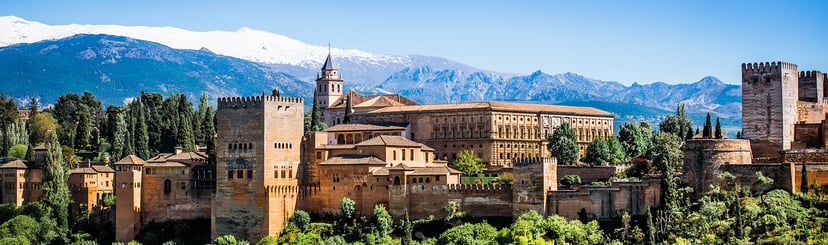
For many private groups, the Nasrid Palaces are the best shared anchor. Much of the experience unfolds through rooms, courts, decorated thresholds and tightly framed architectural sequences rather than through continuous high-level exposure. The Alcazaba should usually be treated as a separate decision because towers, battlements and broad views are central to its character. The Generalife requires a more careful check: its gardens are not uniformly exposed, but terraces, outlooks and open-sided passages can matter more than distance or steps.
No route can be described as universally anxiety-free. Crowding, temporary diversions, weather, the traveler’s symptom level and the precise direction of approach can all change how a place feels. The goal is not a guarantee. It is a plan with fewer surprises, explicit permission to decline an element and a meaningful alternative that does not feel like being left behind.
Begin with a personal exposure profile
“Vertigo-sensitive” is useful planning language, but it covers different experiences. Medical vertigo can involve a sensation of spinning or movement and may occur without any height trigger. Height-related distress can also involve acrophobia, visual height intolerance, balance uncertainty or a combination of these. A city guide cannot diagnose the cause. It can, however, help translate the traveler’s own experience into route decisions.
Before choosing the sequence, ask for concrete descriptions rather than a simple yes-or-no answer about heights. A traveler who is comfortable in an enclosed room high above the ground but distressed at an open railing needs a different plan from someone who reacts whenever a distant valley becomes visible. A person who can tolerate a wide terrace while staying far from its edge may not tolerate a narrow passage with openings on one side. Another may be fine while stationary but unsteady when walking through a crowd near a drop.
Questions that change the route
- Does the trigger begin with visible depth, with proximity to an edge or only when both are present?
- Are windows, balconies, open arcades, bridges, towers, stairs or steep downward views the main concern?
- Does a solid wall feel different from a railing or low parapet?
- Can the traveler cross a brief exposed segment with a companion, or should every such segment be excluded?
- Does crowd pressure worsen symptoms by limiting the ability to stop, turn away or sit down?
- After a trigger, does the traveler recover in minutes, or does the effect continue long enough to end the visit?
This conversation should also define what help is welcome. Some travelers want a companion to walk on the view-facing side and give advance warning. Others find verbal attention intensifies the problem and prefer quiet, a slower pace and the option to turn back without discussion. A guide or relative should not improvise encouragement at the edge. The traveler should decide the language, physical proximity and stop signal in advance.
Do not assume that the most exposure-sensitive person should automatically miss every garden or every view. The better approach is selective. Identify the conditions that matter, verify the likely pinch points and preserve everything else. This is how the visit remains culturally serious rather than becoming a generic “accessible version” stripped of the Alhambra’s architecture, water, ornament and political history.
Use the official access map, but read it for what it does and does not show
The Alhambra’s official accessibility map is an important planning document. It identifies the Nasrid Palaces, Generalife, Alcazaba and Palace of Charles V, distinguishes several slope bands, differentiates regular, irregular and cobbled surfaces, and marks practical points such as rest areas, toilets, first aid and information. Those details help a group understand fatigue, footing and where assistance may be available.
The map is not an exposure map. A shallow path can still feel difficult if it runs beside an open view. A steep path enclosed by planting or walls may be physically demanding yet visually comfortable. A route shown as accessible for mobility may still include a window, terrace, balustrade or directional view that matters to a height-sensitive traveler. Treat the official map as one layer of evidence, then add a second layer based on visual exposure.
Mark four kinds of point before the visit
- Shared anchors: spaces the traveler expects to enter with the group, especially the principal palace interiors.
- Check points: places where the group pauses before proceeding because an opening, terrace or outlook may be visible ahead.
- Optional branches: sections one or more companions can visit while the affected traveler follows a planned alternative.
- Recovery points: named, easy-to-find places where the traveler can sit, orient and decide whether to continue.
This simple annotation is more useful than coloring the entire monument green or red. Height sensitivity is often directional and local. The same courtyard may feel comfortable from one side and difficult from another. The same garden may work when entered toward a wall and fail when approached toward an open panorama. A route plan should therefore describe the next thirty seconds of movement, not merely the name of the next monument.
Operational arrangements can change. Paths close, conservation work redirects visitors and crowd controls affect where people can pause. The enduring principle is to verify the current official map and visitor information shortly before travel, then confirm the first uncertain segment on site with staff. For a broader plan around a fixed admission window, see how to keep the rest of a Granada day flexible around the Alhambra slot.
The Nasrid Palaces are the shared cultural core
The official general daytime itinerary lists the Mexuar, Comares Palace, Palace of the Lions and the Lindaraja corridor within the Nasrid Palaces sequence. That sequence gives the group the Alhambra’s essential courtly story: the relationship between audience and privacy, the controlled movement from one threshold to another, the use of water and light, the political language of inscription, and the contrast between monumental rooms and intimate courts. The official daytime-visit page is the source to recheck for the currently listed visit components.
For a height-sensitive traveler, the palace sequence is often more promising than the Alhambra’s reputation for hilltop views suggests. “Often” is deliberate. The interiors include outlooks, openings and transitions, and crowd flow may prevent lingering or turning around exactly where preferred. Still, the dominant experience is architectural enclosure rather than a continuous walk along exposed edges. That makes the palaces the place to invest the group’s shared attention.
How to interpret the sequence without turning it into an endurance test
Begin with the Mexuar and Comares spaces as rooms of authority, negotiation and dynastic display. This creates a strong intellectual focus before any anxiety about later transitions can dominate the day. In the Court of the Myrtles, attention can remain on proportion, reflection, surface and the framing of the Comares Tower. In the Hall of the Ambassadors, the room itself supplies an encompassing visual field: geometry, calligraphy and the symbolic ceiling can hold attention inward.
The Palace of the Lions offers another shared anchor because its meaning comes from a sequence of courts and rooms, not from requiring the visitor to claim a panoramic edge. The group can study how the courtyard distributes movement, how water organizes the plan and how muqarnas dissolves structural mass into patterned light. A traveler who prefers not to look through certain openings can still participate fully in that interpretation.
The Lindaraja area and connecting corridors deserve a specific warning rather than a blanket exclusion. A corridor or framed outlook can be easy for one person and unexpectedly difficult for another, especially when the view appears suddenly after darker interiors. Ask the guide to announce an opening before the traveler reaches it and to identify whether there is a wall-side line of travel. The traveler may choose to look toward ornament or planting while companions take in the view, then continue together.
Timed admission makes this part of the day operationally important. The group should arrive with enough margin to orient, use facilities and agree on signals without rushing. The ticket-holder details and entry conditions should be checked separately; this private-group Alhambra admission guide explains why the roster and entry window need their own contingency plan. Exposure planning cannot compensate for a missed palace entry.
Do not treat the Alcazaba as compulsory
The Alcazaba is the Alhambra’s fortified sector. Its historical value is considerable: defensive walls, towers, the military quarter and command over the surrounding landscape explain why this hill mattered before the Nasrid palaces became the complex’s most celebrated image. Yet the very features that make the Alcazaba legible as a fortress can make it unsuitable for someone with severe height sensitivity.
Towers, elevated platforms, battlements and open outlooks should be presumed to require individual verification. A photograph can help, but it is not a perfect substitute for standing in the space. Wide-angle images flatten depth; cropped images omit nearby edges; promotional views are often taken from the most dramatic position. The planning decision should be based on the traveler’s trigger profile and current route information, not on whether another visitor called the view “easy.”
The most respectful default is to make the Alcazaba an optional branch after the shared palace core. One companion may join the traveler at a lower-exposure alternative while others visit the fortress. This avoids a familiar failure: everyone approaches the Alcazaba together, the affected traveler reaches the first difficult point, and the group must negotiate in public while the timed day continues around them.
Skipping the Alcazaba is not the same as missing the Alhambra. The traveler can understand its defensive role through an exterior explanation, a ground plan, the relationship between the fortress and palace zone, and views toward the walls from a position chosen for comfort. The group can later exchange observations: those who entered describe the military quarter and landscape command; the traveler who stayed behind contributes what was learned in the Palace of Charles V or through a focused interpretation of the palace-city plan.
The Partal and Generalife need finer-grained decisions
The Partal is not simply “a garden” and the Generalife is not simply “the easy outdoor section.” Both combine architecture, planting, water, terraces, paths and views. A traveler may be comfortable in a planted court yet distressed by the approach to an open outlook. The plan should identify these shifts before the group is committed to a one-way flow.
Partal: transition can be the issue
The Partal area is valuable for understanding how palatial architecture opened toward landscape and how later garden-making shaped the experience of the archaeological remains. It can also function as a transition between the denser palace interiors and more open terrain. That change in visual scale may matter even where there is no dramatic cliff-like edge.
Ask in advance which portions of the current route involve open terraces, downward views or narrow passages beside an edge. Decide whether the traveler wants to attempt a check point with an immediate retreat option or bypass the area altogether. Do not phrase the choice as “just a garden.” The uncertainty itself can be the trigger when the traveler does not know whether an exposed section is around the next turn.
Generalife: some spaces may work, others may not
The official visit information names the Patio de la Acequia, Patio de la Sultana and Water Stairway among Generalife locations. These are culturally important because they show the estate as a place of retreat, cultivation, water management and courtly movement beyond the main palaces. But the route between them includes changing levels and varying degrees of openness. A traveler who enjoys enclosed gardens may still decline a terrace or belvedere.
The official description of the Court of the Main Canal is especially useful for exposure planning. It describes a long, narrow garden that was originally more enclosed, then altered to include a belvedere and an open arcaded corridor. That history explains why the space can feel both inward and outward at once. The garden’s water channel and planting may be comfortable; the open-sided elements and viewing positions may be the decisive concern.
For severe sensitivity, do not decide “Generalife yes” or “Generalife no” as a single block. Decide which named spaces are priorities, which transitions need a live check and where the traveler can wait without losing dignity if the route ahead proves unsuitable. Because the Generalife is physically separated from the central palace cluster, a split there requires more coordination than a short Alcazaba branch. It may be wiser to preserve the Nasrid Palaces and one verified garden segment than to chase complete coverage.
A shared route that preserves meaning
The following sequence is a planning model, not a claim that every current visitor flow will permit the same movements. It is designed to protect the timed palace experience, make the first split predictable and keep the affected traveler connected to the day’s cultural narrative.
Stage one: orient at the Palace of Charles V
Use the Palace of Charles V area as the group’s orientation point before the timed palace entry, subject to current access and crowd controls. Its monumental Renaissance architecture provides an immediate contrast with the Nasrid palaces: imperial geometry beside the more intricate, sequential spaces of the earlier court. This is not merely somewhere to wait. It gives the group a shared interpretive question about conquest, continuity and architectural power.
At this point, review three things only: the exact palace-entry commitment, the first check point after the palace sequence and the first rejoining location. Too many contingencies can become cognitively exhausting. The traveler should know that declining an exposed branch will not trigger a group debate.
Stage two: enter the Nasrid Palaces together
Keep the group together through the Mexuar, Comares and Lions sequences, using wall-side positioning or advance warnings where needed. The guide’s commentary should be delivered where the traveler can stand comfortably, not at the most photogenic opening. Companions who want a view can take it briefly without relocating the entire explanation.
If a threshold reveals unexpected exposure, use the agreed pause signal. One companion stays with the traveler while the guide or another adult checks the next few metres. The check should answer a concrete question: Is there a continuous solid wall? How long is the open section? Is turning back possible? Is there a place beyond it to sit or reorient? “It is fine” is not useful information.
Stage three: split for the Alcazaba if needed
After the palace sequence, companions who want the fortress can take that optional branch. The affected traveler and designated companion return to the named meeting point, spend time with the Palace of Charles V architecture or rest at a verified location shown on the official map. The split has a fixed duration range and a fallback if phones fail.
This is the point at which a private plan can materially change the visit. The value is not exclusivity for its own sake; it is having one person hold the interpretive thread while another manages the exposed branch, the meeting time and the traveler’s alternative without forcing the whole group to choose between abandoning the Alcazaba and pressuring someone to enter it. For tailored coordination of that kind, Inquire now. The relevant service is a route designed around the group’s real trigger profile, not a promise that the monument can be made free of exposure. Explore private Granada touring when the day requires advance route coordination and flexible interpretation.
Stage four: make a fresh Generalife decision
Do not lock the Generalife decision before knowing how the traveler feels after the palaces. Height-related distress can be cumulative even when each individual moment seems manageable. The group should reassess energy, balance and confidence at the rejoining point. If the verified garden route still fits, continue with a defined scope. If not, take the Palace of Charles V or lower-city fallback without treating it as a failed day.
Rejoining works only when the meeting point is exact
“Meet at the Palace of Charles V” is too vague. A large building may have several approaches, interior and exterior circulation, changing queue patterns and weak mobile reception in places. A useful rejoining instruction names the specific entrance, threshold, information point or map feature, identifies which side of it to stand on and gives both a time and a contingency.
Use a two-layer meeting instruction
- Primary: a precise, mutually recognized point shown on the current map or confirmed on arrival.
- Fallback: a staffed information point or another unambiguous location that both parties can reach without entering a one-time sector again.
The group should take a photograph of the agreed point while standing there. This is more reliable than sending a map pin in a complex with walls, multiple levels and similar-looking paths. Each subgroup should also know who is responsible for checking the phone and at what interval. Repeated messaging while someone is symptomatic can add pressure; a single agreed update is often better.
The official visitor questions page states that the Alcazaba, Nasrid Palaces, Partal and Generalife may each be entered only once, while leaving and returning to the broader enclosure is subject to opening times. This rule has major consequences for a split plan. Do not choose a rejoining point that assumes one subgroup can simply walk back through a sector already used. The meeting must sit beyond the one-entry constraint or be reached by both subgroups through permitted circulation.
Give the traveler an active role
A lower-exposure alternative should not reduce the traveler to waiting for the rest of the group. Give the pause its own question or object of attention. At the Palace of Charles V, that might be the contrast between the square exterior and circular courtyard, the political meaning of inserting a Renaissance palace into the Nasrid complex, or the relation between imperial scale and the intimate palace sequence just visited. The traveler can then contribute a distinct observation when the group reunites.
This matters especially in families. Children notice when one adult is treated as the reason everyone “cannot” do something. A pre-agreed split changes the social script: different people are pursuing different parts of the site, and the group will exchange what each saw. No one becomes the obstacle.
Companion roles should be explicit, not improvised
A severe exposure response can make ordinary group behavior unhelpful. Several relatives asking questions at once, touching the traveler without permission, offering competing directions or insisting that the difficult section is almost over can increase disorientation. One companion should be the primary support person for each segment.
The primary companion
This person knows the traveler’s stop word, preferred side of approach and recovery pattern. The role is not to persuade. It is to create space, reduce visual and verbal noise, help the traveler sit or turn toward a stable visual reference, and communicate a simple decision to the rest of the group. The companion should not be the person most emotionally invested in reaching every viewpoint.
The route checker
When uncertainty remains, a different adult or the guide checks the next segment. The checker reports observable conditions rather than conclusions. Useful language includes, “There is an open arcade on the right for about twenty metres, with a solid wall on the left,” or, “The route turns toward a terrace and the valley becomes visible before the next doorway.” The traveler then chooses.
The group lead
One person keeps track of the timed entry, rejoining point and one-entry rules. This role prevents the support companion from having to manage logistics while attending to symptoms. In a private guided visit, the guide can often hold the cultural and timing plan while a relative remains the traveler’s chosen support person.
Agree on three plain signals: one for slowing down, one for stopping immediately and one for ending that section. Avoid euphemisms. A traveler should not need to explain or defend the signal while distressed. The group can discuss what happened later, in a neutral space, if the traveler wishes.
What to do if symptoms begin
This article is route-planning guidance, not medical advice. A traveler with diagnosed vertigo should follow their clinician’s instructions and carry any prescribed treatment as directed. New, severe or unusual symptoms require appropriate medical assessment rather than a touring workaround.
The NHS guidance on vertigo notes that vertigo can affect balance and advises sitting down immediately when dizziness begins, moving the head carefully and slowly, and resting in a quiet, dark room when needed. In an Alhambra plan, the practical implication is clear: the group must know the nearest appropriate place to stop before entering an uncertain segment. “We will find somewhere” is not a sufficient response plan in a crowded monument.
A useful stop sequence
- Stop movement and reduce conversation to one voice.
- Move away from the edge or view only if the traveler can do so safely; do not pull or hurry them.
- Sit at the nearest suitable place identified on the current map or by staff.
- Decide whether the traveler is recovering, needs the first-aid point or should leave the complex.
- Send one clear message to the other subgroup and activate the agreed rejoining or exit plan.
The affected traveler should not be left alone merely to protect everyone else’s itinerary. If they explicitly prefer solitude and can safely navigate, respect that choice; otherwise a companion stays. The group can still preserve meaningful time by using a short split, but care takes priority over completeness.
The Palace of Charles V is a genuine fallback, not a holding pen
A bailout within the Alhambra should retain cultural value and offer a stable place from which to make the next decision. The Palace of Charles V serves this role well because it belongs to the monument’s central historical argument. Its assertive Renaissance form speaks to the political order that followed the Nasrid kingdom, while its position beside the earlier palaces makes the contrast immediate.
The fallback can be structured as a focused study. Compare the building’s exterior geometry with the circular courtyard. Ask how an imperial project changes the meaning of the surrounding palace city. Revisit the sequence just seen in the Nasrid Palaces and identify what changes when architecture shifts from intricate surfaces and choreographed thresholds to monumental classical order. This is substantive, not consolation.
Current opening of interior areas, exhibitions, facilities and circulation should be checked on the day. The reliable promise is not that every room will be available. It is that the Palace of Charles V area provides a named central alternative around which the group can organize. If crowding or access conditions make it unsuitable, use the preselected map-based recovery point instead.
A split-day structure can also reduce pressure. This split Alhambra plan shows how palace time and a lower-city interval can be treated as one coherent day rather than a retreat.
When the lower city is the better second half
If exposure has already triggered significant symptoms, the group should not preserve the Generalife at any cost. Granada’s lower city can continue the historical narrative through interiors and street-level spaces with less emphasis on elevated outlooks. The most coherent pivot is usually toward the Cathedral quarter and the institutions that explain the conquest, Christian monarchy and the remaking of the city after 1492.
The Royal Chapel and the Madraza can extend questions introduced at the Alhambra: who controlled Granada, how knowledge and authority were represented, and what changed when the Nasrid capital entered the Catholic Monarchs’ realm. Current entry procedures and opening times require verification, but intellectually this is a continuation, not a replacement chosen at random.
The Realejo may also work for a calmer return toward the hotel or an unhurried meal, though its streets still include slopes and should not be confused with a flat district. For a traveler whose issue is exposure rather than exertion, a slope between buildings may be entirely acceptable. For someone whose symptoms also affect balance, transport to a precise lower-city drop-off can prevent a difficult descent after the decision to leave the hill.
A vehicle is relevant here only as an exit tool. It should be arranged around the actual permitted pickup point and the traveler’s ability to reach it, not sold as a generic upgrade. The group should know who escorts the traveler, who remains with the rest of the party and whether everyone will reunite in the lower city. For a complete low-hill alternative, use this Royal Chapel, Madraza and Realejo sequence as the supporting Granada plan.
Choose the route by severity, not by age
Height sensitivity appears in children, younger adults and older travelers, and it should not be treated as an age proxy. An older parent may be a strong walker but avoid open edges. A teenager may be physically confident yet experience panic at a tower. A child may tolerate a view while held close to an interior wall but not when adults crowd a railing. The planning response should follow the trigger, not the birth date.
For a traveler who avoids all visible drop-offs
Make the Nasrid Palaces the principal objective, omit the Alcazaba, and include the Generalife only after a route-specific check. Keep interpretations away from windows and terraces. Use the Palace of Charles V as the planned secondary anchor. This version may contain substantial walking and deep cultural content; it is not necessarily a shorter visit.
For a traveler who can tolerate distance from an edge
Identify wall-side paths, wide courts and places where the traveler can remain well back while companions approach a view. The group can share more outdoor space, but the guide should avoid gathering everyone at a parapet for commentary. The traveler controls the distance and may turn inward without missing the explanation.
For a traveler whose balance symptoms are unpredictable
Prioritize nearby seating, shorter commitments between decision points and a rapid route to first aid or exit. A section that is visually comfortable may still be unsuitable during an active episode. The plan needs both exposure information and the practical facilities marked on the official map.
For a child or teenager
Explain the branch in advance without dramatizing it. Let the young traveler choose a neutral signal and identify which adult stays with them. Do not turn the Alcazaba into a test of courage or announce to siblings that the family is missing a view because of one person. A shared object hunt in the palaces, water-system story or geometry task can keep the day centered on discovery rather than avoidance.
Common planning mistakes
Calling the whole Alhambra “high”
The complex occupies a hill, but that fact alone does not describe the visitor’s visual experience. Many important rooms are enclosed or court-focused. A blanket warning can cause a traveler to reject the entire visit unnecessarily. The useful work is to distinguish individual spaces and transitions.
Using step-free and low-exposure as synonyms
They answer different questions. A mobility-oriented route may reduce stairs yet pass a broad view; an enclosed route may include more walking or uneven surface. Consult the official access information for gradients and surfaces, then conduct a separate exposure review.
Leaving the split until the difficult point
A public negotiation beside an edge is unfair to the traveler and disruptive for the group. The optional branch, support companion, meeting point and maximum wait should be agreed before entry.
Choosing a café or shop as the only fallback
Commercial venues can change hours, become full or require leaving the most convenient circulation. A fallback should first be a named cultural or official point that works operationally. Food and rest can follow, but they should not be the sole structure holding the plan together.
Promising that a guide can make the fear disappear
A skilled guide can provide advance warning, choose commentary positions, coordinate splits and reduce uncertainty. They cannot guarantee the absence of symptoms or change the physical character of a tower, terrace or open arcade. Good service is honest about that boundary.
Trying to recover the “lost” section later
The one-entry rule for major sectors means a group may not be able to reverse course and repeat a section. Even where circulation allows a return, the traveler may not benefit from another attempt. Protect the parts that worked and move to the next meaningful anchor.
A verification checklist for the week of travel
The planning principles in this guide are durable, but operational facts are not. Conservation work, route controls, opening arrangements and temporary closures can alter the day. The group should verify the following against current official information and then confirm uncertain points on arrival.
- The timed Nasrid Palaces entry and the names or identification requirements attached to the booking.
- The current visitor route through the palaces and whether any diversion changes the expected direction of approach to an opening or terrace.
- Current access to the Alcazaba, Partal, Generalife and Palace of Charles V areas.
- The one-entry conditions for each sector and any rules governing exit and return to the broader enclosure.
- The latest official accessibility map, including rest areas, toilets, first aid and information points.
- Where a traveler can wait without blocking circulation and where staff recommend rejoining after an optional branch.
- The exact pickup or exit plan if the traveler needs to leave the hill before the rest of the group.
Do not ask staff to certify that a route is “not scary.” Ask observable questions. Does the path have a solid wall or an open railing? Is the view visible immediately? Is the corridor open on one side? Can the traveler turn back before entering? Is there a place to sit beyond it? These answers can be compared with the traveler’s own profile.
A private guide should receive the same briefing before the day, not at the first exposed point. The briefing can be short: trigger conditions, acceptable support, non-negotiable exclusions, the shared cultural priorities and the chosen fallback. The guide then has enough information to adapt commentary and group movement without making the traveler’s condition the subject of the tour.
How to keep the visit emotionally fair to the whole group
A well-designed plan avoids two extremes. In one, the affected traveler feels guilty because every decision is framed as a sacrifice. In the other, companions behave as though the traveler’s distress is an inconvenience to be managed quickly so the “real” visit can resume. Neither produces a good family day.
Use shared anchors first. The group enters the Nasrid Palaces together, studies the same rooms and leaves with a common body of experience. Optional branches come afterward and have defined value for both subgroups. Those visiting the Alcazaba gain the fortress and landscape perspective. Those staying near the Palace of Charles V gain the Renaissance and post-conquest perspective. Rejoining becomes an exchange, not an apology.
Language matters. Say, “We are splitting for two different parts of the site,” rather than, “We have to stay behind.” Say, “The Generalife decision is still open,” rather than, “We will see whether you can handle it.” The traveler retains agency, and companions know the plan was designed before symptoms appeared.
For couples, the support role should not automatically fall on the same partner for every branch. If another trusted companion can stay, the partner may choose to see one optional section without resentment. For multigenerational families, avoid making a child the messenger between adults. One designated group lead handles updates and timing.
There is also value in deciding what not to photograph. Repeatedly asking the traveler to pose near a view, or showing them images of the section they declined while still on site, can turn the rest of the day into a comparison with what was missed. Save the exchange for the rejoining point and let each person choose how much detail they want.
A practical model for three possible outcomes
Outcome one: the full shared core, then separate branches
The group orients at the Palace of Charles V, enters the Nasrid Palaces together and completes the principal interior sequence. Afterward, some companions visit the Alcazaba while the traveler and support person remain with the Renaissance palace study. Everyone rejoins at the agreed point. The Generalife is attempted only through pre-verified spaces, with open terraces optional.
This is often the most balanced version because the group shares the highest-priority cultural material before any split. The affected traveler is not asked to spend the opening hour waiting, and companions do not feel they have abandoned the fortress without consideration.
Outcome two: palaces only, followed by lower Granada
The Nasrid Palaces go well, but the traveler has used enough concentration and does not want further exposure uncertainty. The group leaves the hill or separates temporarily. The lower-city continuation picks up the story at the Madraza, Royal Chapel or Cathedral quarter, subject to current access. The day remains historically coherent.
This outcome is particularly strong when the group values interpretation over completion. It avoids using the traveler’s remaining tolerance on a garden transition merely because it appears on a standard itinerary.
Outcome three: early bailout
Symptoms begin before or during the palace sequence. The support companion activates the stop plan, seeks first aid if appropriate and uses the verified exit or recovery point. The rest of the group either remains together or continues only if the traveler is safely accompanied and explicitly comfortable with the split.
An early bailout should already have a destination, communication plan and decision about whether the day will reconvene. The traveler may rest in the lower city while others finish a limited section, or the whole group may pivot. What matters is that the response was designed before anyone was distressed.
The essential judgment
A severe height sensitivity does not automatically rule out the Alhambra, and it does not automatically rule out the Generalife. It does change the planning unit. Instead of treating the complex as one attraction, treat it as a sequence of interiors, courts, transitions, terraces, outlooks and optional elevated branches.
Build the day around the Nasrid Palaces as the shared anchor. Presume that the Alcazaba needs a separate decision. Read the Partal and Generalife at the level of individual spaces rather than labels. Use the Palace of Charles V as a culturally meaningful regrouping and fallback point. Keep a lower-city continuation ready when the traveler has had enough uncertainty for one day.
The most important operational facts are the timed palace entry, the current route, the one-entry rule for major sectors and the location of rest, first-aid and information points. The most important human facts are the traveler’s exact trigger, their preferred support and the group’s willingness to separate without blame.
That combination preserves what makes the Alhambra worth visiting: not a checklist of viewpoints, but a shared encounter with Nasrid space, water, ornament, power and historical change. The plan succeeds when the traveler participates substantially, companions still have meaningful choices and nobody has to prove courage at an edge.
If you’re interested in any private tours of Granada, please reach out to us.



 So if you are looking for the absolute best in Granada & surroundings with authentic local fully-licensed native guides whose English you can actually understand and with an exclusive and amazingly fun itinerary













