Granada’s Sacred-Art Day Beyond the Alhambra: A Tailor-Made Private Route Through Royal Chapel, Cathedral and San Jerónimo
Updated
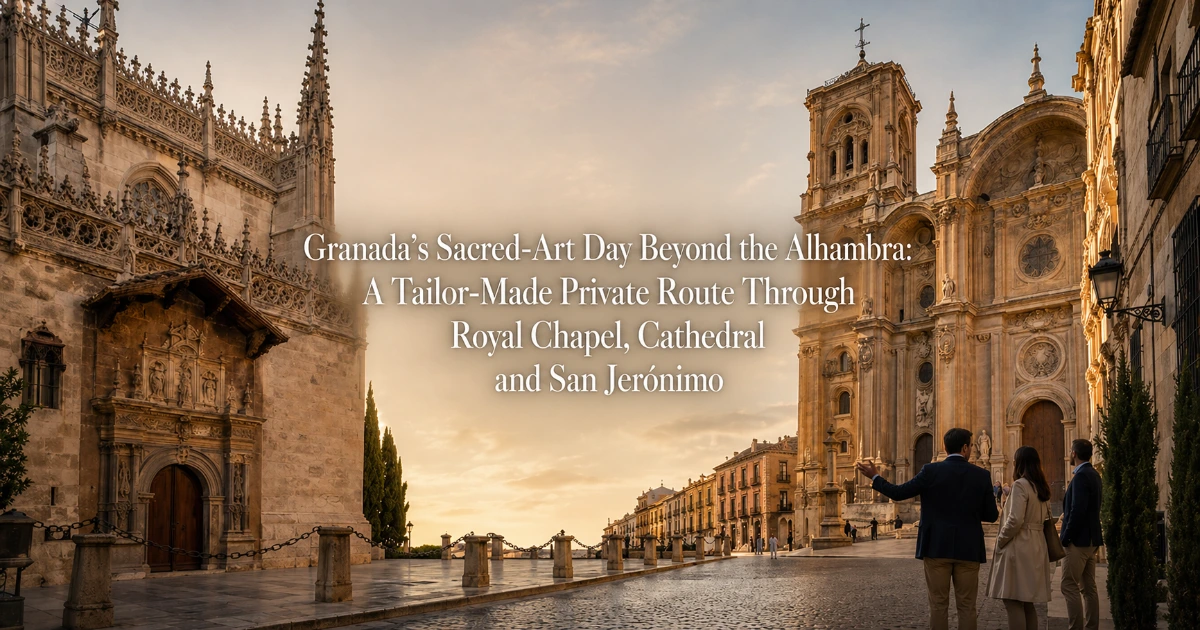
A sacred-art day beyond the Alhambra is worth making into a focused private route when you want Granada’s Catholic-monarchy chapter to feel intelligible, not merely decorative. It works in real city conditions because Royal Chapel and Granada Cathedral sit almost back-to-back in the Cathedral Quarter, while the Royal Chapel-to-San Jerónimo walking hinge carries you from Calle Oficios and Plaza de las Pasiegas toward Calle San Jerónimo without climbing into the Albayzín. The clearest exception is a same-day add-on after a demanding Alhambra morning: if your group is already visually saturated, keep sacred art to a Royal Chapel and Cathedral accent rather than forcing a full route.
In Granada, the sacred-art question is not “which churches are beautiful?” It is how to read the first generation after Nasrid Granada without letting the historic center become a blur of white stone, gilding and dynastic names. For travelers already planning private touring, that distinction matters: a guide can turn three interiors into a coherent arc of burial, legitimacy and monastic patronage, but only if the route has enough time and breath between sites. For the focused version, begin with Royal Chapel and Cathedral private route logic, then extend deliberately to San Jerónimo.
The counterintuitive correction is this: the famous hill neighborhoods are not always the upgrade. Adding the Albayzín or Sacromonte to this particular day can make the itinerary feel larger on paper and thinner in practice, because the body moves from level Centro streets into steeper cobbles just when attention should be settling into interpretation. If you want a second-day choice that compares Royal Chapel with other Granada options, choosing a second day after the Alhambra is a separate planning question. This article solves the narrower one: when the sacred-art route itself deserves the spotlight.
Should sacred art be a full Granada private route after the Alhambra?
Make sacred art a full private route when your trip needs the Christian-monarchy answer to the Alhambra, not another handsome stop inside the old center. The Alhambra gives most visitors the emotional and architectural force of Nasrid Granada; Royal Chapel, Granada Cathedral and the Monastery of San Jerónimo show what the victorious monarchy, the Church and the early modern city chose to build, bury and proclaim immediately afterward. That is the reason to give the route its own half-day or carefully paced day, rather than tacking it onto a crowded “best of Granada” walk.
- Choose the focused route if you have already given the Alhambra proper space, care about dynastic history, or are traveling with someone who enjoys art when it is attached to power, patronage and place.
- Keep it as a short historic-center accent if your group mainly wants one essential non-Alhambra stop, has younger children with limited interior patience, or is flying out later the same day.
- Place it the next morning if the Alhambra visit was long, hot or emotionally consuming; Granada’s religious interiors reward a clearer head more than a packed afternoon.
- Cut San Jerónimo first if time collapses, because Royal Chapel and Granada Cathedral are the tighter historical pair and sit directly beside the Cathedral Quarter’s main walking flow.
This is also the point where a private guide earns the route. Without interpretation, the first two stops can feel adjacent but separate: a royal burial chapel beside a cathedral, both grand, both sacred, both surrounded by small streets and souvenir traffic. With the right thread, the Royal Chapel becomes the dynastic claim, the Cathedral becomes the urban and ecclesiastical claim, and San Jerónimo becomes the quieter extension of early post-conquest patronage. That transformation is not about adding more monuments; it is about making fewer interiors speak more clearly.
Premium spend does not help if you are trying to force too many church interiors into a rushed slot immediately after the Alhambra; even an excellent private guide cannot make them feel distinct when the day is already saturated. What spend can improve is judgment: when to pause, when to skip an extra chapel, how to move from Calle Oficios to the San Jerónimo axis without wasting energy, and how to decide whether your family, parents or celebration group should stop after the Cathedral rather than continue.
How Royal Chapel, Granada Cathedral and San Jerónimo differ
The three sites differ by function before they differ by beauty, and that is the planning key. Royal Chapel is dynastic and intimate by Granada standards; Granada Cathedral is civic, architectural and institutional; the Monastery of San Jerónimo is monastic, quieter and more revealing once the first two have established the political frame. Treating them as interchangeable churches is the mistake that creates sacred-art fatigue.
Royal Chapel: the dynastic hinge, not just another chapel
Royal Chapel belongs first because it gives the day a human and political center. The official Royal Chapel site identifies it as the burial place of Ferdinand of Aragon and Isabella of Castile, along with Joanna, Philip and Prince Michael, which is why the building does more than display sacred art; it anchors the Catholic Monarchs’ Granada project in bodies, memory and dynasty. A private visit should not rush this point. The tombs, the chapel setting and the associated art only land when the guide explains why Granada, rather than Madrid or another royal capital, matters to this burial story.
For travelers, the consequence is practical: start here while attention is fresh. Royal Chapel is close enough to Granada Cathedral that planners often underestimate it, but proximity does not make it mentally light. The chapel asks visitors to shift from Nasrid palaces to royal burial, from ornamental refinement to dynastic assertion, from the Alhambra’s hilltop world to a compressed sacred space in the middle of the commercial center. That is a heavy pivot. If you enter it after a long lunch, an Alcaicería shopping detour and a noisy square, it can feel like a name-and-date stop. If you enter first, it becomes the interpretive key for the rest of the route.
For current access notes, worship-related changes and visitor details, verify with the Royal Chapel’s official site (https://capillarealgranada.com/en/the-temple/) before finalizing the day. The planning principle remains evergreen: do not let the chapel become the place you “fit in” because it sits conveniently beside the Cathedral.
Granada Cathedral: the civic statement that needs room after the chapel
Granada Cathedral should follow Royal Chapel because it expands the story from royal burial to public authority. Its scale, architecture and central position change the emotional register of the route: after the chapel’s dynastic intimacy, the Cathedral announces a new order in the heart of Granada. This is where a guide should slow the group down, not speed them through another grand interior. The visitor’s question shifts from “who is buried here?” to “what did the new Christian city want to become?”
The location matters. Plaza de las Pasiegas, Calle Cárcel Baja, Calle Oficios and the nearby Alcaicería create a dense pedestrian knot where even comfort-first travelers can lose the thread if the route wanders. A strong private sequence keeps the Cathedral visit connected to the chapel but adds a short exterior pause so the façade, square and surrounding streets explain why the building dominates the center. Otherwise, the Cathedral becomes a spacious visual reset without historical force.
For practical visitor information and ticket guidance, use Granada Cathedral’s official visitor page (https://catedraldegranada.com/precios-horarios-de-la-visita/) rather than relying on old notes or hotel hearsay. Avoid building the day around precise opening assumptions unless they are checked when booking; sacred sites can change access around services or special events.
Monastery of San Jerónimo: the depth stop that makes the route feel curated
San Jerónimo is the site that turns the plan from a Cathedral Quarter visit into a true sacred-art route. It sits away from the Royal Chapel and Cathedral cluster, near Calle Rector López Argüeta and the university-side fabric beyond Calle San Jerónimo, so it introduces a physical and mental transition. The monastery’s official site presents it as the first Christian monastery after the conquest by the Catholic Monarchs, which is precisely why it belongs after the central pair rather than before them.
The Monastery of San Jerónimo is not the best choice for travelers who only want the most famous Granada names in the least time. It is the best choice for culture-focused travelers who want to see how early Christian Granada moved beyond royal burial and Cathedral authority into patronage, monastic space and sacred display. The payoff is subtler than the Alhambra and less instantly legible than the Cathedral. That is why it is a poor rushed add-on and a strong guided finale.
For visitor details and possible access changes, confirm through the official Monastery of San Jerónimo site (https://realmonasteriosanjeronimogranada.com/). The decision to include it should come after an honest look at time, energy and appetite for another interior, not because a list of Granada monuments says it is important.
The best sequence through the Royal Chapel-to-San Jerónimo walking hinge
The cleanest sequence is Royal Chapel first, Granada Cathedral second, a short decompression in the Cathedral Quarter, and San Jerónimo last. This order works because it follows the intellectual arc and the walking reality at the same time. It starts in the tightest historic cluster, avoids a premature transfer, and uses the Royal Chapel-to-San Jerónimo walking hinge as a deliberate change of pace rather than an accidental stroll.
Begin around Calle Oficios or Plaza de las Pasiegas, not in the Albayzín. This keeps the first minutes calm and avoids making the group descend or climb before the main visit begins. After Royal Chapel, step into the Cathedral orbit with enough time to read the building from the outside before entering. A guide who moves too quickly here loses one of Granada’s clearest contrasts: the chapel as royal memory and the Cathedral as a public religious monument pressed into a working city center. The transition is only a few steps, but it deserves more than a doorway-to-doorway shuffle.
After the Cathedral, resist the temptation to turn the Alcaicería into a full shopping loop. A short look can be useful because it reminds travelers how commercial density wraps the sacred core, but a long browse changes the temperature of the day. Once bags, ceramics, spices and textiles become the focus, it is hard to recover the sacred-art thread. If artisan shopping is a separate priority, give it its own design rather than attaching it to this route.
The walk toward San Jerónimo should feel like a hinge, not leftover distance. Depending on the exact exit and the group’s pace, the guide may use Calle San Jerónimo, the Plaza de la Universidad side, or a calmer line that avoids the most distracting retail flow. The point is not to pretend the walk is scenic in the Alhambra sense; it is to let the group leave the Cathedral Quarter’s compression before entering a monastery with a different tone. In a private route, that ten-to-fifteen-minute-feeling transition often matters more than another fact delivered at the door.
San Jerónimo last also protects the route from a common planning error: starting with the monastery because it is farther out, then returning to the center for the better-known sites. That may look efficient on a map, but it weakens the story. You ask travelers to process monastic patronage before they have met the royal burial and Cathedral claims that make it meaningful. For a route built around interpretation rather than box-ticking, chronology and emotional build should win over map neatness.
Where sacred-art pacing breaks down in Granada
Sacred-art pacing breaks down when the route ignores what Granada has already done to the body. The Alhambra is not just a monument; it is a sequence of slopes, standing time, stone surfaces, gardens, thresholds and scheduled pressure. Add summer heat, a late lunch, a descent toward Plaza Nueva or a climb from a Realejo hotel, and the next interior can suffer before it begins. The city is compact, but compact does not mean effortless.
That physical truth is why this route should not be treated like a simple old-town circuit. The Cathedral Quarter is flatter than the Albayzín, but it is visually busy. Narrow streets around Calle Oficios, the Alcaicería edge and Gran Vía de Colón pull attention in many directions. San Jerónimo adds a modest walk that feels easy for a fresh couple and less easy for older parents or children after a long Alhambra morning. If a chauffeur is involved, the value is not door-to-door drama at every site; it is the ability to smooth the hotel return, avoid unnecessary hill exposure, or reposition the group after the final stop. For broader Granada routing and drop-off questions, chauffeured Granada planning is a better lens than trying to chauffeur every step of this tight route.
The mood consequence is just as important. When sacred interiors are stacked too tightly, travelers stop seeing differences and start collecting ceilings. The day flattens: tombs, naves, altarpieces, chapels, gilding, repeat. A good route preserves contrast by changing tempo between the chapel, the Cathedral and the monastery. It lets the Royal Chapel feel concentrated, the Cathedral feel expansive and San Jerónimo feel like a quieter culmination. That mood is fragile; once the group feels behind schedule, sacred art becomes obligation rather than discovery.
The cut-first rule is simple. If the route is shrinking, cut the extra exterior detours, the long Alcaicería browse and any hill-neighborhood add-on before you cut interpretive breathing room inside the core sites. If the day is shrinking further, keep Royal Chapel and Granada Cathedral and let San Jerónimo move to another morning or disappear. A shorter route done coherently beats a longer route that leaves everyone unable to remember which interior was which.
How to place this route before or after Alhambra intensity
The best placement is usually the morning after your main Alhambra visit, especially for culture-focused first-timers. That timing allows the Alhambra to remain the emotional high point of the previous day while giving the sacred-art route enough freshness to become a second layer of Granada rather than a lesser sequel. If your trip has only one full day, place the sacred core before a lighter evening rather than after a maximal Alhambra itinerary.
Before the Alhambra, the route can work for travelers who arrive early, have flexible Alhambra timing, and want the Catholic-monarchy context first. The risk is that the Alhambra then becomes a scheduled appointment hovering over the whole morning. If entry timing is fixed and the group is anxious about transfers, the sacred sites will feel rushed. In that case, keep the pre-Alhambra version to Royal Chapel and the Cathedral exterior or a concise Cathedral visit, then save San Jerónimo for another slot.
After the Alhambra on the same day, the route should be used with restraint. A private guide can help the transition from Nasrid palaces to Catholic-monarchy Granada, but the same-day version must be shorter, not merely faster. The best same-day version is often a focused Royal Chapel and Cathedral visit with a calm meal afterward, not the full extension to San Jerónimo. If you are still deciding how to place Alhambra timing within the broader stay, planning Granada around the Alhambra should come before you commit to this route.
On a second day, the route can stretch into a more satisfying cultural morning. Begin with Royal Chapel while the Cathedral Quarter is still settling into the day, move into Granada Cathedral with exterior context, pause for coffee or a light bite near Plaza de la Trinidad or the Cathedral side streets, then continue toward San Jerónimo. The pause is not filler. It prevents the three interiors from collapsing into a single visual category and lets different travelers re-enter the route with attention intact.
For families, the placement depends less on age than on interpretive tolerance. Some teenagers do well when the story is direct: conquest, burial, city-building, patronage. Younger children may need the sacred route shortened and broken with a snack, a square and a clear end point. Older parents may appreciate the flatter Cathedral Quarter but dislike standing too long in any one interior. A private version should not simply slow everything down; it should decide where depth is worth the standing time.
What a private guide changes, and what money cannot rescue
A private guide changes the route by making the monuments answer each other. The value is not only in explaining artworks; it is in choosing the right amount of art. At Royal Chapel, the guide should keep the dynasty and burial story central. At Granada Cathedral, the guide should widen the frame to architecture, city authority and public space. At San Jerónimo, the guide should bring the story into a quieter monastic register without pretending it is the same kind of attraction as the first two. That curation is exactly why tailor-made private day in Granada planning is stronger than a fixed checklist for this topic.
The guide also changes logistics. Sacred sites operate as places of worship as well as visitor monuments, so serious planning should leave room for access changes and should not depend on a fragile minute-by-minute schedule. The center of Granada adds its own friction: pedestrian lanes, taxi limits, short but distracting crossings, and the way a hotel in the Realejo, Centro or Albayzín changes the first and last ten minutes of the route. Private touring can soften these edges by choosing a better meeting point, arranging a sensible finish, and keeping the group from wandering between similar-looking lanes while attention drains.
Money cannot rescue a route that is conceptually overstuffed. A premium private day will not make Royal Chapel, Cathedral, San Jerónimo, Cartuja, Albayzín, Sacromonte and a tasting-menu dinner feel elegant if they are all forced into one day. It will only make the overpacking more expensive. The better luxury decision is subtraction: choose the three sacred-art sites if this is the day’s purpose, or choose the Royal Chapel and Cathedral only if the day’s real purpose is a gentler historic-center overview.
Where private planning does earn its cost is in the planning handoff between history and lived comfort. If you want the Catholic-monarchy story to unfold without turning into another set of beautiful interiors, let the route be designed around your group’s Alhambra timing, hotel position, walking tolerance and dinner plans. For that kind of bespoke pacing, Inquire now.
How to upgrade the day without turning it into a church list
The best upgrade is not a fourth sacred interior; it is a better frame around the three you already chose. Add a calm exterior pause, a controlled market or Alcaicería edge, a well-placed lunch, or a private transfer at the end if the group is continuing to the Realejo or a steeper hotel. Do not add another church because the map says it is nearby. Granada rewards restraint more than accumulation on a sacred-art day.
A strong upgrade begins before the first door. Meet where the guide can set the city frame without fighting traffic noise, then use the short walk into the Royal Chapel area to establish why the center matters after the Alhambra. After the Cathedral, use the pause to name what has changed: the day has moved from royal memory to public Christian authority. Then San Jerónimo becomes a deepening, not a random extension. This is the same reason Historic center private touring should be designed around a theme rather than a sweep of every possible stop.
Food-and-wine travelers should be careful with the lunch and dinner layer. A heavy lunch between Cathedral and San Jerónimo can dull the monastery visit; a long formal lunch can turn the final stop into something everyone politely endures. A light lunch or later restaurant plan usually works better. If the evening is meant to become a dining highlight, use the sacred-art route as the cultural morning and let the dinner breathe on its own. Granada’s MICHELIN Guide selection (https://guide.michelin.com/us/en/andalucia/granada/restaurants) and a restaurant page such as Arriaga – Menú (https://arriagarestaurante.com/menu/) can help with the dining layer, but they should not dictate monument order. For a dining-first evening after culture, Granada fine-dining planning is the better place to compare restaurant mood and menu style.
Celebration travelers often ask for the route to feel special. The temptation is to add a view, a photographer, a hill walk or a longer meal. Sometimes that is right, but not always. For anniversaries, birthdays or multi-generation groups, the more elegant choice may be a quieter morning with a strong guide, a planned pause near the Cathedral Quarter, and a later private dinner or tapas route. The sacred-art morning should leave the group with a coherent memory, not a sense that they were moved through the center as efficiently as possible.
Traveler fit: who should choose the full route, and who should not
The full route is best for travelers who want Granada after the Alhambra to become more historically specific, not merely more complete. It suits couples who like guided interpretation, families with older children who respond to power and dynasty, small groups with a cultural focus, and returning visitors who realized their first Granada trip was too Alhambra-heavy. It also suits travelers who are staying long enough to give the city center its own morning.
It is not the right fit for everyone. If your group is coming to Granada for views, gardens, food and atmosphere, the full sacred-art route may feel too interior-heavy. If the Alhambra already consumed the morning and the group has an evening reservation, reduce the plan. If your children are at an age where every quiet interior feels like a negotiation, use the Royal Chapel and Cathedral as a compact cultural pairing and move on. If older parents are traveling with you and standing tolerance is limited, prioritize interpretive clarity over total coverage.
The full route also needs the right hotel and day rhythm. A Centro or Cathedral Quarter base makes the start easy. A Realejo base can work well if the first transfer is calm and the end is planned. An Albayzín base can be beautiful but adds slope decisions that matter more after the route than before it; returning uphill after several interiors can sour the afternoon. If you are still deciding where to base the stay, where to stay in Granada affects how pleasant this route feels at the edges.
The best private version has a firm end. San Jerónimo should feel like the culmination, not the point from which you suddenly add more. After the monastery, finish with a planned transfer, a short walk back toward the center, or a meal that matches the group’s energy. Do not drift into another monument because the afternoon is technically open. In Granada, open time after a dense cultural route is often more valuable than one more interior.
The final verdict for a sacred-art day beyond the Alhambra
Royal Chapel, Granada Cathedral and the Monastery of San Jerónimo deserve a focused private route when you want Granada’s post-Alhambra story to have shape. The route works because the first two sites form a tight Cathedral Quarter pair and the third uses the Royal Chapel-to-San Jerónimo walking hinge to change the register from dynastic and civic to monastic. It fails when treated as a church checklist, a rushed same-day appendix to the Alhambra, or a way to fill every spare hour in Centro.
The firm editorial call is to do fewer sacred interiors better. Choose Royal Chapel and Granada Cathedral for the essential historic-center pairing. Add San Jerónimo when you have the time, attention and appetite for a deeper sacred-art arc. Cut hill add-ons first, cut shopping drift second, and cut San Jerónimo only when the route no longer has enough room to make it feel distinct. That is how a private Granada day moves beyond the Alhambra without competing with it.
FAQ
Is Royal Chapel worth visiting after the Alhambra?
Yes, Royal Chapel is worth visiting after the Alhambra if you want the Catholic Monarchs’ Granada story to become concrete. It gives the post-Nasrid chapter a dynastic focus that the Alhambra itself does not provide.
Should I visit Royal Chapel and Granada Cathedral together?
Yes, Royal Chapel and Granada Cathedral are best visited together because they sit beside each other and answer different parts of the same historical question. The chapel concentrates on royal burial and dynastic memory, while the Cathedral broadens the story into public religious and civic authority.
Is the Monastery of San Jerónimo worth adding to a private Granada route?
San Jerónimo is worth adding when you have time for a deeper sacred-art route, not when you are rushing through Centro. It works best after Royal Chapel and Granada Cathedral because the monastery extends the post-conquest story into a quieter monastic setting.
What is the best order for Royal Chapel, Cathedral and San Jerónimo?
The best order is Royal Chapel first, Granada Cathedral second and San Jerónimo last. This sequence follows the strongest interpretive arc and uses the Royal Chapel-to-San Jerónimo walking hinge as a natural transition away from the Cathedral Quarter.
Can I do this sacred-art route on the same day as the Alhambra?
You can do a shortened version on the same day as the Alhambra, but the full route is often too much if the Alhambra visit was long or hot. For same-day planning, keep Royal Chapel and the Cathedral as the likely core and add San Jerónimo only if the group still has genuine attention.
When should sacred art remain a short historic-center accent?
Sacred art should remain a short historic-center accent when your group mainly wants a broad first look at Granada, has limited standing tolerance, is traveling with younger children, or is already tired after the Alhambra. In that case, Royal Chapel plus Granada Cathedral is usually enough.
Does a private guide make a difference for Granada sacred art?
A private guide makes the biggest difference by connecting the sites into one historical arc and by controlling pace, pauses and cuts. The guide’s value is less about adding facts and more about keeping the route from becoming three similar interiors in a row.
Should I add the Albayzín or Sacromonte to this same route?
Usually not. The Albayzín and Sacromonte are better treated as separate Granada experiences because their slopes, views and mood change the day. Adding them to this sacred-art route often weakens the focus and increases fatigue.
If you’re interested in any private tours of Granada, please reach out to us.



 So if you are looking for the absolute best in Granada & surroundings with authentic local fully-licensed native guides whose English you can actually understand and with an exclusive and amazingly fun itinerary













