Granada’s Alcaicería Question: When Shopping Belongs Before Realejo, Cathedral or Tapas
Updated
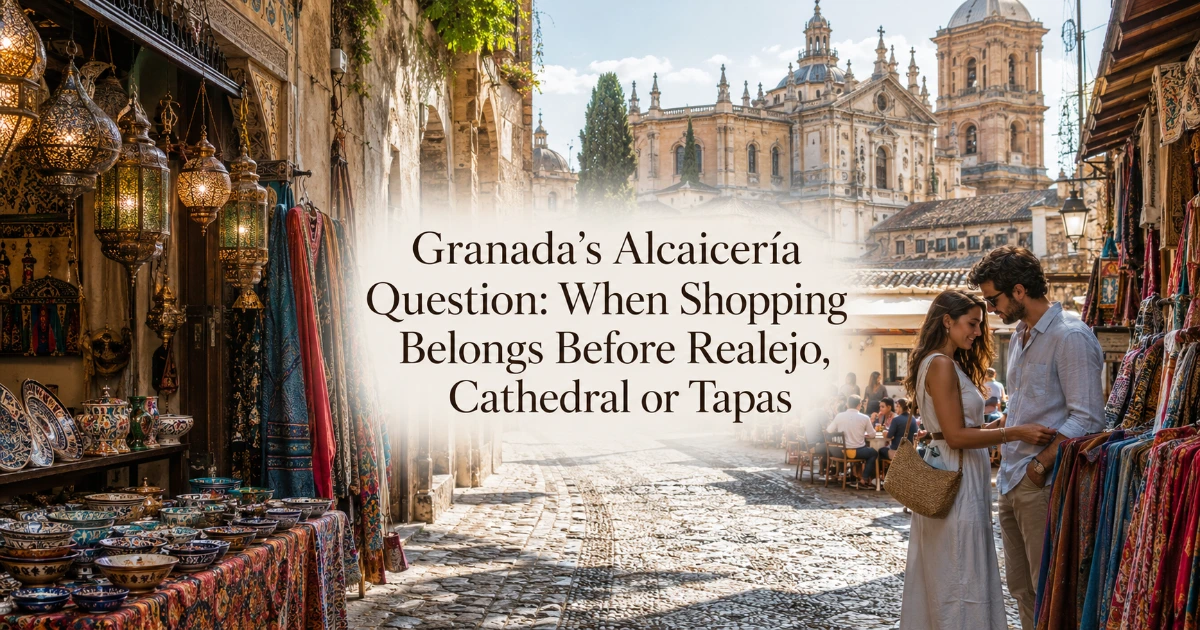
Put Alcaicería shopping before the Cathedral when you want the cleanest Granada sequence; put it before tapas when the purchases are light and the evening is informal; put it before Realejo only when the group still has appetite for a longer wander. The reason is not that Alcaicería needs a large shopping block. It usually does not. The reason is that the Alcaicería-to-Cathedral quarter handoff is one of the city center’s most efficient transitions: a compact, textured pause that can add Granada-specific context without pulling the day toward a hill, a taxi reset or a bag-management problem. The clearest exception is a post-Alhambra afternoon. After the palaces and Generalife paths, higher craft spend does not make poor post-Alhambra timing feel better; at that point, Alcaicería should often be a short pass-through rather than a planned stop.
The useful question is not “Is the Alcaicería worth shopping?” It is “Where does shopping belong so it improves the day instead of stealing energy from Realejo, the Cathedral or a tapas night?” In Granada, the same narrow lanes can feel like a graceful cultural hinge before a sacred-art visit, a pleasant pre-dinner browse before a relaxed evening, or a mood-flattening errand if it comes after too much climbing. This guide answers that placement question only, so it can sit beside deeper shopping and neighborhood planning such as Granada artisan shopping without hill fatigue without becoming another shop list.
The decision in three placements
- Best default: Alcaicería before the Cathedral. Choose this when the Cathedral, Royal Chapel or historic center is the cultural anchor. The quarter-to-monument transition is short, logical and easy to guide without turning shopping into the day’s headline.
- Best light-touch option: Alcaicería before tapas. Choose this when the group wants atmosphere, a small purchase and an easy evening rhythm. It works if bags stay small and no one is trying to inspect every stall before dinner.
- Best only for stronger walkers: Alcaicería before Realejo. Choose this when Realejo is the main mood of the afternoon and shopping is a brief opening note. It breaks down when purchases become bulky or when the group is already tired before the lower-hill streets begin.
- Wrong fit: Alcaicería after a full Alhambra visit. It can work as a ten-minute glance, but not as a serious shopping mission. After the Alhambra, the body usually needs either food, shade, a hotel reset or a simpler evening.
Why Alcaicería before the Cathedral is the cleanest answer
Alcaicería belongs before the Cathedral when you want shopping to serve the historic-center day rather than compete with it. The old market quarter sits beside the Cathedral and Royal Chapel zone, so the route can move from patterned lanes and shopfronts into monumental space without a transfer, a hill climb or a psychological restart. For couples, families and small private groups, that matters more than adding one more stop. It keeps the morning or early afternoon coherent: textile, ceramic and inlay references can be introduced while the group is still curious, then the guide can carry that visual language into the larger story of the center.
The counterintuitive correction is that the Cathedral quarter is often the better shopping base than Realejo when shopping is not the main purpose of the day. Realejo can feel more relaxed and less obvious, but it also asks the group to move away from the tightest Cathedral-Royal Chapel-Alcaicería cluster. If the day’s real priority is sacred art, architecture or a polished first look at the center, Realejo is not the upgrade. It is a different afternoon. Treating it as the “more local” automatic choice can create a route that is more charming in theory and more tiring in practice.
The Alcaicería-to-Cathedral quarter handoff also solves a common private-tour problem: how to include shopping without letting it set the pace for everyone. One person may want to compare ceramics or look at inlaid boxes; another may want the Cathedral; a child may already be asking about lunch. Because the two areas sit so close together, the guide can hold a clear boundary: a short browse, one or two contextual explanations, then onward into the cultural anchor. The day feels curated rather than hijacked by retail attention.
This is where a private guide earns value through editing, not through making the shopping stop longer. The guide can decide whether Alcaicería is a five-minute orientation, a thirty-minute browse or a deliberate purchase window based on the group’s energy, not based on a generic itinerary. For visitors who want the historic-center spine shaped around them, a private historic-center route can place Alcaicería as a useful hinge instead of a detour.
When shopping before Realejo works, and when it quietly weakens the afternoon
Shopping before Realejo works when Alcaicería is brief and Realejo is the true destination. The route can begin with the market quarter’s visual density, then loosen into Realejo’s lower-hill streets, calmer squares and neighborhood texture. This is especially good for travelers who do not want the afternoon to feel dominated by monuments. A couple celebrating an anniversary, for example, may prefer a short browse, a slower Realejo walk and a drink or dinner plan nearby over a tight Cathedral program.
The risk is that Alcaicería makes Realejo feel longer before it has even begun. Granada’s city center is walkable, but the feeling of distance changes when the group has bags, warm weather, museum legs or a later dinner ahead. From the Cathedral quarter into Realejo, the movement is not dramatic like climbing to the Albayzín, but it still shifts the group away from the central cluster and toward a more meandering afternoon. If someone starts comparing several purchases before that shift, Realejo can become the part of the plan everyone has to “finish” rather than the part that gives the day texture.
The body consequence is simple: Granada adds up in small gradients, stone surfaces, standing time and repeated decision points. The Alhambra creates the most obvious fatigue, but the city center can tire visitors through stop-start browsing as much as through climbing. A person who is comfortable walking for two hours may feel very different after thirty minutes of standing in narrow lanes, negotiating purchases, holding a bag, then continuing toward Realejo. The fatigue is not only distance; it is the loss of flow.
Use the Realejo placement when the group wants a mood change after the center and is happy to leave some shopping unresolved. Do not use it when the shopping list is vague but ambitious. “We might buy gifts” is more dangerous than “We want one small ceramic piece” because the vague version expands. If Realejo matters, cut the shopping window first. A focused pass through Alcaicería followed by Realejo is stronger than an overextended browse that makes the neighborhood feel like homework.
This is also where the nearby Realejo content should not be confused with this decision. A Realejo-first base strategy is a hotel and evening-planning question, not automatically a shopping-placement answer. Travelers comparing those broader neighborhood consequences can read Granada’s Realejo strategy separately; for this narrower question, Realejo only wins when shopping stays disciplined.
When Alcaicería before tapas is the right kind of informal
Alcaicería before tapas works when the stop is atmospheric, small and unburdened by serious buying. It can be an elegant pre-evening bridge: a little browsing, a quick explanation of the old commercial quarter, then a turn toward drinks and food while the group still has social energy. The mood advantage is that shopping can replace the awkward dead hour before dinner. Instead of returning to the hotel too early or forcing another monument when attention is fading, the group gets a compact sensory pause.
The condition is that purchases must not drive the night. Tapas in Granada is better when hands are free, curiosity is high and the group is not managing fragile items, multiple bags or shipping questions. If the plan is to move between bars, stand at a counter, compare neighborhoods or follow a guide’s food rhythm, shopping needs to stay light. A single small purchase is fine. A set of ceramics, a fragile gift or anything that needs careful packing starts to dictate the evening.
This placement is particularly good for couples and small groups who want the day to soften before food. A pre-tapas Alcaicería stop gives everyone something to look at together without asking them to process another major site. It can also help a food-and-wine evening feel more grounded in the city center rather than dropped in as a separate dining product. The guide can connect what the group has just seen in the quarter to the surrounding streets, then pivot into local eating rhythms without making the night feel like a lecture.
The mood-killing mistake is to begin a tapas night with unresolved shopping ambition. One person says, “Let’s just look quickly,” then the group spends too long deciding whether a gift is good enough, whether to return later, whether something will fit in luggage, or whether another shop might have a better version. That kind of indecision flattens the evening before food has a chance to do its work. For a private tapas plan, make the rule clear: browse for pleasure, not for completion.
For travelers who want the food part designed rather than improvised, Alcaicería can sit before a private tapas route as a compact prelude. It should not become the first course of a shopping night. The best tapas evenings in Granada usually need appetite, attention and enough looseness for the guide to adjust the order of stops.
When Alcaicería should be only a pass-through
Alcaicería should be a short pass-through when the day already has a heavy cultural anchor, a hill component or a dinner plan that needs energy. This is the editorial no: do not schedule a serious Alcaicería shopping block after a demanding Alhambra visit, before a late formal meal, or when the group has already spent the morning standing inside monuments. In those cases, the quarter is useful as a visual thread, not as a destination.
The Alhambra is the clearest example. A full palace and garden visit asks for concentration, timed entry discipline, walking and repeated transitions between courtyards, viewpoints and paths. After that, travelers often underestimate the difference between “we can walk through the center” and “we can make good buying decisions in the center.” The first may be true; the second may not. Buying requires comparison, patience and emotional bandwidth. After the Alhambra, many visitors have enough energy for a beautiful glance, not enough for thoughtful shopping.
Premium spend does not solve that problem. A more expensive craft piece, a more specialized shop or a more curated buying opportunity does not make poor timing feel elegant if everyone is tired. Paying more can improve guidance, context, access to better judgment and shipping coordination when the timing is right. It does not turn a fatigued post-Alhambra errand into a satisfying experience. The better upgrade is often subtraction: pass through Alcaicería, let the guide explain what you are seeing, then move to food, shade, a hotel pause or a calmer evening.
This is also the moment to prevent purchases from driving the whole route. Decide before entering the quarter whether the stop is for orientation, browsing or buying. Orientation means you keep moving. Browsing means one short window. Buying means the route must be built around packing, payment, possible shipping and the group’s patience. Most Granada days cannot absorb a buying mission casually. When the role of the stop is not named, the stop expands until it decides the route for you.
Families and multigenerational groups should be even stricter. A child who has managed the Cathedral, the Royal Chapel or a city walk may not object to Alcaicería itself; they may object to standing still while adults compare similar objects. Older parents may be comfortable with distance but less comfortable with narrow-lane stop-start movement. For these groups, a guided pass-through can be better than a shopping pause because it preserves dignity and flow.
How to keep purchases from taking over the route
The best way to keep purchases from controlling a Granada day is to assign shopping a role before the route begins. Alcaicería is compact enough to look harmless, which is why it can overrun a plan. It sits right where visitors are already moving between the Cathedral quarter, the Royal Chapel area, Plaza Bib-Rambla and central eating streets. That convenience is valuable, but it also tempts travelers to treat buying as something that can be squeezed in anywhere.
Use three practical limits. First, set a time boundary that matches the next commitment. Before the Cathedral, keep it short enough that the monument remains the mental center. Before tapas, keep it light enough that the evening still feels social. Before Realejo, keep it disciplined enough that the neighborhood does not inherit the group’s fatigue. Second, decide whether anyone is allowed to make a serious purchase. This sounds severe, but it prevents one person’s “quick look” from becoming everyone else’s lost hour. Third, plan the bag consequence. If an item cannot be carried comfortably through the next stop, it does not belong in that part of the day.
There is a difference between curated shopping and souvenir hunting. Curated shopping starts with the traveler’s taste, luggage reality, timing and the rest of the day. Souvenir hunting starts with the hope that the right object will appear if enough stalls are checked. In Granada, the second approach is what makes Alcaicería tiring. The quarter is better used with a filter: one category, one decision window, one onward route.
That is the natural place for private curation. A private shopping plan can make Alcaicería contextual and timed, not a detour that everyone tolerates. It can place the quarter before the Cathedral, before tapas or before a Realejo walk depending on the group’s real priorities, then cut it decisively when it stops improving the day. Travelers who want buying support without letting shopping swallow Granada should consider Granada shopping support as a planning layer rather than a longer retail loop. Inquire now
How the Cathedral option changes the culture-and-shopping balance
Before the Cathedral, Alcaicería becomes context rather than consumption. This is the strongest placement for travelers who want a day that feels culturally complete but not overpacked. The quarter can introduce Granada’s layered commercial memory, visual patterning and the way small lanes press against major religious architecture. Then the group moves into the Cathedral and Royal Chapel orbit with a sharper sense of contrast: intimate retail texture giving way to institutional scale.
The practical benefit is attention management. Monuments ask for a different kind of focus than shopping. If the group shops after the Cathedral, attention can be lower and the stop may feel like a reward that stretches too long. If the group shops before the Cathedral, the guide can use curiosity while it is fresh, then close the retail window before decision fatigue begins. The Cathedral remains the anchor instead of becoming the thing everyone is trying to reach after too much browsing.
This placement also works for celebration travelers who want the day to feel polished but not stiff. A birthday, anniversary or small family milestone does not always need another private room or formal meal. Sometimes the better move is a textured historic-center route with one carefully bounded shopping moment, followed by a beautiful cultural visit and a relaxed evening. The purchase, if there is one, becomes a memory attached to the route rather than a task extracted from it.
The Cathedral placement breaks down when the group wants shopping to be the main purpose. If someone is seriously sourcing gifts, comparing craft categories or planning to ship items, the Cathedral should not be forced into the same tight window. That is when a separate shopping-focused plan, or at least a later dedicated buying slot, is better. The Cathedral should not be treated as a decorative add-on to a retail mission; both experiences suffer when the order is dishonest.
For sacred-art travelers, the cleaner version is to make the center the headline and let Alcaicería supply a short prelude. A more art-focused route through the Royal Chapel, Cathedral and surrounding sacred sites can be planned through a Royal Chapel and Cathedral private tour, with Alcaicería used only where it clarifies the transition rather than steals the frame.
How the Realejo option changes the walking load
Before Realejo, Alcaicería should be treated as a gateway, not a shopping session. Realejo rewards travelers who arrive with enough energy to notice its lower-hill shifts, street rhythm and quieter corners. It does not reward a group that has already burned its patience in the center. The difference can be subtle: the same group that would enjoy a Realejo wander after a ten-minute Alcaicería pass can resent it after forty minutes of browsing and indecision.
Granada’s friction is not only the famous climb to the Albayzín or the Alhambra. It is the way a day can accumulate micro-transitions: crossing from the Cathedral quarter toward another neighborhood, pausing in a square, narrowing into a lane, standing in a shop, then restarting the walk. Each restart asks the group to reassemble. With couples, that can dilute the mood. With families, it can trigger impatience. With older travelers, it can turn an otherwise manageable route into a day of too many pauses.
The Realejo placement is best for visitors who want Granada to feel less monumental and more lived-in after a center introduction. It suits travelers who like a route that loosens as it goes: Alcaicería for density, then Realejo for a calmer second act. It does not suit travelers who need certainty, strong shade control, minimal standing time or a hard dinner reservation that leaves no margin. The more fixed the evening, the less you should gamble on an expandable shopping stop before Realejo.
There is also a bag logic. Realejo is much more pleasant when hands are free. Even small purchases change posture and pace, especially if the group is also carrying water, cameras, jackets or children’s items. If the plan includes meaningful buying, route back toward the hotel, arrange shipping or separate shopping from the Realejo walk. Do not ask Realejo to absorb the consequences of a center purchase just because it looks nearby on a map.
How the tapas option changes the evening mood
Before tapas, Alcaicería should feel like a palate cleanser, not an agenda. It can be one of the better pre-evening moves in Granada because it gives the group a shared visual moment before food. But it only works when the guide, host or traveler keeps the stop short enough that appetite and conversation remain intact. The mood you are protecting is not romance in a generic sense; it is the feeling that the night is opening rather than being delayed.
Tapas culture in Granada can be generous and informal, but that informality does not mean the evening needs no structure. A private tapas route still benefits from timing, neighborhood judgment and a sense of when to move on. If Alcaicería pushes the first drink too late, or if a purchase debate makes the group arrive distracted, the whole evening feels slightly off. The food may still be good, but the social rhythm has been spent in the wrong place.
This placement is strongest when the group has already had its major cultural moment earlier in the day and wants a lighter bridge into the evening. It is weaker when the group is using shopping as a substitute for deciding what kind of night they want. Browse, then tapas is a plan. Browse until we figure out dinner is not. Granada evenings are better when the first food decision is not made by whoever is most tired after shopping.
Fine-dining travelers need an additional distinction. If the night is a formal dinner, Alcaicería before dinner is less forgiving than Alcaicería before tapas. A tasting menu or carefully timed reservation wants a cleaner pre-dinner rhythm, not a last-minute retail errand. When comparing a casual tapas evening with a more structured dining night, use primary references sparingly and directly: the MICHELIN Guide selection (https://guide.michelin.com/us/en/andalucia/granada/restaurants) can help calibrate the formal-dining layer, while a restaurant’s own page such as Arriaga – Menú (https://arriagarestaurante.com/menu/) is the better place to confirm what the meal itself asks from the evening. The shopping decision should serve that rhythm, not crowd it.
The cut-first rule for an overpacked Granada day
When the day is crowded, cut the planned shopping block before you cut the main cultural anchor or the evening reset. This is the firm rule. Alcaicería is valuable because it can be scaled down without disappearing. The Cathedral cannot be meaningfully reduced to a glance if it is the reason for the route. Realejo loses its charm if rushed. Tapas loses its ease if everyone arrives hungry, late or carrying too much. Alcaicería, by contrast, can still do its job as a pass-through with one smart explanation.
The most common overpacked sequence is Alhambra, Alcaicería, Cathedral, Realejo and tapas in one day. It looks efficient because the names are all central to Granada, but the body experiences it as a chain of different attention types: timed palace visit, retail browsing, sacred interior, neighborhood wander and social eating. That is not a rich day for many travelers; it is a day that asks them to keep changing modes. If the Alhambra is already in the plan, be careful about adding Alcaicería as anything more than a glance unless the rest of the day has been deliberately lightened.
The second overpacked sequence is arrival, hotel check-in, Alcaicería, Cathedral and tapas. This can work beautifully if the shopping is short and the arrival has been smooth. It can fail if luggage, transfer fatigue or room timing has already created friction. Travelers arriving from Córdoba, Seville or Madrid often underestimate how much small uncertainty affects the first afternoon. A compact Alcaicería-to-Cathedral handoff can be excellent on arrival; a full shopping plan is usually too much unless the rest of the day is built around it.
For arrival-day judgment, the useful companion question is not whether Alcaicería is pleasant. It is whether touring should happen at all before the body has reset. That broader first-day issue is treated in Granada between train, hotel and Alhambra. For this article’s narrower decision, the answer is clear: if the day is already carrying transfer fatigue, Alcaicería should be a short atmospheric hinge or saved for a better window.
A practical timing blueprint for three common Granada days
The best placement depends on what the day is already asking from the traveler. Use these scenarios to decide where Alcaicería belongs without turning the article into a generic itinerary.
Scenario one: Cathedral and Royal Chapel are the anchor
Place Alcaicería before the Cathedral. Begin with a bounded browse in the quarter, then move directly into the Cathedral-Royal Chapel zone. This gives the guide a natural way to connect small-scale craft references, commercial history and the surrounding sacred architecture. Keep the shopping window short enough that the Cathedral visit still receives the freshest attention. This is the strongest option for first-time visitors who want a graceful center route without committing to a shopping afternoon.
Scenario two: Realejo is the mood you want
Place Alcaicería only as an opening pass-through. The route should not linger unless the group is fresh, the weather is kind and the next commitment is loose. Let the quarter provide a visual contrast, then move toward Realejo before the stop-start shopping rhythm takes hold. This is the right option for couples who want the afternoon to feel less monumental and more conversational. It is the wrong option for anyone who will be disappointed if shopping stays brief.
Scenario three: Tapas is the evening plan
Place Alcaicería before tapas only when the evening is casual and the group is not buying seriously. This can be one of the most pleasant uses of the quarter: a compact browse, a little orientation, then a food route while energy is still social. Keep purchases small, skip fragile items and avoid any decision that requires returning to a shop later. If dinner is formal, or the group is dressing for a reservation, do not let shopping occupy the pre-dinner hour.
Scenario four: The Alhambra has already happened
Make Alcaicería a pass-through or remove it. The Alhambra changes the rest of the day because it consumes attention as well as steps. Afterward, travelers often need food, shade, a hotel pause or a simpler evening more than they need a purchasing decision. If someone in the group cares deeply about shopping, give it a separate window rather than attaching it to the Alhambra’s aftermath.
What a guide can improve, and what the traveler still has to decide
A guide can improve Alcaicería by making it proportionate. The value is not only knowing where to walk. It is knowing when the stop is doing its job and when it is beginning to drain the next part of the day. A skilled guide can translate the quarter into the larger Granada story, watch the group’s energy, prevent one purchase from taking over, and keep the route moving toward Cathedral, Realejo or tapas with purpose.
What the traveler still has to decide is priority. A private guide cannot make a day feel calm if the traveler insists that every possible Granada texture must be included in the same afternoon. The choice has to be honest: culture-first, neighborhood-first, food-first or shopping-first. Alcaicería can support all four, but it cannot be the main event and the light prelude at the same time.
Where premium planning earns its cost is in the sequence. It can prevent the family from standing too long before lunch, prevent a couple’s evening from being flattened by errands, prevent a small group from splitting attention between a buyer and everyone else, and prevent post-Alhambra ambition from turning into late-day fatigue. Where premium planning does not help is pretending that a tired body will enjoy a high-touch shopping stop simply because the object is better. Timing still wins.
The most satisfying version is often modest: a short Alcaicería pass, a clear Cathedral handoff, a Realejo or tapas plan that still has energy, and a guide who knows when not to add more. That restraint may feel less dramatic in an itinerary document, but it usually feels better in the city.
FAQ
Should I shop in Alcaicería before the Cathedral in Granada?
Yes, Alcaicería before the Cathedral is the best default if your main goal is the historic center. The transition is compact, the Cathedral remains the cultural anchor, and shopping can add context without becoming the day’s main event.
Is Alcaicería better before Realejo or before tapas?
Alcaicería is usually better before tapas if shopping stays light, because it creates an easy pre-evening bridge. It is better before Realejo only when the group still has walking energy and accepts that the shopping stop must be brief.
When should Alcaicería be just a pass-through?
Alcaicería should be just a pass-through after a demanding Alhambra visit, before a formal dinner, or when the group is already carrying fatigue. In those cases, a short guided glance is more useful than a planned shopping block.
Can I combine Alcaicería, Cathedral, Realejo and tapas in one day?
You can combine them only if Alcaicería is tightly bounded and one part of the day stays light. If the Alhambra is also included, the plan is usually too crowded unless shopping becomes a quick transition rather than a destination.
Does a private guide make Alcaicería shopping more worthwhile?
A private guide makes Alcaicería more worthwhile when the guide keeps it contextual and timed. The improvement is not simply seeing more shops; it is preventing shopping from disrupting the Cathedral visit, Realejo walk or tapas evening.
Is Alcaicería a good place for serious craft buying?
It can be part of a serious buying plan, but not as a casual add-on before another demanding stop. If buying matters, give it a dedicated window, plan for bags or shipping, and do not force it between major cultural commitments.
What should I cut first if my Granada day is too full?
Cut the planned Alcaicería shopping block first and keep it as a pass-through. The quarter can still add atmosphere in a short visit, while the Cathedral, Realejo or a tapas night lose much more when rushed.
Is Alcaicería worth visiting after the Alhambra?
It is worth passing through after the Alhambra if you are nearby and still curious, but it is rarely the right moment for serious shopping. After the Alhambra, food, shade, a hotel pause or a simpler evening often serves the trip better.
If you’re interested in any private tours of Granada, please reach out to us.


 So if you are looking for the absolute best in Granada & surroundings with authentic local fully-licensed native guides whose English you can actually understand and with an exclusive and amazingly fun itinerary