Granada Between Train, Hotel and Alhambra: When Not to Tour on Arrival
Updated
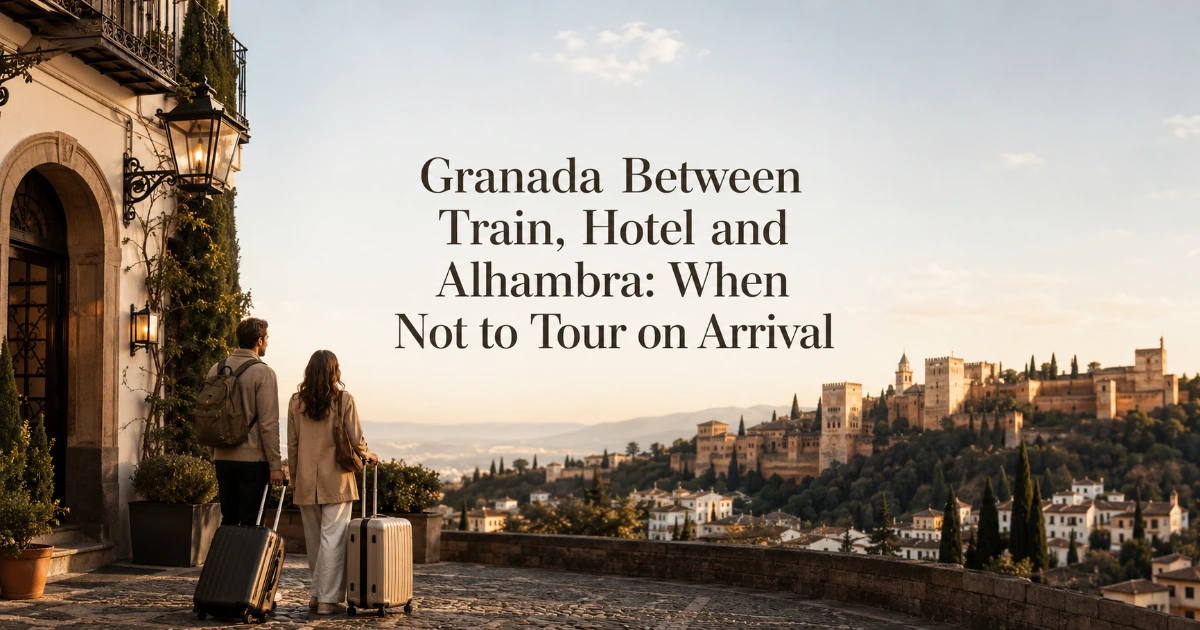
Do not make a full Alhambra tour your default Granada arrival-day plan. The safer default is train, hotel handoff, a small neighborhood reset, and an Alhambra visit protected for the next proper touring window. Granada makes this judgment practical rather than precious: the Granada train station is in the city, the hotel drop can still involve luggage and reception time, and the Alhambra sits uphill with ticket timing that is unforgiving enough to make late ambition expensive. The exception is a genuinely early arrival, a room or bag drop already controlled, travelers who are fresh rather than merely determined, and an Alhambra slot or private visit plan with generous separation from the transfer. Granada punishes arrival-day ambition because its three clocks rarely agree: the train-and-luggage clock, the hotel-room clock, and the fixed monument clock.
The non-obvious local detail is that arriving by rail does not put you on the Alhambra axis. After the Granada train station, you still have the taxi line or private pickup, the hotel threshold, the question of whether your room is ready, and then the uphill move toward Cuesta de Gomérez, the Puerta de la Justicia side, or the main monument access. That is a different proposition from stepping off a train and beginning a flat city walk.
The Alhambra ticket-time risk should sit above every arrival-day fantasy. When your visit includes the Nasrid Palaces, the official system ties that part of the visit to an assigned time, which is why the official Alhambra ticketing page (https://tickets.alhambra-patronato.es/en/) is worth checking before you build a same-day plan. A private guide can improve context, sequence and calm; it cannot turn a fragile arrival into a wise palace day.
Should you tour on arrival day in Granada?
You should tour on arrival day only if the plan stays below the stress line created by the station, hotel and Alhambra. For many discerning travelers, the best arrival day is not empty; it is deliberately narrow. It may include a chauffeured transfer, bag handling, a short orientation, a Realejo reset option, and a calm first dinner. It should not include a forced attempt to “use the afternoon” at the Alhambra simply because the monument is the reason you came.
The right private plan is sometimes transfer and reset only: a clean pickup, luggage control, hotel handoff, a short briefing if useful, and no sightseeing obligation. That is not under-planning. In Granada, it is often the plan that protects the Alhambra, dinner, and the mood of the whole stay.
Use this decision frame before buying more touring:
- Transfer and reset only: best when the train arrives after a long intercity leg, when your party includes children or older parents, when luggage is substantial, or when tomorrow’s Alhambra visit is the trip’s priority.
- Light Realejo reset: best when your hotel is in Realejo, Centro or near the Cathedral Quarter and everyone wants fresh air without a hill campaign.
- Short private orientation: best when you want a guide’s judgment on routes, dinner rhythm and tomorrow’s palace timing, not a formal monuments tour.
- Same-day Alhambra: appropriate only when the arrival is early, controlled and unhurried, with energy still intact and no meaningful risk of colliding with the ticketed entry window.
- Albayzín on arrival: usually the first famous idea to cut, unless you have a carefully managed drop-off, a downhill route, and travelers who actively enjoy uneven slopes after transit.
The first link in the plan should be logistical, not decorative. If the arrival itself is the uncertain piece, consider arranging private arrival transfer support in Granada or a similar handoff before adding any sightseeing. The point is not to make the day fancier; it is to keep the next day from starting with avoidable fatigue.
Why Granada arrival touring breaks down between the train station, hotel and Alhambra
Granada arrival touring breaks down because each move is small by itself, but the sequence is not small. Station to vehicle, vehicle to hotel, hotel to room or luggage storage, room to street, street to hill, hill to monument: none of these needs to be dramatic to flatten the afternoon. The problem is the accumulation.
The Granada train station is manageable, but it is not a friction-free gateway to the Alhambra. A couple traveling light may clear it quickly. A family with bags, a multigenerational party, or a small celebration group with wardrobe, gifts or special dinner plans will feel the transition differently. Even a polished pickup still has to absorb real-life pieces: locating the driver, loading bags, navigating hotel access, and deciding whether to stop at reception or move directly into the city.
The hill is the second source of friction. Granada’s beauty is not just visual; it is vertical. The Alhambra sits above the center, while the Albayzín rises on the opposite side, and the Realejo folds into slopes rather than staying perfectly flat. A route that looks elegant on a map can ask the body for more than the itinerary admits. After a train transfer, this matters. Climbing, queue drag, uneven paving, river crossings near Carrera del Darro, and the late-afternoon heat load in warmer months can make a two-hour “taste” feel like the start of a forced march.
The body consequence is direct: tired legs and overheated attention change how people experience Granada. A traveler who might enjoy Cuesta de Gomérez in the morning may resent it after luggage, check-in uncertainty and a rushed room change. A parent who would normally tolerate one more viewpoint may become the person managing water, shoes, hunger and the quiet worry of getting everyone back downhill. That physical strain does not disappear just because the afternoon was privately arranged.
The third source is mood. When the first hours in Granada become a countdown to the next appointment, the city starts to feel smaller and harsher than it is. Travelers stop noticing the handoff from Centro to Realejo, the change in sound around Plaza Nueva, or the relief of a shaded pause near Campo del Príncipe. Instead, they hear the clock. The arrival day should make Granada feel legible. A crowded plan makes it feel like a sequence of obligations.
The mood consequence is just as important as the physical one. A first evening that begins with pressure can make even the Alhambra feel like another deadline rather than the reason the trip was designed. Couples become tactical, families become managerial, and celebration groups lose the generosity of the first night. In a city where the best memories often depend on pacing, that is a high price to pay for one extra checked box.
The famous thing to cut first: Albayzín on arrival
The Albayzín is often overvalued as an arrival-day add-on because it sounds like a walk, not a commitment. That is the counterintuitive correction: the famous old quarter may be less suitable on arrival than a less famous Realejo reset. The Albayzín rewards time, orientation and legs that are ready for incline. It is not at its best when treated as a quick consolation prize between hotel check-in and dinner.
From Plaza Nueva, the transition into Carrera del Darro and up toward the Albayzín can be beautiful, but it is not neutral. The paving becomes more demanding, the routes fork, and the best viewpoints ask you to climb or accept vehicle assistance. If your group is already carrying the fatigue of Madrid, Córdoba, Seville or Málaga, the Albayzín can turn the first evening into a negotiation: who wants to continue, who wants to sit, who is quietly worried about the descent, and who is already thinking about tomorrow’s Alhambra.
Cut the Albayzín first if the next morning is your Alhambra commitment, if anyone in the party is mobility-sensitive, if your hotel is not already positioned for an easy return, or if dinner matters. Save it for a guided viewpoint plan or a separate evening when the descent can be part of the design rather than an afterthought. The neighborhood is too good to use as filler.
This is especially true if the first instinct is to “just see the view.” In Granada, the view is rarely just the view. It usually comes with a route choice, a slope, a return strategy, and a decision about whether to keep climbing once the group is already committed. A private plan can make the Albayzín elegant, but it does that by giving the neighborhood its own slot, not by squeezing it between arrival logistics and dinner.
The Realejo reset option that works before the Alhambra
The Realejo reset option works because it gives Granada texture without asking the arrival day to become a monuments day. Realejo sits close enough to Centro for a soft first look, close enough to many hotels for an easy return, and low enough in the city to feel manageable before the Alhambra. It is not a substitute for the palace; it is a way to arrive in the city without stealing strength from the palace.
A good Realejo reset begins after the hotel handoff, not before it. Bags should be gone. The party should have had a chance to wash, change shoes, take medication, settle children, or confirm dinner plans. Then the reset can be as simple as a short escorted orientation through the edge of Realejo, a pause around Campo del Príncipe, and a return toward the hotel or a nearby dinner. The aim is to make Granada feel inhabited and readable, not to cover ground.
This is where private planning earns trust by refusing excess. A guide can point out how Realejo sits between the historic center and the Alhambra hill, explain why tomorrow’s route should not start with avoidable climbing, and help you choose whether the evening belongs to tapas, a reserved dinner, or an early night. That kind of guidance is not a “tour” in the conventional sense, but it changes the quality of the stay.
The Realejo reset option is especially useful for couples who want a first sense of place, families who need a light walk before dinner, and food-and-wine travelers who would rather arrive at the table composed than over-walked. It is less useful if your hotel is high in the Albayzín or if the group is already too tired to enjoy even a short walk. In those cases, the better reset is the hotel itself.
A strong Realejo reset has a clear end point. It does not drift into an Alhambra approach, a Cathedral preview, a shopping loop and a viewpoint search. It is successful when the group returns with more appetite, not less; with a clearer sense of Granada’s shape, not a new list of unfinished stops. The reset should leave the Alhambra feeling protected rather than postponed.
How hotel location changes whether you should tour on arrival
Your hotel location changes the arrival-day decision because Granada’s best areas do not create the same first-day burden. The right plan from a Centro hotel may be wrong from an Albayzín hotel, and the right Realejo plan may not suit a property closer to the Alhambra hill. This is why the “train, hotel and Alhambra” question should be answered after the base is known, not before.
If your hotel is in Centro or the Cathedral Quarter
Centro and the Cathedral Quarter make the lightest arrival plan easier. You can usually keep the first afternoon to a hotel drop, a short city-center orientation, and a dinner plan without committing to steep routes. The tradeoff is that this area can tempt travelers into “just one more” stop: Cathedral surroundings, Royal Chapel context, Alcaicería browsing, a look toward Plaza Nueva. That can still be too much if tomorrow is the Alhambra.
From a Centro base, the best cut-first rule is simple: do not turn the first afternoon into a sacred-art preview, shopping loop and hill approach at the same time. Choose one small orientation thread, then stop. For a deeper base decision before booking, compare Centro, Realejo and Albayzín in where to stay in Granada for a comfort-first trip.
If your hotel is in Realejo
Realejo is the most forgiving base for a light arrival before the Alhambra because it can feel local and close without demanding a full climb. It allows a small reset, a plausible early dinner, and an easy return. It also keeps the Alhambra psychologically nearby without forcing you to go there.
The mistake from Realejo is to mistake proximity for readiness. Being closer to the Alhambra hill does not mean your arrival day should include the palace. It means tomorrow’s palace day can start with less confusion, and tonight can stay civilized. If the hotel room is delayed or the group is not yet settled, keep the plan even smaller: check-in, shower, short Realejo orientation if energy returns, then dinner.
If your hotel is in the Albayzín
An Albayzín hotel can be atmospheric, but it often complicates arrival-day touring. Vehicle access, luggage handling, slopes and return routes matter more here. A hotel that feels magical at sunset may still make the station-to-room handoff more complex than a map suggests.
If you are staying in the Albayzín, resist the urge to add a separate arrival walk just because the neighborhood is outside your door. Getting to the room may already be the first route. Your best first-day plan may be to settle, step out only within a very controlled radius, and save the proper viewpoint or Sacromonte sequence for a guided slot when the route can descend intelligently.
If your hotel is near the Alhambra or above the center
A hotel near the Alhambra can make the monument feel close, but closeness does not erase ticket pressure or arrival fatigue. It may reduce one transfer and increase another: easier access to the palace, less spontaneous access to Centro or Realejo, and more dependence on taxis or carefully chosen walking routes.
This base suits travelers who want the Alhambra to dominate the stay, but it does not automatically justify same-day touring. The smarter use of the location is often to sleep well, begin the Alhambra day cleanly, and avoid arriving at the Nasrid Palaces already tired from a station-to-hill scramble.
When arrival touring is a mistake, even with a private guide
Arrival touring is a mistake when the guide is being used to rescue a bad sequence rather than improve a good one. Private touring is strongest when it refines judgment, route and interpretation. It is weakest when it is asked to compensate for a late train, a delayed room, a hungry family, a fixed Alhambra time, and a dinner reservation that everyone still wants to enjoy.
In these cases, the right private plan is transfer and reset only. That may sound restrained, but it is often the more premium decision. It lets the guide or planner protect the next day, brief you on the Alhambra route, handle practical questions, and keep the evening intact without pretending that more sites equals more value.
A chauffeur cannot make an arrival-day Alhambra visit wise if timing and energy are wrong. Premium spend can change comfort, privacy, luggage handling, hotel access and the smoothness of a pickup. It does not change the basic fact that a tired traveler still has to absorb a complex monument, uphill movement and an assigned entry rhythm.
This is the point where affluent travelers sometimes make the expensive mistake. They assume that paying for a private car, private guide and carefully held tickets should allow the day to stretch. In Granada, the better question is not “Can we make it happen?” It is “Will this make tomorrow’s Alhambra better or worse?” If the answer is worse, cut the tour. Keep the handoff.
The same judgment applies even when the group is used to ambitious travel. A private guide can keep a route coherent, but the guide cannot remove every physical consequence of a rushed arrival. A chauffeur can remove waiting and uncertainty, but the chauffeur cannot manufacture rested attention. The premium decision is to use private support where it has leverage: transfer, luggage, timing, route advice and the courage to stop.
Where private planning actually earns the spend
Private planning earns the spend when it removes arrival-day uncertainty without inflating the day. A good handoff can decide the pickup point, manage bags, coordinate the hotel threshold, check whether a short reset is realistic, and protect the Alhambra commitment from emotional overplanning. That is a different service from selling a longer tour.
A chauffeured plan is particularly useful when your group is staying on a slope, traveling with older parents, coordinating a celebration dinner, or arriving after several days of multi-city movement. In those situations, chauffeured Granada planning can be less about spectacle and more about removing the weak points: awkward drop-offs, uncertain return routes, and the temptation to walk uphill when the group should be conserving energy.
A guide can also be valuable without leading a full route. The guide’s best arrival-day role may be a short briefing: how tomorrow’s Alhambra visit should start, which shoes to wear, where not to add the Albayzín, and whether dinner should be near the hotel or worth a controlled transfer. The result is a calmer trip, not a busier one.
For travelers who want a broader planning frame, the best support is usually not a single isolated service but a Granada sequence: arrival transfer, neighborhood reset if appropriate, Alhambra protection, and then a second decision about food, viewpoints, gardens or sacred art. That wider sequencing is where private tours in Granada can be useful without becoming excessive.
If your Granada arrival is already showing signs of strain, let the plan become smaller before it becomes expensive. Share the train, hotel, luggage, dinner and Alhambra constraints, and let the touring design follow the day’s real limits. Inquire now
How to place the Alhambra after the arrival day
The Alhambra belongs in the cleanest protected window you can give it, not in the leftover space after arrival logistics. That is the firm editorial call. If Granada is part of a Madrid, Córdoba and Seville itinerary, the palace should be treated as the anchor around which the Granada stay is built, not as a first-day prize for efficient travelers.
For many private stays, the better sequence is arrival reset, proper sleep, Alhambra and Generalife with a guide, then a later decision about gardens, viewpoints, tapas or a second-day route. A private Alhambra and Generalife tour is most valuable when travelers arrive with attention available. The monument asks for context: court life, water, defensive architecture, Nasrid detail, Christian overlays, garden pacing and the physical relationship between the palace and the city below. Those are not details to absorb while half your mind is still on the train.
Do not over-engineer the day before the Alhambra. Check the official Alhambra opening-hours page (https://www.alhambra-patronato.es/en/visit/opening-hours-and-prices) when you are finalizing, confirm the current ticket conditions, and then protect the surrounding energy. The plan around the palace matters as much as the ticket itself. For a deeper palace-first structure, use a comfort-first plan around the Alhambra as the next planning layer.
When the Alhambra sits the morning after arrival, keep the evening before deliberately plain. Do not add a late hill walk because the group feels briefly revived after showers. Do not turn dinner into a long cross-city transfer unless the table is worth it and the return is controlled. The goal is to arrive at the palace with curiosity, not with the residue of a first-night endurance test.
Dinner is part of the arrival-day decision
Dinner is not a decorative afterthought in Granada; it is one of the reasons to keep the arrival day light. A forced Alhambra attempt, an Albayzín climb and a late return can flatten the first evening so completely that even a carefully chosen table feels like recovery rather than pleasure.
Food-and-wine travelers should be especially disciplined. If your first night includes a special dinner, a tapas plan, or a restaurant from the MICHELIN Guide selection (https://guide.michelin.com/us/en/andalucia/granada/restaurants), do not spend the late afternoon proving how much you can cover. Arrive at dinner with appetite, clean shoes, and enough attention to enjoy the room. That may be the difference between a first night that feels like Granada and a first night that feels like logistics with plates.
The same applies to celebration travelers. Anniversaries, birthdays and family reunions often suffer from over-scheduled arrival days because everyone wants the first hours to feel meaningful. In Granada, meaning can come from restraint: a smooth hotel arrival, a short Realejo look, a composed dinner, and the knowledge that the Alhambra has not been squeezed into the wrong emotional slot.
A restaurant decision also changes the transport decision. If dinner is near the hotel, the first day can stay soft. If dinner is across the city, the return should be part of the plan before the group leaves the room. If the evening is tapas-led, keep the radius small and avoid turning it into a roaming expedition through Centro, Realejo and the Albayzín at once. A good first dinner should make the city feel generous, not make everyone calculate the walk back.
A practical rule for deciding when not to tour on arrival
Do not tour on arrival in Granada when the plan depends on optimism at more than one point. One optimistic assumption may be acceptable: the train will arrive as expected, the room will be ready, the group will feel fresh, the dinner timing will hold, the Alhambra approach will be easy. Two or three optimistic assumptions make the day brittle.
Use this rule instead: if the Alhambra is within the next touring window, spend the arrival day making that visit better. That may mean doing less than you could technically fit. It may mean choosing a hotel reset over the Albayzín, Realejo over a monument loop, or a driver briefing over a guided walk. The right day is the one that leaves the party curious, rested and oriented when the palace finally begins.
This is especially true for first-time visitors. Granada does not need a grand first impression forced into the hour after check-in. It needs enough room for the city’s levels to make sense: station below, center in motion, Realejo as a human-scale edge, Albayzín as a hill to respect, and the Alhambra as the fixed commitment above it all.
Premium spend does not help much here: a chauffeur cannot make an arrival-day Alhambra visit wise if timing and energy are wrong. Spend to simplify the day, not to deny what the day is telling you.
A sample arrival-day sequence that stays below the stress line
The cleanest version of this plan begins before the train reaches Granada. Confirm the pickup or taxi strategy, keep the Alhambra ticket information separate from luggage documents, and decide that the first decision after arrival is the hotel handoff, not sightseeing. That small mental order prevents the group from treating the station exit as the start of a tour.
From the Granada train station, move directly to the hotel. Do not add a coffee stop with bags unless the room or luggage storage has genuinely failed. Once at the hotel, let the room question resolve. If the room is ready, use it. If only luggage storage is available, still give the group a pause before asking for a walking decision. The reset starts when the group is no longer managing bags.
After that, choose one of three endings. The smallest ending is transfer and hotel only, followed by dinner close to the property. The middle ending is the Realejo reset option: a short, low-pressure look at Campo del Príncipe or the neighborhood edge, then dinner. The largest sensible ending is a brief guided orientation that explains tomorrow’s Alhambra route and first-night dining rhythm without becoming a monument tour. Anything beyond that should require a very strong reason.
This sequence is not designed to impress on paper. It is designed to work in the body. It protects legs from the Albayzín, attention from fixed-ticket anxiety, and mood from the feeling that Granada began as a race. That is why it is often the better luxury choice.
FAQ
Should I visit the Alhambra on the day I arrive in Granada?
Usually no. Visit the Alhambra on arrival day only if your train arrives early, your hotel handoff is controlled, your group is rested, and the ticketed entry timing has a generous buffer. Otherwise, keep arrival day to transfer, hotel reset and a light neighborhood plan.
Is Granada train station close enough to start touring immediately?
It is close enough for a controlled transfer into the city, but not close enough to ignore logistics. You still need to manage luggage, hotel access, check-in timing and the route decision before any meaningful touring begins.
What is the best light reset before the Alhambra?
The best light reset is usually a Realejo reset option after the hotel handoff. It gives a sense of Granada without forcing the Alhambra hill, the Albayzín climb or a monuments route into a tired arrival afternoon.
Is the Albayzín a good arrival-day walk?
Not for most travelers arriving by train with luggage and an Alhambra visit ahead. The Albayzín is better when you can give it time, manage the slopes, and design the route around viewpoints and descent rather than treating it as a quick add-on.
Does a chauffeur solve the arrival-day Alhambra problem?
No. A chauffeur can improve pickup, luggage handling, drop-offs and returns, but it cannot make a tired traveler fresh or remove the pressure of an assigned Alhambra entry time. Use the chauffeur to protect the day, not to overload it.
How does hotel location affect the decision?
Centro and the Cathedral Quarter make a light orientation easier; Realejo is strong for a short reset; Albayzín hotels add slope and access considerations; Alhambra-side hotels can help tomorrow’s palace day but do not automatically justify same-day touring.
What should I cut first if my Granada arrival day is overloaded?
Cut the Albayzín first, then any extra monument preview, then any shopping or viewpoint idea that requires a return route. Keep the hotel handoff, dinner plan and Alhambra preparation intact.
Can a private guide help if we do not tour on arrival?
Yes. A private guide can still help with a short orientation, route briefing, dinner judgment and Alhambra preparation. The value is in making the next day smoother, not in forcing a full arrival-day tour.
If you’re interested in any private tours of Granada, please reach out to us.



 So if you are looking for the absolute best in Granada & surroundings with authentic local fully-licensed native guides whose English you can actually understand and with an exclusive and amazingly fun itinerary













