Granada with Kids for a White-Glove Andalusia Trip: How to Place the Alhambra, Albayzín and a Calm Reset Without Hill Meltdowns
Updated
Yes, Granada can work beautifully with kids on a white-glove Andalusia trip, but only if you plan it as a one-big-commitment city: put the Alhambra first, solve at least one uphill transfer by taxi or chauffeur, and keep the second half of that day deliberately soft. That approach works because Granada’s challenge is not raw sightseeing volume. It is elevation, timing pressure, and the way the Alhambra hill, the Albayzín ridge, and the old river-level streets stack fatigue into parts of the day families often underestimate.
The clearest exception is the family trying to turn one Granada day into a full conquest of the Alhambra, the Albayzín, Sacromonte, and a late dinner. That version sounds efficient on paper and feels punishing in real life, especially with younger children, stroller-age kids, or anyone still needing a quiet break after lunch. In Granada, the planning mistake is rarely choosing the wrong sight. It is spending your children’s best energy on the wrong slope at the wrong hour.
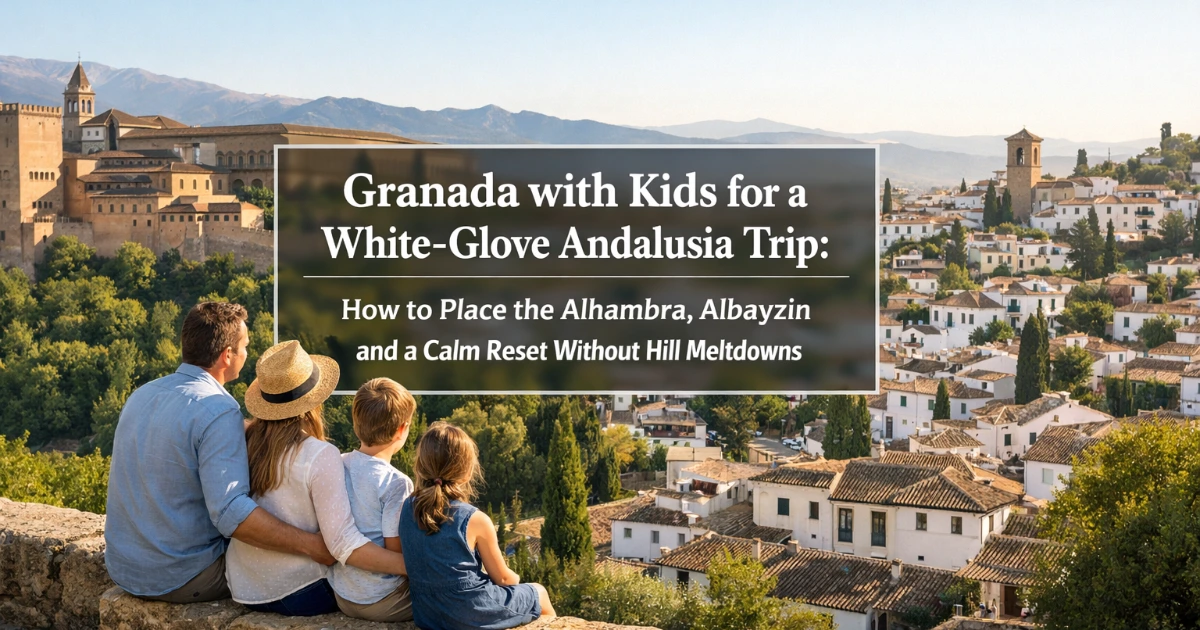
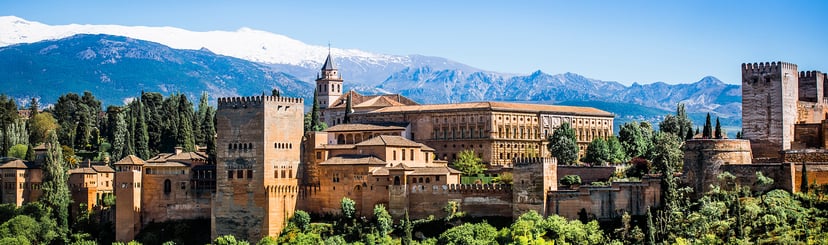
The most misleadingly charming place in this whole equation is Paseo de los Tristes at the base of the Alhambra hill. Families see that postcard stretch, with the fortress above and Carrera del Darro nearby, and assume the monument is “right there.” It is visually close and physically deceptive. Starting from Paseo de los Tristes often means turning a scenic approach into the first patience drain of the day. That is why a guided morning on a private Alhambra and Generalife tour with a realistic transfer plan beats a heroic family walk more often than first-time visitors expect.
Is Granada worth it with kids on a first-time Andalusia trip?
Yes, if you accept one firm editorial rule: Granada is at its best for families when you let one major sight win the day instead of asking the city to prove how much you can stack. The city is absolutely worth including for the Alhambra, the atmosphere around the old quarters, and the sense of arriving somewhere unlike Seville or Córdoba. What makes it fragile for families is that its most photogenic areas are also the places where tired legs and thin patience show up fastest.
The counterintuitive part is this: paying more to stay deep inside the Albayzín does not automatically create a smoother family stop. In fact, for many families it does the opposite. A beautiful room on a steep lane with a magnificent view can make the return leg harder precisely when children are least willing to cooperate. For family comfort, Granada usually works better when the hotel base keeps you closer to the flatter city core or lower Realejo and lets the hills happen as chosen outings rather than compulsory commutes. If your hotel decision is still open, our take on where to stay in Granada explains why the most romantic-looking address is not always the kindest family choice.
There is another reason Granada earns its place: it rewards precision. When a family day is built in the right order, the city feels concentrated rather than sprawling. You can devote a meaningful morning to the Alhambra, recover in gardens or over lunch, and still have room for one carefully chosen old-quarter moment later. That is very different from cities where children spend half the day in transit. In Granada, the distance between decisions is short. The consequence of those decisions is what changes.
The family day shapes that actually work
The best Granada day with kids is almost never the most ambitious one. It is the one that gives the Alhambra its own gravity, protects a recovery window, and treats the Albayzín as optional unless energy is clearly still there.
- Best for ages 8 to 12: morning Alhambra, unhurried lunch, Carmen de los Mártires or hotel downtime, then a very short evening viewpoint stop only if the family is still genuinely cheerful.
- Best for mixed ages including one younger child: Alhambra only, followed by lunch and a real break. Save the Albayzín for a separate session or skip it entirely on this stop.
- Best for teens who actually like history or views: Alhambra in the morning, lunch, and later a targeted Albayzín moment reached by vehicle and walked mostly downhill.
- Best for stroller-age families: make Granada a single-anchor city. Use vehicles for the major hill changes and do not stack the Alhambra with a second uphill district on the same day.
That list may sound conservative, but Granada is a city where conservation is exactly what preserves quality. Families do better here when the second sight is chosen for recovery value, not bragging rights. That is why the calmer add-on often wins over the more famous one. A garden walk, a terrace lunch, or a return to the hotel before evening can make Granada feel like a crafted stop instead of a test.
The cut-first rule is simple: cut the late hill climb before you cut the Alhambra time. If the day starts running hot, late, or fractious, the first thing to sacrifice should be the idea of “just also doing” the Mirador de San Nicolás side of the Albayzín. Families often try to protect that add-on because it looks small on a map. In practice, it is the part that most often flips the mood from engaged to brittle.
The age-and-energy split that should decide your Alhambra day
The Alhambra-heavy day works best for school-age children, is workable but narrower for younger children, and often becomes a single-site day for stroller-age travelers. That is the honest starting point.
Under about four years old: Granada can still be worthwhile, but the family version needs humility. This is not the age band for a triumphant Alhambra-plus-Albayzín plan. Even when a child is content in a stroller for a while, the real issue is not the monument alone. It is the transitions before and after it, the stop-start pacing, the stone surfaces, the waiting moments, and the fact that once a nap window slips, every uphill lane feels longer. For this age band, think in terms of one major visit plus one gentle decompression move. Anything more should be treated as a bonus, not a promise.
Ages five to seven: this is often the trickiest group because they can do a lot, so adults assume they should. They are capable of a rewarding Alhambra morning, especially with context, storytelling, and a guide who keeps the route moving. They are also the age most likely to protest the second climb on principle. The family day that works here is usually Alhambra, lunch, and either Carmen de los Mártires, downtime, or a very short later viewpoint reached the easy way. The family day that fails is Alhambra, lunch, a full Albayzín wander, and then one more scenic detour because everyone is already “out.”
Ages eight to twelve: this is the sweet spot for Granada. Children are old enough to absorb the scale, understand the hill logic, and enjoy the shift between palaces, gardens, and viewpoints. They can usually handle one planned neighborhood add-on if the adults choose it carefully. This is the age band where Granada can feel genuinely premium in the best sense: not flashy, but well-sequenced, comfortable, and satisfying for both generations. Even here, though, you still want one major hill only. The city rewards restraint even when kids are capable walkers.
Teens: teenagers can certainly do more, but the deciding factor is interest, not athletic capacity. A teen who likes history, photography, architecture, or just being somewhere atmospheric may do very well with the Alhambra plus a short old-quarter session later. A teen who is indifferent will feel every inefficient transfer and every uphill switchback more sharply than a curious younger child. Do not assume “they are older, so Granada will be easy.” Older children simply become more vocal about bad sequencing.
There is also a body consequence adults often miss until too late. Granada accumulates fatigue vertically. Families may not walk extreme mileage, yet the day still lands heavy in the legs because the climbs come in concentrated bursts, often after queues, security, or mentally demanding sightseeing. Add heat, bright light, or a later lunch, and the effect is not just tiredness. It is slowed reactions, more sibling friction, and a much lower threshold for small irritations on the return leg.
The mood consequence is equally important. In Granada, an overpacked family day does not simply feel “busy.” It can flatten the whole evening. Children who might have been happy over tapas, dessert, or a gentle paseo through the center can end up glassy-eyed and oppositional if the adults insist on one more ridge, one more mirador, or one more photo stop. The family that preserves the break usually preserves the dinner and the memory of the day as well.
For families who want a broader city framework beyond this kids-specific question, a Granada Alhambra planning guide covers the wider planning logic. The family adjustment is that younger energy changes the cut order. What an adult might classify as “one last scenic stop” is often exactly the wrong final act for a child.
Cuesta de Gomérez versus vehicle drop-off: the hill decision that changes the day
If you remember only one practical distinction, make it this one: Cuesta de Gomérez versus vehicle drop-off is not a style choice. For families, it is an energy-management decision.
Cuesta de Gomérez is beautiful. It is shaded, evocative, and historically atmospheric in a way that makes adults feel they are “arriving properly” at the Alhambra. For older children in cool weather, with a relaxed morning and no second hill planned, that walk can be part of the pleasure. But parents should not confuse beautiful with low-cost. Even a handsome, tree-lined ascent still spends the same legs your children will need later. If the family is already arriving from a hotel with an uphill approach, or if the day includes any later old-quarter ambitions, the scenic climb can be the wrong place to spend energy.
A vehicle drop-off, by contrast, is often the smartest premium choice in Granada because it eliminates the least rewarding strain rather than adding decorative luxury. This is especially true for mixed-age families, anyone managing naps, multi-generational groups, or travelers arriving from a different Andalusian city that same morning. The point is not to avoid walking altogether. It is to avoid walking where the payoff is weakest.
Families often ask whether a standard taxi is enough or whether pre-arranged chauffeur support is worthwhile. The honest answer is that taxis are perfectly adequate when you only need to solve one awkward leg: hotel to Alhambra, Alhambra to lunch, or Albayzín back down. A chauffeur starts to make more sense when the whole day has fixed points that would otherwise create friction: timed monument entry, grandparents, child seat needs, a hotel outside the easiest pickup zone, or the desire to move from one hill zone to another without negotiation or queueing. That is where chauffeured support in Granada stops being decorative and starts being practical.
The wrong place to economize is not always the obvious one. Many families spend freely on views, special dinners, or higher-category rooms, then balk at arranging transport for two short but decisive legs. In Granada, that can be backwards. A reliable pickup after a tiring morning can do more for the day than the prettier suite. The suite may impress you at check-in. The pickup is what keeps the second half from unraveling.
It is also worth being honest about stroller reality. The limiting factor is usually not the mere existence of a stroller. It is the repeated question of whether the stroller needs to be pushed uphill, folded, lifted, or maneuvered on cobbles when a child is no longer willing to be in it. That is why the vehicle decision matters more than many parents expect. Even when a family is comfortable walking a great deal in flatter cities, Granada asks for different muscles and different patience.
One useful rule: if you are choosing between “earning” the Alhambra by walking up from Plaza Nueva and arriving fresher, choose freshness unless the day is otherwise almost empty. Granada looks close from below because the fortress dominates the skyline. The map does not show the quality of fatigue that accumulates between river level, the hill, and the return.
Another useful rule: do not let a picturesque descent trick you into accepting a punishing ascent. The lanes near Carrera del Darro, Plaza Nueva, and the lower Albayzín can feel gentle when you are drifting downhill in good spirits. They are a completely different proposition when you are asking a tired six-year-old to reverse the equation in afternoon light. Families who plan only the outward journey are usually the families who dislike Granada more than they expected.
Weather matters too. In warmer months, the exposed parts of the Albayzín and the later viewpoint stops become the first thing to cut after lunch. In cooler months, the city is far easier to enjoy, but the hill logic does not disappear. In wet weather, steep stone and slick lanes make the case for vehicles even stronger, not because Granada becomes impossible, but because its margins for error get smaller.
What to pair with the Alhambra, and what to skip after it
The best pairing with the Alhambra for most families is not another famous climb. It is a calmer second act that lets the morning stay meaningful instead of turning the whole day into attrition.
Carmen de los Mártires is the standout add-on because it gives families exactly what the Alhambra morning often leaves them wanting: space, greenery, lower emotional demand, and a sense of still being somewhere beautiful without needing to “perform” sightseeing. That is why Carmen de los Mártires Gardens works so well as a calm reset. Children can exhale, adults still feel they have extended the day thoughtfully, and the transition is easier than forcing another photogenic but effort-heavy district. If that sounds like your family’s speed, Carmen de los Mártires Gardens is the rare Granada add-on that actually improves the day instead of merely lengthening it.
The second good pairing is a real lunch followed by an actual break. That may sound unromantic, but it is often the most sophisticated family decision you can make in Granada. The city tempts adults to keep moving because the next view is always “just up there.” Families who stop, eat properly, and return to the hotel for even a short pause frequently end up having a better evening than families who keep chasing momentum. In Granada, recovery is part of the design, not evidence that the plan failed.
A third pairing can work for the right family: a short, selective Albayzín moment later in the day, ideally reached by vehicle and walked in the easier direction. This is the version for older children or teens who still have appetite for one more atmospheric hour. The trick is to define the moment narrowly. You are not “doing the whole Albayzín.” You are taking one carefully placed look, one stretch of lanes, and then leaving while it still feels elegant.
Now the required hard call: the popular late-day Albayzín climb to Mirador de San Nicolás is too much for most families after the Alhambra. Add Sacromonte on top of that and it is usually a mistake. This is the do-not-stack-these-icons judgment that matters most in Granada with kids. The view may be famous, but fame does not shorten the approach, soften the climb, or improve a child’s mood once the day has already peaked.
That advice is not anti-Albayzín. It is pro-sequencing. The Albayzín is better when it gets its own energy, or at least a cleaner slice of the day. Parents often regret what they skipped far less than what they forced. In family travel, the memorable failure is rarely “we did one major thing beautifully.” It is “we nearly had a good day until the last hour.”
If you need a practical cut order when the day starts slipping, use this one. First cut Sacromonte. Second cut the uphill push toward the Mirador. Third cut the idea that everyone must stay out until dinner. Keep the Alhambra time, keep lunch civilized, and keep one quiet hour of goodwill in reserve. That order produces far fewer family blowups than clinging to every famous name on the list.
This is also where premium spend does not help. Paying for a late extra stop does not materially improve the day if the family is already spent. It only makes the fatigue more expensive. The money that helps in Granada usually helps before the strain begins: better timing, better routing, better pickup logic, or better guidance inside the Alhambra. Once children are done, more curation does not rescue the wrong itinerary.
How to place the Albayzín without turning it into a second uphill exam
The Albayzín works best with kids when you stop treating it like an obligatory companion to the Alhambra and start treating it like a separate mood piece that can be inserted only if the family still has margin.
For many families, the best placement is not “after the Alhambra” but “later than the Alhambra.” That might mean another evening, a short pre-dinner outing after a hotel rest, or even the following morning before departure if you have slept in Granada. The reason is simple: the Albayzín is not just a sight. It is a neighborhood of gradients, cobbles, viewpoints, and decision points. It asks more from a tired family than its romantic image suggests.
The version that works is often asymmetrical. Arrive by vehicle toward the upper area you want to experience, keep the objective modest, and let the family walk mostly downhill through the part that interests you most. That turns the Albayzín from a contest into a drift. It also preserves adult attention. When parents are no longer bargaining through each incline, they can actually notice the district.
The version that fails is the one that begins with false confidence in the lower streets. Families leave lunch in the center, meander through Plaza Nueva or along Carrera del Darro, decide they are already “basically there,” and then keep going upward because the view will be worth it. Sometimes it is worth it. The cost is that the return rarely feels worth it to the youngest person in the group. That is the point at which Granada stops feeling special and starts feeling overmanaged.
If you are staying only one night, keep the Albayzín extremely selective. If you are staying two nights, it becomes much easier to give the neighborhood a cleaner slot and therefore enjoy it more. Families planning their wider stop length can use how many days in Granada as the broader framework, but the child-specific answer is straightforward: the moment you try to compress Granada into one arrival, one Alhambra visit, and one major hill neighborhood without recovery time, the city becomes far less family-friendly.
Hotel base matters here more than adults often admit. A family staying in Centro or the more accessible edge of Realejo can choose the Albayzín or decline it depending on energy. A family sleeping deep in the Albayzín often has less choice. The neighborhood becomes part of every return, every stroller decision, every “five more minutes,” and every negotiation over tired legs. That may be romantic for couples. It is not automatically kind to children.
Paying more for a view room deep in the Albayzín does not make the Alhambra day easier; it usually makes the return leg worse.
There is one more subtle consequence. Families who place the Albayzín separately often end up seeing more of it, not less. When children are fresher, adults linger more naturally, detours feel optional rather than coercive, and the whole district reads as texture rather than obstacle course. Good timing does not shrink Granada. It makes it legible.
Where guide and chauffeur support earn their keep, and where they do not
The smartest premium spend in Granada with kids is the spend that removes friction before it turns into family drama. That usually means guidance inside the Alhambra and transport support between hill zones, not an inflated sightseeing list.
A strong private guide is useful here because the Alhambra is not just a monument; it is a timed, spatially layered visit that can drag when families lose the thread. With children, pace and interpretation are linked. When kids know what they are looking at, they move better. When adults are not repeatedly consulting maps, entrances, and sequence questions, the family keeps its rhythm. Good guiding is therefore not about adding information for information’s sake. It is about reducing dead air, confusion, and the kind of micro-delays that make children feel a visit is longer than it is.
Transport support earns its place for a different reason. Granada’s hardest family moments are often not inside the headline sight. They happen between zones: leaving the hotel later than planned, realizing the uphill start is steeper than expected, deciding whether to walk from lunch to the next stop, or watching energy collapse on the wrong side of a hill. A driver or pre-planned transfer turns those fragile moments into clean transitions. That is why guide-plus-transfer days feel disproportionately calmer here.
Where extra spend does not help is in pretending tired children can be bought past a bad sequence. A longer afternoon, a prettier table, or one more chauffeured stop does not fix the decision to overstack the day. Granada rewards precision, not bravado. The best spend buys clarity and cleaner logistics. It does not buy immunity from fatigue.
If your family trip includes grandparents, multiple rooms, or just one carefully placed Granada stop in a larger Andalusia route, this is the point where planning handoff actually changes the experience: a joined-up Alhambra morning, a sensible lunch, and protected transfers between hill zones can preserve both the children’s mood and the adults’ evening. Inquire now
The evening question deserves one final note because it is where ambitious travelers often overcorrect. If adults want one serious dinner in Granada, put it on the night before or after the Alhambra-heavy day, not on the same evening you are also trying to force a second hill. Looking at current menus directly at Arriaga (https://arriagarestaurante.com/menu/) or Faralá (https://restaurantefarala.com/carta/), or at the wider MICHELIN Guide selection (https://guide.michelin.com/us/en/andalucia/granada/restaurants), is useful precisely because it reminds you that a memorable Granada dinner deserves fresh adults and a stable family mood, not parents arriving already depleted from a heroic sightseeing finish.
That is the deeper reason Granada can feel so good when it is done well. The city is intense, but it is compactly intense. Families do not need endless optimization. They need one clean morning anchor, one honest recovery window, and one refusal to turn every hill into a moral duty. Once you make those choices, Granada stops feeling like the most fragile stop in Andalusia and starts feeling like one of the most rewarding.
FAQ
Can you do the Alhambra and the Albayzín in one day with kids?
Yes, but only in a narrowed version. For most families, that means the Alhambra in the morning and a short, selective Albayzín visit later, ideally reached by vehicle and walked mostly downhill. A full Alhambra morning plus a full uphill Albayzín wander is usually too much, especially for younger children.
What is the best age for an Alhambra-heavy day in Granada?
Ages eight to twelve are often the easiest fit because children are old enough to stay engaged and handle one meaningful hill without the day feeling punitive. Ages five to seven can do the Alhambra well, but they need a softer second half. Stroller-age children usually do best when Granada is treated as a single-anchor stop with vehicle help.
Should families walk up Cuesta de Gomérez to the Alhambra?
Only when the family is fresh, the weather is kind, and the rest of the day is intentionally light. Cuesta de Gomérez is attractive, but it still spends energy before the main visit begins. For many families, especially those planning any second hill zone later, a vehicle drop-off is the better choice.
What should families pair with the Alhambra in Granada?
The most reliable pairing is something restorative rather than competitive: a proper lunch, hotel downtime, or Carmen de los Mártires. Those options keep the day graceful. The pairing that most often fails is another hard climb added simply because it is famous.
What popular Granada add-on is too much after the Alhambra?
For most families, the late climb toward Mirador de San Nicolás in the Albayzín is too much after the Alhambra. Adding Sacromonte as well is usually the tipping point from enjoyable to draining. If energy is fading, cut that add-on first.
Is it worth staying in the Albayzín with kids?
Sometimes, but not by default. The Albayzín can be atmospheric and memorable, yet the steep return legs and cobbled lanes often make it a tougher family base than it first appears. Families who value smoother logistics often do better in a flatter base and visit the Albayzín by choice rather than living inside its climbs.
When is a chauffeur or pre-arranged driver actually worth it in Granada?
It is worth it when the day includes timed entries, mixed ages, grandparents, naps, or multiple hill-zone transitions that would otherwise create stress. If you only need one easy transfer, a taxi is often enough. If the whole day depends on precise movement and lower friction, planned vehicle support earns its keep.
Can Granada still be a premium family stop if you skip half the famous list?
Absolutely. In Granada, quality comes from sequencing, not from clearing every headline. A family that sees the Alhambra well, avoids the wrong late climb, and keeps enough energy for a calm evening usually has a stronger Granada memory than a family that technically saw more but enjoyed less.
If you’re interested in any private tours of Granada, please reach out to us.



 So if you are looking for the absolute best in Granada & surroundings with authentic local fully-licensed native guides whose English you can actually understand and with an exclusive and amazingly fun itinerary













