Granada in Winter Light: Alhambra Timing, Sierra Nevada and Shorter City Days
Updated
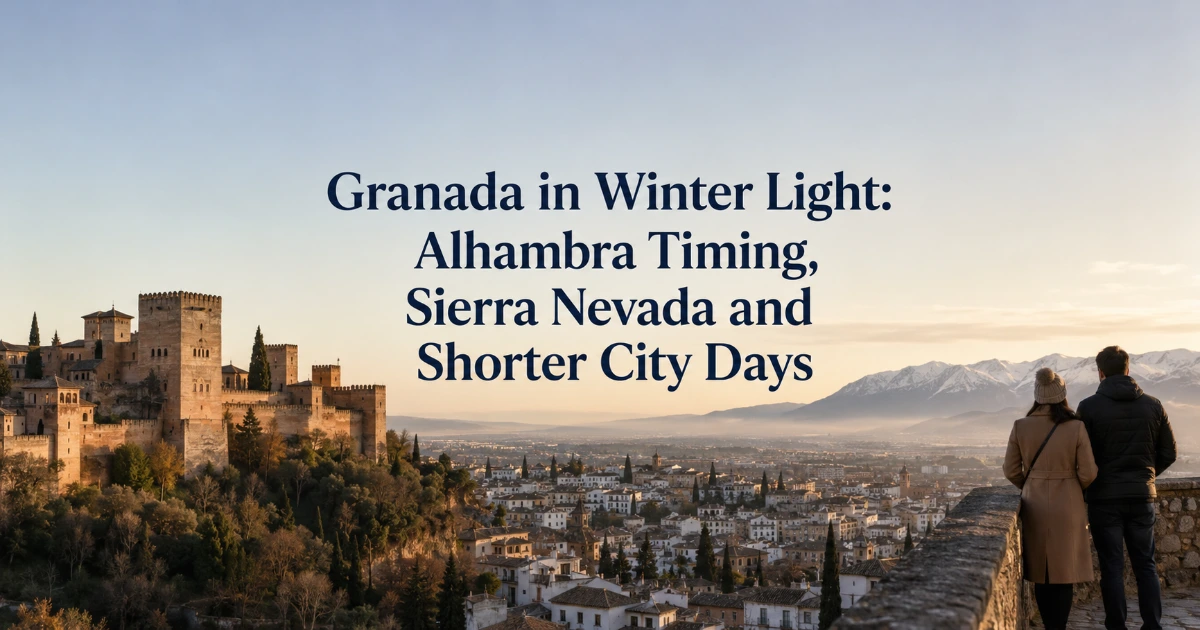
In winter, Granada works best when the Alhambra anchors real daylight, not the end of the day. That order works in the city itself because the palace hill, the Generalife terraces, the Albayzín slopes and the Realejo all ask for light in different ways, and the winter daylight around the Alhambra is the one thing you cannot buy back later. The clearest exception is a ski-led or snow-play trip; then Sierra Nevada may lead the plan, but it should not be treated as an automatic add-on to a serious city stay.
The winter version of Granada is not a warm-season itinerary with a coat; it is a daylight-allocation problem between a hilltop monument, two steep neighborhoods and a mountain road. A small local hinge makes the point quickly: a late palace visit followed by a walk down through Cuesta de Gomérez to Plaza Nueva can feel satisfying, but trying to climb from Plaza Nueva into the Albayzín afterward, cross the Darro, and still reach a viewpoint before the light falls is where polished plans start to fray. For tailor-made seasonal routing, Orange Donut Tours usually starts with the Alhambra as the fixed daylight commitment and then builds the city around it: Granada seasonal private planning.
One operational fact matters more than a general winter-weather summary. The official Alhambra page lists the Monumental Complex day-visit season from October 15 to March 31 with an 18:00 closing time, and it also states that the Nasrid Palaces can only be visited at the time printed on the ticket; confirm details on the official Alhambra opening-hours page (https://www.alhambra-patronato.es/en/visit/opening-hours-and-prices) when you book. That does not mean every winter visit must start at opening. It means the Nasrid Palace slot should be placed where it does not steal the only good hill-neighborhood light of the day.
The winter decision in three scenarios
The right winter order depends less on whether Granada is “cold” and more on what you want the daylight to do. The Alhambra is the fixed point, Sierra Nevada is the rhythm change, and Albayzín or Realejo are the flexible city pieces. Read the plan through the scenario that matches your trip, then cut before you add.
- First Granada visit with one full city day: Put the Alhambra in the main daylight block and keep the Albayzín or Realejo shorter, not later and longer. You can still have a viewpoint, a tapas evening, or a quiet garden edge, but you should not force every famous slope into one short winter afternoon.
- Two or three nights with culture as the priority: Let the Alhambra have one strong daylight session, then use the next day for either a deeper city route or Sierra Nevada. This is the cleanest version for couples, families, and small groups who want the palace to feel unhurried rather than merely completed.
- Celebration or food-and-wine stay: Avoid stacking a late Alhambra, a hill walk, a viewpoint, and a tasting-menu dinner. Winter evenings can be elegant in Granada, but they need a calmer lead-in than a last-minute climb from the Darro or a late transfer down from the mountain.
- Mountain-first travelers: Sierra Nevada belongs when the mountain is part of the identity of the trip, not because it looks tempting on the map. If your group is not genuinely excited by the upland day, keep that daylight in Granada and make the city more complete.
The counterintuitive correction is this: the most famous viewpoint is not always the best winter upgrade. Mirador de San Nicolás can be memorable, but it is overvalued as a default add-on after a late Alhambra because the climb, the crowding around the viewpoint edge, and the time needed to descend can eat the part of the day you were trying to save. A quieter Albayzín route, a Realejo finish, or a composed hotel return may give a better high-end experience than forcing the postcard view at the hardest hour.
Should you visit the Alhambra in the morning or afternoon in winter?
The Alhambra should anchor the clearest daylight block of your Granada winter day, which usually means late morning through early afternoon rather than the final workable hour. The reason is not that morning is always prettier or afternoon is always crowded; the reason is that the palace, gardens, transfers and nearby hills all compete for the same compressed winter window.
A strong Alhambra plan starts by respecting the Nasrid Palace time rather than treating it as one stop among many. The palace complex is not a single doorway off a flat square. Depending on the route, a traveler may approach from the lower city through Cuesta de Gomérez, arrive by vehicle nearer the upper access, or move between the Alcazaba, Nasrid Palaces, Palace of Charles V and Generalife with enough internal walking that the visit becomes a physical sequence, not just a ticket. The best private Alhambra plans use that sequence to make the monument legible. They do not spend the first third of the visit recovering from a rushed transfer. For a private interpretation-led visit, the natural next step is Alhambra and Generalife private tour.
Late morning often gives the best balance for discerning travelers. You avoid making the entire group leave the hotel in a brittle hurry, you still hold enough light for the Generalife and palace terraces, and you can finish with time to decide whether the afternoon belongs to Realejo, a controlled Albayzín angle, or a quiet reset before dinner. An opening-time visit can work beautifully for photographers, repeat visitors, and families whose children are better early than late. It is less ideal for a first day after a late arrival, because winter touring punishes slow starts and tired bodies in the same afternoon.
A late-afternoon Alhambra visit is the narrower choice. It can be atmospheric, and some travelers love seeing the stone shift toward evening. But it works best when you have already accepted that the Albayzín will not also be a full daylight neighborhood route that day. If the Nasrid Palace slot sits too late, the rest of the city becomes a chain of compromises: either you rush from the Generalife toward a viewpoint, or you miss the hill light and try to make up for it with dinner. Neither is a tragedy, but neither is the polished version of Granada.
An afternoon palace slot becomes more defensible for repeat visitors, photography-minded couples, or travelers who have already seen the Albayzín on a previous day. In that case, treat the Alhambra as the day’s final serious cultural act and descend cleanly afterward. Do not add a second ascent. A controlled finish might be the Palace of Charles V, the Puerta del Vino area, a descent through the Alhambra woods, and then a lower-city evening near Plaza Nueva or Realejo. The plan still feels complete because it accepts the winter limit instead of pretending the hill light will stretch.
In winter, the Alhambra also changes how you should think about gardens. The Generalife is not merely an optional “garden section” to be glanced at after the palaces. Its terraces, channels, cypress lines and sightlines toward the city need unforced daylight, and they are part of why a winter palace day feels different from a summer one. If gardens are a serious interest, do not bury them at the tired end of the visit. The broader garden-routing question is better handled in Granada garden travelers planning, but the winter rule is simple: give the Generalife enough light to breathe or cut something else.
How shorter winter days change Albayzín and Realejo routing
Shorter winter days make the Albayzín and Realejo better as chosen routes, not as catch-all leftovers. This is where Granada most often looks easier on a map than it feels to a traveler who has already spent hours inside the Alhambra.
The Albayzín is not just “the old quarter across from the Alhambra.” It is a hill neighborhood of narrow streets, uneven paving, view terraces and repeated climbs. The route from Plaza Nueva along Carrera del Darro and Paseo de los Tristes can be gorgeous in low light, but it is still a corridor that leads you toward decisions: climb toward San Nicolás, continue toward Sacromonte, turn into the tea streets around Calderería Nueva, or preserve energy and return to the lower city. In winter, those decisions matter because the wrong extra climb can make the evening feel shorter than it is.
Realejo behaves differently. It is still sloped, especially as you move toward the Carmen de los Mártires side or the Alhambra edges, but it is more forgiving for travelers who want a shorter cultural finish after the palace. Campo del Príncipe can serve as a softer re-entry into city life; the district can hold a measured walk, a coffee, a small church or street-art thread, and then an easier return toward the center. For couples or older parents who want Granada to feel layered rather than conquered, Realejo is often the more elegant winter afternoon after a substantial Alhambra visit.
There are three practical winter finishes after the Alhambra. The lightest is a descent toward Plaza Nueva and a lower-city evening. The middle version is Realejo, using Campo del Príncipe as the anchor rather than chasing a second panorama. The most ambitious is Albayzín, ideally with a vehicle or guide shaping the climb so you are not wandering uphill through narrow lanes as the day closes. The glamorous version is not always the best one; the best one is the finish your group can still enjoy without watching the clock.
Granada does something specific to the body: it compresses vertical movement into short distances. You may not notice the strain during the first climb because the city is visually absorbing, but the second and third climbs show up in knees, ankles and mood. Cobbles on the Albayzín side, the descent from the Alhambra woods, the pull up toward Carmen de los Mártires, and the small decisions around taxi access all become more important when darkness arrives earlier. This is why a private guide or driver is not only a luxury flourish in winter. It can be the difference between using the hill once well and spending the afternoon in stop-start recovery.
Granada also changes the mood of a trip through light. A winter day with the Alhambra placed well feels concentrated, almost edited: palace detail in daylight, one chosen neighborhood angle, then an evening that still has appetite. A winter day with too much forced after the palace feels flattened; the group is technically seeing more, but the memory turns into staircases, transfers and a dinner table reached with everyone slightly quiet. The purpose of good winter planning is not to make the city smaller. It is to keep the day from feeling smaller than the city deserves.
When Sierra Nevada belongs in a winter Granada stay
Sierra Nevada belongs when it improves the rhythm of the stay, not when it merely fills a spare day. The mountain can be a superb contrast after the Alhambra: open air after enclosed palace detail, a wider horizon after the Darro valley, and a different register for families or couples who do not want two consecutive museum-heavy days. But it should be chosen for the way it changes the trip, not because winter makes it sound obligatory.
For a private Granada stay, the mountain is strongest in three situations. First, it works when you have at least two full usable days and the Alhambra has already received proper daylight. Second, it works when the group wants a genuine change of altitude and pace, not just a scenic drive squeezed between city obligations. Third, it works when the evening after the mountain is deliberately light: a relaxed dinner, a hotel return, or a simple tapas route rather than a complex cultural night.
It is weakest when the city itself is still under-seen. Skip Sierra Nevada in favor of a deeper city day when you have not yet given the Alhambra, the Albayzín, Realejo or the historic center enough attention. That is the firm editorial call for winter Granada: a mountain day should not be bought with the only good city daylight you have. If the palace visit is late, the neighborhood route is already compressed, and the group is hoping to “also see the snow,” the better decision is often to stay in Granada and make the city day more generous.
For travelers who do choose the mountain, keep the claim modest and the logistics serious. Sierra Nevada’s official live page is the place to check current resort conditions and availability before committing to a snow-dependent plan; use the Sierra Nevada live page (https://sierranevada.es/en/invierno/the-station/live/) close to the date rather than relying on general winter assumptions. Orange Donut Tours treats the mountain as a private excursion with weather-aware judgment, not as a guaranteed snow postcard. The dedicated route sits here: Sierra Nevada Mountains private tour.
Do not let the resort decision be made at breakfast on the basis of a pretty skyline. By then, you are usually choosing between a mountain road and a city day that needs its own preparation. A private mountain day is strongest when the pickup, clothing, lunch rhythm and return are settled in advance, and when someone has already decided what the evening will not try to do. That restraint keeps the excursion from spilling into the rest of the stay.
The best mountain day also respects the return. Pradollano and the A-395 road into the Sierra Nevada area are not psychologically far from Granada, but the upland change still resets the group’s energy. After a mountain day, do not schedule a demanding Albayzín climb, a late flamenco context walk, and a formal dinner as if the transfer did not happen. The mountain gives space; it also takes a chunk of daylight and attention. That tradeoff is worth it only when the rest of the stay has room to absorb it.
The day order that usually works best
The strongest winter Granada order is a fixed Alhambra daylight day, then either a mountain contrast or a deeper city day, with Albayzín and Realejo placed according to energy rather than fame. This is not a generic itinerary; it is a sequencing rule for shorter days.
For a two-night stay, the clean version is arrival or first afternoon in the lower city, the Alhambra as the central daylight commitment on the full day, and a restrained evening. The first afternoon can be Realejo, the Cathedral quarter, or a low-impact food route depending on arrival time. Avoid making the first winter afternoon carry both a serious hill neighborhood and a major monument. If you arrive by train or road and then force a climb, you risk spending your only full day recovering rather than looking.
For a three-night stay, the winter plan gains room. One day can belong to the Alhambra and a controlled city finish. One day can become Sierra Nevada, Sacromonte, sacred art, or a deeper Albayzín route. The third night matters because it lets the mountain stop competing with the palace. This is the stay length where Sierra Nevada feels most earned: not wedged into the city, but placed as a contrast after the central monument has already done its work.
For a family trip, especially with children or older relatives, the order should protect knees and attention. A guide can make the Alhambra more vivid by choosing what to explain and what to leave unburdened; a driver can reduce the least rewarding climbs; but neither one should be used to justify overloading the day. The cut is often not an attraction. It is an extra transition. One fewer transfer between Alhambra, Albayzín, Sacromonte and dinner can improve the day more than adding another named stop.
For a celebration trip, decide whether the evening is part of the memory or just the recovery period. If dinner, wine, a hammam, or a special table matters, do not spend the final daylight racing from the Alhambra to San Nicolás and then down again. Choose the palace and one beautiful city edge, or choose the viewpoint and a simpler palace day. The polished version of Granada is usually edited; the overbuilt version becomes a checklist with nicer shoes.
The existing Orange Donut Tours guide on the mountain day goes deeper into the post-palace excursion logic: Sierra Nevada after the Alhambra planning. The difference here is seasonal: in winter, the question is not only whether the mountain feels refreshing after the Alhambra. It is whether the mountain deserves one of the few daylight blocks that can make Granada’s hills feel coherent.
What better logistics can and cannot buy in Granada winter
Better logistics can buy comfort, interpretation, cleaner transitions and fewer wasted climbs; they cannot buy more daylight. That distinction is the heart of premium winter planning in Granada.
A private guide matters most inside the Alhambra and on the hill-neighborhood edges. In the palace complex, a guide can connect the Nasrid detail, water systems, dynastic context, Generalife gardens and city views without making the visit feel like an art-history exam. Around the Albayzín or Realejo, a guide can choose a route that descends intelligently, avoids a punishing climb at the wrong hour, and turns a short winter segment into something complete rather than apologetic. This is where expertise changes the quality of attention, not simply the speed of movement.
A driver matters when the route has genuine vertical friction: hotel to Alhambra access, Alhambra to a Realejo finish, a controlled Albayzín drop-off, or a Sierra Nevada excursion. The best use of a vehicle is not to hover at every corner. It is to remove the dullest climbs and the least scenic transitions so the group’s walking goes into the places that reward walking. In Granada, that can mean saving the legs for the Generalife, for the descent through Cuesta de Gomérez, or for a short Albayzín segment with a real view rather than a forced march.
Here is the limit, stated plainly: A driver cannot create more winter daylight if the Alhambra and hill route are placed too late. Premium spend does not help when the sequence itself is wrong. It can make a late plan more comfortable, but it cannot make the Generalife brighter, the Darro crossing longer, or the San Nicolás view less time-sensitive. The higher-value move is to place the fixed daylight commitments correctly before upgrading the transfers.
That is also where a private planner earns the handoff. Once your Alhambra ticket logic, mountain appetite, hotel location and dinner priorities are known, the right plan becomes quite specific: which access point to use, whether to descend or transfer after the palace, whether the Albayzín deserves its own half-day, and whether Sierra Nevada adds clarity or steals it. To have Orange Donut Tours shape that winter sequence around your dates and group, Inquire now.
Food, wine and the shorter evening after the Alhambra
Winter Granada evenings are better when dinner is used as a landing, not as a rescue for an overfull day. This is especially true for food-and-wine travelers who are tempted to combine the Alhambra, a hill route, a viewpoint and a formal dining room in one push.
The question is not whether Granada has serious dining. It does. The practical question is whether your group will arrive with enough attention left to enjoy it. If you are considering a more formal evening, use official sources such as the MICHELIN Guide selection (https://guide.michelin.com/en/es/andalucia/granada/restaurants) and a venue’s own menu page, such as Arriaga – Menú (https://www.restaurantearriaga.com/en/the-menu/), to confirm the current dining style before locking the day around it. Do not plan a long menu as if it were a casual tapas fallback after a mountain return or a late hill descent.
After a well-timed Alhambra visit, a Granada dinner can feel composed: one drink, one short walk, one table, and enough space in the evening to talk about what you saw. After a day that has tried to take in palace, Generalife, Albayzín, Sacromonte and Sierra Nevada logic all at once, the same dinner can feel like another obligation. This is where premium travelers sometimes make the wrong upgrade. They book a finer table but keep the rough itinerary. The better upgrade is a cleaner day that lets the table matter.
Tapas can be the wiser winter choice when the Alhambra day has been dense. A flexible tapas route lets the group move with appetite and energy, particularly if the hotel is near the center or Realejo. A formal menu is better when the afternoon has been edited and the evening begins calmly. Neither is automatically superior. The correct choice depends on whether dinner is the emotional center of the evening or simply a pleasant end after the palace.
The first thing to cut when the plan is too full
When a winter Granada plan is overloaded, cut the second hill route before cutting the Alhambra’s daylight. This is the simplest mistake-prevention rule.
Do not cut the Alhambra down to a rushed palace-only visit just so the afternoon can carry the Albayzín, Sacromonte and Realejo. Do not keep Sierra Nevada because it sounds seasonal if the city day has already lost its shape. Do not treat Mirador de San Nicolás as mandatory when your group has already had strong Alhambra views and the descent is becoming the main event. Granada rewards restraint because its major experiences are not isolated boxes; they lean into each other through hills, views and return routes.
If you have one full winter day, the cut-first list is clear. First, remove Sacromonte unless flamenco or cave-house context is a central interest. Second, shrink the Albayzín to one purposeful route rather than a wandering climb. Third, save Sierra Nevada for another day unless the mountain is the reason you came in winter. Fourth, keep Realejo as the gentler city finish if the group needs a calmer afternoon after the palace.
If you have two full winter days, the decision opens but still requires discipline. Day one can be Alhambra plus a short city finish. Day two can be Sierra Nevada or a deeper Granada day, not both at full strength. If the group is made up of serious culture travelers, the deeper city day often wins: Royal Chapel, Cathedral, San Jerónimo, Realejo, or a focused Albayzín route can make the stay feel more rooted. If the group needs air, space and a non-urban contrast, Sierra Nevada earns its place.
The best Granada winter plan has a visible refusal inside it. It says no to one famous thing so the chosen things can register. That refusal is not a loss. It is what keeps the Alhambra from becoming a timed errand, the Albayzín from becoming a climb performed in the dark, and Sierra Nevada from becoming a scenic detour that leaves the city under-read.
FAQ
Is winter a good time to visit Granada for the Alhambra?
Yes, winter can be excellent for the Alhambra if you give the monument a strong daylight block. The key is to plan around the Nasrid Palace time, preserve enough light for the Generalife, and avoid adding a full hill-neighborhood route after a late palace visit.
Should the Alhambra be first thing in the morning in winter?
Not always. First thing can work well for early-rising travelers, photographers and families with strong morning energy, but late morning through early afternoon often gives a better balance between hotel rhythm, palace daylight and a manageable city finish.
Can I visit the Alhambra and the Albayzín on the same winter day?
Yes, but the Albayzín should be a chosen route rather than a full wandering add-on. After a substantial Alhambra visit, use one viewpoint, one descent, or one short neighborhood thread instead of trying to include San Nicolás, Sacromonte and the lower Darro all at once.
When should Sierra Nevada be included in a Granada winter stay?
Include Sierra Nevada when you have enough time for the Alhambra first and when the group genuinely wants a mountain contrast. It works best on a second full day or in a three-night stay, not as a rushed add-on to the only complete city day.
When should Sierra Nevada be skipped?
Skip Sierra Nevada when Granada itself is still under-planned. If you have not given the Alhambra proper daylight or you are already compressing the Albayzín and Realejo, a deeper city day will usually produce a better trip than a mountain excursion.
Is Realejo or Albayzín better after the Alhambra in winter?
Realejo is usually the gentler post-Alhambra choice, especially for older parents, families or travelers who want a shorter afternoon. The Albayzín is better when a viewpoint or historic hill route is a priority and the palace visit has not run too late.
Does a private driver make Granada winter planning easier?
Yes, a private driver can reduce unproductive climbs, improve Alhambra access and make Sierra Nevada more comfortable. But a driver cannot fix a sequence that gives the Alhambra and hill neighborhoods too little daylight, so timing still matters more than the vehicle.
How many days do I need for the Alhambra, Albayzín and Sierra Nevada in winter?
Plan at least two full usable days if you want the Alhambra, a meaningful Albayzín or Realejo route, and Sierra Nevada without rushing. With one full day, keep the mountain out and focus on the Alhambra plus one carefully chosen city finish.
If you’re interested in any private tours of Granada, please reach out to us.



 So if you are looking for the absolute best in Granada & surroundings with authentic local fully-licensed native guides whose English you can actually understand and with an exclusive and amazingly fun itinerary













