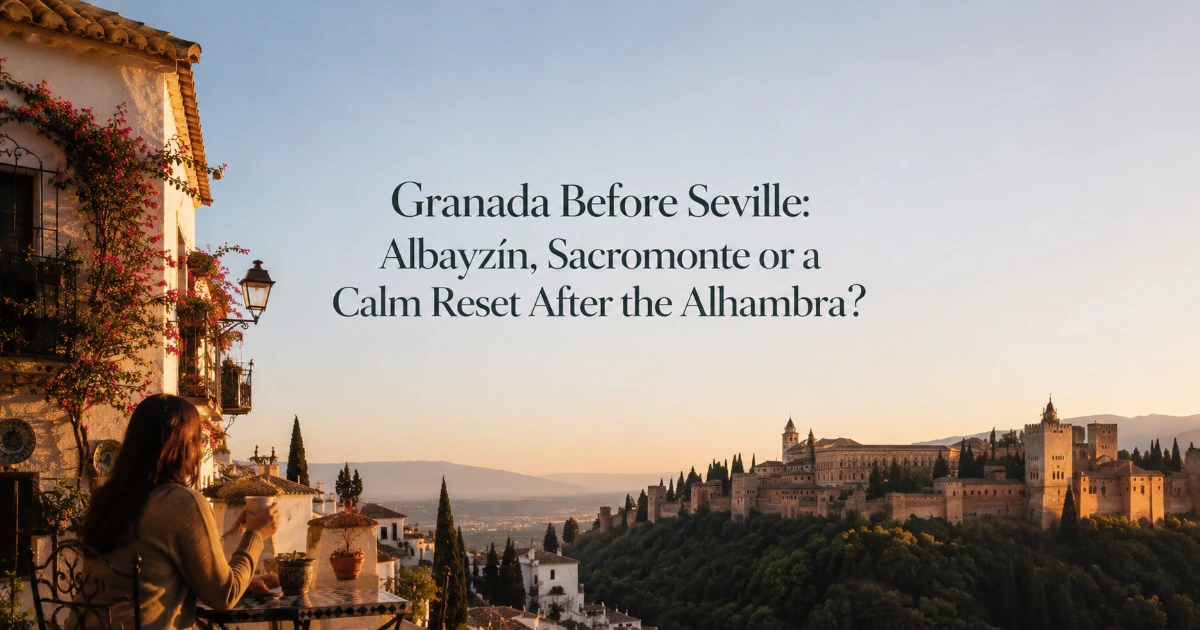
Granada Before Seville: Albayzín, Sacromonte or a Calm Reset After the Alhambra?
Updated
Choose a calm reset after the Alhambra if Seville follows that afternoon, evening, or early the next morning; add a short Albayzín viewpoint only when you have real buffer; leave Sacromonte for a separate Granada evening. This works because the Alhambra is not a simple monument stop: it uses timed attention, slopes, palace pacing, garden distance, and emotional focus before you still have packing, transfers, and a first Seville night ahead. The clearest exception is a traveler with a late next-day departure, strong walking tolerance, and a desire for one final Granada view before the handoff.
Granada’s final hours before Seville should be judged less by what else can be squeezed in and more by whether the Alhambra remains the day’s high point instead of becoming the first stage of fatigue. Arriving in Seville depleted after the Alhambra turns the next city into recovery; arriving with a little appetite, spare attention, and dry clothes changes the entire first impression. That is the narrow question this guide answers. For the broader issue of where Granada belongs in a Madrid, Córdoba and Seville sequence, use our Granada sequencing guide; here, the decision is only what to do after the Alhambra, before Seville takes over.
The premium-travel answer is not automatically “add more.” In this specific Granada-to-Seville slot, the most refined plan may be the plan that refuses the second hill. A private guide, a chauffeured handoff, and a well-chosen restaurant can all improve the day, but they cannot change the basic consequence: if the final Granada hours become a forced extension, the traveler pays for it with body fatigue, flatter mood, and a weaker first evening in Seville.
The post-Alhambra choice before Seville, in trip consequences
The default winner is the calm reset, the best scenic add-on is a controlled Albayzín viewpoint, and the wrong fit is Sacromonte when it is forced into the same travel handoff. This is not because Sacromonte is lesser. It is because the combination of Alhambra intensity, Albayzín slopes, Sacromonte distance, packing, dinner timing, and the road or rail move to Seville makes the final hours of Granada unusually easy to overfill.
Choose the calm reset if Seville is the same day, if anyone in the group is prone to heat or hill fatigue, if you have a special dinner planned, or if the next morning begins with Seville monuments. The reset can be a hotel return, a shower, a quiet drink in Realejo or Centro, luggage order, and a clean departure rhythm.
Choose Albayzín if the view matters more than rest and you can make it a short, guided, largely one-way route. The Albayzín viewpoint after the Alhambra exit is most rewarding when it is treated as a finale, not as the start of a second neighborhood expedition.
Choose Sacromonte only if Granada keeps the evening and Seville waits until late the next day. Sacromonte asks for a different tempo: steeper edges, later energy, cave-side context, and a return plan that does not leave the group dragging luggage or negotiating fatigue.
The practical consequence is simple. A calm reset protects the transfer and the first Seville impression. A short Albayzín view adds emotional closure but spends more walking energy. Sacromonte adds cultural depth only when the itinerary gives it room; otherwise it tends to convert the end of Granada into a body-management problem.
The mood consequence is just as clear. A reset lets the Alhambra linger. A short view can deepen the Alhambra by showing it from across the valley. A forced Sacromonte extension can make the day feel like proof of stamina rather than a considered Andalusia sequence.
Why the Alhambra changes the rest of the day
The Alhambra makes the afternoon feel shorter than it looks on paper. Even a well-paced private visit involves arrival timing, security and ticket checks, palace attention, courtyards, transitions, paving, gardens, and the mental work of absorbing one of Andalusia’s densest cultural sites. Operational details should be confirmed through the official Alhambra site (https://www.alhambra-patronato.es/en/), but the planning consequence is evergreen: once the Alhambra has taken the prime energy of the day, every additional hill or neighborhood has a higher cost.
The non-obvious routing point is that a famous view is not simply waiting at the exit. Many travelers leave the Alhambra and imagine gliding into Albayzín. In practice, a common route drops toward Cuesta de Gomérez and Plaza Nueva, then asks you to cross the Darro-side city and climb again through lanes around Carrera del Darro, Paseo de los Tristes, Cuesta del Chapiz, or the approaches to Mirador de San Nicolás. A taxi can reduce the punishment, but it does not turn the viewpoint into a no-effort add-on.
Granada also does something specific to the body. The city is compact, but compact here does not mean flat. Realejo has its own climbs, Albayzín adds cobbles and irregular steps, and Sacromonte sits beyond the prettiest Darro-side walk just when feet are already warm and attention is thinning. A fit couple may love the extra layer. A family with teenagers, a multigenerational group, or anyone traveling in warm weather may experience the same addition as the moment the day stops feeling curated and starts feeling stubborn.
The mood consequence matters just as much. The Alhambra leaves many travelers quiet, reflective, and visually saturated. If the next move is another steep district, another viewpoint crowd, and then a hurried transfer, Granada can flatten into a checklist. If the next move is a deliberate pause, the city keeps its aftertaste and Seville begins as an arrival, not as a salvage operation.
This is why the body consequence and the mood consequence should be considered together. The body issue is not only sore feet; it is slower decision-making, lower patience with pickup logistics, and less appetite for a first Seville walk. The mood issue is not only tiredness; it is the risk that the Alhambra’s delicacy gets overwritten by the irritation of one extra climb. The most polished Granada plan protects both.
When Albayzín belongs after the Alhambra
Albayzín belongs after the Alhambra when the goal is one precise view and a controlled descent, not a full neighborhood survey. The best use is a compact finale: reach a viewpoint, let the Alhambra reappear across the valley, explain why the opposite hillside matters, and leave before the group’s energy tips from delighted to done.
The strongest version is private and selective. A guide can choose whether to approach from Plaza Nueva, Carrera del Darro, the Darro bridges, or a higher drop-off depending on timing and walking tolerance. That matters because Albayzín is not one street; it is a hillside district where the wrong approach can turn a beautiful view into an awkward climb. When the plan is built around a view rather than a neighborhood march, an Albayzín private tour can become a graceful bridge between the Alhambra and the rest of the itinerary.
Choose Albayzín if you have already checked out, the luggage is handled, Seville is not immediate, and the group still has appetite for context. The view works especially well for travelers who want to understand the Alhambra from outside its walls. Seeing the palace-city from the opposite slope turns the morning’s rooms and courts into a complete urban image. The official UNESCO listing (https://whc.unesco.org/en/list/314/) is useful here because the Alhambra, Generalife and Albayzín are not separate tourist fragments; the view helps the relationship make sense.
The phrase “Albayzín viewpoint after the Alhambra exit” should mean a narrow, deliberate decision: one view, one explanation, one exit. It should not mean wandering uphill until the group discovers that the prettiest lanes are also the lanes that quietly consume time. If Mirador de San Nicolás is the target, build the exit before you build the arrival. If the group is better served by a gentler or less crowded viewpoint, choose that without apologizing. The purpose is perspective, not conquest.
Do not choose Albayzín just because it is famous. The overvalued version is the unplanned sunset push after a full Alhambra visit, especially when the group still has to collect bags, reach the station, or settle into a Seville hotel that evening. If the only way to fit the viewpoint is to rush lunch, skip recovery, and climb hard in the hottest or busiest part of the day, the view is not earning its cost.
Albayzín is most successful in this slot when it feels like an epilogue. A short transfer or guided climb, a view across to the Nasrid palaces, a few minutes of urban context, and then a clean move back toward the hotel or pickup point can be excellent. A long exploration of tea streets, lanes, walls, churches, and multiple miradores may be wonderful on another day, but it changes the category. It becomes a second Granada tour, and that is a different decision before Seville.
When Sacromonte is too much before Seville
Sacromonte is too much before Seville when it becomes a late add-on to an already full Alhambra day. It is a better neighborhood when it has its own purpose: landscape, cave dwellings, flamenco context, social history, and a slower return through the city. Compressed into the same handoff, it often asks the body for more than the trip can repay.
The issue is not distance alone. Sacromonte sits beyond the easiest Albayzín finale, and the most atmospheric approaches tend to make you feel the hillside. After the Alhambra, that means another layer of uneven walking, more route decisions, and often a later return. If Seville is waiting, the practical consequence is plain: the group may arrive with no appetite for a first evening stroll, no patience for hotel formalities, and no clean transition into the next city.
A private Sacromonte plan can be excellent when Granada keeps the night. A guide can make the district feel legible rather than theatrical, distinguish cultural context from tourist shorthand, and build the return before fatigue appears. That is where a Sacromonte private tour earns its place. It does not earn its place when it is treated as a trophy after the Alhambra and before a same-day move.
Sacromonte also changes the emotional register. Albayzín after the Alhambra can be a visual echo: palace on one side, hillside on the other, the morning made legible from a distance. Sacromonte asks for a different kind of attention. It is more social, more historical, more tied to performance context and hillside life. That deserves an evening with room to listen, pause, and return well, not a pressured hour inserted because the name looks essential on an itinerary.
The cut-first rule is simple: if your Granada-to-Seville handoff is already tight, cut Sacromonte before cutting the Albayzín view, and cut the Albayzín view before cutting the reset. The most expensive mistake is not missing one more district; it is letting the end of Granada steal the beginning of Seville.
When the right answer is a hotel reset instead of another neighborhood
The right answer is a hotel reset when the Alhambra has already delivered the day’s cultural weight and the next city needs a clean start. This can feel counterintuitive because a reset sounds less “local” than another neighborhood. In Granada, before Seville, it is often the most city-smart choice.
A calm reset can mean returning to a Centro or Realejo hotel, changing shoes, arranging luggage, cooling down, and choosing one low-effort drink or early dinner rather than another climb. It can also mean using the final Granada hour to sit with the Alhambra experience instead of diluting it. Travelers often underestimate how much better Seville feels when they arrive with enough energy to notice the first courtyard, the first orange trees, or the first walk near the hotel.
Premium guiding does not help if the traveler uses Granada’s final hours to exhaust themselves before Seville. It helps when the guide or planner is allowed to say no: no to the second hill, no to the late viewpoint if the group is fading, no to Sacromonte when the transfer is already doing enough work. Premium spend changes comfort, privacy, timing, and judgment; it does not make an overpacked day lighter just because the logistics are more polished.
This is where chauffeured support can be valuable, but only within limits. A car can improve drop-offs, reduce backtracking, and spare the group from some uphill walking. It cannot remove all cobbles, all steps, or the attention cost of another stop. Use chauffeured Granada routing when the plan truly needs a smoother handoff, not as permission to keep adding hills.
A hotel reset is especially strong when the Alhambra visit has been emotionally successful. When travelers come away satisfied, the temptation is to protect that feeling, not to dilute it. A shower, a quiet half-hour, a packed bag, and an unhurried departure can be the difference between ending Granada with grace and ending it with everyone looking at watches.
The editorial “no” belongs here. If the group is tired, if the weather has made the Alhambra feel heavier, if the evening transfer is fixed, or if Seville begins early the next day, the right answer is a hotel reset instead of Albayzín or Sacromonte. That is not a failure of ambition. It is the moment when the planner protects the whole Andalusia trip rather than maximizing the Granada checklist.
How transfer timing changes the choice before Seville
Transfer timing is the factor that flips the decision. The same Albayzín viewpoint that feels elegant with an overnight buffer can feel punishing when the group is due in Seville for check-in, dinner, or an early Alcázar-oriented next day.
If you leave Granada the same afternoon
Choose the calm reset. After the Alhambra, use the remaining time to return to the hotel, organize bags, eat lightly, and leave without drama. A same-day Granada-to-Seville move is not the moment to prove that you can still climb. It is the moment to make the transfer feel like part of the trip rather than the tax you pay for overplanning.
The same-afternoon plan should be almost boring on purpose: Alhambra, descent, hotel, luggage, food, pickup. The luxury is not novelty; it is avoiding the anxious sequence where one person wants the view, one person wants lunch, one person is worried about the bags, and the driver or train time begins to dominate the mood.
If you leave Granada in the evening
Choose either a very short Albayzín viewpoint or a reset, not both plus Sacromonte. The evening departure creates a false sense of space. In practice, the group still has to manage luggage, food, pickup timing, and arrival energy. A private handoff through Granada-to-Seville private planning can keep the afternoon honest by setting a final stop, a final pickup point, and a no-negotiation departure time.
The evening version is the easiest to overdesign because it looks generous on paper. It is usually not generous if lunch runs late, if the Alhambra visit expands, if the group wants to shop near the Cathedral quarter, or if the hotel pickup must happen from a practical street rather than the most atmospheric lane. Build one beautiful thing, then stop.
If you leave Granada the next morning
Albayzín can belong, and Sacromonte may belong only if the morning after is not demanding. A next-morning departure gives Granada back its evening, but it does not erase the Alhambra’s physical load. The most balanced version is Alhambra, rest, early evening viewpoint, dinner, and a sensible bedtime. Sacromonte should wait unless the travelers specifically want that cultural layer and can keep the next day soft.
When Seville waits until the next morning, the main risk is emotional rather than logistical. Travelers assume the night is free and then spend it proving they can still do more. A better design uses the overnight to restore sequence: Alhambra as centerpiece, reset as buffer, one viewpoint or one dinner as the finale, sleep as part of the handoff.
If Seville’s first day is already ambitious
Choose the reset without guilt. Seville is generous but physically exposing: larger distances, heat-prone open spaces, and a rhythm that rewards arrival energy. A packed Granada finale followed by a monument-heavy Seville day makes both cities feel shorter. The better sequence lets Granada finish with composure and gives Seville a first day that does not begin in deficit.
This is the broader trip consequence. Granada and Seville should not compete inside the same body. If the Alhambra has already taken the most attentive part of the day, the final Granada slot should protect the next city’s first impression. The question is not whether Albayzín or Sacromonte is worthy. The question is whether adding them improves the whole itinerary.
Food, wine and the last-night temptation
Food-and-wine travelers should be especially careful after the Alhambra because a serious dinner changes the value of the afternoon. If the evening includes a tasting menu, a special tapas route, or a Michelin-informed reservation, the calm reset usually beats another neighborhood. The point is not to make the day smaller; it is to make the dinner more enjoyable.
Granada can support both informal tapas culture and more formal dining, and the MICHELIN Guide selection (https://guide.michelin.com/us/en/andalucia/granada/restaurants) is a useful current cross-check when a food-focused evening matters. But a refined dinner after the Alhambra rarely improves when preceded by a late Sacromonte push or a hard Albayzín climb. The traveler consequence is simple: the meal becomes recovery instead of pleasure.
When the meal is the anchor, verify the evening’s shape directly instead of guessing from a generic itinerary. Menus, pacing, and opening rhythm can matter as much as the name on the reservation; sources such as Arriaga – Menú (https://arriagarestaurante.com/menu/) and Faralá – Carta & Menús (https://restaurantefarala.com/carta/) are useful examples of why a serious dinner should be planned backward from the table rather than squeezed after one more hillside route.
For celebration travelers, this is often where private planning has the strongest value. The planner is not merely choosing a restaurant or a viewpoint. The planner is deciding what the couple, family, or small group should not do so the last Granada night lands well. A quiet return, a well-timed drink, and one carefully placed view can feel more memorable than a larger route completed with tired faces.
The best Granada food evening after the Alhambra usually has one of two shapes. Either it is informal and flexible, with a short viewpoint beforehand if the group remains lively, or it is serious and protected, with a reset beforehand and no ambitious hillside addition. The version that tries to be both expansive and refined is the one that most often disappoints.
The private-planner sequence for three real traveler types
Couples should choose one emotional finish. If the Alhambra is the centerpiece, the Albayzín view can be a beautiful echo, but only with a short route and a clean exit. If dinner is the celebration, the hotel reset wins. Do not make the evening carry palace awe, hillside romance, Sacromonte depth, and Seville readiness at once.
For couples, the strongest Albayzín version is not necessarily the longest or the latest. A calmer view before the sunset crowd, followed by a clean return to Realejo or Centro, can feel more intimate than fighting for the postcard moment at the end of an already demanding day. Romance is very sensitive to fatigue; it rarely improves with one more climb.
Families should choose the reset first, then add only the viewpoint if the group is still genuinely lively. Children and teenagers often handle the Alhambra better when the end of the day has fewer negotiations. A promised return to the hotel, a swim if available, a snack, or an easy dinner can save the mood more effectively than one more famous district.
For families, the danger is not that the children fail to appreciate Granada. It is that the adults keep extending the day after the best part has already happened. A short Albayzín viewpoint can work as a visual payoff if everyone is still comfortable. Sacromonte before Seville should be treated as an exception, not as a default family finale.
Multigenerational groups should be conservative with hills. The Alhambra already includes standing, stone, ramps, and transitions. Adding Albayzín requires a route that knows where to reduce climb; adding Sacromonte requires a reason strong enough to justify the return. For older parents, the best luxury is often not a longer day. It is a day that ends before anyone has to admit they are tired.
Food-and-wine travelers should build backward from dinner. If the meal is the final Granada statement, avoid the second neighborhood. If the view is the statement, keep dinner informal and nearby. Trying to make both the view and the dinner equally important is where the day begins to feel managed rather than lived.
First-time Andalusia travelers should also resist the fear of missing out. Seeing less in the last Granada slot can make the whole Madrid, Córdoba, Granada and Seville sequence feel more complete because each city keeps its own mood. Granada does not need to prove itself after the Alhambra. It needs to release the traveler cleanly into Seville.
For a Granada-to-Seville handoff that keeps the Alhambra, the final view question, and the next city’s first day in one coherent plan, Inquire now.
What to stop forcing before Seville
Stop forcing a complete Granada goodbye. The Alhambra is already a complete Granada experience when it is well placed and properly paced. The final slot before Seville should not be asked to represent every remaining neighborhood, every view, and every cultural thread the city offers.
Stop forcing sunset if sunset creates a late transfer. The famous Albayzín view is beautiful outside the perfect postcard moment, and a calmer route often beats the most dramatic light if the group will otherwise arrive in Seville irritable. A viewpoint chosen for comfort can leave a better memory than a viewpoint chosen for photography alone.
Stop forcing Sacromonte as proof that you saw “real” Granada. Sacromonte deserves more than being a final checkbox. If you cannot give it the right time, guide, and return plan, save it for another visit or place it on a fuller Granada stay. A trip can be selective and still be culturally serious.
Stop forcing premium service to solve an overfull design. Private access, guiding, chauffeured transfers, and tailored timing can remove many irritations, but they cannot make every desire fit into one afternoon. The best use of premium planning here is editorial restraint: one final Granada gesture, then a smooth handoff to Seville.
Premium spend does not help much here: premium guiding does not help if the traveler uses Granada’s final hours to exhaust themselves before Seville. The better premium choice is to spend on judgment, pacing, and a clean exit rather than on an itinerary that looks impressive but lands badly.
A practical decision rule for the final Granada slot
Use the final Granada slot as a consequence test. Ask what the choice does to the body, the mood, the transfer, and the first Seville evening. If it improves at least three of those four, it probably belongs. If it improves only the photo count, it probably does not.
The calm reset improves the body, the transfer, and usually the mood. It may not add a new landmark, but it protects the trip. The Albayzín viewpoint improves the mood and the sense of completion when it is short, well-routed, and not competing with departure pressure. Sacromonte improves cultural depth only when the evening is truly Granada’s, not when Seville is already pulling the schedule forward.
This is the cleanest hierarchy for most high-end travelers after the Alhambra: reset first, Albayzín only with buffer, Sacromonte only with a separate evening. The order may sound cautious, but it is based on the way Granada actually feels underfoot: Cuesta de Gomérez, Plaza Nueva, the Darro, Albayzín lanes, Sacromonte edges, hotel logistics, and then the move to Seville all take more energy than a flat map admits.
A good guide can make the Alhambra richer. A good planner can make the Albayzín view more graceful. A good chauffeur can make the handoff smoother. None of them can make fatigue irrelevant. The best Granada-before-Seville plan is the one that lets the Alhambra remain the memory, not the prelude to exhaustion.
FAQ
Should I visit Albayzín after the Alhambra before going to Seville?
Visit Albayzín after the Alhambra only if you have real buffer before Seville and can keep the route short. Treat it as one viewpoint and a controlled descent, not a full neighborhood tour.
Is Sacromonte worth it after the Alhambra if I leave for Seville the next day?
Sacromonte can be worth it if Granada keeps the evening and your next day is not demanding. It is usually too much if you are leaving early, packing late, or planning a major first day in Seville.
What is the best calm reset after the Alhambra?
The best calm reset is a return to the hotel or a low-effort Centro or Realejo pause: change shoes, cool down, organize luggage, eat lightly, and leave enough attention for Seville.
Can a chauffeur make Albayzín or Sacromonte easy after the Alhambra?
A chauffeur can reduce uphill walking and improve pickup timing, but it cannot remove all cobbles, steps, narrow lanes, or the mental fatigue of adding another neighborhood after the Alhambra.
What should I cut first if my Granada day before Seville feels too full?
Cut Sacromonte first, then shorten Albayzín to one viewpoint, and keep the calm reset. The priority is to avoid arriving in Seville tired before the next city has begun.
Is it better to see the Albayzín viewpoint at sunset before Seville?
Sunset is only better if it does not create a rushed transfer or a late, tired arrival in Seville. A calmer earlier viewpoint is often the better choice for a multi-city trip.
Should I plan a special dinner in Granada after the Alhambra?
Plan a special dinner only if the afternoon stays light. A serious dinner works best after a reset or one short viewpoint, not after a full Albayzín and Sacromonte push.
What is the safest choice for families or older parents before Seville?
The safest choice is the hotel reset, with an optional short Albayzín view only if everyone is still comfortable. Sacromonte should wait unless it has its own evening and an easy next morning.
If you’re interested in any private tours of Granada, please reach out to us.
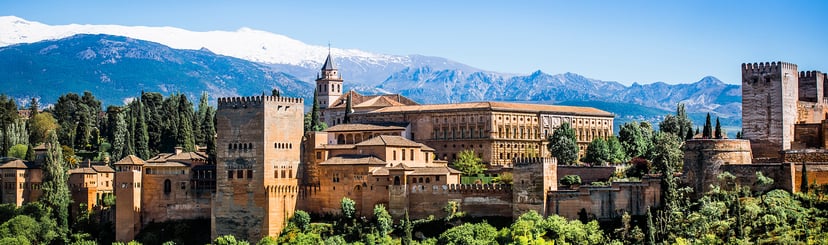



 So if you are looking for the absolute best in Granada & surroundings with authentic local fully-licensed native guides whose English you can actually understand and with an exclusive and amazingly fun itinerary













