Alhambra First or Last? Sequencing Granada Within a Madrid, Córdoba and Seville Trip

Updated
Put Granada late in the trip when the Alhambra is meant to be the emotional climax after Madrid, Córdoba and Seville. That order works because the city rewards arrival with a slower evening, a hotel reset, and a guided Alhambra morning that is not fighting a train transfer, luggage handoff, or last-day checkout. The clearest exception is a trip with fragile Alhambra ticket timing, family fatigue, older travelers, or a fixed celebration dinner in Seville: in those cases, bring Granada earlier and let Seville absorb the loose final days.
The thesis is simple but important: the Alhambra is not just one monument to place inside Granada; it is the hinge that changes the emotional arc of a Madrid, Córdoba, Seville and Granada itinerary. A badly placed Alhambra day within a Madrid-Córdoba-Seville-Granada route can make the finest hotel and the best driver feel like damage control. A well-placed one makes the whole trip feel composed.
One local correction belongs at the start. Staying in the Albayzín because it looks close to the Alhambra is often overvalued for this particular decision. The views can be superb, but the slopes, cobbles, limited vehicle access, and the climb-and-descend rhythm around Plaza Nueva, Cuesta del Chapiz and the Darro can complicate a timed Alhambra morning. For many discerning travelers, Realejo or the Cathedral-side center is the calmer base before an Alhambra day, especially when a guide and transfer are coordinated around the entrance time rather than improvised after breakfast.
The sequence that usually works best
- Best climax route: Madrid, Córdoba, Seville, Granada. Use Córdoba as the compact architectural turn, Seville as the social and evening-rich middle, and Granada as the final concentration of history, landscape and guided interpretation.
- Useful alternative: Madrid, Córdoba, Granada, Seville. Choose this when Alhambra timing is the most constrained part of the trip, when you want Seville for the final celebratory evenings, or when travelers need a flatter final city after Granada’s hills.
- Plan to avoid: Madrid, Seville, Córdoba, Granada with the Alhambra on the final full day before an early departure. It looks elegant on paper, but it gives the most demanding visit the least recovery.
The comparison criteria are not romance or prestige. They are recovery before the Alhambra, transfer pressure on the Alhambra day, how Córdoba and Seville affect energy, how much hill fatigue your group can absorb, and whether the trip needs Granada to be a finale or an early anchor. For the Alhambra itself, start with the official ticketing and visitor requirements on the Patronato de la Alhambra ticket site (https://tickets.alhambra-patronato.es/en/), then build the wider route around the date and access time rather than pretending the palace can be dropped into any empty half-day.
For Orange Donut Tours travelers, the most useful planning move is to decide the city order before hotels harden. The private Alhambra experience can then be shaped around the right morning, the right guide, the right pickup, and the right evening afterward. See the dedicated Alhambra and Generalife private tour when you are ready to think about interpretation, pacing and access flow, but treat the route sequence as the first decision.
Should you visit the Alhambra first or last in a Spain itinerary?
Visit the Alhambra last when you want Granada to serve as the trip’s culmination, but do not save it for the final full day if the next morning involves an early train, flight, or long transfer. The best version is not “last possible day”; it is “late enough to feel climactic, with a buffer around it.”
Granada is unusually powerful at the end of a Madrid, Córdoba and Seville trip because it changes scale. Madrid gives you museums, boulevards and courtly energy. Córdoba compresses centuries into a tighter old-town and Mezquita-centered stop. Seville opens the trip into river, palace, Cathedral, tapas, flamenco context and warm-night sociability. Then Granada narrows the focus again: hill city, palace city, garden city, Moorish and Christian layers held in one high complex above the Darro valley.
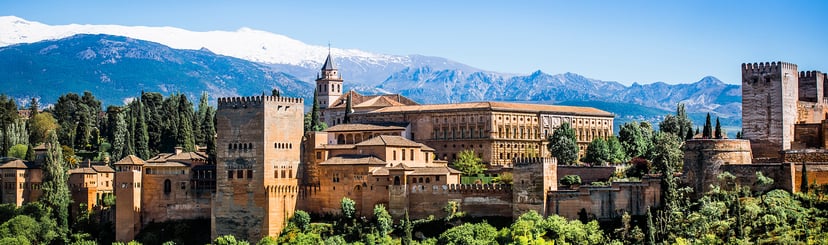
That narrowing is why the Alhambra works so well as a climax. After several cities of movement, the traveler is ready to concentrate. The guided day has a narrative payoff: the Nasrid Palaces, Generalife, fortress views, Realejo edges, the Albayzín across the valley, and the visible city below. It feels less like another monument and more like a final reading of Andalusia.
The mistake is treating “last” as a badge of sophistication. If the Alhambra sits on the final full day and the group is packing, checking train times, managing restaurant expectations, and worrying about the next morning, its intensity can feel heavier than it should. The official Alhambra system is time-sensitive, and the Nasrid Palaces are not a casual drop-in; the official site reminds visitors to carry the relevant ID and to be punctual for palace access. That alone is enough reason not to pair the visit with a chaotic departure edge.
The firmer editorial call is this: save Granada for late in the trip, but do not save the Alhambra for the last possible slot. Give it a clean morning after a proper night in Granada, then leave an unforced evening afterward. If you have only one night in Granada, this becomes even more important; the city needs to be arranged around the Alhambra rather than squeezed around it. For the stay-length question, the adjacent planning guide How many days in Granada for a tailor-made Andalusia trip? is the better place to decide whether the route needs one, two or three nights.
Why Granada late usually beats Granada early
Granada late usually wins because the Alhambra benefits from accumulated context and a calmer arrival rhythm. The monument is richer after Madrid’s royal scale, Córdoba’s Islamic-Christian layering, and Seville’s palace-and-cathedral language have already given the traveler a vocabulary for what they are seeing.
This is not about making travelers “earn” the Alhambra. It is about sequence. If you go to Granada first, the Alhambra can dominate the rest of Andalusia so completely that Córdoba and Seville feel like follow-up chapters. That is not fatal, but it changes the mood. Córdoba’s Mezquita-Catedral may feel smaller after the Alhambra’s palace sequence; Seville’s Alcázar may feel more like a comparison exercise than its own living palace environment. For first-time travelers who want the trip to build, late Granada is cleaner.
There is also a practical reason. Madrid is often the entry point, and Córdoba is a natural rail stop or compact overnight between Madrid and Seville. The official Renfe route information is worth checking before booking because current services, lines and schedules can change, but the general planning principle remains: use rail-friendly city order where possible and do not invent zigzags just to force a romantic ending. The Renfe line information (https://www.renfe.com/es/en/travel/informacion-util/mapas-y-lineas/media-distancia-y-avant) is useful for confirming Granada, Córdoba and Seville connectivity before you commit to a final sequence.
The on-the-ground consequence is felt in the body. Granada asks more of the legs than Madrid’s museum spine or Seville’s flatter historic core. The Alhambra visit includes standing, moving between palaces and gardens, and handling exposed transitions. Then the city below adds slopes: the rise from Plaza Nueva toward Cuesta de Gomérez, the Albayzín’s uneven lanes, the Realejo inclines near Campo del Príncipe, and the temptation to add Mirador de San Nicolás at exactly the moment everyone’s feet are done. Put that at the end of a rushed sequence and the body reads the day as strain. Put it after a composed arrival and it reads as immersion.
Granada also changes the mood of the whole trip when it comes late. Seville can be expansive, social and sunlit; Granada is more inward. The best evening after the Alhambra is not necessarily the most elaborate dinner or the steepest viewpoint walk. It might be a short Realejo stroll, a low-pressure tapas route, or a quiet return to the hotel before a later meal. A formal tasting menu can be wonderful in Granada, and the MICHELIN Guide selection (https://guide.michelin.com/us/en/andalucia/granada/restaurants) is a useful reference for food-and-wine travelers, but a heavy dining commitment immediately after a demanding Alhambra day is not always the most intelligent luxury.
When Granada should come earlier in the route
Granada should come earlier when the Alhambra date is fixed, the group needs Seville’s easier evenings at the end, or the trip cannot spare recovery after the palace day. In those cases, Granada becomes the anchor rather than the climax.
The first reason is ticket logic. Do not build a beautiful route that depends on a single Alhambra slot you do not yet control. If the strongest ticket or guide timing falls earlier, move Granada earlier. The order Madrid, Córdoba, Granada, Seville can be the more polished choice when it protects the Alhambra morning and leaves Seville to close the trip with easier logistics, broader dining options, and less hill exposure.
The second reason is traveler fit. Families with younger children, multigenerational groups, and travelers who dislike steep walking may enjoy Granada more when it is not competing with accumulated fatigue. A child who has already absorbed Madrid museums, Córdoba’s old-town heat, and Seville’s monument mornings may not have patience for a careful Alhambra interpretation at the end. Older parents may be perfectly capable of the Alhambra but less forgiving of the extra route from a hotel to a timed entry, then to gardens, then down into the city.
The third reason is celebration planning. If the trip ends with a milestone dinner, anniversary night, family gathering, or food-and-wine finale, Seville may be the better final base. It offers a softer evening rhythm for groups that want sociability after a full itinerary. Granada can still be profound earlier, while Seville handles the closing mood. This is especially true when the group wants flamenco context, river-adjacent time around Triana and the Guadalquivir, or a final night with fewer slopes between aperitif, dinner and hotel.
The fourth reason is transfer shape. If your Madrid arrival is clean and Córdoba is only a brief stop, it can make sense to continue toward Granada before Seville. This avoids making Granada the farthest-feeling final move. It also reduces the risk of arriving late into Granada, sleeping poorly, and asking the Alhambra day to rescue the plan. For travelers who already know they want guided support across half-day, full-day or multi-day designs, Granada private tour duration options can help frame how much interpretation and city time belongs around the Alhambra rather than after it.
How Córdoba and Seville placement changes Alhambra energy
Córdoba sharpens the Alhambra; Seville either prepares you for it or drains you before it, depending on how you place the cities. The order matters because these are not interchangeable Andalusian stops.
Córdoba is the easiest city to underestimate in this route. Many travelers see it as a convenient stop between Madrid and Seville, but its real sequencing value is interpretive. Seeing Córdoba before Granada gives the Alhambra a deeper frame. The Mezquita-Catedral, Judería lanes, patios, and the old-town compression help the traveler understand how Islamic, Christian and urban layers overlap in southern Spain. Then Granada’s palace-city relationship feels less isolated. It becomes the continuation and transformation of an idea rather than a spectacular one-off.
That is why Madrid, Córdoba, Seville, Granada often works. Córdoba gives context without exhausting the emotional peak. Seville then opens the trip with a different kind of grandeur: the Alcázar, Cathedral, Santa Cruz, Triana and the Guadalquivir. By the time Granada arrives, the traveler has enough Andalusian language to read the Alhambra slowly.
But Seville can also steal energy from Granada if overpacked. A Seville stay that includes Alcázar, Cathedral, Plaza de España, Triana, flamenco, a heavy dinner, and perhaps a day trip can leave the group socially satisfied but physically thin. If the next move is a late transfer to Granada followed by an early Alhambra morning, the Alhambra is technically “last” but emotionally underfunded. That is the planning failure to avoid.
Córdoba after Seville and before Granada is possible, but it needs care. It can work as a buffer if luggage, rail timing and lunch are handled cleanly. It becomes awkward when Córdoba is treated as a full sightseeing day plus a late onward move. A rushed Córdoba stop can flatten the Alhambra before it even begins: too much old-town walking, too much heat exposure, too much station choreography, and then a Granada arrival that leaves no appetite for the city’s evening.
For private travelers, the key is not whether Córdoba or Seville is “better.” It is what each city does to the Alhambra day. Córdoba adds historical clarity. Seville adds atmosphere and social energy. Too much Seville immediately before Granada can leave the Alhambra competing with fatigue; too little Córdoba before Granada can make the Alhambra feel visually impressive but less connected to the route’s larger story. When Córdoba is being considered from Granada rather than as a stop in the main route, the Córdoba from Granada private tour page is more useful than trying to force a last-minute rail stop into a route that is already full.
The cleaner Madrid, Córdoba, Seville, Granada route
The cleanest late-Granada route is Madrid, Córdoba, Seville, Granada, with the Alhambra on the first full morning after sleeping in Granada. This gives the trip a gradual shift from capital to compact heritage city to Andalusian capital to palace finale.
Madrid should not be reduced to a transit gateway, but it should not be asked to carry the Alhambra decision either. Use Madrid for arrival recovery, the Prado or a selected museum plan, Royal Palace context if relevant, and one or two unhurried meals. Then move to Córdoba in a way that preserves the body: arrive with enough time to see the Mezquita-Catedral and old town without turning the day into a luggage management exercise. Córdoba Central is not the old town; the transfer between station, luggage storage or hotel, and the Judería matters more than it appears on a map.
Seville then belongs as the broader Andalusian middle. It gives you longer evenings, a less compressed hotel rhythm, and an excellent place to absorb regional culture without placing every important moment under the pressure of a timed entry. The danger is overuse. If Seville becomes Alcázar, Cathedral, Santa Cruz, Triana, Plaza de España, a river plan, flamenco and a late dinner in two days, Granada inherits the fatigue. The Alhambra should not have to compete with a Seville itinerary that was designed as if bodies do not accumulate strain.
The transfer from Seville to Granada is the planning hinge. Whether you use rail or chauffeur depends on schedule, luggage, travelers and the rest of the trip, but the principle is stable: do not arrive in Granada late, eat too heavily, and expect a precise Alhambra morning to feel effortless. Granada’s station area is not the same as being settled near Realejo, Plaza Nueva or the Cathedral quarter. The first hour after arrival should be about getting composed, not proving that the city can be conquered immediately.
The Alhambra morning should then be protected. That means the guide timing, hotel pickup, ID requirements, ticket type, and palace access rhythm are treated as the spine of the day. It also means the post-Alhambra plan is intentionally lighter than many travelers expect. Add the Albayzín only if the group still has energy and if the route is designed to descend intelligently rather than bounce between hills. Mirador de San Nicolás may be famous, but after a full Alhambra visit it can be the wrong upgrade for comfort-first travelers who would enjoy the city more with a gentler evening.
This is where a private planner earns more than a guide booking. Orange Donut Tours can plan the guide timing and city order around the Alhambra rather than simply adding a tour after hotels are set. The value is in the sequence: which city comes before, how you arrive, where the Alhambra sits, what gets cut, and what the evening becomes. Inquire now
The earlier-Granada route that still feels deliberate
The best earlier-Granada route is Madrid, Córdoba, Granada, Seville, especially when the Alhambra slot is fixed or Seville is the better final celebration city. This route is not a compromise if it is planned as an anchor sequence.
In this version, Madrid gives arrival and capital context, Córdoba gives the first Andalusian compression, and Granada supplies the early high point. The Alhambra then becomes the interpretive anchor for the rest of the south. Seville follows not as an afterthought but as a release: broader streets, longer evenings, river movement, palace comparison, and a more social final rhythm.
This can be excellent for families. The Alhambra comes before the children are tired of being asked to admire architectural detail. It can also be excellent for couples who want Seville’s final nights to hold the celebratory meals, flamenco context or a more relaxed pace. Food-and-wine travelers may prefer this because the Alhambra does not sit on the same day as the trip’s most formal dinner; the Granada evening can be tapas-led or relaxed, while Seville carries the closing dining plan.
The main caution is that Seville after Granada needs its own identity. Do not make every Seville palace or garden a comparison to the Alhambra. The Alcázar deserves its own lens, and Seville’s old center has a different urban texture. If Granada came early, Seville should not try to “beat” it. It should change the pace: less palace intensity per hour, more neighborhood and evening rhythm, more time to let the trip breathe.
The earlier-Granada route also suits travelers who are nervous about ticket fragility. When the Alhambra is the immovable piece, put it where the strongest confirmed access belongs, then design the rest of the route around that fact. This is more honest than promising that a preferred slot will appear later. A premium trip is not made premium by pretending constraints do not exist; it is made premium by absorbing them gracefully.
If Seville is being considered as a private day or onward segment from Granada, the route needs different treatment from a normal city stay. The Seville private tour from Granada option can make sense for certain travelers, but it should not be used as a patch for a route that should simply have placed Seville as its own stay.
Where premium spend helps, and where it cannot rescue the sequence
Premium spend helps most when it protects timing, reduces hill fatigue, and gives the Alhambra a guided narrative; it helps least when it is used to decorate a route with no recovery. The money should go toward sequence, not just comfort symbols.
A private guide matters at the Alhambra because interpretation affects energy. Without a strong guide, travelers can spend their attention on navigation, crowd flow, palace timing and disconnected facts. With a strong guide, the visit has shape: what to notice in the Nasrid Palaces, when to pause, how the Generalife changes the mood, why views toward the Albayzín matter, and how to keep the day from becoming a museum march. This is especially valuable for first-time visitors and multigenerational groups.
A chauffeur or coordinated pickup can also matter, but only in the right places. It can reduce the strain of moving between hotel, Alhambra access points and later city areas. It can help avoid asking older travelers to climb from Plaza Nueva or descend tired from the Alhambra into a crowded evening. It can make Realejo, the Cathedral quarter and the Albayzín easier to combine selectively. But it does not make the Alhambra flat, and it does not remove the need to stand, walk, wait briefly, show documents when required, and respect timed access.
Premium hotels and drivers do not fix a city sequence that leaves no recovery around the Alhambra. That sentence should be taken literally. A superb hotel cannot turn a late Seville transfer, an early Alhambra start, an ambitious Albayzín climb, and a formal dinner into a restful day. A driver cannot compensate for the mental drag of packing and departure pressure. A suite cannot give back the attentional quality lost when the trip places its most demanding cultural visit after too many consecutive full days.
Where premium spend does earn its cost is in coordination. The Alhambra date, guide, pickup, hotel base, post-visit lunch or rest, and evening should be planned together. For comfort-first travelers, the difference between a good day and a great day is often not one more add-on. It is the restraint to cut the add-on that would make the day feel overworked.
What to cut first when the route is getting crowded
Cut the post-Alhambra hill chase first, not Córdoba’s context or Granada’s recovery. The most common planning mistake is adding more Granada after the Alhambra because the city looks compact on a map.
The Alhambra and the Albayzín face each other beautifully, but they are not a casual same-day pairing for every traveler. The route from the Alhambra down toward Plaza Nueva, across the Darro side, and up through the Albayzín can be rewarding with the right pacing. It can also turn a moving morning into a physically jagged afternoon. Carrera del Darro and Paseo de los Tristes are atmospheric, but the climb beyond them is real. Mirador de San Nicolás at sunset is not a universal reward; for some travelers it is the moment the day becomes crowded, steep and performative.
If the trip is getting crowded, do not cut the hotel reset before the Alhambra. Do not cut the guided interpretation that gives the visit meaning. Do not cut Córdoba if it is the route’s best historical bridge between Madrid and Granada. Cut the extra viewpoint, the second palace comparison, the ambitious shopping loop, or the formal dinner that requires everyone to rally after a long day.
Food-and-wine travelers should be especially careful. Granada’s free-tapas culture and relaxed bar rhythm can be a better post-Alhambra match than a tasting menu, even for travelers who normally value fine dining. The MICHELIN Guide selection can help identify serious restaurants, but the planning question is not whether Granada has refined dining. It is whether that dining belongs after the Alhambra, before the Alhambra, or on a different night altogether.
Families and older travelers should also cut the “one more view” instinct. A calm Realejo return, a Cathedral-quarter stroll, or an easy tapas evening may preserve the memory of the Alhambra better than a forced panoramic finish. Private touring should not be used to cram more into the day; it should be used to make the right amount feel beautifully held.
How to place the Alhambra day inside the wider route
The Alhambra day should sit after a night in Granada, before any high-stakes departure, and with a lighter evening planned afterward. That structure works whether Granada is late or early in the trip.
For a late-Granada route, the cleanest version is: arrive from Seville with enough daylight to settle, keep the first evening gentle, visit the Alhambra the next morning with a private guide, and leave the rest of the day selectively open. A second Granada night is the more comfortable version because it lets the Alhambra remain the centerpiece without making the city feel like a transfer stop.
For an earlier-Granada route, the cleanest version is similar: arrive from Córdoba or Madrid, sleep in Granada, visit the Alhambra the next morning, then travel onward only after the day has had room to settle. If you must leave the same day, keep the Alhambra focused and do not add a full Albayzín or Sacromonte extension unless the group actively wants a long day.
Hotel base changes the feel. Realejo can be excellent for travelers who want proximity to the Alhambra side, a gentler local evening, and less old-town congestion than the busiest Cathedral edges. The Cathedral quarter is useful for dining, shopping and flatter immediate movement. The Albayzín can be magical for views and atmosphere, but it is not automatically the most comfortable pre-Alhambra base. Vehicle access, cobbles and slope matter more than the view when a timed palace entry is driving the day. For a base-choice lens, see where to stay in Granada for a comfort-first trip.
The body consequence is real. Granada stacks effort vertically. You may not walk huge distances by big-city standards, but the city adds standing, stone surfaces, slope, sun exposure, and short transfers that feel longer because they are not neutral. A traveler can feel more tired after a carefully guided Alhambra plus a hill neighborhood than after a longer but flatter museum day in Madrid. This is why the sequence should preserve freshness for the Alhambra rather than assuming comfort can be bought at the end.
The mood consequence is just as important. When the Alhambra day is placed cleanly, the trip slows down in the right way. The evening feels reflective, not collapsed. The group can talk about what they saw instead of debating taxis, dinner times and packing. When it is placed poorly, the Alhambra becomes another achievement inside an over-managed itinerary. The palace may still impress, but the day feels shorter, sharper and less generous than it should.
Best sequencing scenarios for Madrid, Córdoba, Seville and Granada
The right sequence depends on whether the Alhambra is your finale, your fixed anchor, or your family-comfort constraint. Use the scenarios below to choose the route rather than defaulting to the prettiest map line.
Choose Madrid, Córdoba, Seville, Granada if the Alhambra is the trip climax
This is the best route for first-time Andalusia planners who want the trip to build toward Granada. It gives Córdoba its contextual role, lets Seville carry the social middle, and gives Granada the final interpretive weight. Place the Alhambra after sleeping in Granada, not after a same-day transfer.
Choose Madrid, Córdoba, Granada, Seville if Seville should hold the finale
This is the better route when Seville has the celebration dinner, the easier final hotel rhythm, the group’s strongest food-and-wine interest, or the most forgiving departure logistics. Granada comes early enough to secure the Alhambra and protect energy, while Seville closes with broader evenings.
Choose Madrid, Granada, Córdoba, Seville only when Alhambra timing forces it
This can work, but it is less elegant because Córdoba loses some of its natural bridge function. Use it when a confirmed Alhambra slot makes early Granada clearly better than waiting. Keep Córdoba afterward focused rather than trying to make it another major peak.
Avoid saving the Alhambra for the final full day before departure
This is the wrong fit for comfort-first travelers, families, older parents, and anyone with a morning departure from Granada or a long onward transfer. The plan may look efficient, but it gives the trip’s most timing-sensitive day the most distracted setting.
Avoid treating Granada as a quick add-on after Seville
Granada can be reached from Seville, but the Alhambra should not be treated as a convenient bolt-on after Seville’s monuments and nightlife. If Granada is in the trip, give it a real night and a protected palace morning. Otherwise, the route may check the Alhambra box without delivering the experience travelers actually came for.
FAQ
Is it better to visit the Alhambra at the beginning or end of an Andalusia trip?
It is usually better near the end if Granada is meant to be the emotional climax, but not on the final full day before an early departure. The strongest plan gives the Alhambra a clean morning after sleeping in Granada and a lighter evening afterward.
Should Granada come before or after Seville?
Granada should come after Seville when the Alhambra is the finale. Granada should come before Seville when Alhambra timing is fixed, the group needs easier final evenings, or Seville is carrying a celebration dinner or smoother departure logistics.
Where does Córdoba belong in a Madrid, Córdoba, Seville and Granada route?
Córdoba usually works best between Madrid and Seville because it gives the route historical context without becoming the final peak. It can also sit before Granada when the route is Madrid, Córdoba, Granada, Seville, but it should not be overloaded with sightseeing and a late onward transfer.
Should the Alhambra be saved for the final full day?
Not if you leave early the next morning, have packing pressure, or are traveling with children, older parents, or anyone sensitive to long standing and hills. Save Granada for late if you want the climax, but place the Alhambra with a buffer rather than on the last possible day.
Can a private driver make a rushed Alhambra day comfortable?
A private driver can reduce transfer strain and help with pickup and drop-off points, but it cannot remove timed access, standing, slopes or the need for recovery. The city sequence still matters more than the car if the Alhambra has been placed poorly.
Is the Albayzín a good base before the Alhambra?
It can be beautiful, especially for views, but it is not automatically the easiest base before a timed Alhambra visit. Realejo or the Cathedral-side center often gives comfort-first travelers a calmer pre-Alhambra setup because slopes and vehicle access are easier to manage.
How should food-and-wine travelers sequence Granada?
Food-and-wine travelers should avoid placing their most formal Granada dinner immediately after a demanding Alhambra day. A lighter tapas-led evening may suit that night better, while Seville or another Granada evening can carry the more ambitious dining plan.
What is the best overall route for first-time travelers?
For many first-time travelers, Madrid, Córdoba, Seville, Granada is the best overall route because it lets the Alhambra close the cultural arc. The exception is when confirmed Alhambra timing, family stamina, or celebration logistics make Madrid, Córdoba, Granada, Seville more graceful.
The final planning judgment
Granada should usually come late, but the Alhambra should not be treated as a last-day trophy. The winning sequence gives the palace enough context before it, enough recovery around it, and enough restraint afterward. Córdoba prepares the eye, Seville broadens the mood, and Granada concentrates the trip into one high, demanding, unforgettable morning.
When the order is right, the Alhambra feels like the trip’s natural culmination or a deliberate early anchor. When the order is wrong, even a premium hotel, a polished driver, and a beautiful dinner can feel like they are trying to repair a route that was never given breathing room. Plan the city order first; then make the Alhambra day exceptional.
If you’re interested in any private tours of Granada, please reach out to us.



 So if you are looking for the absolute best in Granada & surroundings with authentic local fully-licensed native guides whose English you can actually understand and with an exclusive and amazingly fun itinerary













