Triana Ceramics in Seville: When Workshops, Shipping and a Lighter Monument Day Make Sense
Updated
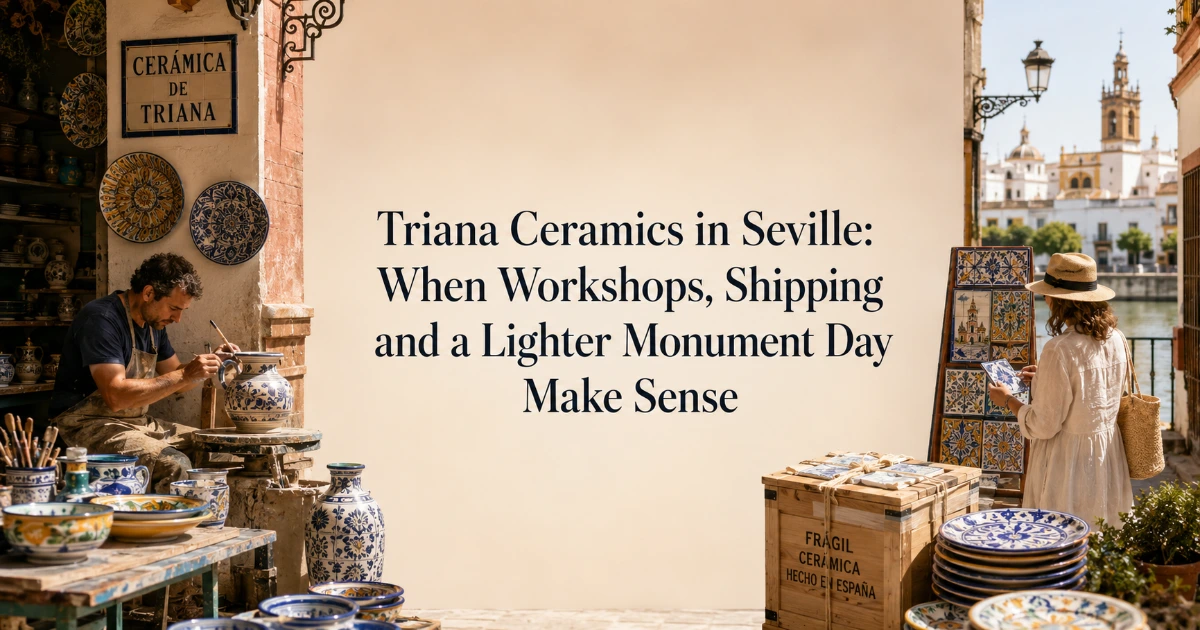
Put Triana ceramics after, not before, a major morning monument when your day includes real buying, shipping decisions or a hotel return. That order works because the Triana ceramics streets near the river are not a quick souvenir spur: once you cross the Guadalquivir by Puente de Isabel II into Plaza del Altozano, the day behaves like a west-bank route, with fragile pieces, slower workshop conversations and a possible return to the hotel shaping every next move. The clearest exception is a booked ceramics workshop; then Triana should lead the day and the monument plan should become deliberately lighter, not merely pushed later.
The Seville-specific thesis is simple: ceramics belong where the route can absorb weight, decisions and time, because a tile panel in Triana changes the day more than another ten minutes inside Santa Cruz. For travelers who want the neighborhood context as much as the purchase, Triana Quarter Private Tours can turn Triana from a shopping errand into a coherent half day rather than a nervous dash across the river.
The route verdict: make Triana a craft arc, not a souvenir detour
The best Triana ceramics plan is a controlled craft arc after one meaningful monument, with time left for selection, packaging and a clean exit. That may sound less ambitious than Alcázar, Cathedral, Giralda, Santa Cruz and Triana in one sweep, but it is the version that most often feels finished rather than squeezed. The point is not that Triana is far. It is close enough to tempt poor planning. The problem is that serious ceramics buying creates a different kind of time: you compare glazes, ask how pieces are made, consider whether a pattern belongs in a kitchen, terrace or collection wall, and then decide whether it travels by suitcase, shipping service or hotel return.
Triana should be treated as a route because the ceramics streets sit behind the riverfront, not inside the monument cluster. A morning at the Real Alcázar or the Cathedral keeps you in the historic center, around Santa Cruz, El Arenal and the Archivo de Indias. Crossing to Triana changes the day’s geometry. If you keep crossing back and forth, the city begins to feel larger, hotter and more fractured than it needs to. If you cross once with a purpose, move through Calle Alfarería, Calle Antillano Campos and the surrounding ceramic-facing streets, and then decide how you are leaving, the same area feels intimate and rewarding.
The firm editorial call is this: if ceramics are more than a casual glance, do not attach them to the end of a maximal monument day. Place them after one headline site, or build a lighter monument day around them. The common mistake is to assume a private guide or driver can make every item fit. Better logistics can remove wasted steps; they cannot make fragile shopping decisions behave like a ten-minute viewpoint stop.
Base location does not erase that logic. A hotel in Santa Cruz may be beautiful for an Alcázar morning, yet it can still make a ceramics return awkward if the group has to re-enter pedestrian lanes with parcels. A hotel around El Arenal or close to the river may make a post-Triana drop easier, but it does not solve workshop timing. A Triana stay makes the craft side feel natural, but it may complicate early monument entries across the Guadalquivir. The route should be designed around the day’s hardest object to move: sometimes that is a person, sometimes heat, and sometimes a wrapped ceramic piece.
Decision matrix: should Triana ceramics come before or after the Alcázar?
For most design-minded travelers, Triana belongs after the Alcázar or Cathedral if the morning ticket is already fixed, before monuments only when a workshop appointment is the anchor, and on a separate or lighter day when ceramics are the primary reason you are crossing the Guadalquivir. The decision should be based on what the stop will create: a purchase to carry, a shipping conversation, a hotel-return need, or a mood shift away from stone corridors and palace rooms.
After one major morning monument. Best for first-time visitors who still want Seville’s essential history, collectors who need comparison time, and couples or families who do not want to start the day with purchase pressure. The route consequence is clean: old town first, river crossing second, Triana decisions third, then lunch, hotel return or a river-adjacent evening.
Before monuments. Best only when a workshop or studio conversation has a fixed morning window, or when heat makes a later craft stop unrealistic. The route consequence is stricter: the monument plan must shrink. Do not begin in Triana, carry fragile purchases, cross back to Santa Cruz and then expect the Alcázar gardens or Giralda climb to feel easy.
Separate workshop-led half day. Best for design travelers, multigenerational groups with mixed energy, and anyone commissioning or buying pieces that require proper handling. The route consequence is calmer: Triana becomes the main event, not the errand after the main event.
Late-day ceramics with hotel return. Best when you are staying in El Arenal, near the river, or using a driver for a planned return. The route consequence is practical: you can finish decisions, send purchases back, and keep the evening from being governed by boxes and bags.
The counterintuitive correction is that starting with Triana because it sounds calmer is often the wrong upgrade. The neighborhood is calmer when you can stay with it. It is not calmer when you turn it into a pre-monument loop that forces another crossing, a taxi reset or an anxious handoff of breakable pieces. A central Santa Cruz hotel also does not automatically make Triana easier; it may be charming for monuments, but for ceramics it still leaves you with the river crossing, old-town walking rhythm and the question of where your purchases go next.
Read the matrix through the exit, not the entrance. Many travelers obsess over whether Triana should start at 10:00 or 4:00, then ignore the harder question: where are you immediately after the purchase? If the answer is lunch near the river, an afternoon hotel rest or a show in Triana, the ceramics stop can feel elegant. If the answer is another timed entry across town, the ceramics stop becomes a burden even when the shop itself was wonderful.
The matrix also protects against a subtle planning error: confusing proximity with compatibility. The Alcázar and Cathedral are compatible because their historic center positions support the same walking zone, even when the day must still be paced carefully. Triana ceramics and a monument are compatible only when the crossing has a purpose and an exit. Without that exit, the route has proximity but not rhythm.
Why the ceramics streets near the Guadalquivir change the route
The ceramics route changes the day because Triana sits close to the center but behaves like a neighborhood with its own pace. Puente de Isabel II delivers you to Plaza del Altozano, where the tourist instinct is to glance at the bridge, photograph the river and wander. The ceramics-minded route asks for something more deliberate: step off the river edge, enter the workshop-and-shop streets, compare older motifs with contemporary pieces, and keep enough time for the conversation that turns a pretty tile into a piece you understand.
This is where Seville does something physical to the body. The old town already asks for slow walking over stone, standing at entrances, moving through shaded lanes and open plazas, and managing heat that can make even short distances feel longer. Add a river crossing, ceramic weight, workshop standing time and the possibility of a Giralda climb, and the day’s strain becomes cumulative rather than dramatic. Nothing looks impossible on a map. The fatigue appears later, when someone is carrying a wrapped plate through Santa Cruz, negotiating dinner timing, or wishing the hotel were closer than it is.
Triana also changes the mood of the trip. A ceramics stop placed after too much sightseeing can flatten a beautiful day into a transaction: choose quickly, ask about shipping quickly, find a taxi quickly. The same stop placed after one well-paced monument can make the afternoon feel shorter and more personal. You move from royal rooms, carved stone or cathedral scale into materials, hands, glazes and domestic design. That contrast is why Triana works so well, but only when the route gives it enough room to breathe.
The micro-location matters. The Triana ceramics streets near the river are close enough to pair with El Arenal, the Mercado de Triana and the west-bank riverfront, but they are not naturally paired with a long Santa Cruz meander after a hot monument morning. If the plan has you crossing the Guadalquivir twice before lunch, the route is already telling you something is wrong.
There is also a bridge choice hidden inside the plan. Puente de Isabel II is the natural ceremonial crossing into Plaza del Altozano and the most intuitive way to read Triana as a neighborhood. Puente de San Telmo can make sense when the day is coming from the southern edge of the center or when a driver is setting a different pickup point. The distinction sounds minor until the group is tired. In Seville, the wrong last ten minutes can make a carefully chosen piece feel heavy before it has even reached the hotel.
When a Triana workshop deserves the best part of the day
A ceramics workshop deserves the best part of the day when the traveler wants process, not merely a purchase. That includes collectors who care about technique, design travelers comparing patterns and finishes, families who want a tactile memory, and celebration travelers who would rather commission or choose one meaningful object than accumulate small souvenirs. In those cases, the workshop should be placed when the group is alert enough to listen, ask and decide.
The practical consequence is that a workshop-led Triana day should not be paired with the city’s heaviest monument sequence. If a workshop is set in the morning, the afternoon should usually hold one lighter historic stop, a shaded river hour, a lunch plan, or a guided neighborhood walk. If the workshop is in the afternoon, the morning should be one carefully chosen monument, not a race through the full UNESCO cluster. Real Alcázar, Cathedral or Casa de Pilatos? is the kind of monument decision to settle before you add a hands-on craft commitment.
Workshops are also a wrong fit for travelers who mainly want to browse. There is no shame in preferring a shorter ceramics stop with a knowledgeable guide who can explain Triana’s craft identity and help you separate meaningful pieces from filler. A workshop becomes overvalued when it consumes the freshest hours of the day but the group is too impatient, too jet-lagged or too focused on hitting the Alcázar and Cathedral to enjoy the making process.
For private touring, the best workshop plan is not the longest one by default. It is the one that leaves space after the session for the practical decisions it creates. A piece made or chosen in Triana may need drying time, packing, later pickup, shipping discussion or a hotel handoff. If none of that is planned, the workshop may be memorable in the moment but awkward for the rest of the day.
Design travelers should also decide before the day whether they are shopping for a room, a table, a wall or a memory. A collector looking for a panel or a set needs slower comparison and may benefit from photos of the intended space. A family choosing one small piece needs less sourcing and more storytelling. A celebration couple may want the purchase to mark the trip rather than decorate a room immediately. Those differences shape the route because they shape how long decision time should last.
Shipping and hotel returns: the fragile-purchase decision
Shipping and hotel returns change the route because they decide whether Triana is the middle of the day or the end of the touring day. When a shop or studio can arrange shipping, you may be able to continue more lightly, but the conversation still takes time and should happen before the group is hungry, overheated or late for a timed entry. When shipping is not appropriate, not available, or not worth the cost for a smaller piece, the route should assume the purchase needs a safe hotel return.
The key distinction is between removing weight and removing complexity. Shipping may remove the weight. It does not remove the need to choose, confirm packing expectations, provide addresses, understand timing in broad terms, and decide whether the piece is worth sending rather than carrying. A hotel return removes the object from your hands but may require a driver, a nearby base or a planned break. Neither option should be treated as an afterthought squeezed between the Cathedral and dinner.
For a hotel return, it usually makes sense to finish the ceramics portion before a natural reset: lunch, a late-afternoon pause, or an evening plan that starts either in Triana or back across the river. If your hotel is in El Arenal or close to the Guadalquivir, that return can be elegant. If your hotel is deep in Santa Cruz, the driver or taxi logic needs to be more deliberate, because the old-town edges and pedestrian lanes can make a “quick drop” less quick than it sounds.
For shipped purchases, the route can continue toward the Mercado de Triana, a river walk, or a west-bank flamenco evening, but only if the group is not mentally done. Ceramic buying is decision-heavy. After comparing sizes, glazes and shipping options, many travelers need a simple next step. A drink, a shaded river stretch, or a short guided context walk will work better than adding another interior visit just because it is nearby on the map.
The lunch decision should move with the shipping decision. If purchases are staying with you, lunch should not require a long walk, a crowded interior or a chair squeezed between parcels. If purchases are being shipped, lunch can become the pause that separates shopping from the evening. If purchases are going back to the hotel, the cleanest version is often ceramics, return, reset, then dinner. That may look less efficient on paper, but it removes the low-grade anxiety that makes groups check bags and boxes instead of listening to each other.
This is why hotel returns are not merely a luxury flourish. They can change what kind of afternoon is possible. Without a return, the group may reject a better piece because it is inconvenient, or accept a lesser one because it fits a tote bag. With a planned return, the buying decision can be about quality and fit rather than transport anxiety. The return earns its keep when it protects judgment, not when it lets the schedule become careless.
The lighter monument day that actually works
A lighter monument day works when it chooses one primary historic anchor, then lets Triana provide the afternoon contrast. The strongest version is not “less Seville.” It is a more legible Seville: one palace, cathedral or house-museum experience in the morning, lunch or a short reset, then the river crossing into Triana for ceramics, neighborhood context and purchase logistics. This gives the day a beginning, middle and end instead of a checklist.
If the Real Alcázar is the morning anchor, keep the afternoon craft-led rather than forcing the Cathedral and Giralda too. If the Cathedral and Giralda are the anchor, give Triana enough space afterward and avoid treating the Alcázar gardens as an extra. If Casa de Pilatos or another palace is the anchor, Triana can become the tactile counterpoint: tile, clay, color and domestic scale after aristocratic rooms and courtyards. The pairing works because it changes register, not because it adds more prestige.
The famous thing to cut first is the extra climb or extra interior that exists only because it is famous. The Giralda can be wonderful, but if your day already includes a major monument, ceramics buying and an evening reservation, the climb is often the element that tips the body from pleasantly engaged to quietly depleted. In a ceramics-led day, the better choice may be Cathedral without tower, Alcázar without extra wandering, or a palace visit without another museum afterward.
For travelers planning a wider private day, a private Seville day without midday burnout is the broader frame; this article’s narrower answer is that ceramics make the case for restraint even stronger. You are not only protecting energy. You are protecting the quality of the decision that brought you to Triana in the first place.
If a timed ticket forces the monument late, invert the day only with discipline. A gentle Triana morning can work before a late Alcázar or Cathedral entry if you are browsing lightly, shipping immediately or returning purchases before the ticket. It fails when the morning becomes a serious shopping session and the afternoon still expects full monument stamina. Late monument windows can be useful, but they do not make fragile objects disappear.
What to cut first when Seville is getting overpacked
When the day is getting overpacked, shorten the generic old-town wandering first, then remove the extra tower, museum or second major monument before you remove the ceramics stop you genuinely care about. The reason is simple: Triana ceramics are not interchangeable with another view of Santa Cruz. If the traveler lens is collecting, design or craft, the stop is part of the purpose of the day, not decorative filler.
This plan should be shortened, skipped or moved to another day when you have only one first-time day in Seville and timed monument entries already dominate it. It should also be moved when the group includes travelers who tire quickly in heat, children who will not tolerate long purchase conversations, or anyone who sees ceramics as a duty rather than an interest. In those cases, a short Triana context walk may still make sense, but a serious workshop or buying session will not earn its place.
The cut-first rule is especially important before an evening with formal dinner, a flamenco booking or a next-day departure. A fragile purchase at 6:00 p.m. can quietly take over the evening if nobody has decided how it is getting back to the hotel. A second monument, by contrast, is often easy to postpone or replace with exterior context. A private day should not make the most distinctive part of the afternoon feel like a logistics problem.
Stop forcing Triana into the same day as every headline sight just because the map says it is close. The city’s distances are deceptive because the emotional tempo changes: palace concentration, cathedral scale, narrow-lane walking, river crossing, craft selection and dinner readiness all draw from the same energy pool. If you want to keep Triana, let something else go.
Mixed-interest groups need an even sharper cut. The collector may want another thirty minutes comparing patterns; the non-shopper may already be done. A private guide can redirect part of the attention toward neighborhood context, river history or a short Mercado de Triana pause, but only if the schedule has slack. Without slack, the ceramics stop becomes a negotiation between people rather than an encounter with craft.
Where private guiding and premium logistics change the result
Private guiding changes the Triana ceramics day by reducing guesswork at the exact points where travelers usually lose time. A good guide can decide whether to cross by Puente de Isabel II or adjust from the San Telmo side, keep the route from drifting into a souvenir hunt, explain why certain motifs and workshop traditions matter, and help the group choose when to pause, buy, ship or return to the hotel. Shopping Private Tours are most valuable here when the brief is specific: ceramics, workshop context, shipping questions and a lighter monument day, not open-ended browsing.
Premium logistics are worth it when they change comfort, privacy or timing. A driver can make sense if fragile pieces need a hotel return, if the group includes older parents or children, if heat makes an unplanned walk across the old town unattractive, or if the evening begins away from Triana. A private guide can keep the day from becoming overplanned by making decisions in sequence: monument first, crossing second, ceramics third, exit plan fourth.
Premium spend does not help when the underlying sequence is wrong. More spending does not fix poor sequencing: a chauffeured return cannot make a Cathedral climb, Alcázar gardens, a workshop, shipping paperwork and a flamenco transfer feel unrushed. The value is in designing a day that needs fewer rescues, not in paying for a rescue after the day has been overloaded.
That is the natural point for a planning handoff. If you want Triana ceramics to sit around a monument window, workshop interest, shipping decision and hotel-return plan without turning the day into a private logistics spreadsheet, Inquire now and ask Orange Donut Tours to shape the sequence around what you actually want to buy, learn or avoid carrying.
The best pre-tour brief is concrete rather than grand. Say whether you want to buy for a home, understand the neighborhood, meet a maker, avoid carrying objects, or pair Triana with flamenco. Say who in the group is enthusiastic and who is merely agreeable. That lets the route protect the right minutes: comparison time for the collector, shade and seating for older travelers, a tactile moment for children, or a clean hotel return for the person managing the evening.
Pairing ceramics with food, flamenco or a river hour
Ceramics pair best with a simple Triana or river-adjacent add-on, not with a second heavy cultural block. Food works when it follows the shopping decision rather than interrupting it. A river hour works when it lets the group decompress after choosing and packing. Flamenco works when the venue location supports the exit plan rather than forcing another rushed crossing.
If the evening belongs in Triana, Teatro Flamenco Triana (https://www.teatroflamencotriana.com/en/home/) is the natural named anchor to verify directly before booking. The advantage is not merely theme; it is route coherence. Ceramics, dinner and flamenco can stay west of the Guadalquivir, making the day feel less chopped up. If the evening belongs back in the historic center, Museo del Baile Flamenco (https://museodelbaileflamenco.com/index.php/el-museo/) gives you an old-town anchor to confirm, but then the ceramics portion needs a cleaner hotel-return or shipping plan before you leave Triana.
A river hour is the underrated connector. After ceramics, a walk along the Guadalquivir or a private river moment can absorb the change in mood without adding another interior. For travelers who want Triana in a broader river-shaped day, a private Guadalquivir day is the adjacent planning logic. For a night built around context before performance, where flamenco belongs in Seville helps decide whether Triana or Santa Cruz should hold the evening.
The mood consequence is real. A ceramics day followed by a short river stretch feels resolved: material, neighborhood, water, dinner. A ceramics day followed by a frantic cross-town transfer can make even beautiful purchases feel like baggage. The better evening is not always the more elaborate one. It is the one that does not punish the afternoon’s best decision.
Food-and-wine travelers should be especially careful here. A serious lunch before ceramics can soften the group’s decision energy, while a late dinner after an unresolved purchase can make the afternoon feel like administration. The neatest rhythm is usually monument, ceramics, simple pause, then dinner; or workshop, lunch, hotel return, then flamenco. The meal should punctuate the route, not rescue it.
Three route shapes for Triana ceramics in Seville
Use these route shapes to decide how much of the day Triana should own. They are not store lists and they do not depend on fragile opening-hour promises. They are planning patterns for different travelers, each with a clear consequence for monuments, shipping and hotel returns.
- The collector’s after-monument route. Start with one major monument in the historic center, cross the Guadalquivir once, spend unhurried time in the Triana ceramics streets near the river, then decide between shipping, a driver-assisted hotel return or a simple west-bank evening. This suits travelers who want Seville history and a serious ceramics purchase in the same day.
- The workshop-led Triana morning. Begin in Triana when the group is fresh, make the workshop or studio conversation the anchor, then keep the afternoon to one lighter historic stop, lunch, river time or a hotel reset. This suits design travelers, families who want a hands-on memory, and anyone commissioning or making pieces.
- The hotel-return ceramics afternoon. Keep the morning light, cross to Triana after lunch or a short reset, buy with the exit plan already settled, and send pieces back before dinner or flamenco. This suits celebration travelers, older parents, groups staying near El Arenal, and anyone who knows fragile purchases will otherwise govern the evening.
The best choice is the one that removes the least flexibility from the rest of the day. If you are a collector, protect comparison time. If you are a workshop traveler, protect morning attention. If you are buying for a home, protect the return plan. A private route should not ask one ceramics stop to serve every possible purpose.
Avoid the hybrid that tries to take the best part of all three. That is the day that starts with a workshop, adds the Alcázar, browses for a large purchase, returns to the hotel, and still expects an effortless flamenco evening. It sounds bespoke but behaves like overpacking. Choose the route shape that matches the dominant purpose, then let the other pleasures appear as supporting moments.
Details to keep flexible rather than overbooked
The details that should stay flexible are the ones that depend on the actual object you choose. Do not promise yourself that every purchase will be easy to carry, that every small studio will solve shipping in the same way, or that a hotel return will take only a few minutes. Confirm the practical points when you buy, keep the afternoon less crowded than the map suggests, and avoid putting a hard dinner transfer immediately after a ceramics decision.
It also helps to separate browsing time from decision time. Browsing can be relaxed and conversational. Decision time is more concentrated: size, pattern, quantity, packing, address, hotel return, suitcase space, and whether the piece belongs in your home or only in the emotion of the day. A guide-led route can prevent the group from using all its energy on browsing and then rushing the only decision that matters.
For a more local-feeling day that includes Triana without centering purchases, Seville like a Local Private Tour can work well. For this article’s ceramics-first problem, however, the final route should be judged by three questions: did you cross the river only when you were ready, did the monument plan leave enough attention for craft, and did every fragile object have a realistic exit?
Leave some softness in the plan. Seville rewards attention, and Triana ceramics reward comparison. The best version of the day gives you enough structure to avoid waste and enough room to recognize the piece, pattern or workshop conversation that made crossing the Guadalquivir worthwhile.
One small discipline helps: decide what kind of object would justify the logistics before you enter the buying portion. A set, a panel, a single plate, a gift or a workshop memory each creates a different exit. This does not make the experience less spontaneous; it prevents a beautiful but impractical object from hijacking the afternoon after the emotional decision has already been made.
FAQ
Is Triana ceramics worth planning around in Seville?
Yes, if ceramics, design or craft buying are a real interest rather than a casual souvenir idea. Triana is worth planning around because purchases, workshops and shipping decisions change the route; if you only want a quick glance, keep it short and do not build the day around it.
Should I visit Triana ceramics before or after the Alcázar?
Visit Triana ceramics after the Alcázar if the Alcázar is your fixed morning anchor and you plan to browse or buy. Visit Triana before the Alcázar only when a workshop appointment makes Triana the day’s main event, and then keep the later monument plan lighter.
Can I combine Triana ceramics, the Cathedral and the Real Alcázar in one day?
You can, but it is usually too much if ceramics involve serious buying, shipping or a workshop. A better plan is one major monument plus Triana, or a broader monument day with only a short Triana context stop.
Does shipping make a Triana ceramics stop easier?
Shipping can make the rest of the day physically easier, but it does not remove the time needed to choose pieces, discuss packing and confirm practical details. Treat shipping as part of the route, not as a magic fix at the end.
When does a hotel return make more sense than carrying ceramics?
A hotel return makes sense when pieces are fragile, heavy, numerous or likely to distract from dinner, flamenco or a later monument. It works best when the return is planned before you buy, especially if your hotel is not right by the river.
Is a ceramics workshop in Triana good for families?
It can be excellent for families who want a tactile, slower Seville memory, but it should replace something rather than sit on top of everything else. With children, do the workshop when energy is fresh and avoid pairing it with a long tower climb or a second major monument.
What should I skip if the day is too full?
Skip the extra tower, the second major monument or the generic old-town wander before you cut a ceramics stop that matters to you. If ceramics do not matter to the group, move Triana to a short context walk or another day.
Can Triana ceramics work before a flamenco evening?
Yes, especially when the evening stays in Triana or when purchases are shipped or returned to the hotel first. If the show is back across the river, build in a clean transfer so ceramics do not turn into a rushed pre-show errand.
If you’re interested in any private tours of Seville, please reach out to us.





 So if you are looking for the absolute best in Seville & surroundings with authentic local fully-licensed native guides whose English you can actually understand and with an exclusive and amazingly fun itinerary













