The Archivo de Indias Moment in Seville: Cathedral Context, Empire History and When Paper Beats Another Palace
Updated
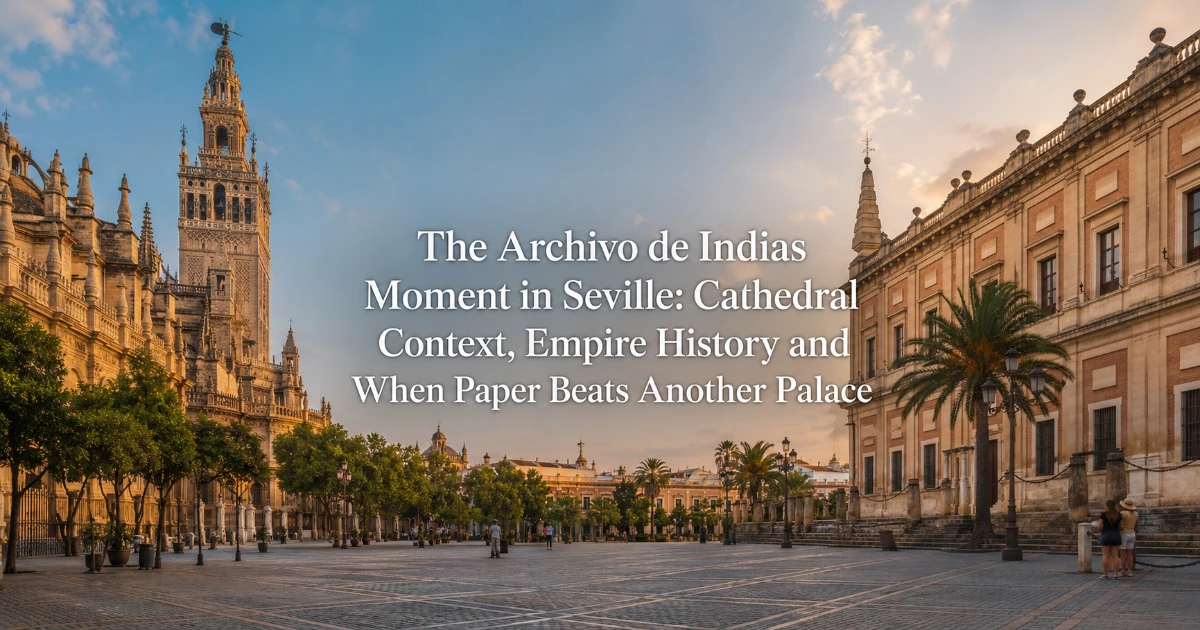
Verdict: Give the Archivo de Indias real time when you want Seville Cathedral to make political and commercial sense, not only spiritual and artistic sense. It works in real city conditions because the building sits at the Cathedral to Archivo de Indias edge, beside the Cathedral and opposite the Alcázar, so a few steps across Plaza del Triunfo can shift the story from worship to monarchy to imperial administration without another transfer or a long exposed walk. The clearest exception is a day when your group is craving gardens, tiles, courtyards and room-by-room visual pleasure; then another palace can be a better use of limited energy. In Seville, the Archivo is not a museum afterthought; it is the hinge that turns the Cathedral from a sacred monument into the city’s operating manual for empire.
That is why the Archivo de Indias belongs in the plan for a particular kind of traveler: the visitor who hears “New World,” “trade monopoly,” “Columbus,” “Casa de Contratación,” and “royal power” and wants the city itself to connect those ideas. Pairing it with a precise Cathedral visit, rather than leaving it as a leftover, can change the whole morning; the better setup is a guided Cathedral arc that ends with the Archivo as the interpretive aftershock, not a random extra. Orange Donut Tours can shape that Cathedral-first context through a Seville Cathedral private tour when the goal is to see why this corner of Seville held ecclesiastical power, trade power and royal power in such a tight urban triangle.
The authority signal is not subtle. The UNESCO World Heritage listing (https://whc.unesco.org/en/list/383/) treats Seville Cathedral, the Alcázar and the Archivo de Indias as one monumental complex, and the Cathedral’s own World Heritage note (https://www.catedraldesevilla.es/en/the-cathedral/world-heritage-site/) says their coexistence in the same space expresses the city’s Muslim, Christian and sixteenth-century Puerto de Indias layers. The non-obvious local proof is the edge itself: as the tram slides along Avenida de la Constitución and groups peel between the Cathedral doors, the Archivo’s sober Renaissance shell does not compete for attention. It corrects attention. The mistake is assuming the less ornate building is the lesser stop.
The counterintuitive cut is the unplanned Santa Cruz wander immediately after the Cathedral when your morning already has enough beauty but not enough interpretation. Santa Cruz is atmospheric and can be excellent with a purpose, yet its lanes often turn a clear heritage morning into pretty blur. When the goal is to understand why Seville became the gateway for imperial paperwork, the Archivo can beat another lane, another courtyard and, on some days, another palace interior.
Is the Archivo de Indias worth visiting after Seville Cathedral?
Yes, the Archivo de Indias is worth visiting after Seville Cathedral when the Cathedral has raised more questions than it answered. The Cathedral shows wealth, devotion, scale and memorial ambition; the Archivo explains the administrative machine that helped make that scale possible. The two buildings need each other more than casual visitors realize. Standing in the Cathedral, it is easy to think only in terms of faith, art and royal prestige. Stepping to the Archivo adds ships, documents, permissions, lawsuits, maps, accounts and control.
The visit does not need to become an academic archive session. The traveler payoff is not that you inspect every document case or master colonial bureaucracy in detail. The payoff is that the Cathedral suddenly becomes part of a system. The Giralda is not only a tower. The tomb of Columbus is not only a monument. The nearby Alcázar is not only a royal residence. The plaza outside is not only a handsome UNESCO zone. The surrounding buildings begin to read as pieces of a city that handled movement: people, silver, claims, faith, information and authority.
That is where paper can beat another palace. A palace gives immediate pleasure: carved ceilings, tiles, gardens, intimate rooms and noble self-presentation. The Archivo gives sequence. It helps a traveler understand why Seville’s beauty is not merely decorative. The former Casa Lonja, later the Archivo General de Indias, places commercial and colonial administration beside the Cathedral rather than somewhere abstract. The building was constructed in the sixteenth century for merchant activity and became the Archivo General de Indias in the eighteenth century; UNESCO identifies it as home to documents concerning the discovery of and relations with the New World. That does not make it visually richer than the Alcázar. It makes it intellectually sharper after the Cathedral.
For a first visit, this distinction matters because Seville is unusually seductive. A visitor can spend a day moving from one beautiful surface to another and still leave without a clear understanding of why the city was historically powerful. The Archivo interrupts that pattern. It asks a better question: who recorded, authorized, disputed and profited from the movement that the Cathedral monumentalizes?
A practical matrix for the Archivo decision
- Give the Archivo real time when your group likes maps, documents, trade routes, empire history, legal history, maritime history or the story behind Columbus’s symbolic presence in Seville Cathedral.
- Keep it as a short contextual stop when you want the World Heritage triangle to make sense but your day still needs Santa Cruz shade, lunch timing or the Alcázar to carry the emotional weight.
- Choose another palace instead when the group is visibly hungry for color, gardens and interiors, especially after a dense Cathedral visit.
- Skip forcing it when younger children, celebration travelers or visually driven companions are already at the edge of patience; the building rewards attention more than momentum.
- Upgrade the guiding, not the duration when you want the Archivo to connect Cathedral, river trade and the Alcázar. A better explanation beats a longer unstructured stay.
This is also where a broader historical route can help. The Archivo is strongest when it is not isolated from the city around it, so a heritage-focused morning through Orange Donut Tours’ Historical Monuments private tour can treat it as the point where plazas, power and paperwork converge rather than as a small museum to be “covered.”
How the Archivo changes Cathedral context
The Archivo changes Cathedral context by moving the Cathedral from sacred spectacle into civic and imperial consequence. Without the Archivo, many travelers understand the Cathedral as a massive Christian monument built on layers of Islamic Seville, with the Giralda and Patio de los Naranjos as essential clues. With the Archivo, the story continues outward: Seville’s Cathedral is also the ceremonial face of a city that became a command point for transatlantic trade and colonial administration.
That shift is especially useful after visitors see the scale of the Cathedral. Scale can numb people. A guide can explain chapels, choir, altarpieces, tombs and the Giralda, yet the size of the building may still feel like a statement without a mechanism. The Archivo supplies the mechanism. It brings in the less photogenic but decisive instruments of power: records, authorizations, correspondence, claims, voyages, disputes and the long chain of documentation that turned distant territories into administrable possessions in the Spanish imperial imagination.
One useful correction is that the Archivo is not there merely because Seville had empty space beside the Cathedral. The Cathedral, Alcázar and Archivo are not three attractions that happen to cluster conveniently. They form a readable power map. The Cathedral expresses sacred authority and civic wealth. The Alcázar expresses royal residence, ceremonial control and courtly continuity. The Archivo expresses the paperwork that kept empire legible. That physical proximity is the historical argument. The Cathedral to Archivo de Indias edge is one of the rare places in Europe where a traveler can move from prayer to palace to paper in minutes and feel how those forces reinforced one another.
The Cathedral’s official World Heritage material rightly points to the coexistence of these buildings as a sign of Seville’s urban history. That is not just a heritage label; it is a planning clue. Seeing the Cathedral alone can leave a traveler admiring the outcome. Adding the Archivo can reveal the system behind the outcome. A private guide can make that transition clean by using the plaza as a map: Cathedral wall behind you, Archivo beside you, Alcázar across the way, Avenida de la Constitución carrying modern movement past older lines of power.
This is the moment when documentary history becomes visible outside the cases. The point is not to stare at paper until the day goes flat. The point is to understand why paper mattered enough to occupy such a central building. A city that controlled permissions, fleets, appointments, reports and claims could turn distance into administration. That is a different kind of drama from a palace ceiling, but it can be more revealing for history-minded travelers.
The consequences for your day are practical. After the Cathedral, the Archivo gives mental continuity without demanding a new neighborhood. It keeps the group in the monumental core instead of sending them into heat, shopping streets or a restaurant search too soon. It also prevents the morning from ending at peak grandeur. Rather than leaving the Cathedral and immediately asking “Where next?”, you step into a second lens and let the city answer.
Who should give the Archivo de Indias real time?
The Archivo deserves real time for travelers who would rather understand Seville’s global role than simply add one more beautiful interior. That includes history travelers, culture-first couples, university-age families, small groups with a strong reader in the party, and visitors who enjoy the invisible systems behind monuments. It is also an excellent choice for travelers who have already seen the Alcázar or who are intentionally resisting a day made only of tiled rooms and garden photographs.
A strong Archivo visitor often has one of four interests. The first is empire history: how the Spanish monarchy tried to know, classify and control overseas territories. The second is maritime history: how the Guadalquivir and the wider Atlantic world shaped Seville’s fortunes. The third is documentary culture: how archives, maps and correspondence can be as powerful as walls. The fourth is Cathedral context: how sacred space, royal policy and trade became entangled in the same city center.
The Archivo also suits travelers who like a quieter interpretive beat after a crowded monument. Seville Cathedral can fill the senses with height, shadow, stone, chapels and movement. The Archivo changes the volume. Its sobriety can be a relief when the group has had enough ornament but still has attention left. For some visitors, that quieter gear is exactly when the historical story lands.
Families should be selective. Older children or teenagers who like maps, ships, court intrigue or “how empires worked” can find the Archivo surprisingly compelling with the right guide. Younger children who need color, movement and tactile variety will usually do better with a shorter exterior explanation and a route that quickly returns to visual reward. The same is true for multigenerational groups: the Archivo can be excellent if everyone agrees to listen and look slowly; it can create friction when one half of the family expected palace romance and the other half expected a history seminar.
Couples and celebration travelers should ask an even sharper question: what mood do you want the morning to create? The Archivo gives seriousness and depth. It can make the Cathedral feel more consequential and make lunch conversation better. It will not produce the sensory softness of a palace garden or a long Santa Cruz stroll. For an anniversary day, it works best as a meaningful hinge before something more atmospheric, not as the whole emotional center of the day.
The Archivo should stay a short contextual stop instead of a main visit when the group is tired, overheated, visually saturated from the Cathedral, or clearly more excited by the Alcázar, Casa de Pilatos, Dueñas or Lebrija than by documentary history. That is not a failure of taste. It is good planning. A document-led stop asks for a specific kind of attention, and forcing it on the wrong day can make even a brilliant city feel like homework.
How to keep the route visually satisfying
The route stays visually satisfying when the Archivo acts as a hinge between major visual moments, not as a dry pause after the Cathedral. The best plan gives the eye a pattern: grandeur, restraint, street texture, shade, then either palace richness or evening performance. That rhythm matters because the Archivo’s power is conceptual. It needs visual support from the city around it.
Start with Seville Cathedral or the Cathedral exterior, depending on the day’s full plan. The Cathedral provides scale and the first layer of awe. Then move to the Archivo with a clear purpose: not “we might as well pop in,” but “now we test what made that scale possible.” Keep the explanation anchored in the plaza, the Cathedral wall, the Alcázar gate area and the old trade story. This prevents the archive from floating away into abstraction.
After the Archivo, resist the temptation to drift aimlessly. Choose one visual answer. For some travelers, that answer is the Alcázar, especially when they have timed entry and the gardens are central to the day. For others, it is a short, deliberate pass into Santa Cruz, using the district for shade and urban texture rather than letting it swallow the afternoon. The useful Santa Cruz move is selective: a lane, a patio threshold, a shaded square, and then out. The weak move is wandering until every white wall and iron balcony begins to repeat.
The route can also move toward El Arenal if lunch is the next anchor, but that belongs to a different planning problem than this article’s narrow question. The closest related Orange Donut Tours guide, Seville After the Cathedral: Archivo de Indias, Santa Cruz or Arenal Lunch Before the Alcázar, handles the broader post-Cathedral timing choice. Here, the narrower point is that the Archivo deserves real time only when it clarifies the Cathedral and sets up the next visual chapter instead of stealing it.
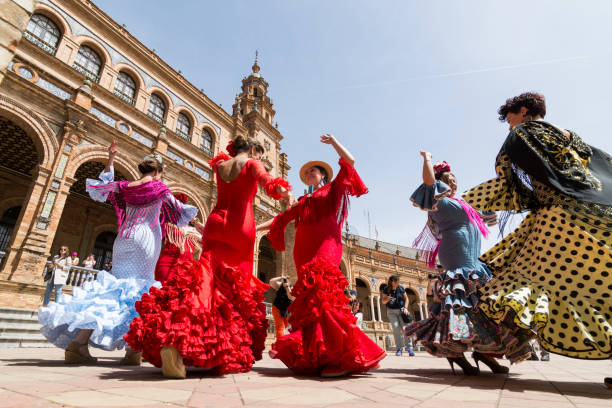
One excellent evening repair, when the day has leaned intellectual, is flamenco context. The Museo del Baile Flamenco (https://museodelbaileflamenco.com/index.php/el-museo/) is useful to name not because this article is a flamenco guide, but because it shows how Seville can balance documentary weight with embodied culture later in the day. Paper in the morning and performance in the evening can work beautifully. Paper in the morning, another dense museum at midday, and no sensory release can make the day feel shorter than it was.
For food-and-wine travelers, the Archivo is often best placed before lunch rather than after. A document-led stop asks for alertness. After a long lunch, wine and warm streets, its restraint can read as austerity. Before lunch, it gives the meal a sharper conversation: trade, Atlantic routes, sugar, cacao, silver, bureaucracy, faith and appetite all belong to the same broader world. The day becomes richer without becoming heavier.
For comfort-minded visitors, the visual route should also respect the body. The old center of Seville asks more of travelers than the map suggests. Stone reflects heat, tram crossings interrupt flow on Avenida de Constitución, Cathedral and Alcázar entries can create standing time, and the open edges of Plaza del Triunfo can feel exposed when the sun is high. The Archivo’s proximity helps, but proximity is not a cure for an overloaded morning. Keep the loop tight and the purpose clear.
When another palace is the better use of time
Another palace is the better use of time when your main regret risk is missing Seville’s intimate interiors, not missing imperial context. This is the firm editorial call: do not choose the Archivo as the main post-Cathedral stop for a group that came to Seville craving carved ceilings, tilework, gardens, salons and a slower domestic scale. In that mood, the right palace can carry the day better than paper.
The Alcázar remains the obvious palace priority for a first visit when timed access, energy and weather cooperate. It is not just decorative; it contains layers of royal, Islamic, Mudéjar and later courtly history. But the traveler consequence is different. The Alcázar gives immersion. The Archivo gives explanation. A family or couple who has waited all morning for gardens may not thank you for substituting documents because the archive is historically important. Importance is not the same as fit.
Casa de Pilatos, Dueñas and Palacio de la Condesa de Lebrija can also beat the Archivo on the right day. They are especially strong when the group wants a more private-feeling visual world after the Cathedral: courtyards, collections, tile, aristocratic scale and a sense of Seville lived through domestic prestige rather than imperial filing systems. The tradeoff is that these palaces require more movement and more curation. They are not all sitting on the same edge of the Cathedral. The trip becomes less about the World Heritage triangle and more about how Seville’s elite interiors translate power into beauty.
The cut-first rule is simple: when the day is already packed with Cathedral, Alcázar, Santa Cruz, lunch and an evening booking, cut the Archivo as an interior visit before you cut breathing room. Keep it as an exterior or brief contextual stop at the Cathedral to Archivo de Indias edge, then protect the rest of the sequence. The building can still do its interpretive work in ten focused minutes outside or in a short pass, while a rushed full visit can make the whole day feel dutiful.
This is where premium spending has limits. A private guide can make the Archivo more meaningful by turning documents into routes, plazas and consequences. A private guide cannot make a document-led stop satisfying for travelers who need visual palace richness that day. Paying more changes the quality of explanation, pacing, privacy and customization; it does not change the basic fact that some travelers are moved more by rooms and gardens than by archival logic.
When the palace mood is stronger, use the Archivo as context and then commit to the palace. Do not apologize for that. The better Seville day is not always the one with the most UNESCO logic. It is the one where the chosen depth matches the people in front of you. For a deep palace comparison beyond the Alcázar, the adjacent planning piece on a curated Seville palace day is the better next read.
What a private guide changes when the subject is documents
A private guide changes the Archivo by making the invisible city visible before and after the document cases. That is the natural value of guidance here. In a palace, the guide interprets rooms you can already admire. At the Archivo, the guide must build a bridge between paper and place. Done well, the visitor starts seeing the Cathedral, the Alcázar, the river direction and the city’s old commercial geography as part of one system.
The first gain is selection. Archive-led stories can sprawl quickly: Columbus, Magellan and Elcano, the Casa de Contratación, fleets, viceroyalties, maps, trade, law, slavery, evangelization, shipping, taxation, disputes and colonial violence. A visitor does not need all of that at equal volume. A private guide can choose the thread that fits the group. A maritime-history traveler gets ships and the Guadalquivir. A Cathedral traveler gets sacred power and the Columbus memory. A family with teenagers gets the tension between adventure stories and administrative control. A food-and-wine traveler gets goods, routes and appetite without turning the morning into a commodity lecture.
The second gain is pacing. The Archivo should not be paced like a checklist museum. It works best as a sequence of interpretive beats: plaza orientation, short building explanation, selected interior or exhibition focus if appropriate, then a return to the city outside. The guide’s job is to know when the point has landed. Too little time and the Archivo remains a name. Too much time and the energy thins. The right duration is not a fixed number; it is the point at which the Cathedral has been reinterpreted and the group is still curious.
The third gain is moral clarity. Empire history should not be polished into romance. The Archivo can be fascinating precisely because it holds the administrative memory of unequal power, extraction, ambition, faith, law and violence. A serious guide does not flatten that into either triumphalism or a generic guilt lecture. The goal is to show how Seville’s beauty and global reach were connected to systems that affected millions of lives far beyond Andalusia. That is one reason the Archivo can feel more adult than another decorative stop.
The fourth gain is logistics. Private touring can make the documentary subject easier by controlling what happens around it: when the Cathedral comes first, how long the group stands in exposed areas, whether Santa Cruz follows as shade or as a focused Jewish-quarter and old-town layer, whether the Alcázar stays later, and how lunch avoids becoming a rushed rescue mission. The guide cannot remove the heat or the density of the old center, but can prevent the plan from becoming a sequence of small frictions.
That is the right moment to hand planning over. When the purpose is to make documentary history visible through plazas, trade routes and Cathedral context, the tour should be shaped around your party’s curiosity rather than a public-route script. For a specialist Cathedral and Archivo thread, or for a broader private heritage day that decides whether the Archivo, Alcázar, Santa Cruz or a palace deserves the longer slot, Inquire now.
The body-and-mood test for a Seville heritage day
The Archivo decision should pass a body test before it passes an interest test. Seville’s monumental core looks compact, but the day can become physically heavier than expected. Cathedral interiors involve standing, slow movement and visual overload. The Alcázar can add gardens, uneven surfaces and more standing. Santa Cruz can add beautiful but directionless walking. High sun on pale stone and plaza edges makes short distances feel longer, especially for older parents, children or travelers dressed for a refined lunch rather than an endurance walk.
Because the Archivo is close, it can reduce transfer drag. That is one of its quiet strengths. A focused stop beside the Cathedral uses geography intelligently. It does not require a river crossing to Triana, a ride out to Cartuja, or a second old-town loop. But closeness can create its own trap: travelers keep adding “just one more nearby thing” until the day loses shape. The archive should be chosen for meaning, not because it is conveniently near everything else.
The mood test is just as important. After the Cathedral, travelers often need one of three emotional directions. Some need depth: “Now I understand why this mattered.” The Archivo serves them. Some need beauty at a gentler scale: “Now give me a courtyard, shade and color.” A palace serves them. Some need release: “Now let us walk, eat or sit.” Santa Cruz, El Arenal or a well-timed lunch serves them. Confusing those moods is where many overplanned Seville days go wrong.
The Archivo preserves the mood of inquiry. It does not lighten the day in the same way a garden does. It can make the morning feel more coherent, more adult and more memorable, but it can also narrow the emotional range if nothing visually generous follows. That is why the best Archivo route pairs it with one strong visual counterweight: Cathedral scale before it, palace or Santa Cruz texture after it, or flamenco later. The goal is not to make every hour intellectual. The goal is to let each hour have a job.
Season and heat sharpen the choice. In warmer months, a long Cathedral-plus-Archivo-plus-Alcázar sequence may be too much without careful timing and a pause. The related Orange Donut Tours high-heat Seville strategy is worth reading when temperatures, older parents or children change what a “nearby” stop really costs. In Seville, a short distance can still be the wrong distance at the wrong hour.
Practical route notes for a specialist Archivo moment
A specialist Archivo moment works best as a sequence walkthrough rather than a standalone museum visit. The sequence should have a clear before, during and after. Before the Archivo, the guide should plant the question inside Seville Cathedral: where did this wealth, symbolism and global memory come from? During the Archivo, the guide should answer through documents, the building’s former commercial purpose and the administrative story of the Indies. After the Archivo, the guide should return the group to the city with a practical next step.
The cleanest version is Cathedral first, Archivo second, then one controlled visual release. This version suits history travelers because the Cathedral raises the stakes and the Archivo clarifies them. It also suits comfort-minded visitors because the distance is minimal and the route does not scatter. The risk is density. Keep the Cathedral interpretation focused; do not explain every chapel before asking the group to absorb the archive’s documentary logic.
The second version is exterior triangle first, Cathedral second, Archivo third. This works when the group needs orientation before entering any monument. Start at the Cathedral to Archivo de Indias edge, name the three powers in the triangle, then enter the Cathedral with that map already in mind. Afterward, the Archivo becomes confirmation rather than surprise. This is especially useful for executives, academically curious travelers or anyone who dislikes being pulled through monuments before understanding the frame.
The third version is Archivo as a short pivot before the Alcázar. This works only when the Alcázar is still the emotional center of the day. Use the Archivo to explain the documentary and commercial side of empire, then let the Alcázar show royal and architectural continuity. Do not overextend the archive here. The traveler has already chosen palace richness as the main act, so the Archivo should sharpen the palace, not compete with it.
The weakest version is Cathedral, Archivo, Santa Cruz, Alcázar and an evening show with no pause. That itinerary looks efficient on a map and often fails in the body. By late afternoon, the archive is remembered as a dim intellectual pause, Santa Cruz as a blur, and the Alcázar as something endured rather than absorbed. Better to decide early which element gets real time and which becomes context.
Before visiting, use official pages for narrow operational checks rather than relying on recycled schedules. The Ministry of Culture’s official Archivo General de Indias page (https://www.cultura.gob.es/cultura/areas/archivos/mc/archivos/agi/portada.html) is the right place to confirm current visitor information and exhibitions. For the bigger heritage frame, use UNESCO and the Cathedral’s own materials. Then let the touring decision be editorial, not bureaucratic: what job should the Archivo do in your day?
When paper beats another palace, in one sentence
Paper beats another palace in Seville when the traveler’s real question is not “Which room is more beautiful?” but “How did this city turn faith, monarchy, ships and records into global power?” That is the Archivo de Indias moment. It is not the flashiest answer, and it is not the right answer for every traveler. But for the right visitor, placed immediately beside Seville Cathedral and read against the Alcázar, it can do what another palace sometimes cannot: make the city’s beauty accountable to history.
The best use is disciplined. Give it real time when it explains the Cathedral. Keep it brief when it only needs to frame the World Heritage triangle. Choose another palace when the day needs visual generosity. Do not force the Archivo because it is important. Use it because it answers the question your morning has genuinely created.
FAQ
Is the Archivo de Indias worth visiting in Seville?
Yes, the Archivo de Indias is worth visiting when you want Seville’s Cathedral, Alcázar and empire history to connect. It is less satisfying as a casual visual stop and stronger as a guided context visit.
Should I visit the Archivo de Indias before or after Seville Cathedral?
For most history-minded travelers, after Seville Cathedral works better because the Cathedral raises the questions that the Archivo helps answer. An exterior orientation before the Cathedral can also work when the guide wants to frame the whole World Heritage triangle first.
How much time should I give the Archivo de Indias?
Give it real time only when documents, maps, trade routes and imperial administration are central to your interests. Otherwise, keep it as a focused contextual stop so it sharpens the Cathedral and Alcázar without taking over the day.
Is the Archivo de Indias better than the Alcázar?
No, not in general. The Alcázar is usually the better first-visit choice for visual richness, gardens and palace immersion. The Archivo is better when the priority is understanding how Seville’s Cathedral and imperial history fit together.
Who should skip a full Archivo visit?
Travelers who need color, courtyards, gardens and room-by-room beauty that day should skip a full Archivo visit and use it only as context. It can feel too restrained for younger children, celebration travelers or visually driven groups.
Can a private guide make the Archivo de Indias more engaging?
Yes. A private guide can connect the Archivo to plazas, Cathedral symbolism, the Alcázar, the Guadalquivir trade story and the wider logic of empire. The value comes from selection, pacing and context rather than simply spending longer inside.
How do I keep an Archivo stop from making the day feel too dry?
Pair it with a strong visual rhythm: Cathedral scale before it, then either a selective Santa Cruz pass, the Alcázar, another palace or an evening flamenco context. The Archivo should be the hinge, not the only mood of the day.
What should I cut first if my Seville monument day is too packed?
Cut the full Archivo interior first when your group is not document-curious, but keep a short exterior explanation at the Cathedral to Archivo de Indias edge. That preserves the historical frame without crowding the day.
If you’re interested in any private tours of Seville, please reach out to us.




 So if you are looking for the absolute best in Seville & surroundings with authentic local fully-licensed native guides whose English you can actually understand and with an exclusive and amazingly fun itinerary