Seville in High Heat: Morning Monuments, Midday Reset and an Evening River Strategy
Updated
In high heat, Seville should be planned as a split day: Real Alcázar and the Cathedral first, hotel return around lunch, then the Guadalquivir as the evening strategy, not an afterthought. That works in real city conditions because the monuments sit close together, while the walk out of them crosses bright stone plazas, exposed tram corridors and old-town lanes that feel very different after late morning. The clearest exception is a traveler who dislikes early starts more than heat; for that guest, a lighter monument plan and a later indoor cultural evening is more honest than pretending the whole historic core can be made comfortable at noon. In Seville, heat is not a weather detail layered onto sightseeing; it is the design constraint that decides whether the Alcázar, Cathedral, Santa Cruz and river feel like one composed day or four separate endurance tests.
The useful rule is simple: split the day before choosing the attractions. A midday reset in Seville heat is not a luxury flourish or a sign that the itinerary is thin; it is the mechanism that keeps the evening possible. The route hinge is Plaza del Triunfo. From the Puerta del León side of the Real Alcázar, you can move toward the Cathedral and Giralda without wasting transfer time, but the same compactness becomes a liability if you keep adding exposed crossings after the sun has taken over the stone. For private, tailor-made days, this is where seasonal private Seville planning earns its place: the guide sequence, pickup points and pause windows are designed around the city’s rhythm rather than around a generic list of sights.
The high-heat decision matrix for a Seville day
The best high-heat Seville plan is a three-part sequence: serious monuments early, real withdrawal at midday, and a low-friction evening by the river or in a focused cultural venue. The matrix below is not about what is most famous. It is about what each part of the city does to your energy, your group mood and the quality of the hours that follow.
Early morning: Real Alcázar and Cathedral logic
Best use: the day’s highest-context sites, especially the Real Alcázar, the Cathedral and the exterior context around Plaza del Triunfo. The payoff is that the group can listen, look and connect details before heat turns interpretation into endurance.
Traveler consequence: you get the historic argument of Seville while attention is still fresh. Families avoid the first complaints of the day; couples avoid turning the monuments into a negotiation about shade; small groups can move as one rather than pausing every few minutes to recover.
Late morning into midday: return, do not drift
Best use: hotel return, shower, quiet lunch, pool time where available, or a calm indoor pause. The key is to stop before the group is visibly depleted, not after.
Traveler consequence: the day feels deliberately shaped rather than interrupted. Without this pause, the evening often becomes shorter, flatter and more transactional: dinner is earlier, conversation is quieter, and the river becomes something you pass rather than something you use.
Evening: Guadalquivir, Triana edge or one cultural anchor
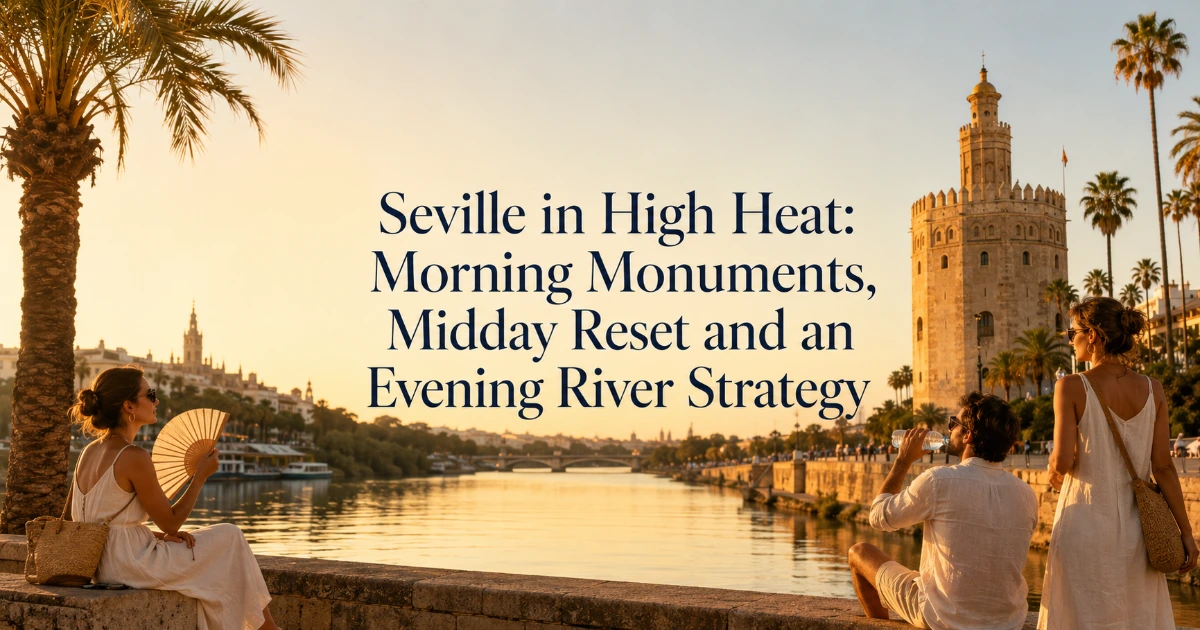
Best use: a slow riverfront progression from the old town toward Torre del Oro, Puente de San Telmo, the Arenal side, or across toward Triana if the group has recovered well. The river is not a substitute for sightseeing; it is a different kind of Seville, with fewer stop-start decisions.
Traveler consequence: the city feels wider and calmer. Instead of forcing one more interior, you let the Guadalquivir carry the end of the day and preserve enough appetite for dinner, flamenco or a celebration moment.
Wrong slot: noon-heavy monument walking
Best use: almost none, unless weather is unusually forgiving or your group is unusually heat-tolerant. This is the slot where many expensive plans lose their elegance.
Traveler consequence: skip-line access may remove entry delay, but it does not cool Plaza del Triunfo, shorten the walk back to the hotel, or make a tired group absorb Mudéjar, Gothic and Habsburg context with pleasure.
The counterintuitive Seville correction is that the less glamorous choice, going back to the hotel, often creates the more polished day. The overvalued upgrade is the “just one more stop” after the Cathedral, especially if it points toward Plaza de España, a full Triana walk or another palace before the pause.
Which Seville sights belong early in high heat?
The Real Alcázar and the Cathedral belong early because they ask for attention before they ask for admiration. They are close enough to pair in one high-quality morning, but they are dense enough that the order matters. If your group starts with the Real Alcázar, the guide can use courtyards, thresholds, palace layers and garden transitions to establish the city’s Islamic, Christian and courtly timeline while everyone is still alert. From there, the Cathedral and Giralda context make more sense: the scale is not just impressive; it is the architectural answer to a city that changed rulers, rituals and public identity.
For official access information, use the Real Alcázar official site (https://alcazarsevilla.org/) and the Cathedral official site (https://www.catedraldesevilla.es/en/) when confirming details before travel. The editorial point is not to memorize hours or prices far in advance; it is to avoid building a high-heat day around assumptions that might fail at the entrance. A private guide can make the monuments easier to understand, but the schedule still has to respect the physical city outside the doors.
The strongest morning sequence is usually Alcázar first, Cathedral second, Santa Cruz shade third, and hotel return fourth. This is not because the Cathedral is less important. It is because the Real Alcázar rewards a mind that has not yet been filled with visual scale, and because the exit into the Patio de Banderas and the Cathedral quarter gives the guide several natural interpretive pivots. Plaza del Triunfo is the seam: it lets you move between the palace, Cathedral, Archivo de Indias and Santa Cruz without a vehicle, but it also exposes the mistake of thinking “nearby” means “easy” at every hour.
When the morning is private, the value is not just access. It is selection. On a Historical Monuments Private Tour, the guide can decide when to linger, when to compress, when to read the group and when to step away from the biggest plaza into a narrower lane. That judgment matters more in high heat than in mild weather because the cost of a wrong ten minutes is higher. A few extra stops for background can be wonderful in spring; in July or August, the same stops can become a quiet drain before the Cathedral visit even begins.
Do not overload the morning with every famous name. Casa de Pilatos, Plaza de España, Triana ceramics, a food walk and a rooftop drink are all worthy in the right plan, but they do not all belong beside the Alcázar and Cathedral on a high-heat morning. The cut-first rule is this: if the added sight requires a new exposed transfer, a new interpretive chapter and a delayed hotel return, cut it before you shorten the Alcázar or flatten the Cathedral into a quick look. The morning should carry the city’s core argument, not prove how much you can fit before lunch.
What time should you return to the hotel in Seville heat?
In high heat, return to the hotel shortly after the two-monument block, usually around the lunch threshold rather than after a third outdoor stop. Exact timing depends on your start, the group’s pace and the day’s conditions, but the principle is firm: the hotel return should happen before the group becomes visibly worn down. Waiting until everyone “needs” the pause is how a refined plan becomes reactive.
Reject a midday monument visit even with skip-line support when it forces you to cross exposed plazas after a late start, when children or older parents are already warm, when your group has a dressed-up dinner or flamenco evening ahead, or when the visit would eliminate the hotel pause. Skip-line support removes one form of friction; it does not remove the heat load of reaching the site, standing in transitional spaces, climbing, listening, exiting and then finding your way back through the same bright city.
Seville is not physically punishing in the way a hill city is, but high heat changes the body’s relationship to flat walking. The old town offers shade in fragments, not in a continuous canopy. A narrow lane in Santa Cruz can feel manageable, then a few minutes later Avenida de la Constitución, Plaza Virgen de los Reyes or the open edge toward the river can feel much longer than the map suggests. Feet slow down, conversation becomes functional, and the group starts choosing the nearest option rather than the best one. That is the moment when a day loses its quality.
A proper midday reset also changes the evening mood. Travelers often think of the pause as subtraction: two hours removed from sightseeing. In practice, it adds back the part of the day that people remember best. A couple can enjoy the river without negotiating fatigue. A family can reach dinner without a child’s patience already spent. A celebration group can dress, regroup and step out with the sense that the day has another chapter. Without the pause, the evening is still possible, but it often feels borrowed from the next day’s energy.
The counterintuitive correction is that a glamorous base can complicate the plan if it encourages you to keep walking instead of returning. Staying close to Santa Cruz, El Arenal or Puerta de Jerez can be excellent, but proximity is not permission to drift through the hottest hours. The hotel is valuable only if you actually use it. In high heat, the best base is not the one that lets you avoid every transfer; it is the one that lets you withdraw cleanly and re-enter the city with intention.
The noon mistake: paying for comfort while designing discomfort
The most common high-end planning mistake is using premium logistics to justify a noon-heavy walking route. Chauffeuring does not make a noon-heavy walking route feel premium in Seville heat. It can improve pickups, reduce cross-city transfer stress and help a group avoid unnecessary backtracking, but it cannot make the Real Alcázar gardens, Cathedral approaches, Santa Cruz lanes and river crossings feel gentle when the day has been overloaded.
Premium spend earns its cost when it changes the shape of the day. A private pickup after the Cathedral can keep guests from hunting for transport when they are ready to withdraw. A guide can choose the shaded line through Santa Cruz instead of the most obvious line on a map. A chauffeur can make the evening return easier if the group finishes across the river in Triana or near a flamenco venue. Those are comfort gains because they reduce decision fatigue and keep the group from stretching the wrong hour.
Premium spend does not earn its cost when it simply dresses up an overpacked plan. A vehicle waiting nearby is helpful, but the guide still has to lead people through streets, courtyards, thresholds and security points. A skip-line arrangement is helpful, but the group still has to stand, listen and move. A luxury hotel is helpful, but only if the itinerary gives you enough time to return, cool down and recompose. The spend has to buy restraint, not just motion.
If you are deciding specifically whether to keep a car and driver in the Seville plan, the most honest question is not “Can it make the whole day easier?” but “Which hot, low-value transitions will it remove?” For a deeper vehicle-specific lens, see this chauffeur-led Seville day guide. For the high-heat day in this article, the car is a tool around the split, not a reason to ignore the split.
How to move from Santa Cruz shade to Guadalquivir evening
The evening river strategy works because it changes the city’s texture after the hotel pause. Santa Cruz shade to Guadalquivir evening is a real routing move: begin with the old town’s narrowness, then let the walk widen toward Puerta de Jerez, Torre del Oro, the Arenal edge and the bridges. The point is not that the river is always cool or empty. The point is that the river gives the group a more forgiving evening rhythm than another dense interior.
After the reset, the old town can be re-entered selectively. You might use a short Santa Cruz walk for orientation, not for a second history lecture. You might pass the Cathedral exterior again because the scale reads differently when no one is trying to absorb a full visit. You might let the guide take the group toward the Torre del Oro side, where the Guadalquivir becomes a planning tool rather than a scenic add-on. The city opens out, the pace naturally slows, and the evening can feel social again.
For couples and celebration travelers, the river can create a graceful transition from monuments to dinner. It gives the day a visible change of register: from palace rooms and sacred scale to water, bridges and a softer horizon. For families, it reduces the number of “stand here and listen” moments. For food-and-wine travelers, it gives appetite time to return before tapas, a tasting menu or a flamenco night. For older parents, it can be calmer than another old-town loop if the route is kept short and the pickup point is planned before the walk begins.
The Guadalquivir should not be treated as filler because filler is what happens when a planner has no better idea after the monuments. A river strategy has a job. It lowers interpretive load, widens the route, supports conversation and gives the evening a sense of arrival. A private river plan, including Guadalquivir private experiences, works best when it is tied to the morning’s restraint: the river feels generous only if the group has not been spent getting there.
There is one honest exception. If your hotel is far from the historic core, or if the group strongly prefers a formal indoor evening, the river may not be the best use of the recovered hours. In that case, choose one cultural anchor and make the transfer simple. The Museo del Baile Flamenco can be a useful indoor evening fit for travelers who want the flamenco context without turning the whole night into a neighborhood expedition; confirm current visit and performance information through the Museo del Baile Flamenco (https://museodelbaileflamenco.com/index.php/el-museo/) before you set the final plan.
A heat-aware Seville day sequence that actually holds together
A high-heat Seville day should read like a sequence of energy states, not a parade of attractions. The following order is deliberately narrow. It solves the title’s problem: which sights belong early, when to return to the hotel, and why the Guadalquivir belongs in the evening rather than as a leftover.
- Start with the Real Alcázar. Use the first serious attention of the day for the palace, courtyards and gardens. The guide’s job is to keep the visit rich without letting it swell beyond the group’s capacity. This is where private pacing is most visible: not in rushing, but in choosing which layers deserve full explanation and which details can be used as elegant connectors.
- Move to the Cathedral and Giralda context. The Cathedral belongs close to the Alcázar in the morning because the contrast is powerful and the geography is tight. The exterior around Plaza del Triunfo and Plaza Virgen de los Reyes gives the guide enough context to connect the sites. If the group wants the Giralda ascent, treat it as an energy decision, not an automatic trophy.
- Use Santa Cruz as a shaded connector, not a full second tour. Santa Cruz is seductive in high heat because the lanes feel protective. That does not mean the neighborhood should absorb the entire late morning. Use it to soften the route back, add Jewish-quarter context where relevant, and avoid the harshest crossings. Do not turn it into a wandering session that delays the hotel.
- Return to the hotel before the day starts making choices for you. This is the decision that separates a composed plan from a survival plan. The reset may include lunch, quiet time, a swim, or simply air-conditioned silence. What matters is that the group is no longer accumulating heat while pretending the next stop will fix it.
- Re-enter through a short old-town or Arenal move. The evening should not restart with another major interior unless that is the whole purpose of the night. Keep the re-entry short, use the route to regain orientation, and avoid a new chain of stops that pulls the group away from dinner or the river.
- Let the Guadalquivir carry the evening. Whether the route stays near Torre del Oro, crosses toward Triana, or pairs with a private boat component, the river should be used as the day’s release valve. It gives the itinerary a slower final chapter without asking everyone to process another monument.
- Add flamenco only when it has its own place. Flamenco can be a superb evening anchor, but it should not be squeezed in after an overlong monument day. If Museo del Baile Flamenco or another venue is part of the plan, treat it as a chosen finale and simplify the river or dinner around it.
This sequence is especially useful for first-time visitors because it gives them the city’s core monuments without making the entire day feel like a history exam. It also suits private groups where ages, stamina and interests vary. The guide can widen or narrow the interpretive layer as the morning unfolds, then hand the group back to the hotel before small discomforts become group dynamics.
What to skip first when the plan starts to swell
Cut the third major attraction before you cut the midday return. In a high-heat Seville day, the hotel pause is more valuable than one more famous stop. This is the firm editorial call: a two-monument morning plus a recovered river evening beats a three-monument day that leaves everyone too tired to enjoy dinner.
The first cut is usually Plaza de España at noon. It is magnificent in the right slot, but it is not a reward when the group is already hot and the plan still needs a hotel return. The second cut is a full Triana deep dive immediately after the Cathedral. Triana deserves time, especially for ceramics, food and river identity, but forcing it into the hottest part of the day turns a distinctive neighborhood into a transfer burden. The third cut is a second palace after the Real Alcázar. Casa de Pilatos or another palace can be excellent on a different day, but it does not need to compete with the Alcázar in the same high-heat morning.
Also be selective with the Giralda. The ascent can be memorable, and the tower is central to Seville’s identity, but it is not automatically the best use of energy for every private group in high heat. If one person is excited and the rest are already fading, the guide should not let the climb define the morning. In private touring, the better decision is often to keep the group intact and use the tower as context from below.
Families should cut anything that creates a long wait for a small payoff. Older parents should cut any add-on that requires standing in glare after the main sites. Couples should cut the errand-like stop that interrupts the day’s romance: the “quick look” that is neither guided deeply nor enjoyed slowly. Food-and-wine travelers should protect appetite and timing; a rushed extra stop before lunch can flatten the meal that was meant to be one of the day’s pleasures.
Where private touring changes the day
Private touring changes the high-heat day when it turns local judgment into a route, not when it promises to eliminate the season. The best private plan makes the morning coherent, shortens low-value transitions, sets the midday boundary, and designs the evening before the group is tired enough to make poor choices.
A guide-led monument sequence is the most important upgrade in the morning. Without guidance, travelers often spend too much energy deciding what they are seeing, where to enter, when to move and how much of a site deserves their attention. In heat, those decisions have a physical cost. A guide can keep the Alcázar from becoming a maze of beautiful fragments and keep the Cathedral from becoming only size and shadow. That is not just educational value; it is energy management.
Pickup and drop-off planning can also change the day, especially for families, older parents and celebration groups dressed for the evening. Chauffeured Seville support is most valuable around the edges: hotel departure if the base is outside the easiest old-town line, recovery after the monument block, evening return from Triana, or a transfer that keeps the group from re-crossing the city when everyone is done. The car is less valuable in the middle of the compact monument core, where walking and interpretation still rule the experience.
Customization matters because high heat exposes small differences inside a group. One traveler wants every dynastic layer in the Alcázar; another cares more about gardens and photography. A teenager may tolerate history if the morning moves cleanly; a younger child may need the reset before the adults think it is necessary. A celebratory couple may prefer a shorter Cathedral visit if it protects the evening river and dinner. Private design lets those tradeoffs happen quietly, without turning the day into a committee meeting.
If you want a Seville day shaped around early monuments, a real midday withdrawal and a river-led evening rather than a generic full-day route, Inquire now. The useful conversation is not simply “What can we see?” It is “Where should the day stop, restart and open out so the city still feels generous after sunset?”
How this changes for different travelers
The same split-day architecture can serve different private travelers, but the emphasis should change. For couples, the morning should be rich but not exhaustive, with the river used as a tonal shift before dinner. The risk for couples is over-documenting the city: too many interiors, too many context stops, and not enough time to feel the day together. A shorter Cathedral interior, a clear Santa Cruz connector and a calm Guadalquivir evening can feel more memorable than a maximalist route.
For families, the key is to avoid making the children carry the adult ambition of the itinerary. The Real Alcázar can work beautifully with younger travelers when the guide uses courtyards, water, palace stories and gardens rather than continuous lecture. The Cathedral can work when it is framed around scale, symbols and a few memorable details. The midday hotel return is not negotiable for many families in high heat; it is the difference between an evening that still has curiosity and an evening spent repairing the morning.
For older parents or mixed-generation groups, the issue is not only distance. It is standing time, glare, transitions and the mental effort of following complex history while managing discomfort. Keep the monument block focused. Pre-plan the hotel return. Keep the river walk short enough that it remains a pleasure, and decide the pickup point before crossing to Triana. A plan that looks slightly conservative on paper often feels far more graceful in the city.
For food-and-wine travelers, the mistake is treating lunch and dinner as recovery after sightseeing damage. In Seville heat, meals should be protected experiences, not emergency repairs. A strong morning, a clean pause and a river-led evening give appetite room to return. If flamenco is part of the night, place it deliberately: either as the cultural anchor after a light river move or as the reason to shorten the river and keep dinner simple.
When the river is not the answer
The Guadalquivir is the best evening strategy when the group has recovered enough to enjoy openness, movement and a lower-context final chapter. It is not the best strategy when the day has already run late, when the hotel is poorly placed for a clean re-entry, or when the group’s real desire is a seated cultural evening. A river plan should feel like release, not another obligation.
If the morning starts late, reduce the monuments rather than pushing the entire sequence later. Choose one major interior, use Santa Cruz briefly, return to the hotel, and then decide whether the evening belongs to the river or flamenco. If the group is staying outside the central old-town orbit, use private transfer logic more assertively: a direct evening drop near Torre del Oro or a planned return from Triana can be better than asking everyone to improvise after dinner.
If the trip has more than one Seville day, do not force the river to carry everything on the monument day. A separate Guadalquivir or Triana-focused plan can give the river more space and reduce pressure on the first morning. For travelers considering that broader river-led day, this private Guadalquivir day guide is the more focused next read. The point here remains narrower: on a high-heat monument day, the river’s job is to make the evening feel possible and composed.
FAQ
What is the best high-heat Seville itinerary for first-time visitors?
The best high-heat Seville itinerary for first-time visitors is Real Alcázar early, Cathedral next, a short Santa Cruz shade connector, a hotel return around lunch, and a Guadalquivir evening rather than a third major midday attraction.
Should I visit the Real Alcázar or the Cathedral first in hot weather?
Visit the Real Alcázar first if your group is willing to start early, because it rewards fresh attention and sets up the city’s layered history before the Cathedral’s scale. The Cathedral can follow well in the same morning if you keep the route focused.
Is a midday hotel return really necessary in Seville heat?
Yes, for most high-heat private itineraries, a midday hotel return is the decision that keeps the rest of the day enjoyable. It prevents the evening from becoming a tired afterthought and gives the group enough recovery for dinner, flamenco or the river.
Can skip-line support make a midday monument visit worth it?
Not usually. Skip-line support can reduce entry delay, but it does not remove the heat of the approach, the effort of standing and listening, or the fatigue of exiting and returning through the historic core.
Why use the Guadalquivir in the evening instead of adding another monument?
Use the Guadalquivir in the evening because it lowers the interpretive load after a dense morning. The river widens the city, supports conversation and creates a calmer final chapter before dinner or a cultural event.
Where does Santa Cruz fit in a high-heat Seville day?
Santa Cruz fits best as a shaded connector after the Alcázar and Cathedral, not as an open-ended late-morning wander. Use it for context and route softness, then return to the hotel before the pause window disappears.
Should families plan Seville differently in high heat?
Families should make the same split even more firmly: one strong monument sequence early, a real hotel pause, and an evening with fewer fixed explanations. Children often handle the Alcázar well when the guide keeps the visit visual, varied and paced.
Is Museo del Baile Flamenco a good high-heat evening option?
Museo del Baile Flamenco can be a good high-heat evening option when your group wants an indoor cultural anchor after the hotel reset. It works best when the river, dinner and show timing are planned together rather than stacked at the last minute.
If you’re interested in any private tours of Seville, please reach out to us.





 So if you are looking for the absolute best in Seville & surroundings with authentic local fully-licensed native guides whose English you can actually understand and with an exclusive and amazingly fun itinerary













