Beyond the Alcázar: A Curated Private Seville Palace Day with Casa de Pilatos, Dueñas and Lebrija
Updated
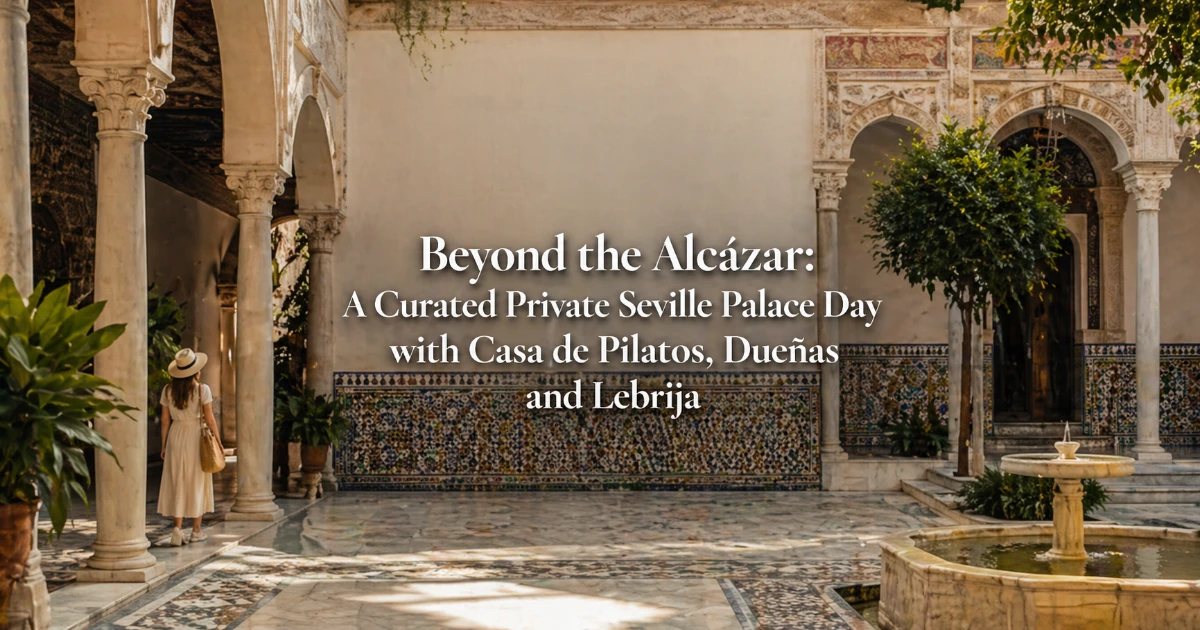
Choose Casa de Pilatos as the anchor and add only one second palace, usually Dueñas for lived-in noble-house atmosphere or Lebrija for collection-led Roman and archaeological depth. That is the strongest beyond-Alcázar palace day because the Alcázar-to-Casa de Pilatos heat hinge forces a real decision: after the royal gardens and Santa Cruz lanes, pushing east to Plaza de Pilatos changes the body’s pace, the shade pattern, and the afternoon’s appetite for more interiors. The exception is a first Seville visit with only one monument slot; then keep the Alcázar as the main event and treat Casa de Pilatos as a replacement, not an add-on. Seville’s private palace day works when each interior answers a different cultural question, not when every beautiful courtyard gets added because it is available.
This guide is not a general Seville monuments plan. It assumes you are already drawn to palace interiors and are trying to decide whether Casa de Pilatos, Palacio de Dueñas and Palacio de la Condesa de Lebrija create a deeper day beyond the Alcázar, or merely a more crowded one. For the broader first-day decision between royal palace, cathedral and Casa de Pilatos, start with the Alcázar, Cathedral or Casa de Pilatos guide; the route below is for travelers who want a narrower, more connoisseur-level palace interior day without letting Seville’s old-town rhythm do the damage.
The palace-depth matrix: choose the second interior by what it adds
The useful comparison is not which palace is prettiest; it is which interior adds the least repetition after Casa de Pilatos. Casa de Pilatos, Dueñas and Lebrija all give you courtyards, tile, carved detail and layered domestic space, so the day needs a controlling theme. Without one, the third palace often turns into decorative overload: more arches, more rooms, more objects, and less memory of why any one house mattered.
Casa de Pilatos — the anchor beyond the Alcázar. Choose it when you want the clearest bridge between Seville’s Mudéjar language, Renaissance ambition and noble-house choreography. Its official page from the Ducal House of Medinaceli Foundation describes the palace as essentially built between the 15th and 16th centuries, which is exactly why it works after the Alcázar: it feels like Seville’s aristocratic world adapting courtly and Mediterranean taste into a private house rather than repeating a royal residence. Check the official visitor page here: Casa de Pilatos official information (https://fundacionmedinaceli.org/en/monuments/house-of-pilate/).
Palacio de Dueñas — the lived-in noble-house layer. Add Dueñas when you want social memory, literary atmosphere, gardens and the feeling of a house whose identity is tied to family history rather than only architectural synthesis. It is stronger for couples, older parents, and travelers who respond to rooms as lived spaces rather than as a sequence of styles. Its official visitor information is maintained by the palace here: Palacio de Dueñas official site (https://www.lasduenas.es/en).
Palacio de la Condesa de Lebrija — the collector’s layer. Add Lebrija when you want mosaics, archaeology and the sense of a private collection arranged inside a noble Sevillian house. It is the most distinct second stop for travelers who want Roman and antiquarian context, especially if the trip also includes Italica, Córdoba or a deeper Andalusian history arc. The official site describes its mosaics and archaeological remains here: Palacio de Lebrija official site (https://palaciodelebrija.com/).
The firm editorial call is this: Casa de Pilatos plus one of the other two is a better private day than Casa de Pilatos plus both. The popular but weaker move is to keep adding interiors because a chauffeur can reposition the group. A car can shorten some transfers, but it cannot make three dense palace interiors feel fresher, and it cannot remove the old-town walking that still happens between drop-off points, entrances and hotel returns.
- Best two-palace pairing for cultural range: Casa de Pilatos and Lebrija, because the day moves from architecture and noble ceremony into mosaics, collecting and antiquity.
- Best two-palace pairing for a softer, more atmospheric day: Casa de Pilatos and Dueñas, because the second house changes the emotional register instead of demanding another analytical push.
- Best choice for a family with limited patience for rooms: Casa de Pilatos only, followed by a shaded old-town walk and a long reset; add Dueñas only when the group is still engaged.
- Best choice after a heavy Alcázar morning: Casa de Pilatos as the only additional palace, then stop. The second private house belongs on another day or not at all.
The first counterintuitive correction is that the famous Alcázar is not always the thing to squeeze into this palace day. The Alcázar is essential for many first visits, and the official site presents it as a royal palace with history running from the 11th century to the present day, but that scale is exactly why it can consume the attention budget before Casa de Pilatos has a fair chance to register. The official Alcázar site is here for planning confirmation: Real Alcázar de Sevilla official site (https://alcazarsevilla.org/).
How Casa de Pilatos differs from the Alcázar
Casa de Pilatos differs from the Alcázar because it translates Seville’s royal and Mudéjar language into a private noble-house setting, with a tighter domestic rhythm and a more legible sequence of courtyard, rooms, tile and sculpture. The Alcázar is a royal complex: gardens, ceremony, political continuity and broad historical layers. Casa de Pilatos is more intimate and more concentrated; the traveler consequence is that you spend less energy crossing a vast complex and more energy reading details at close range.
That difference matters after the Alcázar because the eye can become lazy. A traveler who has just moved through the Patio de las Doncellas, the Hall of Ambassadors and the Alcázar gardens may think another Mudéjar-inflected space will feel redundant. Casa de Pilatos avoids that when a guide frames it as a noble-house argument rather than a smaller version of the Alcázar. The question changes from “Is this as grand?” to “How did Seville’s elite absorb, display and domesticate the city’s mixed artistic vocabulary?” That shift is the whole reason the house earns its place.
The route consequence is just as important as the art-historical one. Casa de Pilatos sits toward Plaza de Pilatos, away from the Cathedral-Alcázar axis and beyond the most familiar Santa Cruz wander. Reaching it from the Alcázar means crossing the old-town interior through streets such as Águilas, Alfalfa-side lanes or the busier commercial seams near the center. This is not a dramatic distance on a map, but in Seville it can be the walk where the day changes temperature. Shade appears and disappears quickly, the street widths vary, and a group that felt fresh in the Alcázar gardens can arrive at the next entrance less receptive than expected.
That is why the Alcázar-to-Casa de Pilatos heat hinge should shape the plan before anyone talks about adding Dueñas or Lebrija. In a private route, the guide’s job is not only to explain tile, plasterwork and lineage; it is to decide when the group is still capable of noticing those things. A culture-focused couple may enjoy the eastward walk as a transition. A family with children, a multigenerational group or travelers in a warm spell may need a pickup, a pause or a reversed sequence. The content is only valuable if the body arrives ready to use it.
Casa de Pilatos is also the place where a private guide can prevent a common misunderstanding: Mudéjar is not just a decorative label. In a palace day, the guide should connect materials, patronage, craft traditions and social display so that tilework, carved ceilings and courtyard planning do not collapse into a single “Andalusian style” blur. When the guide makes that distinction early, Dueñas and Lebrija become choices with consequences rather than more rooms on the same visual loop.
How many Seville palace interiors should a private day include?
A private Seville palace day should usually include two interiors, not three, once the Alcázar has already been covered on the trip. The best formula is Casa de Pilatos in the morning, a real midday reset, and either Dueñas or Lebrija later. A private Seville palace day should usually not include every palace interior available.
The cut-first rule is simple: cut the third palace before you cut the reset. Many travelers resist that because the palaces feel close enough to combine and because a high-end private day can make logistics look deceptively easy. Premium access or a chauffeur does not prevent palace fatigue if the route ignores midday heat and interior repetition. Paying more changes comfort when it gives you better sequencing, better interpretation, a calmer pickup, or a more coherent theme; it does not earn its cost when it simply lets you reach a third entrance while everyone is already saturated.
There is a second reason not to force all three. Casa de Pilatos, Dueñas and Lebrija are not interchangeable, but they are all interiors that ask for slow looking. The traveler has to notice doorways, courtyards, tile bands, domestic thresholds, family display, garden glimpses and collections. After two houses, the third often becomes a memory problem. People remember that it was beautiful, but not what it did differently. That is not a failure of the palace; it is a failure of the day design.
For a route that joins palace interiors with broader monuments, the natural fit is a guided heritage day rather than a palace marathon: Historical Monuments Private Tour. The difference is editorial discipline. A monuments day can use Casa de Pilatos as contrast after the Alcázar or cathedral. A palace-interior day needs Casa de Pilatos as the anchor and one second house as the chosen lens. Those are different products, and treating them as the same is how private touring starts to feel expensive but strangely unfocused.
Two interiors also leave room for Seville to breathe. A palace day should not erase the city between palaces: the Alfalfa edge, the Encarnación side near Las Setas, the Cuna shopping spine, the quieter approach to Dueñas, and the return toward El Arenal or Santa Cruz all affect how the day feels. The value of a private guide is partly in deciding when to narrate those transitions and when to let the group rest. Constant commentary can be as tiring as constant walking.
The shade-smart sequence: Casa de Pilatos, hotel reset, then one second house
The strongest sequence is Casa de Pilatos first, a protected midday pause, then Dueñas or Lebrija according to the theme of the group. This order works because Casa de Pilatos requires attentive looking and sits far enough from the Alcázar axis to make timing matter. It also prevents the afternoon from being spent in a forced effort to keep appreciating details after the city has already drained the group.
Morning: make Casa de Pilatos the anchor, not the afterthought
Start the palace day with Casa de Pilatos when the group is fresh. The house rewards close looking, and the morning gives the guide a cleaner chance to establish the vocabulary that will govern the day: Mudéjar inheritance, noble patronage, Renaissance display, domestic thresholds and the difference between a palace as residence and a palace as royal stage. Beginning here also frees the route from the temptation to linger too long around the Cathedral-Alcázar corridor just because that is where many first-time plans naturally begin.
For travelers staying around Santa Cruz, Puerta de Jerez or El Arenal, the move to Plaza de Pilatos should be treated as part of the route design, not dead time. A shaded walk can work when the weather and group energy are favorable. A chauffeured reposition can work when the group includes older parents, children, celebration travelers in dressier clothes, or guests who need to conserve attention for the interiors. The mistake is pretending the transfer is irrelevant. In Seville, a short old-town crossing can decide whether the second hour is curious or merely polite.
Midday: stop before the city starts editing the day for you
The midday break should be a real pause, not a quick drink inserted while everyone remains mentally on tour. This is where a hotel reset matters. Seville’s historic center can feel compact in the morning and surprisingly exposed later: pale paving reflects heat, narrow lanes create brief pockets of shade but not continuous shelter, and the bright stretches near Avenida de la Constitución, Plaza Nueva or the commercial spine around Cuna can leave the body tired before the mind admits it. The city does not only add steps; it adds heat load, glare, slower decision-making and a lower tolerance for dense rooms.
A proper reset changes the afternoon mood. Without it, the day can flatten into dutiful appreciation: another courtyard, another ceiling, another family name, another object. With it, the second palace feels chosen rather than endured. Couples preserve the appetite for dinner, families avoid the brittle late-afternoon moment when every doorway becomes a negotiation, and small groups keep enough patience for questions. This is not softness; it is the practical condition that lets a private cultural day stay alive.
Afternoon: choose Dueñas or Lebrija, not both
After the reset, the afternoon should answer one question. Choose Dueñas when the group wants the emotional texture of a noble house, garden atmosphere and a stronger sense of life continuing inside historic walls. Choose Lebrija when the group wants a collector’s mind, Roman mosaics, archaeology and an interior that turns the palace into a curated cabinet of historical appetite. Do not add both unless the group has a rare tolerance for interiors and the day is deliberately designed as a specialist deep dive.
The physical route also differs. Dueñas pulls the day toward the northern old-town side, near the Encarnación orbit rather than the Alcázar-Cathedral core. Lebrija sits on Calle Cuna, more central to the commercial old town and easier to combine with a shorter interpretive walk around the shopping spine and nearby squares. Neither is difficult in isolation. The difficulty comes from pretending that proximity equals freshness. After Casa de Pilatos, the second house should feel like a turn in the story, not just the next available address.
When a chauffeur is part of the day, use it for the reset and the edges, not as permission to overpack the center. A pickup after Casa de Pilatos, a hotel return, and a later reposition near the afternoon palace can be highly worthwhile. For the broader question of when a car changes the day and when it merely waits nearby, use the chauffeur-led Seville day guide. The palace-day version of the answer is especially clear: the car is valuable when it protects attention; it is poor value when it hides an overambitious plan.
When Dueñas adds the distinct layer
Dueñas is the better second palace when the group wants a house that feels inhabited by memory rather than organized primarily around comparison. After Casa de Pilatos, it softens the day. The visitor is not only decoding architectural inheritance; they are entering a noble-house atmosphere tied to gardens, family display, literary associations and the sense that Seville’s private histories are not separate from its public monuments.
That makes Dueñas especially good for celebration travelers, couples, older parents and first-time visitors who want depth without turning the afternoon into a seminar. It can also suit families better than Lebrija when the children are responsive to gardens and lived spaces but not to object-heavy explanation. The palace still needs interpretation, but the emotional register is more forgiving. A guide can use it to talk about aristocratic Seville, domestic ritual and changing tastes without asking the group to inspect every object as evidence.
The tradeoff is that Dueñas can feel too atmospheric for travelers who want a sharper historical argument. After Casa de Pilatos, some guests want the second stop to make an obvious leap: from Mudéjar and Renaissance noble-house architecture into archaeology, antiquity and collecting. Dueñas does not always provide that leap as clearly as Lebrija. Its payoff is mood, memory and residence; if the group wants a more object-led or Roman layer, choose Lebrija instead.
Dueñas also changes the afternoon’s route feel. Moving toward the Encarnación side can be pleasant after a reset, but it is less satisfying when treated as a rushed continuation from the Alcázar corridor. This is where private pacing should be honest. If the morning already included the Alcázar and Casa de Pilatos, Dueñas may be the palace to save for another day. It deserves visitors who still have the patience to notice atmosphere rather than simply record that they have been there.
There is one more practical consequence. Dueñas often works best when the evening plan is not too formal or too immediate. Its softer ending can lead beautifully into a relaxed aperitif or an unhurried return, but it can lose some of its effect if the group is already watching the clock for a tasting menu, a flamenco reservation or a transfer. In that case, choose one afternoon palace, shorten the commentary, and leave enough margin for the evening to feel intentional rather than rescued.
When Lebrija adds the distinct layer
Lebrija is the better second palace when the group wants the clearest contrast with Casa de Pilatos: from architecture and noble ceremony into collecting, mosaics and antiquity. It is the more analytical choice, and that is exactly why it can be excellent in a private day. Instead of giving the traveler another version of palace atmosphere, it asks a different question: how did a Sevillian house become a frame for archaeological memory and cultivated ownership?
For culture-focused travelers, that shift can be the strongest beyond-Alcázar move. Casa de Pilatos explains how a noble residence can stage lineage, taste and architectural hybridity. Lebrija explains how collections can turn a house into an argument about the past. The Roman mosaics and archaeological material make the second stop feel less like another decorated interior and more like a collector’s chosen world. That difference is particularly useful for travelers who have visited or will visit Italica, who are comparing Andalusian cities, or who want Seville to connect with Roman Hispania rather than only with royal and Mudéjar narratives.
The wrong fit is the group that is already object-tired. Lebrija is not the place to drag people after they have stopped absorbing names, materials and chronology. It can be compact and rewarding, but it asks for attention. If the group has spent the morning in the Alcázar, then moved through Casa de Pilatos, then had only a token pause, Lebrija may feel like a beautiful room full of things rather than the distinct intellectual layer it can be. In that case, the better plan is to leave Lebrija for a second day or skip it entirely.
Lebrija’s central position on Calle Cuna can also be deceptive. Because it sits near a familiar shopping and walking spine, travelers may assume it is an easy add-on after almost anything. The entrance may be easy to reach, but the collection is not a casual palate cleanser. It deserves a guide who can select what matters, connect the mosaics to the day’s theme, and avoid turning the visit into inventory. This is where private touring earns its keep: not by describing every piece, but by cutting the route down to the pieces that change the traveler’s understanding.
Choose Lebrija over Dueñas when the day’s theme is “Seville as a private collector’s city,” “Roman memory inside noble houses,” or “how aristocratic interiors absorb older civilizations.” Choose Dueñas over Lebrija when the theme is “Seville’s lived noble houses,” “gardens and domestic atmosphere,” or “a gentler second interior after Casa de Pilatos.” The better house is the one that changes the story you are telling.
When the Alcázar still belongs in the same day
The Alcázar belongs in the same day only when the trip cannot give it a separate slot, or when Casa de Pilatos is being used as a carefully chosen contrast rather than as the first stop in a palace marathon. In that scenario, the route should be Alcázar first, Casa de Pilatos second, then stop. Dueñas and Lebrija should not be forced into the same day unless the group has explicitly chosen density over ease.
This is a different article’s problem, but it matters here because many private Seville plans begin with the Alcázar by default. The Alcázar is large, layered and garden-heavy. It can be extraordinary with a private guide, especially when the visit is shaped around historical continuity rather than a room-by-room march. For travelers who want that depth, Real Alcázar Private Tours is the more direct starting point. After that, Casa de Pilatos can act as the private-house counterpoint, and the day should end before the comparison loses force.
The cut-first move is to drop the cathedral or the third palace, not the breathing space. This may sound severe, but it prevents a familiar luxury-travel regret: the day looks impressive in the proposal and becomes too blurred in the lived experience. If the Alcázar is included, the guide should make the thematic relationship explicit. The Alcázar shows royal power, garden scale and long political continuity. Casa de Pilatos shows how a noble house can compress and reinterpret Seville’s artistic languages. That two-part contrast is strong. Adding Dueñas and Lebrija on top of it usually weakens the memory of all four.
There is an exception for specialist travelers: architects, historians, collectors or guests returning to Seville for a second or third stay may intentionally want a dense interior study. Even then, the day needs rules. Keep commentary selective. Build in a hotel return. Avoid a formal lunch that makes the afternoon heavy. Decide in advance whether the second private house is Dueñas or Lebrija, and hold the third as a flexible possibility rather than a promise. The best private days leave room to stop while the group is still interested.
What a private guide changes in a palace-interior day
A private guide changes a Seville palace day by making fewer interiors mean more. The guide should choose a theme, control the sequence, read the group’s energy and decide when to cut. That is more valuable than simply arranging tickets or moving a party from one entrance to another. Palace interiors reward selection. Without selection, even excellent rooms become a decorative stream.
The strongest private version of this day begins with a question at booking: what do you want the palaces to explain? A couple may want beauty, privacy and a calm cultural arc before a special dinner. A family may need Casa de Pilatos plus one flexible afternoon decision. A small group of culture-focused travelers may want Pilatos and Lebrija because the collection layer gives the day intellectual bite. A multigenerational party may need Pilatos and Dueñas because the emotional tone and garden rhythm are easier to sustain. The itinerary should not be identical for all four.
This is also where Orange Donut Tours’ bespoke planning is the right fit: Tailor-Made Seville private tour. The private value is not in claiming that every palace is essential. It is in building a coherent palace day around two interiors, a shaded transition, a real reset and an evening that still feels like part of the trip rather than the recovery from it.
Food-and-wine travelers should treat the palace route as an evening-planning decision, too. A formal dinner after a dense interior day needs space in the mind as much as time in the diary. Confirm live dining details directly when needed, whether that is a menu check at abantalrestaurante.es/menu (https://abantalrestaurante.es/menu/) or reservation information at ispal.es (https://ispal.es/reservas/). The practical point is not that a palace day must end in fine dining; it is that the afternoon palace choice changes how much appetite, patience and conversational energy remain.
For a curated private palace day, the clean handoff is this: choose Casa de Pilatos as the anchor, choose Dueñas or Lebrija for one distinct reason, and refuse the third interior unless the group truly wants a specialist day. When you want that decision made around your party, your hotel position, your heat tolerance and your evening plans, Inquire now.
FAQ
Is Casa de Pilatos worth visiting after the Alcázar?
Yes, Casa de Pilatos is worth visiting after the Alcázar when it is framed as a private noble-house contrast rather than as a smaller royal palace. It adds the strongest depth when the guide explains how Seville’s Mudéjar, Renaissance and aristocratic languages work inside a domestic palace setting.
Should I visit Casa de Pilatos, Dueñas and Lebrija all in one day?
Usually no. Casa de Pilatos plus Dueñas or Lebrija is the better private plan for most culture-focused travelers because the second house can add a distinct layer without turning the day into decorative overload.
Which is better after Casa de Pilatos: Dueñas or Lebrija?
Dueñas is better after Casa de Pilatos when you want atmosphere, gardens, noble-house memory and a softer afternoon. Lebrija is better when you want mosaics, archaeology, collecting and a sharper contrast with the architectural language of Casa de Pilatos.
Can I combine the Alcázar and Casa de Pilatos in a private Seville day?
Yes, but the clean version is Alcázar first, Casa de Pilatos second, then stop or move into a low-intensity reset. Adding Dueñas or Lebrija on the same day usually weakens the experience unless the group has chosen a specialist interior-study day.
What is the best palace itinerary in Seville beyond the Alcázar?
The best beyond-Alcázar palace itinerary is Casa de Pilatos in the morning, a hotel reset or long shaded pause at midday, then either Dueñas for lived-in noble-house atmosphere or Lebrija for collection-led archaeological depth.
Is a chauffeur useful for a Seville palace day?
A chauffeur is useful for hotel resets, edge-of-center pickups and conserving energy between old-town zones. It is not a cure for palace fatigue, because the group still has to absorb dense interiors and manage short walks near entrances and within the historic center.
Which Seville palace is best for families?
Casa de Pilatos is usually the best anchor for families because it is rich but more contained than the Alcázar. Add Dueñas only when the group still has energy for a second house; choose Lebrija for families with older children or teenagers who are genuinely interested in mosaics, archaeology and collections.
How should I plan a palace day in hot weather?
In hot weather, place Casa de Pilatos early, avoid a midday old-town crossing when possible, return to the hotel or take a long shaded pause, and choose only one afternoon palace. The reset is not optional if you want the second interior to feel meaningful.
If you’re interested in any private tours of Seville, please reach out to us.





 So if you are looking for the absolute best in Seville & surroundings with authentic local fully-licensed native guides whose English you can actually understand and with an exclusive and amazingly fun itinerary













