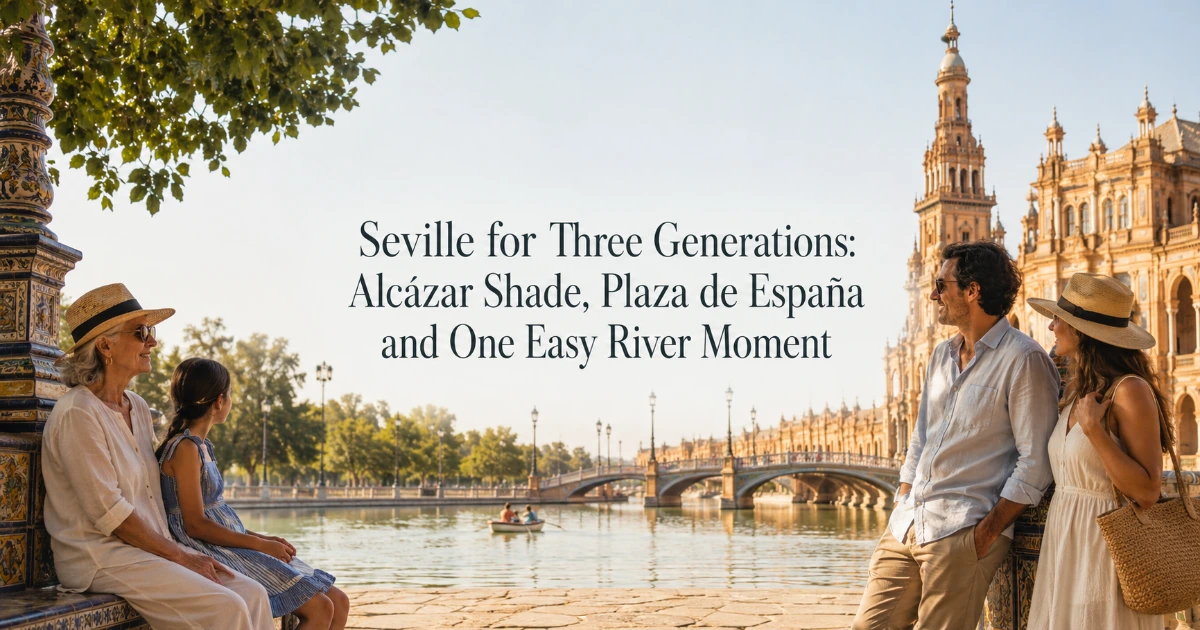
Seville for Three Generations: Alcázar Shade, Plaza de España and One Easy River Moment
Updated
For three generations in Seville, the strongest first-day shape is not a greatest-hits march; it is a morning Real Alcázar visit held to a humane length, followed by Plaza de España as the open-air reset, then one easy Guadalquivir moment instead of another old-town push. This works because Seville rewards shade, short transitions and changes of texture more than it rewards one more narrow-lane stop after attention has thinned. The clearest exception is a group with significant mobility needs, very young children in a stroller, or older relatives who need guaranteed seating and step-free certainty; this route reduces strain, but it does not solve all mobility needs.
The thesis is simple and specific to this city: the day succeeds when the palace is treated as the intellectual anchor, Plaza de España as the mood repair, and the river as the soft landing before everyone starts negotiating dinner. The hinge that proves it is not theoretical sits outside the Alcázar itself: Puerta del León and Patio de Banderas can feel compressed just when a mixed-age group is trying to decide what comes next, so the plan needs a clear exit before fatigue turns into committee planning. For a deeper palace-first plan, use Real Alcázar private tours as the specialist anchor rather than stretching the whole morning across too many monuments.
The planning answer: one palace, one civic reset, one river exhale
A three-generation Seville day should be built around one serious indoor-outdoor monument, one expansive outdoor pause and one gentle river-facing close. That order gives grandparents, parents, teenagers and younger children a shared story without making everyone absorb Seville in the same way for the same length of time. The Real Alcázar carries the historical weight; Plaza de España changes the body language; the Guadalquivir gives the group permission to stop performing interest.
The practical reason to keep the frame this narrow is that Seville’s center can make distances feel shorter on a map than they feel to a mixed-age group. The old town around Santa Cruz is beautiful but visually dense, with uneven surfaces, narrow turns, doorway bottlenecks and a habit of making every pause happen in the wrong place. Plaza de España and the river solve a different problem: they let people spread out, look up, take photographs without blocking a lane, and recover from palace detail without needing a formal lunch or hotel return immediately.
This is not a generic family day and it is not a kids-only compromise. It is a shared-attention day for travelers who want adults to come away with real context, younger travelers to avoid being trapped in one long lecture, and older relatives to feel that the day has been paced with dignity. The best version is privately guided not because a guide makes every step easy, but because a guide can read when the group has stopped listening and change the sequence before the day becomes heavy.
The morning sequence in real Seville conditions
The smoothest morning does not begin with a long hotel lobby debate. It begins with a clear meeting point, a defined Alcázar window and a guide who knows the first outdoor reset is already part of the plan. If the hotel is in Santa Cruz, the group may walk, but that walk should be treated as part of the morning’s energy budget rather than as a free prelude. If the hotel is in El Arenal, near the river or farther out, the first transfer should be arranged so nobody starts the day by navigating traffic, heat and directions at once.
The first practical checkpoint is the Alcázar entrance area. Puerta del León, Patio de Banderas and the nearby Cathedral-side streets can compress quickly, so the guide should keep the group moving with purpose instead of letting people scatter for photos, water and questions all at once. This is especially important for three generations because the group rarely tires together. One person wants the perfect entrance photograph, one wants the bathroom, one wants shade, and one wants to know why the line is not moving. Good pacing prevents those separate needs from becoming the tone of the morning.
The second checkpoint is the exit. A mixed-age group should not leave the Alcázar and then decide from scratch whether to wander Santa Cruz, find lunch, call a car or walk toward Plaza de España. That decision should already be designed with a fallback. If the group exits strong, continue to the plaza. If the group exits warm, hungry or quiet, shorten the transition and make the next pause more practical. If the group exits scattered, do not add a “quick” lane walk to prove you are seeing more of Seville.
This is why the route feels calmer when it is sequenced as a walkthrough rather than a checklist. The Alcázar has a beginning, a middle and an exit strategy; Plaza de España has a reset job; the Guadalquivir has a closing job. The group does not need to keep voting on what kind of day it is having. The day has already answered that question.
A decision matrix for a mixed-age Seville first day
The day becomes easier to design when each stop has one job and no stop is asked to do everything. Use this matrix to decide what belongs, what shrinks and what gets cut before the itinerary becomes a monument relay.
Mixed-age route matrix:
- Real Alcázar: best for shared historical depth, palace gardens and a guided story; weakest if the group expects to cover every room and courtyard in full.
- Plaza de España: best when the group needs space, sunlight or a lighter visual reward after palace detail; weakest when scheduled as a rushed photo stop between two demanding interiors.
- Guadalquivir moment: best as the calm close after the plaza, especially when the group is not ready for another old-town lane; weakest if treated as a long add-on after everyone is already done.
- Triana: best when the evening has a flamenco or food reason; weakest when it becomes a second neighborhood walk tacked onto an already full first day.
The firm editorial call is this: do not stack the Real Alcázar, the Cathedral and Giralda, Plaza de España, Triana and an evening show as one continuous push. That is not an ambitious family day; it is a day that asks the slowest walker, the least museum-tolerant child and the most detail-hungry adult to fail in different ways. If a major cathedral visit matters, it belongs either as a separate morning or as a deliberately lighter pairing, not as the reflexive next stop because it is nearby.
The counterintuitive correction is that Santa Cruz is often overvalued immediately after the Alcázar for this specific group type. The neighborhood is close, evocative and worth seeing, but after a palace visit its narrow lanes can feel like more compression rather than relief. For couples or art-focused adults, that can be lovely. For three generations, the better first reset is usually the open scale of Plaza de España, where people can separate by a few meters without feeling separated from the group.
How long can the Real Alcázar realistically hold a mixed-age group?
The Real Alcázar can usually hold a three-generation group well for about 90 minutes, with 120 minutes as the upper edge when everyone is rested and genuinely interested. It should be shorter than many adults expect when there are young children, stroller logistics, heat, a late arrival, or grandparents who want to enjoy the day without turning the palace into an endurance test. A beautifully guided 75 to 90 minutes can leave a stronger memory than a two-and-a-half-hour visit that drains the rest of the route.
The official Real Alcázar site is the place to check current access details before the day, but the planning question is not only entry; it is attention. The official Real Alcázar website (https://alcazarsevilla.org/) helps confirm the operational side, while the editorial decision is how much palace your group can enjoy before returns diminish. Skip-the-line access does not prevent fatigue if the group stays too long inside one monument. It protects the start, not the whole arc of the morning.
The visit should be edited around contrast. Start with the palace as a living royal site and layered Mudéjar, Gothic and Renaissance setting, then let the guide choose a handful of rooms and courtyards that make the story legible without trying to decode every surface. The gardens are not just a pretty finish; they are part of the energy strategy. A child who has stopped listening indoors may rejoin the group outside, and an older adult who has been standing too long may find the gardens easier if the pace slows and the commentary becomes lighter.
Where premium guidance earns its cost is in restraint. A strong guide knows when not to add one more dynasty, one more tile explanation or one more detour because the adult enthusiasts are still nodding. The best guide protects the shared attention of the group rather than rewarding the most intense listener. That is the difference between a palace visit that becomes the day and a palace visit that sets up the day.
What to keep inside the Alcázar, and what to stop explaining
Inside the Alcázar, keep the storylines that help three generations understand why the palace feels layered rather than merely ornate. The most useful thread is coexistence and adaptation: Islamic forms, Christian royal power, later courtly additions and garden culture all visible in one site. That gives adults enough substance, teenagers a pattern to recognize, and younger travelers a simpler visual game: arches, water, courtyards, tiles, shade.
What you should stop forcing is exhaustive room-by-room coverage. Detail fatigue inside the Alcázar is real because the site asks the eye to work constantly. A private guide can pause at fewer places and make those places count: a courtyard where geometry becomes readable, a garden axis that changes the temperature of the morning, a threshold where the palace shifts from ceremony to retreat. That is better than trying to prove value by multiplying stops.
Seville does something to the body that planners often underestimate. Standing in courtyards, filtering through doorways, adjusting to sun and shade, and navigating the exit flow around Patio de Banderas can tire a group before the walking distance looks impressive on paper. The fatigue is not only about steps; it is about attention, heat load, stop-start movement and the small physical tax of keeping three generations together in a popular monument.
For children under about seven, the Alcázar works best when the gardens are not postponed until everyone is already frayed. For older children and teenagers, the palace works when the guide gives them patterns and power stories rather than decorative description alone. For grandparents, the visit works when standing time is watched carefully and the group does not treat every beautiful room as a mandatory teaching moment. The palace is the anchor, but it should not consume the whole social patience of the day.
When Plaza de España is the reset, not the main event
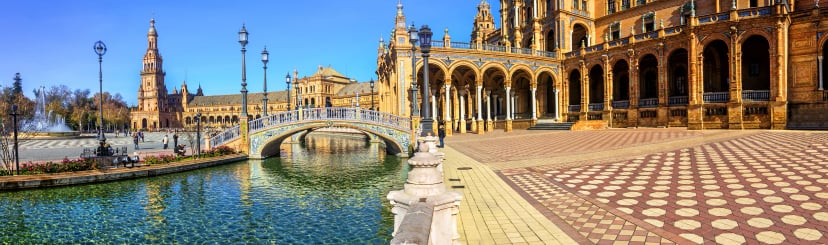
Plaza de España is the reset when the group has absorbed enough palace detail and needs air, scale and a less verbal kind of pleasure. It is not a lesser stop after the Alcázar; it is the release valve. The plaza’s broad curve, bridges, canal, tilework and open space let different ages enjoy the same place differently without asking them to stand in a tight semicircle around a guide.
The official tourism page from Visit Seville is useful for orienting the site and its Ibero-American Exposition context, especially the Aníbal González design story and the relationship with Parque de María Luisa. Use the official Visit Seville Plaza de España page (https://visitasevilla.es/en/plaza-de-espana/) for that basic grounding, then plan the visit as a pacing tool rather than a lecture stop. The plaza usually works best after the Alcázar because it changes the group’s posture: shoulders drop, cameras come out, children move ahead, and older adults can take in the space without another dense interior.
Do not make Plaza de España carry too much explanation. A few minutes of context is enough for most groups: why it was built, how the regional tile benches work, why the semi-circular form photographs so well, and how it sits against Parque de María Luisa. After that, the value is movement and breathing room. This is where Plaza de España private tours earns its place when the guide uses the stop to loosen the day, not to turn the plaza into another full monument.
The mood consequence is immediate. If you go from Alcázar detail straight into more old-town explanation, the day can start to feel smaller even though the sights are important. If you go to Plaza de España, the day feels wider. That matters for family harmony: the person who wants photographs, the person who wants architecture, the person who wants to sit, and the person who wants to move can all get something without a formal split.
Lunch and pause logic without turning the day into a food hunt
Lunch should support the route, not become a second planning project. For this three-generation day, the best lunch is usually close enough to the Alcázar or the Plaza de España transition that it does not require a new neighborhood decision. A long search for the perfect table can undo the morning’s pacing because hunger arrives at different times for different ages. The planner’s task is not to find the most talked-about meal; it is to keep the group from spending its best post-palace hour in a sidewalk negotiation.
If the group exits the Alcázar hungry, pause before Plaza de España rather than dragging everyone across the next stage on the promise that lunch will be better later. If the group exits with good energy, keep the reset first and let the meal happen after the plaza or near the river. The right answer depends less on the clock than on body language: slower walking, shorter answers and fewer questions usually mean the group needs food or seating before more culture.
For food-and-wine travelers, this can feel like a sacrifice, but it often protects the better meal later. A serious dinner is easier to enjoy when the first day has not become a heroic lunch chase. Seville rewards eating well, but this particular route is not about proving culinary range. It is about keeping three generations in a good mood long enough that the evening remains open.
The Plaza de España to river moment is the route hinge
The Plaza de España to river moment matters because it turns sightseeing into an easier physical sequence instead of a set of isolated attractions. From the plaza, the group can leave the monumental curve, pass the green edge of Parque de María Luisa, and work toward the Guadalquivir without re-entering the tightest lanes of the old town. That transition is the reason the route feels calmer than an Alcázar-Santa Cruz-Cathedral stack.
There are several ways to handle the river depending on energy. The simplest is a short river-facing pause near the Torre del Oro side, where the group can look across the Guadalquivir and decide whether the day has enough left for Triana. Another is a light cruise or private river experience if the day is celebratory, the weather suits it, and the group benefits from sitting together without needing to keep walking. For the river layer, Guadalquivir private tours is the natural next step when the river is meant to be part of the design rather than an afterthought.
The key is not to oversell the river as a grand finale. Its value for three generations is that it gives the day an easier landing. A river hour can let the adults continue talking about the Alcázar, give younger travelers a change of scene, and reduce the feeling that the entire first day was spent inside historic density. That is a body consequence as much as a scenic one: fewer lane changes, less doorway compression, more seated or slow-moving time, and a better chance that dinner does not begin with everyone recovering from the itinerary.
If the group is still fresh, the river can frame a gentle look toward Triana. If the group is tired, it can be the point where you stop and return to the hotel. That flexibility is exactly why it belongs after Plaza de España. It gives the day a graceful off-ramp instead of forcing a yes-or-no decision about another neighborhood while everyone is standing in the sun.
Should the river moment replace another old-town stop?
Yes, for most three-generation first days the river moment should replace another old-town stop, not sit on top of it. The stop to cut first is usually the extra Santa Cruz wander after the Alcázar, the second palace, or a quick Archivo de Indias glance that no one has enough attention to understand. Those are all defensible choices on a different day. They are not the best use of shared energy once the Alcázar has already done the heavy lifting.
The most common mistake is confusing proximity with suitability. The Cathedral, Giralda, Archivo de Indias and Santa Cruz are close to the Alcázar, which makes them tempting. But closeness does not remove the attention cost. For a group with older parents and children, another old-town stop often creates the exact problem the day is trying to avoid: people standing while one adult tries to care, another checks the time, and someone younger starts asking when the “real” break happens.
The cut-first rule is practical: once the Alcázar is in the morning, cut the least seated, least open-air, least emotionally distinct next stop. That is usually more old town, not Plaza de España and not the river. If you have a second Seville day, save Santa Cruz depth, the Cathedral/Giralda or another palace for a time when the group can approach it fresh. If you only have one first day, let the river absorb the pressure instead of making the old town prove itself again.
There is one exception. If the group includes adults who have traveled specifically for sacred architecture or medieval urban history, then the old-town stop may outrank the river. In that case, shorten the Plaza de España visit and make the river a glimpse rather than a planned pause. But do not pretend the full version of everything will feel elegant. It will feel full, and full is not the same as well designed.
Age bands: how the same route changes by generation
A multigenerational Seville day works best when every age band has a different way to participate in the same route. The goal is not to make the day childish, and it is not to make younger travelers tolerate an adult itinerary silently. It is to give each generation a reason to stay with the group without asking everyone to process Seville through the same attention span.
- Under seven: keep the Alcázar shorter, bring the gardens forward, and avoid promising a long old-town wander afterward. Strollers may help between sites, but narrow lanes, paving changes and crowded thresholds mean a stroller does not make the day friction-free.
- Ages eight to twelve: use the palace as a pattern hunt: water, animals, tiles, hidden power symbols and garden routes. Plaza de España then becomes a reward that still feels cultural.
- Teenagers: give them a role in the day: photography at Plaza de España, route choices by the river, or flamenco context if Triana is part of the evening. They often resist being managed more than they resist history.
- Parents: protect decision energy. The plan should not require parents to arbitrate every pause, bathroom stop and snack question in public.
- Grandparents: watch standing time more than walking distance. A short walk with a clear purpose is often easier than a static explanation in a crowded courtyard.
The route also changes with arrival condition. After a train or flight, the Alcázar may need to be shorter and the river may become the true success of the day. After a full night’s sleep and a slow breakfast, the palace can take more space. For first-day arrival logic beyond this three-generation route, a Seville arrival-day plan can help decide whether to tour at all or keep the day lighter.
The return leg decides whether the day still feels easy
The return leg should be planned before the day starts, not negotiated when everyone is tired. From the river, the group has a few sensible endings: return toward the hotel on the historic-center side, cross briefly toward Triana if there is a clear reason, or pause near the river and let the evening plan begin later. The wrong ending is a vague “let’s see how we feel” that turns into a slow search for taxis, food or one more view.
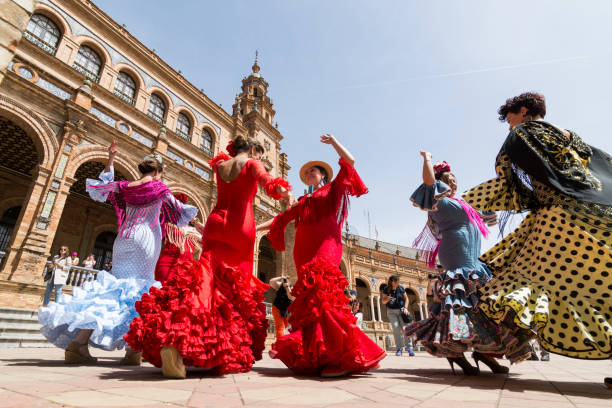
Triana is appealing because it gives Seville a different texture, but it should not be treated as a casual bonus for every mixed-age group. Crossing toward Calle Betis or deeper into Triana adds a river crossing and a return question. That can be worthwhile if the evening has a purpose, such as ceramics context, dinner or flamenco, but it is not automatically easier than staying near the old-town side. If flamenco is part of the day, Teatro Flamenco Triana (https://www.teatroflamencotriana.com/en/home/) is a useful primary-source check for venue information; still, the show belongs only if the group’s evening energy is real, not imagined at breakfast.
For many families, the cleanest finish is not to cross into Triana at all on this day. Let the Guadalquivir be the view, not the start of a second neighborhood. For celebration travelers or older teenagers, a short Triana layer can work beautifully, especially when a guide has already prepared the context rather than leaving the group to arrive cold. The decision is less about whether Triana is worth it and more about whether the return leg will still feel composed.
Weather pivots: heat, rain and the Seville midday slowdown
Weather changes the value of each part of the route. In high heat, the Alcázar should happen early, Plaza de España should be treated as a shorter reset, and the river should move later or become a seated experience rather than a sunny walk. In mild weather, the plaza can stretch because the group is not spending attention on heat management. In rain, the plaza remains visually rewarding but loses some of its reset power, so a cafe pause or hotel return may beat forcing the full outdoor arc.
The Seville midday slowdown is not just a cultural rhythm; it is a planning advantage when used honestly. A family that tries to power through the warmest, most crowded or most tiring part of the day often pays for it at dinner. A family that accepts a midday pause can make the evening feel like a second chapter. For deeper heat-specific sequencing, Seville in high heat strategy is the more focused companion piece.
Heat also changes the body language of the group. Grandparents may stop volunteering discomfort until it is too late; children may show fatigue as irritability; teenagers may detach; parents may become logistics managers instead of travelers. A guide cannot change the weather, but a guide can reduce the number of exposed decisions and move the group toward shade, seating or a cleaner ending before fatigue becomes the day’s dominant memory.
Where private planning changes the day, and where money does not
Private planning changes this day most when it edits the route in real time. A private guide can compress the Alcázar without making it feel thin, move Plaza de España earlier if the group needs air, decide whether the river should be a walk, cruise or viewpoint pause, and protect the parents from becoming the tour directors. That is especially valuable when one grandparent loves history, one child needs motion, and another adult wants the day to feel polished rather than improvised.
Premium spend does not help where it simply adds more content to an already overloaded day. Paying for access, transport or a guide can improve timing, privacy and interpretation, but it cannot make a tired group care about a fourth major stop. The best value is not in buying the longest itinerary; it is in buying the judgment to stop before the day loses its shape. A broad orientation such as the Best of Seville private tour works when it is tailored down to this rhythm rather than inflated into a checklist.
There is also a chauffeur question. A car can help with hotel pickup, weather pivots and a clean return, especially if the hotel is not close to the Alcázar or if older relatives need fewer transitions. But inside the historic core, a car is not a magic solution. The most important comfort upgrade is often the human one: a guide who knows when to pause, what to cut, and how to keep three generations part of the same conversation.
If you want Orange Donut Tours to shape the Alcázar, Plaza de España and Guadalquivir sequence around your family’s ages, arrival condition, hotel location and evening plans, Inquire now. The best private version is not a longer day; it is a day with fewer exposed decisions and a guide who can change the rhythm before anyone has to ask.
The route that keeps the evening intact
The most balanced version starts at the Real Alcázar, exits decisively, avoids a long Santa Cruz drift, moves to Plaza de España for air and scale, then finishes with a short Guadalquivir pause or river experience. That order keeps the day from flattening into one long historical explanation. It also lets the evening remain available for dinner, a gentle stroll, or flamenco if the group still has the appetite for it.
If the evening includes Triana, reduce the afternoon. Do not ask the group to do a full palace morning, a plaza wander, a river walk, a Triana context walk, dinner and a show unless everyone is unusually energetic and the next morning is light. Teatro Flamenco Triana, dinner in Triana or a ceramics-led walk can each belong in a Seville stay, but not all of them need to attach to the same first-day spine.
The mood you are protecting is not laziness; it is shared goodwill. When the day ends with enough energy for people to choose dinner calmly, the whole trip feels better. When the day ends with the group too tired to enjoy the evening, the morning’s cultural value gets discounted in memory. Seville is generous, but it is not better when every hour is filled.
What to cut first if the day starts slipping
If the day starts slipping, cut the stop that adds the most standing and the least change of texture. Usually that means removing a secondary old-town stop, shortening Santa Cruz, or saving Triana for another day. Do not cut the Plaza de España reset first unless weather makes it uncomfortable; it often does more for the group’s mood than another historically significant interior would do at the wrong time.
Cut commentary before cutting the route’s emotional shape. A good guide can reduce explanation inside the Alcázar and still keep the visit meaningful. A parent can shorten the photo time at Plaza de España and still let the group breathe. A river moment can be a ten-minute view instead of a longer cruise. Those trims preserve the sequence: depth, air, water, return.
There is one stop you should not force for appearances: the “quick” Cathedral/Giralda add-on. The Cathedral is too important to be treated as a quick garnish, and the Giralda adds its own physical demand. If it matters to your group, give it a proper window. If it does not, do not insert it because first-time visitors feel they should. The day already has a serious monument in the Alcázar.
FAQ
How long should three generations spend in the Real Alcázar?
Plan about 90 minutes for most mixed-age groups, with 120 minutes only when everyone is rested, mobile and interested. Shorten the visit to 75 to 90 minutes if there are young children, heat concerns, late arrivals or older relatives who tire from standing.
Is Plaza de España worth visiting after the Alcázar?
Yes. Plaza de España is often the best reset after the Alcázar because it gives the group open space, a change of scale and a less verbal experience after palace detail.
Should the Guadalquivir river moment replace Santa Cruz?
On a three-generation first day, it often should replace a long Santa Cruz wander after the Alcázar. Santa Cruz is valuable, but immediately after the palace it can feel like more compression when the group needs air and a simpler finish.
Can we add the Cathedral and Giralda to this route?
You can, but it changes the day from balanced to monument-heavy. For most mixed-age groups, the Cathedral and Giralda deserve their own focused window rather than being stacked after the Alcázar.
Is this Seville route stroller-friendly?
It is stroller-aware, not fully stroller-proof. Plaza de España and river-facing stretches are easier than many old-town lanes, but the Alcázar area, Santa Cruz edges, paving changes and crowds can still create friction.
Should we cross into Triana at the end?
Cross into Triana only if the evening has a clear purpose, such as dinner, ceramics context or flamenco. If the group is tired, keep the Guadalquivir as the closing view and save Triana for another day.
Is a private guide worth it for a multigenerational Seville day?
Yes, when the guide is allowed to edit. The value is not just explanation; it is pacing, cutting, adapting to energy levels and keeping parents from having to manage the day in public.
What is the first thing to cut if the day feels too full?
Cut the extra old-town stop first. Keep the Alcázar as the anchor, Plaza de España as the reset and the river as the soft landing, then save deeper Santa Cruz, Triana or the Cathedral for a better window.
If you’re interested in any private tours of Seville, please reach out to us.





 So if you are looking for the absolute best in Seville & surroundings with authentic local fully-licensed native guides whose English you can actually understand and with an exclusive and amazingly fun itinerary













