How to Spend a White-Glove Second Day in Seville: Triana, Plaza de España or a Sherry Day in Jerez?

Updated
For most travelers on a refined first visit, the best second day in Seville stays in Seville: cross Puente de Isabel II into Triana in the morning, use Plaza de España as a deliberate afternoon anchor, and keep Jerez de la Frontera for the smaller set of visitors whose trip is genuinely driven by sherry. That verdict works because day one usually concentrates Alcázar, Cathedral and Santa Cruz into a dense, lane-heavy circuit; day two earns its place by changing the texture of the city without adding a full transfer reset. The clearest exception is the traveler who would remember a cellar visit and serious tasting more vividly than one more Seville evening.
In Seville, the strongest second day is not the one with the longest attraction list. It is the one that replaces monument pressure with neighborhood texture, broad urban space or a product-led escape, while still keeping your legs, appetite and attention in good enough shape to enjoy the night. That is why the stay-local plan beats the filler move: another diluted wander through the old core.
If day one already handled the icons in the right order, as in our first-day Seville plan, then day two should not be a weaker rerun. It should either change the city’s feel by crossing the river into Triana, widen the frame with Plaza de España and the Parque de María Luisa side of town, or leave Seville altogether for a tasting-led day that justifies the effort.
The default winner: a stay-local day with Triana first and Plaza de España second. It gives contrast, keeps logistics smooth and leaves the evening intact.
The quieter runner-up: a Triana-heavy slow day with only a brief Plaza stop, best when day one was demanding or your group wants more food, shopping or riverfront time than landmark time.
The purposeful exception: Jerez de la Frontera, but only when sherry is a real trip priority rather than a decorative add-on.
The wrong fit: trying to make Plaza de España carry an entire second day by itself, or padding it with another vague Santa Cruz encore.
The comparison that matters: not fame, but walking load, transfer resets, weather exposure, how much the day changes the trip mood, and whether Seville still feels good at dinner.
The second-day rule: change texture, not the sightseeing count
Your second day should feel like a change in surface, pace and orientation, not a lower-energy sequel to Santa Cruz.
That distinction sounds abstract until you see how Seville behaves in real movement. Day one usually compresses decision-making: narrow lanes, monument entrances, queue timing, church floors, courtyard stops, then more lane navigation. Crossing Puente de Isabel II into Triana is different immediately. The bridge itself announces the change. Behind you is the monument-heavy core; ahead of you are Altozano, the market side, ceramics, local bars and a part of the city that rewards lingering more than checklisting. For a second day, that matters more than adding one more famous façade.
The common mistake is assuming that a good second day needs another big-name sight to justify itself. It does not. In Seville, a better rule is this: keep the morning human-scale, keep the afternoon legible, and keep the evening worth dressing for. Triana helps with the first part because it is textured rather than congested. Plaza de España helps with the second part because it is visually coherent and easy to understand from the moment you arrive. Jerez de la Frontera only wins when the purpose of the day is tasting, not just motion.
The filler move, especially if you only have two nights, is a padded old-town encore: another long Santa Cruz wander, perhaps a generic carriage or river add-on, and lunch stitched in simply because the Alcázar and Cathedral are already behind you. That usually feels less like a curated day than a gap being filled. The firmer editorial call here is that Seville does not need an encore of its center on day two; it needs a change of register.
There is a second correction worth making early. Plaza de España is not overrated, but it is over-assigned. It is a superb anchor for a refined second day and a weak whole-day answer on its own. Travelers often think the open setting will make it automatically restful. Sometimes it does. Just as often, it turns into one large exposed loop with too little narrative in it unless you place it inside a broader day.
Should you stay in Seville or leave the city on day two?
Stay in Seville on the second full day unless wine is one of the main reasons you came to Andalusia.
For first-time visitors, couples celebrating, families balancing adults and children, or small groups trying to protect energy after a monument-led first day, the stay-local option is usually stronger. From Santa Cruz or El Arenal, you can reach the river quickly, cross into Triana without making the morning feel like a departure, and later move to the Parque de María Luisa side of town without turning the day into transport logistics. That smoothness is not a minor detail. It is what lets day two feel chosen rather than leftover.
Staying local is also best for travelers who care about the last Seville evening. Perhaps you have a rooftop aperitif in mind, a serious dinner, a celebration wardrobe change, or simply the desire to wander the lit streets without watching the clock. Leaving the city shifts the emotional weight of the day. However pleasant the road or train may be, Jerez inserts a departure, a return and a low-grade sense that dinner depends on how cleanly the day runs.
Leave Seville only when the content of the day is strong enough to justify giving up those local advantages. Jerez de la Frontera earns that trade when the group truly wants bodegas, sherry styles, cellar atmosphere and a food-and-wine narrative that cannot be improvised back in Seville. It also gets stronger for repeat Spain visitors who have already done the city-center essentials, or for travelers on longer Andalusia stays who are not asking one Seville weekend to do every job at once.
Who should avoid the Jerez option? Travelers with a next-morning departure, very young children, older relatives who do better with one base and fewer resets, and anyone who tends to enjoy wine in a casual, one-glass-with-dinner way rather than as the point of the outing. Jerez is close enough to be feasible and far enough that it should replace the day, not share it. If that feels like too much commitment, it probably is.
That is why the local recommendation is not a timid answer. It is the stronger one. Seville’s second day is at its best when it opens the city outward rather than sending you into another tunnel of monuments or off on an excursion that your trip length has not really earned.
How much walking do Triana, Plaza de España and Jerez really imply?
None of the three options is as effortless as it sounds; they simply tire the body in different ways.
Seville does something very specific to the body on day two. Santa Cruz fatigues through compression: turns, stops, shade-hunting, standing, church floors and constant small decisions. Triana spreads the strain into a more pleasant rhythm, but it still includes a real bridge crossing, longish riverfront segments and plenty of standing around food counters, ceramic shops or bars. Plaza de España looks easy because it is open and intelligible, yet its openness creates longer uninterrupted walking and more weather exposure than the old lanes. Jerez lightens the city walking but replaces it with departure friction, platform or curbside waiting, cellar standing, steps in historic buildings and the heaviness that comes from sitting, tasting and returning rather than simply strolling.
- Triana plus Plaza de España: expect a full city day with meaningful walking broken into manageable blocks. It feels easier than another monument circuit because the stops are more voluntary, but it is not a lazy half-day unless you keep the route deliberately short.
- Triana-heavy slow day: this is the gentlest city option. The walking is still there, but it is more interruptible. You can shorten it after lunch without making the day feel unfinished.
- Plaza de España-centered day: easier to navigate than Santa Cruz, but more exposed and more repetitive if you overstay. Broad surfaces can be kinder for some travelers, yet the long curves ask more of knees and stamina than photographs suggest.
- Jerez de la Frontera day: the step count may be lower inside Seville, but the total fatigue can still be higher because the day starts earlier, ends later and includes transfer resets before you even begin tasting.
The key comparison is not simply more walking versus less walking. It is broken walking versus continuous walking. The southern edge of Plaza de España can feel longer than the Santa Cruz lanes because there are fewer accidental pauses and less intimate scale to mask distance. In Santa Cruz, corners, shops and shade create natural punctuation. At the Plaza, the sweep itself is the point, so you keep moving. That can be liberating for some travelers and surprisingly draining for others.
The day also lands differently on the mood of the trip. A local Triana-and-Plaza plan usually preserves curiosity into the evening: you come back cleaner in the head, with time to reset and go out again. An overstuffed old-town encore can make the city feel smaller because it keeps returning you to the same lane logic. Jerez can be wonderful, but it changes the emotional shape of the day from city-stay to excursion. When it works, that feels purposeful. When it does not, Seville ends up as a hotel between transfers.
For families, multigenerational groups and celebration travelers in nicer shoes, this distinction matters. Triana gives you chances to stop, sit, snack and change course. Plaza de España gives you clarity and photogenic space, but less concealment from heat or wind and fewer excuses to pause unless you build them in. Jerez gives you the least improvisation. Once you leave the city, the day has a set direction.
The strongest local sequence: Triana first, Plaza de España second
For most travelers, the most rewarding second day is a sequence, not a single sight: Triana in the morning, lunch on that side of the river or nearby, then Plaza de España as the day opens out.
This order works because it mirrors what your trip needs after the Alcázar-Cathedral-Santa Cruz concentration of day one. Morning is when Triana feels most like a lived-in quarter rather than an afterthought. Crossing Puente de Isabel II early gives you a decisive change of scene without the psychological drag of going somewhere else. You reach Altozano, the Mercado de Triana side and the first stretch of Calle Betis quickly, yet the city already feels re-edited: less queue logic, more neighborhood rhythm, more choice about whether to browse, eat, linger or keep moving.
This is also where a guide earns value differently than on day one. In the old center, a guide is often managing entrances, order and historical overload. In Triana, the value is interpretation and editing. Instead of simply drifting past ceramics, parish façades, market stalls and river views, you understand why the quarter feels distinct and how to read it without overwalking it. For travelers who want that layer, a Triana Quarter private tour is the more natural upgrade than trying to motorize the whole day.
Late morning into lunch is where this plan breathes. Triana gives food-and-wine travelers a reason to slow down, couples a less performative part of the city, and families a less ceremonial set of decisions than another church or palace. If the group wants shopping, snack stops or simply a seat with a view back toward the center, this side of the river handles that better than Santa Cruz. The walking remains real, but it is broken into pieces. You are not pushing through one continuous corridor of obligation.
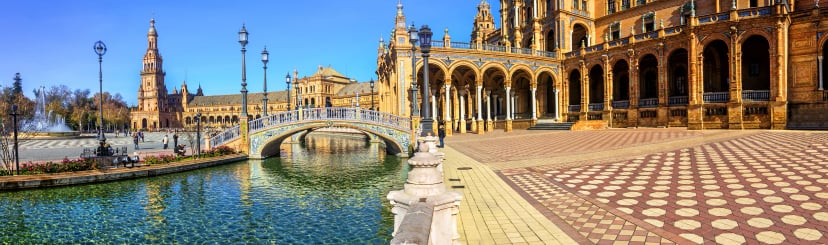
Then, instead of returning to the old core for a second act that feels familiar, move outward to Plaza de España. This is the point of the sequence. Triana gives texture; Plaza gives scale. One is intimate and irregular, the other grand and legible. Together they make day two feel like a genuine continuation of Seville rather than a spare-parts itinerary.
Plaza de España works best here as a deliberate chapter rather than the opening act. Later in the day, especially when light softens, its long curves, tiled detail and generous sightlines feel earned rather than under-explained. If the group prefers a structured arrival and context rather than a casual drop-in, a Plaza de España private tour can turn a photogenic stop into a coherent part of the day. What it should not do is bloat the schedule into an all-day ceremony.
There is also a practical comfort benefit. By the time you arrive, you know how the group is moving. If energy is high, you can extend into the Parque de María Luisa edge, use benches and shade strategically, and let the wider spaces relieve the lane fatigue of day one. If energy is middling, Plaza still works because it delivers a strong sense of place quickly. That flexibility is exactly what a second day needs.
The best proof that this sequence is the winner is what happens at the end of it. You are still in Seville. You have not spent the afternoon watching the clock for a return. You can go back to the hotel, pause, dress for dinner, or take an evening walk that feels like part of the city instead of a decompression chamber after a day trip. For celebration travelers, that is huge. For couples, it preserves romance. For families, it preserves patience. For food-and-wine travelers, it means the dinner still matters because you are not already spent.
The quieter runner-up is to keep almost all of the day in Triana and the river corridor, using Plaza de España only briefly or not at all. That can be the better answer if day one was very full, if someone in the group needs shorter walking windows, or if the real goal is browsing, conversation and a long lunch. But for most first-time visitors, the fuller Triana-plus-Plaza arc feels more complete without becoming cumbersome.
Reverse the order and the day is weaker. Starting at Plaza de España can make Triana feel like a nice leftover rather than the main change in city texture. Starting in Triana lets the day get deeper before it gets broader.
Why Plaza de España is better as a chapter than the whole book
Plaza de España deserves time, but it rarely deserves your entire second day.
The reason is not that it disappoints. It is that its strengths are concentrated. You arrive, the form makes sense at once, and the visual reward is immediate. For photo-focused travelers, for parents whose children do better in open space, and for anyone who felt squeezed by Santa Cruz, that clarity can be a relief. The surfaces are broader, the lines are simpler, and the area reads faster than the old center.
Yet this is exactly where many itineraries misjudge it. The southern edge of Plaza de España may feel simpler than the Santa Cruz lanes, but it often asks more from the body because the walking is longer and less interrupted. In Santa Cruz, the turn-by-turn rhythm hides distance. At the Plaza, the sweep is visible, so you keep taking it in one go. Add heat or bright light, and what looked like an easy pause in the day becomes one large exposed segment.
That is why Plaza works so well as an anchor after Triana or before an elegant evening, and so poorly as a padded stand-alone second day. A discerning traveler notices when a schedule looks beautiful on paper but thin in lived experience. Two hours at the Plaza can feel satisfying. Six hours arranged around it can feel like a scenic gap.
There are, of course, narrower cases where a Plaza-led day is the right call. One is mobility. If the group wants fewer lane decisions, fewer old-stone thresholds and clearer sightlines, broad formal space can genuinely help. Another is celebration styling: some travelers want one beautifully framed, low-conflict block of the day for portraits or a polished visual memory. In those cases, the Plaza earns its place. The mistake is assuming that because it photographs well, it automatically structures a full day well.
If you want the Plaza without the thinness, pair it with something that changes the emotional register around it. Triana does that best. A lunch plan does it next best. Another meander through Santa Cruz does not. That pairing is the difference between a composed second day and a handsome but hollow one.
This is also where paying for more vehicle time or ornamental add-ons can backfire. The Plaza is already legible. It does not need theatrical padding to feel important. It needs proper placement inside the day.
When a sherry day in Jerez de la Frontera earns the whole day
Jerez de la Frontera earns your second day only when sherry is the story, not when you simply want an excursion because the major Seville monuments are done.
For the right traveler, Jerez is excellent. Food-and-wine couples, collectors, hospitality professionals, repeat Spain visitors and small groups that love cellar atmosphere will often remember a serious sherry day more vividly than one more urban stroll. It offers a different Andalusian vocabulary: bodegas, tasting sequence, cellar scale, grape and style distinctions, and the sense that the day is built around a product rather than a skyline.
But this is the exception because the day has a different cost structure. Leaving Seville means a real departure from your hotel rhythm, whether that happens by road or through Santa Justa station. You are not just adding content; you are resetting the whole day. That reset can be energizing when the group wants it. It can also flatten the Seville stay when the trip is short and the city itself still has unused range.
Think of Jerez as an all-in decision, not a sidecar. Once it is the plan, let it be the plan. Do not try to wedge Triana or Plaza de España around it as if they were errands. If a tasting-led excursion is truly the right answer for your trip, build it as a complete Jerez winery day and allow Seville to have its own evening before or after.
Who should choose it? Travelers staying three or more nights in Seville, repeat visitors who have already had their monument and neighborhood days, and anyone whose happiest travel memories come from vineyards, cellar visits, guided tastings and long lunches rather than city wandering. Who should decline it? First-timers with only two nights, groups with mixed interests, families whose day unravels when transport is rigid, and anyone protecting a major dinner reservation back in Seville.
This is also the option where extra service can materially change the experience. A driver or fully coordinated day reduces the choppy feeling that can come with station timing, local transfers and the return leg. The benefit is not just comfort in the seat. It is continuity. The day feels like one argument rather than four separate tasks. In Jerez, that coherence is worth paying for more often than it is on a purely local Seville day.
The honest counterpoint is that Jerez can feel more dutiful than delicious when the group likes the idea of sherry more than the reality of spending a whole day around it. Fortified wine is specific. Historic cellars are specific. If your palate is broad but your enthusiasm is casual, Seville itself may give you a better day because the pleasure is more varied and less dependent on one theme carrying everything.
And then there is the evening question. A strong local second day sends you into dinner still inside Seville’s rhythm. Jerez sends you back after an excursion. That is not automatically worse. It is simply different. For some travelers it feels satisfying and grown-up. For others it removes the looseness that makes Seville special at night. Knowing which camp you are in matters more than whether Jerez sounds sophisticated on paper.
When sherry is genuinely central, though, the verdict flips cleanly. In that narrower case, staying local can feel like the compromise, and Jerez becomes the purposeful second day that the city-centered plan cannot match.
What to cut first, and where spending more stops paying
Cut the diluted old-town encore first, and do not assume that more transport automatically makes a better second day.
The first thing to remove when an itinerary starts feeling padded is the idea of one more little thing in the historic center. Another Santa Cruz drift, an ornamental carriage loop, or a river add-on inserted only because there is space on the calendar seldom improves a short Seville stay. Those pieces can be pleasant, but pleasant is not the same as purposeful. On a high-value trip, filler feels expensive faster than it feels charming.
If your second day stays between Triana, Plaza de España and dinner back near the center, paying for a full-day chauffeur is unnecessary.
Why? Because the best local second day is fundamentally walkable, interruptible and close-grained. What earns its cost is not a parked vehicle waiting all day. It is better sequencing, contextual guiding, a short transfer at the right moment, or help designing a route that matches the group’s actual pace. The smarter spend is precision, not simply more hardware.
Extra spend helps much more in three situations: when heat or mobility makes the move from Triana to Plaza de España feel longer than it looks; when a multigenerational or celebration group wants a perfectly timed bridge between daytime exploring and an evening booking; and when Jerez is on the table and the real enemy is transfer friction. In those cases, a driver or tailored routing changes the day from workable to seamless.
It also pays to decide whether day two is ultimately a daytime story or an evening story. If the night matters most, protect it. Do not force a heavy lunch, cross-town shopping and an overlong Plaza stop before a tasting-menu reservation. If you are planning around a serious dinner, confirm the current offering directly at abantalrestaurante.es/menu (https://abantalrestaurante.es/menu/) and keep the afternoon lighter than your ambition initially suggests. The most common Seville planning mistake at this level is not underplanning; it is building a day so full that the dinner becomes recovery work.
This is where Seville reveals what it does to the trip mood. A well-edited second day leaves you with the feeling that the city still has something to give after dark. An overstuffed second day makes the evening feel like an obligation or a cancellation risk. That difference is invisible when you read an itinerary and obvious when you live it.
If you need a clean cut-first rule, use this one. Do not try to make all three title options coexist. Pick the Triana-and-Plaza local day or pick Jerez de la Frontera. The moment you attempt Triana, Plaza de España and a sherry-country escape in the same second day, quality drops everywhere.
How day two becomes chosen rather than leftover
Second day feels chosen when the service matches the friction, not when the itinerary tries to prove its value by adding more stops.
A private guide is most useful in Triana because that quarter rewards explanation, taste and selective pacing. A short transfer or carefully timed vehicle matters most between widely separated points, or when the group would rather arrive calm than technically accomplish a walk. A full chauffeured setup matters most when the day leaves the city or when mobility, heat or celebration logistics make the easy answer less easy in practice.
That is why truly smooth second-day planning is less about luxury as a label and more about fit. Some groups want a morning of rich interpretation and a later independent stroll. Some want one unified route with no decision fatigue. Some need the confidence that comes with chauffeured Seville touring because the trip includes grandparents, children, formal evening plans or very limited tolerance for heat and walking resets.
What matters is that the second day should look intentional by the time you step back into the hotel. Triana plus Plaza de España should feel like a deliberate widening of Seville, not a collection of leftovers after the icons. Jerez should feel like a serious wine-country decision, not a prestige detour. When the route, service and pacing line up, the day stops looking secondary at all.
If you want that decision made around your hotel, walking tolerance, dining plans and whether Jerez is actually worth giving up a Seville evening for, Inquire now.
FAQ
What is the best second day in Seville for first-time visitors?
For most first-time visitors, the best second day stays in the city: Triana first, Plaza de España second. It changes the feel of the trip without forcing a full excursion, and it keeps Seville available to you at night. That matters more than squeezing in another famous name. After the Alcázar, Cathedral and Santa Cruz, the goal is not bigger sights; it is a better rhythm. Triana gives neighborhood texture, Plaza de España gives formal scale, and the combination feels complete without becoming another monument marathon.
Is Jerez worth leaving Seville on a two-night trip?
Usually not. On a two-night stay, Jerez is best treated as the exception for travelers whose trip is genuinely centered on sherry. Otherwise, the cost is high: you give up time in Seville, add departure-and-return friction, and reduce the flexibility of your final evening. If you love wine in a broad sense but do not need a dedicated cellar day, Seville itself generally offers the stronger second-day experience.
Is Triana enough for a full second day in Seville?
It can be, especially if you want a slower day with more food, browsing, conversation and riverside time than landmark time. Triana works particularly well for couples, small groups and anyone arriving to day two with tired legs from the old center. For most first-time travelers, though, it is better as the main morning chapter of the day rather than the only chapter. Adding Plaza de España later gives the day more breadth without turning it into a rush.
Is Plaza de España enough for a full second day?
Rarely. Plaza de España is beautiful and useful, but its strength is concentrated rather than all-day. It gives fast visual reward, clear movement and a welcome break from old-town density, yet it usually feels thinner than travelers expect if it has to carry an entire day by itself. It works best as an anchor paired with Triana, lunch or another carefully chosen part of the city, not as a padded stand-alone plan.
Which second-day choice involves the least walking?
A Triana-heavy slow day is usually the least frustrating on foot because the walking is broken into shorter, more interruptible pieces. Plaza de España can be easier to navigate but not always easier on the body, because the open arcs encourage longer uninterrupted walking. Jerez can reduce city walking but still feel tiring because of early starts, transfer points, standing during visits and the return to Seville. The lowest-friction answer is not the one with the fewest steps; it is the one with the best pauses.
Do families or multigenerational groups usually do better staying in Seville on day two?
Yes. Staying in Seville gives you more room to adapt the day in real time. You can shorten Triana, extend lunch, take a quick transfer to Plaza de España, or return to the hotel before dinner without feeling that the whole plan has collapsed. Jerez is much less flexible once the day begins. For children, grandparents or mixed-energy groups, the local option is normally the more comfortable and more elegant choice.
Do I need a chauffeur for a second day in Seville?
Not always. If you are keeping the day local between Triana, Plaza de España and the center, a full-day chauffeur is often more than you need. A guide, a short well-timed transfer or smart routing may deliver more value. A chauffeur becomes much more worthwhile when the day includes Jerez, when heat or mobility is a concern, or when a celebration group needs very controlled timing between sightseeing and evening plans.
Does the answer change if I have three or four days in Seville?
Yes. The longer the stay, the stronger the case for Jerez de la Frontera becomes, because you are no longer asking one second day to solve every Seville need at once. With more time, you can keep a proper neighborhood-and-Plaza day in the city and still reserve another day for sherry country. If you are still shaping the broader trip, start with our guide to how many days in Seville.
If you’re interested in any private tours of Seville, please reach out to us.





 So if you are looking for the absolute best in Seville & surroundings with authentic local fully-licensed native guides whose English you can actually understand and with an exclusive and amazingly fun itinerary













