Seville’s María Luisa Park Decision: Plaza de España, Archaeology Museum and Shade Before Dinner

Updated
The best use of María Luisa Park before dinner is usually not a full park expedition; it is a controlled arc: Plaza de España first, then shade, then a clean move toward dinner. That works in real Seville because the open plaza is brilliant but exposed, while the park’s interior paths soften the body after a monument-heavy day. The clearest exception is a culture-led traveler who has saved energy for archaeology: when the Archaeology Museum is available, it can turn the visit from a scenic pause into a deeper chapter on Roman, Tartessian and Ibero-American Seville.
The thesis is simple: María Luisa Park should be planned as Seville’s late-day pressure valve, not as a photo errand. The decision is not “Is Plaza de España beautiful?” It is “How much meaning, shade and walking can you use before dinner without dulling the evening?” A useful private route around Plaza de España answers that question before the day starts.
One non-obvious local hinge matters immediately: the body feel of the day changes once you cross from the tiled openness of Plaza de España toward the María Luisa Park shade arc that leads in the direction of Plaza de América. The distance is not dramatic on a map, but the sensation is. Families stop negotiating. Older travelers stop managing glare. Couples stop checking the time and begin enjoying the hour. That is the planning value here.
Is María Luisa Park worth it before dinner in Seville?
Yes, María Luisa Park is worth it before dinner when you use it as a paced transition between the city’s major sights and the evening. It is not worth it when you try to make it carry too many jobs at once: full sightseeing, museum depth, family playtime, formal photos, and a dinner transfer from the wrong side of the city.
The park sits just beyond the tight old-town rhythm that defines much of a first Seville stay. Santa Cruz is intimate, shaded in places and atmospheric, but it can also feel like a sequence of narrow turns, restaurant decisions and foot traffic around the Cathedral and Alcázar. María Luisa Park is different. It opens the day out. That is useful before dinner, because the traveler who has spent a morning inside monuments often needs proportion, air and a gentler walking rhythm more than one more enclosed stop.
The correction is that Plaza de España should not always become the center of the afternoon. It is the famous image, but it is also the most exposed part of the decision. If your group is already warm, hungry, dressed for dinner, or traveling with children who are close to done, Plaza de España should remain a short stop rather than a full park strategy. Take the view, read the tiled provincial benches selectively, understand the 1929 Ibero-American Exposition frame, and move into the trees. The park is what makes the plaza usable late in the day.
That is especially true for travelers staying in Santa Cruz or El Arenal. The map can make the move look like an easy extension from the Cathedral zone, but Seville walking is cumulative. A morning around the Alcázar gardens, the Cathedral perimeter, Archivo de Indias, and Santa Cruz lanes can leave legs more tired than the distance suggests. The late afternoon should reduce decision pressure, not add another badge to the day.
Use María Luisa Park before dinner when the next meal is nearby enough, late enough, or planned with a clear return. Use it with caution if dinner is in Triana, Alameda or deep inside the old town and the group still needs to dress, rest or cross town. The park feels restorative when it completes a day. It feels stranded when everyone is suddenly far from the hotel, dressed a little too warmly, and asking where the next taxi or table is.
Plaza de España, Archaeology Museum or shade: the decision matrix
The right María Luisa Park plan depends on whether your priority is image, context, cooling, or keeping dinner energy intact. This is the comparison that should control the afternoon.
Choose Plaza de España as the main event when you have limited time, first-time visitors, teenagers who need a visual payoff, celebration travelers who want a polished photo moment, or guests who would rather understand one great civic space than wander. Keep it concise if heat, glare or dinner clothing will limit comfort.
Add the Archaeology Museum when your travelers genuinely like objects, ancient layers and slower interpretation. It adds depth because it links Seville to Itálica, pre-Roman material and the longer story behind Andalusia’s visible monuments. It should not be added as a casual filler stop, and travelers should check the official Junta de Andalucía listing (https://www.juntadeandalucia.es/organismos/culturaydeporte/servicios/directorio-instituciones/detalle/2614.html) and museum site close to travel, because the museum has been listed as temporarily closed during its building project.
Use the shade arc as the main strategy when the day has already included the Alcázar, Cathedral, Santa Cruz or a late lunch. This is the best choice for families with younger children, older parents, travelers sensitive to heat, and anyone heading to dinner or flamenco later. The value is not that you “see more”; it is that you arrive at dinner with a calmer body and a better mood.
Skip the full park plan when you have only a narrow window before a reservation, when the group needs a hotel reset, or when the day already includes too much walking. In that case, Plaza de España alone is enough, and sometimes even that should be a drive-by or brief guided stop rather than a wandering hour.
This matrix matters because the three options create different evenings. Plaza de España gives a strong visual memory. The Archaeology Museum, when available, gives intellectual continuity. Shade gives endurance. The mistake is pretending those payoffs are interchangeable.
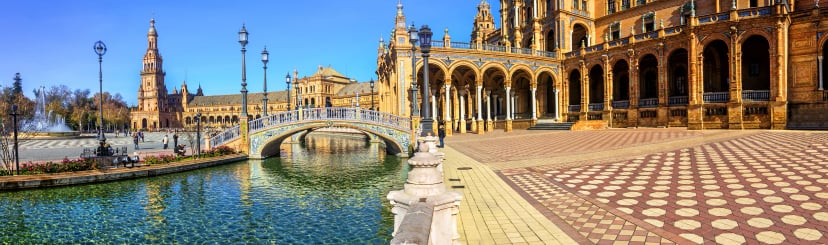
The official city tourism page describes Plaza de España as framed by María Luisa Park and tied to the Ibero-American Exposition of 1929, and that is the right historical frame to keep in mind. The plaza is not simply a pretty semicircle; it is a staged civic gesture, with tilework, bridges, towers and provincial imagery doing political and theatrical work at the same time. The planning consequence is that a guide can explain it efficiently without requiring a long, exposed self-guided loop. The official tourism page is useful for basic background, but the route decision still depends on your group’s energy and dinner geography: Visita Sevilla on Plaza de España (https://visitasevilla.es/en/plaza-de-espana/).
When Plaza de España is enough
Plaza de España is enough when the afternoon needs one memorable Seville image and then a softer exit. This is the right call for first-time visitors who have already done the Alcázar and Cathedral, for families with younger children, and for travelers who have a serious dinner or flamenco plan later.
Plaza de España rewards a concise visit better than many travelers expect. You do not need to inspect every tile bench, cross every bridge, or circle the entire building to understand the space. A good short stop should include the main approach, the tiled provincial benches as a selective story rather than a checklist, the canal and bridges, and the relationship between the grand architecture and the park behind it. That can be enough, especially when the light is strong or the plaza is busy.
The exposed character of the plaza is the practical limiter. Its scale is part of the pleasure, but it also means that visitors can spend more energy than they planned simply moving from one side to the other. In cooler months, that may be fine. In warmer conditions, the same “quick look” can become a glare-heavy loop. For travelers who value polish, the answer is not necessarily to buy more time. It is to make the stop more deliberate.
Couples often overbuild the Plaza de España hour because it feels like it should be romantic. It can be, but only if the visit is edited. A formal photo session, a long self-guided wander, a full park loop and then a dinner transfer can turn romance into logistics. A better version is a guided approach, a few intentional viewpoints, one shaded continuation, and a dinner plan that does not force a long return across the city.
For families, Plaza de España is usually strongest as a visual anchor, not as the whole late afternoon. Children may like the space, the bridges and the scale, but they rarely need a complete historical unpacking of every tile panel. For children under about seven, keep the plaza portion brief and let the park absorb the restless energy. For children between about eight and twelve, use the provincial tiles and bridges as a short visual puzzle. Teenagers often respond better to the architecture, film references and photography, but even then the plaza should not be stacked after a heavy museum morning without a reset.
Stroller reality is mixed. The broader park and plaza routes can be easier than tight old-town lanes, but a stroller does not erase heat, glare, uneven transitions, or the need to manage the return leg. A stroller helps with distance; it does not make a child patient at the end of a hot day. The cut-first rule for families is clear: do not stack Alcázar, Cathedral, Santa Cruz, Plaza de España, a full park loop and Museo del Baile Flamenco in one continuous day with children. Something will flatten, and it is usually dinner or the show.
There is also a value judgment here. Paying for a better guide can change the quality of the Plaza de España stop because the guide can compress context, choose viewpoints, and keep the route from wandering. Paying for more time does not automatically improve it. Once the group has absorbed the scale and meaning of the plaza, the next improvement is usually shade, a drink, a hotel pause or a cleaner dinner transfer.
When the Archaeology Museum adds real depth
The Archaeology Museum adds real value when your afternoon needs cultural depth rather than another open-air landmark. It is most worthwhile for travelers who like material history, Roman layers, Tartessian questions, and the pre-Alcázar story of Seville.
The museum choice should be treated carefully because the institution has been affected by a major building project and has been listed by the Junta de Andalucía as temporarily closed. That means the decision is not simply “Should we go?” It is “Is an interior visit actually available during my dates, and if not, should the museum’s Plaza de América setting still shape the route?” This is where a high-end plan earns its restraint: do not promise a museum visit that may not be operating, and do not pad the day with a closed-door stop unless the exterior context helps the story.
When available, the Archaeology Museum changes the emotional register of the park. Plaza de España speaks in ceremony, tile and twentieth-century civic staging. The Archaeology Museum points backward, toward the material record beneath the city’s later palaces and churches. For travelers who have just seen the Alcázar, that deeper layer can clarify why Seville is not only a Moorish-Christian monument city. It is also a river city, a Roman-linked city, a collecting city, and a city whose visible beauty often rests on buried continuities.
The traveler consequence is focus. A museum visit asks for slower attention and cleaner sequencing. It should not be jammed between a long plaza wander and a dinner reservation with no margin. If you add archaeology, cut the decorative excess elsewhere: no full park circuit, no forced detour to Triana before dinner, and no extra old-town loop “because it is nearby.” Nearby is not the same as usable after a warm day.
The best archaeology version starts with a purposeful Plaza de España introduction, moves through shade toward Plaza de América, and treats the museum as the intellectual endpoint, not the random add-on. If the museum is not available, Plaza de América can still work as a brief context stop: the pavilions around it, the Ibero-American Exposition setting, and the shift from monumental theater to garden district all help explain how this part of Seville was designed to stage culture, not merely decorate the city.
For food-and-wine travelers, the museum decision depends on the dinner. If the evening meal is meant to be the day’s climax, do not over-invest in a late cultural stop. Let the park sharpen appetite and mood. If dinner is casual and the traveler’s main interest is history, archaeology can take the lead, with dinner placed afterward as a gentle landing rather than a performance.
For small groups, the museum can be the point that keeps different interests aligned. One traveler gets the postcard view, another gets ancient context, another gets shade, and no one has to surrender the whole evening. But only if the pacing is honest. A private guide can read the group in real time: linger over the plaza’s political symbolism if energy is high, shorten the plaza if glare is draining the group, or pivot toward shade and context if the museum is not the right move that day. For a more history-led Seville route beyond this one district, Historical Monuments Private Tour is the better next planning step.
How the María Luisa Park shade arc changes the afternoon
The María Luisa Park shade arc changes the afternoon because it reduces heat load, decision fatigue and emotional friction before the evening begins. In Seville, shade is not a decorative comfort; it is often the difference between a day that keeps its shape and a day that feels longer than it was.
This is the most important planning idea in the article. María Luisa Park is not only “green space near Plaza de España.” It is a physical transition from exposure to recovery. The route from the plaza into the interior paths gives travelers a chance to slow their pace without feeling as if they have stopped sightseeing. That matters because many discerning travelers resist going back to the hotel too early, even when their bodies would benefit from it. The park offers a compromise: still in the city, still meaningful, but less abrasive than another paved square.
Seville does specific things to the body. The old town asks for repeated small adjustments: narrow lanes, uneven surfaces, turns around groups, shade that appears and disappears, and the cumulative work of standing while listening to context. The Cathedral and Alcázar areas add queue awareness and crowd navigation, even when the logistics are well managed. By late afternoon, the issue is rarely one dramatic climb or one long walk. It is the accumulation of heat, standing, glare, and small route decisions. A shaded park sequence lowers that load.
It also changes the trip mood. When the late afternoon is exposed and overfilled, dinner begins with people recovering from the day rather than enjoying the evening. Conversation narrows to taxis, water, shoes and whether there is time to change. When the park sequence is shaded and edited, the evening feels earned rather than rescued. The day seems shorter, even if the traveler has seen the same number of meaningful places.
This is where premium planning should be clear-eyed. A driver can improve pickups, reduce cross-town transfers and make the start or end of the park visit cleaner. A driver cannot replace the comfort benefit of shade and a realistic walking plan. Paying more for a vehicle does not help if the group still spends the wrong 40 minutes exposed, overdressed or walking away from the next meal.
The best shaded route depends on what came before. After an Alcázar morning, use the park as a decompression path rather than a second garden study. After a Cathedral and Santa Cruz route, let the park widen the day and avoid returning immediately to tight lanes. After a late lunch, keep the park slow and avoid turning it into a fitness walk. After a cruise arrival or train arrival, the park can be a first gentle Seville moment if the old town would feel too compressed before check-in.
For families, shade is not just about temperature. It is about negotiations. Children are more flexible when the next stage feels physically easier. Grandparents are more relaxed when the route does not require constant recalculation. Parents stop translating every attraction into “how much longer?” The park makes mixed-age travel feel less like a compromise because the setting can hold different paces inside the same route.
That said, do not romanticize the park into an all-purpose solution. It still requires walking. It still requires a return plan. It still requires deciding whether dinner follows directly or after a hotel reset. If the group is already depleted, the best upgrade may be to cut the park and preserve the evening. A beautiful place is not automatically a good addition once the day is full.
The cleanest sequence: approach, plaza, shade, decision point, dinner
The cleanest María Luisa Park sequence is to approach Plaza de España with purpose, limit the exposed time, move into shade, decide whether archaeology belongs, then place dinner so the evening does not drift. This sequence works because each step answers the next practical question.
Approach with context, not wandering
Start by deciding how you will reach the plaza. A hotel in Santa Cruz, El Arenal or around the Cathedral zone makes the approach feel straightforward, but the late-day return still matters. If the group has dressed for dinner, or if children are already tired, consider a vehicle drop-off near the plaza and a guided route from there. If the group wants a walking build, connect from the old town with enough margin and do not pretend the park is “just next door” after a full monument morning.
The approach should give the plaza its historical frame before the group is standing in the most exposed part of it. A concise explanation of the Ibero-American Exposition, Aníbal González’s design language, and the provincial tile benches helps travelers see the space before they start photographing it. This prevents the common pattern: twenty minutes of photos first, then no attention left for meaning.
Use Plaza de España as the reveal
Plaza de España should feel like a reveal, not a maze. The semicircle, canal, bridges, towers and tiled benches do not need to be consumed equally. A guide can choose a few stopping points that carry the whole story. That is especially helpful for private groups where one person wants architecture, another wants family photos, and another is watching the dinner clock.
For couples and celebration travelers, use the plaza early enough that photos do not become a rushed pre-dinner obligation. For families, make the stop interactive and finite. For culture travelers, spend more time on the symbolic program and less time on duplicate viewpoints. For older parents, prioritize shaded edges and avoid unnecessary backtracking across the open space.
Move into shade before the group asks for it
The best shaded move happens before fatigue becomes visible. Once the group begins asking whether there is more to see, you have waited too long. The transition from plaza to the park interior should feel intentional: a change of pace, temperature, sound and walking rhythm. This is where the day begins to recover.
The route toward Plaza de América is useful because it gives the park a direction. Direction matters. A shapeless park wander can make travelers uneasy before dinner because they do not know whether they are getting closer to the next stage or simply filling time. A guided shade arc gives them confidence that the hour has an endpoint.
Make the archaeology decision late, not early
Do not decide on the Archaeology Museum only because it appears on the map. Decide after the plaza and shade have shown you the group’s energy. If the museum is open and the group is curious, it can become the deeper cultural anchor. If the group is warm, distracted or dinner-focused, keep archaeology as exterior context and save serious ancient history for another route or day.
This late decision is one of the reasons private touring fits the district. The value is not simply private explanation; it is the ability to avoid committing the afternoon to the wrong intensity. The same planned hour can become scenic, scholarly or restorative depending on how the group is actually doing.
Place dinner as the landing, not the rescue
Dinner after the park should feel like the natural landing of the route. If the meal is in Santa Cruz, leave enough time to return without turning the walk back into a second tour. If dinner is in El Arenal, the move can be cleaner, especially when the group wants a slightly broader evening without crossing the river. If dinner is in Triana, be more careful: the river crossing and return logistics can be rewarding on the right night, but it is a different evening strategy, not an automatic continuation of María Luisa Park.
For travelers pairing the park with flamenco, the venue geography matters. Museo del Baile Flamenco sits back in the old-town orbit rather than inside the park district, so the park should not run late unless the transfer is already handled. Check the Museo del Baile Flamenco (https://museodelbaileflamenco.com/index.php/el-museo/) directly for its own museum and show information, then decide whether the pre-show hour belongs in Santa Cruz or at Plaza de España. The mistake is trying to do both at full depth before the curtain.
When the route needs to be built around season, heat, shade and evening timing, seasonal private planning in Seville is often more useful than simply adding a car or another sight. A private guide can make the park-and-Plaza sequence context-rich without exhausting the traveler, then hand the group into dinner with the day still intact. Inquire now
Family, older-parent and mixed-energy rules
Families and mixed-generation groups should treat María Luisa Park as a comfort route with one visual peak, not as a full cultural circuit. The goal is to give everyone a satisfying Seville moment without forcing the youngest or oldest traveler to carry the cost.
For children under seven, keep the plan simple: Plaza de España as the visual hit, then shade, water, a small pause and a clear exit. The Archaeology Museum only works for this age band if the child is museum-tolerant, the visit is short, and the adults do not need deep interpretation. Otherwise, the museum becomes the place where the day’s patience runs out.
For children roughly eight to twelve, the route can hold more story. The provincial tiles at Plaza de España, the bridges, the idea of the 1929 exposition and the contrast between palace-like architecture and park landscape can all work. The trick is to keep the interpretive moments short and varied. This age group often enjoys moving between open space and shade, but not being asked to stand still in both.
For teenagers, Plaza de España can carry more weight. Architecture, photography, film references and the scale of the space can all land well. Teenagers also tend to detect filler quickly. If the Archaeology Museum is not central to their interests, do not sell it as an obligatory educational stop. Make a cleaner bargain: one strong plaza visit, a shaded walk, and a dinner or flamenco plan that respects the evening.
For older parents, the park is valuable because it changes pace without creating the hill or stair problems found in other cities. But Seville’s challenge is not only vertical. It is exposure, standing, surfaces and the distance back to comfort. Older travelers may not complain until the fatigue is already baked in. Build the exit before you need it.
Do not stack these icons in one continuous family day: Alcázar interiors and gardens, Cathedral and Giralda, Santa Cruz wandering, Plaza de España, a full María Luisa Park circuit, Archaeology Museum, and a flamenco evening. The sequence sounds efficient because the places are all “important.” In practice it creates heat load, attention fatigue, dinner resistance and a late return that feels heavier than the itinerary promised.
The cut-first move is the full park loop. Keep Plaza de España and the shaded transition; cut the idea that the family must “do” the entire park. If a child is fading, cut the museum. If an older parent is fading, cut the long return walk. If dinner is the priority, cut any stop that delays the reset. The success of the day will be remembered by the evening’s mood, not by whether every green path was covered.
Families who need a wider Seville plan around Alcázar, Plaza de España and easier resets may want to compare this narrow park decision with a fuller Seville with kids strategy. The María Luisa Park decision is one piece of that larger puzzle, not a substitute for planning the whole family day.
Where dinner should sit after the park
Dinner should sit close enough to the park route that the late-day calm is not lost in transfer friction. The best dinner plan depends less on the restaurant category and more on whether the group needs a hotel reset, a direct meal, or a flamenco continuation.
If your hotel is in Santa Cruz, the strongest version may be park first, hotel reset, dinner nearby. Santa Cruz is atmospheric at night, and the return to a familiar base can make the whole evening easier. The risk is repeating the old-town walk when everyone is already tired. Keep the return direct. Do not turn it into another interpretive route unless the group asks for it.
If your dinner is in El Arenal, the park can lead into a broader evening with less psychological backtracking. El Arenal sits between the old town and the river, and it can work well for travelers who want a polished meal after an open-air late afternoon without diving immediately back into the tightest lanes. This is often a good couple or adult-small-group choice.
If your dinner is in Triana, decide whether the river is truly part of the night. Triana after María Luisa Park can be lovely, but it is not the same route as a park-and-dinner plan near the old town. You are adding a crossing and a different neighborhood rhythm. That may be worthwhile for food-and-wine travelers who want ceramics, river identity or a less monument-centered evening. It is less sensible for families who still need an easy bedtime or travelers with an early train the next day.
If the evening includes flamenco, plan backward from the venue. Museo del Baile Flamenco and many old-town flamenco plans pull you back toward the central lanes. Triana flamenco pulls you toward the river and across it. A park visit that runs too long can make the pre-show meal feel rushed. A shorter Plaza de España stop, followed by shade and a direct transfer, often beats a fuller park route that leaves everyone negotiating timing.
The late-day mood determines whether the park feels restorative or stranded. A graceful park hour before dinner makes the city feel generous. A late, unanchored park wander makes Seville feel spread out just when the traveler wants ease. That is why the dinner decision belongs inside the park plan, not after it.
For celebration travelers, the best premium spend is usually in the choreography: guide timing, reserved meal, clean pickup, and a route that avoids changing shoes, rushing photos or arriving flushed. The spend that does not earn its cost is extra transport used to compensate for an overfilled route. Comfort comes from the sequence first and the vehicle second.
How a private guide changes this district without overworking it
A private guide changes María Luisa Park by turning a potentially scattered district into a paced story with exits. That is different from simply narrating Plaza de España.
The guide’s first job is compression. Plaza de España contains architecture, politics, regional identity, tilework, the 1929 exposition, urban planning and popular image-making. A traveler can read about all of that, but not while standing in glare with a dinner reservation approaching. A good guide chooses what matters for that group. For a family, that may be bridges, tiles and a short story of Spain’s provinces. For a history traveler, it may be the exposition and the connection to Seville’s twentieth-century civic identity. For a design traveler, it may be Aníbal González and the staged regionalist language.
The second job is restraint. The guide should be willing to say that Plaza de España is enough today, or that the museum does not belong, or that the shaded path should replace the extra stop. This is the point where a private experience becomes more valuable than a longer itinerary. The best decision is often a cut, not an addition.
The third job is reading the group. Heat-aware travelers do not all react the same way. One guest may be energized by open space; another may be fading quietly. Children may look fine until the moment they are asked to wait. Older parents may conserve politeness until the return is too far. A private guide can adjust before the route breaks.
The fourth job is connecting the district to the rest of Seville. María Luisa Park should not float outside the trip. It should relate to the Alcázar gardens, to Santa Cruz, to the river edge, to 1929 Seville, to Itálica if archaeology is part of the broader itinerary, and to dinner geography. When those connections are made lightly, the district feels meaningful without becoming a lecture.
This is also where the broader Best of Seville private tour can be useful for travelers who want Plaza de España placed correctly among the Alcázar, Cathedral, Santa Cruz and other first-visit priorities. The park itself is not the whole day; it is the part that decides whether the day arrives at dinner with grace.
The best version by traveler type
The best María Luisa Park plan changes by traveler type, but the winning pattern remains the same: edit the plaza, use shade deliberately, and make dinner geography part of the route.
Couples and celebration travelers
Use Plaza de España for the emotional high point, not for a drawn-out march. Choose a few views, leave space for photographs, then move into the park before the scene loses its charm. Dinner should be close enough or choreographed enough that the couple does not spend the next hour solving logistics. If the celebration is formal, keep the walking shorter than you think you need.
Families
Make Plaza de España the shared visual win and the park the pressure release. Keep archaeology conditional, not obligatory. Children need a clear sequence: big square, shade, pause, exit, dinner. The return leg must be as planned as the arrival. A family day often fails not at the attraction, but on the way back from it.
Culture-first travelers
Use the Archaeology Museum when it is available and when the group has saved attention for it. If not, build archaeology into the commentary through Plaza de América, Itálica context and the longer timeline of Seville. Do not turn the park into a generic pretty walk when the traveler actually wants interpretive depth.
Food-and-wine travelers
Let dinner control the intensity. If the evening meal is important, the park should sharpen appetite and calm, not compete with the meal. If the dinner is relaxed, the route can hold more historical content. Avoid adding a river crossing, museum stop and formal meal unless the group genuinely wants a long evening.
Older parents and comfort-sensitive travelers
Keep the route directional and reversible. Use vehicle support for the start or finish, but do not rely on it to fix poor walking choices inside the district. Choose shaded pauses before they are needed, and avoid the temptation to see every corner because the park looks gentle on the map.
FAQ
Is Plaza de España enough without visiting the rest of María Luisa Park?
Yes. Plaza de España is enough when time is short, the group is warm, or dinner is the real evening priority. Add only a short shaded continuation if the group needs a calmer transition before leaving.
Should I visit the Archaeology Museum with Plaza de España?
Visit the Archaeology Museum only if it is open during your dates and your group wants deeper historical context. Because the museum has been listed as temporarily closed during renovation work, confirm the official site close to travel before planning an interior stop.
How long should I allow for Plaza de España and María Luisa Park before dinner?
Allow a concise late-afternoon window rather than a sprawling park circuit. A focused Plaza de España visit plus a shaded walk is usually stronger before dinner than trying to cover the entire park.
Is María Luisa Park good for families with children?
Yes, if the route is edited. Families should use Plaza de España as the visual anchor, the park shade as the reset, and cut the museum or full loop first when children start to tire.
Is the park a good idea before flamenco in Seville?
It can be, but only when the venue timing is built into the route. If your flamenco plan is near Museo del Baile Flamenco or Santa Cruz, leave the park early enough for a calm return, dinner and seating.
Can a driver make the María Luisa Park visit easier?
A driver can make the arrival and departure easier, especially in heat or for older travelers. A driver cannot replace shade, realistic walking, and a route that avoids spending too long in exposed areas.
Where should dinner be after María Luisa Park?
Dinner works best when it is near the return route, after a hotel reset, or planned with a clear transfer. Santa Cruz, El Arenal and Triana can all work, but Triana adds a river-crossing rhythm that should be chosen deliberately.
What should I skip if the Seville day is getting too full?
Skip the full María Luisa Park loop first. Keep Plaza de España and the shade arc if they still help the evening; cut the museum, extra old-town wandering, or a distant dinner transfer if the group is fading.
The final decision
Plan María Luisa Park as a pre-dinner sequence, not a sightseeing bucket. The strongest default is Plaza de España for the reveal, the María Luisa Park shade arc for comfort, and a dinner plan that does not ask the group to recover from the route. Add the Archaeology Museum only when it is available and when your travelers have the attention for it. Cut the full park loop when the day is full. That single editorial choice will do more for the evening than another famous stop.
Seville rewards travelers who understand when to stop forcing the day. In this district, the reward is practical: less glare, fewer negotiations, better dinner energy, and a more coherent memory of Plaza de España. The park is not just what comes after the photograph. It is the part of the day that decides whether the photograph still feels good two hours later.
If you’re interested in any private tours of Seville, please reach out to us.





 So if you are looking for the absolute best in Seville & surroundings with authentic local fully-licensed native guides whose English you can actually understand and with an exclusive and amazingly fun itinerary













