Alcázar Gardens, Casa de Pilatos or María Luisa Park? Choosing a Seville Garden Visit by Design, Shade and Scale

Updated
Which Seville garden are you actually choosing?
Is the best garden visit in Seville the one with the deepest history, the most dependable shade, the shortest walking commitment or the easiest fit around a fixed monument entry? The answer changes because the Real Alcázar gardens, the gardens of Casa de Pilatos and María Luisa Park are not three versions of the same pleasure. They are different designed landscapes, created for different patrons, different scales of movement and different relationships between architecture and planting.
The Real Alcázar offers a royal landscape assembled over centuries, where small garden rooms, water, tile, walls and vegetation extend the meaning of the palaces. Casa de Pilatos concentrates the relationship between a noble residence, Renaissance ordering and inherited Mudéjar space into a much tighter visit. María Luisa Park turns garden design outward: it is a large civic landscape shaped for public movement, monuments and the urban theater of the 1929 Ibero-American Exhibition.
That difference matters more than a generic promise of greenery. A garden can feel intimate while still demanding a long total visit. It can contain substantial shade while requiring exposed walks between shaded sections. It can be free of an admission commitment yet consume more steps than a paid palace garden. It can also be historically important without being the right addition to a day already carrying the Cathedral, Giralda, Alcázar interiors or an evening performance.
For a design-minded first visit, use five questions. What kind of history do you want the landscape to explain? How much time on hard surfaces is comfortable? Is your entry time fixed or flexible? Will the visit happen in mild weather, strong sun or rain? Finally, where must you be before and after it? Those questions produce a more reliable choice than asking which garden is “prettiest.”
- Choose by design depth: the Alcázar is the richest study of a royal garden evolving with palace history; Casa de Pilatos is the sharpest study of garden and aristocratic house as one composition; María Luisa is the broadest study of public landscape and early twentieth-century civic identity.
- Choose by operational scale: Casa de Pilatos is the most concentrated, the Alcázar is intimate in its individual spaces but substantial as a complete monument visit, and María Luisa has the most elastic boundaries because you decide where the park begins and ends.
- Choose by schedule pressure: the Alcázar has the strongest admission dependency, Casa de Pilatos still belongs inside a monument opening window, and María Luisa is the least tied to a booking even though weather and daylight remain real constraints.
The useful comparison, then, is not palace versus park in the abstract. It is layered royal landscape versus concentrated palace garden versus expansive public realm, tested against the conditions of your actual Seville day.
Three designed landscapes, not interchangeable green space
The Alcázar: landscape as accumulated court history
The Real Alcázar gardens make sense only when read as part of the palatial complex. An official Alcázar curatorial publication describes a site of Andalusi origin that accumulated Mudéjar, Gothic, Renaissance and Baroque layers. It explains that former Muslim orchards were reorganized from the sixteenth century according to European Renaissance ideas: geometric beds, clipped hedges, brick paths, tiled benches, fountains and pools. Water and paved ground are not embellishments added to “nature”; they are structural parts of the design.
The same publication characterizes the principal gardens as a chain of relatively small spaces, including the Jardín de Troya, Jardín de la Danza, Jardín de las Flores, Jardín de la Galera, Estanque de Mercurio and Jardines de Carlos V. This is the key to the Alcázar’s spatial personality. Its strongest moments do not depend on one enormous vista. They emerge through thresholds, changing levels, glimpses, reflections and the transition from one outdoor room to another.
Editorially, this makes the Alcázar the best choice when you want the garden to carry historical argument. The placement of a pool, the direction of a path, the meeting of a tiled surface with a hedge and the framed view back toward palace architecture all help explain how successive courts reused and restated the site. The garden is evidence, not relief from the “serious” monument.
Casa de Pilatos: landscape as an extension of the house
Casa de Pilatos works at a more domestic and aristocratic scale. Spain’s official tourism description of the gardens dates the palace to the fifteenth and sixteenth centuries and explains that a large Renaissance patio organizes rooms and gardens while earlier Mudéjar rooms were retained. It identifies two distinct garden experiences: the Great Garden, with loggias, a central pond and hedge-edged paths, and the smaller Pretorio garden, arranged in four areas on different levels around a large rectangular pond.
Here the interest lies in compression. Architecture, collection, patio and planted space can be read in close succession. You do not need the length of a royal complex or an urban park to understand the designer’s argument. The house controls the view, the loggias give the garden a built frame, and the changes of level make the smaller Pretorio garden spatially active rather than merely ornamental.
Casa de Pilatos is therefore particularly strong for visitors who care about the conversation between Renaissance classicism and Seville’s Mudéjar inheritance. It is not a substitute Alcázar. Its value is precisely that it reveals a different social scale: noble residence rather than royal compound, concentrated collecting culture rather than centuries of sovereign expansion.
María Luisa Park: landscape as civic identity
María Luisa Park belongs to a different chapter. The official national tourism portal identifies it as Seville’s great urban park, designed by the French landscape gardener Jean-Claude Nicolas Forestier for the 1929 Ibero-American Exhibition. It highlights the revival of a Neo-Sevillian or Neo-Arab garden language and the extensive use of fountains, ponds, brick and ceramic tile, as well as spaces and monuments dedicated to literary figures.
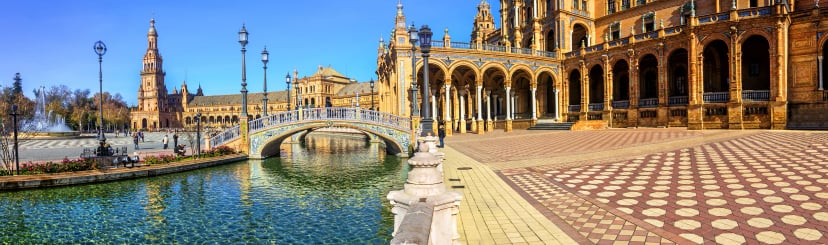
This is a public landscape designed to shape movement through the city. Its plazas, water features, monuments and planted avenues do not serve one palace façade; they stage a broader idea of Seville for residents and visitors. The park’s relationship with Plaza de España and Plaza de América also makes it inseparable from the exhibition-era remaking of the southern city.
Choose María Luisa when the public scale is part of the attraction. It offers room to walk, pause and choose a partial route, but that freedom has a cost: without a defined circuit, the visit can spread. A traveler seeking one exquisite garden room may find it diffuse. A traveler seeking a landscape that opens Seville beyond the medieval and early modern core may find that spaciousness essential.
The Real Alcázar gardens: intimate spaces inside a high-commitment visit
Why design-minded visitors choose it
The Alcázar rewards attention to sequence. Hedges can work like walls, tree trunks like columns and canopies like ceilings; water establishes axes and doubles architecture through reflection. The official curatorial text repeatedly treats vegetation as architecture and shade as a design value. That provides a useful way to look: not for a single panoramic climax, but for how each enclosure changes proportion, sound, temperature, light and the relationship between body and palace.
The transition from the Jardín de Troya to the Estanque de Mercurio, or from smaller enclosed gardens toward more formal spaces, can be read as a change in political and aesthetic language. Renaissance geometry did not erase the site’s earlier water culture; it reorganized inherited land and hydraulic ideas. Later layers added still more variation. A specialist visit is strongest when these changes are interpreted rather than flattened into one label such as “Moorish garden.”
That interpretive density is the Alcázar’s principal advantage. It also explains why a quick garden-only mentality often disappoints. The gardens acquire meaning from the palaces, and the palaces prepare the eye for the gardens. Visitors who hurry through interiors to “get outside” can miss the design conversation they came to see.
Why small garden rooms do not mean a small day
Individual Alcázar gardens often feel human in scale, but the complete experience is not compact. Time on foot accumulates through admission, palace rooms, patios, garden transitions and the walk back toward the exit. The visual rhythm encourages stopping, changing direction and looking back. That is excellent for historical depth and less suitable for a day already overloaded with standing and hard surfaces.
The ground itself is part of the composition. Brick, tile and other paved areas create pattern, reflection and continuity between building and garden. They also mean that “garden visit” should not be translated into soft, level parkland. Changes of level and architectural transitions are integral to some sections. Travelers with limited walking tolerance should judge the Alcázar by the total monument route, not by the apparent size of any one garden room.
Shade is likewise episodic. Trees, hedges, walls, galleries and arcades produce filtered or architectural shade, but open paths and formal areas remain exposed at certain hours. The Alcázar can feel cooler than a broad plaza, yet it is not a promise of comfort in severe heat. A fixed entry can also prevent you from simply moving the entire visit to the most favorable hour.
The admission commitment is decisive
At the evidence check used for this guide, the official Alcázar visitor page listed opening hours of 09:30–17:00 from 1 October through 31 March and 09:30–19:00 from 1 April through 30 September. It listed general admission at €15.50 and reduced admission at €8, with sales online or at the Patio de Banderas. These are operational details, not timeless facts, so recheck the same page before building the day around them.
The page also notes that individual spaces or gardens may close for maintenance, urgent needs or weather alerts without a corresponding discount or refund. That matters for expectations. Do not make the entire value of an Alcázar booking depend on one named garden, one fountain or one photograph. The resilient reason to choose it is the complete relationship among palace, patio, garden and accumulated history.
If your Alcázar admission is already fixed, the practical decision is rarely whether to add another major garden immediately afterward. It is how much of the Alcázar landscape to prioritize and what to remove elsewhere. For a closer look at the admission formats and what each emphasizes, compare the Alcázar’s general route, royal rooms and gardens.
Casa de Pilatos: the strongest garden study for a more contained visit
A palace garden in concentrated form
Casa de Pilatos is the most useful choice when you want design complexity without the operational weight of the Alcázar. Its central patio establishes orientation, and the gardens unfold as extensions of a residence rather than as a separate park. The preserved Mudéjar rooms, Renaissance patio and later garden interventions allow several periods to remain legible within a comparatively contained setting.
The Great Garden and the Pretorio garden should not be collapsed into one image. The Great Garden uses loggias, busts, hedged paths and a central pond to create a cultured architectural setting. The smaller garden uses division, level changes and a long body of water to create intimacy with tension. The experience is one of alternation: enclosed room, open patio, framed garden, shaded gallery, sunlit water and another threshold.
This is why Casa de Pilatos can be more satisfying than a larger park for an architecture-led traveler. Every movement has a nearby built reference. The garden rarely asks you to forget the house; it asks you to understand how the house reaches outward. A visitor interested in proportion, collecting, classical reference, tile, carved surface and the adaptation of inherited Andalusian forms will find more to study than the site’s modest scale suggests.
Compact does not mean effortless
Casa de Pilatos generally creates a lower walking commitment than a full Alcázar visit or a broad circuit through María Luisa Park, but it should not be sold as physically neutral. The Pretorio garden’s different levels are part of its design, and hard palace and patio surfaces remain underfoot. Sun reaches open courtyards and garden clearings even when rooms and loggias provide nearby relief.
Its comfort advantage is the repeated possibility of moving between interior and exterior. That can make pacing easier in warm weather, because the visit contains its own changes of light and enclosure. Still, an architectural shade line is not the same as a cool indoor rest, and the exact accessible route should be checked directly if level changes are a concern.
The better planning insight is that Pilatos has a favorable ratio of interpretation to distance. You can study a central organizing patio, two distinct garden ideas and the dialogue between Mudéjar and Renaissance design without allowing the visit to dominate the entire day. That makes it especially valuable on a second morning, after the Alcázar has already supplied royal scale, or on a first visit when stamina is more limited than curiosity.
Its opening window still matters
Casa de Pilatos is a heritage property, not a public park. Its gardens are experienced through the palace visit and therefore depend on the site’s current opening and admission arrangements. Opening hours and prices can change, so verify the current arrangements directly with the operator before relying on a narrow gap in the day.
Geographically, its Plaza de Pilatos address places it in the historic center but away from the southern park axis. That can be an advantage. It can sit naturally with another palace, the Salvador area, the Museo del Baile Flamenco or Casa de la Memoria without pulling the day toward Plaza de España. For a deeper palace sequence, shape a palace-focused day beyond the Alcázar.
The strongest reason to choose Pilatos is not that it is “easier Alcázar.” It is that it offers a more concentrated question: how did an elite Sevillian house turn inherited local forms, Renaissance ambition and garden architecture into a coherent private world?
María Luisa Park: the greatest freedom and the greatest risk of underestimating scale
A public landscape with an exhibition-era argument
María Luisa Park is the right option when you want landscape design to explain modern Seville’s civic image. Forestier’s work and the 1929 exhibition context connect planting, water, ceramic decoration, literary commemoration and monumental architecture. The park does not merely surround Plaza de España; together, the park, plazas and pavilions form a major statement about how Seville presented itself in the early twentieth century.
The Neo-Sevillian or Neo-Arab label is most useful when treated as a designed revival rather than as proof of medieval continuity. Water, brick and tile recall older regional vocabularies, but they are deployed in a modern public park for mass circulation and civic representation. That distinction helps design-minded visitors see the park as an act of historical selection: a later city choosing which visual elements should signify “Seville.”
Its literary monuments and named spaces also diversify the experience. This is not one patron’s garden or one palace’s extension. It is a landscape of civic memory, leisure and display, where the route can move between quiet planted enclosures and ceremonial spaces. The park is therefore strongest for visitors who want to read the city beyond royal and ecclesiastical power.
Unrestricted access does not make time irrelevant
The official tourism portal describes María Luisa as having unrestricted access. For planning purposes, that removes the admission pressure attached to the Alcázar and Casa de Pilatos. You can shorten the visit, return later or select one zone without feeling obliged to “complete” a paid monument.
Yet the absence of a ticket creates a different planning risk: the park has no obvious natural finish. Plaza de España can become a long photographic stop; a shaded path can lead toward Plaza de América; a museum or pavilion may tempt an additional visit; and the return to the old town still requires distance. Freedom must be paired with a self-imposed boundary.
For most visitors, “María Luisa Park” should mean one deliberate circuit rather than the entire green area. One option emphasizes Plaza de España and adjacent park detail. Another continues toward Plaza de América and the exhibition pavilions. A third treats the park as a calm passage between the southern monumental zone and another appointment. Each is valid, but they are different commitments.
Shade is broad but not continuous
María Luisa can offer the largest amount of tree shade among the three choices, especially when a route follows planted paths rather than ceremonial plazas. It can also expose you to the longest unshaded connections. Plaza de España’s open scale, sunlit water edges and broad paved areas behave differently from a narrow garden enclosure or palace loggia.
Walking tolerance therefore matters more than the map’s green color suggests. Park distance is elastic: the energetic traveler keeps extending the route, while the heat-sensitive traveler may discover that the next shaded destination is farther than expected. Surfaces also change across paths, plazas and architectural edges, so the park should not be imagined as one uniformly soft promenade.
María Luisa is an excellent choice in mild conditions, for travelers who value spaciousness and for days already oriented toward Plaza de España. It is less convincing as an improvised midday refuge in extreme heat. For a route built specifically around its southern sights, plan María Luisa Park around Plaza de España and museum time.
This is also the point at which a private guide can materially improve the day. The value is not adding all three landscapes; it is reading the fixed entries, design interests, weather and walking tolerance, then selecting and pacing the one garden that makes the monument day more coherent. Inquire now when that editorial choice matters more than accumulating stops.
Shade in Seville is a moving pattern, not a permanent amenity
The word “shaded” is too blunt for these landscapes. Shade may come from a tree canopy, a clipped hedge, a wall, a loggia, an arcade or the angle of a building. Each behaves differently through the day and across the seasons. A route that feels protected in the morning can become exposed later; a pool that cools the visual field does not necessarily lower the physical demand of standing beside it.
At the Alcázar, shade is spatially rich but fragmented. The pleasure comes from moving between bright water, filtered canopy, enclosed garden and architectural shadow. At Casa de Pilatos, shade is often closely tied to the building, so interior and exterior can alternate more readily. At María Luisa, shade may cover longer planted stretches, but the park’s open civic spaces and connecting distances make overall exposure harder to predict.
During extreme heat, garden design should not be asked to defeat weather. Andalusia’s official emergency guidance advises avoiding outdoor activity from midday to sunset during the hottest conditions, seeking shade or cooled places, carrying water, covering the head, wearing light clothing and reducing physical effort. That guidance should override any itinerary’s aesthetic ambitions.
In practical terms, a severe-heat day favors an early Alcázar entry if the monument is essential, a concise and carefully timed Casa de Pilatos visit if its interior-exterior rhythm suits the group, or a María Luisa circuit at a cooler hour rather than across the middle of the day. None should be described as comfortable regardless of temperature.
Season also changes the visual emphasis. In cooler months, open paths and sunlit plazas may be welcome, and the park’s larger scale becomes easier to enjoy. In warm shoulder seasons, the balance between sun and shade can shift within a single visit. Planting and flowering vary, but the design value of water, geometry, tile, walls and framed views remains even when a traveler’s imagined “garden in bloom” is not present.
Rain changes the comparison again. The palace sites retain substantial indoor interpretation, while a park-led visit depends more heavily on outdoor conditions. At the Alcázar, however, weather alerts can also affect garden access. Wet hard surfaces, changes of level and reduced visibility should encourage a shorter, more conservative route rather than an attempt to preserve every planned stop.
For a broader way to rearrange the city when temperatures govern the schedule, plan Seville for high heat.
Let the fixed part of the day decide the flexible part
When the Alcázar is already booked
If the Alcázar is a fixed commitment, its gardens are usually the major designed landscape of that day. Give them interpretive room rather than treating them as the final ten minutes after the palaces. Adding Casa de Pilatos immediately can create repetition at the level of patios, tile and palace attention, even though the two sites are historically distinct. Adding María Luisa can create a different kind of overload: less thematic repetition, but substantially more distance.
The better choice is often to deepen the Alcázar and keep the rest of the day lighter. A garden specialist may focus on the relationship among the smaller principal gardens, water and palace thresholds. A first-time visitor may prefer a balanced palace-and-garden route. The important point is that the booked monument already supplies both architecture and landscape; any additional garden needs a specific purpose.
When Plaza de España is non-negotiable
If Plaza de España is already part of the plan, María Luisa becomes the natural garden because it explains the plaza’s landscape context and prevents the stop from becoming an isolated photograph. Even then, decide whether the park is a short interpretive extension or a substantial walk toward Plaza de América. The answer should depend on heat, walking tolerance and the next appointment, not on a desire to collect every landmark.
When a palace-focused second day is the goal
Casa de Pilatos is strongest when the Alcázar has been seen on another day or when the trip deliberately explores Seville’s noble houses. Its concentrated gardens provide variation without demanding the public scale of María Luisa. It also allows the guide or independent traveler to compare patronage: how royal, noble and civic landscapes use some of the same regional materials for different social purposes.
When the evening has a fixed performance
Evening geography can settle a close decision. A performance at Museo del Baile Flamenco or Casa de la Memoria keeps the center of gravity in the old town, making Casa de Pilatos or a carefully paced Alcázar day easier to integrate. Teatro Flamenco Triana shifts the evening west across the river; in that case, a long southward park extension can be an unnecessary third axis for travelers with limited stamina. This is route judgment, not a statement that one venue is artistically superior.
What each option gives up
The Alcázar gives up flexibility
Choose the Alcázar for the deepest relationship among garden, palace and long historical change. In exchange, accept admission planning, a substantial total visit, visitor flow and the possibility that a specific area may be unavailable. Its intimate rooms do not make the overall commitment intimate. It is the least suitable choice for a traveler who wants only an unstructured outdoor pause.
Casa de Pilatos gives up breadth
Choose Casa de Pilatos for close reading, a favorable interpretation-to-distance ratio and the most concentrated dialogue between house and garden. In exchange, accept that it will not provide the urban scale, long shaded wandering or civic landscape of María Luisa, nor the historical accumulation and royal symbolism of the Alcázar. Its garden pleasure is framed, edited and inseparable from the palace.
María Luisa gives up containment
Choose María Luisa for public space, exhibition history, flexible access and the possibility of a broad walk. In exchange, accept that the design narrative is more dispersed and that scale can quietly consume energy. It asks the visitor to create a route boundary. Without one, the park can become a sequence of attractive but weakly connected pauses.
These tradeoffs reveal why “best garden” is the wrong universal category. The Alcázar is strongest when history should deepen a booked monument. Pilatos is strongest when architecture and garden should be understood at close range. María Luisa is strongest when the city’s public landscape, Plaza de España and spacious movement are part of the objective.
- For maximum historical layering: favor the Real Alcázar, provided the group can absorb the full monument commitment.
- For maximum design concentration: favor Casa de Pilatos, especially when another palace is not being added merely for quantity.
- For maximum schedule freedom: favor María Luisa Park, but define the circuit before entering it.
- For lower walking tolerance: Casa de Pilatos often has the best scale, while exact level and access needs still require direct verification.
- For a day already heavy with interiors: María Luisa can supply openness in mild weather; in harsh heat, openness may become the disadvantage.
- For a first and only Seville monument day: the Alcázar usually carries the most historical consequence, but its gardens deserve protected time within that visit.
Conditions that change the recommendation
Extreme heat
Severe heat moves the decision away from aesthetic preference and toward exposure management. A prebooked Alcázar visit may remain essential, but the garden portion should be paced selectively rather than expanded because shade appears on the map. Casa de Pilatos benefits from its tighter interior-exterior sequence. María Luisa, despite broad tree cover in places, becomes less persuasive when the route requires long open connections.
Mild winter sun
Cooler conditions can reverse that order. María Luisa’s scale becomes an asset, open plazas feel inviting and the lack of admission pressure allows a long, unhurried circuit. Alcázar garden light can be especially revealing when the sun is lower, but winter closing time shortens the available window. Casa de Pilatos remains the compact option and can fit well into a day with another indoor collection.
Rain or unstable weather
A palace garden is easier to reinterpret when showers arrive because rooms, patios and covered architectural edges remain part of the visit. María Luisa has fewer ways to convert a park walk into a substantial indoor experience without adding a separate museum. The Alcázar’s operational note about weather-related closures also means that a rainy-day plan should value the palaces independently of the gardens.
Limited stamina
Walking tolerance is not just a question of distance. Standing, hard surfaces, transitions, visual concentration and the effort of navigating crowds all matter. Casa de Pilatos generally offers the most contained study. The Alcázar can work when the route is intentionally selective and the rest of the day is reduced. María Luisa can work only when the chosen circuit is genuinely short rather than theoretically shorten-able.
A serious interest in landscape design
A specialist may reasonably choose more than one across separate days because the comparison itself is valuable. The Alcázar explains inherited landscape and courtly transformation; Pilatos shows a noble house translating Renaissance and local forms; María Luisa shows a modern civic revival of regional motifs. Combining all three in one day, however, reduces the time needed to perceive those distinctions.
A first visit with only one garden slot
Use the surrounding itinerary as the final filter. If the Alcázar is already booked, its gardens fill the slot. If the Alcázar is on another day and you want a focused palace study, choose Pilatos. If Plaza de España is central and weather is mild, choose María Luisa. A well-built multi-day plan can separate these experiences rather than forcing a single overloaded comparison; place the garden inside a three-day Seville itinerary.
A one-minute way to choose
Start with the fixed commitment. An existing Alcázar entry outweighs a general wish to “see a garden.” Build the gardens into that monument and resist adding another large landscape unless it serves a clearly different purpose.
Then name the design question. Choose the Alcázar to understand royal landscape as historical layering. Choose Casa de Pilatos to understand how a noble residence organizes patio, loggia, collection and garden. Choose María Luisa to understand public landscape, 1929 civic display and the modern reinvention of Sevillian garden language.
Now test shade against scale. Do not ask which place has shade; ask how far you must travel between shaded moments, at what hour and over what surfaces. Alcázar shade is varied and episodic, Pilatos shade is closely connected to architecture, and María Luisa shade can be broad but separated by open space.
Finally, protect the rest of the day. The right garden should improve the sequence before and after it. It should not turn the Cathedral into a rushed prelude, an evening performance into a tired obligation or Plaza de España into an afterthought. The best selection is the one whose design value remains legible at the group’s actual pace.
- Real Alcázar gardens: best fit for the first-time visitor who already considers the Alcázar essential and wants the most historically layered landscape.
- Casa de Pilatos gardens: best fit for the design-focused visitor who wants high interpretive density with a more contained walking commitment.
- María Luisa Park: best fit for the visitor who wants public landscape, flexible access and exhibition-era Seville, with enough time and suitable weather for its scale.
Choose the garden that completes the argument of the day
A Seville garden visit is most rewarding when it does more than provide a pleasant interval. The Alcázar can show how water, paving, vegetation and enclosure carry the memory of successive courts. Casa de Pilatos can show how a noble house makes landscape part of architecture and collecting. María Luisa can show how a modern city turned selected regional forms into a public identity.
The decision becomes clear when design, shade and scale are treated together. Historical depth without enough time becomes superficial. Shade without a realistic route becomes false reassurance. Flexible access without a boundary becomes fatigue. Compactness without genuine interest in palace design becomes merely convenient.
Choose one landscape for the question you most want Seville to answer, then give it enough time to answer well. For a privately paced route that coordinates the garden with monument entries, walking tolerance and the surrounding day, explore private Seville tours.
If you’re interested in any private tours of Seville, please reach out to us.





 So if you are looking for the absolute best in Seville & surroundings with authentic local fully-licensed native guides whose English you can actually understand and with an exclusive and amazingly fun itinerary