Paris for a Traveler With Limited Standing Tolerance: Opéra, Covered Passages and a Seated Art Day

Updated
The workable answer: three shared anchors, two short transfers and a defined standing budget
Yes, a traveler who cannot stand for long can share a substantial Paris architecture and decorative-arts day at the Palais Garnier, Galerie Vivienne and the Musée des Arts Décoratifs. The day should not, however, be planned as a continuous walk with occasional rests. It works better as three deliberately bounded encounters: a compact Palais Garnier public-circuit visit, one selected line through Galerie Vivienne, and a seated, object-led museum session. The links between them belong in a vehicle unless the traveler has specifically said that steady walking is easier than waiting upright.
The distinction matters. A person may be able to walk several hundred metres at a comfortable pace yet become symptomatic after three minutes in a security line, at a lift landing or while a guide speaks beside a display case. Another traveler may tolerate quiet standing but struggle with stairs, uneven thresholds or repeated sit-to-stand transfers. “Limited standing” is therefore not a softer synonym for ordinary sightseeing fatigue. It is a route-design constraint that must be measured at the moments when Paris usually asks visitors to stop: ticket checks, bag inspection, crowded thresholds, photo pauses, elevator waits and gallery explanations.
Before selecting a time slot, establish the traveler’s own standing budget. The useful number is the maximum uninterrupted standing period, not the total amount of walking possible in a day. Add the recovery time needed after that limit, whether a high chair is usable, whether a standard wheelchair is acceptable for part of the visit, and whether the traveler can manage one or two steps when a nominally accessible route changes. A route built for an eight-minute limit should normally end each standing exposure well before eight minutes. The unused margin is what absorbs a slow security check or a lift that arrives full.
The three anchors have different kinds of exposure. Palais Garnier has the highest operational uncertainty because admission is timed, the official visit takes about 90 minutes, online booking is mandatory, and a disabled visitor using free prebooked admission must still collect the admission documents at the ticket office. The building verifies an accessible lift to the public-tour areas, but it does not promise a chair at every interpretive point. Auditorium access can also disappear because of rehearsals. These details were checked on 29 August 2026 against the official Palais Garnier visit page.
Galerie Vivienne presents almost the reverse problem. The covered passage is free, has three street entrances and is only 176 metres long, so there is no admission desk to solve. Yet its own site does not verify public benches, a lift route or step-free conditions at every entrance. Its low queue exposure can tempt a planner to treat it as effortless, when the real risk is a sequence of slow decorative stops with nowhere confirmed to sit. The Musée des Arts Décoratifs offers the most controllable seated portion: its collections extend over seven floors, all exhibition spaces are described as reachable by elevator, wheelchairs are available on request at arrival, and accessible toilets are verified. The museum’s scale is the danger, not a lack of access.
A sound day therefore gives each place a different job. Garnier supplies the ceremonial architecture. Galerie Vivienne explains how nineteenth-century decoration entered a commercial urban interior. The Musée des Arts Décoratifs turns those observations into a seated study of furniture, interiors, materials, design and period rooms. That is more coherent than trying to “see everything,” and it leaves credible ways to shorten the day without losing its intellectual thread.
- At Palais Garnier: reserve the access sequence, not merely an admission time. The arrival, document collection, security and first seat or lift matter as much as the rooms.
- At Galerie Vivienne: choose one entrance, one principal decorative focus and one confirmed seated stop. Do not make all branches compulsory.
- At the Musée des Arts Décoratifs: choose one collection thesis and two adjacent clusters of rooms. Use the verified wheelchair loan or another agreed mobility aid rather than hoping gallery benches appear when needed.
- Between anchors: set an exact rejoining point before anyone separates. “Meet at the passage” is too vague when there are three entrances.
Travelers deciding whether this specialist day belongs inside a broader stay can place this access-shaped day inside a three-day Paris plan. For a different mobility problem involving two very large art institutions, compare it with a Louvre–Orsay mixed-mobility plan.
Why “accessible” and “low standing” are not the same promise
Accessibility information is indispensable, but it answers only part of this traveler’s question. A wheelchair-accessible entrance establishes that a route exists for a wheelchair user. It does not necessarily state how long someone will wait before using it, whether the rest of a private group may remain together, whether a lift requires staff intervention, or whether seating is available where the building’s meaning is best explained. Conversely, a level passage may look simple on a map while offering no verified public chair at all.
Verified fact: Palais Garnier states that its tour is accessible to visitors with reduced mobility, including wheelchair users, and that an accessible lift reaches the tour areas. It also states that the temporary exhibitions at the Opera Library-Museum and the bookshop are not accessible to visitors with reduced mobility. Editorial consequence: the visit should be designed around the accessible public circuit itself, not around an assumption that every advertised component can be added. Route judgment: the group should decide in advance which two or three interiors justify the standing expenditure and treat anything else as optional.
Verified fact: the Musée des Arts Décoratifs is described as fully accessible, with exhibition spaces served by elevators and wheelchairs available on arrival without advance reservation. Editorial consequence: the museum can supply actual seated movement rather than merely a promise of occasional rests. Route judgment: do not wait until the traveler has exceeded the standing limit before requesting a chair. If a wheelchair is acceptable, arrange it at the beginning of the museum visit so that the group can study objects together from the first gallery.
Verified fact: Galerie Vivienne’s producer-owned site gives a 176-metre length, free entry, daily access from 8:30 to 20:00 and entrances at 4 rue des Petits-Champs, 5–7 rue de la Banque and 6 rue Vivienne. It celebrates the mosaic floor, glazed roof, cupola and neo-classical decorative scheme but makes no equivalent promise about public seating. The current details appear on the Galerie Vivienne site. Editorial consequence: the passage is a short architectural object, not a guaranteed rest zone. Route judgment: a confirmed chair in an accessible premises, or a very brief threshold-and-cupola visit, is safer than planning to improvise.
This separation between fact and judgment prevents two common failures. The first is overconfidence: assuming that a lift icon removes every queue, threshold and coordination issue. The second is overcorrection: stripping the day of substance and offering only vague advice to move slowly. A serious plan can preserve Garnier’s theatrical space, the passage’s decorative urbanism and the museum’s material history. It simply has to assign the standing budget to the moments of greatest interpretive return.
Palais Garnier: spend the standing allowance on ceremonial space, not administration
The Palais Garnier should usually be the first anchor because its entry is the least flexible and because the traveler begins the day with the largest reserve. The public visit entrance is listed at the corner of rue Scribe and rue Auber. Online booking is mandatory, visit admission is not sold on site, and the standard self-guided duration is given as 1 hour 30 minutes. A traveler entitled to disabled admission and an accompanying person may qualify for free admission, but the prebooked documents must be collected at the ticket office. Entitlement should never be inferred from a diagnosis or from limited standing alone; the relevant supporting document and the Opera’s current rules govern.
The practical objective is to remove standing from the administrative sequence. One companion or guide can hold the booking details and supporting documents. The traveler can remain seated in the vehicle until the group knows which door and queue to use, provided the drop-off is legal and the venue’s arrival procedure permits it. The Opera publishes an accessibility contact, including accessibilite@operadeparis.fr, for current information and reservations. A pre-visit message should ask four concrete questions: which entrance applies to the booked visit, where the lift route begins, whether the visitor must join the general security line, and where the traveler can wait seated if the admission flow pauses.
Do not bring luggage to this anchor. The official page says cloakrooms are not open during visiting hours and that suitcases and travel bags are prohibited. For a traveler with limited standing, discovering this at the door is not a minor inconvenience: it can consume the entire reserve in a curbside reorganization. Bags should be reduced before departure, and anything essential for medication, mobility or identification should remain easy to retrieve without unpacking the group’s belongings.
A compact interpretive sequence
A conventional visit tends to accumulate explanation wherever the decoration is richest. That can create long static intervals in precisely the spaces where circulation is busy. A better sequence uses three interpretation stations and lets the transitions carry some of the commentary.
- First station: the building as urban theatre. Begin seated, ideally before entry or immediately after reaching a usable resting point. Explain how Charles Garnier’s opera house turns arrival, display and movement into part of the performance. This gives the traveler a conceptual map before any staircase, lift or crowd competes for attention.
- Second station: ceremonial circulation. Use the Grand Staircase or the closest accessible vantage point as evidence of social choreography: branching routes, polychrome surfaces, sculpture, light and elevated landings. Keep the formal talk short. The point is not to catalogue every material but to show that the audience was staged before it reached the auditorium.
- Third station: the Grand Foyer and the performance of looking. From a seated or supported position where permitted, connect mirrors, gilding, painted decoration and the long axial room to the social function of an interval. The group can then observe details while moving rather than standing for another lecture.
The auditorium should be treated as a possible addition, not the day’s contractual centre. The Opera warns that rehearsals cause frequent and unpredictable auditorium closures and that no visit admission guarantees access. For an architecture traveler, that is disappointing but not fatal. The public circuit still supports a strong interpretation of theatre as a building of approach, hierarchy and social display. A guide who has framed the day around those ideas can absorb an auditorium closure without making the traveler wait in hope of a reopening.
Seating deserves exact language. The official accessibility information verifies the lift; it does not verify a chair at each major room. A traveler who needs continuous seated interpretation should ask whether personal mobility equipment can be used throughout the public circuit and whether any venue-provided chair is available. Do not promise a bench because photographs show one, because another visitor remembers one, or because a guide has previously seen movable seating. Furnishings, barriers and room access change.
When to shorten or abandon the interior
The compact version should end while the traveler still has reserve for the exit. A 45- to 60-minute private interpretation of the public circuit may be more appropriate than following the full 90-minute self-guided rhythm. The Opera’s current page also lists a 45-minute “flash” guided format, but schedule, language and suitability are date-specific; its existence is useful evidence that a shorter visit is operationally conceivable, not a promise that it will match this group.
Set a stop rule before arrival. If the combined ticket, security and lift wait approaches the traveler’s uninterrupted standing maximum, do not spend the remaining capacity simply because the reservation is valuable. One alternative is a seated exterior reading from the vehicle or a nearby confirmed chair, concentrating on the façade, the avenue alignment and the building’s public symbolism, followed by the covered passage. The group loses interior richness but keeps the architecture narrative. Another is for one companion to complete the administrative steps while the traveler joins only when the route is ready. The correct choice depends on the venue’s current procedure, not on an assumption that a private group can bypass controls.
From Opéra to Galerie Vivienne: the transfer is part of the access plan
On a map, the Opéra district, the covered passages and the Louvre’s north side look close enough to link on foot. That is not the right test. The relevant question is how much static time the walk creates: waiting to cross broad streets, stopping for façade explanations, negotiating a crowded pavement, or standing while the group decides which entrance to use. A short vehicle leg can preserve the traveler’s capacity for the passage itself.
The default rejoining point should be written into the day plan as a full address. For this sequence, 4 rue des Petits-Champs is often the most intelligible starting reference because it opens into Galerie Vivienne from the southern side of the passage network and keeps the following move toward the Louvre area legible. That is an editorial routing preference, not a verified curbside-access promise. The actual drop-off point, pavement condition and threshold should be confirmed for the date, and the other official entrances at 5–7 rue de la Banque and 6 rue Vivienne remain useful alternatives.
There are two sensible group patterns. In the fully shared version, everyone transfers together, preserving conversation and eliminating uncertainty. In the brief split version, the traveler with limited standing and one companion ride while any willing walkers make the exterior connection independently. The guide should remain with the traveler whose access needs govern the route, give the walkers the exact entrance in advance, and avoid starting the key passage interpretation until all have rejoined. The split should last only as long as the transfer; it should not create a premium experience for one half and an improvised wait for the other.
Use the passage as one architectural room
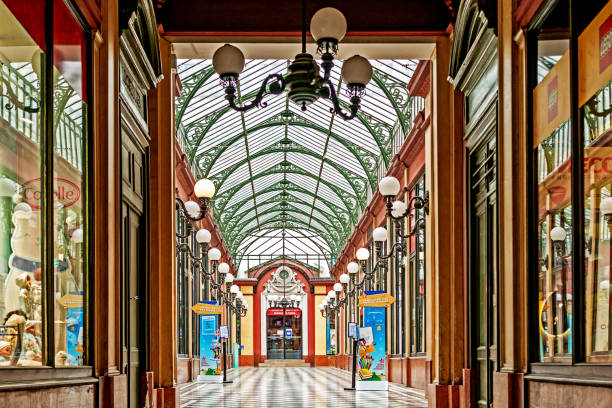
Galerie Vivienne is best understood as a designed interior embedded in the city. Its 176 metres are enough to reveal a sequence of mosaic pavement, glazed roofing, shopfront rhythm, neo-classical ornament and a cupola without turning the passage into an endurance walk. The interpretive payoff comes from comparison: Garnier’s grand ceremonial world becomes, here, a commercial interior at a more intimate scale. Decoration does not merely beautify circulation; it encourages looking, lingering and consumption while sheltering the pedestrian from weather.
For a traveler with limited standing, the dangerous phrase is “we will just stroll through.” Strolling often means repeated stops. Instead, choose one central observation point and one seated explanation. The group can enter, move continuously to the chosen feature, spend a short interval looking, then either exit through the selected branch or return to the confirmed chair. There is no need to visit all three street mouths. The passage’s architectural logic can be explained with a plan and a few sightlines.
The passage itself is free and currently listed as open daily from 8:30 to 20:00, but the individual businesses inside keep their own hours and access conditions. A tea room, bookshop or other premises should not be treated as a bailout unless someone has confirmed a chair, the threshold, the opening time and the group’s ability to sit without a long wait. Buying something does not guarantee immediate seating, and an elegant interior is not automatically step-free.
If no chair is verified, shorten the visit before arrival. A threshold view, a direct move to the cupola or principal junction, and a return to the vehicle can still establish the passage as a bridge between theatre architecture and decorative arts. The guide can reserve the fuller discussion for the next seated interval, using the traveler’s own photographs or prepared visual references. That is preferable to completing the passage while the traveler searches for somewhere to lean.
A coordinated guide and mobility-aware route become materially valuable here because one guest’s standing limit determines when the whole group enters, where it reunites and whether the passage remains a shared experience. The service is not about adding more stops; it is about making the same three anchors usable without forcing one person to wait alone. For a tailored discussion of access, interpretation and group pacing, Inquire now, or explore private Paris touring options.
The seated interval: recovery must be booked as firmly as admission
The transition between Galerie Vivienne and the Musée des Arts Décoratifs needs a real seated interval, not a hopeful pause on the way. It is the point at which the traveler can recover from the two less predictable environments before entering the venue with the strongest verified mobility provisions. For many groups, this means a reserved meal or private room with a chair of known height, an accessible toilet and a direct vehicle pickup afterward. Those details matter more than culinary ambition on this particular day.
The interval should be long enough to reset symptoms, not merely to consume food. A traveler who needs 20 minutes after reaching the standing limit should not be asked to stand again after 15 because the museum slot is approaching. Build the admission time around the recovery requirement. If the group reaches the seated stop early, that is useful margin. If it arrives late, the museum program should shrink rather than compress the recovery.
Keep interpretation light during the first part of the pause. Once the traveler is settled, the guide can connect the morning’s two architectures: Garnier’s monumental circulation and Galerie Vivienne’s commercial promenade. This seated synthesis prevents the museum from becoming a third unrelated attraction. It also allows the guide to explain the afternoon choice before the group reaches the lobby: interiors and furniture, materials and making, or Art Nouveau to Art Deco and modern design.
Musée des Arts Décoratifs: use the elevators to narrow the museum, not to conquer seven floors
The Musée des Arts Décoratifs occupies part of the Louvre complex and is entered at 107–111 rue de Rivoli through the Jardin du Carrousel, according to the regional destination information. Its collections are described across seven floors and include furniture, objects, design, jewelry, toys, graphic design, fashion and textiles, Art Nouveau, Art Deco, wallpapers and reconstructed interiors. The Paris Region museum page marks the site and building as fully accessible to independent wheelchair users, verifies an accessible toilet and states that wheelchairs can be borrowed on request at arrival without advance reservation.
The museum’s own accessibility information further states that all exhibition spaces are accessible by elevator. That is the strongest vertical-access statement among the day’s three anchors. It does not mean every possible route is equally efficient. Seven floors create decision fatigue, repeated lift waits and a temptation to cross the building for isolated masterpieces. The mobility-aware plan chooses a small number of related spaces once the current gallery map and any closures are known.
Arrival and the first seated decision
“Entrance via the Jardin du Carrousel” should not be translated into “vehicle at the door.” The group should confirm the legal drop-off point and the distance from curb to entrance. The guide or companion can check the admission line while the traveler remains seated nearby or in the vehicle where possible. A recommended time reservation can reduce uncertainty, but no responsible plan should promise zero waiting unless the museum itself confirms a priority procedure for that visitor.
Request the wheelchair at reception before beginning the collection route if the traveler is willing to use it. The source states that advance reservation is not necessary, but availability can still be finite; a same-day call is sensible when the chair is essential rather than optional. Confirm whether a companion will push, whether the traveler can transfer independently, and whether the group’s chosen rooms are all operating on the elevator route that day.
Ordinary gallery seating should remain a bonus. The wheelchair loan is the verified seated mechanism. A traveler who does not use a wheelchair may prefer a personal approved mobility aid or short, chair-to-chair interpretation, but those arrangements need current permission and exact seating confirmation. A museum described as fully accessible is not making a universal promise that every display case has a bench beside it.
Choose one of three intellectual tracks
Interiors and furniture: This is the most direct continuation from Palais Garnier and Galerie Vivienne. Use period rooms, furniture, wallpaper and domestic objects to ask how decoration organizes movement, status and daily ritual at different scales. The guide can compare a theatrical public interior, a commercial passage and a reconstructed domestic setting without requiring the group to see every century. Two or three carefully selected rooms can support a richer discussion than a seven-floor survey.
Materials and making: Select objects in glass, ceramics, metalwork, textiles, jewelry or wood and follow the relationship between technique and surface. This track suits travelers who care about craftsmanship more than chronological completeness. It also works well from a wheelchair because interpretation can concentrate on a few objects visible from a stable position, with the guide supplying close visual detail rather than asking the traveler to move repeatedly between cases.
Art Nouveau, Art Deco and modern design: Use the museum’s strength in Art Nouveau and Art Deco to extend the morning from nineteenth-century historicism toward modern decorative systems. The central question becomes how line, material, industry and modern life changed the idea of a total interior. This track pairs especially well with another architecture day; travelers can extend the architecture theme through Haussmann, Guimard and a modern counterpoint rather than forcing every architectural period into this single route.
For collector-level distinctions among Paris decorative-arts institutions, compare Gobelins, the Musée des Arts Décoratifs and Nissim de Camondo by research purpose. That broader comparison is useful for another day; it should not persuade a traveler with limited standing to add a fourth anchor here.
A museum rhythm that keeps the group together
Begin with a seated orientation in the lobby or first confirmed resting position. State the track and the stopping rule. Then move to the first cluster of rooms, interpret two or three objects, and return to seated movement before symptoms appear. Use the elevator once to reach the second cluster rather than oscillating between floors. The group should remain close enough that the traveler hears the same object discussion as everyone else; asking one person to sit in the centre while others scatter to cases recreates the very fragmentation this plan is designed to avoid.
If some members want more, schedule a controlled divergence only at the end. The traveler and one companion can finish at the agreed accessible exit while the remaining guests visit one nearby additional room, then rejoin at a named place and time. Do not set the meeting point as “downstairs” or “by the entrance.” Large cultural buildings can have multiple lift landings and lobby zones, and a tired traveler should not have to search for the group.
A 75- to 90-minute object-led visit is often enough for this route, especially after Garnier and the passage. The museum may remain open longer, and its collections reward repeat visits, but available opening time is not the same as useful capacity. The day has succeeded when the traveler can compare the three interiors with clarity, not when the group has touched every floor.
A complete route without a continuous walk
The following sequence is a planning model rather than a promise of exact timings. Admission windows, opening hours, traffic and individual recovery needs must be fitted around the traveler’s standing limit. The important feature is the alternation between bounded exposure and verified sitting.
- Seated departure briefing: Review the traveler’s standing maximum, the stop signal, the Garnier access contact, the exact Galerie Vivienne entrance and the museum’s wheelchair plan before leaving the accommodation.
- Palais Garnier compact circuit: Arrive only when the guide or companion is ready to manage documents and identify the correct line. Use the lift route, three interpretive stations and a pre-agreed interior limit. Treat the auditorium as conditional.
- Vehicle transfer to 4 rue des Petits-Champs: Keep the whole party together unless the able walkers prefer a brief independent exterior link. Rejoin at the full address before interpretation begins.
- Galerie Vivienne selective passage: Move to one principal decorative feature, then to a confirmed chair or back to the vehicle. Do not use shopping stops as unplanned standing intervals.
- Reserved seated recovery: Allow the traveler’s actual recovery time. Confirm chair height, toilet access and pickup point in advance. Decide the museum track while everyone is seated.
- Vehicle transfer to the Jardin du Carrousel approach: Confirm the current drop-off and accessible entrance sequence. Request the museum wheelchair at arrival if it is part of the plan.
- Musée des Arts Décoratifs object study: Follow one intellectual track across no more than two practical gallery clusters. Use elevators to reduce vertical strain and finish before the exit becomes another endurance test.
This sequence also protects the group’s evening without making dinner or a return to the accommodation the subject of the article. A traveler who finishes the museum with reserve can choose what comes next. A traveler who reaches the stop rule still has a direct vehicle exit. Neither outcome requires the rest of the party to discover, late in the day, that the only available plan is to split.
Bailouts that preserve the decorative-arts argument
A credible bailout is not merely a faster way back to the accommodation. It should retain enough of the day’s central idea that the traveler does not feel removed from the group’s cultural experience. The strongest alternatives keep at least two of the three scales in view: monumental public architecture, commercial interior and museum object.
If Palais Garnier becomes the problem
When the entry line, document collection or lift route consumes too much standing capacity, replace the interior with a seated exterior reading. From a legal stopping point or a confirmed nearby chair, discuss the façade, the building’s position in the Opéra district, and the way its ceremonial identity begins before the visitor enters. Then continue to Galerie Vivienne and the museum. The day still moves from public spectacle to commercial decoration to collected objects.
If the auditorium is closed but the public circuit remains accessible, keep the visit. Shift the emphasis to arrival, staircase, foyer and social circulation. The closure should not trigger a long wait or repeated checks. The Opera explicitly says auditorium access cannot be guaranteed, so the interpretation must be complete without it.
If Galerie Vivienne offers no usable chair
Do not search from premises to premises after the traveler is already tired. Use the passage as a brief visual hinge: enter through the preselected door, view the mosaic and glazed structure from the shortest practical line, then return to the vehicle. Deliver the fuller comparison during the reserved seated interval. Because the passage is only 176 metres and free to enter, shortening it does not create the psychological pressure of “wasting” an expensive admission.
If even the short interior line is unsuitable because of a threshold, crowd or weather-related congestion at the entrances, omit the passage physically but keep it intellectually. A guide can use a plan and verified images during the seated interval to explain how the covered passage differs from Garnier. This is an interpretive fallback, not a claim that a remote explanation equals being there. It preserves the museum’s context while respecting the stop rule.
If the Musée des Arts Décoratifs must shrink
The first reduction is from two gallery clusters to one. Choose the cluster that most directly completes the morning: period rooms and furniture after Garnier, or Art Nouveau and Art Deco after a discussion of urban decoration. The second reduction is to a single object family studied from the wheelchair. A carefully interpreted group of chairs, textiles, glass or jewelry can still demonstrate how design joins use, technique and status.
If an elevator is unexpectedly unavailable, do not improvise a stair route for a traveler whose condition makes standing or climbing unsafe. Ask staff which chosen spaces remain reachable by an accessible route. If the answer no longer supports the planned subject, end the museum attempt and complete the day with a seated comparative session elsewhere. The official accessibility statement is evidence of the normal provision, not evidence that equipment can never fail.
If symptoms change during the day
Use a two-signal rule: the traveler has a discreet signal for “finish this explanation and sit” and a second for “leave now.” The group agrees in advance that neither requires debate. The first signal activates the nearest verified chair or vehicle. The second cancels the next anchor. A guide can then give the rest of the group a choice between ending together or continuing independently after the traveler and companion have a confirmed departure.
The key is that the traveler does not have to justify the decision in public. APF France handicap’s cultural program emphasizes access to cultural participation and the quality of welcome, including accompanied group outings; its context is broader than tourism, but the principle is relevant. A building can be technically accessible while a group experience remains excluding if one person must repeatedly negotiate for a seat or persuade others to stop. The source is available from APF France handicap.
Choose the plan by the traveler’s actual mobility pattern
Good walking tolerance, poor static standing: Keep transitions in motion and explanations seated. This traveler may prefer a short continuous line through Galerie Vivienne to a slow stop-start visit. At Garnier, the priority is bypassing avoidable waits, not necessarily reducing every metre. In the museum, a chair positioned for longer object discussions may be more useful than full-time wheelchair use.
Limited walking and limited standing: Use a vehicle for both inter-anchor transfers and a wheelchair for the museum from the outset. At Garnier, confirm whether the traveler’s own chair or another mobility device is appropriate for the public circuit; do not assume the Opera loans one. Galerie Vivienne becomes the most conditional anchor because its public seating and step-free details are not verified by the supplied source.
Variable pain, postural symptoms or unpredictable weakness: Make the morning plan intentionally conservative. Keep the museum track undecided until the seated interval, because the traveler may arrive with capacity for two clusters or only one. The guide should carry the conceptual structure so that shortening the route does not produce a scattered selection of objects.
A multi-generational family: Give children or energetic adults a defined observation task rather than allowing them to drift ahead. At Garnier they can identify repeated materials or sightlines; in Galerie Vivienne they can compare floor, roof and shopfront patterns; at the museum they can choose one object that translates the morning’s decoration into domestic scale. This keeps the group intellectually shared while the traveler moves at a different physical rhythm.
A traveler who is willing to use a wheelchair only temporarily: The Musée des Arts Décoratifs is the logical place to use it because the loan and elevator access are verified. Present the chair as a tool that preserves participation, not as a symbol of decline. The decision belongs to the traveler. The planner’s role is to explain the consequence honestly: without a seated mobility option, the museum may need to be much shorter.
Verified access checklist for the final itinerary
Operational facts change more quickly than the architectural interpretation. The following items were checked against the named sources on 29 August 2026. They should be reconfirmed after any substantive source update or correction and again close to the travel date when a lift, admission procedure or chair is essential.
Palais Garnier
- Book online; the official page says visit admission is not sold on site.
- Confirm the corner of rue Scribe and rue Auber as the applicable visit entrance and ask whether the accessible arrival sequence differs.
- If using disabled free admission, confirm documentation and the ticket-office collection step.
- Ask where the accessible lift route begins and whether a companion may complete any administrative step while the traveler waits seated.
- Plan without guaranteed auditorium access because rehearsals can close it unpredictably.
- Do not rely on the temporary exhibitions at the Opera Library-Museum or the bookshop as part of a reduced-mobility route; the official page lists them as inaccessible to visitors with reduced mobility.
- Leave suitcases and travel bags elsewhere because the cloakrooms are not open during visiting hours and those items are prohibited.
Galerie Vivienne
- Use one of the three published entrances: 4 rue des Petits-Champs, 5–7 rue de la Banque or 6 rue Vivienne.
- Recheck the passage’s published daily hours and any temporary closure.
- Do not infer public benches, a lift or step-free entry from the passage’s short length.
- Confirm the exact premises, chair, threshold and opening time if a seated stop is essential.
- Write the rejoining entrance into every group member’s itinerary.
Musée des Arts Décoratifs
- Confirm the entrance through the Jardin du Carrousel and the current legal drop-off point.
- Reserve an admission time where recommended, while retaining margin for security and entry.
- Ask staff to mark the elevator route to the selected rooms on the current map.
- Request a wheelchair at arrival if needed; the published information says advance reservation is not required, but a same-day check is prudent when availability is essential.
- Locate the accessible toilet before entering the collection route.
- Choose the room clusters from the current open-gallery list rather than from an old floor plan.
Transfers and contingencies
The City of Paris disability-mobility page states that adapted Paris taxis may have a ramp or a descending pivot seat and charge the same regulated fares as ordinary taxis. It also describes Pam Francilien as an eligibility-based public transport service rather than a general visitor shuttle. Read the current distinctions on the City of Paris mobility page. For this itinerary, a pre-arranged vehicle is useful only when it reduces curb waits, clarifies pickup points and keeps the group together. A generic car booking without exact doors and rejoining instructions does not solve the standing problem.
Carry the venue contact details, the traveler’s documentation where relevant, a written stop rule and the full street address for each meeting point. Record whether the traveler can transfer into a standard car, needs a ramp, uses a pivoting seat, or requires space for a mobility aid. These are operational facts, not preferences to discover at pickup.
What a successful day should feel like
The measure of success is not that every advertised room was open or every branch of the passage was crossed. It is that the traveler remained part of the same conversation as the rest of the group. Garnier should reveal architecture as ceremony; Galerie Vivienne should show decoration shaping urban commerce; the Musée des Arts Décoratifs should let the group test those ideas against objects and interiors while seated.
The route should also leave no hidden dependence on luck. A lift is verified where a lift is claimed. A chair is confirmed where a chair is essential. The free passage is treated as a standing risk rather than mislabeled as a rest. The museum’s seven floors are narrowed by intellectual purpose. Vehicle transfers are short and address-specific, with a clear rejoining procedure.
That is the difference between an accessible-looking itinerary and one built for limited standing tolerance. The latter does not remove Parisian substance. It protects the traveler’s capacity for the moments that carry the most meaning, and it gives the group dignified alternatives when the city’s operational details change.
If you’re interested in any private tours of Paris, please reach out to us.



 So if you are looking for the absolute best in Paris & surroundings with authentic local fully-licensed native guides whose English you can actually understand and with an exclusive and amazingly fun itinerary













