Mont-Saint-Michel from Paris: When the Distance Calls for an Overnight Instead of a Day Trip

Updated
Mont-Saint-Michel from Paris is usually better as an overnight when you want abbey depth, bay atmosphere, and a Paris dinner that is not defined by the return drive. The Paris to Mont-Saint-Michel return day is not difficult because the abbey is confusing; it is difficult because distance consumes the soft parts of travel: unhurried arrival, time on the ramparts, the climb to the abbey, and a civilised evening back in the city. The clearest exception is a dedicated same-day abbey run for travelers who accept an early departure, a late return, and no serious Normandy add-ons.
From Paris, Mont-Saint-Michel is less a sightseeing question than a threshold question: once the plan needs history, tide, village texture, and dinner energy, the overnight stops being indulgence and becomes route discipline. That is the thesis of this guide, and it is the reason a private Mont-Saint-Michel plan should start with the return, not with the postcard. For a focused abbey-first route, Orange Donut Tours can shape the day around Mont Saint-Michel private touring rather than pretending the distance is a minor detail.
The non-obvious correction is that a chauffeur still does not deliver you to the abbey door. Official visitor access moves through mainland parking, the Le Passeur shuttle or walkway approach, the village gate, the narrow Grande Rue, and then the uphill abbey route; the official Mont-Saint-Michel access page (https://www.ot-montsaintmichel.com/en/discover/visit-the-mont-saint-michel/access-the-mont-saint-michel/by-car-motorbike-and-camping-van/) is useful because it reminds planners that the last layer is local movement, not highway speed. This is why the Paris return threshold matters more than the theoretical drive time.
The Paris return threshold: when a day trip stops earning its cost
The Paris return threshold is reached when the trip requires both a full abbey visit and a pleasant evening after the return. A same-day visit asks the traveler to absorb the outbound drive, the final transfer layer, the climb through the village, the abbey itself, the descent, the shuttle layer, and then the long ride back toward Paris. At that point, the question is not whether the destination is worth seeing. It is whether the return erases too much of what made the day worth booking.
The road hinge is also concrete: hotel departure, western exit from Paris, the A13 and A84 corridor, then the visitor-area transition before the mount itself. For a couple celebrating a birthday, a family with older parents, or a small group with mixed energy levels, the threshold often arrives earlier than expected. The abbey is not a flat museum with a single timed entrance and a café reset five steps away. It sits above a compact medieval village, and even a beautiful visit involves stone, slope, stairs, wind exposure, and a return route that cannot be made short by enthusiasm. The body keeps score: a long seated transfer stiffens the legs, the village climb asks for patience, the abbey route concentrates attention, and the evening return can turn dinner into an obligation rather than a pleasure.
Paris hotel geography also changes the calculation. A palace-area hotel in the 8th, a Left Bank stay near Saint-Germain, or a family base near the Eiffel Tower can each make the morning departure feel different before the real road even begins. Cross-city movement to western rail or road exits is not the main event, but it is the first quiet deduction from the day. When the calendar also contains Louvre or Orsay reservations, a serious dinner, or a Versailles day, forcing Mont-Saint-Michel as a same-day excursion can flatten the surrounding Paris stay.
Use this rule: if your Mont-Saint-Michel day needs to feel like a historical encounter rather than proof that you reached the island, plan one night. If it needs to be one image, one abbey visit, and a late Paris return with no complaint about fatigue, a day trip can work. If the plan includes abbey depth, a tide-aware walk, an unrushed lunch, a quieter village moment, or a relaxed dinner return, it has crossed the Paris return threshold.
Route-based comparison: three ways to place Mont-Saint-Michel from Paris
The right route is the one that matches the ambition of the visit, not the one that squeezes the most place names into a single day. Mont-Saint-Michel can be handled as a same-day dedicated trip, a one-night abbey route, or part of a Normandy itinerary. Each has a valid use, but only one is usually kind to travelers who want both substance and a decent rhythm.
1. Same-day dedicated abbey run
A same-day dedicated abbey run works only when Mont-Saint-Michel is the day’s single purpose. The best version leaves Paris early, treats the outbound drive as part of the commitment, keeps the abbey visit focused, and accepts that the return will be late enough to make a refined dinner plan risky. This route suits energetic travelers with limited dates, couples who care more about seeing the abbey than lingering in Normandy, and groups who are comfortable with a long vehicle day.
The mistake is adding more to make the distance feel “worth it.” That logic is backwards. The distance is already the cost; extra stops often reduce the payoff. A short comfort stop en route is sensible. A full secondary destination is not. The same-day abbey run should not become a blurred Normandy sampler just because the map shows other names nearby.
2. One-night Mont-Saint-Michel route
A one-night Mont-Saint-Michel route is the strongest choice when the abbey is the emotional center of the excursion. It gives the site a second light condition, reduces the pressure to rush the village climb, and makes the return to Paris feel chosen rather than endured. The overnight does not need to become a hotel-ranking exercise; its value is structural. It moves the return out of the same day, which gives the abbey back its scale.
This version suits travelers who care about medieval history, sacred architecture, photography, quieter movement, and a dinner that does not have to happen after hours in a vehicle. It is especially good for families with children who need a break between transfer and abbey, or for older travelers who can climb better when the day is not built like a race. It also works for food-and-wine travelers who would rather place a simple Normandy dinner in the route than arrive back in Paris too tired to enjoy the reservation they protected for weeks.
3. Normandy itinerary with Mont-Saint-Michel saved for the right place
A Normandy itinerary wins when the trip is really about the region, not only the mount. If D-Day beaches, Bayeux, Caen, Rouen, cider country, coastal villages, or family history are already part of the wish list, Mont-Saint-Michel should be sequenced inside Normandy rather than forced as a Paris out-and-back. That is a different planning problem, and it deserves a different route. Orange Donut Tours covers the broader question in its guide to Normandy as a Paris day trip or overnight.
The editorial judgment is firm: do not combine same-day abbey plus Normandy add-ons from Paris if you want the day to feel premium in practice. Mont-Saint-Michel should be an overnight or saved for a Normandy itinerary when the wish list expands beyond the abbey itself.
Is Mont-Saint-Michel from Paris worth a day trip?
Mont-Saint-Michel is worth a day trip from Paris only when the day is allowed to be long, singular, and honest about the return. The abbey’s history, the tidal setting, and the village silhouette justify effort, but they do not cancel fatigue. A same-day visit can be memorable; it simply cannot be made to feel like Versailles, Giverny, or Champagne in terms of travel burden.
This is where many Paris plans go wrong. Travelers borrow the mental model of a closer day trip: depart after breakfast, tour a major site, lunch well, return with enough energy for a polished evening. That model does not translate neatly here. Versailles has its own planning complexity, but the official Versailles planning page (https://en.chateauversailles.fr/plan-your-visit) belongs to a very different distance category. Giverny is also a separate rhythm; the official Monet Foundation page (https://fondation-monet.com/en/giverny-2/) supports a garden visit that can live inside a Paris-based day without asking the traveler to surrender the evening in the same way.
The counterintuitive point is that the glamorous Paris base can make the Mont-Saint-Michel day feel more strained, not less. A beautiful hotel near Avenue Montaigne or the Place Vendôme sets a high expectation for the evening return. When the car reaches Paris late, the contrast between the lobby, dinner clothes, and the day’s road time becomes obvious. For guests who care about the whole trip mood, that contrast matters. A day trip may satisfy the checklist but still make the Paris stay feel shorter.
A day trip is most defensible when the traveler has already seen Paris well, has no museum-heavy next morning, and understands that the day’s luxury lies in privacy and clarity rather than leisure. It is least defensible on a first Paris stay of three or four nights, when losing one complete day to the road can crowd out the Seine, the Louvre, the Left Bank, and the unplanned hour that often makes the city feel personal. For a broader shortlist of realistic excursions, compare the Mont decision with which private day trip from Paris fits your style.
What an overnight unlocks at Mont-Saint-Michel
An overnight unlocks better timing, better attention, and a less brittle day. It does not make the abbey larger or magically empty, and it does not guarantee perfect tides or weather. What it changes is the traveler’s relationship to the site. Instead of compressing every impression between a long outbound drive and a long return, the overnight lets the visit breathe across two smaller travel arcs.
The first gain is arrival without panic. You can reach the area, orient through the visitor access layer, approach the mount, and choose whether the abbey belongs late that day or the following morning. That flexibility matters because Mont-Saint-Michel is vertical and concentrated. When everyone arrives at once, the Grande Rue can feel like a funnel. When your schedule is not fighting a same-day return, you can let the village be a route rather than a bottleneck.
The second gain is light and tide awareness. The bay is not background scenery; it is part of the reason the abbey exists where it does. The local tourist office’s tide schedules (https://www.ot-montsaintmichel.com/en/tide-schedules/) are worth checking before finalizing the route, not because every trip must chase the highest tide, but because tides affect how the place feels, how the approach photographs, and how much time you may want outside the walls. An overnight gives you a better chance of seeing the mount in more than one mood.
The third gain is dinner logic. A same-day trip often makes dinner either too late, too casual, or too dependent on everyone’s stamina. An overnight lets dinner happen near the route, while Paris keeps its own evening for another day. This is a mood consequence as much as a logistics point. When the return is postponed, the mount is not competing with a reservation back in Saint-Germain or the 8th; the day can end with the place you traveled to see.
The fourth gain is historical attention. The abbey rewards a guide who can connect monastic function, pilgrimage, military resilience, architecture, and the bay’s geography without turning the visit into a lecture march. That attention is easier when the group is not watching the clock for a late Paris return. The official abbey site’s practical information page (https://www.abbaye-mont-saint-michel.fr/en/visit/practical-information) is the place to check current visit details, but the planning decision is larger than admission logistics: the question is whether you want enough energy to understand what you came to see.
The add-on to cut first: same-day abbey plus Normandy extras
The first thing to cut is the fantasy of Mont-Saint-Michel, D-Day beaches, and a meaningful Normandy stop in one Paris-based day. The map can make this look tempting because all the labels belong to the same region in a traveler’s mind. In real routing, they pull the day in different directions. Mont-Saint-Michel sits on the western edge of Normandy’s visitor imagination, while the D-Day beaches demand their own coast, context, and emotional bandwidth.
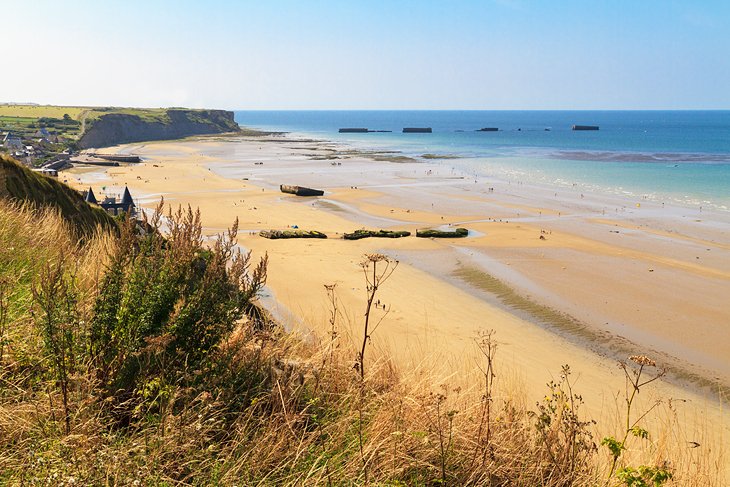
Adding Omaha Beach, Arromanches, Bayeux, or Caen to a same-day Mont-Saint-Michel route usually steals from the abbey without doing justice to the war history. It creates a day of arrival fragments: arrive, look, move, arrive, look, move. That is not depth; it is geographic proof. For travelers with family military history, serious interest in World War II, or a desire to understand the landing beaches with a guide, the right move is to choose Normandy as the frame and use private Normandy touring to build a route with enough room for respect.
The same cut-first rule applies to food stops. A quick regional bite can support the day. A destination lunch that requires a detour can break it. Mont-Saint-Michel already has a long access story: road or rail from Paris, the visitor-area transition, shuttle or walkway, the village, the climb, the abbey, and the return. If lunch becomes another anchor, the abbey visit gets squeezed or the Paris return gets later. Neither outcome helps discerning travelers.
There are exceptions, but they are narrow. A private driver may allow a short, well-placed pause in a Normandy town en route, especially on an overnight when the day is not racing back to Paris. A family might need a comfort stop that becomes a simple meal. A historian might prefer to skip a leisurely lunch entirely and spend the time with a guide inside the abbey. The point is not to remove pleasure; it is to stop adding obligations to a day whose central problem is already distance.
Where private planning changes the day, and where it cannot erase distance
Private planning changes the day when it reduces decision load, sequences the transfer cleanly, and protects the quality of the abbey visit. It can choose the departure time, match the guide to the group’s historical appetite, anticipate the final access layer, place comfort stops before people need them, and avoid the false economy of adding too much. It can also decide that the best answer is not a longer day, but a better-shaped overnight.
Where premium spend changes the experience is in privacy, clarity, and route control. A driver can remove the strain of self-driving after a long site visit. A guide can make the abbey’s architecture legible instead of letting the group drift through stone rooms with only a few dates. A planner can look at the rest of the Paris stay and decide whether Mont-Saint-Michel belongs before or after museum days, celebration dinners, or a departure morning. These are real improvements because they change how the day is felt.
Where premium spend does not help is the distance itself. A chauffeur does not make a same-day plan feel restful if the traveler expects abbey depth and a relaxed dinner return. The vehicle may be excellent; the road is still long. The access layer may be handled gracefully; the mount still requires walking and climbing. The guide may be superb; the brain still has to absorb history after hours of movement.
This is why Orange Donut Tours should be used as a route designer, not merely as a way to buy the maximum possible itinerary. If the trip has five Paris nights and Mont-Saint-Michel is the one major excursion, the answer may be a dedicated overnight. If the trip has three Paris nights and the couple has never seen Versailles, the Louvre, or the Seine properly, the better answer may be to save Mont-Saint-Michel for a Normandy stay. If the travelers are already moving between Paris and western France, the route may be reshaped so the mount becomes a transfer highlight rather than a return-day burden.
For travelers comparing several excursions, private day trips from Paris can be useful, but Mont-Saint-Michel belongs at the far edge of that category. Treat it as a distance decision first and a sightseeing decision second.
When to choose Normandy instead
Choose Normandy instead of a stand-alone Mont-Saint-Michel overnight when the story you want is regional. Mont-Saint-Michel is powerful enough to anchor its own one-night route, but it is not the only reason to leave Paris for the northwest. Normandy becomes the better frame when the trip includes D-Day history, medieval Bayeux, Caen’s war memory, coastal movement, cider and countryside, or a family heritage thread that deserves more than a passing stop.
The strongest Normandy plan usually avoids making Mont-Saint-Michel the first and only proof of the region. It can place the abbey where it makes sense geographically, after the beaches or before a return route, rather than forcing every road back through Paris. This is particularly important for multi-city travelers who might continue toward Brittany, the Loire, or another western French stay. In those cases, the mount can act as a hinge rather than an endpoint.
Choose Normandy when the emotional tone would be wrong for a compressed day. D-Day sites need respect, silence, and context. Bayeux deserves time if the tapestry, cathedral, or old town matter to you. Caen is not a quick garnish if the historical narrative is serious. Mont-Saint-Michel also deserves attention. Combining all of that into a Paris return day turns a region of layered memory into a sequence of car doors.
Choose the Mont-Saint-Michel overnight when the abbey is the point and the rest should stay quiet. That route can still include a carefully chosen pause, but it should not pretend to be Normandy in full. Choose the Normandy itinerary when the region is the point and the abbey is one chapter. The distinction protects both the place and the traveler.
How the return shapes the body and the mood of the trip
The body consequence of Mont-Saint-Michel from Paris is cumulative. It is the seated transfer, then the standing transition at the visitor area, then the shuttle or walkway, then the village incline, then the abbey stairs, then the descent, then the return sequence. None of these pieces is impossible for a healthy traveler. Together, they make the late-day return feel heavier than the itinerary line suggests.
For older parents, the issue is often not one staircase; it is repeated transitions. For children, it is not the abbey’s beauty; it is the time gap between breakfast in Paris and the moment the day becomes interesting to them. For a small private group, it is not the strongest walker; it is the slowest recovery curve. One guest may want another rampart view while another is already thinking about the ride back. A private plan can manage those differences, but an overnight gives them more space to resolve without resentment.
The mood consequence is just as important. A same-day visit can make Mont-Saint-Michel feel like a conquest: departure, arrival, climb, photograph, return. An overnight makes it feel more like a place: approach, settle, observe, visit, pause, return. The difference shows up in conversation. On a rushed day, the car ride back becomes the dominant shared memory. On a better-shaped route, the group is more likely to talk about the abbey church, the bay light, the village after the main pressure has eased, or the guide’s explanation of why the site held such spiritual and strategic force.
Paris also has its own mood to protect. A short stay in the city should not feel like a set of recoveries from ambitious excursions. If Mont-Saint-Michel is placed before a major museum morning, a late dinner, or a departure day, it can disturb the next day’s quality. If it is placed as an overnight between Paris chapters, or as part of a Normandy extension, it can strengthen the whole trip instead of borrowing energy from it.
A practical one-night sequence from Paris
The cleanest one-night sequence gives Mont-Saint-Michel one protected afternoon or evening and one calmer morning. It does not need to be ornate. It needs to remove the same-day return and stop treating the abbey like a roadside attraction.
- Day one morning: leave Paris without adding a museum, shopping appointment, or heavy lunch first. From a Left Bank hotel, build in the cross-city exit rather than pretending the day begins at the périphérique. From the Right Bank, avoid stacking a palace-hotel breakfast, delayed checkout logistics, and a long road departure into the same morning.
- Day one afternoon: arrive in the Mont-Saint-Michel area, handle the visitor access layer, and choose whether the village or abbey comes first depending on timing, energy, and current visit conditions. The aim is not to tick every lane; it is to arrive with enough attention left for the climb.
- Day one evening: let dinner belong to the route rather than Paris. This is the moment the overnight pays back the planning cost. No one is checking the clock for the final hours to the city.
- Day two morning: use the second light condition for the abbey, the ramparts, the bay view, or a quieter village walk. Then return to Paris with the day still usable, or continue into Normandy if the larger itinerary points west.
This sequence is also where a tailor-made planner can add genuine value. Some travelers should prioritize the abbey visit before dinner. Others should arrive, orient, sleep, and visit the abbey in the morning. Some families need the village kept brief and the guide’s storytelling concentrated. Some couples want the bay and dinner to carry the emotion of the trip. Orange Donut Tours’ better job here is not to sell the longest possible day; it is to decide whether your Paris stay can afford the distance, whether Mont-Saint-Michel belongs as a focused overnight, or whether Normandy should carry the narrative. For a private route shaped around your actual trip, tailor-made Paris planning can connect abbey time, driver pacing, guide depth, and the right overnight logic. Inquire now.
How to decide before you book
Decide by asking what would make you regret the trip. If the regret would be missing Mont-Saint-Michel entirely, a same-day dedicated visit may be acceptable. If the regret would be seeing it in a way that felt rushed, distant, or physically draining, choose the overnight. If the regret would be reaching the abbey but missing the D-Day beaches or Bayeux context that first drew you west, choose Normandy instead.
The most useful booking question is not “Can it be done?” It can. The better question is “What must still feel good at the end of the day?” If the answer is a celebratory Paris dinner, a fresh next morning, or a meaningful conversation about the abbey rather than the drive, the day trip is probably the wrong frame. If the answer is simply standing before the abbey once in a lifetime, and everyone accepts the road cost, the day trip has a place.
Travelers who value comfort should also count the surrounding days. Mont-Saint-Michel after an overnight flight is usually too much. Mont-Saint-Michel the day before a packed Louvre or Versailles plan can make the Paris stay feel punishing. Mont-Saint-Michel in the middle of a five- or six-night Paris stay can work if the next day is lighter. Mont-Saint-Michel as a one-night bridge into Normandy can be excellent. The destination is fixed; the consequences depend on where it sits.
That is the final editorial call: for a discerning Paris stay, Mont-Saint-Michel should be a dedicated same-day exception, a better one-night route, or part of Normandy. It should not be an overloaded day that asks distance, history, tide, dinner, and regional add-ons to behave as if they were all close to the Louvre.
FAQ
Can Mont-Saint-Michel be done as a day trip from Paris?
Yes, Mont-Saint-Michel can be done as a day trip from Paris, but it should be treated as a long, dedicated abbey day with an early departure, a late return, and no meaningful Normandy add-ons. It is not a relaxed Paris-adjacent excursion.
When should Mont-Saint-Michel from Paris be an overnight?
Plan an overnight when you want abbey depth, time for the village and bay, a less rushed climb, and a return that does not compromise dinner or the next morning in Paris. The overnight is especially useful for families, older travelers, celebration trips, and travelers who care about history.
Is a chauffeur enough to make Mont-Saint-Michel a comfortable day trip?
A chauffeur improves privacy, comfort, and the return after a tiring visit, but it does not remove the distance, the access transition, or the climb through the site. If you expect a restful day and a polished Paris dinner afterward, a chauffeur alone is not enough.
Can you combine Mont-Saint-Michel and the D-Day beaches in one day from Paris?
You should not combine Mont-Saint-Michel and the D-Day beaches in one Paris-based day if you want either place to be treated well. Choose a Normandy itinerary for D-Day history, and place Mont-Saint-Michel within that larger route if the trip has enough time.
Is it better to stay near Mont-Saint-Michel or in another Normandy town?
Stay near Mont-Saint-Michel when the abbey is the emotional center of the route and you want easier access to evening or morning atmosphere. Stay elsewhere in Normandy when the beaches, Bayeux, Caen, or a wider regional story matter more than the mount alone.
How does Mont-Saint-Michel compare with Versailles or Giverny from Paris?
Mont-Saint-Michel is a much heavier distance decision than Versailles or Giverny. Versailles and Giverny can usually live inside a Paris-based day more naturally, while Mont-Saint-Michel often consumes the full day and challenges the evening return.
Should families visit Mont-Saint-Michel from Paris in one day?
Families can visit in one day if everyone is comfortable with long transfers and a focused abbey visit, but an overnight is usually kinder for children, older relatives, and mixed-energy groups. The route involves more transitions and climbing than many families expect.
When should you skip Mont-Saint-Michel on a short Paris stay?
Skip Mont-Saint-Michel on a short Paris stay when it would displace core city experiences, strain a museum-heavy itinerary, or force a late return before an important next day. Save it for a Normandy extension or a longer Paris trip if the only available version is rushed.
If you’re interested in any private tours of Paris, please reach out to us.


 So if you are looking for the absolute best in Paris & surroundings with authentic local fully-licensed native guides whose English you can actually understand and with an exclusive and amazingly fun itinerary













