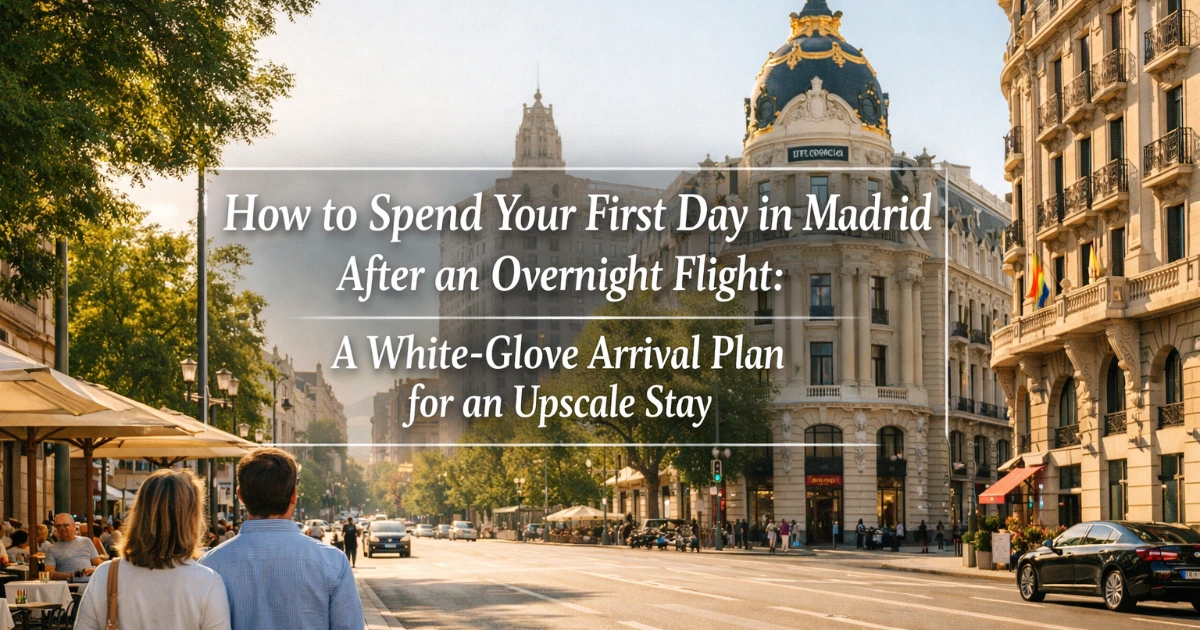
How to Spend Your First Day in Madrid After an Overnight Flight: A White-Glove Arrival Plan for an Upscale Stay
Updated
Your first day in Madrid after an overnight flight should not be a shortened sightseeing day. The best plan is hotel handling first, then a short outdoor stretch beginning at Retiro’s Puerta de Alcalá edge, then a long lunch in Salamanca or Las Letras, and only one light cultural stop if your energy still feels steady. That sequence works unusually well in Madrid because the city’s easiest arrival-day geography sits along the east-central spine from Retiro to Jerónimos, Paseo del Prado, Salamanca, and Las Letras: you can get outside quickly, sit down properly, and avoid the cross-city resets that make a no-sleep afternoon feel twice as long.
The clearest exception is the traveler who lands with a genuinely ready room, has no children or older relatives to manage, and came to Madrid mainly for art. Even then, the Prado Museum is better the next morning than the first afternoon. In Madrid, the winning arrival day is not an abbreviated version of day two. It is a deliberately incomplete day that uses the city’s park edge, lunch culture, and short vehicle hops to preserve your first evening instead of emptying it out before dinner.
Use this arrival-day grid before you plan anything else:
- Best overall for most first-timers: airport to hotel, bag drop or quick freshen-up, Retiro’s Puerta de Alcalá edge, long lunch in Salamanca, then a soft finish in Las Letras or back near the hotel.
- Best if the room is not ready: keep the first hours outdoors, leave bags only for a park-and-lunch sequence, then check in later instead of waiting in the lobby and trying to invent a full sightseeing agenda.
- Best if art is non-negotiable: give yourself air, lunch, and one tightly limited indoor stop today, then put the Prado Museum where it belongs: tomorrow morning.
If you have not settled your neighborhood yet, where to stay in Madrid for a luxury first stay matters here because day-one fatigue in Madrid is mostly a geography problem, not a motivation problem. If the airport handoff itself is part of what you want smoothed out, an airport-arrival service is one of the few upgrades that changes the first three hours in a real way.
What should you do in Madrid on your first day after an overnight flight?
Start east of the old-center postcard zone, not in the middle of a heroic checklist. The right first day in Madrid is built around a park edge, a seated lunch, and one easy transition, not around proving you can push through fatigue.
The most useful non-obvious starting point is Retiro’s Puerta de Alcalá edge rather than the deeper interior of Retiro. That corner beside Plaza de la Independencia gives you exactly what an overnight-flight arrival day needs: immediate fresh air, trees, broad paths, handsome city views, and an easy exit back to Alcalá, Serrano, or a short ride toward Jerónimos or Salamanca. You can feel that you have arrived in Madrid without committing to a full park expedition. On sleepy legs, that distinction matters. The common mistake is treating Retiro like a destination to “cover,” wandering far toward the lake or the Crystal Palace, and turning a restorative walk into the first hidden overreach of the trip.
This is also why the glamorous west-side start around Plaza de Oriente, the Royal Palace, and Plaza Mayor is overvalued on landing day for many first-time visitors. It looks logical on an attraction list, but it puts you on the wrong side of the center for the calmest hotel-lunch-park rhythm, especially if your hotel is in Salamanca, Retiro, Jerónimos, or nearby blocks that naturally feed into the Prado side of the city. Crossing west for a ceremonial sight first, then crossing back east for lunch or rest, is the sort of extra reset that does not sound expensive until your body is running on overnight-flight concentration.
Madrid helps you if you let lunch do real work. A long lunch here is not dead time between landmarks. It is the hinge that turns an airport arrival into a city day. Salamanca gives you polished dining rooms, good acoustics, and streets such as Serrano, Claudio Coello, and Jorge Juan that are pleasant to enter and leave without fighting the entire old core. Las Letras gives you a more atmospheric finish once you are fed, with Plaza de Santa Ana, Huertas, and the literary quarter offering a slower kind of wandering than the queue-heavy monument circuit. Both neighborhoods let you feel the city before you ask too much of yourself.
The thesis for day one is simple and very specific to Madrid: use the Retiro-to-lunch spine to arrive in the city gradually, then decide whether you have enough focus left for one controlled indoor stop. Do not reverse that order. Madrid rewards restraint on arrival day because the city becomes more enjoyable, not less, when your first impression is air, lunch, and a compact neighborhood drift rather than one major interior after another.
If you want the dining side of that lunch handoff mapped in more detail, our curated Madrid food-and-wine day goes deeper on which route best suits a polished, first-time stay. What matters here is that lunch belongs in the middle of the arrival plan, not at the end of a sightseeing push.
The route that usually wins: hotel, Retiro’s Puerta de Alcalá edge, long lunch, one soft finish
The route that usually wins is the one that asks you to make only one real decision after lunch: keep going lightly or stop. That is a much better arrival-day test than asking whether you can tolerate one more queue, one more ticket, or one more district.
Begin with the hotel because clean arrival mechanics matter more than symbolic first stops. If your room is ready, go in, shower, change, and leave again before you get trapped by the idea of a nap that runs too long. If the room is not ready, drop bags or keep them with a driver only long enough to bridge the first outdoor stretch and lunch. The next move is Retiro’s Puerta de Alcalá edge. Not the whole park, not a determined loop, and not the “while we’re here, let’s keep walking” version that quietly turns into a three-neighborhood afternoon. Start where the city feels elegant and breathable, then leave before the walk becomes an assignment.
That starting point works because it is a hinge, not a commitment. From the Puerta de Alcalá side, you can take the park in small, satisfying doses. You can drift inside for half an hour, sit, look at the city reassembling around you, and walk out on the same side without the mood shift that comes from retracing a dense old-town route. If you are traveling as a couple, this is where the first-day plan begins to feel good rather than merely efficient. If you are traveling with children, parents, or a small celebratory group, it gives everyone a low-stakes way to re-enter the day together.
Lunch comes second because Madrid is kinder after you have been seated for a while. Salamanca is the safer lunch district when comfort, calm service, and polished surroundings matter most. The area around Jorge Juan and Claudio Coello tends to support exactly the kind of long, composed midday meal that can absorb the rough edges of a red-eye arrival. Las Letras is the better lunch or post-lunch zone when you want more street life, more literary atmosphere, and a softer handoff into a compact neighborhood walk. The right choice depends less on abstract “best neighborhood” debates than on where your hotel is and how much walking appetite remains after the park.
The handoff from Salamanca to Las Letras after hotel check-in is one of Madrid’s best first-day sequences because it asks for only one change of scene. You settle into the city in the east or center-east, eat properly, then either drift south toward the literary quarter or take one short ride and finish on foot. That is far more forgiving than forcing Salamanca, then the Prado, then the Royal Palace, which looks cultured and ambitious in a draft itinerary and feels chopped up in practice. Arrival-day plans break not because any one stop is bad, but because three good stops in the wrong order create too many endings and restarts.
The soft finish matters as much as the opening. After lunch, you want one of three endings: a short wander in Las Letras; a return to the room for a real pause and a later aperitif or early dinner; or one light cultural stop that can be ended without regret. That last option is the exception, not the default. The best arrival-day route in Madrid always preserves your right to stop. A plan that still looks good only if you “push through” is already the wrong plan.
This is where experienced local planning earns its keep. Not because Madrid is hard to navigate, but because first-day friction hides inside tiny transitions: where the car leaves you, whether the room is available, whether the stroller or jackets are in the wrong bags, whether lunch is too far west, whether the museum choice commits you to another district, whether someone in your group is fading faster than they admit. Arrival-day success is mostly the art of preventing those minor frictions from hardening into the afternoon’s entire identity.
Airport to hotel reality: when to go straight in, when to leave bags behind, and when not to
The airport transfer is usually not the part that ruins the day; the room-ready handoff is. Most arrival-day frustration in Madrid begins at the hotel door, when travelers realize they are too early for a proper check-in and start improvising a full sightseeing afternoon to fill the gap.
If your room is ready or can be made ready quickly, go straight in. That is the cleanest version of the day because it lets you change pace on purpose instead of in reaction. A shower, a clothing change, and ten quiet minutes in the room do more for the first afternoon than almost any attraction. The point is not to disappear for hours. The point is to stop feeling like you are still carrying the airport with you. Couples often underestimate how much that reset shapes the mood of the next six hours; families and multigenerational groups usually discover its value immediately.
If the room is not ready but the hotel can store bags and give you a place to freshen up, use that and get moving. What you do not want is a lobby wait that turns into indecision, then a rushed late lunch, then an overcompensating museum or monument visit because you feel the day is slipping away. On a red-eye arrival, the lost hour in the lobby often feels more exhausting than the actual travel. The better answer is to commit to a short outdoor stretch and lunch immediately, knowing that the room will be more useful later than it is at midday.
Leaving bags behind only makes sense under narrow conditions, and it is worth being strict about them. Leave bags behind only if the first sequence is outdoors plus lunch, if you are carrying medications and valuables with you, if everyone in the group can function from a small day bag, and if the coordination is genuinely easy. That can work well when you have private transfer support, when the hotel is not ready, and when the first route is simply airport to hotel door, then Retiro’s edge, then lunch, then back for check-in. In that scenario, keeping larger luggage out of the way can make the first hours feel significantly cleaner.
Do not leave bags behind if the plan includes shopping, a museum, children who need spare clothes or snacks beyond a day bag, grandparents who may need room access sooner than expected, valuables you would rather not separate from, or more than one hotel room with different readiness. Do not leave bags behind just because the phrase sounds elegant. A bag strategy that requires multiple calls, timing guesswork, or re-meeting a driver at the exact moment everyone is fading is not a white-glove solution. It is one more moving part on a day that should have fewer of them.
There are two first-day upgrades that often earn their cost. The first is guaranteed room access in some form, whether that means a pre-booked previous night or an agreed early-arrival setup through the hotel. The second is transport continuity for one or two key handoffs, especially if your group includes children, parents, or celebration timing that you do not want to disrupt with improvisation. Both change the day because they remove decision points when judgment is weakest.
Paying for a more luxurious lunch or hotel does not fix an overstuffed arrival day.
That sentence is worth stating plainly because arrival days tempt travelers into the wrong kind of upgrade. A more beautiful dining room does not make two museums and a palace easier. A more expensive room does not make west-side sightseeing less fragmented if your hotel and preferred lunch route are east. The spending that helps on day one is logistical and private: room access, bag handling, transfer continuity, and the ability to stop without penalty when someone in the party is done.
For travelers who want the city to feel composed from the first curbside moment, this is exactly why an airport-arrival setup often matters more than another attraction ticket. The elegant version of day one is not the version with the longest list. It is the version where nothing forces you to choose badly while tired.
Retiro, Salamanca, or Las Letras: which neighborhoods work best on sleepy legs?
On sleepy legs, Retiro, Salamanca, and Las Letras are the neighborhoods that work best; the west-side monument cluster works worst for most first-day arrivals. The reason is not beauty. It is how each area handles transitions when your body is behind your calendar.
Retiro for air, shade, and an arrival feeling without a full walking day
Retiro is the best first move when you need the city to open gently. You are outdoors quickly, you can keep the stroll brief, and you do not have to “finish” anything. Retiro’s Puerta de Alcalá edge is especially useful because it offers the least commitment with the most elegance. You can step into the park from the Plaza de la Independencia side, absorb Madrid’s scale and daylight, then step back out toward Alcalá or Serrano as soon as the walk has done its work. For couples, this feels refined without feeling stage-managed. For families, it gives children space before lunch. For older travelers, it is one of the easiest ways to enjoy the city without locking into a museum timetable.
Retiro is less useful if what you want most is immediate café and street life. The park calms the body, but it does not by itself create that first animated sense of urban immersion. That is why it works best as a beginning rather than as the whole plan. Think of Retiro as the city’s decompression chamber on arrival day. The mistake is assuming that because it feels easy at the beginning, more of it must be better. On day one, more is often just more.
Salamanca for the longest, calmest lunch and the smoothest room-to-table rhythm
Salamanca is the easiest neighborhood for a serious arrival-day lunch when comfort and low-friction service matter more than theatrical atmosphere. The streets around Jorge Juan, Claudio Coello, and Serrano are good at absorbing a long midday meal without turning it into a production. If your hotel is already in Salamanca or on its western edge, this is the cleanest possible rhythm: room or bag drop, short outdoor stretch, lunch, then a brief post-lunch drift or a return to the room. There is very little performative about that route, which is exactly its strength.
Salamanca is not the right answer if your emotional need is to feel at once that you are in the old literary or historic heart of Madrid. It is a district that excels at poise rather than drama. But that is precisely why it performs so well on no sleep. Arrival-day lunches work best where the room is comfortable, the approach is simple, and the neighborhood does not insist that you turn lunch into a long stroll you did not really choose. Salamanca knows how to let lunch be lunch.
It is also where premium spend often earns its keep cleanly. Not because the district is “more upscale” in the abstract, but because a polished lunch room in Salamanca can hold a tired party together better than a buzzy, crowded, must-visit venue elsewhere. Celebration travelers often think the first day needs the most famous possible booking. It rarely does. What it needs is a table that makes everyone glad they sat down.
Las Letras for the prettiest soft finish once you are fed and checked in
Las Letras is the best arrival-day finish when you want atmosphere after lunch without another major commitment. The neighborhood gives you compact, walkable texture around Plaza de Santa Ana, Calle de las Huertas, and the literary lanes running toward Carrera de San Jerónimo. It feels distinctly Madrid without demanding the kind of attention a major museum does. If Salamanca is where you recover your composure, Las Letras is often where you recover your enthusiasm.
This is why the Salamanca-to-Las Letras handoff after hotel check-in is so effective. Lunch in Salamanca lets the body slow down; Las Letras lets the mood come back. One short ride or a manageable continuation south changes the scene enough that the afternoon feels shaped rather than repetitive, but you are still not forcing another big objective. You are simply letting the city become legible at the pace your body can actually handle.
Las Letras is a weaker choice as the first stop straight from the airport if your group needs open space, if your children need room to move, or if someone is already visibly wilted. It works better after lunch than before it. The quarter’s charm is in its texture, not its spaciousness. That makes it better as an earned finish than as a first landing pad.
Why the Royal Palace side is the glamorous wrong turn on day one
The Royal Palace side of the city is the glamorous wrong turn on day one for many first-time visitors. That includes Plaza de Oriente, the palace approach, and the temptation to “just keep going” into Plaza Mayor and nearby old-center lanes. None of those places are unworthy. They are simply costly in the wrong way on arrival day if your hotel, your lunch logic, and your likely second-day museum plans are all anchored farther east.
The problem is not only walking distance. It is fragmentation. Start west and the day begins to ask for too many transitions: transport from airport to hotel, hotel to west side, west side to lunch, lunch to another interior, interior back to the hotel, then perhaps out again for dinner. Madrid is broad enough that those transitions add up even when each individual move seems manageable. The city does not punish you with relentless hills in the central districts, but it absolutely punishes false efficiency. A route that looks compact from afar can still feel overhandled by late afternoon.
If you are staying right by the palace side and the Royal Palace is a top personal priority, you can make a restrained version of that route work. But for the traveler described by this article—first-time, long-haul, comfort-oriented, and not trying to score a sightseeing quota—the east-to-center-east spine wins much more often. It is easier on the body, kinder to the group dynamic, and more likely to leave the evening intact.
Prado Museum or Royal Palace on the same arrival afternoon?
If you are weighing the Prado Museum against the Royal Palace on the same arrival afternoon, the practical answer is usually neither in full. The stronger editorial judgment is this: the Prado Museum is a bad first-day bet after an overnight flight, and pairing it with the Royal Palace is how travelers accidentally turn a promising afternoon into a blur.
The Prado Museum deserves fresh eyes, not dutiful eyes. It is one of those places where half-attention feels like a form of self-sabotage. Visitors often tell themselves they will “just do highlights,” but on arrival day that tends to become a rushed sequence of famous rooms and little retention. You may technically have gone, but you have not really had the experience you crossed the ocean to have. That is why the correct move for art-first travelers is usually to protect the Prado rather than force it. Put it in the next morning, when your attention is available, your legs are clearer, and the museum can be the main event instead of the consolation prize for landing early.
If you need a narrow operational reference point before you book that visit, use the official Prado visit page (https://www.museodelprado.es/en/visit-the-museum). It is a planning tool, not permission to wedge the museum into the wrong afternoon.
The Royal Palace is slightly different. It is more skimmable than the Prado in the sense that you can understand what it is faster. But that does not make it a strong arrival-day choice. It sits on the wrong side of the center for many of the calmer day-one hotel and lunch routes, and it asks for the kind of ceremonial interior attention that feels longer when you are already tired. The palace can work on a later day when it is the focus of a west-side route. It works less well as a westward detour after park time in Retiro, lunch in Salamanca, or an early drift through Las Letras.
So if the question is specifically Prado versus Royal Palace on the same first afternoon, protect the Prado and resist the Palace detour unless the Palace is one of the main reasons you are in Madrid and your hotel location makes that route unusually simple. The more common first-timer mistake is to assume that because the two sights are famous, doing both proves that the afternoon was well spent. In reality, it usually proves only that the day was overpacked.
If you insist on one indoor art stop on arrival day, choose the one you can quit without regret. For some travelers that is not the Prado at all, but a shorter, more modular look elsewhere. The official Reina Sofía visit page (https://www.museoreinasofia.es/en/visit) is the right place to confirm visit logistics if modern art is the main draw. The official Thyssen permanent collection page (https://www.museothyssen.org/en/collection/permanent-collection) is helpful if you want to preview a collection that can be approached more selectively. Neither of those pages changes the core judgment: arrival-day value in Madrid comes from restraint, not from trying to bank every cultural priority before your body has caught up.
The first thing to cut, whenever the day starts to swell, is the ticketed indoor visit after lunch. Cut that before you cut the room pause, and cut it before you cut the long lunch. Travelers often do the opposite because lunch feels negotiable and the museum ticket feels “important.” In Madrid, on this specific first day, lunch is the important thing. It is what allows the evening to exist as something better than mere recovery.
If art is central to the trip, the smarter move is to push the full museum plan to day two and use a dedicated framework such as Golden Triangle without museum fatigue. That is where the Prado belongs: in a day that is built for it, not borrowed from the day you landed.
What Madrid does to your body on day one, what it does to the trip mood, and where extra spend is actually useful
Madrid tires people less by steepness than by breadth, sunlight, queue drag, and repeated resets. The city’s center looks compact in theory, but the difference between one elegant east-side sequence and three loosely connected districts is much larger in the body than it appears on a map. Walking from Puerta de Alcalá down Paseo del Prado feels graceful when you are fresh; adding a west-side monument circuit, another major interior, and a second cross-town transfer is how the day quietly turns heavy. In warmer weather, the open avenues and stone surfaces also make midday effort feel brighter and longer than many travelers expect.
Madrid also changes the mood of a trip very quickly on day one. Handle the arrival well and the city feels warm, sociable, and unexpectedly easy: the park settles you, lunch restores you, and even a short evening outing feels like pleasure rather than effort. Handle it badly and the first day flattens everything that comes after. Suddenly dinner becomes a task, the second morning begins with catch-up fatigue, and the trip can feel as if it started one emotional step behind schedule. This is why protecting the evening is not a soft luxury concept here. It is a practical outcome of what you did, or did not do, between the hotel and lunch.
Where premium service helps is very specific. It helps at the airport handoff. It helps with guaranteed room access or at least a clean bag-and-freshen-up arrangement. It helps when one short vehicle transfer removes an awkward cross-city move for tired adults, children, or parents. And it helps when someone local has already designed the order of the day so that nobody is making ambitious decisions while sleep-deprived. This is why a chauffeured Madrid day can be worth considering even if you are not trying to “tour by car” in the usual sense. On arrival day, the car is often about deleting one bad transition, not adding more places.
Where premium spend does not earn its cost is just as important. It does not earn its cost when it is trying to rescue a crowded schedule. A more expensive lunch is still just lunch if the route before and after it is wrong. A hotel suite still cannot fix the mistake of forcing Retiro, the Prado Museum, and the Royal Palace into the same afternoon. And a private driver is wasted if the real issue is that the plan should have stopped an hour ago. White-glove travel on arrival day is not about turning the city into a set piece. It is about protecting attention, privacy, and the right to quit while the day still feels attractive.
For celebration travelers, this can be the hardest judgment of all because the instinct is to make day one feel “special” immediately. In Madrid, special often comes from underplaying the first afternoon. It can be a beautiful lunch, a park edge, one polished neighborhood, and a return to the room with enough energy left for a handsome drink or dinner. The city is much better at rewarding that kind of composure than at flattering a first-day performance.
A white-glove first-day Madrid outline you can actually enjoy
A good white-glove arrival outline in Madrid is not long. It is simply clean. The point is to decide the day’s one hinge in advance: whether the room comes first or whether the city comes first for an hour before lunch.
If the room is ready when you arrive
Go straight to the hotel, get yourself properly back into day mode, and leave before the room turns into a cave. Then head for Retiro’s Puerta de Alcalá edge for a compact walk. Follow that with a serious lunch in Salamanca if you want the calmest, most polished midday experience. After lunch, choose one finish only: Las Letras for atmosphere, the room for a true pause, or a single light indoor stop that can be abandoned without regret. The evening should still feel open enough for a drink, an early dinner, or simply a second, shorter walk near the hotel.
If the room is not ready
Do not wait around to see whether fatigue becomes motivation. Drop bags or keep them out of the way only for the simplest possible sequence: hotel door, park edge, lunch, then back for check-in. This is the version of arrival day where outside air matters most because it prevents the airport-to-lobby feeling from lingering too long. Once lunch is over and the room is likely available, stop trying to earn the rest of the day. Go in, settle, and decide whether the evening deserves a small outing or a complete surrender. Either can be the right answer.
If you are traveling with children, parents, or a small celebratory group
Simplify earlier than you think you need to. With children, the park edge is often more useful than any museum, and lunch needs to happen before anyone gets brittle. With parents or older relatives, minimize the number of get-in/get-out transitions and treat seating, shade, and restroom access as first-order planning facts, not details to improvise. With a celebration group, choose one polished lunch and one elegant after-lunch neighborhood rather than trying to make the entire city perform on command. Madrid is very good at atmosphere when you stop forcing it.
The custom version of this day is where private planning becomes naturally valuable. This is not because Madrid is hard. It is because the best arrival-day route depends on your exact landing pattern, your hotel block, whether the room is ready, whether lunch is the emotional anchor of the day, and whether the afternoon should end with Las Letras, a short museum look, or an unapologetic retreat to the room. Orange Donut Tours can turn those variables into one clean arrival outline instead of leaving you to solve them on the sidewalk.
If you want the whole trip to follow the same logic, how many days in Madrid helps put the bigger stay in order. If you want the first afternoon itself shaped around your flight, hotel, walking appetite, lunch priorities, and whether you need a driver for one key handoff, a tailor-made Madrid plan is the most direct next step. Inquire now
FAQ
Is the Prado Museum worth doing on the day you land in Madrid?
Usually no. The Prado Museum is absolutely worth doing in Madrid, but not usually on the same afternoon as an overnight-flight arrival. It is better the next morning, when you can give it real concentration instead of tired obligation.
Should I start in Retiro or at the Royal Palace after a red-eye flight?
Start in Retiro, specifically near Retiro’s Puerta de Alcalá edge. It gives you air and beauty without forcing a full sightseeing commitment. The Royal Palace side is a weaker first move unless you are staying right there and the palace is a major personal priority.
Which neighborhood is best for lunch on arrival day: Salamanca or Las Letras?
Salamanca is usually better for the lunch itself because it is calmer and easier to handle when you are tired. Las Letras is often better as the post-lunch neighborhood because it gives you atmosphere in a compact, easy-to-walk finish.
Is it worth paying for early check-in in Madrid after an overnight flight?
Often yes, if that payment truly buys you room access rather than vague possibility. On a long-haul arrival, a shower, clothing change, and short pause can be more valuable than another sightseeing ticket. What is not worth paying for is a premium room if the day is still overpacked.
When is it smart to leave bags behind instead of waiting for the room?
It is smart only when the next sequence is simple: outdoors first, lunch second, room later. It works best when valuables and essentials stay with you, when there is private transfer continuity or effortless hotel storage, and when nobody in the party urgently needs full room access.
Can I do Salamanca and Las Letras on the same first day in Madrid?
Yes, and for many travelers that is one of the best arrival-day combinations in the city. Salamanca handles the long lunch well, and Las Letras gives you a softer, more atmospheric finish than another major sight would.
Is a chauffeur worth it on your first day in Madrid?
It can be, but not because you need to see more. It is worth it when it removes one awkward transfer, keeps luggage from dictating the day, and helps a tired group move cleanly between airport, hotel, lunch, and one final stop.
What should I cut first if the first afternoon is getting too ambitious?
Cut the ticketed indoor visit first. Keep the room pause and keep the long lunch. In Madrid, on arrival day, the museum or monument you postpone usually costs you less than the lunch or reset you skip.
If you’re interested in any private tours of Madrid, please reach out to us.




 So if you are looking for the absolute best in Madrid & surroundings with authentic local fully-licensed native guides whose English you can actually understand and with an exclusive and amazingly fun itinerary