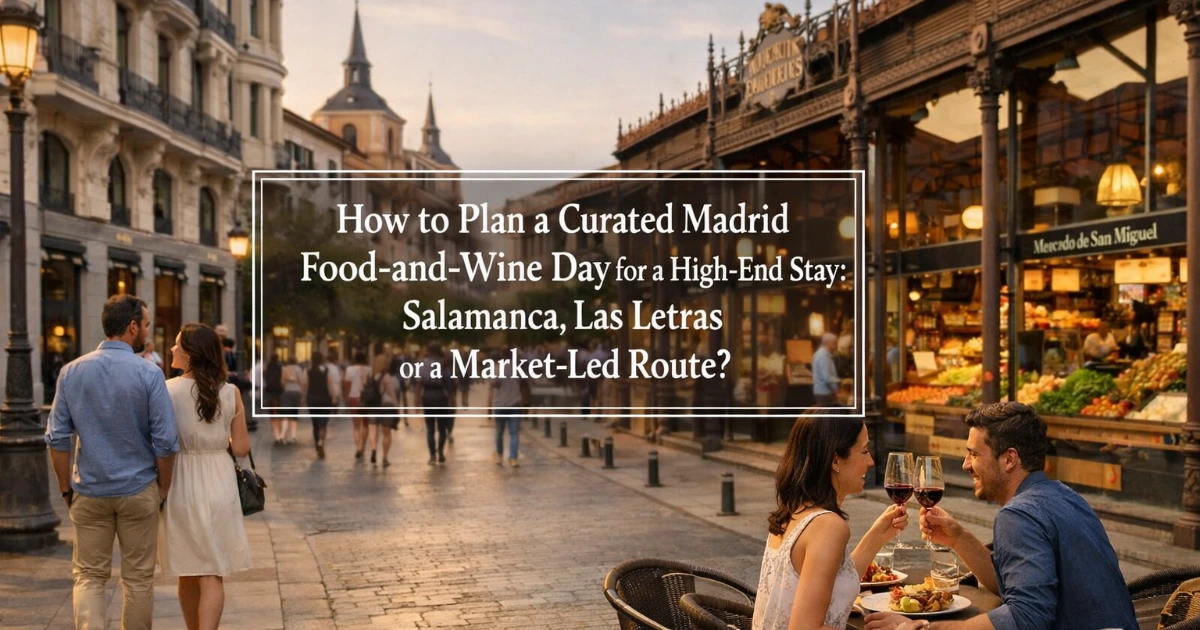
How to Plan a Curated Madrid Food-and-Wine Day for a High-End Stay: Salamanca, Las Letras or a Market-Led Route?
Updated
Las Letras is the best default shape for a curated Madrid food-and-wine day on a high-end stay, because it lets you combine one serious cultural stop, a real lunch, a later tapas drift, and a strong dinner radius without turning the day into taxi choreography. Madrid stretches farther than many first-time visitors expect, and the walkable spine from Plaza de Santa Ana down Calle Huertas toward Paseo del Prado keeps appetite, wine, and energy in the same part of town long enough for the city to feel coherent.
The clearest exception is a lunch-led day. If your trip revolves around a polished midday reservation, a shopping window, and a calmer, better-upholstered feel, Salamanca is stronger—especially around Calle Jorge Juan between Serrano and Velázquez, where the route makes practical sense rather than just sounding glamorous.
The real planning question is not which district looks most elegant on a map. It is which district lets you eat at the right moments, walk the right distance, and arrive at the evening still curious rather than already finished. In Madrid, the best food-and-wine day is not the one with the most famous names. It is the one that keeps your appetite from colliding with the city.
That is also why the famous stop many discerning travelers over-prioritize is Mercado de San Miguel. It may deserve a look if you are already near Plaza Mayor, but it is not the premium default for a full food-and-wine day, and it is rarely the place that makes the day feel more considered than random. If your hotel choice is still open, this guide to where to stay in Madrid for a luxury first stay will help you match your base to the route you actually want.
Which Madrid district is best for a food-and-wine day: Salamanca, Las Letras, or a market-led route?
Choose by meal anchor, not by hype: Las Letras is best for the broadest mix of food, wine, first-time atmosphere, and one cultural stop; Salamanca is best when lunch is the day’s main event; and a market-led route only wins when the market itself is part of the point, not just a famous box to tick.
Best overall: Las Letras. Pick this when you want the fullest Madrid feeling in one contained area: a museum or literary stroll, a real lunch, and a slower afternoon that can turn into later grazing or dinner without a long reset. It suits couples, first-time visitors, and travelers who want the city to feel lively rather than staged.
Best when lunch is the climax: Salamanca. Pick this when the day should feel polished from the first coffee through the final digestif, with a smart shopping window built in and fewer compromises on seating, acoustics, and service. It suits celebration lunches, adult family groups, and travelers who would rather sit well than wander widely.
Best only when ingredients and browsing matter as much as the meal: a market-led route. Pick this when you want produce, jamón, cheese, olive oil, gifting, or a more flexible route for mixed appetites. It is the weakest choice for couples who want one seamless, atmospheric day with a strong lunch and an even stronger evening.
The hierarchy is clear: Las Letras is the default winner, Salamanca is the sharper specialist, and the wrong premium assumption is that a famous market automatically makes the best food day.
Why Las Letras usually wins the day
Las Letras wins because it holds together. In practical route terms, the quarter sits between the Paseo del Prado side and the Sol-facing center, so you can give the day more than one register—culture, lunch, wine, and evening atmosphere—without forcing your body to start over every two hours.
That matters more in Madrid than many visitors realize. A day that looks compact on a hotel concierge map can feel very different once you have stood in a museum, walked several broad blocks in sun, sat through a long lunch, and then discovered your evening bar sequence is actually across town. Las Letras minimizes that re-start problem. It lets you spend your energy deciding what you want to taste, not how to recover from the last transfer.
The district also has a useful internal gradient. Around Plaza de Santa Ana and the busiest stretch of Calle Huertas, the quarter can tilt noisy and nightlife-heavy. Move toward Lope de Vega, Cervantes, or the Prado edge and it becomes calmer, more textured, and easier to use for a food-and-wine day that still feels grown-up at 6 p.m. That is the difference between a route that feels literary and urban, and one that accidentally turns into a bar crawl in fancy shoes.
For first-time visitors, Las Letras offers a rare thing in European capitals: a day that can still feel generous without becoming overprogrammed. You can begin with one focused cultural stop, keep lunch meaningful, return to the hotel if needed, and come back out for wine and small plates without losing the line of the day. This is especially good for couples, because the district gives you time together instead of making the route itself the project.
The best way to use Las Letras is to keep the morning selective. One museum, one literary stroll, or one quiet coffee-and-bookshop start is enough. From there, lunch should be the first real anchor, not the third snack stop. After lunch, do less. Madrid’s late rhythm rewards travelers who leave some appetite—and some emotional space—for the evening. If you want guidance on bar order, pacing, and where a tapas-led afternoon turns into a better dinner zone, Tapas Private Tours make the most sense in this part of the city, where the value lies in sequencing rather than distance-saving.
Las Letras is also the easiest route for adding art without letting art swallow the food day. The official Prado visit page (https://www.museodelprado.es/en/visit-the-museum) is the practical place to confirm current entry details before you go, but the more important editorial point is this: do not try to “do the Prado” before lunch. Use it as a focused stop. Pick one painter, one wing, or one ninety-minute intention. Anything more starts turning a food-and-wine day into a museum day that happens to contain lunch.
If modern art suits your appetite better than old masters, the official Reina Sofía visit page (https://www.museoreinasofia.es/en/visit/) is the right planning check for the southward version of this route. That option works best when you lean toward Antón Martín and Atocha rather than back toward the Plaza de Santa Ana strip. It is a slightly sharper, less cushioned day, but it can be excellent for travelers who want their food route to feel more urban and less salon-like.
Las Letras is not the best answer for everyone. If what you really want is a hushed lunch room, designer browsing, and an afternoon that feels upholstered rather than animated, Salamanca is better. And if you dislike weekend street energy, terrace spill, or the possibility of crossing paths with nightlife before dinner, the quarter can annoy you unless your route stays on its quieter edges.
Still, for a single curated Madrid food-and-wine day, Las Letras usually wins because it gives you more Madrid per decision. You are not paying for prestige as much as continuity. That is a better bargain for discerning travelers than many more expensive-looking alternatives.
When Salamanca beats Las Letras
Salamanca beats Las Letras when lunch is the main event and the day should feel polished from the first hour. This is the answer for celebration travelers, comfort-first visitors, and small groups who care as much about calm service, cleaner acoustics, and easier seating as they do about culinary variety.
The most useful micro-location is Calle Jorge Juan between Serrano and Velázquez. Not because it sounds fashionable, but because it works. Within a few blocks, you can move from coffee to aperitif to a serious lunch, fold in a shopping window on Serrano or nearby side streets, and still keep the day elegant rather than diffuse. If you are coming from the Recoletos side, the approach feels easy; the mistake is assuming that ease continues after lunch when you start adding southbound plans. That stretch behaves like a usable food-and-wine corridor, not just a wealthy address.
Salamanca also wears the day differently on the body. The pavements are broader, the rhythm is more deliberate, and the neighborhood invites sitting rather than constant grazing. That is good news if you are traveling with parents, with a celebration group, or with anyone who would rather enjoy two excellent stops than improvise through six. It is less good if your idea of Madrid is a flowing tapas narrative that grows more animated as the night goes on.
This is where many affluent travelers misread premium spending. Paying more in Salamanca often does change the day when it buys table comfort, attentive pacing, an easier reservation, or a short car transfer between hotel and lunch. The neighborhood supports that kind of spend. But it does not magically turn Salamanca into the best place for every food mood. The district is strongest when you accept its bias toward a composed lunch and a measured afternoon.
Mercado de la Paz is an important reason Salamanca can feel richer than just “designer stores plus expensive lunch.” It gives the neighborhood a real market note without changing the tone of the day. If you want a pre-lunch browse, a gourmet gift stop, or a place where produce and prepared foods can coexist with the more polished parts of the district, Mercado de la Paz makes far more sense than going west to chase central-market fame. It belongs to the route instead of interrupting it.
That is also where the Mercado de San Miguel comparison becomes useful rather than theoretical. For premium travelers, the meaningful tradeoff is Mercado de San Miguel perimeter versus Mercado de la Paz. The San Miguel area can be a quick look if you are already doing the Royal Palace or Plaza Mayor side of Madrid, but it pulls you into the busiest historic-center current and encourages standing, snacking, and moving on. Mercado de la Paz, by contrast, supports the Salamanca day you were already having.
A Salamanca day improves when you resist the urge to make it prove it can do everything. Keep the shopping window contained. Use lunch as the emotional center. If you need a walk afterward, do one civilized stretch, not a second program. If you want the neighborhood explained properly—why certain streets work, where the elegant version of Madrid feels alive rather than sterile, and how to combine the district with a meal without overloading it—a Salamanca Private Tour is the natural companion because the value here lies in calibration, not sheer sightseeing volume.
Salamanca is also where Madrid’s broad blocks can surprise people. On a map, the jump from lunch to a shop to the Retiro edge or down toward the Prado can look modest. After wine, after a long meal, and especially in warmer months, it is not modest. Madrid asks more of your feet than its elegant facades suggest. A route that seems “just a little walk” at 11 a.m. can feel like bad sequencing by 5 p.m.
A pricier dinner reservation still does not rescue a poorly sequenced food day after a long Salamanca lunch, a museum detour, and a cross-city transfer. Premium spend does not help when the real problem is that you planned two climaxes and left no appetite for the second one.
So when should Salamanca win? When the day should feel refined, lunch-heavy, and mildly dressed up; when shopping is part of the pleasure rather than a separate errand; and when you would rather have three strong moments than six variable ones. If that is your brief, Salamanca is not the runner-up. It is the exact answer.
A market-led route only works when the market is part of the point
A market-led route is right only when you want to taste Madrid through ingredients, producers, and flexible browsing, not when you simply want somewhere famous to snack. For discerning travelers, that distinction matters.
The common mistake is assuming a famous market is automatically the premium answer because it looks photogenic, central, and efficient. In practice, markets can either add texture or flatten the whole day into a series of standing bites. Once that happens, you lose the pleasure of a composed meal, and with it much of what makes a high-end city stay feel indulgent rather than merely busy.
Mercado de San Miguel is the famous Madrid food stop that is overvalued for discerning travelers. Even when it is convenient, it works better as a brief curiosity than as the spine of a curated day. It draws the day toward the densest tourist center, encourages grazing before you know whether the appetite is worth spending, and often turns the route into a search for breathing room rather than quality.
That does not mean market-led days are weak. It means they have to be built differently. Mercado de la Paz works for a polished Salamanca-anchored route because it preserves tone and keeps you on useful ground. Antón Martín works for a looser downtown version because it pairs naturally with Las Letras, Atocha, or a modern-art lean. Both can reward travelers who want to talk about produce, buy something for later, or let a group split briefly according to taste without destroying the day.
This is especially relevant for families, mixed-generation groups, and friends with uneven appetites. Markets can absorb different needs better than dining rooms can. Someone can focus on cured meats, someone else on sweets, someone else on a quick drink, and no one has to commit too early. That flexibility is real value. But the route still needs one seated anchor meal. Without it, the day becomes snack logic, and snack logic is not the same as satisfaction.
The best market-led plan in Madrid uses one market, not several. It adds one neighborhood after the market, not three. And it treats the market as either the opening act or the interlude, never as a substitute for the whole score. If you try to do Mercado de la Paz, then Antón Martín, then a major dinner, you have not designed a premium day. You have designed a series of appetites that undermine each other.
Standing and nibbling also changes the body differently from a sit-down lunch. You are on your feet more. You notice crowd drag more. You are more likely to keep eating without registering how full you have become. That can be fun for a short stretch. It is not usually the right physiological setup for a standout dinner later in the day.
This is where guided judgment really earns its keep. In a market, the difference between an insightful stop and a touristy blur often comes down to stall choice, sequence, and knowing when to stop buying and sit down. Madrid’s Historic Markets Private Tour is most valuable not because markets are hard to find, but because the right market, the right stall, and the right handoff to lunch are not obvious from the outside.
If you are a serious cook, a food-and-wine traveler who enjoys product more than plating, or a family group that needs flexibility, a market-led day can be excellent. If you are a couple seeking atmosphere, pacing, and one graceful through-line from morning to night, it is usually the weaker answer.
Lunch-heavy, tapas-heavy, or dinner-led? Pick the route by the meal that matters most
The clearest way to choose between Salamanca, Las Letras, and a market-led route is to decide which meal is supposed to matter most. Madrid is forgiving in many ways, but it is not forgiving when you pretend every meal can be the headline.
For lunch-heavy travelers, Salamanca is best.
If lunch is the emotional center of the day, Salamanca should usually win. The neighborhood accommodates anticipation well: coffee, a little walking, maybe a market browse or a smart shopping pass, then a proper meal that can take its time. Afterward, the right move is almost always restraint. One café, one digestif, one elegant walk, perhaps a short return to the hotel. Do not go hunting for a second act just because the day still has hours left in it.
This is the route for celebration couples, adult family groups, and travelers who like the feeling of arriving somewhere slightly composed. It is also the best answer for anyone who dislikes the uncertainty of tapas pacing. In Salamanca, you know where the day is going. That confidence is part of the pleasure.
For tapas-heavy travelers, Las Letras is best.
If what you want is progression rather than climax—vermouth, a late lunch or early snack, then a sequence of wines and smaller plates—Las Letras is the best setting. The district has the right density for a day that unfolds in chapters. More importantly, it allows you to change your mind. If lunch runs long, the evening can become lighter. If lunch stays restrained, the evening can expand.
That flexibility is a major advantage in Madrid, where late eating is normal but traveler stamina is not infinite. In Las Letras, you can keep the mood buoyant by moving a little, sitting a little, and never committing too heavily too early. Salamanca is much weaker at this style because its best version tends toward seated polish, not improvisation.
For dinner-led travelers, the answer flips according to where dinner actually is.
If the entire day is built around one destination dinner, choose the neighborhood that gives you the easiest glide path into that reservation. In many cases that means Las Letras or the Prado-side edge around Neptuno and Plaza de la Lealtad, not Salamanca, because you can keep lunch lighter, use a cultural stop well, and arrive in the evening with your appetite intact.
Salamanca only wins the dinner-led question when the dinner itself is already in Salamanca and lunch stays deliberately modest. Otherwise, a Salamanca lunch tends to steal too much from the evening. This is the clearest condition that flips the verdict away from the district’s elegance.
Dinner-led travelers should also secure the evening table first, directly on the restaurant’s own site, before designing the rest of the day. If your evening revolves around a high-demand booking, use the restaurant’s official reservation channel—something like DiverXO reservations (https://diverxo.com/en/reservations/) is the right planning model—then backfill the day with a lighter lunch and a shorter route. The city should serve the reservation, not compete with it.
If your real question is which dining rooms deserve research once the route is settled, our fine-dining guide to Madrid is the better next read. This guide is about day shape, because in Madrid the wrong shape can make even a great restaurant land badly.
How to add one cultural stop or shopping window without breaking the meal rhythm
One add-on is good. Two is usually one too many. For a Madrid food-and-wine day, the right planning principle is to choose either one cultural stop or one shopping window, then protect the rest of the route from ambition.
For Las Letras, the cleanest add-on is art. A focused Prado visit before lunch is the easiest version because it uses the museum while your energy is fresh and leaves the afternoon free to soften into food and wine. A focused Reina Sofía stop works if the route leans south toward Atocha and Antón Martín. In both cases, the operative word is focused. Choose depth over coverage. The day is supposed to make the museum feel easier, not the museum feel triumphant.
For Salamanca, the cleaner add-on is shopping. A contained browse on Serrano, Ortega y Gasset, or the Jorge Juan grid fits the district’s tempo better than forcing a museum crossing. Forty-five minutes works. Two hours changes the metabolism of the day. Once shopping becomes its own expedition, lunch drifts late, feet get tired, and the evening has to absorb the cost.
For a market-led route, the cultural stop should be the smallest of all. A market is already stimulation: sound, standing, deciding, tasting, looking. Add a full museum afterward and the day often becomes effortful. If you want culture on a market day, make it something brief and adjacent, not a second centerpiece.
The first thing to cut when the route starts to look overstuffed is the second geography. Do not try to “sample” Salamanca, Las Letras, and central-market Madrid in one day just because taxis exist. Madrid is not hard to navigate, but every neighborhood handoff resets the appetite, the pace, and the conversation.
For couples, the mood often lives or dies in the late-afternoon hour between lunch and first drink. The mood-killing mistake is using that hour to catch up on the neighborhood you skipped. Use it badly—standing in a queue, changing neighborhoods, recovering from a heavy meal you did not need—and the evening arrives flat. Use it well—a short pause at the hotel, a measured walk, one calm cultural stop, or a simple transition to the next glass of wine—and the whole day feels more generous than it really was.
This is one of Madrid’s most subtle strengths and one of its easiest mistakes. The city is full of good options; the trick is not to keep proving that to yourself all day long.
What to cut first, where extra spend really changes the day, and why guidance can be worth it
The first thing to cut is the second lunch-equivalent. In Madrid, that usually means one of three things: the overlong market graze, the “quick” snack that turns into a meal, or the extra bar stop you take because you are in a good neighborhood and do not want to leave. This is the cut that preserves dinner, preserves mood, and preserves the sense that the day was shaped rather than accumulated.
The second thing to cut is the neighborhood you only added for bragging rights. If Las Letras is already working, do not force Salamanca in just because it sounds refined. If Salamanca is already working, do not detour to the Plaza Mayor side merely to say you saw Mercado de San Miguel. The most expensive mistake in Madrid is often not monetary. It is narrative: too many unrelated highlights fighting each other inside one day.
Extra spend changes the trip when it buys judgment, reservation security, quieter transitions, or a driver at the precise moment the city starts feeling longer than expected. It changes less than travelers assume when it is spent only on prestige labels or room tariffs. A guide who can thread Salamanca lunch into Mercado de la Paz, or Prado timing into Las Letras tapas, often improves the day more than an extra course at dinner.
That is because the hidden friction in Madrid food days is not finding somewhere good to eat. The city has plenty of that. The friction is knowing which excellent option belongs in which part of the day, and which one should wait for tomorrow. For couples, that can be the difference between a day that feels intimate and one that feels like project management. For families and small groups, it can be the difference between everyone staying on the same rhythm and the afternoon dissolving into conflicting appetites.
When a private guide handles neighborhood handoffs, reservations, and market choices, the day stops feeling like a string of good guesses and starts feeling intentional. That is the moment where private touring becomes more than convenience. It becomes editorial control over the city.
FAQ
Which district is best for a first Madrid food-and-wine day?
Las Letras is the strongest default for a first Madrid food-and-wine day because it combines atmosphere, walkability, one sensible cultural stop, and a better evening rhythm than the other options. Salamanca is stronger only when lunch and shopping are the real priorities.
Is Mercado de San Miguel worth visiting on a high-end stay?
It can be worth a quick look if you are already near Plaza Mayor, but it is overvalued as the backbone of a premium food day. For discerning travelers, it usually works better as a brief curiosity than as the route itself.
Is Mercado de la Paz better than Mercado de San Miguel?
For a polished food-and-wine day, yes. Mercado de la Paz fits naturally into Salamanca’s lunch-and-shopping rhythm, while Mercado de San Miguel tends to drag the day into the busiest tourist center and encourages too much standing, snacking, and crowd management.
Can I combine Salamanca with the Prado in one day?
Yes, but only if you keep one of them selective. A focused Prado visit and a serious Salamanca lunch can work. A full Prado session, a long Salamanca lunch, shopping, and a major dinner usually do not.
Which route is best for a celebration dinner?
A dinner-led day usually favors Las Letras or the Prado-side axis unless the reservation itself is in Salamanca. The goal is to reach the evening table hungry and relaxed, not proud that you also forced in the wrong lunch.
Is a market-led route good for families or small groups?
It can be very good for families or mixed groups because markets absorb different appetites and attention spans well. It works best when the group still commits to one seated meal and does not treat the market as an excuse to snack all day.
How much walking should I expect on a Madrid food-and-wine day?
More than the map suggests. Madrid’s blocks are broad, museum visits add standing time, and lunch plus wine make later walks feel longer. This is one reason neighborhood discipline matters so much.
Do I need reservations for this kind of day?
Yes, especially if lunch or dinner is meant to be a real anchor rather than an improvisation. The more high-stakes the meal, the earlier you should secure it and then build the rest of the day around that fixed point.
If you’re interested in any private tours of Madrid, please reach out to us.




 So if you are looking for the absolute best in Madrid & surroundings with authentic local fully-licensed native guides whose English you can actually understand and with an exclusive and amazingly fun itinerary













