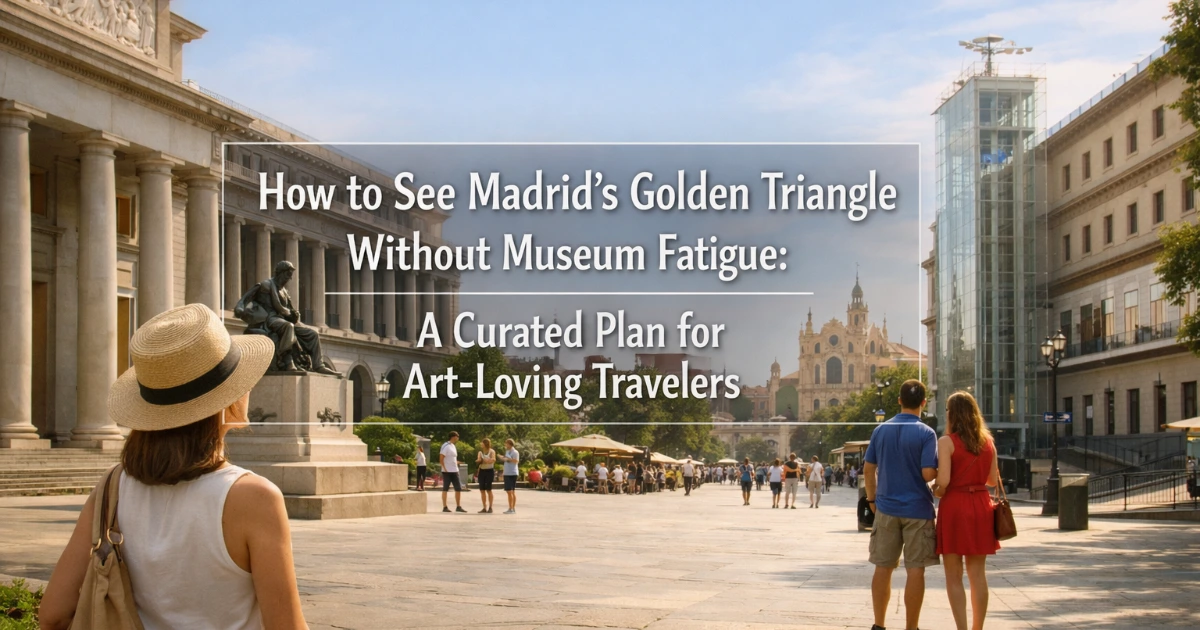
How to See Madrid’s Golden Triangle Without Museum Fatigue: A Curated Plan for Art-Loving Travelers
Updated
The right way to see Madrid’s Golden Triangle is usually not to “do the Prado, Reina Sofía, and Thyssen” in full. The day works best when you choose one anchor museum, then either add a second museum very selectively or break the visual intensity with Retiro Park. That wins in Madrid because the museum spine is compact enough to tempt overplanning, yet long and mentally demanding enough to punish it: lunch on the Paseo del Prado between the Prado and the Thyssen can preserve your attention for the afternoon, while pushing too far south toward Atocha after a full Prado morning often turns art into blur. The exception is travelers with a narrow, pre-decided agenda—repeat visitors, scholars, or committed modern-art lovers—who may want a denser two-museum day built around one specific priority.
The thesis here is simple and very Madrid-specific: the Golden Triangle is not a collecting problem, but a pacing problem. The best day is the one that still leaves you able to care by the final gallery, still willing to stroll before dinner, and still glad you came to the city rather than merely checked off its most famous institutions.
Everyone else should cut first, not add first. The first thing to cut is the fantasy of doing all three museums in full on one day. If you already know you want a guide who can shape that decision around your attention span rather than the map, private museum tours are the most natural next step.
A second correction is worth making early because it saves both money and energy: paying for a private car just to move between the Prado, the Thyssen-Bornemisza, and Retiro Park usually does not earn its cost. These stops sit close enough that curbside waiting, loading, and traffic lights can eat the same minutes you thought you were buying back. The upgrade that matters more is not a car between nearby stops, but a sharper museum focus and cleaner sequencing.
How many museums can you really do in one day in Madrid?
For most first-time art-loving visitors, one museum done properly or two museums done selectively is the sweet spot. A split art-and-park day is often the most satisfying version of the Golden Triangle because it lets the city interrupt the museums before the museums flatten the city.
- One museum: Best for travelers who care about context, want time to look rather than skim, and would rather leave with clear memories than a blurred final impression. This is the strongest choice for the Prado.
- Two museums: Works when one of them is approached as a focused visit, not a completion exercise. The pairing has to be chosen for visual rhythm, not prestige.
- Split art-and-park day: Best for couples, families, celebration travelers, and mixed-interest groups who want the day to feel cultured but not airless. Prado plus Retiro is the safest version.
- Three museums in full: Rarely worth it in one day. Even when the walking looks manageable on a map, the attention cost is far higher than the distance cost.
That last point is where many otherwise well-planned Madrid trips go wrong. Visitors see that the museums are all part of the so-called Golden Triangle and assume the phrase implies a logical same-day sweep. It does not. “Close together” in this part of Madrid is deceptive. You are not moving through a compact medieval quarter with naturally varied streets and frequent resets. You are moving along a grand museum-and-park axis where the spaces are broad, the pavements invite longer strides than tired legs really want, and the concentration demanded inside each building has very little in common with the open-air ease of neighborhood strolling later in the day.
If you care about the day’s emotional shape, not just the intellectual ambition, treat the number of museums as a cap on attention. One museum gives you room for lunch, discussion, a pause on a shaded bench, and perhaps a proper wander into Retiro or toward the elegant edge of Jerónimos. Two museums can be excellent, but only if the first does not consume the second. Three full museums are usually the option people brag about at breakfast and regret at dinner.
There is also a practical difference between “seeing” and “absorbing.” In Madrid, the museums themselves encourage focused looking more than total coverage. The official Prado visit page itself highlights a guided collection visit of roughly 90 minutes, which is a useful reminder that even the institution does not assume every serious visitor should attempt every room. That matters because travelers often think trimming the visit is a compromise when, in fact, it is often the more sensible choice.
Prado vs Reina Sofía vs Thyssen-Bornemisza: what actually changes your day
The real choice is not which museum is “best” in the abstract, but which museum earns the most attention from your particular group before fatigue arrives. The Prado, Reina Sofía, and Thyssen-Bornemisza do not tire people in the same way, and they do not combine equally well.
Prado: the strongest single-museum day, and the hardest museum to follow badly
The Prado is the museum most likely to justify being your only major stop. It rewards depth, but it also punishes greed. A serious Prado morning asks for slow looking, comparison, and context. It is the place where five paintings examined properly can be more satisfying than fifty rooms hurried through, and where a concentrated Prado private tours often beats a longer self-guided visit simply because it protects the quality of attention.
Why the Prado is harder to follow badly than the others comes down to mental texture. The collection asks for close observation of narrative, symbolism, dynastic history, and painterly decisions over time. That is thrilling when you still have energy and punishing when you are already saturated. This is why the common plan of “big Prado morning, quick lunch, then another major museum” so often underperforms. The issue is not only time. The issue is that the Prado leaves a lingering cognitive aftertaste. You may still be physically capable of entering another museum, but your visual discrimination has already dulled.
The travelers who do best with the Prado as a single anchor are first-timers, older travelers who prefer a calmer rhythm, couples who want lunch to remain a pleasure rather than a refueling stop, and families with teenagers who can handle one serious cultural session but not a whole day of interpretive effort. It is also the right call for anyone who suspects that the city’s evening matters as much as the museums. Madrid is generous at night. The Prado deserves a day that does not steal the rest of it.
If you want narrow practical details before committing, the official Prado visit page is the place to confirm current access information. For planning purposes, the more useful evergreen truth is that the Prado should be designed around concentration, not completion.
Reina Sofía: excellent for a committed modern-art traveler, but not the automatic second museum
The Reina Sofía is the right anchor when twentieth-century art is the point of the day, not when you are trying to prove you can cover the full Golden Triangle. It works well for travelers who already know they want modern and contemporary work, for returning visitors who have “done” the Prado before, and for groups with a clearer interest in modern Spanish history, politics, and formal experimentation than in dynastic portraiture or religious painting.
Its practical character is different, too. At the south end of the axis near Atocha, the Reina Sofía is not just “another museum nearby.” It changes the day’s geometry. The official Reina Sofía visit page even notes that online ticket holders are generally best entering through the Nouvel Building on Ronda de Atocha, which is a small but revealing detail: this museum sits in a different urban hinge from the Prado-and-Thyssen pair. Once you are down near Plaza del Emperador Carlos V and the Atocha side of the district, the day feels longer than it did up by the Prado.
That urban shift is precisely why the Reina Sofía is so often the wrong add-on after a full Prado morning. After a full Prado morning, Reina Sofía is usually the wrong second museum. The problem is not status; it is sequence. By then you have already spent your best concentration on Old Masters, broad art-historical framing, and long gallery time. Asking the brain to pivot again into a different interpretive mode at the point when your feet are heavier and the afternoon light is brighter rarely produces the sharp modern-art encounter you imagined.
The Reina Sofía is therefore strongest in one of two versions: as your main museum of the day, or as part of a south-to-north pairing in which it comes first and the second stop is shorter, more transitional, and easier to read. That is why Reina Sofía private tours tend to work best when they are treated as the backbone of the day rather than a box to tick after the Prado.
Thyssen-Bornemisza: the best bridge museum, and the most forgiving second stop
The Thyssen-Bornemisza is often the museum that makes a two-museum day possible. That is not because it matters less; it is because it is more legible as a bridge. Where the Prado can consume a whole morning and the Reina Sofía can feel like a fresh thesis statement, the Thyssen often reads cleanly in a curated pass. It helps travelers see transitions across schools, periods, and styles without demanding the same kind of total surrender a big Prado session does.
This is exactly why the Thyssen is the museum I would most readily add second. Its position on the Paseo del Prado between the Prado and the Cibeles side of central Madrid also helps. If you stop for lunch somewhere on the Paseo del Prado between the Prado and the Thyssen, you are using the district as it wants to be used: museum, pause, museum, then either coffee, park, or hotel. The walking order is calm, and lunch timing changes your concentration later in the day more than people expect.
The official Thyssen permanent collection page is useful before you go because it clarifies the breadth of the collection. In practical trip terms, that breadth is the point. The Thyssen lets travelers who want range experience a lot without feeling trapped inside one dense narrative. It is therefore the most forgiving museum for a shorter afternoon session and the likeliest to feel rewarding even when you are no longer at peak freshness.
A focused Thyssen-Bornemisza private tours visit also works well for mixed groups because it can be scaled. Serious art lovers can go deeper; less museum-hungry companions can still enjoy the arc of the visit without feeling marooned in a full scholarly march. That flexibility is one reason the Thyssen is such a useful second act.
Prado plus Retiro versus Reina Sofía plus Thyssen: the fork that saves the day
If you are deciding between a split museum-and-park day and a true two-museum day, these are the two sequences to compare first. They solve different problems, and choosing the right fork prevents both masterpiece overload and the dead-leg walking that makes central Madrid feel bigger than it is.
Choose Prado plus Retiro when the trip is about quality, mood, and a good evening
Prado plus Retiro is the better answer for a first trip, a romantic trip, a family day with older children, or any visit where the evening still matters. The rhythm is logical: arrive while you are fresh, give the Prado your best attention, have lunch nearby, then let the city open up. Retiro Park is not a consolation prize after culture. It is what allows the culture to settle.
This matters physically. Standing in galleries on stone floors is tiring in a way many travelers underestimate, and Madrid’s broad avenues add a subtle extra load because the district rarely breaks into the kind of short, varied, intimate blocks that make walking feel accidental. Retiro changes the body’s experience of the day. Once you cross into the park from the Jerónimos side or along the Alfonso XII edge, the stride length changes, the visual field widens, and people who were starting to fade often recover quickly. Even a modest loop toward the lake or the Palacio de Cristal can do more for the afternoon than another hour indoors.
There is a mood consequence too. Madrid becomes especially rewarding later in the day, when aperitifs, dinner, and long evening conversations come into play. A Prado-plus-Retiro day usually leaves travelers open to that rhythm. They dress for dinner without rushing, remember what they saw, and still have enough curiosity left for a detour, a proper bar stop, or a relaxed return through Salamanca or the central boulevards. If the point of travel is not merely cultural acquisition but a whole day that keeps its shape, this is the winning fork.
This is also where a Retiro Park private tours can make sense for travelers who want the afternoon to remain guided without staying in museum mode. It creates a softer second act, especially for mixed groups where one or two people love art more intensely than the others.
Choose Reina Sofía plus Thyssen when modern art is the brief and the group can handle two interiors
Reina Sofía plus Thyssen is the cleaner two-museum day for travelers who want two serious institutions without the heaviness of a full Prado morning first. The sequence works best south to north: begin at the Reina Sofía while everyone is still sharp, then move back up the axis for lunch and a shorter Thyssen session. This order prevents the modern museum from becoming an afterthought and uses the Thyssen’s legibility as a landing rather than a second mountain to climb.
The route itself matters. Starting near the Nouvel or Sabatini side of the Reina Sofía anchors you close to Ronda de Atocha and Plaza del Emperador Carlos V. From there, the move north toward the Prado-Thyssen stretch feels like a return toward equilibrium rather than a late-day push into a denser zone. By contrast, doing the Prado first and then dragging yourself south again to the Reina Sofía often feels longer than the map suggests, especially in heat or after a large lunch.
This pair suits travelers who already know they want twentieth-century art, couples on a return trip, or small groups where everyone is genuinely museum-committed. It is less suitable for families with mixed ages, for anyone who knows they lose focus after lunch, or for celebration trips where the emotional goal is “cultured and pleasurable” rather than “maximal coverage.” The sequence can be excellent. It just asks for a more self-aware group.
The wrong way to use this fork is to pretend it is a loophole that lets you also squeeze in a “quick Prado.” It does not. Once you start stacking three headline institutions, you stop making choices and start collecting obligations.
What a focused guide changes, and what it does not
A focused private guide changes far more than line-by-line interpretation. In the Golden Triangle, good guidance changes what feels worth your time because it decides the scale of the visit before the museum decides it for you.
This is especially obvious at the Prado. Unassisted visitors often lose time not because they are incapable of reading labels but because they are constantly renegotiating the day: should we go upstairs, double back, add one more room, pause here, skip there, sit now, push on? Those micro-decisions erode energy. A strong guide removes that drift. You stop moving like a person trying not to miss anything and start moving like a person with a point of view.
The same principle applies to mixed-interest groups. Couples do not fatigue in the same way. Parents and teenagers almost never do. One traveler wants context, one wants visual highlights, one wants fewer stairs, one wants a proper lunch, one wants to save appetite for dinner. Museum fatigue is often not “too much art” but too many unspoken mismatches. A private guide who knows Madrid can solve that by trimming the visit at the right moment, moving lunch ten or fifteen minutes earlier than expected, choosing the more forgiving second museum, or sending the group toward Retiro instead of into another gallery.
What guidance does not do is magically make a bad plan good. If you insist on a full Prado morning, a full Reina Sofía afternoon, and a token Thyssen stop in between, the presence of a guide will not rescue the underlying design. A guide sharpens a sensible day; it does not repeal human attention span.
Where guidance becomes genuinely high-value is when the stakes of the day are emotional as much as cultural. Think of the couple on a short first trip, the family with one serious art lover and three willing companions, the small celebration group who want something intelligent without becoming studious, or the food-and-wine travelers who know lunch and dinner are part of the day’s pleasure. Those are the travelers who feel the benefit fastest. They are not buying “more facts.” They are buying editorial restraint applied in real time.
If that sounds like your group, the right move is usually to plan the number of museums before you think about routes and vehicles. That is the moment where a tailored guide saves the day from overload. When the objective is a day that still feels generous by late afternoon, not one that collapses into silence by 5 p.m., Inquire now.
Where extra spend earns its place, and where it does not
Spend more on judgment and comfort around the day; spend less on performative upgrades inside a very walkable museum zone. That is the clearest value rule for Madrid’s Golden Triangle.
Private guiding, timed planning, and help shaping the right lunch window are worth real money here because they protect the part of the trip that is hardest to recover once lost: attention. A hotel pickup can also be worthwhile if you are staying farther west, have older travelers in the group, are visiting in high heat, or want to arrive at the first museum without already using up energy on logistics.
By contrast, paying more for a private car between Golden Triangle stops usually does not materially improve the day. Between the Prado, Thyssen-Bornemisza, and Retiro Park, the friction is rarely distance alone. It is stop-start timing. Waiting at the curb, buckling in, inching forward, and being dropped a short distance later does not create the kind of release people imagine. Walk those segments when you can. Save the car for the hotel transfer, the move to lunch if it is well outside the district, or the trip onward to a very different part of the city.
This is also the place to be honest about guided focus versus “skip-the-line” mythology. Ticketing help can be useful, but in this district the deeper win is not always faster entry. It is entering the right museum at the right level of ambition. A traveler who gets into the wrong second museum five minutes faster has not solved the core problem.
There is a bodily consequence and a mood consequence to spending well. Body first: Madrid’s museum core invites long periods of standing, crossing broad streets, and continuing onward because the next cultural stop appears deceptively close. Mood second: once a day tips from eager to overfilled, everything afterward becomes more transactional. Lunch becomes efficiency. The park becomes optional. Dinner becomes recovery. Good spending prevents that slide. Bad spending decorates it.
A curated plan that keeps the Golden Triangle rewarding
If you want a single planning framework to remember, use this one: pick one anchor museum, choose whether the afternoon needs art or air, and never let prestige choose the second stop for you.
If this is your first serious art day in Madrid
Choose the Prado as the anchor. Give it the morning. Lunch on or just off the Paseo del Prado between the Prado and the Thyssen, then decide honestly whether you still want another interior. In many cases the right move is Retiro, not another museum. This is the day shape that makes Madrid feel both cultivated and humane.
If modern art is your real priority
Start at the Reina Sofía and pair it, if needed, with a shorter Thyssen visit. This produces a coherent two-museum day without asking the Prado to do too much in passing. It is the best answer for travelers with a clear twentieth-century bias and enough appetite for two substantial interiors.
If your group has uneven museum stamina
Do not compromise by cramming all three museums halfway. Compromise by choosing one museum fully enough to feel real, then giving the afternoon a softer second act. That may be Retiro, a long lunch, coffee with a view over the boulevard, or a light neighborhood stroll. The day will read as more refined, not less ambitious.
If you are building this into a longer Madrid stay
Spread the museums across the trip. There is no prize for consuming the Golden Triangle at once. Put one serious museum day early, then save another museum for a different morning with fresh attention. If you are shaping a wider first visit, our 3-day Madrid itinerary shows how this art day fits without stealing energy from the rest of the city.
That broader point is worth ending on before the FAQ. Madrid is better when it stays dimensional. The city gives back when culture, air, appetite, and evening life still speak to one another. The Golden Triangle should intensify the trip, not dominate it. The best version is not the one with the most ticket scans. It is the one that still leaves room for conversation on the walk out.
FAQ
Can you do Prado, Reina Sofía, and Thyssen in one day?
You can enter all three in one day, but that is different from seeing them well. For most travelers, doing all three in full creates diminishing returns by the second half of the afternoon. A more rewarding plan is one anchor museum plus either a carefully chosen second museum or a museum-and-Retiro split.
Which museum should first-time visitors choose if they only do one?
The Prado is usually the best one-museum choice for a first serious art day in Madrid. It has the strongest payoff when approached with focus, and it leaves open the most satisfying afternoon options afterward. The main exception is a traveler whose primary interest is twentieth-century art, in which case the Reina Sofía may deserve the anchor slot.
Is the Reina Sofía worth it if you are not a modern-art specialist?
Yes, but it is most satisfying when chosen deliberately rather than added automatically. If modern and contemporary art are not your natural preference, the Reina Sofía can still be rewarding with a focused route and clear context. What tends not to work is visiting it as a tired second act after an expansive Prado morning.
What is the best second museum after the Prado?
The Thyssen-Bornemisza is usually the better second museum after the Prado because it is easier to read in a curated pass and works well as a bridge rather than a second marathon. The wrong add-on after a full Prado morning is usually the Reina Sofía, which asks for a sharper mental reset than most travelers still have available.
Who should do Prado plus Retiro instead of two museums?
Couples on a short first trip, families with mixed museum stamina, celebration travelers, and anyone who wants the evening to stay lively should strongly consider Prado plus Retiro. That sequence gives the morning to art and the afternoon to recovery, which often leads to a better overall Madrid day than stacking interiors.
Does a private guide really help in the Golden Triangle?
Yes, when the guide is shaping scope as much as interpretation. The biggest benefit is not hearing more facts; it is avoiding wasteful choices, wrong sequencing, and the temptation to turn a strong museum day into an endurance test. Good guidance is most valuable when the group has mixed priorities or limited time.
Should you book a driver for the museum area?
Usually not for the short hops between the Prado, Thyssen-Bornemisza, and Retiro. Those segments are often easier on foot than they are by car once loading and curbside timing are counted. A driver is more useful from hotel to first museum, in very hot weather, for travelers with mobility concerns, or when you are heading to a lunch or evening destination well beyond the museum district.
How far in advance should you check museum logistics?
Check the official sites before the day of your visit, especially if you care about timed entry, access points, or temporary operational details. Use the official Reina Sofía visit page, the Prado visit page, and the Thyssen site to confirm current information, but keep your planning framework simple: decide your anchor museum first, then decide whether the afternoon wants another gallery or a change of pace.
If you’re interested in any private tours of Madrid, please reach out to us.



 So if you are looking for the absolute best in Madrid & surroundings with authentic local fully-licensed native guides whose English you can actually understand and with an exclusive and amazingly fun itinerary