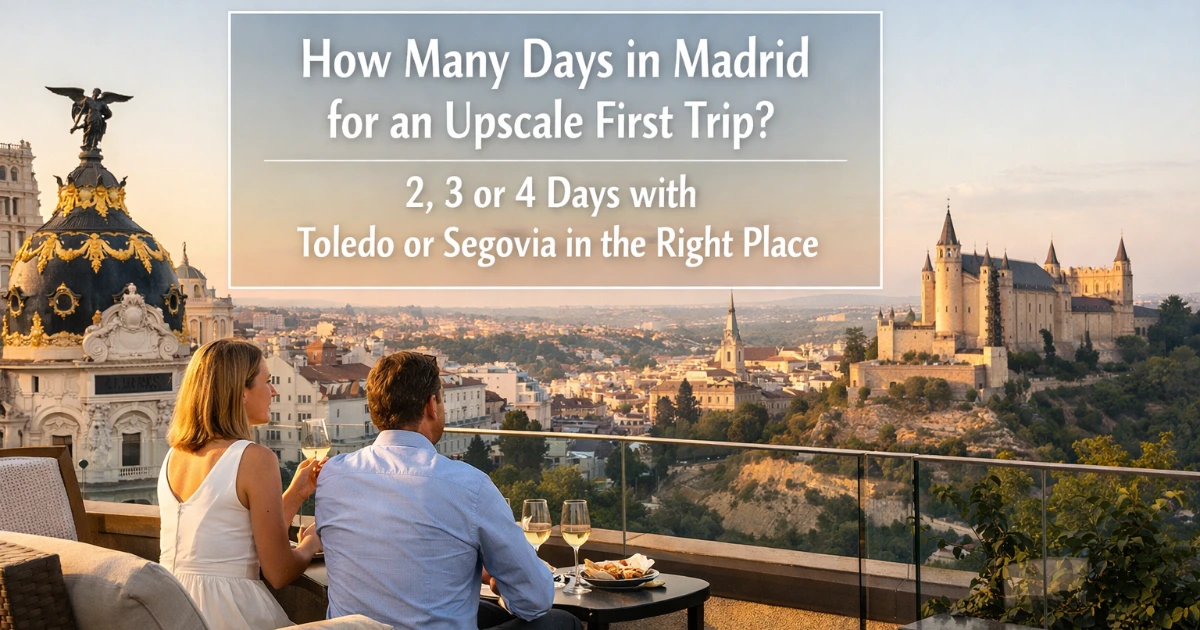
How Many Days in Madrid for an Upscale First Trip? 2, 3 or 4 Days with Toledo or Segovia in the Right Place
Updated
The answer before you book another night
Three days is the best first Madrid stay for most discerning travelers. It is the point at which the Royal Palace and old-center circuit, the Prado-led museum day, and one slower neighborhood afternoon all fit without turning the trip into a march between tickets. Madrid is one of the rare capitals where rhythm matters more than raw trip length. In real city conditions, that matters more than squeezing in one more monument. Madrid opens up when you have time for the museum-park axis, a proper lunch, a pause, and an evening that still feels alive. The clearest exception is a traveler folding Madrid into a longer Spain journey who wants a tightly edited city-only visit; for that traveler, two days can work, but only if Toledo and Segovia stay out of the plan.
Here is the local hinge that usually gives the right answer: the Atocha-side Prado edge. Once you finish a serious Prado day and step back out near Atocha, you are not really done with Madrid yet. Most first-timers still need Retiro, a gentler cultural block, and the Retiro-to-Salamanca afternoon block more than they need a dawn departure. That is why the Atocha-side Prado edge matters so much: it shows when another dawn departure is a downgrade, not an upgrade. Paying for a private day trip on a short Madrid stay weakens the city experience instead of upgrading it, and the extra city-only fourth day is the one travelers add too casually when they have not decided what that day is actually for.
The planning grid that usually gets it right
- Default winner: 3 days in Madrid if this is your first upscale visit and you care about art, heritage, meals, and not arriving at dinner exhausted.
- Runner-up: 4 days if the fourth day is clearly assigned, usually to Segovia and sometimes to Toledo.
- Use 2 days: when Madrid is one stop on a bigger Spain itinerary and you accept a city-only edit.
- Wrong fit: 2 days plus Toledo or Segovia, or 4 city days with no real purpose beyond adding one more ticket.
If you already know you want a city-only version of the sweet spot, this Madrid 3-day itinerary is the closest starting framework. The rest of this guide is about what those extra days really buy once museum attention, dinner energy, and the pull of Toledo or Segovia are weighed honestly.
What 2 days in Madrid really buys
Two days in Madrid buys a sharp first look, not a full first relationship with the city. It works best for travelers using Madrid as one piece of a wider Spain trip, for repeat Europe visitors who do not need every headline sight, and for business or celebration travelers with limited time who still want the capital to feel intentional rather than incidental. In practice, two days means one day anchored around Habsburg Madrid and the Royal Palace area, and one day around the Prado side of town with either Retiro or a single secondary museum. It is enough to understand the city’s tone. It is not enough to understand its range.
The consequence of picking two days is that you must be willing to cut with discipline. The second museum is usually the first thing to trim, not the evening. That may sound backwards, but on a short Madrid stay a strong dinner, a slower paseo, and the feeling of arriving somewhere before you are depleted matter more than claiming three institutions in forty-eight hours. If you rush the Prado, sprint across to Reina Sofía, and then try to add Toledo or Segovia because you have a private car, you end up collecting transfers and entrances rather than Madrid itself.
Two days also exposes a common planning mistake: maps make central Madrid look tighter than it feels in the body. The old center, the Prado spine, Retiro, and the shopping and restaurant streets of Salamanca do connect, but they do not behave like a single compact museum quarter. There are resets. Taxis solve some of that, but not the mental friction of changing districts, re-orienting, and deciding what the rest of the day is for. For couples flying long-haul, families managing different energy levels, or travelers with one big evening reservation, a tight two-day stay can still be excellent. It just stops being excellent the moment you ask it to carry a day trip too.
The travelers most likely to regret a 2-day answer are first-timers arriving from long-haul flights, serious museum visitors, and anyone who imagines that Madrid behaves like a quick palace-and-plaza capital. It does not. Even when the center looks manageable on a map, the city asks for one more half day of appetite and attention than people initially budget. Add arrival fatigue, a celebratory lunch, or one important evening reservation, and those two days can shrink to something closer to one and a half.
Is 3 days enough in Madrid for a first trip?
Yes, 3 days is enough in Madrid for a first trip, and for many travelers it is the best answer rather than a compromise. Three days lets the city break into three distinct moods instead of one long historical blur: old Madrid and the palace circuit, the museum-and-park axis around the Prado, and then a day that belongs to the way Madrid actually feels when you are not rushing between signatures. That third day is what turns the stay from respectable to memorable.
The value of a third day is not that it adds more quantity. The value is that it changes pace. You can give the Prado real attention without worrying that every minute there is stealing time from the rest of the city. You can let the Royal Palace and the old-center walks happen without stacking them onto an art marathon. And you can reserve one day for the softer but still deeply city-specific sequence that visitors underestimate: a measured morning, Retiro, a few blocks of Salamanca, maybe Las Letras, perhaps a targeted second museum, then a lunch or dinner that is not rushed. That is a very different experience from a 2-day sprint, and it is why 3 days is the default answer for couples, multigenerational families, small groups, and food-and-wine travelers.
Three days is also where expert planning begins to matter more than brute stamina. On a shorter trip, you mostly need restraint. On a three-day trip, sequence becomes the real skill: which museum deserves the long visit, which should stay focused, and whether neighborhood time comes before or after art. If your first instinct is to keep stacking museums because Madrid is a capital city, that is usually the wrong instinct. Madrid does not run out of quality on day three; it simply changes register. That is when the city starts rewarding curiosity, comfort, and better pacing rather than just endurance.
Another reason 3 days wins is that Madrid’s best first-trip contrasts are not next-door contrasts. The palace side and the Prado side are mentally different visits. Retiro and Salamanca are different again. When each gets its own share of the trip, travelers stop feeling as if they are speed-dating the city. That matters for couples and small groups in particular, because different interests can overlap without anyone feeling that the plan has tipped completely toward art, shopping, or history. Three days gives Madrid just enough room to feel coherent instead of crowded.
What actually fills day 3 after the Prado, palace, and the museum spine
Day 3 should usually stay in Madrid. That is the clearest planning call in this guide, and it becomes even clearer after a real museum day. The Atocha-side Prado edge is the clue: once you have done the Prado properly and felt the pull of Atocha, Paseo del Prado, and the park, leaving the city the next morning often comes a touch too early. What most first-timers still have not done is let the city breathe. They have seen the headline facades, but they have not lived the transitions that make Madrid feel generous rather than dutiful.
Before you decide that day 3 belongs to Toledo or Segovia, compare your interests against the official Prado visit page (https://www.museodelprado.es/en/visit-the-museum) and the official Reina Sofía visit page (https://www.museoreinasofia.es/en/visit). For some travelers, a single morning at the Prado is enough. For others, it is not remotely enough, especially if a temporary exhibition, a focused Goya or Velazquez priority, or a serious interest in Guernica changes the weight of the visit. The same logic applies if you are deciding whether Thyssen should be a light stop or a real one; the official Thyssen permanent collection page (https://www.museothyssen.org/en/collection/permanent-collection) is useful precisely because it helps you decide how much of your energy belongs inside a museum and how much should stay with the city around it.
What fills day 3, then, is not filler at all. It is the Retiro-to-Salamanca afternoon block that many first-timers skip because it looks less monumental on paper. Start with air and trees rather than another queue. Cross by Puerta de Alcala instead of treating the park as a backdrop. Let Salamanca do what it does well: wider streets, browsing, lunch, design, polished service, and a different social temperature from the palace side of town. If you are museum-led, a targeted secondary museum fits beautifully before or after that sequence. If you are not, the city still carries the day with ease. For travelers who want the museum side of Madrid handled with more precision, this Golden Triangle pacing guide is the most helpful companion read.
This is also where Madrid separates itself from cities that demand constant monument-chasing. On day 3, the payoff is not another mandatory landmark; it is the confidence to enjoy the city at full volume without feeling that you are wasting time. That is why the short-stay temptation to bolt for Toledo or Segovia is often a mistake. The part of Madrid you would be giving up is not a spare afternoon. It is the part that makes the rest of the stay feel whole.
What a fourth day really adds, and the extra day people add too casually
A fourth day in Madrid earns its place only when it changes the shape of the trip. If it does not change the shape, it usually does not deserve the room night. This is the extra day travelers add too casually: the city-only fourth day that exists because “more time is always better,” but in practice turns into a second-tier museum, some shopping that could have fit elsewhere, and a dinner reached with no special anticipation. Madrid can absolutely carry four days. It just does not do so automatically.
The strongest city-only use of a fourth day is not another heavy cultural slog. It is recovery, depth, or specialization. Maybe the group is mixed and one day needs to move slower. Maybe you are serious about shopping and want Salamanca to be more than a quick pass after Retiro. Maybe you are a football household and the Bernabeu belongs on its own logic. Maybe you have a late celebration dinner and want a deliberately light afternoon. Or maybe day 3 became more museum-heavy than expected and the fourth day now buys back ease. Those are real reasons. “One more day because Madrid is the capital” is not, by itself, a real reason.
This is where the Retiro-to-Salamanca afternoon block matters again. That block is what a fourth day can buy besides another museum: a day that feels physically lighter and socially richer. It gives you time for the city at conversation pace, not just at ticket pace. That makes a difference for couples traveling for birthdays or anniversaries, for families that need breaks between formal visits, and for food-and-wine travelers whose best memories may come after 6 p.m. rather than before noon.
There is also a difference between a day that is loose and a day that is shapeless. Madrid rewards looseness: a park, a browse, a long aperitif, a late table. It punishes shapelessness: drifting between districts because there is technically more time. A city-only fourth day works when you know whether it is for recovery, shopping, football, extra art, or a celebration rhythm. Without that intention, four days can feel less elegant than three.
For most first trips, though, the stronger use of a fourth day is to leave the city once, well, and return with the evening still intact. That is why the 4-day answer is usually not “more Madrid.” It is “Madrid plus one carefully chosen out-of-town day.” The question is which one, and that answer is not the same for every traveler.
Toledo or Segovia: which one actually earns the extra day?
Segovia is the better default extra day for a first Madrid stay, while Toledo is the richer but more demanding alternate. The reason is not beauty. Both are beautiful. The reason is friction. The Toledo versus Segovia departure burden from a Salamanca base is not a minor detail. From a Salamanca base, Segovia usually asks less of the departure and less of the body. Chamartin sits more naturally for northbound rail and northbound road departures than Atocha does for a southbound Toledo morning, and that small routing reality is one of those details that changes how the day feels. Toledo often starts with a more awkward reset and then asks more once you arrive.
That does not make Toledo wrong. It makes Toledo specific. It is the better choice for travelers who actively want layered medieval history, a denser old-city atmosphere, more dramatic topography, and who do not mind that the day’s walking rhythm can feel more compressed. Toledo has stronger intensity. Segovia has cleaner flow. One city folds around slopes, stone lanes, and the sensation of working your way through a hill town. The other gives you a clearer sightline between headline moments: aqueduct, old center, cathedral, Alcazar. For many comfort-first first-timers, that cleaner line is exactly why Segovia earns the fourth day.
How the choice usually breaks down
- Choose Segovia if you want the smoother default, are based in Salamanca, care about keeping the evening alive back in Madrid, or are traveling with parents, children, or mixed walking speeds.
- Choose Toledo if your interest is specifically in layered religious history, El Greco, tighter medieval texture, and you accept that the day may feel steeper, denser, and a little more exacting.
- Skip both if you only have 2 days, or if your 3-day Madrid plan still has unresolved museum and neighborhood gaps.
Toledo’s burden is not just distance; it is cumulative effort. Station arrival, transfer logic, the old city’s inclines, the way one lane suddenly becomes steps, the way heat or crowds collect in stone corridors, the way lunch timing can decide whether the day feels cultured or simply packed: all of that is real. Segovia is not effortless either, especially if you walk all the way toward the Alcazar, but the energy curve is friendlier. The open setting around the aqueduct and the clearer progression of the day help travelers feel oriented rather than managed. If you want the fuller comparison and the alternatives beyond these two, this full day-trip comparison goes deeper.
One more honest correction: do not choose Toledo merely because it sounds like the “more cultural” answer. On a first Madrid stay, the better answer is often the day that fits the stay, not the day with the densest historical symbolism. The right extra day is the one that leaves Madrid strengthened, not the one that leaves you too spent to enjoy your final dinner there.
Who should keep all days inside Madrid
Some travelers should keep every day inside Madrid, even when they technically have four. Art-led travelers are the clearest example. If the Prado is not a box to tick but a real priority, and if Reina Sofía or Thyssen matter beyond their headline works, then leaving the city can be the wrong kind of efficiency. The same is true for dining-led travelers who care as much about long lunches, aperitifs, and a proper final dinner as they do about monuments. Madrid is unusually rewarding when meals are allowed to shape the day rather than just interrupt it.
Families and multigenerational groups are the next strong city-only candidates. A day trip adds invisible administrative load: station timing, vehicle transfers, bathroom timing, snack timing, energy mismatches, and the emotional cost of one person holding everyone else’s pace. In Madrid itself, those frictions are easier to absorb. You can re-route with a short taxi. You can slow lunch down or split an afternoon more easily. You can let one part of the group rest while another keeps going. That flexibility is worth more than many travelers realize until they have already overplanned.
Celebration travelers also often do better by staying in Madrid. If the trip includes an anniversary dinner, a proposal, a milestone birthday, or simply a high-value evening you do not want flattened by a long day, the city-only choice becomes stronger. Madrid’s late rhythm is a feature, not an afterthought. A day that ends with energy still in reserve has a very different emotional tone from one that ends with everybody back at the hotel reassembling themselves after a long return. Not every excellent first Madrid trip needs a day trip. For many of the travelers best served by premium planning, the maturity is in knowing when to stop adding them.
This city-only answer is also right for visitors who are choosing Madrid as a base for ease, not conquest. Some travelers arrive after Andalusia, after work, after a long-haul flight, or in the middle of a larger European route. For them, the capital does not need to prove itself by generating another transfer day. It needs to be generous, legible, and enjoyable. Madrid can do that exceptionally well, but only if you let it remain a city rather than turning it into a launch pad.
Where paying more changes the trip, and where it does not
Premium spend changes a Madrid trip most when it buys clarity, not just comfort theater. A guide changes the Prado more than a larger room changes the Prado. A driver changes a Toledo or Segovia day more than a more expensive train seat changes it. A well-placed hotel changes every single morning and evening. Those are the upgrades with real force. They remove decision drag, compress awkward transfers, and protect the parts of the day you actually remember. If your answer is a 3-day city stay, a well-built city day around the palace, old center, and museum spine does more for the trip than sprinkling small premium upgrades everywhere.
Premium spend does not help when you force Toledo or Segovia into a two-day Madrid stay. A private car may make that day smoother, but it cannot give the city back. That is the clearest place where spending more does not earn its cost. Another corrective example: a glamorous Salamanca hotel does not erase the Atocha departure burden on a Toledo morning. It may improve the room and the surrounding dinner options, but it does not change the geometry of the day. In other words, comfort spend should follow the plan; it should not be asked to rescue the wrong plan.
Where paying more often does pay off is in one of two directions. Either you buy a better city day, with a strong guide and the confidence to see the core without rushing, or you buy a better fourth day, with transport and pacing that make Segovia or Toledo feel deliberate rather than improvised. Travelers leaning toward the city-only answer often do best by starting with the Best of Madrid private tour as the backbone and building outward. Travelers leaning toward a fourth-day add-on often get more value by investing in the day-trip design itself rather than in incidental upgrades around it.
What Madrid does to the body over 2, 3, and 4 days
Madrid is kinder on the knees than some Spanish cities, but it is harder on the feet than first-time visitors expect. The main issue is not steepness inside the city; it is accumulation. Museum floors are real walking. The old-center and palace side can be more stop-start than the map suggests. The Prado side of town pulls you south and east, while Salamanca pulls you back north and a little outward. In a 2-day stay, those shifts can feel efficient on paper but tiring in the body. In a 3-day stay, they become manageable because the trip stops asking one day to do three jobs.
A day trip changes the body in a different way. Toledo adds climbs, uneven stone, and the fatigue that comes from repeated small vertical decisions rather than one clear uphill. It also adds transfer resets: station or car, arrival orientation, uphill or shuttle logic, then the reverse in the afternoon. Segovia can still be a full walking day, especially if you keep going all the way toward the Alcazar, but the line of effort is easier to understand. The day tends to feel cleaner physically because the route is less tangled. That is part of why Segovia more often earns the extra day for travelers who want a smoother first visit.
Heat and timing matter too, even when you do not want to overstate them. Madrid can ask more from you in the middle of the day than the postcard version of the city suggests, and Toledo can magnify that because there is less sense of easy reset once you are in motion. That does not mean you avoid these places. It means you plan length around what the body can enjoy, not just what the list can hold.
What Madrid does to the mood of the trip
Madrid’s greatest luxury is not a monument. It is the evening mood you still have left after a well-structured day. A good 3-day plan protects that. You finish the Prado with curiosity still intact. You arrive at dinner wanting conversation rather than silence. You walk out for a drink or dessert because it sounds appealing, not because you feel obligated to make the most of the city. This is one reason short-stay day trips can be such a bad trade. They do not just consume hours; they flatten the tone of the trip.
The mood consequence is especially important for travelers who are choosing Madrid as much for lifestyle as for monuments. Couples celebrating something important, friends traveling for great meals, visitors who like beautiful service but dislike feeling herded, and anyone who wants the trip to feel polished rather than overengineered usually needs one Madrid day that is not built around departure logistics. That day is often day 3. It can be light on landmarks and still feel rich because the city is finally being experienced at its natural social pace.
This is also why the wrong extra day is so disappointing. A fourth city day with no clear idea behind it can make the trip feel longer in a flat way, as if the city is stretching instead of deepening. A fourth day that has a defined emotional job, whether that is Segovia, Toledo, a slower shopping-and-park day, or a recovery day before a major dinner, does the opposite. It gives the stay shape. When people say Madrid was “just right” or “a little too much,” they are often describing mood management more than sightseeing volume.
Base choice changes the answer more than people expect
Your hotel base can flip the right answer between 3 and 4 days, or between Segovia and Toledo. A traveler based near Retiro or Las Letras will feel the museum-and-park half of Madrid more easily and may discover that a 3-day city stay is enough. A traveler based in Salamanca may love the dining, shopping, quieter polish, and overall comfort, but should be honest about the morning geometry of the trip. Salamanca is excellent for Madrid living; it is not automatically excellent for every departure. That is especially true if Toledo is in the mix.
The Salamanca example is worth stating plainly because it is a mildly counterintuitive local correction. Salamanca is often the most appealing upscale base for a first stay, but from that base a Toledo departure can feel more burdensome than travelers expect, while Segovia often feels more natural. By contrast, if your stay will be almost entirely city-only, Salamanca can be a splendid argument for three days because it gives that Retiro-to-Salamanca afternoon block real substance. If you want help choosing between Salamanca, Las Letras, Justicia, and Retiro before you lock the trip length, this where-to-stay guide is the right next read.
Base choice also changes how quickly you can recover from a heavy morning. From Retiro or Las Letras, a midday break after the Prado or Reina Sofía is simpler, and that alone can save a 3-day trip from becoming overfilled. From Salamanca, the reward often comes later in the day: better browsing, calmer avenues, and stronger dinner geography. Neither is universally superior. Each simply pulls the trip toward a different kind of satisfaction.
The practical takeaway is straightforward: do not separate base choice from stay length. The wrong hotel can make four days feel awkward. The right hotel can make three days feel ample. And if you are debating a day trip, your base is not an aesthetic side issue; it is part of the transport equation.
How to choose without second-guessing yourself
If you want the most reliable answer, choose 3 days for a first Madrid trip and do not apologize for it. Choose 2 days only when Madrid is one carefully edited stop inside a longer Spain route and you are willing to keep the stay fully inside the city. Choose 4 days only when the fourth day has a declared purpose. Most often that purpose is Segovia. Sometimes it is Toledo. Sometimes, for art-maximalists, shoppers, mixed-energy families, or celebration travelers, it is a slower Madrid day that lets the city land properly. What you should not do is mistake more nights for more value without deciding what those nights are buying.
The cut-first rule is equally important. If the plan starts to bulge, cut the day trip before you cut the third day in Madrid. If it is still too full, cut the second museum before you cut the neighborhood-and-evening time that makes Madrid feel complete. Put differently, the right answer is not the longest one. The right answer is the one that lets one day hold the palace and old center, one day hold the Prado side properly, and one day either deepen Madrid or cleanly step outside it. When travelers regret a Madrid plan, they usually do not regret having too little ticketed content. They regret losing the afternoon that should have gone to Retiro and Salamanca, or the dinner they were too tired to enjoy after forcing Toledo onto the wrong day.
For families, couples, and small groups, the real relief comes when somebody solves those sequencing questions before arrival: which museum deserves the long slot, whether the fourth day should stay in Madrid or go to Segovia, and how the hotel base changes the station or driving burden. That is where private Madrid day trips and tailor-made private touring stop being generic add-ons and start removing friction from the exact decision this article has been solving. When you want the city, the day trip, and the pacing designed as one coherent stay rather than three separate bookings, Inquire now.
FAQ
Is 2 days enough for a first trip to Madrid?
Two days is enough for a selective first look at Madrid if you keep the stay city-only. It is not enough for a satisfying first trip if you also try to add Toledo or Segovia.
Is 3 days too much for Madrid?
No. Three days is usually the sweet spot because it allows one heritage day, one museum-led day, and one slower day for neighborhoods, meals, and the part of Madrid that visitors often rush past.
Should I do Toledo or Segovia on a 3-day Madrid trip?
Usually no. On a true 3-day first stay, the extra day is more often better spent inside Madrid, especially after the Prado and palace circuit. Add Toledo or Segovia when you have a fourth day, not when you are still trying to finish the city.
Which day trip is easier from a Salamanca hotel?
Segovia is usually the easier default from a Salamanca base because the departure logic is cleaner than Toledo’s and the walking flow tends to be less taxing once you arrive.
Is Toledo worth it over Segovia?
Toledo is worth choosing over Segovia when layered medieval history, El Greco, and a denser old-city atmosphere matter more to you than ease. It is the more demanding day, which is why it is not the universal default.
Who should keep all days inside Madrid?
Art-led travelers, food-and-wine travelers, mixed-age families, and celebration travelers often do best by keeping every day in Madrid. They usually benefit more from a better-paced city stay than from another transfer-heavy day.
What should art lovers do with day 3 in Madrid?
Art lovers should usually keep day 3 in the city and use it for a more focused second museum, a return to the Prado if needed, and time around Retiro and Salamanca rather than leaving town too soon.
Does a private driver make a short Madrid stay suitable for Toledo or Segovia?
No. A private driver makes the journey smoother, but on a short Madrid stay it does not solve the real problem, which is that the city itself has not yet had enough room to unfold.
If you’re interested in any private tours of Madrid, please reach out to us.




 So if you are looking for the absolute best in Madrid & surroundings with authentic local fully-licensed native guides whose English you can actually understand and with an exclusive and amazingly fun itinerary