The Lisbon Tile Museum Morning: Madre de Deus, Alfama and a Design Stop in One Route
Updated
The best Lisbon Tile Museum morning starts with Madre de Deus before Alfama, then uses Alfama as the street-level proof of what the museum has just explained, and finishes with one design stop in Chiado only if the group still has appetite for looking closely. That order works because the National Tile Museum sits east of the old-city walking spine, near Rua Madre de Deus and the Xabregas edge rather than inside Alfama itself; starting there prevents the day from opening with cobblestone climbing, tram crowding, and a transfer reset before the most context-heavy stop. The clearest exception is a shopping-led day: if your real goal is buying, commissioning, or comparing tile makers, separate the museum from the shopping-focused route and let the museum serve as context on another morning.
The thesis is simple but specific to Lisbon: azulejos make most sense when you see them first as a language in the former Madre de Deus convent, then as urban skin in Alfama, and only afterward as contemporary design judgment in Chiado. This is not a generic museum-plus-neighborhood loop. It is a morning for travelers who want tile, craft, old-city context, and one polished design finish without turning a specialist subject into a souvenir chase. It also sits naturally beside Tailor-Made Private Tours of Lisbon when the goal is not just to see blue-and-white surfaces, but to understand why certain motifs, repairs, facades, and shop claims deserve attention.
The verdict: make it a focused morning, not a full art day
The Tile Museum earns a morning because it asks for concentration before Lisbon asks for leg work. The permanent route is strongest when travelers arrive fresh enough to notice how technique, repetition, patronage, convent architecture, and city imagery build on one another. After that, Alfama changes the mood from museum reading to lived streets. Chiado belongs last because it is the cleanest place to translate the morning into design taste, but it should not be asked to carry the whole route.
The firm editorial call is this: do not build this as a three-museum day, and do not bolt it onto Belem, MAAT, or Gulbenkian unless the party has unusually high art stamina. Lisbon rewards curiosity, but it punishes overfilled cultural days with hot pavements, slow transfers, and short tempers. If tiles are the question, the answer is not more museums. It is a more intelligent sequence: Madre de Deus for the grammar, Alfama for the city body, Chiado for the buying eye.
The route also suits repeat visitors better than first-timers trying to cover every headline monument in one day. A first Lisbon visit often needs Belem, Baixa, Alfama, and one viewpoint before it needs specialist depth. A second visit, a design-led stay, or a private cultural morning can give azulejos the attention they deserve without stealing oxygen from the rest of the itinerary. That is why this article narrows the question deliberately: not “what are the best things to do in Lisbon,” but how to shape one morning around tiles so it feels coherent, comfortable, and worth the time.
What this route refuses to do is just as important as what it includes. It does not make tiles stand in for all Portuguese craft, and it does not pretend that one museum can explain every Lisbon facade. Its strength is more modest and more useful: it gives travelers enough structure to notice better, choose more carefully, and avoid treating every blue panel as the same kind of object. That restraint is what makes the morning feel premium without becoming inflated.
The ranked route ladder for this specific morning
The best route is a three-step ladder: 1. Madre de Deus first, 2. Alfama second, 3. Chiado design stop last. This order is not about prestige. It is about cognitive load and city movement. Madre de Deus gives the group a controlled visual vocabulary before the day becomes uneven, Alfama tests that vocabulary against exterior walls and old-city texture, and Chiado lets the group make calmer judgments about modern design without confusing retail polish with cultural understanding.
The runner-up is Madre de Deus followed by a shorter Alfama descent and no Chiado stop. This is the better version for families with children, older parents, heat-sensitive travelers, or anyone with dinner plans that should not be sacrificed to one more boutique. It still gives the route its essential arc. What it loses is the contemporary design translation; what it gains is a cleaner lunch landing, less decision fatigue, and fewer late-morning transfers.
The weakest version is Chiado first, then Alfama, then the museum. It looks attractive on paper because Chiado is central, elegant, and hotel-friendly, especially for travelers staying around Baixa-Chiado, Avenida da Liberdade, or Principe Real. In practice, it puts the lightest interpretive stop before the deepest one, then sends the group across Lisbon after the old city has already taken energy out of the legs. The counterintuitive correction is that central Lisbon is not always the best place to start a specialist Lisbon morning. For this subject, the eastern museum edge wins.
A fourth version belongs to a different article: a buying-first day that uses Chiado, Principe Real, and selected ateliers with shipping questions, custom commissions, and material comparison. That can be excellent, but it should not pretend to be a museum morning. For a more retail-driven design day, the adjacent planning lens is closer to Lisbon for Tile-and-Design Buyers than to this Madre de Deus sequence.
Why the museum deserves the morning slot
The National Tile Museum deserves the morning because its best moments reward slow looking before fatigue makes pattern feel repetitive. The official museum page describes the National Tile Museum as housed in the former Convent of Madre de Deus and frames it around the history of glazed tiles in Portugal; use the National Tile Museum official page (https://www.museusemonumentos.pt/en/museus-e-monumentos/museu-nacional-do-azulejo) to confirm current public status before placing it in a live itinerary. That official check matters because venue works, special closures, and visitor conditions are not details a polished city guide should invent.
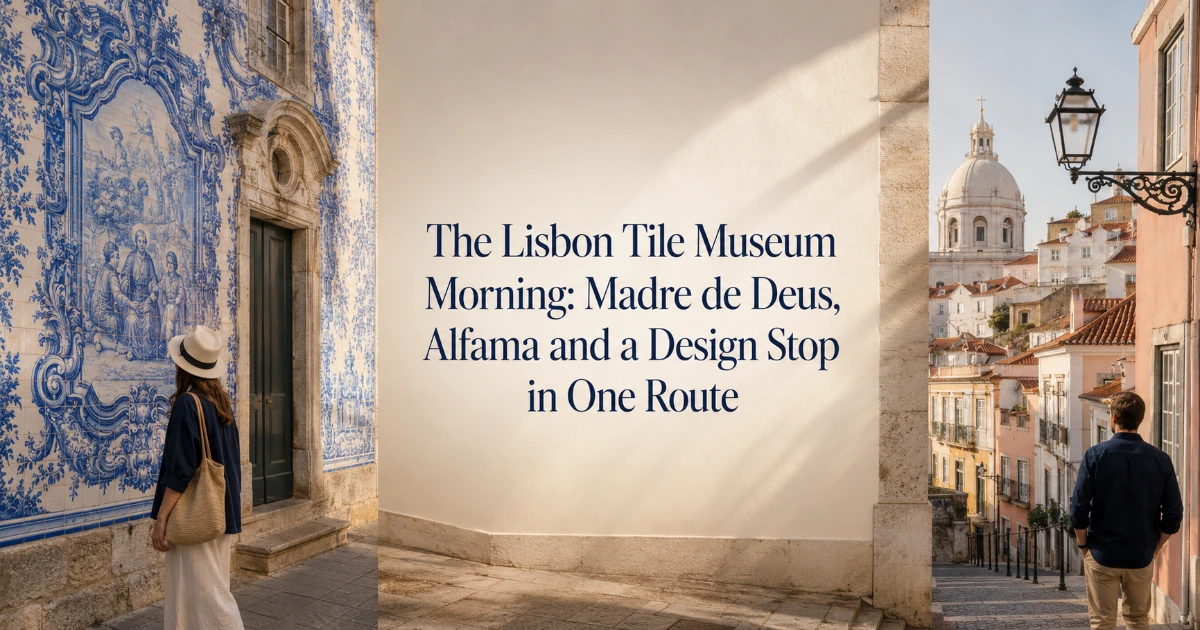
What the morning slot changes is attention. The museum is not just a row of attractive panels. It starts to teach the eye how tiles moved from pattern to picture, from surface to narrative, from sacred interiors to civic identity. When you see that early, the rest of Lisbon becomes easier to read. A damaged facade in Alfama stops looking merely picturesque. A late decorative panel becomes a clue about status, climate, maintenance, and the Portuguese habit of making walls carry memory.
Madre de Deus also holds the route together because the building itself is part of the lesson. The former convent, the church, the sacristy, the choir areas, and the dense layering of gilded carving, painting, and tile create a different kind of museum visit from a neutral white gallery. A guide can connect the decorative density to patronage, devotion, repair, and display, but the traveler still needs time to let the rooms work. Rush that sequence and the museum becomes a pretty stop. Give it the morning and it becomes the interpretive anchor of the route.
There is a practical reason, too. Starting east means the day opens with a planned arrival rather than a wandering search. The museum is not on the same friction-free path as Baixa, Chiado, or the riverfront cafes most visitors already know. A morning pickup or guided transfer makes the out-and-back geography feel deliberate. Drifting there after a late breakfast, especially from a hilltop hotel or after an Alfama climb, often turns the first serious stop into the place where everyone checks the time.
How Alfama changes the route after Madre de Deus
Alfama changes the route by turning azulejos from collection objects into street evidence. After Madre de Deus, the group no longer sees tiles only as museum pieces; it starts noticing how Lisbon’s walls manage light, weather, repair, memory, and social display. That is the reason Alfama belongs after the museum, not before it. The neighborhood gives context, but it is a demanding teacher if the body is already tired.
The most useful Alfama segment is not a heroic climb to every viewpoint. It is a selective old-city passage that lets the guide point out facades, repairs, thresholds, corners, and sightlines without forcing the group into a full castle route. Alfama’s value here is texture and continuity, not conquest. When a morning has already included the museum, adding every steep lane between the Se, Sao Jorge, and Graca usually turns a design-led route into a hill-management exercise.
This is where Lisbon does something very physical to the body. Calcada paving, narrow pavements, uneven steps, sun bouncing off pale walls, tram congestion, and short-but-steep climbs can make a route feel longer than the map suggests. The city does not need to be extreme to be tiring; it only needs to add repeated small frictions. One unnecessary uphill return, one crowded tram decision, or one hot pause at the wrong corner can flatten the pleasure of a morning that began with excellent focus.
A private route can therefore treat Alfama as a chosen edit rather than a compulsory maze. Some travelers should take a lower, gentler Alfama thread and leave castle-height views for another day. Others can add a higher section if they have strong mobility, mild weather, and real interest in the old defensive line. The best version depends less on age than on the evening plan. A couple with a later tasting menu, a family with teenagers, and a multigenerational group should not be asked to spend the same amount of leg energy after the museum. The Alfama-focused extension at Alfama and Bairro Alto Private Tour is useful when the neighborhood, rather than the tile museum, should become the main subject.
Where the design stop belongs: Chiado after context, not before it
The design stop belongs after Alfama because buying judgment improves once the eye has been trained. Chiado is the right finish when the group wants a polished design note, a calmer retail environment, or a contemporary bridge from historic azulejos to present-day taste. It should be a single stop, not a shopping crawl, unless the morning’s purpose has changed.
Chiado works because it is legible, central, and easier to exit toward lunch, a hotel reset, or an afternoon plan. It also has the right mood for design travelers: more edited than a generic souvenir corridor, less demanding than another hillside push, and close enough to Baixa-Chiado that the route can end without drama. But Chiado is overvalued when travelers use it as a substitute for understanding. Buying expensive tiles does not replace understanding the museum context.
That sentence matters for premium travelers. Spending more can buy a better object, a more careful commission, a safer shipping conversation, or access to a more knowledgeable seller. It cannot, by itself, tell you whether a motif is historically meaningful, tourist-facing, recently made, poorly restored, or simply attractive. The museum gives the morning a standard of judgment before the wallet enters the conversation.
For serious buyers, one design stop in Chiado may be too little, and that is precisely why the Tile Museum should be separated from a shopping-focused day when commissioning, shipping, vendor comparison, or room-specific sourcing is the real objective. In that case, use the museum as a prior context session, then dedicate a separate route to shops, ateliers, lead times, packing, and taste decisions. The shopping-specific service path at Lisbon Shopping Private Tours makes more sense when the purchase process, not the museum arc, is the priority.
The route in real time: what to see, what to skip, and when to move
A good version of the morning spends its first serious attention inside Madre de Deus, not in transit chatter. The museum segment should cover the core collection logic, the convent setting, the church or chapel spaces when available, and one or two anchor works that explain Lisbon before and after the earthquake, imported influence, local adaptation, and the shift from pattern to narrative. It should not try to turn every panel into a lecture.
The first move to skip is completionism. A specialist museum can be ruined by the desire to prove that every room was covered. Travelers who care about design usually remember five precise explanations better than thirty hurried labels. The guide’s job is to keep the eye from going numb: identify a technique, show a variation, connect it to architecture, then move before the group stops seeing. This is where private guiding earns its keep, not through theatrical over-explanation but through disciplined omission.
After the museum, the route should move toward Alfama with a clear endpoint already chosen. A vague promise to “wander Alfama” is what creates late-morning drift. The group needs to know whether the Alfama portion is a lower-lane texture walk, a cathedral-edge context stop, a selective climb, or a view-led extension. Without that decision, the morning starts to borrow time from lunch and then from the afternoon.
Finally, Chiado should be treated as a finish line, not a new beginning. One design stop can sharpen the route beautifully: compare historic motifs with contemporary taste, discuss what makes a piece feel thoughtful rather than merely decorative, and decide whether any purchase deserves follow-up. Three stops can work for buyers, but for culture-first travelers they usually dilute the museum. The day should end with a clearer eye, not a bag full of objects chosen because the group was tired.
What the city does to the mood of the morning
Lisbon can make a short plan feel full when the route respects mood as much as geography. Madre de Deus creates a contemplative beginning. Alfama adds street pressure, sound, weather, and human scale. Chiado restores polish and gives the morning a civilized exit. In that order, the day feels like it has opened, deepened, and resolved.
Reverse the order and the mood often degrades. Chiado first can feel pleasant but shallow; Alfama then absorbs more energy than expected; the museum at the end becomes a duty rather than a discovery. The problem is not that any one stop is weak. The problem is that the emotional rhythm is wrong. Design travelers often underestimate this because they focus on content: museum, old district, shop. The better question is what each stop asks from the group.
Madre de Deus asks for concentration. Alfama asks for physical negotiation. Chiado asks for taste and restraint. That sequence protects the late day because the hardest looking happens before the hardest walking, and the most optional spending happens after the group already has standards. The result is a morning that can end with lunch, hotel time, or an unforced afternoon rather than a sense that Lisbon has been mined for content.
This matters for celebrations and food-and-wine travelers. A private morning should not steal the evening it is meant to enrich. If dinner is important, the route should land cleanly before the group starts bargaining with its own energy. A current restaurant listing such as Marlene, on MICHELIN Guide (https://guide.michelin.com/us/en/lisboa-region/lisboa/restaurant/marlene) can help with culinary context, while an official PDF (https://belcanto.pt/uploads/Belcanto_FAQ_EN_Abr25.pdf) is the kind of direct operational source travelers should check for venue-specific details. The morning’s job is not to become a dining guide; it is to leave the evening intact enough for one.
When a chauffeur or private guide changes the value
A private guide changes this route most when the traveler wants connection rather than coverage. The value is not merely that someone explains tile history in the museum. It is that the same person can connect a motif in Madre de Deus, a patched facade in Alfama, a shopkeeper’s claim in Chiado, and the traveler’s own buying instinct without making the morning feel academic.
That bridge is difficult to create casually. Without guidance, many visitors leave the Tile Museum admiring surfaces but still unable to judge what they see on the street. Without a route plan, many visitors enjoy Alfama but fail to connect its exterior tile culture to the museum’s chronology. Without buying context, many visitors enter a design shop and respond only to color. A strong private morning turns those three moments into one conversation.
A chauffeur or carefully arranged transfer changes comfort when the group has limited energy, hotel logistics are awkward, or the morning includes a later lunch, celebration, or evening reservation. It is most useful at the start and at the transition out of the eastern museum zone. It is less useful as a substitute for walking inside Alfama, because the neighborhood’s point is not just arrival; it is controlled exposure to the old city’s surfaces, slopes, and thresholds. The chauffeur can save the day from bad transfers, but cannot make Alfama flat.
Premium spend earns its cost when it removes route uncertainty, protects timing, provides a specialist guide, or prevents the group from turning every decision into a negotiation. Premium spend does not help when it is poured into more stops than the morning can absorb, or into expensive objects bought before the eye has learned what it is seeing. For travelers deciding whether the route needs a vehicle, the broader comfort logic in Is a Chauffeured Lisbon Day Worth It? is the right companion piece.
Who should choose this route, and who should not
This route suits design-minded travelers, repeat visitors, culture-led couples, and small private groups who prefer one subject handled well to a day of scattered highlights. It is especially good for travelers who have noticed tiles across Portugal but have not yet understood how to read them. The payoff is not simply seeing the National Tile Museum. The payoff is walking out into Lisbon with a better eye.
It also works for families when the adults care about design and the guide can keep the museum tactile: materials, animals, ships, patterns, repairs, city scenes, and the difference between a wall that decorates and a wall that tells a story. It is less effective for children if the museum becomes a long chronology lecture. The route should be adapted by shortening Alfama, choosing one visual thread, and ending before the design stop becomes parental wish-casting.
This is not the right morning for travelers who dislike museums, want only iconic viewpoints, or are trying to squeeze Lisbon into a first-day checklist after an overnight flight. Nor is it ideal for visitors who need a no-hills day. Alfama can be edited, but it cannot be turned into a smooth, flat showroom. If the group’s mobility needs are significant, the museum can stand alone with a gentle lunch plan, while Alfama moves to a different route with a more suitable descent strategy.
The route is also a poor fit for travelers who want to shop heavily in one continuous block. If the goal is to compare tile makers, discuss shipping, find contemporary ceramic work, and make purchasing decisions, do not hide that behind a museum morning. Build a buying day honestly and use the museum either as pre-trip reading, a separate guided visit, or a shorter context session. A confused purpose is the fastest way to make both the museum and the shops feel less satisfying.
The cut-first rule when the morning gets too full
Cut Chiado first if the morning gets crowded. This may sound surprising because Chiado is elegant, convenient, and pleasing, but it is the most optional piece of this specific route. Madre de Deus is the interpretive anchor. Alfama is the street translation. Chiado is the design coda. A coda is valuable only when the main movement has been heard.
The second cut is any extra viewpoint that turns Alfama into a climb-heavy detour. One view can be useful if it clarifies the city’s relationship to the river, the old quarters, and the eastern approach. Several views after a museum morning usually become a fitness tax. Travelers remember the exhaustion more clearly than the difference between miradouros.
The third cut is a long lunch far from the route. A beautiful lunch can be the right move, especially for a celebration, but a distant lunch forces the morning into transfer mathematics. After Madre de Deus, Alfama, and possibly Chiado, the best lunch is one that lands the group smoothly. A route that ends in Chiado can support a central lunch. A route that ends lower in Alfama or near Baixa needs a different plan. The important point is not the restaurant name; it is avoiding a late transfer that makes the whole morning feel longer than it was.
Do not cut the explanation that connects museum and street. That is the piece most travelers think they can supply for themselves, and it is often the piece they miss. Without it, the route becomes a museum visit plus a neighborhood stroll plus a shop. With it, the morning has an argument: Lisbon’s tiles are not decoration alone; they are a city language that moves between craft, devotion, climate, commerce, and memory.
How to position the route inside a larger Lisbon stay
This morning belongs best after travelers have had at least a little contact with Lisbon, but before they have become visually saturated. It can work on a first full day for repeat visitors or design-first travelers. For classic first-timers, it often works better on day two, after Belem, Baixa, or a lighter arrival route has already given them a basic city frame.
The Tile Museum morning should not compete with a Sintra day, a Belem monument morning, or a full food-and-wine itinerary. It is a focused cultural route and needs room around it. Pairing it with a late afternoon sail, a low-effort dinner, or a calm hotel reset can work beautifully. Pairing it with another major museum or a long cross-city shopping list often turns precision into accumulation.
Hotel location affects the ease of the morning but should not control the intellectual order. A Chiado hotel makes the final design stop easy. An Avenida da Liberdade hotel may make a chauffeured start more attractive. A Principe Real base can be pleasant for the evening but less efficient for an early eastern start. The route still wants Madre de Deus before Alfama because the subject, not the hotel, should lead the sequence.
If Alfama itself is your main Lisbon priority, use a dedicated Alfama strategy rather than folding everything into this museum route. The city guide Start High in Alfama is a better fit when the castle, viewpoints, and downhill sequencing are the center of the day. This Tile Museum morning uses Alfama selectively. That restraint is why it works.
Source checks before you lock the morning
The operational fact to verify before committing is whether the museum is available on your date and whether any works change access to the spaces that make Madre de Deus the anchor. The official museum page should control that check, not a generic listing or a cached travel note. You do not need to turn the article into a timetable; you need a route flexible enough to adjust if public access, restoration work, or a special closure changes the museum portion.
The fallback should be chosen before the morning is confirmed. If the museum cannot anchor the route, the replacement should either become a neighborhood-and-design morning or move into a broader art itinerary; it should not be a scrambled search for another tile-adjacent attraction. That keeps the promise honest. The traveler either gets a Tile Museum morning, or gets a different route with a different purpose.
If the museum is unavailable during your dates, do not force a replacement museum into this exact structure. Use the morning for an Alfama surface-reading walk and a design stop, or shift to a broader art route, but do not call it the Tile Museum morning without the museum. The authority of this plan comes from how Madre de Deus disciplines the eye before Lisbon opens into streets, shops, and facades.
This is why source discipline and local judgment have to work together. Official pages can verify venue status, a Michelin listing or restaurant document can support a dinner detail, and a private planner can decide what those facts mean for pacing. None of those sources, by itself, sequences the city for the traveler. The better morning comes from using verified details lightly, then making the harder editorial choices: start east, edit Alfama, stop shopping before it dilutes the route.
How Orange Donut Tours would shape it privately
Orange Donut Tours would shape this as a private cultural morning with a clear end state: the traveler should leave knowing how to read Lisbon’s tiles more intelligently. The route would start with the museum, not because it is the grandest stop in Lisbon, but because it gives the rest of the morning its grammar. From there, Alfama becomes evidence, and Chiado becomes a judgment test rather than a decorative afterthought.
The private planning value sits in the editing. A couple with a celebration dinner can keep Alfama shorter and end cleanly in Chiado. A family can choose a more visual museum thread and reduce the shop component. A design collector can keep the museum focused but add a more serious buying conversation later in the trip. A comfort-first group can use a chauffeured start and a guided walk that avoids turning the old city into an endurance exercise.
The guide’s role is also to prevent two common forms of overreach. The first is academic overreach: explaining so much history that the group stops looking. The second is retail overreach: turning every tile reference into a purchase prompt. A good guide knows when to say, “This is worth studying,” when to say, “This is only charming,” and when to say, “Do not buy yet; you need a better comparison.”
For travelers who want the museum, Alfama, and one design stop connected by motif, craft, history, comfort, and buying judgment rather than placed side by side as a checklist, Inquire now. The route should feel shorter than its content, not because it is thin, but because the decisions have already been made for the right reasons.
FAQ
Is the Lisbon Tile Museum worth visiting in the morning?
Yes, the Lisbon Tile Museum is strongest in the morning because it rewards fresh attention before Alfama’s hills, cobblestones, and street decisions start draining energy. A morning visit also makes the museum useful for reading the rest of the city, not just admiring objects in isolation.
Should I visit Madre de Deus before Alfama?
Yes, Madre de Deus before Alfama is the better order for a tile-focused route. The museum teaches the visual language first, and Alfama then shows how tile, repair, weather, and old-city life appear outside a collection setting.
Where should a design stop fit after the Tile Museum?
A design stop fits best at the end, usually in Chiado, after the museum and a selective Alfama walk. Placing it last helps travelers judge contemporary pieces with more context and keeps the stop from becoming a generic shopping break.
Can I combine the Tile Museum, Alfama, and Chiado in one half day?
Yes, but only with restraint. The half day should focus on the museum, a selective Alfama segment, and one design stop, not a full Alfama climb, multiple shops, and a long cross-city lunch.
When should the Tile Museum be separated from a shopping day?
Separate the Tile Museum from a shopping day when the main goal is buying, commissioning, vendor comparison, shipping, or room-specific sourcing. In that case, the museum is better as a separate context visit, not the same morning’s main event.
Is Alfama too tiring after the Tile Museum?
Alfama can be tiring after the Tile Museum if the route tries to climb too much or chase several viewpoints. A lower, selective Alfama thread works better for many private groups because it provides street context without turning the morning into a hill day.
Does a private guide matter for this route?
A private guide matters when you want the museum, Alfama, and the design stop to connect. The guide can link motifs, techniques, facades, history, and buying judgment so the route feels like one cultural argument rather than three separate stops.
What should I cut first if the morning is running long?
Cut the Chiado design stop first if the morning is running long. The museum is the anchor and Alfama is the street translation; Chiado is valuable, but it is the most optional part of the route.
If you’re interested in any private tours of Lisbon, please reach out to us.


 So if you are looking for the absolute best in Lisbon & surroundings with authentic local fully-licensed native guides whose English you can actually understand and with an exclusive and amazingly fun itinerary













