Lisbon for Tile-and-Design Buyers: Azulejos, Chiado and Shipping Time Without Hill Drag
Updated
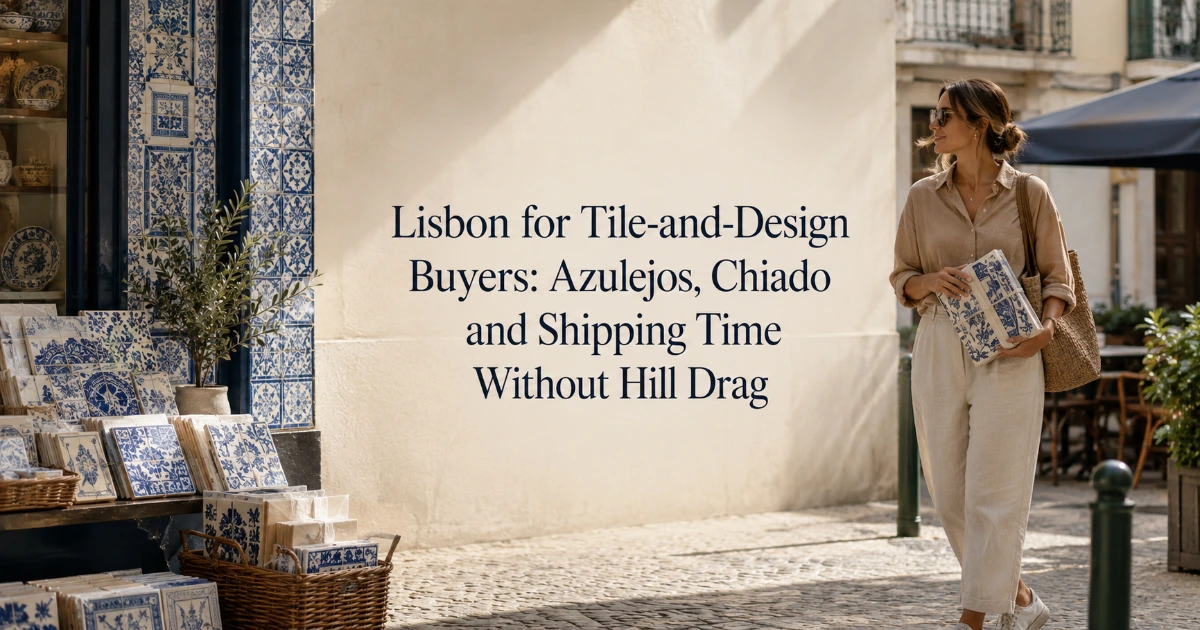
For tile-and-design buyers, Lisbon works best when azulejo context comes before shopping, Chiado becomes the controlled buying spine, and shipping admin is held to a short buffer instead of allowed to swallow the day. That order fits the city because the most meaningful tile references sit outside the neatest design-shopping streets, while the buying neighborhoods themselves climb quickly, narrow at the edges, and punish backtracking over calçada. The clearest exception is a traveler whose only goal is acquisition: if you already know makers, formats, and shipping terms, skip the distant context stop and spend the morning on appointments.
In Lisbon, the strongest tile-buying day is not a shop hunt; it is a context-led Chiado design route that lets Azulejos become a cultural decision before they become a shipping decision.
The small hinge is Baixa-Chiado itself: one station name covers two levels of the city. The Rua Garrett side keeps you in the buying spine; the Bairro Alto and Largo do Chiado edge begins the gradient toward Rua da Misericórdia and Príncipe Real. That split is why a buyer’s day needs discipline. Let the morning roam too wide and the afternoon turns into a stair-and-cobble negotiation just when you need clear judgment.
If you are asking for a private plan, the useful question is not simply where to buy tiles. It is how to learn enough to choose well, still have time to buy, and not let packing or shipping flatten dinner. That is the planning gap behind Lisbon Shopping Private Tours for travelers who want context, not a storefront sprint.
The ranked ladder for a Lisbon tile-and-design buying day
The best version is a narrow day with four rungs: context, Chiado, a capped logistics buffer, and one optional design extension. Anything beyond that should earn its place by improving the purchase, reducing physical drag, or sharpening taste.
- First rung: azulejo context before buying. Begin with enough history, technique, and pattern language to make the later shopping choices feel informed. This may mean the National Tile Museum when it is the right fit and available, or a guided surface-reading route through tiled façades, churches, and interiors when a distant museum stop would pull the day apart.
- Second rung: Chiado as the buying spine. Use the Chiado design route as the practical center because it concentrates browsing, comparison, cafés, hotel access, and onward choices better than a scattered hunt through Lisbon’s hills.
- Third rung: shipping time as a buffer, not the climax. A serious purchase needs packing, documentation, address checks, and timing questions, but those should be capped. Logistics must be named early so they do not ambush the last hour.
- Fourth rung: Príncipe Real only if the group still has attention. It is valuable for design-minded travelers, but the climb and the extra browsing can make it a poor automatic add-on after a detailed tile morning.
- Cut-first rung: a distant tile stop when buying is the real objective. A design-shopping day should skip a distant tile stop when the group has only half a day, already understands the category, or needs appointment time more than museum time.
This ladder is deliberately stricter than a generic shopping itinerary. Lisbon rewards curiosity, but it also taxes indecision. A couple can lose twenty minutes debating whether to climb toward Príncipe Real, another twenty settling purchase documentation, and another twenty finding a comfortable place to sit. By late afternoon, the day no longer feels like a design route; it feels like admin performed on a slope.
The counterintuitive correction is that the most glamorous-looking start is not always the best start. Avenida da Liberdade can be comfortable for hotels and luxury retail, but it is not the most efficient opening for tile-and-design buying if your priority is Azulejos plus independent design context. Starting there often creates a polished but thin morning, then forces the cultural and purchase decisions into the day’s more tired half. For a broader fashion-and-design arc, use the separate sequencing logic in a tailor-made Lisbon shopping-and-design day; for this tile-focused day, Chiado should control the rhythm.
Start with azulejo context before you buy
Azulejo context belongs at the start because it changes what you notice, what you reject, and how confidently you ask questions later. Without it, many buyers over-index on color and age cues, then discover too late that the more interesting distinction is technique, period reference, architectural use, restoration ethics, or whether a piece will actually live well in a modern home.
The cleanest context anchor, when it fits the day and is operationally available, is the National Tile Museum at Madre de Deus. The official National Tile Museum page (https://www.museusemonumentos.pt/en/museus-e-monumentos/museu-nacional-do-azulejo) describes a collection covering glazed tiles from the second half of the 15th century to the present day, with an introduction to materials and manufacturing techniques before the chronological route. That sequence matters for buyers: it teaches you to see process before pattern, which is usually the difference between a souvenir decision and a collection-minded decision.
But the museum is not automatically the best start for every private day. Madre de Deus sits away from the Chiado design route, and the transition back into the buying core can consume the very attention you wanted to preserve. Before anchoring a morning there, check the current official page rather than relying on an old official PDF, a saved itinerary, or a remembered opening pattern. If the site status, closure notices, or your own timing make the stop awkward, the smarter substitute is not another distant museum. It is a tighter guided reading of Lisbon’s tile language in streets and interiors closer to the day’s buying spine.
This is where the previous azulejo question differs from the buyer’s question. A pure tile-history day can let Madre de Deus and Alfama lead. A buying day has to be more economical. The existing ODT guide on whether Azulejos should shape a tailor-made Lisbon day is useful for that broader cultural decision, especially if you are deciding how much tile history should enter a first visit: azulejo-led Lisbon day. Here, the answer is narrower: start with enough context to buy better, then leave before the context starts stealing buying time.
The practical consequence is simple. A morning that begins with interpretation gives the buyer language. You can ask whether a panel is historic, reproduction, restored, contemporary, or decorative in spirit. You can separate a charming single tile from a coherent set. You can recognize why Portuguese tile is not just a blue-and-white visual shorthand, but a building skin, a devotional surface, a shopfront memory, a civic façade, and a domestic object. That vocabulary reduces second-guessing later, which is valuable when a couple or family has different taste thresholds.
For comfort-first travelers, context also keeps the day calmer. Instead of walking into shops with the vague hope that something will “feel Lisbon,” you know what you are looking at. The buying conversation becomes shorter, more precise, and less vulnerable to impulse. That does not make the day cold; it makes it more satisfying. People buy with more pleasure when they understand what they are choosing.
Best Lisbon neighborhoods for azulejo and design buying without hill drag
Chiado should be the main buying neighborhood because it gives tile-and-design travelers the best balance of cultural texture, route control, comparison time, and recovery points. Príncipe Real is a selective extension, Alfama is better as context than as a hauling route, and Baixa is useful as a connector rather than the emotional center of the day.
Chiado: the controlled core
The Chiado design route works because it lets the day stay legible. Rua Garrett, Largo do Chiado, the Rua do Carmo side, the edge toward Praça Luís de Camões, and the quieter transitions toward Rua do Loreto all keep the buyer close to cafés, hotel pickups, taxis, and short resets. This matters more than it sounds. A design buyer needs time to compare texture, scale, provenance language, and shipping terms. That kind of attention deteriorates quickly when each stop requires a climb, a tram wait, or a crowded lane.
Chiado also keeps mood intact. The neighborhood feels like a city rather than a showroom corridor: bookstores, theatres, tiled façades, churches, old commercial interiors, and design-facing retail sit close enough together that a guide can keep the route cultural between purchases. This is the natural conversion moment for a private tour, because route discipline prevents the day from becoming transactional. The guide’s value is not only knowing where to walk; it is deciding when to stop interpreting, when to let the buyer browse, and when to move before the group loses the thread.
There is one correction to make here: Chiado is efficient, but it is not flat. The slope from Baixa upward, the polished stone underfoot, and the stair-like transitions around side streets mean that even a central route benefits from pacing. A half-step of route discipline in Chiado saves more energy than a late chauffeured rescue after the group has already wandered into the wrong edge of Bairro Alto with bags, tile boxes, or tired parents.
Príncipe Real: the stylish extension, not the default opening
Príncipe Real belongs after Chiado when the traveler still wants contemporary design, concept-store browsing, or a more residential-feeling finish. It should not be the automatic first stop for a tile buyer unless appointments or a specific design brief demand it. The route from Chiado toward Rua da Misericórdia and up toward Príncipe Real is handsome, but it turns the day into a slow climb at exactly the point when buying decisions may be getting heavier.
For couples and small groups, the extra neighborhood can be excellent if the morning stayed contained. For families, older travelers, or anyone planning a special dinner, it can be the point where the day starts to fray. The consequence is not only physical. Once Príncipe Real is added too early, the group often begins comparing objects across too many categories: tile, ceramics, textiles, contemporary Portuguese design, small furniture, gifts. That makes decisions less confident, not more refined.
Alfama: tile atmosphere without purchase logistics
Alfama is valuable for reading tile in place, but it is not the best neighborhood for carrying fragile purchases through the day. Its lanes, viewpoints, stair sections, and tram-crowded edges create a different kind of beauty from Chiado: more atmospheric, less efficient, more vertical, and harder to pause in comfortably with bags. Use Alfama for context if the route is descending, if a guide is controlling the walking line, or if the day includes architectural surface-reading rather than serious buying.
The common mistake is treating Alfama as a romantic shopping add-on. It is better understood as a visual lesson. Around Santa Luzia and the Portas do Sol side, tiles are part of the city’s exterior memory; around lower lanes, they appear in fragments, thresholds, and façades. That is useful before buying, but once the group starts carrying anything fragile or mentally comparing purchase options, Alfama’s charm becomes drag. If you want Alfama to be more than a blur, it needs its own descending logic rather than being bolted onto a shopping day.
The Chiado design route: what to do there, and what not to force
The Chiado design route should do three jobs only: refine taste, support comparison, and leave room for one serious purchase conversation. It should not try to become every version of Lisbon shopping at once.
A strong route begins by narrowing the brief before entering the first buying environment. Are you looking for historic-feeling Azulejos, contemporary ceramic work, a panel for a kitchen or bath, portable decorative pieces, a giftable object, or simply enough exposure to know whether a purchase belongs in the trip? Those are different days. A guide or planner should not wait until the second hour to ask. The answer determines how much interpretation, browsing, and shipping time the route can support.
For collectors, the route should allow slower looking and fewer stops. The buyer may need to compare surface irregularity, edge condition, restoration signs, pattern continuity, and the credibility of the seller’s explanation. A quick shop sweep is almost useless here. The gain comes from fewer rooms, more questions, and an earlier shipping conversation so the decision does not become rushed.
For design-led couples, the route can be more conversational. One traveler may care about material story while the other cares about whether the object will work at home. Chiado helps because it allows nearby pauses where the decision can settle. A café pause is not indulgence; it is decision architecture. It prevents the couple from buying against fatigue or rejecting a good piece because the last shop was crowded.
For families or celebration groups, the Chiado design route should be even tighter. Give the group enough tile context to make the day feel culturally rooted, then limit the active buying window. Children, older parents, and friends who are not buying will tolerate the day better if the route includes visual texture between shops and does not ask everyone to stand through every shipping conversation. This is where a private plan earns its keep: the buyer can go deeper while the rest of the group still feels included.
What should you not force? Do not force every design category into the same afternoon. Tile, ceramics, fashion, jewelry, books, and home objects all sit temptingly close in Lisbon’s central neighborhoods, but a day that chases all of them rarely produces better purchases. It produces a more tired buyer. If Azulejos are the reason for the day, let them remain the organizing idea and let other design stops support that idea rather than compete with it.
There is also no virtue in dragging the route through a famous street just because it appears in generic shopping advice. If the street does not improve comparison, comfort, or context, it is decoration. A premium private day should be edited more sharply than a public self-guided list. The best stops are not the maximum number of stops; they are the stops that let the buyer leave Lisbon with a clearer eye.
Shipping time should be named, capped and kept out of the day’s emotional center
Shipping should be discussed early enough to avoid surprises and late enough not to dominate the cultural part of the day. The mistake is pretending shipping is a minor afterthought, then losing the final hour to forms, packing questions, address checks, and uncertainty.
For tile-and-design buyers, the shipping-time buffer should sit after the shortlist, not before the learning. In practice, that means your guide or planner knows that the day may need a protected purchase window, but the group does not spend the morning talking about cartons. The first half of the day builds judgment. The later buffer handles practical consequences: who is packing, what is being insured, how the address will be written, whether the seller ships directly, and what the buyer must confirm independently before final purchase.
This is a service boundary as much as a schedule issue. A guide can help you ask clearer questions, keep the route on time, translate context when appropriate, and prevent the day from being hijacked by logistics. A guide should not become your customs broker, interior designer, or guarantee against every shipping variable. The cleanest private day names the boundary from the start: the tour can protect the buying process, but final purchase and shipping terms belong between buyer and seller.
Buying expensive pieces does not make the day better if shipping errands replace cultural context. That sentence is worth holding onto because it catches a common premium-travel error. Spending more can improve comfort, guide quality, private pacing, appointment filtering, and a chauffeured transition when the route truly needs one. Spending more does not rescue a day that has allowed admin to become the main event.
Ask for documentation when it matters, but do not let documentation become the group activity. An invoice, packing note, certificate, official PDF, or follow-up email can be reviewed after the tour or during a deliberately capped buffer. The rest of the group should not be standing in a doorway while one buyer negotiates line-item details for thirty minutes. That is when the mood changes from cultural acquisition to errand fatigue.
The practical limit depends on the day, but the principle is stable: cap the live shipping conversation, gather the next-step information, and move. If the purchase is substantial enough to require more time, build a separate appointment or after-tour admin slot. This is especially important before a special dinner, food-and-wine evening, or family plan. A tile day should end with the feeling that Lisbon became more legible, not with everyone remembering the last form they had to read.
What Lisbon does to the body during a design-shopping day
Lisbon makes a design-shopping day feel shorter than it looks on a map because climbing, cobbles, narrow pavements, tram edges, and repeated micro-decisions tax the body before the itinerary appears full. A route that seems modest in distance can feel substantial when it includes the Baixa-to-Chiado rise, the Rua da Misericórdia climb, polished calçada underfoot, and pauses where the group stands instead of sits.
This matters because buying requires a different kind of energy from sightseeing. At a viewpoint, fatigue can be softened by the view. In a shop or studio, fatigue turns into impatience, vagueness, or conflict. One traveler wants to compare one more piece; another wants coffee; a third starts asking whether the object will even survive shipping; a fourth is already thinking about dinner. The city has not failed the plan. The plan has asked the wrong kind of attention from tired legs.
A chauffeured element can help when the route crosses neighborhoods, when the group includes older parents, or when the day begins away from the buying core. It is less helpful inside the tightest part of Chiado, where short walking segments, stairs, narrow streets, and central drop-off logic limit what a vehicle can solve. For a deeper look at when a car changes Lisbon and when it cannot, use the chauffeured Lisbon day guide. For this specific tile route, the vehicle earns its cost at transitions, not as a substitute for editing.
There is a good rule for comfort-first buyers: do not carry the object unless the object is small enough to forget. Even a modest package changes how the body experiences Lisbon. It changes balance on cobbles, makes café pauses clumsier, slows stairs, and quietly discourages spontaneous looking. If the object is fragile or meaningful, arrange pickup, delivery, or a return plan instead of turning the rest of the day into a protective walk.
Heat also changes the buying day, even when it is not extreme. The exposed moments between neighborhoods, the reflective stone, and the standing time inside and outside shops can make the afternoon feel blunt. That is why a tile-and-design route should not leave all serious decisions until the end. Put the most demanding judgment before the group has entered late-day heat, late-day crowds, or late-day hunger.
What Lisbon does to the mood if shipping and hills take over
Lisbon keeps a design day elegant when the route feels like discovery; it flattens the mood when the final memory becomes climbing, waiting, and solving purchase logistics in public. The emotional arc matters, especially for couples, celebration travelers, and families who want the day to feel shared rather than divided between buyer and non-buyer.
A good tile day has a particular rhythm. The morning gives meaning. Chiado gives choice. A pause gives the decision room to breathe. A capped logistics buffer gives confidence. The finish gives the group a sense that the evening is still theirs. When that rhythm holds, the purchase feels like a cultural souvenir in the serious sense: not a trinket, but a piece whose story belongs to the day.
When the rhythm breaks, the group mood changes quickly. The buyer becomes absorbed in details, the non-buyers become spectators, and Lisbon’s slopes become more noticeable. A street that felt charming before lunch feels like a problem after a shipping conversation. A tiled façade that might have delighted the group becomes visual noise. This is why route discipline is not a luxury add-on. It protects the shared mood of the day.
For food-and-wine travelers, this is especially important. A design-buying afternoon that ends late, uphill, and administratively tangled can dull the appetite for a carefully planned dinner. The issue is not only tired feet. It is cognitive residue. People bring the unresolved purchase into the meal. They check emails, revisit dimensions, second-guess the shipping address, or wonder whether they should have bought the other piece. A cleaner day creates a cleaner evening.
The best private version does not remove spontaneity; it protects it. By containing the route and naming the logistics, the guide gives the group permission to notice Lisbon again between buying decisions. Praça Luís de Camões, the descent toward Baixa, the theatre edges of Chiado, the viewward pull toward the river, and the tiled surfaces on ordinary façades all remain part of the day. Without that, shopping becomes a spreadsheet with a hill attached.
How a guide makes buying feel cultural rather than transactional
A guide improves this day most when they control sequence, translate context into buying judgment, and keep the group from confusing more stops with better taste. The guide’s value is not a secret shop list; it is the ability to keep the day from breaking its own purpose.
Before the first serious buying stop, a guide can make the eye sharper. They can explain why tiles in Lisbon appear on façades, churches, interiors, stations, shopfronts, and domestic spaces; why repetition and modularity matter; why a panel reads differently from a single tile; and why condition, provenance language, and reproduction claims deserve careful questions. This context does not need to become a lecture. It needs to be timed so the buyer can use it.
During the Chiado design route, the guide becomes an editor. They can pace the group through Rua Garrett and the Largo do Chiado side without letting the route drift too far into Bairro Alto. They can notice when the buyer needs five quiet minutes, when the family needs a seated pause, and when Príncipe Real would add pleasure versus when it would simply add slope. That judgment is hard to replicate from a saved map.
For private groups, the guide also protects non-buyers. A spouse, parent, teenager, or friend who is not purchasing can still enjoy the day if the route keeps returning to cultural context. The guide can make a façade, church tile scheme, or street transition meaningful while the buyer browses. Without that, the day becomes one person’s errand and everyone else’s waiting time.
That is why tailor-made planning matters more here than in a simple sightseeing day. The route has to understand taste, energy, luggage, dinner plans, mobility, and whether the traveler wants to acquire, learn, browse, or commission. A fixed list of shops cannot do that well. A private route can: Tailor-Made Private Tours of Lisbon.
There is also a firm boundary: guides can help structure questions and keep time, but the buyer should own the final purchase decision. That boundary keeps the day honest. A good guide should never pressure a purchase to prove the tour’s value. The value is that the buyer understands more, wastes less time, and leaves with a decision that still feels good after dinner.
A practical day flow for tile-and-design buyers
The smoothest day flow is context in the morning, Chiado buying before late fatigue, shipping questions in a capped buffer, and only then a selective extension. This order preserves both judgment and the evening.
- Morning context. Begin with the National Tile Museum if it fits the day and is available, or with a closer guided tile-reading route if the museum would create too much transfer drag. The purpose is not to “complete” tile history. The purpose is to build enough visual intelligence to buy with confidence.
- Transition into Chiado. Move toward the Chiado design route before the group is tired. Use Baixa-Chiado, Largo do Chiado, Rua Garrett, and the Praça Luís de Camões edge as a controlled spine, not as a starting point for random detours.
- Focused browsing. Limit the number of active buying stops. Serious tile and design decisions need comparison, but too many comparisons blur the eye. Two or three purposeful stops usually serve the buyer better than a long list.
- Seated pause before purchase. Give the decision a short pause before finalizing. This is especially useful for couples, collectors, and anyone buying for a home project rather than as a travel keepsake.
- Shipping-time buffer. Confirm packing, delivery, documentation, timing, and follow-up responsibilities without turning the whole group into an audience for admin.
- Optional Príncipe Real extension. Add it only if the group still has appetite for contemporary design and the evening plan can absorb the extra climb or transfer.
- Clean finish. End near a comfortable return point, hotel pickup, or dinner-friendly route. Do not end the day carrying fragile purchases uphill.
This flow is not rigid; it is protective. It gives the buyer space to learn, compare, and purchase without asking the city to behave like a flat design district. Lisbon is not that city. Its beauty comes partly from verticality, tiled surfaces, old commercial layers, and irregular transitions. The plan should use those qualities, not pretend they are irrelevant.
For cruise travelers or airport-adjacent schedules, compress the flow rather than widening it. A short Lisbon tile-and-design plan should keep context close, buy in Chiado, and cut Príncipe Real. A longer private day can include more texture, but only if the shipping buffer and return plan are already clear. A celebration day should be stricter still: protect the evening, because the best purchase will not compensate for a tired dinner.
What to cut first when the plan gets crowded
Cut the farthest, least purchase-relevant stop first, even if it is culturally attractive. The most common mistake is protecting every interesting tile reference while squeezing the actual buying decision into the least comfortable part of the day.
First, cut the distant tile stop if the museum or context anchor creates transfer drag on a day built around buying. That does not mean tile history is unimportant. It means this particular day has a different success metric: better purchase judgment without hill fatigue. When time is tight, a guided tile-reading route closer to Chiado can be a better buyer’s tool than a fuller museum visit across town.
Second, cut the automatic Príncipe Real extension if the group has already made a serious purchase or if shipping details are still unresolved. Príncipe Real is rewarding when it adds taste and breadth. It is not rewarding when it turns a clean Chiado decision into an uphill browsing obligation.
Third, cut the fantasy of comparing every possible shop. Fragile claims about inventory change too quickly to make a live shop list trustworthy, and a serious buyer should not outsource judgment to a generic roundup. What matters is the brief, the route, the questions, and the ability to stop when the right piece appears. A longer list can make the buyer feel more diligent while actually making the decision worse.
Fourth, cut the idea that premium spend must show itself as more objects, more appointments, or more neighborhoods. The better upgrade is often a calmer route, a knowledgeable guide, a driver for the right transfer, and enough margin to settle the purchase without making the group wait. Paying more should change comfort, privacy, timing, or clarity. It should not buy a more exhausting version of the same day.
Finally, cut late-day admin when it starts threatening the evening. Gather the documents, confirm the next step, and move the unresolved details outside the touring window. A tile purchase can be meaningful without being fully processed in front of everyone. The evening should still feel like Lisbon, not the back office of the purchase.
A tile-and-design day works when the route never forgets why the object matters. Start with context, buy in the part of the city that supports comparison, cap shipping time, and refuse the hill drag that makes a good purchase feel heavier than it is. When you want that balance built into a private Lisbon day, Inquire now.
FAQ
Should I start a Lisbon tile-buying day at the National Tile Museum?
Start there if it is available, fits your timing, and you want deeper azulejo context before buying. Skip it if you have limited time, appointments in Chiado, or a group that will lose energy during the transfer back to the buying core.
What is the best neighborhood for azulejo and design buying in Lisbon?
Chiado is the best practical center for a tile-and-design buying day because it supports comparison, cafés, hotel access, and short route adjustments better than a scattered hill route.
Where does Príncipe Real fit in a tile-and-design day?
Príncipe Real works best as an optional extension after Chiado, especially for travelers who still want contemporary design browsing. It should not be the default opening unless a specific appointment or design brief requires it.
Is Alfama good for buying tiles?
Alfama is better for tile atmosphere and guided context than for serious purchase logistics. Its lanes, slopes, and crowded edges make it less suitable once you are carrying fragile items or comparing purchase options.
How much time should I leave for shipping tiles from Lisbon?
Leave a capped buffer after you have shortlisted or chosen pieces. Use that time to confirm packing, shipping, documentation, and follow-up responsibilities, but do not let it replace the cultural part of the day.
Should a private guide handle shipping for tile purchases?
A private guide can help you ask better questions, keep the route on time, and protect the group’s rhythm. Final purchase terms, shipping agreements, insurance, and documentation should remain between buyer and seller.
Can I combine azulejo context, Chiado, Príncipe Real and Alfama in one day?
You can, but it is often too much for a buyer-focused day. If buying is the priority, keep Chiado central, use Alfama for context only when the route is controlled, and add Príncipe Real only if the group still has energy.
What should I skip first if my Lisbon design-shopping day is too full?
Skip the distant tile stop first when buying time is the priority, then cut the automatic Príncipe Real extension if shipping details or group energy are already under pressure.
If you’re interested in any private tours of Lisbon, please reach out to us.


 So if you are looking for the absolute best in Lisbon & surroundings with authentic local fully-licensed native guides whose English you can actually understand and with an exclusive and amazingly fun itinerary













