How Romantic Travelers Reinvented the Alhambra: Washington Irving, Owen Jones and the Palace Visitors Still Expect

Updated
The Alhambra visitors inherit was edited in the nineteenth century
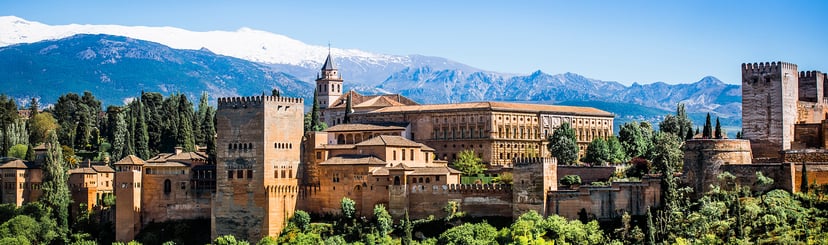
The familiar story says that Romantic travelers found the Alhambra sleeping above Granada, recognized its beauty and carried an endangered masterpiece back into European attention. That story contains a measure of truth, but it disguises the more consequential act. Writers, architects, publishers and exhibition designers did not simply transmit the palace. They selected its moods, reorganized its history, restored missing color on paper and turned particular rooms into a portable idea of Islamic Spain. Much of the Alhambra that visitors anticipate before they enter is therefore nineteenth-century: moonlit solitude, jewel-like surfaces, secret histories, melancholy dynasties and an apparently complete grammar of ornament.
The physical monument is older, more complicated and less obedient. The Nasrid palatine city was developed over generations by the last Muslim dynasty of the Iberian Peninsula, then altered after the Christian conquest of Granada in 1492. It passed through court use, military administration, residence, neglect, repair, restoration and modern conservation. A carved stucco panel may preserve fourteenth-century work beside later infill. A roofline can belong to a restoration campaign rather than the moment imagined by a tale. A pavement may be modern, even when the water channel it frames follows an older spatial logic. The visitor is never encountering one date.
Washington Irving and Owen Jones are central because they taught different audiences how to make that complexity feel coherent. Irving converted residence, anecdote and ruin into narrative intimacy. Jones converted measurement, color traces and architectural analysis into plates that could be studied, copied and eventually inhabited as exhibition scenery. Irving made the Alhambra feel remembered; Jones made it feel reproducible. Their work helped secure attention for the monument, yet it also encouraged generations of readers to confuse literary atmosphere with historical evidence and reconstructed pattern with an untouched surface.
The useful question for a repeat visitor is not whether the Romantic Alhambra is false. It is where that image came from, what it illuminated and what it made harder to see. Once that question is carried into the Nasrid Palaces, familiar rooms change character. The Court of the Lions becomes both a fourteenth-century court and a laboratory of nineteenth-, twentieth- and twenty-first-century conservation. Color becomes evidence rather than decoration. A legend becomes a traceable narrative choice. Beauty remains, but it acquires a history of looking.
Washington Irving did not simply record an enchanted palace
A residence that created authority
Irving reached Granada in 1829 with an established literary reputation and a deep interest in Spain’s history. His temporary residence within the Alhambra gave him something more valuable than picturesque access: it gave his future readers the sensation that the narrator had crossed a threshold closed to ordinary travel. He could present himself not as a distant antiquarian cataloguing a ruin, but as a temporary resident moving through chambers after ordinary callers had gone, hearing stories from residents and watching the hill change with weather, darkness and sound.
That position matters because intimacy is one of the book’s principal claims to truth. In the preface to the revised edition, Irving explains that some tales and essays were drafted during his stay in the Alhambra, while others drew on notes and observations made there. He also describes an effort to give old stories local verisimilitude. The wording can be read directly in the digitized revised edition of his Alhambra writing. It confirms close engagement with place, but it does not turn every scene into a neutral record. “Verisimilitude” is a literary achievement: the construction of credibility through selected detail.
Irving’s Alhambra is built from several kinds of material. There are travel observations, historical sketches, adapted legends, comic encounters, descriptions of local residents and stories of hidden treasure, enchanted soldiers and dynastic catastrophe. He moves between the present of 1829 and a loosely assembled Moorish past with unusual ease. The transitions are part of the pleasure. A doorway, tower or evening sound becomes permission to leave documentary time and enter legend. The building seems to generate its own tales.
This was a deliberate narrative choice. The Alhambra of strict chronology would have required distinctions among Nasrid reigns, post-1492 interventions, changing administrative uses and the varied social histories of people living on the hill. Irving instead offered a palace in which temporal layers could speak to one another. The result was more memorable and more transportable. Readers who might never master a dynastic sequence could remember an abandoned chamber, an old guardian, a moonlit court or the imagined sorrow of a defeated ruler.
Ruin as a storytelling device
Romantic writing treated incompleteness as an invitation. Missing surfaces, damaged rooms and uncertain origins did not merely frustrate knowledge; they created space for emotional reconstruction. Irving used that space expertly. The palace appears as a survivor whose very deterioration confirms the pathos of a vanished civilization. Silence can imply secrecy. Fragmentation can imply loss. A weathered wall can carry more emotional authority than a fully documented one because it seems to have endured what the narrator can only evoke.
The difficulty is that ruin is never an innocent category. In 1829 the Alhambra was not an empty relic suspended outside modern Granada. It was administered, inhabited and embedded in the social life of the city, even if parts were in poor condition. By arranging present-day inhabitants as picturesque companions to a grander lost age, Romantic narration could make living people appear as minor figures inside someone else’s elegy. Their knowledge entered the book, but usually after passing through the author’s selection, tone and market.
That does not make Irving useless as a witness. His pages preserve perceptions of the complex, social encounters and details of travel culture that a formal architectural survey would omit. They also helped create international affection for the Alhambra at a moment when concern for its condition was growing. The responsible reading is double. Irving can be evidence for how an educated foreign visitor experienced and narrated the site in the early nineteenth century; he cannot be treated as transparent evidence for the Nasrid court.
This distinction changes what a visitor listens for. The celebrated mood of solitude is not a surviving fourteenth-century feature. It is partly a product of the narrator’s privileged residence, the timing of his walks and a literary tradition that valued ruins after dark. The legends are not labels attached by the original builders. They are later acts of memory, sometimes based on local tradition, sometimes reshaped by print. Even the broad opposition between refined Moorish splendor and inevitable Christian victory belongs to a long historiographic habit, not to the carved walls themselves.
Irving’s most durable invention was a way of moving through the palace
The influence of Tales of the Alhambra lies less in any single factual claim than in its route through attention. Irving teaches the reader to begin with atmosphere, move toward an anecdote, allow the anecdote to open a historical recess and return to the present with the room emotionally charged. This rhythm survives in countless descriptions of the monument. A court is introduced as beautiful, a tale supplies drama, and only afterward does architecture enter.
That order has consequences. The Hall of the Abencerrajes, for example, is commonly approached through a massacre legend and the supposed memory of blood. The story is powerful because the architecture seems to confirm it: an enclosed hall, a central basin and a name already associated with noble rivalry. Yet a compelling fit between room and tale is not the same as secure evidence for the event. The legend directs the eye before the fabric has been examined. It makes the basin a witness and the stain a relic, although the historical case is far less certain than the narrative.
Irving also helped consolidate the idea of the Alhambra as the final dream of a doomed “Moorish” civilization. The elegiac frame can honor artistic achievement, but it compresses more than two centuries of Nasrid politics, diplomacy, taxation, construction and court life into an ending already known. The palace becomes beautiful because it is lost. Its makers become representatives of decline rather than historical actors managing a frontier kingdom with changing alliances and formidable cultural resources.
A repeat visit can reverse the sequence. Begin with the room’s material and institutional function, then ask how later stories attached themselves to it. Where does water enter? How is access controlled? Which inscriptions praise the ruler, invoke God or describe the building’s own beauty? What can the plan tell us about ceremony, privacy and movement? Only after that evidence is visible should the Romantic story return. It will often become more interesting, because it can be recognized as an intervention rather than mistaken for an original caption.
This approach pairs naturally with a second Alhambra visit organized around epigraphy, water, restoration or court life. Irving need not be discarded. He becomes one layer among several: a nineteenth-century reader whose extraordinary success shaped the expectations of later readers, filmmakers, designers and travelers.
Owen Jones turned the Alhambra into a system of evidence
Measurement, return and publication
Owen Jones approached the monument with a different instrument. Trained as an architect, he traveled to Granada with the French architect Jules Goury and undertook a demanding campaign of drawing and measurement. The published title page identifies plans, elevations, sections and details derived from drawings made on site in 1834 and 1837. That documentary claim, along with the contents of the volumes, can be checked in the transcribed 1842 publication.
The title is significant because it announces an architectural hierarchy of evidence. A plan locates rooms and routes. An elevation records vertical organization. A section shows relationships that a picturesque view can conceal. A detail isolates ornament for close study. Jones did not treat the Alhambra only as scenery. He treated it as a designed system whose principles could be recovered through disciplined observation.
Color made the project more ambitious and more uncertain. By the nineteenth century, many surfaces had lost pigment, been weathered, repaired or overpainted. Jones examined surviving traces and attempted to distinguish observed condition from reconstructed appearance. The volumes include an “Actual State of the Colours” plate and commentary that separates what could still be seen from a proposed restoration of the chromatic scheme. This is a crucial distinction for modern readers. Some of the most persuasive images in the publication do not merely document what stood before Jones; they visualize an argument about what had once been there.
That argument was not arbitrary. It depended on close looking, repetition across surviving fragments and a developing theory of architectural color. Jones’s plates can therefore be both rigorous and speculative. Their precision of line may make every conclusion appear equally certain, but measurement and reconstruction are not the same operation. A dimension taken from a wall and a color field inferred from residual pigment have different evidentiary status, even when they share a page.
The book made the palace portable
Jones’s great achievement was to produce more than a record. He created an apparatus through which the Alhambra could travel without its hill, climate, history or material decay. The reader could compare patterns, trace geometric relations and study inscriptions and surfaces at a scale unavailable during an ordinary visit. The expensive color plates gave distant audiences a palace more saturated and internally consistent than the one most travelers encountered.
The sequence of representations mattered. Plans and sections kept ornament attached to architecture; detail plates allowed it to detach. Once detached, a pattern could be copied into a drawing room, theatre, exhibition hall, ceramic border or printed textile. The transformation did not require malicious intent. It followed from the practical usefulness of the plate. Architects and manufacturers looking for motifs could extract a border more easily than they could reproduce the social and hydraulic organization of a Nasrid palace.
A scholarly study of Jones’s legacy describes his Alhambra work and color theory as a cornerstone of the later Alhambresque and notes that ornament plates were frequently privileged over, or separated from, the plans and elevations that gave them architectural context. The argument is developed in the study of Jones, Alhambresque design and European interiors. This helps explain a paradox. The more accurately Jones recorded individual motifs, the easier it became for later users to circulate those motifs inaccurately as a generalized sign of exotic refinement.
For present visitors, the most important legacy is perceptual. Jones trained audiences to expect the Alhambra as a grammar: repeated stars, interlacing bands, calligraphic friezes, colored tile and precisely nested geometry. That expectation reveals real qualities of Nasrid design, yet it can also turn rooms into pattern libraries. The eye begins to harvest motifs rather than ask what the inscriptions say, how water organizes movement, why a façade addresses a particular court or how ornament marks hierarchy.
How measured drawings became a nineteenth-century dream machine
Print was only one stage in the Alhambra’s reinvention. Jones later helped translate architectural study into immersive display, most famously through the Alhambra Court at the rebuilt Crystal Palace at Sydenham. There, visitors could enter a walk-through evocation assembled from casts, painted surfaces and architectural reconstruction. The palace no longer had to be imagined from a plate. It could be experienced as an environment near London, alongside other historical and geographical “courts” arranged for education and spectacle.
The exhibition format intensified two tendencies already present in the book. First, it rewarded visual completeness. A display intended to explain a style cannot remain as fragmentary as an archaeological site; gaps must be managed, repeated units completed and colors made legible at a distance. Second, it placed the Alhambra within a comparative system that classified cultures through representative forms. Visitors could move from one court to another and learn to identify a civilization by its decorative vocabulary.
This was intellectually productive. Jones argued that historical ornament contained principles worthy of serious study, and his attention to Islamic design challenged assumptions that European classical traditions held a monopoly on architectural order. His later design theory treated pattern, proportion and color as disciplined systems rather than as ornamental excess. Yet the same process could make the Alhambra seem timeless. Once the palace became the exemplary container of a “Moorish” style, the political history of the Nasrid kingdom, the Arabic language of its inscriptions and the specific labor of its makers receded behind a recognizable visual category.
Reproduction also changed the direction of authority. Before the publication, a traveler might compare an engraving with the building. After Jones, the building could be judged against the plate. Missing pigment looked like loss because the printed reconstruction supplied an imagined whole. Irregular repairs looked like deviations because the drawing clarified an ideal geometry. A modern visitor can still feel this reversal when a bright reconstruction appears more “Alhambra-like” than the surviving wall from which it was inferred.
This is why the companion question of color deserves its own attention. The argument is not that the palace was originally pale, nor that every vivid reconstruction is certain. It is that color survives in unequal traces and must be read by material, date and degree of inference. A closer study of glaze, painted plaster and surviving Nasrid color provides the necessary counterweight to both the fantasy of a uniformly beige ruin and the fantasy of a perfectly recoverable polychrome interior.
Orientalism was a way of arranging knowledge, not just a decorative look
The Alhambresque is often discussed as a visual style: horseshoe arches, slender columns, muqarnas, interlace, calligraphy and saturated color. That description is useful but incomplete. Orientalism also concerned who had the authority to classify, describe, reproduce and market cultures designated as “Eastern.” It operated through scholarship, collecting, tourism, exhibitions, diplomacy and imperial power as well as through design.
Spain occupied an especially revealing position. Granada was geographically European, yet foreign travelers repeatedly described its Islamic past as an entrance to an imagined Orient. The Alhambra allowed a visitor to experience exotic distance without leaving Europe. Its Nasrid architecture could be admired as sophisticated and at the same time framed as the residue of a defeated, vanished people. That combination—proximity, difference and political closure—made the palace unusually available for Romantic possession.
Irving and Jones participated in this culture differently. Irving organized the site through narrative types familiar to Romantic readers: the last ruler, the secret chamber, the beautiful captive, the faithful retainer, the treasure waiting beneath ordinary life. Jones organized it through architectural categories and reproducible principles. Neither can be reduced to a crude caricature. Irving listened to local stories and cultivated sympathy for the Islamic past. Jones measured with exceptional care and treated Islamic ornament as a serious intellectual achievement. Their respect was real. So was the asymmetry through which an American author and a British designer could become international authorities on what the Alhambra meant.
The issue becomes clearer when the ornament travels. A band of Arabic epigraphy may become an abstract border when copied by someone unable to read it. A court designed around water, shade, ceremony and controlled access may become a smoking room whose “Moorish” identity rests on surface motifs. A dynastic palace may become a general sign for sensuality, leisure or theatrical luxury. The forms remain visible while the relationships that produced them disappear.
Reducing Orientalism to bad taste misses this mechanism. Some Alhambresque interiors were technically accomplished and historically informed; others were free fantasy. Both could participate in a market that detached Islamic design from living communities and converted it into a European resource. The question is not simply whether a copy was beautiful. It is what was made portable, what was left behind and whose knowledge was credited in the process.
Popular memory followed the same pattern. The Alhambra became a stage for an endlessly repeated final chapter of Muslim Spain. Boabdil’s departure, dynastic rivalry and forbidden romance overshadowed less dramatic subjects: taxation, diplomacy, craft organization, agriculture, water management, legal life and the daily maintenance of a palace city. The conquered past was easier to romanticize when it was presented as complete and irretrievable. Continuities across Granada, North Africa and the wider Mediterranean complicated that emotional closure, so they often received less attention.
A broader Granada itinerary can restore some of those connections. The Madraza, Corral del Carbón and the urban fabric of the Albayzín place palace ornament within institutions of learning, commerce and domestic life rather than treating it as an isolated miracle. Reading Islamic Granada beyond the palace complex is therefore not an optional add-on to this argument. It helps return the Alhambra to a city whose history did not begin or end at the Nasrid Palaces.
The source-led visit begins when the familiar rooms stop explaining themselves
For repeat visitors, the practical difficulty is not a shortage of beauty. It is that the palace, Irving’s prose, Jones’s plates and successive restoration campaigns can all feel equally authoritative. A specialist reading changes the visit by keeping those evidentiary categories separate while they are compared. The useful sequence is not another recital of highlights, but a deliberate movement from text to image to fabric: what did Irving ask the reader to imagine, what did Jones record or reconstruct, and what does the room now permit us to say?
This is the point at which private interpretation has a material purpose. A source-led private Granada tour shaped around Alhambra reception and restoration history can preserve enough continuity to compare a passage, a plate and a conservation decision without turning the visit into a seminar detached from the building. The advantage is not a claim of hidden access. It is the ability to slow down at the few places where evidence diverges, adjust the emphasis to what a repeat visitor already knows and protect the argument from the pressure to cover every celebrated room again. For that specialist brief, Inquire now.
The Court of the Lions is where the argument becomes physical
No part of the Alhambra has been more successful as an image than the Court of the Lions. Its arcades, clustered columns, two projecting pavilions and central fountain can be recognized from engravings, photographs, souvenirs and replicas even by people who have never visited Granada. The court seems to offer the Romantic ideal in a single view: delicacy, symmetry, water, enclosure and a hint of private court life.
It is also the wrong place to rely on a simple opposition between “original” and “restored.” The court is a historical assembly in which Nasrid design, post-conquest use, repair, nineteenth-century intervention, modern archaeology and recent conservation all remain relevant. The spatial conception belongs to the palace associated with Muhammad V, and important Nasrid material survives. Yet the appearance of roofs, plasterwork, pavement, planting and the fountain environment has changed repeatedly. Every photograph records a particular state, not the court outside time.
A study published by the Patronato de la Alhambra describes the space as periodically reworked and warns that historical photographs must be correlated with archaeology and documentary evidence. It identifies the years from 1840 to 1900 as especially consequential in the remaking of the Alhambra as a modern monument. That methodological warning is available in the research on photography, restoration and the Court of the Lions. A photograph can show that a feature existed when the image was made; by itself, it cannot establish that the feature was Nasrid, original to that location or accurately reconstructed.
Nineteenth-century restoration frequently aimed to recover visual unity. Missing ornament might be completed, damaged surfaces renewed and roof forms interpreted according to prevailing ideas of “Arab” architecture. Such interventions should neither be accepted uncritically nor dismissed as mere vandalism. They arose within a period when the Alhambra was becoming a protected national and international monument, and when restoration was often understood as the recovery of an ideal state rather than the minimal stabilization of accumulated history. The work preserved material and public attention even as it sometimes introduced conjecture.
Later conservation philosophy became more cautious about stylistic completion. Archaeological method, documentary research and the legibility of interventions gained importance. That shift did not produce a perfectly neutral court. Conservation always involves decisions: which historical state deserves emphasis, which later addition carries value, how water should run, how fragile surfaces can be protected and what materials can safely replace failed ones. The modern court is not a time machine; it is a carefully managed historical object.
The lions and the water system
The fountain makes this layered condition especially visible. The twelve marble lions are celebrated as sculpture, but they are also components in a hydraulic ensemble. Their material condition cannot be separated from centuries of water, mineral deposits, previous repairs, environmental exposure and changes to the system that supplied and drained the court.
The modern conservation campaign proceeded in stages rather than through a single cosmetic cleaning. An initial intervention began with one lion in 2002. The remaining lions and the fountain were treated between 2007 and 2010, followed by work on the hydraulic system and archaeological investigation in 2010–2012. The project concluded with the court’s Macael marble paving. The sequence is documented in the Patronato account of the fountain and court restoration.
That chronology changes how the court should be described. The bright marble underfoot is not simply “how the Nasrid court looked,” nor is it an arbitrary contemporary design. It belongs to a conservation presentation informed by archaeological investigation, material requirements and a renewed hydraulic system. The lions are original historic sculptures that have undergone extensive conservation; their current surface is the outcome of age and treatment, not untouched medieval freshness. Water is both part of the intended experience and an agent of deterioration that must be controlled.
The interpretive payoff is substantial. Instead of asking whether the court is authentic, ask how authenticity is distributed. Original material may survive in an altered position. A later replacement may protect adjacent Nasrid work. A nineteenth-century repair may be inaccurate as a reconstruction yet valuable as evidence of restoration history. A modern insert may be visually quiet precisely because it is not supposed to compete with older fabric. The court becomes legible as a chain of custody rather than a binary of real and fake.
Four kinds of evidence should remain separate
A disciplined second visit becomes easier when every impressive claim is assigned to the kind of evidence that can support it. The categories overlap, but they should not be collapsed.
- Surviving fabric. Material that can be examined in the building: masonry, timber, stucco, tile, marble, pigment traces, tool marks, joins and patterns of wear. Its date and degree of alteration may still require specialist study.
- Documentary representation. Plans, measured drawings, written descriptions, inventories and photographs. These record a selected state from a selected viewpoint. Jones’s plate and a nineteenth-century photograph are evidence, but neither is the wall itself.
- Reconstruction. A reasoned proposal for a lost appearance, whether printed as restored color, completed in plaster or presented digitally. Reconstruction can be rigorous without becoming certain.
- Reception. The stories, emotions and visual conventions through which later audiences understood the palace. Irving’s moonlit intimacy and the Alhambresque interior belong here. Reception changes history even when it does not describe original fabric.
These distinctions prevent two opposite mistakes. The first is credulity: assuming that a famous story or beautiful plate is direct evidence of Nasrid life. The second is purism: treating every later intervention as contamination and imagining that the monument would be more truthful if all post-medieval layers could be mentally removed. The Alhambra is valuable both for what survives from the Nasrid period and for the unusually rich record of how later societies interpreted, repaired and used that survival.
Some distinctions are visible to an attentive traveler. Newer plaster can differ in texture; repairs interrupt patterns; pigment survives more strongly in protected recesses; a roof or pavement may sit in tension with an older wall. Others cannot responsibly be decided by eye. Dating a timber, identifying a plaster campaign or reconstructing a hydraulic sequence may require laboratory work, archival documents and archaeological context. Intellectual restraint is part of seeing well.
Three expectations worth testing inside the palaces
Expectation one: the original Alhambra was a complete jewel box
Jones’s restored color plates and later exhibition environments encourage the idea of total saturation: every field resolved, every band legible, every hue balanced within a complete system. Surviving traces strongly support the importance of color in Nasrid interiors. Glazed tile, painted plaster, gilding and colored timber were not peripheral decoration. They articulated hierarchy, caught changing light and made inscriptions and geometric structures more legible.
What does not follow is that a single modern reconstruction can recover every room with equal certainty. Pigment survives unevenly. Colors change chemically and optically. Later coatings obscure earlier work. A repeated motif may suggest a missing sequence without proving its exact tone. Jones’s value lies partly in showing that color had to be taken seriously; his authority should not erase the boundary between observed trace and completed hypothesis.
The better question is local. Which color is physically present here? Which is inferred from another part of the complex? Is the plate showing “actual state” or restoration? Does the current surface preserve Nasrid pigment, later repainting or modern conservation? This method replaces the blunt debate between beige authenticity and colorful fantasy with a graded account of evidence.
Expectation two: the palace was designed for private reverie
Irving’s nocturnal residence made solitude feel native to the Alhambra. Modern travel writing often preserves that preference, treating other visitors as interference with the “real” palace. Yet the Nasrid palatine city was not built as a retreat for solitary aesthetic contemplation. Its spaces managed audiences, administration, dynastic representation, household life, security, service and ceremony. Privacy existed, but it was socially organized, not equivalent to Romantic isolation.
This does not mean atmosphere is irrelevant. Light, water, sound and framed views were active architectural materials. The mistake is to detach sensory refinement from political function. The Hall of Ambassadors can be experienced as sublime while also being read as a throne space whose inscriptions, scale and ceiling contributed to sovereign representation. A court can feel intimate while regulating who could approach, wait, cross or be seen.
Recognizing function also changes the emotional response to crowds. Congestion can obstruct close looking and should be managed where possible, but the presence of a public is not a betrayal of an originally solitary monument. The palace has been looked at, occupied and reinterpreted for centuries. The specialist task is to recover moments of concentration without pretending that silence itself is Nasrid evidence.
Expectation three: ornament is the building’s universal language
Jones’s details are so lucid that they can make pattern seem self-sufficient. Geometry certainly crosses linguistic boundaries, and the pleasure of proportion does not depend on reading Arabic. But the Alhambra’s ornament is not mute. Epigraphic bands praise rulers, invoke divine protection, repeat poetic phrases and sometimes allow the architecture to speak in the first person. The written word participates in the spatial program.
When calligraphy is reduced to arabesque, a major channel of meaning disappears. So does the relation between ornament and patronage. Repetition is not merely decorative abundance; it can reinforce claims of blessing, sovereignty and order. Variation matters as much as recurrence. A phrase placed near a threshold does different work from the same phrase repeated high on a wall.
Textiles offer a useful comparison because they show how patterns circulated through trade, court consumption and skilled production rather than emerging from an isolated palace aesthetic. Following Nasrid textiles and Granada’s silk networks expands the field from walls to movable luxury objects, commercial institutions and Mediterranean exchange. It also makes clear why “Islamic ornament” should not be treated as a timeless storehouse of motifs waiting for European design reform.
Irving and Jones should be read against each other
The strongest interpretation does not choose the writer over the architect or the measured plate over the tale. Their differences expose the mechanisms of nineteenth-century mediation. Irving supplies narrative movement, social encounter and atmosphere. Jones supplies dimensional order, comparative detail and chromatic argument. Irving’s uncertainty often becomes productive legend; Jones’s uncertainty can disappear beneath graphical precision. Each corrects the other, and each needs correction from the building.
Set an Irving passage beside a Jones plate and several questions emerge. What does the story omit that the plan makes unavoidable? What does the plan exclude that the resident narrator noticed? Does the color reconstruction make a literary mood more persuasive, or does it replace melancholy ruin with designed brilliance? Which later image became more influential: the dim palace of memory or the saturated palace of ornament?
The answer is that both survived. Popular culture learned to alternate between them. The Alhambra could be a fragile ruin haunted by the past and an inexhaustible pattern book for modern design. The contradiction was commercially useful. One image promised emotional authenticity; the other promised visual abundance. Visitors still arrive carrying both, often expecting the palace to be simultaneously faded and jewel-like, deserted and theatrically complete.
The surviving fabric refuses that synthesis. Some rooms are spatially powerful but materially sparse. Some surfaces preserve astonishing detail beside obvious repair. Some colors are legible only at close range. Some famous effects depend on later maintenance that keeps water moving and courtyards coherent. The palace is not disappointing when it departs from the image. The departure is evidence of the image’s history.
Restoration is not the opposite of history
Discussion of the Alhambra often treats restoration as a veil placed over an authentic core. That metaphor is too simple. Without sustained repair, fragile plaster, timber, tile and hydraulic infrastructure would not survive for interpretation. Restoration is one of the processes through which history reaches the present. The critical issue is not whether intervention occurred, but what evidence informed it, what was changed, how clearly the change can be identified and which values guided the decision.
Nineteenth-century restorers worked with different expectations from contemporary conservators. Stylistic unity and visual completion could be understood as acts of fidelity. Later professionals placed greater weight on archaeological sequence, documentation, reversibility and respect for accumulated states. Neither period was internally uniform, and modern practice continues to involve debate. A visitor should therefore resist using “Victorian” or “modern” as automatic verdicts.
Later work can also become historically significant in its own right. A nineteenth-century reconstruction may tell us little about the exact form of a lost Nasrid element, yet much about Spain’s emerging heritage institutions, the international market for Alhambresque ornament and the period’s theory of restoration. Removing every such layer would erase the very reception history that explains why the monument looks as it does and why it became globally famous.
The most honest language is specific. Say “Nasrid fabric with later repair” when that is known. Say “nineteenth-century reconstruction based on surviving motifs” when documentation supports it. Say “modern conservation presentation” when a current surface belongs to a recent project. Avoid calling a whole room original or fake. Rooms are assemblies, and their parts have different biographies.
Return with two Alhambras in view
Romantic travelers did not invent the Alhambra’s beauty, but they did invent many of the habits through which that beauty is recognized. Irving made the palace intimate, haunted and narratively available. Jones made it measurable, colored and reproducible. Exhibition culture and the decorative market then carried their Alhambras into interiors far from Granada, where Islamic architecture could be admired, classified and detached from the histories that produced it.
The modern palace visitor inherits those achievements and distortions together. Irving can sharpen attention to atmosphere while obscuring institutional life. Jones can restore intellectual respect for geometry and color while encouraging the eye to treat architecture as detachable ornament. Restoration can preserve the monument while adding new historical layers that later audiences mistake for medieval certainty.
A source-led return does not diminish wonder. It relocates wonder from a fantasy of untouched survival to the more demanding fact that a fragile palace has endured through use, translation, repair and argument. In the Court of the Lions, the fountain is at once Nasrid sculpture, hydraulic apparatus, Romantic icon and conserved material. In a colored plate, the Alhambra is at once measured record and reconstruction. In Irving’s tale, Granada is at once observed place and literary stage.
That double vision is the reward for repeat visitors. Look first at what survives. Then identify the book, image or restoration that taught you what to expect. The distance between them is not an obstacle to understanding the Alhambra. It is one of the monument’s most revealing historical spaces.
If you’re interested in any private tours of Granada, please reach out to us.



 So if you are looking for the absolute best in Granada & surroundings with authentic local fully-licensed native guides whose English you can actually understand and with an exclusive and amazingly fun itinerary













