The Defensive Alhambra: Gates, Walls and the Landscape Around Granada

Updated
The Alhambra is usually introduced through surfaces: carved plaster, glazed tile, calligraphy, water and the changing light of the Nasrid palaces. That emphasis is understandable, but it can leave the monument’s most consequential fact in the background. The palaces belonged to a defended settlement on the Sabika ridge, and their beauty depended on a system that controlled approach, visibility, residence and movement. The walls were not a picturesque border around court life. Gates, towers, military housing, service routes and difficult terrain helped make court life possible.
The interpretive question, then, is not simply whether the Alhambra was “a palace or a fortress.” It was both, as well as a citadel, administrative centre, residential quarter and urban enclave. The more useful question is how those functions were joined without becoming identical. A gate could delay an attacker, regulate ordinary traffic, display dynastic authority and separate social worlds. A tower could watch the Vega, anchor a wall, house people and later acquire civic meanings unrelated to its first construction. A military quarter could protect the ruler while operating as a neighbourhood with homes, storage and circulation of its own.
This article reads the Alhambra from the defensive evidence outward. Its thesis is that the complex is best understood as a sequence of controlled thresholds laid across a highly particular hill. The sequence begins with terrain, tightens at gates, expands into the Alcazaba’s military quarter, and then connects—selectively—to royal and urban precincts farther east. That reading also requires restraint. Today’s visitor paths are not a transparent survival of medieval military circulation; exposed foundations do not explain themselves; restored walls can make uncertain evidence appear complete; and famous stories about secret entries or last stands often exceed what the surviving fabric can prove.
For travelers already planning palace-focused study, this is a different kind of second look. It complements rather than repeats questions of ornament, water or court ritual; our guide to choosing a specialist theme for a second Alhambra visit sets those alternatives beside one another. Here, the reward lies in seeing why the Alhambra occupies this ridge, why an apparently inconvenient turn at a doorway matters, and why a low line of excavated masonry may say more about the citadel’s daily operation than a dramatic siege anecdote.
Begin with the Sabika ridge, not the battlements
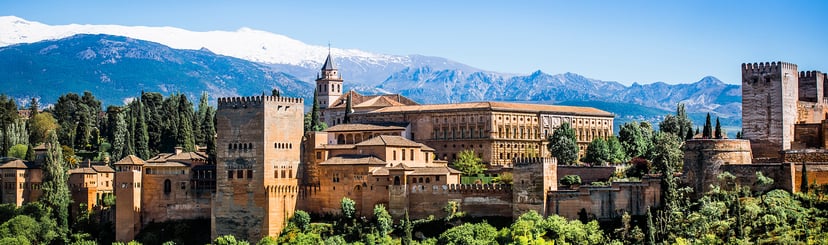
Fortification is often described as an inventory of objects: wall, tower, gate, ditch. At the Alhambra, that inventory is incomplete without the land beneath it. The complex occupies the Sabika, a long elevated ridge above the Darro valley, facing the Albaicín across the river and looking west toward Granada and the Vega. Its sides are not uniform. Slopes, ravines and changes of level limit where large groups can approach easily, conceal some lines of movement and expose others. The ridge therefore does defensive work before a constructed wall is reached.
The Alcazaba takes the western end of this topography, where the hill points toward the city like the narrowed end of a ship. That position gives the military enclosure a distinct relationship to both the lower city and the rest of the palatine settlement. Looking west from the sector of the Torre de la Vela, the viewer can understand why surveillance mattered: the city spreads below, the plain opens beyond, and routes toward the hill can be read as movement through space rather than as lines on a plan. Looking east, the citadel does not terminate the Alhambra; it guards and regulates entry into a larger settlement extending along the ridge.
This is the first correction to a palace-centred visit. The Alcazaba is not merely an old fortress attached to a more refined ensemble. Its location gives the entire complex a defended front. The western towers address the city and open country, while the walls running east enclose a chain of palatial, administrative, residential and service spaces. Defense is therefore distributed. It is concentrated in the citadel, but it also appears in perimeter walls, gate-towers, protected walks, controlled passages and the ability to separate one sector from another.
A commanding view can be pleasurable now and still have had practical value in the past. Yet visibility was never absolute: buildings, vegetation, folds in the ground and the ridge itself created blind zones. Defense depended on overlapping positions and constrained approaches, not one all-seeing lookout.
The hill’s relationship to Granada matters just as much as its height. The Alhambra was not a remote mountain castle. It belonged to the city’s political and economic life while standing apart from it. Access routes climbed from inhabited quarters; water had to be brought and distributed; provisions, officials, soldiers, craftspeople and petitioners moved between the lower city and the ridge. A defended court could not close itself permanently. Its architecture had to admit necessary circulation without surrendering control over who entered, by which route and into which zone.
That tension—connection without openness—explains why gates deserve more attention than their façades usually receive. A wall only excludes in the abstract. A gate is where exclusion becomes a managed decision. It stages the moment at which terrain, architecture, personnel and authority converge.
A gate is a process, not a hole in the wall
The most revealing defensive feature at the Alhambra is often not thickness but sequence. A straight opening offers a direct line from outside to inside. A bent entrance breaks that line, slows movement, limits what an approaching person can see and creates points from which guards can observe or intervene. The principle is easy to name and easy to oversimplify. Not every turn proves a specific combat scenario, and later rebuilding can alter the original experience. What matters is the cumulative arrangement: approach, concealment, turn, covered space, another turn, controlled release.
The official description of the Alcazaba gives an unusually clear example at the foot of the Torre del Homenaje. It records a gradual approach around the tower’s base, a wall that forces a turn while hiding the main door from exterior view, and then a vaulted interior passage with further bends. Before the passage opens into the Plaza de Armas, an opening above permitted control and, in hostile circumstances, attack from the upper level. The same covered corridor provided access toward lower levels of the tower and toward the wall-walk by a narrow, steep stair. These details are documented by the Patronato’s official Alcazaba account.
Read as a single mechanism, the entrance did more than delay a rush. It denied the approaching person a clear view of the door until late in the sequence. Once inside, it substituted a confined, roofed route for open ground. It placed vertical control above horizontal movement. It also distributed authorized users: one direction led toward the tower, another toward the adarve, and the main progression toward the military quarter. The architecture converted entry into sorting.
That sorting function is central to the Alhambra’s military urbanism. Soldiers, residents, messengers and people bound for other precincts did not all require the same access. A gate could support routine movement while preserving the option to narrow, stop or redirect it. Defense included the ordinary administration of a protected place, not only response to assault.
Modern circulation can blur this logic. Visitors usually arrive through managed entrances, follow directional signs and move along surfaces adapted for conservation and public safety. Openings that once related to patrol routes may be approached from the reverse direction. A passage that formerly compressed movement may now feel like a brief architectural curiosity because the surrounding sequence has been interrupted. Other routes are closed, partly lost or detached from the buildings they served. The visitor should resist the seductive assumption that the order of today’s itinerary reproduces the order of medieval access.
A useful method is to pause mentally at each threshold and ask four questions. What could be seen before the entrance? How many changes of direction were required? Who could watch the movement, including from above? What destinations became available after the threshold? These questions do not require an invented battle scene. They allow the surviving geometry to speak in terms of control.
- Visibility: Was the door exposed from a distance, or screened by a wall, tower or turn?
- Speed: Could several people pass abreast, or did the route narrow and bend?
- Vertical advantage: Were there upper positions, openings or wall-walks governing the passage below?
- Distribution: Did the gate release movement into one space, or divide it toward several controlled destinations?
The Torre del Homenaje entrance answers all four in a coherent way. It conceals, slows, subjects and distributes. That coherence is stronger evidence than any claim that a named historical figure fought at a particular corner. It also explains why the Alcazaba’s entrance is architecturally inseparable from the tower, walls and quarter behind it. The defensive unit is not the doorway alone; it is the full chain of approach and response.
Puerta de la Justicia: defense joined to representation
The Puerta de la Justicia demonstrates a related but more monumental problem. The Patronato dates the gate-tower to 1348, during the reign of Yusuf I, and identifies it as one of the principal entrances integrated into the palatine city’s wall and tower system. The official account also notes that the gate commander resided there after the Castilian conquest until French troops arrived in 1810. Those facts, available in the official history of the Torre de la Justicia, establish both a Nasrid construction context and a long afterlife as an inhabited point of control.
Its scale can tempt visitors to treat it as a ceremonial frontispiece. Yet monumentality and defense are not opposites. A major gate had to communicate authority precisely because it was a place where authority was exercised. The large exterior arch announces the entrance, but the interior route does not offer a simple axial passage into the city. Changes of direction mediate the transition. The visitor is brought under the mass of the tower, through a sequence in which spatial command is felt physically.
This coexistence of display and constraint is characteristic of courtly fortification. The gate says that entry is possible, but not self-determined. It dignifies arrival while demonstrating that the ruler controls the terms. Decorative signs associated with the gate have accumulated extensive interpretation, some careful and some speculative. For a defensive reading, the more secure starting point is the architecture’s work on bodies: it frames, slows, turns and admits.
The Torre del Homenaje entrance and the Puerta de la Justicia should not be collapsed into one type. The Alcazaba approach is embedded in the garrison’s internal defensive apparatus. The Justice Gate serves the wider palatine city and presents a more public face. Their shared use of indirect movement shows a common concern with controlled access, but their scale, audience and urban role differ. One protects and organizes the military enclosure; the other negotiates entry into the larger walled settlement.
A third category is the postern: a smaller opening serving limited, emergency or specialized movement. Posterns matter because they reveal that a fortified perimeter could not function through monumental gates alone. Water service, communication, rapid closure, discreet passage and the separation of wall sectors could require secondary openings. Yet these are also the features most vulnerable to legend. A narrow door in a wall almost invites a tale of betrayal or escape. The responsible approach is to distinguish architectural possibility from historical identification.
That distinction becomes especially important around the stories of Granada’s transfer in 1492. A particular opening may be well suited to concealed passage without being demonstrably the opening used on a famous night. The shape of a route can establish tactical plausibility; it cannot by itself name the event that occurred there. In this part of the Alhambra, restraint is not a failure of imagination. It is the method that preserves the difference between evidence and folklore.
The Alcazaba was a military neighbourhood
Once the bent entrance releases movement into the Alcazaba, the interpretation changes scale. The enclosure is not only a platform for towers. The official description calls the interior a residential area for an elite garrison serving the sultan and identifies the excavated sector as the Barrio Castrense, or military quarter. A narrow street runs through it, separating irregular groups of dwellings on one side from more regular spaces on the other, interpreted as possible storage or troop accommodation. The same Patronato account of the Alcazaba emphasizes that guards could live there with their families.
This evidence changes the emotional register of the site. Low walls that appear abstract from above become traces of a lived urban environment. The quarter required access, food, water, storage, rest, domestic routine and communication with the wider complex. Soldiers were not perpetually stationed on battlements. They inhabited a neighbourhood whose organization supported readiness over time.
The word “quarter” is more accurate than “barracks” if barracks suggests a single institutional block. The excavated plan presents multiple units, narrow circulation and differentiated spaces. Some houses follow familiar courtyard-based principles on a small scale. Other areas appear more regular and may have served collective or logistical purposes. The settlement therefore combined domestic and military functions rather than dividing them neatly.
Its position inside a larger fortified ensemble is equally significant. The Alcazaba’s garrison watched not only external approaches but the palatine city itself. That does not imply suspicion at every moment; it reflects the political reality of guarding a ruler, court and administrative centre. The citadel could serve as a secure nucleus within the wider enclosure, capable of controlling connections toward walls and adjacent precincts.
Here the relationship between military and royal space becomes more legible. The garrison was close enough to respond, but not absorbed into the palaces. Controlled passages and differences of level mediated proximity. Courtly privacy, service movement and military deployment demanded different rhythms. The Alhambra’s strength lay partly in keeping these systems connected without allowing them to merge into undifferentiated openness.
The archaeological remains also force a question about reconstruction. A visitor sees foundation walls, restored wall tops, modern walking surfaces and areas cleared by excavation. These elements do not all belong to the same historical moment. Archaeology reveals patterns by removing later deposits, but the act of exposure creates a new landscape. Consolidation then stabilizes fragile masonry, often making a low wall easier to read while also giving it a visual finish it never possessed in use.
A dated archival object makes this history of interpretation tangible. The Alhambra archive catalogues a July 1920 plan sketch of the military quarter attributed to Modesto Cendoya, drawn in black and red pencil on graph paper and preserved as APAG/Colección de Planos/P-008632. The record can be consulted through the institutional catalogue entry for the Barrio Castrense sketch. The plan is not medieval evidence in itself. It is evidence of how the exposed remains were being recorded and understood in the early twentieth century.
That distinction matters. The quarter has at least two histories: the history of occupation and the history of excavation, drawing, consolidation and presentation. A careful reading asks which walls are original fabric, which were rebuilt or capped, which spaces are interpretations based on partial remains, and which apparent routes exist because modern access has been laid across the archaeological field. Without that second history, the site can look more complete and more certain than it is.
The point is not skepticism for its own sake. Nasrid households, later occupants, excavators, architects and conservators all shaped what can now be seen. A wall can remain materially medieval while its present height, edge or relationship to a path reflects a modern decision.
Torre de la Vela: mass, height and the limits of the view
The Torre de la Vela dominates many impressions of the Alcazaba because it combines heavy masonry with an extraordinary outlook. In Nasrid times it was known as the Torre Mayor. The official description records four floors, a basement with a dungeon and an upper terrace. It notes that the lowest part is more massive for stability, while interior space increases higher in the structure, and that defensive battlements once crowned the terrace but were lost over time through earthquakes. These details are set out in the Patronato’s account of the Torre de la Vela.
The internal section matters as much as the skyline. A tower is not a solid icon. It is a stacked building whose lower mass resists weight and whose upper levels create usable rooms, circulation and lookout positions. Its defensive value comes from structural permanence, elevation, controlled access and connection to adjacent walls. The official documentation also records a barbican around the base, reinforcing the approach before the tower itself was reached. The terrace is the culmination of that layered system, not the entire tower.
Today, the broad view can encourage a retrospective fantasy of complete command. Yet seeing far is not the same as knowing everything. A watcher could identify movement in the city, across the plain or along exposed routes, but distance reduces detail and weather changes visibility. Nearby ravines and the folds of the hill create concealed approaches. Towers worked because they belonged to a network of walls, gates, patrols and signals—not because one person on one roof could master the landscape.
The lost battlements are a useful warning about visual completeness. Many visitors assume that a famous silhouette is the historic silhouette. The official record explicitly notes change through seismic damage. Later repairs, the presence of the bell and the tower’s post-medieval civic role further complicate any attempt to freeze it in the Nasrid period. What survives is authentic fabric with an extended biography, not an untouched time capsule.
A defensive reading of the view should therefore move in both directions. From the tower outward, ask which approaches are visible and which disappear behind terrain. From the landscape inward, ask how the tower would have appeared to someone below. Its visibility projected power. The Alhambra announced itself from the city even as its gates withheld easy access. Surveillance and spectacle reinforced one another.
The tower also clarifies the difference between strategic terrain and scenic landscape. The Vega’s openness, the city’s density, the Darro corridor and the facing Albaicín are beautiful from above, but they are also distinct zones of movement and habitation. Fortification enthusiasts gain more by naming those zones than by treating the panorama as a single postcard. The view becomes analytical when each sector is connected to routes, resources, neighbourhoods and possible lines of approach.
How military space connected to the royal precincts
The Alcazaba’s defensive significance is sometimes overstated in a different direction: as though the citadel were a self-contained castle and the palaces merely happened to grow beside it. The Alhambra developed across successive phases, and the relationship between western fortress, royal compounds and the urbanized ridge changed with those phases. Still, the spatial principle is durable. The military enclosure protected a larger political organism.
The connection can be read as a gradient rather than a single doorway. At one end stand the garrison quarter, major towers and wall-walks. Moving east, one encounters spaces associated with access, service, administration and court. Farther along the ridge were residential and productive parts of the palatine city. Each zone depended on the others, but access could be filtered. A soldier’s route to a wall, a courtier’s route to an audience and a worker’s route to a service area were not interchangeable simply because they lay within the same perimeter.
This helps explain why the Alhambra should be called a defended settlement rather than just a fortified palace. The perimeter enclosed more than royal apartments. It contained people and activities necessary to sustain governance. Defense protected relationships: ruler and guard, palace and store, gate and street, water supply and household. The walls defined a political geography.
For visitors, the hardest part is that those relationships are no longer fully visible. Buildings have vanished, routes have been interrupted, and surviving landmarks receive unequal attention. The Nasrid palaces are densely legible because rooms, inscriptions and decoration hold the eye. The military quarter is more fragmentary. The result is an interpretive imbalance: palace space feels inhabited and specific, while defensive space can feel generic. A specialist reading reverses that imbalance by reconstructing function from plan, threshold and terrain without pretending that every uncertainty has disappeared.
This is also the point at which an architecture-focused private visit can materially change the outcome. The value is not access to invented secrets. It is disciplined comparison: distinguishing a medieval turn from a modern diversion, a documented residential unit from a conjectural label, original masonry from a consolidated edge, and a plausible postern function from a named historical episode that remains unproven. For fortification enthusiasts commissioning a study-led Alhambra visit, that interpretive continuity prevents the Alcazaba from becoming a scenic prelude to the palaces.
A tailored route can also place the evidence in the right order: terrain before tower, approach before gate, gate before quarter, quarter before royal connection. Palace-focused visitors who now want the fortress and its relationship to Granada interpreted through surviving structures rather than legends can explore private Granada tours or Inquire now about a specialist-led study.
Building phases: the wall is a historical document
No single date explains the Alhambra’s defenses. The Sabika had fortification before the mature Nasrid palatine city, and the complex expanded, repaired and reoriented over centuries. Muhammad I, founder of the Nasrid dynasty in the thirteenth century, is central to the establishment of the royal city and strengthening of the citadel. Later rulers added gates, towers, palaces and urban infrastructure. Yusuf I’s construction of the Puerta de la Justicia in 1348 belongs to that continued development rather than to one original master plan.
After 1492, Christian occupation did not place the walls outside history. Command structures changed, buildings were adapted, damaged or replaced, and new political meanings settled over Nasrid fabric. Military use continued in altered forms. The Justice Gate’s residence for the gate commander is one clear example of a defensive structure retaining an administrative and residential function under a new regime.
Later centuries added further disruptions: neglect in some sectors, repairs in others, seismic damage, military interventions, new routes and changing attitudes toward the monument. By the nineteenth and twentieth centuries, the Alhambra had become an object of increasingly systematic conservation as well as romantic projection. Archaeologists and architects exposed remains, removed some later accretions, stabilized walls and made choices about which historical state should be legible.
Conservation cannot preserve every phase with equal visual force. Exposing an earlier wall may reduce the visibility of later deposits; protecting fragile masonry may require caps, fills or supports; safe access may require new surfaces. The question is whether intervention is documented, distinguishable and proportionate.
For the visitor, three kinds of material should be held apart even when they touch:
- Surviving fabric: masonry, foundations, openings or finishes materially inherited from an earlier phase.
- Conservation fabric: repairs, caps, fills or supports added to protect surviving material and make its form readable.
- Interpretive infrastructure: paths, railings, signs, lighting and route controls installed for modern access and stewardship.
These categories are not always visually obvious. A discreet repair may disappear into the whole, while original masonry can look new after cleaning or consolidation. Colour alone is therefore a poor guide to date.
The military quarter makes the issue especially acute. Low archaeological walls need protection at their exposed tops. Once capped, they read as continuous outlines. That continuity helps visitors perceive rooms and streets, but it can suppress the fragmentary nature of the evidence. A plan may be secure at foundation level while upper-storey arrangement, roof form or exact room use remains unknown. The visible outline is a base for interpretation, not permission to imagine a complete barracks in every detail.
The same caution applies to gateways. Door leaves, paving, parapets and upper chambers may belong to different dates. A bent route can remain legible after surfaces are renewed, supporting a functional claim about controlled access without justifying a cinematic account of a particular confrontation.
Conservation can also change what a visitor is allowed to see at any given time. Closures or diversions may interrupt the ideal evidence sequence, especially in a monument under continuous care. Rather than treating that as a failed visit, use substitute evidence: another bent entrance, a sightline from a neighboring tower, an archival plan, or the relationship between a wall and the terrain below. Our guide to reading the Alhambra when conservation changes the route develops that method.
The larger lesson is that restoration is not a footnote added after architectural history. It is one of the phases through which the defensive Alhambra has reached us. To read the walls well is to ask both “What did this structure do?” and “Why can I see it in this form now?”
Siege narratives: why the most vivid story may be the least secure
Fortresses attract stories of surprise attacks, treachery, tunnels and hidden doors because such stories give static masonry a dramatic plot. The Alhambra has more than its share. Some narratives preserve historical memory; others combine a real feature with an uncertain event; still others belong largely to later imagination. The difficulty is not eliminating story but assigning it the right evidential weight.
A scholarly study by Jesús Bermúdez Pareja on the posterns of the Alhambra illustrates the problem. It discusses a narrow opening near the Torre de Juan de Arce whose position, concealment and relation to irregular terrain made it a plausible candidate for a secret or “betrayal” postern. Yet the study treats the identification with the entry associated with the transfer of the Alhambra as uncertain. It also considers other possible openings and emphasizes how some posterns were transformed, obscured, restored or known only through incomplete traces. The article is available through Cuadernos de la Alhambra.
This is a model of responsible interpretation because it keeps several levels of claim separate. The opening exists. Its terrain and narrowness suit discreet movement. Historical accounts describe controlled entry. But matching one material remnant to one episode remains provisional. The uncertainty is not a reason to ignore the postern; it is part of what the postern teaches about evidence.
The events of 1492 are especially vulnerable to simplification. Granada’s surrender followed negotiation and capitulation, not a final cinematic storming of the Alhambra’s principal gate. That political transition does not make the defenses irrelevant. It shows that fortifications exert power even when not breached in battle. Strong walls can shape negotiation by raising the cost and uncertainty of assault. Conversely, a negotiated handover can transfer a fortress whose military architecture remains intact.
A single secret-entry story can obscure the practical multiplicity of openings. A large fortified settlement needed major gates, secondary posterns, service access and connections between wall sectors. Architectural study restores that network.
There is also a temporal trap. A postern visible today may have been altered after the event attached to it. A gate known by a later name may be projected backward. A rebuilt wall can preserve the location of an opening while changing its appearance. When the date of the fabric and the date of the story are not aligned, confidence should fall.
A sound on-site formulation uses calibrated language. Say that a feature “could have supported discreet passage” when the geometry allows it. Say that scholars “have proposed” an identification when the evidence is debated. Reserve “was used” for cases supported by a reliable documentary and material chain. This vocabulary may feel less dramatic, but it gives the traveler something more durable than legend: an understanding of how historical knowledge is made.
Three thresholds, three kinds of evidence
Comparing three entrance types helps prevent the entire defensive system from collapsing into one generic category.
The Torre del Homenaje approach
This is the strongest surviving lesson in tactical circulation. The approach is screened, the route bends, the interior is vaulted, oversight is vertical and movement is distributed toward the tower, wall-walk and military quarter. Its meaning emerges from sequence. The evidence is architectural and spatial, supported by the official description.
The Puerta de la Justicia
This is a major urban gate-tower where controlled circulation is joined to monumental representation. Its date under Yusuf I and its integration into the palatine wall system are secure. Its later occupation by a gate commander demonstrates continuity of control across political regimes. Its meaning emerges from scale, authority and the management of formal arrival.
The postern near the Torre de Juan de Arce
This is a smaller and more contested case. Terrain, concealment and dimensions make discreet use plausible. The identification with a famous entry episode is not certain. Its meaning emerges from evidential limits: a structure can strongly support a function while weakly supporting a specific story.
Together, the three thresholds form an evidence spectrum. The first is read through surviving route geometry. The second combines dated construction, urban role and later documentary history. The third requires a conversation between fabric, terrain and historiography. A specialist visit should change method as the evidence changes rather than apply the same level of certainty everywhere.
This comparison also reveals that “defensive” does not mean “purely military.” The Justice Gate embodies political display; the Alcazaba entrance supports residential circulation; the postern may relate to routine service as much as emergency. Fortification is an urban system with military capacity, not an architecture activated only during war.
Reading the Alhambra against Granada
The defensive Alhambra becomes more intelligible when its relationships to the lower city are kept in view. Across the Darro stands the Albaicín, itself shaped by walls, gates, cisterns, lanes and changes of level. Below and west lie routes into the civic and commercial city. Southward, the slopes descend toward the historic Realejo. The ridge is separate, but it is never isolated from these urban geographies.
Water makes that interdependence unmistakable. A palatine city on a ridge required engineered supply and distribution. Although this article focuses on walls and gates, defense cannot be separated from infrastructure. A protected settlement that loses water cannot rely indefinitely on masonry. The Alhambra’s hydraulic system therefore belongs to the logic of resilience as well as garden aesthetics. Readers interested in the wider urban network can follow Granada’s cisterns, channels and water geography beyond the ridge.
The view toward the Albaicín also corrects the notion that the Alhambra alone possessed sophisticated urban form. The Nasrid capital was a landscape of connected fortified and residential zones. Gates mediated between them; paths climbed and descended; walls marked political and social boundaries without stopping exchange. The Alhambra’s distinctiveness lies not in being the only ordered place above a chaotic city, but in concentrating royal, military and ceremonial power within a carefully defended elevation.
Extending the visit into Granada helps test that proposition. The Madraza, Corral del Carbón and surviving Andalusi houses reveal other scales of institutional, commercial and domestic architecture. They show that courtyard planning, controlled entrances and inscriptions belonged to a wider urban culture, even when their functions differed from the palatine city. Our guide to reading Islamic art and architecture beyond the Alhambra supplies that supporting context.
For fortification specialists, the most productive outward glance is comparative rather than scenic. Ask how the Alhambra’s gates related to city approaches; how the Alcazaba’s western position addressed the Vega; how the Darro ravine separated and connected hills; and how secondary passages may have used folds in the land. The landscape is not background to the walls. It is the medium in which the walls operated.
A disciplined sequence for an architecture study
A defensive reading benefits from a different order of attention than a conventional highlights tour. The goal is not to rush to the highest tower or collect every gate name. It is to build an evidence chain in which each observation makes the next one more intelligible.
- Orient from the landscape. Identify the Sabika ridge, western point, Darro valley, Albaicín, lower city and Vega. Note where slopes assist defense and where routes must climb.
- Study an approach before crossing it. At the Alcazaba entrance, reconstruct what an arriving person could and could not see. Follow the turns mentally before discussing combat.
- Track distribution after the threshold. Observe how access relates to the Torre del Homenaje, wall-walks and the military quarter. Entry is meaningful because of the spaces it controls.
- Read the quarter as urban archaeology. Separate street, dwellings and possible collective or storage zones. Treat low walls as evidence of plan, not as complete rooms.
- Use the Torre de la Vela to test sightlines. Name visible sectors and hidden terrain. Distinguish strategic observation from the modern pleasure of the panorama.
- Compare a monumental gate with a postern. Contrast public authority, routine control and discreet passage. Adjust certainty to the quality of the evidence.
- End with phases. Identify where later occupation, earthquake damage, excavation and conservation have shaped the form now visible.
This order is interpretive, not a claim about the only feasible visitor route. Conservation and access management may require a different physical sequence. The point is to preserve the logic even when the feet move otherwise. A guide can introduce the terrain at one viewpoint, carry the gate questions into a later passage, and return to the military quarter through archival plans if part of the fabric is inaccessible.
The method also guards against information overload. Terms such as adarve, barbican, postern and bent entrance should be tied to a visible relationship. Naming every tower without explaining its role weakens the larger argument.
For a highly informed audience, uncertainty should be explicit rather than hidden behind fluency. Mark which interpretation comes from official site documentation, which from a scholarly proposal, which from comparative architectural reasoning and which remains an editorial synthesis. That hierarchy allows experts and serious enthusiasts to disagree productively without confusing disagreement with error.
What the defensive reading changes
Once gates, military housing and terrain are treated as one system, the Alhambra’s palaces look different. Their refinement no longer appears to float above practical life. It rests within a defended city whose guards had homes, whose entrances sorted movement, whose towers combined mass with observation, and whose water, walls and roads tied the ridge to Granada.
The defensive reading also changes the meaning of beauty. Indirect passages create suspense; thick towers produce monumental calm; framed glimpses appear as movement turns; high terraces reveal immense views. These effects can be aesthetically powerful without having been designed only for aesthetic pleasure. Architecture often acquires beauty through the precision with which it solves political and practical problems.
Equally, the reading changes what counts as evidence. A famous decorated surface may be visually richer than a wall stump, but the wall stump can disclose street width, property division or the relation between domestic and collective space. An archival sketch can reveal the history of excavation. A repaired parapet can raise questions about earthquakes and restoration. A contested postern can teach more about historical method than a confidently repeated legend.
The deepest payoff is to replace the false choice between fortress and palace with a more exact proposition: the Alhambra was a courtly city whose magnificence depended on managed access to a difficult, engineered and inhabited ridge. Its defenses were not an outer shell. They were part of the settlement’s social order.
That proposition still leaves an open question for every serious visit. When so much of the Alhambra’s power came from deciding who could see, enter and move through each zone, how should we interpret a monument now organized around mass public circulation? The modern route opens the palatine city to the world, but it also rearranges the very thresholds that once defined it. Reading the defensive Alhambra means holding both realities in view: the controlled settlement that was, and the conserved public monument through which we now try to understand it.
If you’re interested in any private tours of Granada, please reach out to us.



 So if you are looking for the absolute best in Granada & surroundings with authentic local fully-licensed native guides whose English you can actually understand and with an exclusive and amazingly fun itinerary













