Montserrat With Limited Mobility From Barcelona: Rack Railway, Cable Car or Private Road?

Updated
The seductive mistake in planning Montserrat with limited mobility is to treat the rack railway, cable car and mountain road as three scenic versions of the same arrival. They are not. They create different chains of standing, boarding, stairs, gradients, weather exposure and return risk long before anyone reaches the basilica. A five-minute ascent can be the least suitable choice if it begins with unavoidable stairs. A vehicle can remove several transfers yet still leave uncertainty about parking and the final approach. A railway described as adapted can be the soundest public option while still requiring careful scrutiny of the Barcelona departure, the connection and the tired return.
The useful question is therefore not “Which way up is most beautiful?” It is “Which complete route lets this family reach the same cultural anchors, stay together and retain a credible way home?” That shift matters for wheelchair users, travelers with arthritis or balance concerns, older parents who can walk but cannot stand for long, people managing pain or breathlessness, and multigenerational groups whose members have very different reserves of energy. It also prevents the usual weak advice to “walk less,” which says nothing about stair dependence, platform changes, toilet access or what happens when the weather changes.
The route is a chain, not a single ascent
A Montserrat day begins at the Barcelona accommodation, not at the foot of the mountain. For each option, map six links: leaving the hotel or apartment; reaching the first station or vehicle; waiting and boarding; making any connection in the Monistrol area; moving from the upper arrival point into the sanctuary complex; and repeating the process after several hours, when the person with limited mobility is likely to have less capacity than in the morning.
That last link is often omitted from planning. A traveler may manage a platform change, a flight of stairs or a prolonged stand once, then find the same task substantially harder on the return. Good routing therefore uses the person’s likely afternoon capacity, not their freshest morning performance, as the governing measure. It also distinguishes a movement that is technically possible from one that is repeatable without pain, instability or forced separation from the rest of the family.
Three characteristics reveal the burden of the chain. Transfer count measures how often the traveler must stand, turn, cross a gap, fold or reposition a mobility aid, or wait for companions and luggage. Vertical dependence identifies where stairs, lifts, ramps or slopes are unavoidable. Reversibility asks how easily the group can shorten the day, change modes or leave when conditions deteriorate. A route with fewer minutes in motion can score worse on all three.
Clarify the cultural purpose before choosing the chain. A family centered on worship and the basilica has a different tolerance for scenic transport than one whose principal aim is the mountain panorama. A group primarily interested in art may be satisfied by a compact museum-led visit during poor visibility. The companion guide on how sacred music, museum art and mountain landscape compete for time helps establish that priority. Here, the task is to make the chosen purpose reachable without pretending every arrival mode supports it equally well.
Define the mobility limit before choosing the scenery
“Limited mobility” is too broad to select a route. A person who uses a wheelchair full time, a traveler who can climb six steps with a rail, and an older adult who walks steadily but cannot queue for twenty minutes may all use the same phrase while needing entirely different plans. The family should agree on functional conditions rather than a diagnosis.
- Stairs: Can the traveler climb and descend them safely, and can the task be repeated later in the day?
- Standing: How long can the traveler wait without a guaranteed seat? A short ride does not compensate for a long standing queue.
- Transfers: Can the person board independently, cross a platform gap, turn in a confined space and manage a mobility aid during the change?
- Gradient: Is a gradual slope acceptable, or does any sustained incline create pain, breathlessness or braking difficulty?
- Weather exposure: Does cold, heat, wind, rain or low visibility materially reduce stability or endurance?
- Toilet timing: Does the plan require a known accessible toilet at predictable intervals rather than an improvised search?
- Group cohesion: Is temporary separation acceptable, or must children, grandparents and the mobility-limited traveler remain together throughout?
Answers should be specific enough to exclude unsuitable modes. “A few steps are fine” is not yet useful; ask whether that means two broad steps with a handrail or a longer stair sequence with people waiting behind. “Can walk slowly” does not reveal whether the person can stand while a cabin arrives. “Uses a folding wheelchair sometimes” does not establish whether the traveler can transfer into a standard vehicle seat or whether the chair must remain occupied and secured.
Use the least flexible requirement as the route constraint. In a mixed family, the athletic members can usually adapt to a slower or shorter visit; the traveler facing stairs or an inaccessible transfer cannot adapt in the same way. This is not about making the day smaller. It is about placing cultural depth where the group can actually share it.
Rack railway: the most clearly documented reduced-mobility ascent, but not a friction-free day
Ferrocarrils de la Generalitat de Catalunya states that the Montserrat rack railway reaches the center of the monastery complex in about fifteen minutes and that both the trains and platforms are fully adapted for people with reduced mobility. The same official rack railway information identifies free parking at Monistrol-Vila for up to 1,000 cars and 70 coaches. These are the strongest verified access facts among the three arrival modes considered here.
They support two distinct chains. The all-rail version links a Barcelona departure with a connection in the Monistrol area and then the rack railway to the sanctuary. The hybrid version uses a vehicle to Monistrol-Vila, where the family transfers to the rack railway. The hybrid can preserve the mountain-rail experience while removing the urban station journey and allowing mobility equipment, coats and other necessities to travel in one vehicle to the lower station.
For a wheelchair user or anyone who cannot safely use stairs, the official adaptation claim makes the rack railway the public ascent worth investigating first. It does not prove that every preceding station, lift, corridor and boarding point in the Barcelona-to-Montserrat chain will meet a particular traveler’s needs on a particular day. Nor does it specify the platform gap, wheelchair-space procedure, boarding assistance or whether a lift elsewhere in the journey is temporarily unavailable. Those details require route-specific confirmation.
For a cane user or an older traveler with fatigue, the more important question may be seating rather than step-free access. A train can be adapted and still involve waiting, crowding or a period without a seat. Confirm whether the planned service is likely to provide seated travel, what happens if a train is busy, and where the traveler can sit during the connection. Do not use the fifteen-minute rack journey as a proxy for the burden of the entire trip.
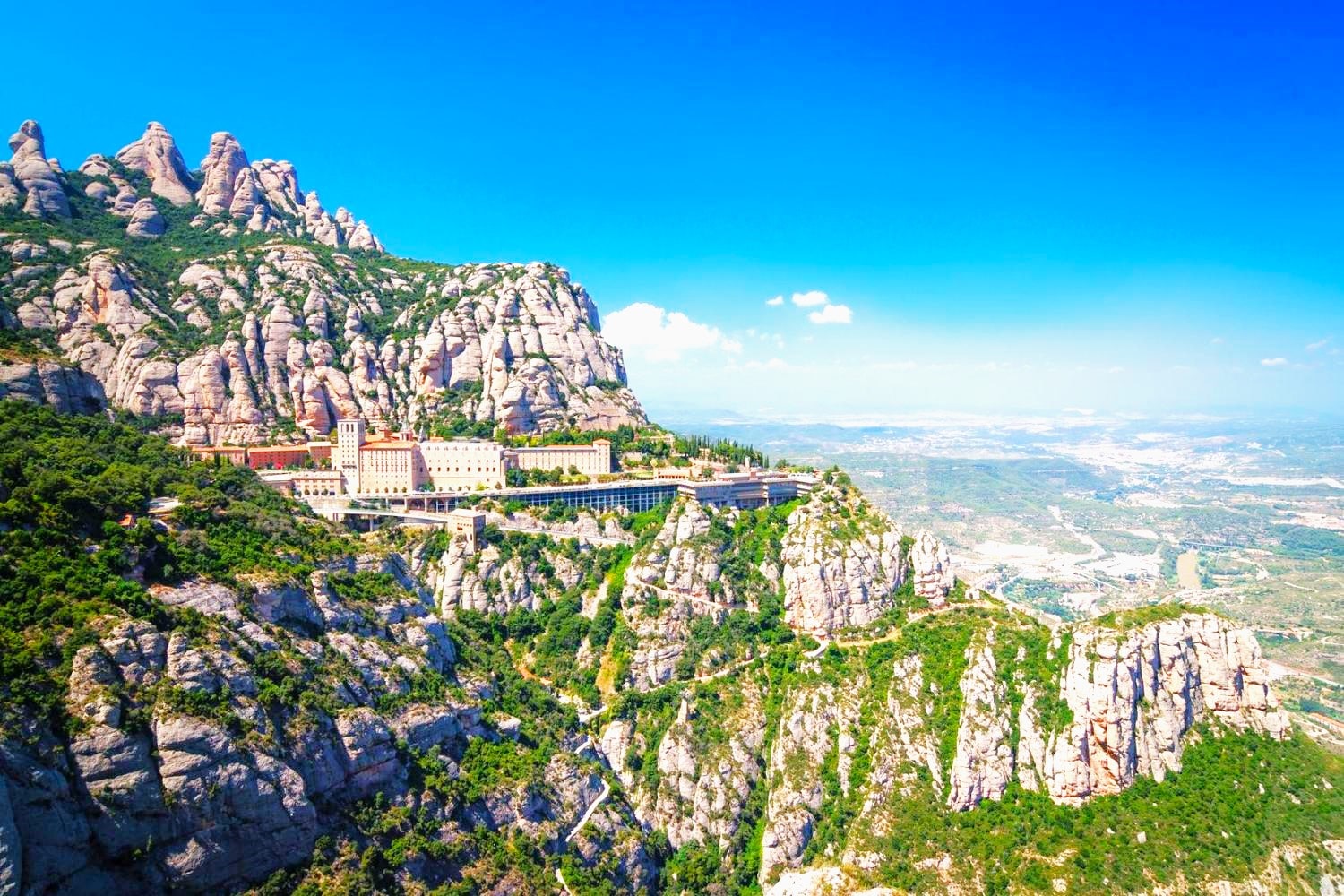
The upper arrival is operationally valuable because it places passengers in the central sanctuary area rather than obliging them to complete a road-to-rail transfer after the ascent. Yet “center” should not be translated into “everything is level.” Montserrat is a mountain complex, and the final route to the basilica, museum, toilets and a chosen viewpoint still needs to be described step by step. The official railway statement is about trains and platforms; it is not a blanket guarantee for every path beyond them.
The rack railway also offers a relatively legible bailout structure. A family using the hybrid approach can return to the same lower station and rejoin its vehicle without repeating an urban rail chain. A family traveling entirely by rail remains dependent on the sequence of return services and connections, so it should record the day’s operating times and preserve more buffer than the minimum theoretical interchange. In both cases, the return should be planned around reduced afternoon stamina.
Cable car: a brief ride that can create the hardest transfer
The Aeri de Montserrat cable car is visually dramatic and operationally quick. The operator says cabins depart approximately every fifteen minutes and the ride takes about five minutes. The same official cable-car guidance, however, states that the facilities are not wheelchair accessible and that passengers must use stairs. It also says parking is available only while spaces remain.
Those facts overturn the assumption that the shortest ascent is the easiest. For a wheelchair user who cannot transfer and climb stairs, the cable car is not a viable arrival mode under the operator’s stated conditions. For a traveler using a cane, managing balance problems or recovering from surgery, the decision turns on the exact stair demand, handrail use, crowd pressure and ability to board a moving or time-sensitive cabin environment. “Can do stairs at home” is not enough unless the family understands the real sequence and the person can repeat it on the return.
The cable car can still be a reasonable choice for someone whose walking range is limited but whose stair function and balance are reliable. In that case, its scenic value may justify the concentrated transfer effort. The family should nevertheless count all preceding movements: travel from Barcelona, arrival at the lower station, access to the boarding point, any wait without a seat, cabin boarding, upper-station exit and the route onward to the sanctuary. The five-minute ride is only one element.
Parking uncertainty matters for a vehicle-to-cable-car plan. An available space cannot be assumed, and a driver arriving with a mobility-limited passenger needs a plan for what happens if the lower car park is full or the passenger cannot manage the station approach. That contingency should be decided before leaving Barcelona, not improvised beside the mountain.
Weather adds another layer. Aerial transport is more exposed to operating restrictions than a simple road transfer, but no family should invent a wind threshold or infer service status from conditions in Barcelona. Check the operator’s live information for the travel date. If there is meaningful doubt, switch modes before departure. Treating the rack railway as an effortless last-second substitute at the cable-car station understates the geographic and logistical work needed to reposition the group.
Route judgment: choose the cable car only when stairs are genuinely acceptable, standing tolerance is adequate, the whole party understands the return demand and the scenic ascent is itself a high priority. Do not select it merely because the ride is short or because non-specialist descriptions call it convenient. In accessibility planning, an explicit stair requirement outweighs a general promise of speed.
Private road: fewer passenger transfers, limited parking and no automatic doorstep
Montserrat’s official visitor guidance says cars may reach the sanctuary’s attended parking area and warns that capacity is limited. It also identifies Monistrol de Montserrat as the transfer area for visitors continuing by rack railway or cable car. The official road-access page therefore supports road travel as a direct mountain approach, but not as a promise of immediate parking, unrestricted drop-off or a level path from vehicle to basilica.
For many private families, the road option has one decisive advantage: it can remove repeated passenger transfers. A suitable vehicle can collect the group at its Barcelona accommodation, carry a folding chair or walker without repeated handling, preserve a familiar seat and allow the driver to adjust departure time when the traveler needs longer to get ready. Those are practical outcomes, not decorative upgrades. They matter most when standing, platform circulation, boarding or the risk of separation creates more difficulty than the distance itself.
The vehicle still has to fit the person. Confirm door opening, step height, grab handles, seat position, legroom and storage before assigning “private road” as the accessible answer. A high step into a large van may be harder than a level train boarding. A wheelchair user who cannot transfer needs a properly equipped vehicle and a documented securement arrangement, not a standard car with an optimistic description. A walker must be stowed without blocking the passenger’s safest exit.
Road flexibility becomes most valuable on the return. The family can leave when fatigue, pain or weather reaches its threshold instead of protecting a chain of scheduled connections. Coats, medication and mobility equipment remain close at hand. A younger family member can accompany the mobility-limited traveler to the vehicle without forcing the entire group through multiple platforms. Even so, road incidents, congestion, works and meteorological effects can alter the route. The Catalan Traffic Service provides official live traffic information for checking those conditions.
There is also a useful hybrid: vehicle to Monistrol-Vila, then the adapted rack railway. This can be superior to driving all the way when the family wants the shared rail ascent, prefers the large documented lower parking area or wants to avoid uncertainty at the sanctuary car park. It is inferior when the act of transferring out of the vehicle is itself the principal problem. The hybrid should be chosen because it reduces the right friction, not because combining modes sounds more complete.
Route judgment: private road travel is most persuasive when one controlled vehicle keeps the family together, removes an unsafe station chain and creates a flexible return. It is not automatically superior for a traveler who finds vehicle boarding difficult, suffers on mountain roads or can use the adapted rail chain comfortably. It also cannot erase the need to verify the path from the attended parking area into the sanctuary.
Choose by transfer capacity, not by diagnosis
Two travelers of the same age and with the same medical label may need opposite routes. The following branches are route judgments based on function; they are not medical advice and do not replace the traveler’s own assessment.
A wheelchair user who cannot climb stairs
The cable car is excluded by the operator’s own accessibility statement. The rack railway becomes the public ascent to examine, provided the complete rail path, wheelchair spaces, lifts and boarding arrangements are confirmed. A direct road plan can reduce transfers further, but only with the correct vehicle and a verified route from parking or an authorized passenger set-down point. The choice between rack and road then depends on whether the rail connection is manageable and whether the vehicle can deliver a safer total chain.
A traveler who walks but cannot stand for long
Do not let step-free language obscure the seating problem. The traveler may manage the cable-car stairs yet be unable to wait without support. The rack railway may be technically accessible yet tiring if the connection is crowded. A private vehicle may provide the most reliable seat, but the final parking-to-sanctuary movement remains. Ask where a guaranteed seat exists at every wait, not merely whether seating exists somewhere in the station or complex.
An older parent with stable gait and limited endurance
All three modes may remain possible, but repeatability controls the decision. The cable car works only if the stair sequence is comfortable both ways. The rack railway often balances scenery with a documented adapted platform environment. The road can conserve energy for the basilica and museum. Families making similar decisions across the city may find the principles in pacing a Barcelona stay with older parents useful: preserve capacity for the irreplaceable interior rather than spending it on avoidable transitions.
A mixed-mobility family that wants to remain together
The correct mode is the one the least mobile member can use without a parallel route. Sending some relatives by cable car while another takes the rack railway may appear to preserve everyone’s preference, but it introduces missed connections, different arrival points, phone dependence and uncertainty about where the group will reunite. A single shared ascent usually produces a richer visit than two optimized but disconnected journeys.
The same principle applies on site. Choose one basilica meeting point, one museum decision and one nearby landscape moment rather than allowing the energetic members to pull the day outward. The related guide to mixed-mobility routing around shared anchors and rejoining points explores this family dynamic on Barcelona’s other major hill; at Montserrat, the consequences are sharper because the return chain is longer.
A grandparent traveling with young children
A stroller and a mobility aid create separate handling tasks. Even when each item is manageable alone, repeated folding, lifting, boarding and supervising can overwhelm the adults responsible for both. Favor the route with the fewest moments in which a child, a bag and an aid must be controlled simultaneously. The scenic mode should not require the mobility-limited adult to wait alone while another adult manages equipment.
The sanctuary is not one flat destination
Arriving in the center of the monastery complex is useful, but it does not turn Montserrat into a single level interior. The sanctuary is embedded in mountain terrain, and a family still has to negotiate the relationship among arrival points, exterior spaces, the basilica, the museum, toilets, food or rest stops and any viewpoint. Exact gradients and step-free paths should be confirmed rather than inferred from a map.
Maps are especially weak at showing functional effort. A short line can conceal a sustained incline, a route across an exposed space, a threshold, a detour to a lift or a queue in which there is nowhere to sit. Conversely, a slightly longer route with a gentle gradient and predictable seating may be easier. Ask for the route a wheelchair or reduced-mobility visitor actually uses, not the shortest pedestrian line.
Separate three kinds of movement. Necessary circulation connects the chosen arrival mode to the primary cultural anchor and back. Optional circulation adds the museum, a viewpoint or another interior. Mountain extension includes funiculars, trails or more distant lookouts. The last category should never be assumed accessible merely because the rack railway is adapted. Each extension needs its own current evidence, and it should be removable without weakening the core visit.
For a family with limited mobility, the core should fit inside a compact triangle: one sacred anchor, one sheltered cultural anchor and one landscape experience close enough to abandon if visibility or energy declines. That design creates depth without making success depend on distance. It also provides a dignified answer when one relative wants the spiritual meaning of Montserrat and another wants art or scenery.
Do not schedule every available feature. The gain from a fourth stop is often smaller than the cost of another slope, queue and uncertain toilet. The family should know which element is essential, which is desirable and which is expendable before it arrives. This is how a route remains coherent when conditions change.
Build the visit around three shared anchors
The basilica: protect the sacred purpose without assuming every devotional route is equivalent
For families drawn by Montserrat’s religious significance, the basilica is usually the anchor that justifies the journey. Plan the arrival mode and first movement around reaching it while the mobility-limited traveler is freshest. Confirm the current step-free entrance, the precise route from the chosen arrival point, any security or queue procedure, and whether services or liturgical activity affect visitor circulation.
Distinguish entry to the main basilica space from any additional devotional route within the complex. A general statement that the basilica can be visited should not be stretched into a promise that every associated shrine, elevated area or procession path is step-free. Ask the official visitor service to describe the exact experience the family wants. This distinction prevents a painful outcome in which the group reaches the building but discovers that the most personally important element follows a different access sequence.
Seating must also be verified in context. The presence of pews or chairs in a sacred interior does not necessarily mean a sightseeing visitor may sit immediately, that a seat is available during a busy period or that the queue before entry offers support. A traveler who cannot stand should have a planned resting point before and after the basilica rather than rely on incidental seating.
The museum: the most clearly documented on-site accessibility anchor in the supplied evidence
Montserrat’s official visitor site says the museum’s newer entrance eliminated architectural barriers. It also confirms guided visits for groups and audioguides for individual visitors. The official Montserrat Museum page therefore provides a stronger documented basis for reduced-mobility planning than a vague promise that “the whole site is accessible.”
The museum can play several roles. It can be the family’s principal art experience, an indoor complement to the basilica or the weather fallback when cloud, rain or wind weakens the landscape element. It also allows the group to share interpretation without requiring a mountain extension. A private family should still confirm the route from its arrival point to the museum entrance, lift operation inside, accessible toilet proximity, available seating and the duration appropriate to the traveler’s stamina.
Use the museum to deepen rather than merely lengthen the day. Choose a small interpretive thread—Montserrat’s collecting history, the relationship between sacred setting and secular art, or a few works that matter to the family—rather than attempting exhaustive coverage. A focused visit reduces standing and makes it easier for children and older relatives to remain engaged together.
A viewpoint: choose a verified near-sanctuary outlook, not an aspirational walk
The mountain landscape should not disappear from an access-conscious plan, but it needs a different definition. The objective is a shared view from a point whose surface, gradient, exposure and distance have been checked for the specific traveler. It is not to reach the highest or most photographed lookout. A modest outlook that everyone can reach together has greater value than a celebrated panorama that divides the family.
Visibility is part of the decision. On a cloudy day, pushing farther for a theoretical view adds exposure without guaranteeing a reward. Keep the viewpoint optional until the family has assessed weather and energy on arrival. If it is removed, the basilica-and-museum visit should still feel complete.
The strongest shared sequence is usually basilica first when sacred interest leads, museum first when weather is unstable or art is the primary purpose, and the near-sanctuary viewpoint only after the group confirms that energy remains. This is an editorial route judgment, not a claim that one physical path fits every visitor. The exact order can change with current entry arrangements and the location of the verified step-free route.
The verification call that prevents a false promise
An accessibility plan fails when broad labels replace operational answers. “Adapted,” “accessible” and “close” are starting points, not the end of due diligence. Before booking, ask the operator, visitor service or tour planner to confirm the full chain in plain language. Written answers are preferable when a detail determines whether the traveler can participate.
For the Barcelona departure and rail connection
- Which exact station entrances and lifts create the step-free path for the planned service?
- Are those lifts currently operating, and what is the alternative if one is unavailable?
- Is advance assistance required or recommended for wheelchair boarding?
- What is the platform gap or boarding method at each train, including the rack railway?
- Where are wheelchair spaces, companion seats and guaranteed resting points?
- How much connection time remains realistic for a traveler who moves slowly?
- Where is the nearest accessible toilet along the chain, and during what hours is it open?
The official rack-railway page verifies adapted trains and platforms; it does not answer every question above for the entire journey from a particular Barcelona address. Confirming the chain is not distrust of the operator. It is the necessary step between a system-level accessibility statement and an individual journey.
For the cable car
- Where exactly are the required stairs, and must they be used in both directions?
- Are there handrails, landings or any alternative route for a traveler who can manage only a few steps?
- How long might passengers need to stand before boarding?
- What is the current operating status and weather policy for the travel date?
- What happens if the lower car park is full?
Do not ask whether the cable car is “mostly accessible.” The operator has already stated that the facilities are not wheelchair accessible and that passengers use stairs. The useful inquiry is whether a non-wheelchair traveler with a specific, limited stair capacity can safely complete the exact sequence. When the answer remains vague, choose another mode.
For a private vehicle or road plan
- What is the vehicle’s boarding step, door width, seat height and mobility-aid storage arrangement?
- Can the traveler remain in a wheelchair, or must they transfer to a vehicle seat?
- Where may the vehicle legally park, wait or set down passengers at the sanctuary?
- What is the confirmed path from that point to the basilica and museum?
- What is the contingency if the attended parking area is full or road conditions deteriorate?
- Can the driver remain available for an earlier return without creating an access-control problem?
For the sanctuary itself
- What is the current step-free route to the basilica’s main visitor area?
- Does the family’s desired devotional experience follow the same route?
- What gradients and surfaces occur between arrival, basilica, museum and the proposed viewpoint?
- Where is the closest accessible toilet to each anchor?
- Where can a person who cannot stand wait before entry?
- Are wheelchairs available, and if so, must they be reserved or collected from a particular point?
- Which interior or outdoor area offers the simplest bailout when fatigue rises?
The verified sources used here establish the adapted rack railway, the cable car’s stair barrier, the museum’s barrier-reducing entrance and the road-parking framework. They do not establish every gradient, seat, toilet or temporary lift condition needed by every traveler. A responsible plan leaves those details marked for direct confirmation rather than filling the gaps with confident language.
Weather changes the answer before it changes the landscape
Montserrat’s appeal is partly atmospheric, but weather is an access condition as well as a scenic condition. Wind can increase instability. Rain can make an exposed transfer harder. Heat or cold can shorten standing tolerance. Low cloud can remove the visual reward that justified an aerial ascent or a longer outdoor route. Conditions at the mountain should be checked independently from conditions at the Barcelona hotel.
Build the weather response in layers. If transport is operating but visibility is poor, retain the basilica and museum, shorten exterior circulation and make the viewpoint optional. If the cable car’s status is uncertain, choose the rack railway or road before leaving Barcelona rather than carrying a mobility-limited traveler to a lower station with no assured alternative. If road incidents or meteorological effects are reported, review the official traffic information and compare the rail chain. If several systems are disrupted, replace the mountain day rather than forcing a fragile itinerary.
The museum is especially valuable here because its official accessibility statement and indoor cultural substance allow the day to remain meaningful without a long outdoor extension. The basilica may also retain the sacred purpose, subject to current visitor arrangements. A poor-visibility plan should not feel like a failed landscape day padded with waiting; it should be reframed as a compact sacred-and-art visit.
A weather fallback in Barcelona should match the original cultural purpose. A family traveling for sacred art may prefer a church-and-museum day to a generic sightseeing substitute; a landscape-led family may choose an interior-rich day and revisit Montserrat only if its schedule permits. The fallback should be selected in advance, with any time-sensitive admissions treated separately. Its purpose is to make cancellation a controlled decision rather than a morning crisis.
Set bailout points before departure
A bailout point is the moment at which the family has already agreed to shorten, switch or abandon the route. It should be tied to observable conditions: pain above a personal threshold, inability to secure a seat, a lift failure, a full car park, a weather warning, a delayed connection or a toilet-access problem. Without that agreement, families tend to continue because they have invested time, even after the route has stopped serving the traveler.
Bailout one: before leaving Barcelona
Check mobility status, operator information, traffic conditions and the mountain forecast before the traveler is committed to a station or vehicle. If the cable car is uncertain, change modes now. If the rack chain depends on a lift whose status cannot be confirmed, compare the road or hybrid plan. If the traveler has had a difficult morning, reduce the cultural program before departure rather than hoping stamina improves at altitude.
Bailout two: at the lower transfer area
For the vehicle-plus-rack plan, Monistrol-Vila is a rational decision point: the family can assess whether the traveler can transfer and whether the rack operation matches expectations while the vehicle remains part of the return plan. For a cable-car plan, discovering that the stairs are unsafe should end that mode; it should not trigger pressure to “try once.” Repositioning to another ascent may require time and transport, so the alternative must be prearranged rather than assumed.
Bailout three: on arrival at the sanctuary
The first objective is not to start walking. It is to orient the group, identify the confirmed toilet and resting point, and compare actual conditions with the plan. If the route to the first anchor is steeper, busier or more exposed than expected, change the order or reduce the visit. A basilica-only or museum-led visit can still be complete when it reflects the family’s priority.
Bailout four: after the first anchor
Pause before adding the second element. Ask about pain, breathlessness, balance and concentration, not just whether the traveler is “fine.” People often answer politely when they fear disappointing relatives. The family should have permission to return after one meaningful experience. A premature departure is better than a difficult descent or a missed connection.
Return contingency
Record the final usable return options for the chosen date, but do not plan around the last theoretical departure. Preserve a buffer for slow movement, toilet use and platform access. Keep operator contacts, booking references and the driver’s number accessible to more than one adult. Charge phones, but do not make family reunification depend solely on a signal or message.
If the group separates for any reason, designate a physical meeting point and a time after which everyone follows the return plan. A mobility-limited traveler should not be the person waiting alone while others complete an optional viewpoint. The safest contingency is usually to keep the core group together and let optional extensions go.
A compact on-site sequence with room to contract
A good limited-mobility itinerary should be able to lose its final third without damaging its identity. Build it in modules rather than a continuous march.
Module one: arrive, orient and secure basic needs
Before the first cultural stop, identify the return point, the verified accessible toilet and the nearest legitimate resting place. Confirm that the actual route matches what was described. This pause is not wasted time; it prevents a later emergency from turning into a long search across unfamiliar gradients.
Module two: visit the primary anchor
Choose the basilica when sacred purpose leads, or the museum when art and weather resilience lead. Enter while the traveler’s concentration and physical reserve are strongest. Keep interpretation selective. A family guide should avoid talking while the group is negotiating a slope, threshold or crowded transition; explanation belongs where everyone can stop safely and hear.
Module three: reassess rather than automatically continue
Use a seated pause if a verified seat is available. Check pain, warmth, hydration, toilet need and return timing. The next module is optional. This explicit reassessment helps an older relative decline an extension without feeling responsible for cancelling the whole day.
Module four: add the second indoor anchor or a near viewpoint
If the group began at the basilica, the museum offers a sheltered second layer. If it began at the museum, it can proceed to the basilica under the confirmed access arrangement. Add a landscape outlook only when the surface, gradient, visibility and exposure are suitable. Do not attach a mountain extension merely because the family is “already there.”
Module five: return before the route becomes fragile
Leave enough capacity for the same transfers in reverse. The return is part of the visit, not an administrative afterthought. A family traveling by rail should protect its connection buffer. A family with a vehicle should monitor traffic and parking logistics. Anyone planning the Barcelona evening can use how to shape the evening after Montserrat to avoid placing another demanding commitment immediately after a variable mountain day.
This sequence is deliberately modest in geography and rich in choice. It allows the family to experience Montserrat as sanctuary, collection and landscape without making all three compulsory. It also gives a guide or family organizer a clear place to contract the day when the person’s condition changes.
When private transport and mobility pacing materially change the result
Private transport becomes relevant when it changes the family’s access outcome, not merely the polish of the day. Its strongest case is a traveler who can enjoy the basilica or museum once on site but is likely to be depleted, destabilized or separated by the Barcelona station, multiple boardings, stairs or an inflexible return. One suitable vehicle can reduce those transitions and keep mobility equipment, medication and weather layers available.
Mobility pacing is equally important. A private guide or planner can place interpretation at seated or sheltered points, hold the group to one shared cultural objective, and remove optional extensions before they consume the traveler’s return capacity. The benefit is not “seeing everything.” It is preventing the most mobile relatives from setting a pace that quietly excludes the person the route was meant to accommodate.
A hybrid vehicle-and-rack plan can be the most elegant operational solution when the family wants the railway but not the urban rail chain. A direct road plan can be better when transferring at Monistrol-Vila is still too demanding. An all-rail plan can be entirely appropriate when the traveler is comfortable with the confirmed station sequence and values independent public transport. Private service is therefore conditional, not a universal recommendation.
No provider should promise what only the venue or operator controls. Parking capacity, lift status, cable-car operation, sanctuary access rules and weather remain external constraints. The planner’s job is to verify, sequence and hold a credible alternative—not to convert uncertainty into sales language.
The route judgment, with one final verification reminder
For a wheelchair user who cannot use stairs, the Aeri de Montserrat cable car is ruled out by the operator’s published conditions. The rack railway has the clearest official reduced-mobility statement: adapted trains and platforms, a roughly fifteen-minute ascent and a central monastery arrival. Private road travel can reduce the chain further when the vehicle and final access are suitable, but limited sanctuary parking and the unverified last movement from vehicle to anchor prevent it from being treated as automatic door-to-door access.
For a traveler who walks but has limited endurance, the choice is more nuanced. Select the cable car only when its stairs and standing demands are comfortably repeatable and the aerial experience materially matters. Select the rack railway when a documented adapted ascent and shared rail experience outweigh the connection burden. Select road or a vehicle-plus-rack hybrid when the Barcelona-side transfers, equipment handling or need for an early return would otherwise consume the day.
On site, use the basilica, Montserrat Museum and one verified near-sanctuary viewpoint as a modular set rather than a compulsory circuit. The museum has the strongest cited on-site barrier-reduction evidence. The basilica route, seating, toilets, gradients and any viewpoint path should be reconfirmed for the actual travel date and the traveler’s precise functional limits. Mountain funiculars and longer walks are separate decisions, not automatic additions.
The family that needs one shared visit without risky transfers or forced separation has reached the point where tailored coordination can change the result. Review private touring in Barcelona and Catalonia and Inquire now, while requiring the final plan to be checked again against live operator status, road conditions, parking, lifts, step-free routes, seating and accessible-toilet information shortly before travel.
If you’re interested in any private tours of Barcelona, please reach out to us.








 So if you are looking for the absolute best in Barcelona & surroundings with authentic local fully-licensed native guides whose English you can actually understand and with an exclusive and amazingly fun itinerary













