When the Guadalquivir Changes the Plan: Seville Cruise Operations, Heat Thresholds and a Land-Based Celebration Fallback

Updated
The celebration begins several days before the boat moves
A private Guadalquivir cruise can be the emotional center of a Seville celebration, but it should not be treated as an immovable appointment. The useful planning model begins at the moment of booking and continues through the final walk to the embarkation point. At each stage, a different fact can change the shape of the day: the assigned vessel, the confirmed dock, a heat or wind warning, a navigation restriction, or the operator’s decision to alter the route or sailing time.
That does not make the cruise a weak choice. It makes it a conditional anchor. The distinction matters because a celebration can survive a conditional anchor very well when the switch rules are agreed in advance. It fails when every other reservation, transfer and ceremonial moment assumes that the advertised departure will happen from the advertised place at the advertised time.
- At booking: confirm the meeting point, the type of vessel, the boarding method, the access limitations, the expected duration, and the terms governing route or time changes.
- About 72 hours before: review the official heat-health outlook and AEMET warnings, because the Andalusian heat system evaluates the coming three days rather than only the temperature shown for the current hour.
- The day before: ask the operator to reconfirm the dock, sailing time, vessel and any access notes. A generic confirmation that “the cruise is operating” is not enough for a tightly sequenced celebration.
- On the day: check for a fresh operator message, a changed warning level, or a dock relocation before the party leaves the hotel or begins another fixed visit.
- At boarding: accept that the crew and captain may still have to modify the operation. The fallback should already be ready, not invented on the quay.
For the broader choice between the river, the Alcázar and Triana as a celebration centerpiece, first compare Seville’s main celebration-day anchors. This guide addresses the more specific problem that begins after the river has already been chosen: how to protect the occasion when the river, weather or operation changes the plan.
What the booking actually depends on
The familiar image is simple: arrive beside the Torre del Oro, step aboard and watch Seville open along the water. The operating chain behind that image is more complicated. A successful departure depends on at least four linked elements: the operator must run the service, the assigned vessel must suit the party, the embarkation point must remain usable, and the navigable city reach must remain available under the relevant port and bridge conditions.
The advertised meeting point is a precise operational fact
One Seville cruise operator identifies its meeting point as the Embarcadero de la Torre del Oro, Marqués de Contadero s/n, and requires passengers to show a physical or digital voucher to the crew. The same operator notes that accessibility is not identical across every boat, including for wheelchairs and strollers. Those details are published on the operator’s booking information for the Torre del Oro embarkation point.
This is the first place where celebration planning becomes more exact than ordinary sightseeing. “Torre del Oro” describes a landmark and a general riverfront area; it does not by itself establish the correct gate, boarding ramp, side of the promenade, vehicle set-down point or vessel. A couple in formal shoes, an older parent, a guest using a wheelchair, a photographer carrying equipment, or a small party arriving with flowers and a cake all experience the same dock differently. The relevant question is not merely whether the quay is central. It is whether the final approach works for this party and this boat.
A dock change therefore has consequences beyond a revised map pin. It may alter the walking surface, the number of steps, the distance from the nearest practical vehicle stop, the time needed to gather the group and the point from which the rest of the day should continue. When an operator announces a new embarkation location, ask for the full street-level address, the riverbank, the nearest recognizable landmark, the boarding lead time and any change to access. Do not accept “near the river” as a usable alternative.
The vessel is part of the access plan
Private river experiences are often discussed as though privacy alone defines the product. Operationally, the vessel matters just as much. Shade, enclosed space, step height, gangway angle, toilet access, stable seating and room for mobility equipment can affect whether the cruise remains appropriate even when it is technically sailing. Because fleet assignment can change, an access promise should be attached to the specific vessel or to a guaranteed equivalent, not only to the company name.
This point is especially important in heat. A one-hour route on a shaded vessel with easy boarding is not the same physical proposition as an exposed upper deck reached by steep steps. The official temperature outside is only one input; the party’s actual exposure begins while waiting on the quay and continues through boarding, seating and disembarkation. A celebration planner should therefore ask where guests wait, whether shade is available before boarding, and whether the operator can confirm the usable seating configuration.
The operator may change the form of the service
The operator’s event-charter terms state that force majeure can prevent the service from being provided in the agreed form, in which case the customer is notified and amounts paid are refunded. The same terms also allow the itinerary or sailing time to be changed at the captain’s direction. The exact contractual wording and current conditions should be checked on the operator’s event-boat contracting conditions.
The practical lesson is not to assume that every change equals cancellation. The service may still operate with a different departure time, altered route or revised sequence. That can be acceptable for an ordinary free evening, yet disruptive to a proposal, anniversary, birthday or family gathering built around a photographer, floral delivery, reserved meal, performance or timed monument visit. The contract answers what the operator may do; the celebration plan must answer what the travelers will do if that happens.
Three different systems can signal that the day should change
Seville travelers often look for one decisive weather number. In reality, three systems answer different questions. AEMET issues meteorological warnings by threshold and area. The Andalusian health authorities publish heat-health levels based on forecast excess above local thresholds. The cruise operator and port system decide whether and how the vessel can operate. These systems inform one another, but they are not interchangeable.
AEMET thresholds describe meteorological severity
For the Campiña sevillana area, AEMET’s warning-threshold document lists maximum-temperature levels of 38°C for yellow, 40°C for orange and 44°C for red. It also lists maximum-gust thresholds of 70, 90 and 130 kilometres per hour for yellow, orange and red. The figures appear in AEMET’s official Meteoalerta threshold annex.
These are warning thresholds, not published automatic cancellation points for every Guadalquivir cruise. A yellow heat warning does not prove that a particular vessel will cancel; a lack of warning does not prove that the experience will be comfortable for every guest. The value of the thresholds is that they provide an authoritative escalation scale. They tell the planner when to move from routine confirmation to an active decision about exposure, timing and suitability.
Meteosalud describes health risk over the next 72 hours
The Junta de Andalucía explains that Meteosalud evaluates forecast temperature excess above the threshold for each zone during the next 72 hours. It reports level 0 green, level 1 yellow, level 2 orange and level 3 red. The current framework and protective guidance are set out on the Junta’s official extreme-heat protection page.
This health scale should be read alongside, not instead of, AEMET. AEMET tells you how severe the forecast phenomenon is within the warning system; Meteosalud frames the expected health impact against local thresholds. For a celebration party, the health level is especially relevant when guests are older, pregnant, very young, taking medication that affects heat tolerance, recovering from illness, or simply unaccustomed to Seville’s summer conditions.
The operator and port determine operational viability
Even on a meteorologically calm day, navigation can be affected by port controls, bridge movements or other operational conditions. The Port Authority’s guidance for recreational craft states that a red lock light means stop and a green light permits continuation. At Puente de las Delicias, a flashing red signal means passage is impossible, while a slow red signal indicates that the bridge is opening or closing. These rules are published in the Port of Seville’s official navigation guidance for recreational vessels.
Travelers do not need to interpret bridge lights from the quay or negotiate with the port. They do need to understand the consequence: an operation can change for reasons that are not visible in a standard weather app. The operator’s direct notice remains the essential trigger. If the captain changes the route or time, the relevant planning question is not whether the sky looks acceptable from the hotel window. It is whether the revised service still supports the celebration sequence.
Heat thresholds should trigger decisions, not myths
The most useful heat plan separates official facts from editorial judgment. The official facts are the warning levels, health levels and operator information. The editorial judgment is the party’s pre-agreed point for moving, shortening or replacing the cruise. That judgment should be made before the forecast becomes emotionally inconvenient.
At yellow heat-warning level, the cruise may remain entirely workable, particularly if it operates later, offers shade and requires little exposed waiting. The planning response is to reconfirm the vessel, boarding conditions, water provision, walking distance and actual time on an exposed deck. It is also the moment to remove unnecessary outdoor segments before and after the river, so that the cruise is not simply the last hour of an already overheated day.
At orange level, the celebration should be treated as a heat-management problem rather than a normal sightseeing day. A late sailing may still be possible, but the surrounding schedule needs to become lighter and more controlled. An early monument visit followed by a long exposed crossing, a midday photo session and an evening cruise can create cumulative strain even when each booking looks reasonable in isolation. Couples who want the river to remain central should keep the daytime sequence short, shaded or indoors, and hold the land fallback ready until the operator and the party both confirm that the sailing is still a good fit.
At red level, the sensible planning presumption is that the celebration should not rely on exposed outdoor movement. This is an editorial safety judgment, not a statement that every operator automatically cancels. A vessel with enclosed climate-controlled space may still be treated differently from an open deck, but the boarding approach and riverfront waiting remain part of the experience. The land plan should move to the front unless the operator confirms the exact operating conditions and the guests’ health profile makes the exposure reasonable.
Meteosalud orange or red should produce the same kind of reconsideration even when the AEMET warning color is not identical. The health scale exists to flag risk, not to decorate a forecast. A premium celebration is not improved by preserving a boat booking at the cost of drained guests, abandoned photographs or an early retreat from the evening.
For a complete hot-weather sequence beyond the cruise itself, build the wider day around Seville’s high-heat rhythm. The important connection is cumulative exposure: the cruise should be judged as one part of the day’s thermal load, not as an isolated hour.
Wind, navigation and comfort can matter before cancellation
Wind deserves its own decision rule because operational viability and celebration quality are different questions. A vessel may be able to sail while an open-deck toast, speech, recorded music, floral arrangement or formal photograph becomes awkward. The AEMET gust thresholds provide an objective escalation scale, but the party can choose a lower comfort threshold for changing the format.
That lower threshold is not an official safety rule and should never be presented as one. It is a private planning choice. For example, a couple may decide that any active wind warning prompts a call with the operator about deck use and route exposure. A group with older guests may decide that the cruise remains only if stable indoor seating is guaranteed. A photographer may need to know whether the planned portrait position remains usable. Each rule converts a vague worry into a practical question.
River conditions also include what the guests cannot assess themselves. Port signals and bridge operations govern passage; the captain and crew assess the vessel’s operation; the operator communicates what changes. A traveler should not attempt to override that chain because conditions appear mild from shore. The correct response to a navigation-led delay is to obtain the revised departure, duration and endpoint, then test those facts against the rest of the celebration.
Suppose a cruise is moved later by ninety minutes. The boat still sails, but the shift may now collide with a performance or push a formal dinner beyond the party’s preferred pace. Suppose the route is shortened. The experience may remain pleasant, yet no longer provide the intended sunset or city-view sequence. Suppose the departure point changes. The revised dock may be manageable for two people and unworkable for a guest using mobility equipment. None of these situations requires panic; each requires a defined switch rule.
The recheck trigger is a change in information, not a date on the calendar
Many itineraries use a single reconfirmation twenty-four hours before. That is useful, but insufficient for a weather- and operations-dependent celebration. The stronger method is event-based: recheck whenever a new piece of information crosses a threshold that could alter the route.
- An operator notice arrives: compare the revised time, itinerary, vessel or duration with the fixed parts of the day.
- The dock changes: obtain the exact address, bank, access route and vehicle approach before accepting the change.
- AEMET raises the warning level: reassess exposed waiting, deck conditions and cumulative heat or wind across the day.
- Meteosalud raises the health level: reconsider whether the party’s age, health and heat acclimatization still fit the planned exposure.
- The operator cannot confirm the assigned vessel: treat accessibility, shade and seating as unresolved rather than assuming an equivalent boat.
- A port or bridge condition alters navigation: ask for the operational consequence in traveler terms: departure, duration, route and endpoint.
- A guest’s condition changes: use the fallback even if every external system remains green. Official permission to operate does not obligate the party to proceed.
The final decision can be organized into four operating states. In the first, the cruise is confirmed as booked and still suits the guests. In the second, it operates with a manageable modification, such as a revised time that can be absorbed without damaging another fixed element. In the third, it is technically available but no longer a good celebration fit because of heat, wind, access or cumulative fatigue. In the fourth, it is cancelled or materially suspended. The land route is designed for the third and fourth states; it should not be reserved only for a formal cancellation.
A dock alternative must be tested against the whole route
When an embarkation point changes, travelers naturally focus on whether they can reach it. The deeper question is whether the revised geography preserves the sequence. A celebration day usually contains several dependencies: a guide or host, a vehicle, luggage or gifts, a photographer, a reserved table, a performance, and perhaps a monument with fixed entry. Moving the boat may pull every one of those pieces out of alignment.
Ask the operator five concrete questions. Where exactly is the new dock? Is the vessel unchanged? Is the departure time unchanged? Is the cruise duration or endpoint different? What boarding access should the party expect? Then ask the route coordinator another five. How long will the party need to reach the new point under current traffic and heat? Where can the vehicle legally and practically set down? Does anyone need a slower approach? Which later reservation loses its buffer? At what point does the change become worse than the prepared land plan?
For a couple staying in Santa Cruz or El Arenal, a central dock change may be absorbable. For guests staying farther away, moving with mobility equipment, or arriving directly from a monument, the same notice can become the dominant logistical event of the afternoon. The decision should be based on the party’s actual movement, not on a map that makes all riverfront points look adjacent.
This is one place where private coordination has a material purpose. One person can communicate with the operator, revise the vehicle instruction, alert the photographer or venue, and release the fallback sequence without asking the celebrating couple to manage four parallel conversations. Travelers considering that level of coordination can review privately coordinated Guadalquivir experiences as a service context, rather than treating the cruise as a stand-alone purchase.
The land fallback should continue the Guadalquivir story
A strong fallback does not pretend the river was irrelevant. It keeps the Guadalquivir as the organizing subject while moving the celebration onto land. The natural arc links the Torre del Oro embarkation area, the southern monumental landscape around Plaza de España and María Luisa Park, and Triana’s river-facing identity. These places tell different parts of the same city story: defense and arrival at the river edge, civic reinvention on the south side, and craft, labor and performance across the water.
The fallback should also preserve the emotional structure of the original plan. A cruise usually promises three things: a change of perspective, a private interval away from street traffic, and a visual finale. The land route should replace each function deliberately. A guided riverfront origin supplies perspective; a reserved interior or controlled private visit supplies the pause; Plaza de España or a carefully timed Triana river view supplies the finale.
Begin at the intended point of departure
Unless heat, wind or access makes the riverfront inappropriate, keep the Torre del Oro area as the opening. Meeting where the boat would have departed prevents the fallback from feeling like a retreat to an unrelated district. The guide can use the river, tower, quay and opposite bank to explain why the Guadalquivir was not scenery added to Seville but infrastructure that shaped the city’s power, movement and imagination.
This opening should be concise in severe heat. The purpose is to establish the river as the subject, not to force a long exposed walk. A shaded vehicle or short transfer can then carry the party to the next controlled segment. In comfortable conditions, continue along the riverfront far enough to read the relationship among the Torre del Oro, the Arenal side and Triana without turning the afternoon into an endurance promenade.
Use Plaza de España as a designed ceremonial space
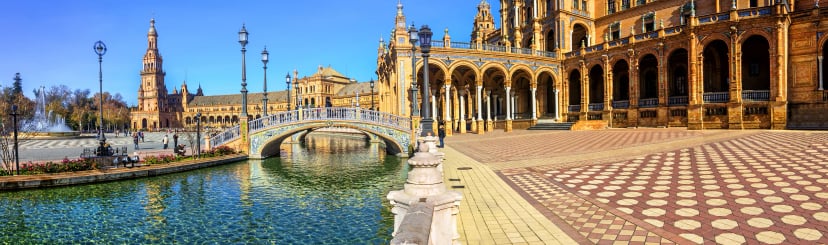
Plaza de España is not a literal substitute for a boat, but it can replace the sense of occasion. Its scale, water, bridges and architectural framing create a formal setting for photographs, a toast or a private exchange of gifts. The site also shifts the narrative from the historic river economy to the city’s modern self-presentation through the 1929 Ibero-American Exposition.
Timing is crucial. In high heat, Plaza de España belongs late in the day or in a short, tightly controlled visit with transport close at hand. In strong wind, the open space may be visually impressive but uncomfortable for a prolonged ceremonial moment. The planner should be willing to reverse the sequence, use the surrounding park for shade, or reduce the plaza to a brief finale. For deeper context on how the exposition and later river projects reshaped Seville, follow the city’s 1929 and 1992 transformation along the river.
Make Triana the interpretive center, not a loose food crawl
Triana is the most convincing land-based continuation because its identity is inseparable from the river crossing. Yet the fallback becomes thin if it is reduced to wandering Calle Betis and stopping wherever a table appears. Choose one substantive focus: ceramics and the material history of the neighborhood, flamenco context, river labor and urban separation, or the changing meaning of the bridge connection to the old city.
A ceramics-led version can move from the river edge into the workshop and kiln story, then return to a view across the water. A flamenco-led version can establish Triana’s performance context before a pre-booked evening at Teatro Flamenco Triana. A broader performance alternative could use the Museo del Baile Flamenco or Casa de la Memoria, depending on availability, timing and the desired artistic setting. These institutions should be checked directly for current programs and access; they are not interchangeable merely because each relates to flamenco.
The celebration should have a defined climax in Triana: a private studio appointment where available, a prepared gift connected to local craft, a reserved performance, or a river-facing toast at a controlled time. The point is not to imitate the boat. It is to create a moment that could only happen in Seville and still makes sense after the river has changed the plan. For a more sustained neighborhood interpretation, treat Triana as a full cultural chapter rather than an after-dinner backdrop.
Choose the fallback order by the trigger
When heat is the trigger: begin with the most climate-controlled or shaded component, keep outdoor river interpretation brief, and reserve Plaza de España for the cooler edge of the day. Triana can hold the central indoor visit or performance. A vehicle link between the southern monumental zone and Triana may be more sensible than asking formally dressed guests to accumulate exposure.
When wind is the trigger: reduce time on open bridges and broad riverfront spaces. Use interiors for the interpretive core, then take a short river view only if conditions are comfortable. A photograph beside the water can remain; the plan should not depend on an extended outdoor toast or delicate decoration.
When a dock change is the trigger but the cruise may still operate: preserve the land sequence as a flexible holding pattern. A guide can begin with river context near the confirmed meeting area, then shorten or release the next segment when the operator finalizes boarding. This works only when the fixed bookings later in the evening have enough buffer.
When the operator cancels: commit to the fallback promptly. Do not leave the couple waiting beside the river while repeated calls consume the best light and the group’s attention. Confirm the contractual next steps separately, then move into the prepared sequence. The emotional success of the day and the financial administration of the cancelled service are different tasks.
Preserve the occasion by designing equivalent functions
The right fallback is not measured by price, duration or the number of stops. It is measured by whether it preserves the functions that made the cruise desirable. For most celebration couples, those functions are privacy, a change of perspective, a sense of progression and one memorable closing image. The land plan should assign each function to a specific place or action.
- Privacy: use a reserved interior, a private guided appointment or a deliberately quiet interval rather than an unstructured public promenade.
- Perspective: interpret Seville from both banks or from the relationship between the Torre del Oro, Arenal and Triana, rather than replacing the river with unrelated monuments.
- Progression: move from river origin to civic spectacle to neighborhood identity, so the afternoon still has a beginning, development and finale.
- Ceremony: preselect where the toast, proposal, gift, portrait or speech will occur under both the cruise and fallback plan.
- Closing image: choose either the river at the cooler edge of the day, Plaza de España in suitable conditions, or the transition into a flamenco performance.
This functional approach prevents a common mistake: treating every cancelled outdoor element as something to be replaced with more indoor sightseeing. A celebration does not need a monument for every lost minute. It needs a sequence that still feels intentional. One strong cultural visit, one controlled pause and one visually resonant finale usually serve the occasion better than a hurried collection of substitutes.
Five realistic scenarios and the corresponding route judgment
A yellow heat warning, a shaded vessel and a late departure
The official threshold prompts review, not automatic cancellation. Confirm shaded seating, boarding exposure, water and the time guests must wait at the quay. Reduce the daytime schedule, move formal photographs away from the hottest period and keep the Triana fallback ready. If the operator confirms the vessel and the couple remains comfortable, the cruise can still anchor the evening.
An orange heat warning with an open-deck vessel
The river may still operate, but the celebration fit has weakened. Ask whether an enclosed or more shaded equivalent is guaranteed. If not, move the central experience to an interior Triana or flamenco component and use the riverfront briefly near sunset. The change is not an admission that the original plan failed; it is a decision to preserve energy and attention for the parts of the evening that matter.
A wind warning while the operator says the boat is sailing
Separate safety and comfort. The operator controls the operational call; the couple controls whether the conditions support their intended celebration. If the plan depends on an exposed toast, live music, flowers or formal portraits, ask how the vessel will actually be used. A stable indoor setting on land may deliver the desired atmosphere more reliably, with a short river view retained as context.
A morning dock change for a guest with limited mobility
Do not proceed on the strength of a new map pin alone. Obtain the boarding surface, steps or ramp, vehicle set-down, distance to the vessel and confirmation that the assigned boat remains suitable. If any access point is unresolved, activate the land plan and adapt it around shorter transfers and verified entrances. The value of the fallback is that the guest does not become the reason the celebration appears to collapse.
A last-minute operator cancellation after the party is dressed and ready
Move immediately from operational uncertainty to the first prepared land element. Keep the river story by beginning near the intended embarkation area only if conditions are suitable; otherwise start with the reserved interior and return to the river later. One coordinator should handle the operator’s notice, refund process, vehicle update and venue timing away from the couple. The day should feel redirected, not publicly renegotiated.
The operator checklist should be specific enough to change a decision
A long list of generic questions can create the appearance of preparation without producing useful answers. Ask only for information that affects access, suitability or sequence, and record the answer beside the corresponding fallback action.
- What is the exact embarkation address, riverbank and recognizable meeting landmark?
- What vessel is currently assigned, and can that assignment change?
- How do guests board: level access, ramp, gangway or steps?
- Is the assigned vessel suitable for the party’s wheelchair, stroller or other mobility needs?
- Where do guests wait before boarding, and is that waiting area shaded?
- Is physical or digital proof of booking sufficient for this service?
- When does the operator normally make a weather or navigation decision?
- How will a dock, time or route change be communicated on the day?
- Could the cruise end at a different point from the departure point?
- What happens under the current terms if force majeure prevents the agreed service?
- Who is the live contact once the party is in transit to the dock?
The answers should be shared with the person controlling the rest of the route. A driver needs the actual set-down point, not the landmark name. A guide needs the revised start time. A photographer needs to know whether the planned light and location survive. A venue needs notice if the party will arrive earlier or later. The couple should not be the communications hub.
A practical verification sequence for the final 72 hours
Seventy-two hours before
Check the Junta’s Meteosalud level and the AEMET forecast and warnings for the relevant area. Note whether the trend is stable, rising or uncertain. Ask the operator whether the vessel, departure point and time remain as booked. Confirm that the land fallback’s key interior or performance element is still available. This is the point for a calm adjustment, not for a final decision based on a single long-range number.
The day before
Obtain a direct operator reconfirmation. Repeat any accessibility requirement rather than assuming it remains attached to the booking. Check the exact meeting instructions and voucher format. Review the fixed parts of the celebration and identify the latest moment at which the cruise can move without damaging them. Confirm transport instructions for both the cruise and land routes.
The morning of the celebration
Review the latest warning and health levels, then check messages from the operator. If a threshold has changed, make the agreed call rather than reopening the entire debate. Tell every supplier only the information relevant to them. If the fallback is activated, confirm the ceremonial moment and finale so that the revised day retains its emotional shape.
Before leaving for the river
Reconfirm the dock and live contact. Verify that the party has the required voucher and that any mobility or boarding arrangement is still acknowledged. Check whether the operator has changed the endpoint or duration. When the information is incomplete, do not use travel time to “see what happens” unless the group has consciously accepted that uncertainty.
After any material notice
Recheck the exact source of the change. A weather-app icon, an official warning, a health alert, a port restriction and an operator message do not carry the same operational meaning. The operator should translate port and navigation conditions into a service update. The planner should translate that update into a route decision. The travelers should receive a clear plan, not a chain of unresolved technical details.
What remains evergreen, and what must be rechecked
The planning logic is durable. A cruise remains dependent on operator confirmation, vessel suitability, dock access, weather and navigation. A land fallback remains strongest when it preserves the river narrative through the Torre del Oro area, Plaza de España and Triana rather than abandoning the subject. A celebration remains easier to protect when the switch rules are agreed before emotions and sunk costs enter the decision.
The volatile details require verification. Warning thresholds and health protocols can be revised. Operators can change fleets, docks, access notes, schedules and contractual terms. Port guidance can be updated. The operational sources cited here were checked on November 1, 2026; they should be checked again after a substantive source-page update or correction, and at least annually.
For travelers, the final recheck is more immediate: confirm the operator notice, current alert level, exact dock, assigned vessel and boarding access before the party commits to the river. A cruise should never be promised under all conditions. The promise that can be kept is a coherent Seville celebration, with the Guadalquivir still at its center whether the group sees it from the deck or reads its story from the city around it.
When one coordinator needs to manage operator updates, transport changes and a polished land sequence without making the celebration visibly reactive, Inquire now
If you’re interested in any private tours of Seville, please reach out to us.





 So if you are looking for the absolute best in Seville & surroundings with authentic local fully-licensed native guides whose English you can actually understand and with an exclusive and amazingly fun itinerary













