Seville With an Autistic Child: Aquarium, María Luisa Park and Casa de Pilatos in One Shared Day

Updated
An aquarium is not automatically a low-stimulation place. Darkened galleries can feel containing to one autistic child and disorienting to another; water movement may be regulating, while pumps, excited school groups, queue uncertainty or abrupt changes in light may be difficult. The useful question is therefore not whether Seville Aquarium is “autism-friendly” in the abstract. It is whether its actual conditions on the chosen morning fit this child’s current sensory, communication and movement needs—and whether the family can leave without the departure feeling like a failed day.
That distinction changes the whole itinerary. Instead of stacking three attractions and hoping everyone lasts, build one shared Seville day in three different modes: a structured indoor opening at Seville Aquarium, a low-demand transition through María Luisa Park, and Casa de Pilatos only as an optional cultural peak. The palace is not the reward for good behavior, and skipping it is not a loss. It is a branch that remains available when regulation, interest and family energy align.
This plan is for families traveling with an autistic child and siblings, often with parents or grandparents who also want a meaningful day rather than separate parallel holidays. It assumes that no two autistic children share the same profile. Some need advance detail; some find too much previewing increases anxiety. Some seek movement, pressure or sound; others need reduced input. Some communicate distress early, while others appear calm until a threshold is crossed. The route works because it creates choices before anyone reaches that threshold.
A shared day should be designed around recovery, not endurance
The aquarium–park–palace sequence is valuable because each phase asks something different of the nervous system. The aquarium offers a defined destination and a legible beginning. María Luisa Park removes the pressure to look, listen or learn on command. Casa de Pilatos, if used, brings the family back into a more formal cultural setting for a limited final visit. The day alternates demand rather than merely alternating indoors and outdoors.
The sequence also makes geographic sense. Seville Aquarium sits by the river, close enough to the southern side of María Luisa Park for the park to become the natural next zone. Casa de Pilatos is farther into the historic city and should be treated as a deliberate second move, not an automatic walk-on continuation. That second transfer is the moment to decide whether the family still wants an interior, whether a shorter ground-floor visit is enough, or whether everyone should end after the park.
For a broader family framework—including how heat, landmark scale and child energy affect other Seville days—use this wider Seville-with-children planning guide. The present route is narrower and more specialist: it centers sensory verification, previewable transitions and a rejoining plan that keeps siblings in the same overall day.
The aquarium is structured, but it is not predictably quiet
Aquariums often look calm in photographs because the animals move slowly and the galleries are visually controlled. A family can still encounter several forms of friction at once: a compressed entrance queue, conversations echoing near popular displays, children moving unpredictably, darkness followed by bright thresholds, mechanical or water-related background sound, and a route that may feel difficult to pause or reverse. None of those conditions is inherently intolerable. Their significance depends on the child, the crowd and the family’s exit options.
The official Seville Aquarium ticket page gives useful operational facts, but operational access is not the same as sensory suitability. For September through June, it states opening hours of 10:00 to 18:00 from Monday to Friday and 10:00 to 19:00 on Saturday and Sunday, with access to the route ending one hour before closing. It accepts mobile admission and describes the full route as wheelchair accessible. Those details were verified on 31 October 2026 and should be checked again when planning dates outside that period or after a substantive page update. See the official Seville Aquarium ticket page.
For this itinerary, the earliest practical entry is usually preferable—not because opening time guarantees silence, but because it gives the family more day in which to recover, change course or stop. A fixed early slot also makes the visual schedule easier: breakfast, vehicle or walk, aquarium, exit, park. By contrast, a late aquarium entry turns every delay into pressure and leaves the park serving as a corridor to the next commitment rather than a genuine decompression phase.
What to verify before promising the aquarium
Contact the aquarium close enough to the visit that staffing, group bookings and operational conditions are meaningful. Ask direct questions rather than requesting a general assurance that the venue is suitable. The family needs information that can change a decision.
- Ask whether school groups, camps or unusually large bookings are expected during the intended entry window.
- Ask where the entrance queue forms, whether a prebooked family can wait away from the densest line, and what happens if the child cannot remain in the queue.
- Ask whether any galleries contain sudden audio, amplified interpretation, flashing or rapidly changing light, unusually dark passages, or narrow gathering points.
- Ask whether staff can identify the fastest route to an exit from different parts of the visit and whether leaving early is straightforward.
- Ask whether there is any calm waiting point before entry or immediately after exit. Do not assume a named “quiet room” unless the venue confirms one for the date.
- Ask about toilet locations, because a toilet detour can become the most difficult transition when the route is already demanding.
- Ask whether re-entry is possible after leaving. Plan as though it is not unless it is explicitly confirmed.
These questions do not require a child to disclose more than the family wishes. A concise explanation—“We need to reduce waiting, avoid surprise sound effects and know the quickest exit”—is often more operationally useful than a broad diagnostic label. The aim is not special treatment as an abstract benefit; it is a clear sequence with fewer unknowns.
Build a visual schedule that includes change
A visual schedule can reduce uncertainty, but a schedule that shows only the ideal route may create a new problem when the day changes. The National Autistic Society recommends approaches such as previewing places with pictures or maps, identifying noise, lighting and crowd triggers, carrying sensory aids, avoiding over-scheduling, planning calm-space breaks and contacting providers in advance. Its guidance is a useful starting point, not a substitute for the child’s own established supports. See the National Autistic Society holiday and travel guidance.
For this Seville day, use a schedule with four visible stages and two visible branches:
- Stage one: travel to Seville Aquarium, enter, look at selected areas, then leave.
- Stage two: move to María Luisa Park, choose a bench or gazebo, drink, eat something familiar and reduce demands.
- Stage three: decide together between Casa de Pilatos and ending the cultural program.
- Stage four: return to the accommodation or continue with a separately planned, low-demand evening.
- Branch A: “Aquarium shorter” can be shown as an ordinary option, not an emergency.
- Branch B: “No palace today” should appear from the beginning, so removing Casa de Pilatos is a planned choice rather than a surprise cancellation.
The format should match the child. It might be photographs, icons, written cards, a map with removable symbols, or a short list on a phone. Show only information that helps. A minute-by-minute plan can be reassuring for one child and oppressive for another. The durable principle is that the next transition, the likely sensory change and the exit option are understandable before they happen.
Use the same cue at each transition. For example: “Two more viewing areas, then outside,” followed by a visible card moving from aquarium to park. Avoid introducing the palace during the aquarium unless the child benefits from the full-day preview. For many families, it is better to keep Casa de Pilatos visibly optional and make the decision after food, water and a period with no interpretive demands.
Inside the aquarium, manage duration before content
The family does not need to complete the entire route to have had a successful aquarium visit. Decide in advance which measure matters most: staying within a comfortable time band, seeing a small number of preferred animals, practicing one new transition, or sharing an experience with siblings. “Finish the aquarium” is a poor objective because it makes the building, rather than the child’s regulation, the judge of success.
At entry, one adult should manage admission and staff communication while another stays available to the child and siblings. This division prevents the child from becoming the waiting point around which everyone else performs logistics. Mobile admission may reduce document handling, but it does not remove the need to verify where the family stands, when scanning occurs and whether bags or equipment create additional checks.
Once inside, keep the group compact without forcing every person to look at every display. Siblings can have a simple shared mission—choose one animal to sketch later, find one surprising adaptation, or take turns choosing a viewing stop—while the autistic child is free to engage differently. A child who watches moving water for ten minutes has not “missed” the exhibit because the family moved less distance. A child who wants to pass quickly through a darkened area should not be delayed for an adult explanation.
Use an agreed exit signal that does not require a full verbal account. That might be a card, hand sign, phrase, or movement toward the designated adult. The signal should trigger action, not a debate about whether the child can continue for five more minutes. If the family needs to clarify whether the request means “pause” or “leave,” establish two different signals before arrival.
Three aquarium exit points in the plan
Think of exit readiness as three decisions rather than one dramatic moment.
- Early exit: the entrance or first galleries are already too demanding. Leave promptly and move to the park. Do not try to recover the value of the admission by extending exposure.
- Planned short visit: the child is regulated, but the agreed duration or preferred-display goal has been reached. Leave while the experience is still neutral or positive.
- Fuller visit: the child remains engaged and the family continues, while preserving the right to stop without adding Casa de Pilatos later.
The second option is often the most useful. It allows the aquarium to remain a complete experience even when it is not a long one. It also protects the park from becoming a place where the family merely recovers from preventable overload.
The transfer to María Luisa Park is part of the sensory plan
On a map, the aquarium and park belong to the same southern zone of central Seville. On the ground, the transfer can still be the point where heat, hunger, traffic noise, uncertain walking distance or disagreement between siblings accumulates. Do not describe it simply as “a short walk” unless the family has assessed the exact route, weather and child’s movement needs.
Choose the transfer mode before entering the aquarium, then preserve the right to change it. Walking can provide movement and a gradual return to daylight. It can also be too much after a demanding interior or during high temperatures. A prearranged pickup, taxi or private vehicle can shorten exposure, but only if the pickup point is explicit and the vehicle is reachable without an extended curbside wait. The correct choice is the one that makes the transition legible, not the one that looks most efficient on an itinerary.
Use a transition object or repeated action: headphones on before leaving, the same drink offered outside, a photo of the next park landmark, or a two-step cue such as “vehicle, then bench.” Keep adult conversation low during this move. The child does not need a debrief, praise, questions about favorite animals and a new explanation of Plaza de España all at once.
María Luisa Park is a regulation zone, not another attraction to complete
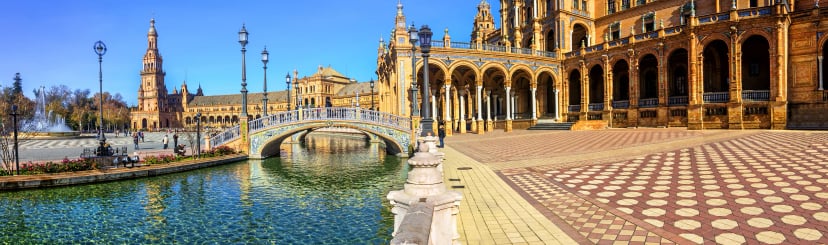
The park should carry less agenda than the aquarium. Its value lies in permission: permission not to interpret, not to pose for photographs, not to keep pace with a guide and not to decide immediately whether the palace will happen. The official Seville tourism page lists free admission, winter opening from 08:00 to 22:00 and summer opening from 08:00 to 24:00. It also notes fountains, numerous benches and gazebos where visitors can rest. See the official María Luisa Park information.
Those amenities make the park useful, but they do not make every part of it quiet. Fountain sound may mask surrounding noise for one child and be aversive to another. Open paths can feel freeing or insufficiently bounded. Landmark areas may attract denser visitor movement, while interior paths may feel calmer but harder to navigate. Birds, bicycles, maintenance work, performances or temporary activity can alter conditions. The family should choose a rest point by observed conditions that day, not by a promise that any named corner is always tranquil.
Enter the park with one immediate purpose: find the pre-agreed rest type. That might be a bench with a clear view of the path, a gazebo with shade, a quieter path where movement is possible, or a spot near but not directly beside a fountain. Avoid walking deeply into the park while repeatedly asking, “Is this place okay?” The adult responsible for scouting should look ahead while the child remains with the familiar support person.
A useful park interval is long enough for demands to fall but not so open-ended that the next step becomes impossible to predict. Show the park card, then a simple decision card: palace or finish. The decision should come after hydration, food if needed, toilet planning and a period without questions. Regulation is not the same as stillness; a child who needs to move may recover better through a bounded walking loop than by sitting.
Use three kinds of rest, not one
- Sensory rest: reduce conversation, visual demands, close crowding and unexpected touch. Headphones, a cap, sunglasses or a familiar object may help if they are already part of the child’s routine.
- Decision rest: stop asking what comes next. Adults can quietly assess energy, weather and timing before presenting one clear choice.
- Social rest: allow siblings and adults to disengage from constant monitoring for a bounded period, while roles remain clear and the child is not made responsible for everyone’s mood.
This is why María Luisa Park is more than a scenic interlude. It changes the family’s decision quality. A palace choice made immediately outside the aquarium is often a reaction to sunk cost or itinerary ambition. The same choice made after a low-demand park interval is more likely to reflect the actual state of the group.
Keep siblings in the same day without making them spectators
A shared itinerary should not mean that siblings spend every minute waiting quietly for one child’s needs. Nor should inclusion require the autistic child to tolerate every sibling preference. The practical answer is a series of brief, reversible differences inside one common route.
At the aquarium, siblings can receive one independent task that does not slow the child: choose a single display to revisit only if conditions permit, photograph one detail, or note one question for later. In the park, one adult can take siblings on a short, map-bounded loop while the autistic child rests with another adult. The loop should return to the same pinned location at a named time. This is a short separation within a shared day, not a division into separate sightseeing programs.
Where possible, choose a sibling activity that remains meaningful even if it is cut short. A ten-minute look toward Plaza de España, a small photography challenge or a single fountain circuit is easier to stop than an activity with a queue or fixed admission. Avoid telling siblings they will “definitely” get the palace later. Their certainty should be attached to the rejoining point and the next family decision, not to an attraction the group may drop.
Grandparents also need a role that is realistic. A grandparent who is comfortable sitting with the child may provide continuity while parents walk briefly with siblings; another may prefer to join the movement loop. Do not assign the most physically or emotionally demanding support task by default. Clarify who carries medication, communication supports, water, admission information and the child’s preferred sensory items so that a short split does not separate the child from essential equipment.
The meal break should lower uncertainty, not introduce a new performance
Food can become the hidden fourth attraction in this itinerary. A long search, unfamiliar menu, noisy room or wait for a table can erase the benefit of the park. Decide before the day whether the family will carry familiar food, use a preselected simple meal option, or return to the accommodation if eating elsewhere becomes difficult. Respect the rules of each venue and do not depend on being able to eat wherever the group happens to stop.
The decision point for Casa de Pilatos should come after the child has had access to familiar food or drink, not while everyone is hungry. Adults should also separate hunger from sensory fatigue. A child may appear ready to stop all activity when the immediate need is food; equally, eating does not necessarily restore capacity for another interior.
For a longer Seville stay, it is often better to distribute major sights across several days rather than compressing the city into a single family marathon. This three-day Seville framework can help adults place the aquarium day within the wider trip, even when the family adapts its dining and sightseeing choices around the child’s established routines.
Casa de Pilatos is a conditional cultural peak
Casa de Pilatos belongs at the end because it concentrates several demands that are easier to judge after the aquarium and park: a formal entrance, an interior route, visual density, historic interpretation and the social expectation that a family should keep moving through a valued monument. It can also be a rewarding contrast. The palace’s patios, tilework, sculpture and domestic scale offer a different encounter with Seville from the vastness and ceremony of the Alcázar.
The official Andalusia tourism listing for 2026 gives opening hours of 09:00 to 18:00, describes the ground floor and upper floor as separate visit components, and marks the site as accessible for people with disabilities. Those are useful planning facts, particularly because a ground-floor-only visit can be treated as a complete branch rather than the beginning of an obligation to continue upstairs. See the official Andalusia tourism listing for Casa de Pilatos.
Accessibility labels should not be read as a sensory guarantee. Before the visit, verify the entrance process, likely waiting conditions, whether the upper floor has a fixed departure or guided format, where toilets are located, which areas are step-free on the intended route, and how quickly the family can leave from the ground floor. Ask whether large groups are expected in the desired window. The fact that a venue is physically accessible does not answer questions about echo, crowd compression, interpretive audio, staff flexibility or the child’s ability to pause.
The palace should also be previewed honestly. Its patterned surfaces may be absorbing for a child who enjoys visual detail and overwhelming for a child who finds dense visual fields difficult. Courtyard transitions can create sharp changes in brightness and temperature. Quiet-looking rooms may become crowded when a group arrives. These are not claims that Casa de Pilatos will feel one way; they are the conditions to examine through current photographs, official information and direct contact.
Families comparing the palace with the park as a final focus can use this Seville comparison of Casa de Pilatos and María Luisa Park by design, shade and scale. For adults who want deeper art-historical context without making the child’s day carry it all, this specialist palace guide helps place Casa de Pilatos within a separate palace-focused day.
Use a two-threshold decision
Do not decide only once. The first threshold is in María Luisa Park: does the family travel toward Casa de Pilatos at all? The second is at the palace entrance: do observed conditions still support entry? A calm park interval does not guarantee that the urban transfer, queue or threshold will remain manageable.
At the first threshold, look for affirmative capacity rather than the absence of visible distress. Is the child showing interest, communicating readiness, accepting the next transition and able to use familiar supports? Are siblings and adults still able to move without resentment or urgency? Is there enough time to visit without racing closing procedures? If the answer is uncertain, stopping after the park is a sound decision.
At the second threshold, check the real entrance. A prebooked plan should still be abandoned if the queue is dense, a group has arrived, the child rejects the threshold, or the family’s designated support adult no longer has the capacity to manage another interior. The cost of unused admission should not become a reason to override current information.
Three afternoon branches keep the day shared
Branch one: aquarium, park, ground floor of Casa de Pilatos
Choose this when the aquarium ended before fatigue, the park interval restored decision-making capacity and the child accepts the second transfer. Keep the palace brief and define its endpoint before entering. The family might choose one patio sequence, one visual theme or the ground floor only. Adults who want fuller interpretation can receive it in concentrated form rather than through a continuous lecture.
Siblings can each choose one feature to notice, but no one should be required to complete a scavenger hunt. A task is useful only when it supports engagement; it should disappear immediately if it adds demand. End while the group can still leave coherently. The upper floor remains an additional decision, not the presumed second half.
Branch two: aquarium, longer park interval, no palace
This is not the lesser itinerary. It is often the more coherent shared day. The family has completed a structured indoor visit, used one of Seville’s important public landscapes and preserved enough energy for an ordinary evening. Siblings can have a short landmark loop or photography task in the park, while the autistic child keeps a predictable base. Adults can save Casa de Pilatos for another morning, perhaps in a smaller group.
Show the “finish” card before leaving the park, then make the return direct. Do not add a compensatory stop because adults feel the day needs more culture. An unplanned shop, church doorway or scenic detour can be harder than the palace would have been because it has not been previewed.
Branch three: early aquarium exit, park recovery, coordinated rejoining
Use this when the aquarium becomes difficult near entry or early in the route. One adult moves with the child directly toward the agreed recovery setting; another manages siblings and any practical issue such as bags or transport. The family then reunites at the park or, if the child needs a faster return, at the accommodation.
The siblings’ branch should remain small. They might complete a few more minutes of the aquarium only if the adults have already agreed who exits, who stays, how long the extension lasts and where the group will rejoin. Otherwise everyone leaves together. Improvising these roles while the child is distressed usually creates more speech, more waiting and more uncertainty.
If the child returns to the accommodation, the shared day can still resume later through a low-demand common activity, but do not promise that rejoining will happen. The plan should allow the autistic child and support adult to end without becoming responsible for whether others enjoy the afternoon.
Bailout transport must be arranged before it is needed
A bailout is not merely “we can get a taxi.” It is a sequence with a location, decision-maker, communication method and rejoining point. In Seville, the difference between a vehicle being theoretically available and practically useful may be a hot wait, a confusing curb, a walk from a restricted or congested street, or a driver who cannot identify the family’s exact side of a large public space.
Create three map pins before departure: the aquarium pickup point, the park pickup point and the Casa de Pilatos pickup or meeting point. Confirm that each pin is on a street where the planned vehicle can actually stop, and identify a nearby landmark that can be described verbally. Do not rely on a pin placed in the center of a building or park. Share the pins with every adult, not only the person who booked transport.
For public transport, current route and stop data can help with advance planning, but it should not be the only bailout. When this guide was verified, Spain’s National Access Point listed TUSSAM bus and tram data updated on 29 September 2026 and valid from 28 September 2026 to 17 January 2027, covering 59 routes and 1,055 stops and including accessibility information in the GTFS dataset. See the official National Access Point listing for TUSSAM data. That dataset supports route research; it does not confirm the real-time crowd, lift status, shade, noise or suitability of a specific stop for a particular child.
A private vehicle can materially change the day when the family needs a known pickup, child equipment kept together, a familiar seating arrangement and the ability to move directly between the aquarium, park, palace and accommodation. It is not automatically calmer: waiting for a delayed vehicle, changing cars or discovering that the pickup point is inaccessible can be equally disruptive. The service is useful only when the driver, guide and family share the same pins, branch logic and authority to abandon the next stop.
The bailout card
Place one concise card in every adult’s phone or printed pack:
- Exit phrase: the exact phrase that means the plan changes now.
- Lead adult: who stays with the child.
- Logistics adult: who handles staff, admission, bags and vehicle communication.
- Pickup pin: the exact location for the current phase.
- Fallback destination: park rest point or accommodation.
- Sibling plan: leave together, or continue for a pre-agreed limited period with a named adult.
- Rejoin rule: the place and latest time for one update, without repeated calls while the child is regulating.
This card is especially important in a multigenerational group. Under stress, adults often act from different assumptions: one tries to preserve the booking, one starts searching for food, one asks the child repeated questions, and one calls a vehicle without telling the others. A written division of roles reduces the amount of negotiation occurring around the child.
A sibling rejoining plan needs one place, one time and one channel
“Meet us in the park” is not a plan. María Luisa Park is large, and familiar-looking paths, fountains or benches can be described differently by different people. Choose a point that can be pinned on a map and recognized from a photograph. During the first park arrival, every adult should physically see it. If the chosen point becomes crowded, use a preselected secondary pin rather than searching collectively for somewhere better.
Set one update time rather than continuous messaging. The adult with the child should not need to narrate regulation minute by minute. A message such as “staying at park pin until 14:00” or “returning to accommodation; next update at 15:00” gives siblings and the other adult enough information to act without creating pressure.
The rejoining activity should be low-demand. Do not reunite immediately at the entrance to Casa de Pilatos or another timed commitment. Rejoin at the park rest point, vehicle or accommodation, then make the next decision. This avoids turning the child’s return into a countdown that everyone is watching.
Siblings should know that a rejoin may mean returning together, not continuing with the original plan. They can be disappointed without being blamed or silenced. Adults can acknowledge the change privately and preserve another opportunity elsewhere in the trip. What matters is that the autistic child is not framed as the person who “cancelled” Seville for everyone.
Adjust the route to the child, not to an autism stereotype
Age can affect communication, independence and sibling expectations, but age alone does not predict sensory capacity. A younger child may use a highly effective picture schedule; a teenager may need privacy and control over what is disclosed to staff. An adult-sized child may find a crowded threshold more physically difficult even when the same space was manageable years earlier. Build from the person’s actual profile.
For a child who needs high predictability
Preview the exterior of all three places, the vehicle, the park rest point and the “no palace” branch. Use the same words in advance and on the day. Make closing or access uncertainty explicit: “We plan to visit the aquarium, then the park. The palace happens only if it is open, not crowded for us and you choose it.” Avoid surprise upgrades such as adding the upper floor because the child appears calm.
For a child who becomes anxious with too much previewing
Show only the next phase and the stable return plan. Adults can hold the full branch map while the child sees aquarium, then park, then one choice. Do not repeatedly ask for a decision about Casa de Pilatos before the park interval.
For a movement-seeking child
The park may work better as a bounded loop than a seated pause. Mark the start and finish, keep one adult on the same route and preserve access to water and shade. At the palace, replace “stand and listen” with short observations and permission to move where venue rules allow.
For a child sensitive to sound or light
Verify the aquarium’s darkest and noisiest transitions, carry already familiar supports and plan the daylight change at exit. In the park, remember that natural sound is still sound; fountains, birds and busy landmark zones may not be restful. At Casa de Pilatos, prepare for contrast between exterior light, patios and rooms rather than assuming a historic interior will be dim and quiet.
For a child with limited interoceptive awareness or delayed signs of overload
Use scheduled checks for water, toilet, temperature and food without requiring the child to identify every internal state. Adults should watch for the child’s known early signals and leave before the only available signal is crisis. A calm appearance is not sufficient evidence that adding the palace is wise.
Carry less, but make the essential kit redundant
The useful kit is the one adults can reach without emptying a bag in a queue. Keep admission information, communication supports, a charged phone, power supply, water, familiar sensory items, any necessary medication and a simple change layer in known locations. If the group may split briefly, duplicate critical low-cost items such as a visual card, ear protection or written contact details where practical.
Do not introduce new sensory equipment on the trip and assume it will help. Headphones, sunglasses, weighted items or chew tools are useful when they are already accepted and appropriate for the child. The same applies to reward systems: a palace should not become the condition for receiving a basic regulation support or familiar food.
Photograph the essential cards and map pins so that a lost paper schedule does not remove predictability. Also keep a plain-language note in Spanish or English, depending on the family’s needs, describing the operational request: reduced waiting, clear exit directions, minimal verbal interaction during distress, or permission for one adult to handle admission while another waits aside.
A final verification checklist for the week of the visit
- Confirm the aquarium’s current opening hours, last route access, mobile admission process and the intended entry time.
- Ask the aquarium about group bookings, entrance waiting, sudden sound or light, exit routes, toilets, calm waiting possibilities and re-entry.
- Check the weather and heat exposure for the aquarium-to-park transition; decide the default transfer and vehicle fallback.
- Select a primary and secondary rest point in María Luisa Park from current maps, while accepting that observed conditions may require a change.
- Confirm Casa de Pilatos opening, ground-floor and upper-floor arrangements, access route, likely queue, toilet location and exit process.
- Save exact pickup pins and a photograph or description of each meeting point.
- Share the visual schedule, branch rules, adult roles and sibling rejoining plan with every adult before breakfast.
- Keep “no palace” visible as a complete ending, not a hidden contingency.
Operational details in this guide were verified against the named official or institutional sources on 31 October 2026. Hours, access arrangements, group conditions and transport data can change. Recheck the relevant source after a substantive page update or when planning for a later operating period; direct confirmation is particularly important for sensory conditions, because published accessibility information rarely describes the exact sound, light and crowd profile of a particular time slot.
Where a bespoke private sequence changes the outcome
The value of a private guide or coordinated vehicle is not that it makes autism predictable. It is that one person can hold the sequence while parents attend to the child and siblings: confirming current conditions, keeping explanations concise, moving admission tasks away from the waiting child, adjusting cultural content, notifying the driver, and preserving a clear rejoining point. That coordination matters most when the plan branches, not when everything proceeds perfectly.
For this family segment, a useful private day should be designed around the child’s established communication and sensory supports, with Casa de Pilatos expressly removable and the park treated as a substantive part of the route. It should also leave siblings with bounded moments of choice and give grandparents roles that match their mobility and confidence. A prewritten plan shared with the guide and driver is more valuable than vague requests for flexibility.
Orange Donut Tours can build that kind of sequence through private Seville touring tailored to family access, pacing and group coordination. The inquiry should include the child’s preferred preview format, known triggers, useful supports, tolerance for queues and vehicles, sibling ages, mobility needs across generations, and the family’s preferred bailout destination. That information makes it possible to verify the morning and design the rejoining plan before the family is standing in a crowded threshold.
The best version of this day is not the one that reaches all three names in the title. It is the one in which the aquarium has a clear exit, the park genuinely lowers demand, the palace remains optional, and every family member understands how the group stays connected when the route changes. For a bespoke aquarium–park–palace sequence with verified transitions and shared bailouts, Inquire now.
If you’re interested in any private tours of Seville, please reach out to us.





 So if you are looking for the absolute best in Seville & surroundings with authentic local fully-licensed native guides whose English you can actually understand and with an exclusive and amazingly fun itinerary













