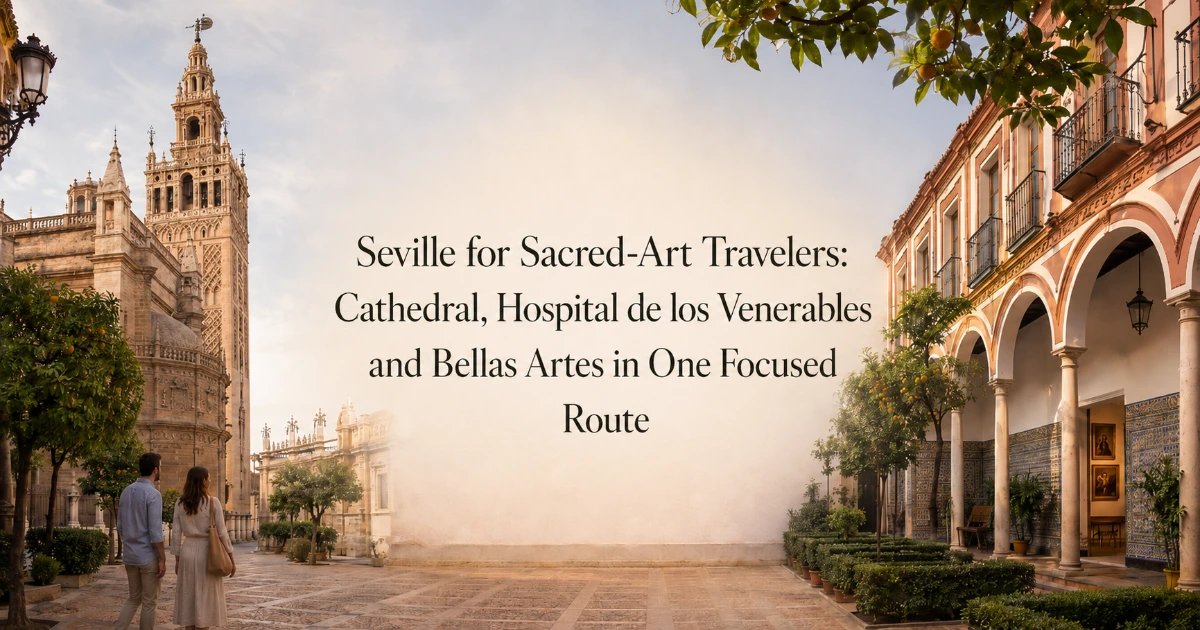
Seville for Sacred-Art Travelers: Cathedral, Hospital de los Venerables and Bellas Artes in One Focused Route
Updated
The best sacred-art route in Seville is Cathedral first, Hospital de los Venerables second, Santa Cruz as the controlled breathing space, and Bellas Artes only if you still want a deeper painterly chapter. This order works because the city’s religious art is dense, the old center is walkable but mentally crowded, and the short Cathedral to Hospital de los Venerables transition changes scale before the Cathedral becomes too much. The clearest exception is the traveler who wants the Cathedral to remain the day’s emotional high point; in that case, skip Bellas Artes rather than forcing a final museum.
The article-specific thesis is simple: Seville’s sacred art is best read as a sequence of patronage, devotion, and neighborhood movement, not as a checklist of churches. Start with the Cathedral’s theological scale, shrink the room at Venerables, let Santa Cruz soften the body, then decide whether the Museo de Bellas Artes de Sevilla will clarify or blur what you have already seen. One non-obvious route cue matters early: the prettiest approach is not always the calmest one. Coming out toward Plaza del Triunfo and the Archivo de Indias edge gives you a clearer reset than drifting immediately into the narrowest Santa Cruz lanes, where groups stop, fans open, and the day begins to feel slower than it is.
The sacred-art route matrix: what each stop earns
This route is worth building only if each stop changes the scale of looking. The Cathedral establishes the theme; Hospital de los Venerables makes it intimate; Santa Cruz keeps the day from becoming a sealed-room marathon; Bellas Artes belongs when you want collection depth rather than another beautiful interior.
Route-fit matrix for a focused Seville sacred-art day
- Seville Cathedral: Best first because its altarpieces, chapels, tombs, treasury logic, and devotional images set the language of patronage and public faith. Skip the urge to treat it as a quick monument before the “real” art; here, the monument is the art argument.
- Hospital de los Venerables: Best second because the smaller Baroque interior changes the traveler’s tempo after the Cathedral. It suits couples, culture-focused families, and art travelers who want Seville’s religious painting to feel legible rather than monumental.
- Santa Cruz: Best as a routed pause, not as a separate neighborhood tour. Its lanes, shaded bends, and plazas are useful because they prevent sacred-art fatigue between interiors.
- Bellas Artes: Best as the optional depth stop. It belongs when you want to connect Cathedral and Venerables iconography to the broader Sevillian school; it is not mandatory for every first stay.
The cut-first rule is firm: if the Cathedral has already done the work for you emotionally, Bellas Artes should be skipped to protect the Cathedral experience. A tired visitor who adds the museum for completeness often remembers fewer works, not more. This is the counterintuitive correction many high-end itineraries miss: the more serious art day is sometimes the shorter one.
This is also why this route should not be treated as a generic art roundup or as an automatic extension after the Real Alcázar. The Alcázar has its own visual grammar of palace, garden, Mudéjar detail, and royal ceremony. If you are actually planning an art day after the palace, the more relevant comparison is After the Alcázar in Seville. This article solves a narrower question: how to build one Cathedral-led sacred-art route without monument fatigue.
Start at Seville Cathedral because the art is not a museum warm-up
Seville Cathedral should come first because it gives the route its vocabulary. The point is not only to enter a vast Gothic building; it is to understand why sacred art in Seville so often carries public memory, confraternity culture, royal ambition, and local devotion at the same time. The Cathedral’s own official artistic-heritage material (https://www.catedraldesevilla.es/en/the-cathedral/artistic-heritage/) frames the collection as art serving faith, which is exactly the lens a sacred-art traveler needs before stepping into smaller rooms.
For a discerning visitor, the mistake is to spend the Cathedral visit chasing surface grandeur. The largest spaces can make the eye lazy. A guide should slow the group at the right chapels, distinguish devotional image from decorative excess, and connect the scale of the altarpieces to the civic and ecclesiastical wealth that made them possible. Without that interpretive thread, the Cathedral becomes an impressive shell with scattered artworks; with it, the route becomes a study in how Seville made theology visible.
The first decision is whether to include La Giralda. For a general monuments day, the tower can be a memorable vertical chapter. For this sacred-art route, the climb is often overvalued because it shifts the body from looking to exertion and moves the mind from iconography to views. That does not mean the tower is wrong. It means the tower should not steal the first hour if the day’s real purpose is painting, sculpture, patronage, and sacred space. Travelers who want a Cathedral-led visit with access handled can review La Giralda Cathedral Skip-the-line Private Tour, but the interpretive choice still matters more than the faster doorway.
Skip-the-line access does not create sacred-art understanding without interpretation. Premium spend does not earn its cost when it only buys a faster doorway and no explanation of why a chapel, retable, tomb, or image matters. Paying more changes the day when it gives you better sequencing, a guide who can choose what to omit, and a rhythm that keeps the group engaged rather than merely admitted.
What the Cathedral does to the body should shape the rest of the day. Stone floors, vertical looking, chapel-by-chapel attention, and the natural pull toward the Giralda can tire even travelers who are physically comfortable. Add the pedestrian flow around Avenida de la Constitución and the Cathedral perimeter, and the group may feel more worn down than the distance suggests. This is why the next move should be short, shaded where possible, and lower in scale.
The Cathedral also sets the mood. If the first stop is rushed, the whole route feels like a series of obligations. If the first stop is curated, the mood becomes more concentrated: a few works, a few patronage stories, a clear sense of how Seville’s sacred imagery speaks. The best Cathedral visit for this route is not maximal; it is selective. A private Cathedral focus through Seville Cathedral Private Tours can be shaped around sacred art rather than a general greatest-hits script.
Cathedral to Hospital de los Venerables: the scale shift that keeps the day readable
The move from Cathedral to Hospital de los Venerables is the route’s hinge because it changes the size of the room before attention collapses. The distance is short enough to keep continuity, but the feeling changes sharply: from Cathedral perimeter and Plaza del Triunfo to the more enclosed Santa Cruz fabric around Calle Mateos Gago, Calle Ximénez de Enciso, Plaza de Doña Elvira, and Plaza de los Venerables.
This transition is where a private guide earns the day. A map will get you there, but a map will not decide whether to use the walk as a silence break, a patronage bridge, or a neighborhood explanation. The most polished version treats the Cathedral to Hospital de los Venerables walk as a controlled decompression: step out of the great ecclesiastical machine, cross the old-city edge with purpose, and enter a smaller Baroque setting where painting and architecture are easier to hold in the mind.
Hospital de los Venerables changes the route because it narrows the emotional register. Its identity as a historic priests’ hospital and Baroque interior makes the sacred-art story less about overwhelming scale and more about local devotion, clerical care, and the Sevillian Baroque. The Fundación Focus visit page (https://fundacionfocus.es/visita-turistica/) is the practical primary source to check before you go; for planning purposes, the more important point is that the visit should feel like a scale shift, not a second monument squeezed after the first.
At Venerables, the wrong approach is to repeat the Cathedral’s method. You do not need another long survey. You need tighter looking: how a smaller sacred setting concentrates the eye, how Baroque religious art uses emotion and clarity differently from a vast Gothic church, and how Seville’s artistic identity moves between public grandeur and private devotion. A good guide will not over-explain every surface. The room should feel readable, not decoded to death.
The local friction is subtle. Santa Cruz is close, but it is not fast in the way a straight avenue is fast. The lanes invite stopping; other visitors pause in doorways; groups spill into small plazas; and the prettiest turns can add small delays that matter after a serious Cathedral visit. This is why the Hospital de los Venerables works best as the immediate second stop, before lunch, shopping, flamenco planning, or hotel-return negotiations begin to dilute the route.
There is also a traveler-fit consequence. Couples often enjoy the intimacy of Venerables after the Cathedral because the day becomes more conversational. Families with older children can handle it if the Cathedral visit was selective. Multigenerational groups should avoid turning the walk into a long Santa Cruz lecture before entering; use the neighborhood as a soft transition, then let the interior carry the next chapter. Travelers who want Santa Cruz history in more depth can place Santa Cruz Private Tours on a different day or ask for a lighter version woven between the two sacred-art stops.
Use Santa Cruz as a breathing instrument, not a postcard detour
Santa Cruz prevents fatigue when it is used as pacing, not as decoration. The neighborhood’s value in this route is not that it is charming; the value is that it lets the eye recover from gold, stone, altarpieces, painted ceilings, and sacred narrative without breaking the theme entirely.
The best Santa Cruz segment is short and intentional. After Venerables, let the group move through one or two small spaces rather than collecting every photogenic bend. Plaza de Doña Elvira can work as a gentle pause if the group needs air. Callejón del Agua can make sense when shade and old-city texture matter more than speed. The Cathedral side of Calle Mateos Gago gives a clearer return toward food, hotel, or the next transfer. Each choice has a consequence: one preserves calm, one adds texture, one prepares the exit.
Seville does something particular to the body in the old center. The distances look modest, but heat, stone glare, slow pedestrian currents, and repeated standing can make a short sacred-art morning feel longer than its route line. The body is not only walking; it is looking upward, waiting in thresholds, adjusting to dim interiors, stepping around uneven pavement, and re-entering bright streets. A sensible Santa Cruz pause acknowledges that physical load instead of pretending that a few more lanes are free.
Seville also changes the trip mood quickly. A focused Cathedral and Venerables morning can leave travelers feeling sharpened, as though the city has given them one coherent idea. A bloated version, with every lane and every church added, makes the day flatten into “more old town.” Santa Cruz should make the route feel shorter and calmer, not more comprehensive. That is especially important for celebration travelers and food-and-wine travelers who want enough energy left for a late lunch, a sherry conversation, or an evening performance.
Museo del Baile Flamenco is a useful example of restraint. It may be a worthwhile cultural stop in the right Seville stay, especially when flamenco context is part of the evening, but it does not belong inside this sacred-art route. Dropping it between Venerables and Bellas Artes pulls the group into a different expressive world too soon. If flamenco is important, pair it later with dinner or a dedicated context walk rather than making it compete with sacred painting.
For comfort-first travelers, Santa Cruz is also where logistics should stay quiet. A chauffeur cannot solve every old-town pinch because the most useful segments are pedestrian and small-scale. What a chauffeur can do is support the larger day: a smarter hotel return after Bellas Artes, a cooler transfer from the museum side, or a less tiring evening pickup. Inside Santa Cruz itself, better judgment beats more transport.
When Bellas Artes belongs, and when to leave it out
Bellas Artes belongs when the visitor wants deeper art context after the Cathedral and Venerables, not when the itinerary needs a third prestigious name. The Museo de Bellas Artes de Sevilla can be immensely rewarding for sacred-art travelers because its collection helps connect Seville’s devotional imagery to the broader Sevillian school, religious painting, former convent settings, and the city’s long relationship with patronage. Its official collection notes (https://www.museosdeandalucia.es/web/museodebellasartesdesevilla/las-colecciones) are the right primary source for understanding the museum’s scope without turning the route into a fragile list of current display details.
The museum’s location changes the decision. Bellas Artes sits at Plaza del Museo, away from the Cathedral-Santa Cruz knot. That separation is useful if you want a fresh chapter after lunch or a hotel reset. It is costly if the group is already tired, because the move from Santa Cruz through the commercial spine around Calle Sierpes, Tetuán, or the broader old-center streets can feel like a transfer even when it remains inside the historic city. The museum is not far in abstract planning terms; it is far enough to create a mental reset.
The firm editorial call is this: add Bellas Artes only when someone in the group actively wants the painting chapter. If the Cathedral and Venerables have already answered the day’s question, do not add the museum out of guilt. Bellas Artes should be skipped to protect the Cathedral experience when the group is first-time, heat-sensitive, traveling with children who have already behaved beautifully, or planning a significant dinner later. Completeness is not the same as cultural depth.
When Bellas Artes does belong, it should not be visited as a full survey. Keep the focus on religious painting, the Sevillian school, and the works that clarify what the Cathedral and Venerables introduced. This is where Murillo, Zurbarán, devotional tenderness, monastic patronage, and Counter-Reformation clarity can become more than names. The guide’s task is to choose a line through the collection, not to prove how much the museum contains.
There is a mood consequence as well. A late Bellas Artes visit can either deepen the day or turn it gray. If the group enters with purpose, the museum feels like a quieter afterword. If the group enters because the itinerary said so, the rooms become another set of frames after a morning of sacred saturation. The difference is not the museum’s quality; it is the visitor’s remaining attention.
The Bellas Artes test: attention, not ambition
Before committing to Bellas Artes, judge attention rather than ambition. The best sign is not that someone says, “We should probably see it.” The best sign is that the group is still asking visual questions: why Murillo feels different from Zurbarán, why certain saints recur, why Sevillian patrons invested so heavily in religious imagery, or how paintings made for devotion behave differently once they are displayed as museum works. When those questions are alive, Plaza del Museo is worth the transfer.
The warning signs are equally clear. If the group is already choosing restaurants, asking how far the hotel is, or looking for shade before looking at façades, the museum will probably reduce the memory of the morning. This is not anti-museum advice. It is a memory-protection rule. Sacred-art travelers often assume that more works create more understanding, but in Seville the opposite can happen: after a major Cathedral visit, one additional room can make the strongest images blur together.
When Bellas Artes is included, the exit plan should be part of the decision. A group staying near Santa Cruz may not want to walk back through the same commercial center after the museum. A group headed toward El Arenal or Triana may find the Plaza del Museo side a cleaner bridge to the next part of the day. The museum belongs more easily when it helps the afternoon flow; it belongs less when it creates a tired return across the old center.
Food-and-wine travelers should be especially selective. A serious lunch after Cathedral and Venerables can be part of a wonderful Seville day, but it often leaves the group less receptive to another museum. In that case, Bellas Artes may work better as a separate morning or as part of a broader second-day art plan. The sacred-art route does not fail when Bellas Artes is omitted; it fails when Bellas Artes is added after the route has already reached its natural conclusion.
A focused sacred-art route in Seville: the order that avoids monument fatigue
The best order is Cathedral, short Santa Cruz transition, Hospital de los Venerables, controlled pause, then Bellas Artes only for art-depth travelers. This sequence keeps the route coherent because each stage answers a different question: how sacred power is staged, how devotion becomes intimate, how the neighborhood gives the body room, and how the museum deepens the painterly context.
Stage 1: Seville Cathedral as the theme-setter
Use the Cathedral to define the route’s central ideas: iconography, patronage, devotion, public memory, and the difference between sacred art in use and sacred art in a gallery. Keep the selection disciplined. The route does not need every chapel, every tomb, and a tower climb unless the traveler’s priorities demand it.
Stage 2: Cathedral to Hospital de los Venerables as the reset
Do not waste the transition by wandering without purpose. Move from the Cathedral edge toward Santa Cruz with a clear line, using the walk to let the group’s eyes and body settle. The phrase Cathedral to Hospital de los Venerables should mean a planned scale shift, not simply the next pin on a map.
Stage 3: Hospital de los Venerables as the intimate Baroque chapter
Let Venerables narrow the day. This is where the sacred-art traveler can feel how Seville’s devotional world works at a smaller size. The right visit is concentrated and calm; the wrong visit tries to compete with the Cathedral.
Stage 4: Santa Cruz as the fatigue filter
After Venerables, use Santa Cruz to test the group’s remaining energy. If conversation is still lively and the eye still feels fresh, Bellas Artes may belong. If the group goes quiet, starts talking about lunch, or wants shade more than another room, the route has given enough.
Stage 5: Bellas Artes as optional collection depth
Add Bellas Artes only when the group wants to move from sacred interiors into a museum argument. Keep the visit selective, preferably after a pause. The museum should clarify the morning, not compete with it.
This sequence is especially strong for couples who like a cultured day without rushing, small groups with one or two serious art lovers, celebration travelers who want a meaningful morning before a more relaxed evening, and families with older children who can handle one major monument plus one smaller interior. It is less successful for travelers who primarily want panoramic views, broad sightseeing, shopping, or an Alcázar-first day.
Season and temperature can flip the answer. In high heat, the Cathedral and Venerables can still make sense early, but Bellas Artes should be treated with more caution because the museum transfer and old-center re-entry add load. The smarter version may be Cathedral, Venerables, lunch, hotel reset, then evening plans. For more detailed heat planning, use Seville in high heat as the broader city strategy and keep this sacred-art route narrower.
Private guiding changes the route only when it changes understanding
A private guide is most valuable here when the day needs interpretation and restraint, not when the only goal is admission. The route crosses three modes of sacred art: Cathedral art embedded in liturgical and civic space, Venerables as a smaller devotional and Baroque setting, and Bellas Artes as collection context. The traveler benefit is not more facts; it is having one mind connect iconography, patronage, and neighborhood movement so the day feels like one argument rather than three stops.
This is the natural planning handoff. If your group includes a serious art lover, a partner who wants beauty without academic heaviness, parents who need well-managed walking, or friends who care about lunch and evening energy as much as paintings, the route should be tailored before the day begins. The question is not “Can we fit it all?” The better question is “Which sequence will make the art stay vivid?” Inquire now and ask Orange Donut Tours to shape the Cathedral, Hospital de los Venerables, Santa Cruz, and Bellas Artes around your group’s attention span, mobility, and appetite for interpretation.
Paying more helps when it buys judgment: a guide who knows when to stop talking, a route that avoids needless backtracking, and a plan that can cut Bellas Artes without making the day feel diminished. Paying more does not help when it simply adds a vehicle for streets where walking is the point, a longer checklist, or priority access without a clearer art thread.
The route also benefits from pre-commitment. Decide before the day whether Bellas Artes is a likely yes, likely no, or conditional. Decide whether La Giralda is essential or secondary. Decide whether lunch should sit between Venerables and Bellas Artes or after the whole route. Those choices sound small, but they prevent the day from being negotiated while everyone is standing in sun, hungry, and surrounded by competing options.
Cut-first rules for travelers who want the day to stay elegant
The first thing to cut is not usually Venerables; it is the extra layer that changes the theme. If the route is about sacred art, resist adding a palace, a flamenco museum stop, a shopping errand, or a second church simply because it is nearby. Seville’s center rewards restraint because proximity can be deceptive: every “quick” addition adds thresholds, decisions, and sensory load.
- For couples: Keep Cathedral and Venerables, then decide whether Bellas Artes will make the conversation richer or make the afternoon feel dutiful. A beautiful lunch can be the better third act.
- For families: Keep the Cathedral selective, use the walk to Venerables as a reset, and make Bellas Artes conditional. Children who succeed at two serious sacred-art stops should not be punished with a third room-heavy visit unless they genuinely want it.
- For small groups: Agree on the art depth in advance. One passionate art traveler can enjoy Bellas Artes while others fade; a private plan should either satisfy that person with a selective museum visit or separate the group’s afternoon.
- For celebration travelers: Do not let the route consume the day’s social energy. Cathedral and Venerables can give the celebration meaning; Bellas Artes belongs only if the group wants a quieter cultural finish before the evening.
- For food-and-wine travelers: Place lunch as a deliberate break rather than a reward after overreaching. If the meal is important, do not make Bellas Artes compete with it unless the art is the true priority.
There is one exception to the cut-first rule. If the traveler is specifically studying Sevillian painting, Bellas Artes may become the anchor rather than the add-on. In that case, shorten the Cathedral, keep Venerables precise, and give the museum the freshest possible attention. That is a different day from a general sacred-art route, and it should be planned honestly.
FAQ
Can you visit Seville Cathedral, Hospital de los Venerables and Bellas Artes in one day?
Yes, but it only works well when the Cathedral visit is selective, Hospital de los Venerables is treated as a smaller scale shift, and Bellas Artes is added only for visitors who still want deeper art context. For many travelers, Cathedral and Venerables with a careful Santa Cruz pause is the stronger day.
Should Bellas Artes be before or after Hospital de los Venerables?
Bellas Artes should usually come after Hospital de los Venerables, and often after a pause. Venerables keeps continuity with the Cathedral and Santa Cruz; Bellas Artes changes the route into a museum chapter, which is better once the sacred interiors have already set the theme.
How does Santa Cruz prevent sacred-art fatigue?
Santa Cruz prevents fatigue when it is used as a short, intentional transition between interiors. Its lanes and plazas give the eyes and body a break from large sacred spaces, but it should not become a long neighborhood tour inside this route.
Is this route better than an Alcázar day?
It is better only for travelers whose priority is sacred art, iconography, patronage, and religious painting. The Alcázar is better for palace architecture, gardens, royal history, and Mudéjar detail. Combining both into the same serious half-day usually weakens both experiences.
Do you need a private guide for sacred art in Seville?
You do not need one to enter the sites, but a private guide can make the day more coherent. The main value is interpretation: connecting Cathedral art, Venerables, Santa Cruz movement, and Bellas Artes into one readable sequence instead of a list of attractive stops.
Where does Museo del Baile Flamenco fit with this route?
Museo del Baile Flamenco fits better as a separate cultural or evening plan, not as a stop inside the sacred-art route. It changes the mood from religious art to performance culture, which can be excellent later but distracting in the middle of this focused day.
What should be cut first if the day feels too full?
Cut Bellas Artes first unless the group’s main purpose is Sevillian painting. The Cathedral and Hospital de los Venerables make the clearest sacred-art sequence; Bellas Artes is the optional depth layer, not the stop that saves the day.
Is skip-the-line access enough for a Seville Cathedral art visit?
No. Skip-the-line access can reduce entry friction, but it does not explain iconography, patronage, chapel hierarchy, or why certain works matter in Seville’s sacred-art story. For this route, interpretation matters more than access alone.
If you’re interested in any private tours of Seville, please reach out to us.





 So if you are looking for the absolute best in Seville & surroundings with authentic local fully-licensed native guides whose English you can actually understand and with an exclusive and amazingly fun itinerary













