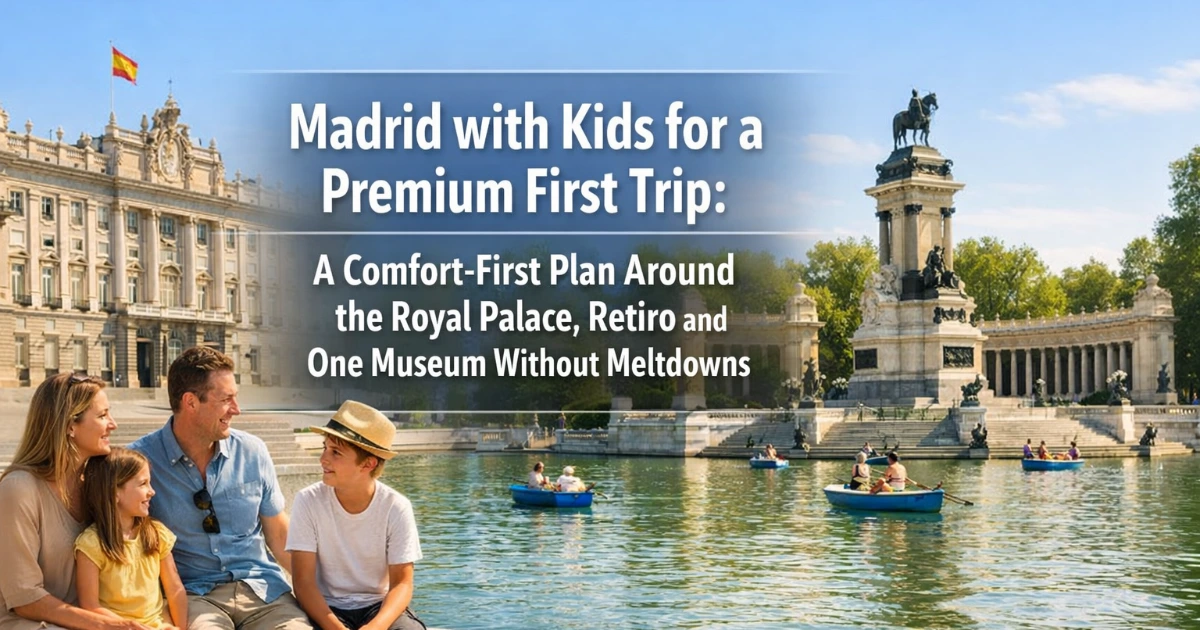
Madrid with Kids for a Premium First Trip: A Comfort-First Plan Around the Royal Palace, Retiro and One Museum Without Meltdowns
Updated
Start with the day shape that actually works
Yes: on a first premium Madrid trip with kids, do the Royal Palace first, keep only one museum, and let Retiro finish the day. That shape works because Madrid looks compact on a map but this west-to-east cultural line asks for more standing, crossing, and behavioral discipline than first-time families expect, especially once you add security, museum quiet, and midday heat on stone. The clearest exception is a toddler-heavy, stroller-heavy, or arrival-day schedule; then the museum is the first thing to cut, not the park.
In Madrid, the family luxury move is not to buy more activities. It is to spend your best behavior hours on the most formal stop, cross the city only once, and end where children can move. A practical local cue makes the point: use the Plaza de Oriente benches before Royal Palace entry for a quick drink, snack, sunscreen check, or last-minute bathroom plan before you commit to security. Those few minutes often matter more than adding another ticket. Families who want expert handling of the morning formalities usually benefit most from starting with a focused Royal Palace private tour and keeping the rest of the day flexible.
The overprogrammed Madrid family move on a first premium stay is trying to combine the Royal Palace, the Prado, and Reina Sofía in one cultural sweep because they all sound central. They are central enough to tempt you, but not close enough in child-energy terms. Two formal museums back-to-back after the palace turn a celebratory day into a compliance test, and the adults end up negotiating every ten minutes instead of enjoying the city.
This is not anti-culture advice. It is pro-sequencing advice. Madrid rewards families who separate grand interiors from one another and let the city breathe in between. When parents stop trying to prove that children can handle “real travel” through sheer density, the city actually becomes more sophisticated for everyone. Adults see more with less friction, and children meet Madrid through contrast instead of pressure.
The first thing to cut is not the park
The first thing to cut from this Madrid family day is always the second museum, not Retiro and not the palace. Families sometimes feel guilty about this because Madrid is famous for art, and parents do not want to “waste” a first trip by seeing only one major collection. In practice, that guilt creates the exact kind of day that children remember badly: long indoor stretches, repeated reminders to stay close, too much visual input, and a late afternoon with nowhere generous to decompress.
Retiro is not filler after the serious sights. It is the part of the plan that keeps the palace and the museum from feeling punitive. When children leave one formal indoor stop and step into wide park paths, open sky, and the option to simply move without being corrected, the whole day changes character. Adults also benefit more than they admit. A family that reaches the Retiro edge with some goodwill intact still has a chance at a civil dinner, a pleasant aperitif, or an easy ride back to the hotel. A family that forces a second museum usually spends the evening recovering from the afternoon.
There is another quiet planning trap here. Some first-time visitors assume that once they are inside Retiro they should keep marching until they have seen every postcard location, including the lake and the Palacio de Cristal, as if the park were another checklist sight. It is not. On a family first day, Retiro works best as relief, not as one more thing to complete. If the children are happily moving on the nearest useful edge of the park, that is success, not unfinished business.
Parents also sometimes cut lunch too aggressively because they are trying to “protect” sightseeing time. In Madrid, that usually backfires. A decent pause between palace and museum is not dead time; it is the reset window that makes the museum viable at all. The family that sits down before anyone is angry almost always tours better than the family that squeezes in one more sight before eating.
Royal Palace first or Retiro first in Madrid with kids?
For most first-time families, Royal Palace first is the right call. The palace asks for the freshest version of your children: the one who can still listen, wait, lower the volume, and accept that this stop runs on institutional timing rather than playground timing. If you spend that first reservoir of patience in Retiro and then try to move from free running to interior formality, the palace often lands badly, even when the total hours look reasonable on paper.
The city layout reinforces that answer. The palace sits on Madrid’s western monumental side, while the Prado-Retiro spine pulls you east across a longer stretch than many visitors assume. Doing the palace first allows you to make one clean directional move through the day. You can finish the formal morning, take lunch, choose your one museum, and then let the day loosen as you arrive near the Puerta de Alcalá side of Retiro. Reversing that order often means asking children to tighten up just when the adults would also prefer the plan to get easier.
The main exception is a genuinely low-capacity day: same-day arrival, a child who still naps, or a family with under-fives who need movement before anything cultural. In that case, Retiro first can work, but only if you are honest about the consequence. You are not building toward a full palace-plus-museum program later. You are choosing a softer day in which the palace may be shortened, delayed, or dropped. Families go wrong when they pretend the park is just a warm-up and then still expect top behavior in the palace after lunch.
The lunch hinge belongs between the palace and the museum, not after the museum. This is where many otherwise good itineraries wobble. Families leave the palace mildly tired, tell themselves they will eat after one more stop, and then try to enter a museum with the whole group already frayed. Even a simple sit-down meal or a well-timed cafe break changes the next two hours more than most upgrades do.
- Royal Palace -> lunch -> Prado -> Retiro is the strongest all-round first-trip shape for school-age children and mixed-age groups.
- Royal Palace -> lunch -> Retiro is the wisest version for toddlers, stroller-heavy families, or anyone arriving tired.
- Retiro -> lunch -> Royal Palace is the specialist exception, not the default, and works only when the day is intentionally light and the palace is treated as optional rather than guaranteed.
The one-museum rule for Madrid families
The one-museum rule for Madrid families is simple: choose exactly one serious indoor collection on the same day as the Royal Palace, and stop there. That is not a timid recommendation. It is the adult decision that gives the day its shape. The Royal Palace is already a formal, high-attention interior. Adding one museum can still feel balanced because the second indoor stop changes the subject and the pace. Adding two museums turns the day into a continuous corridor of looking, listening, queueing, and redirecting.
Madrid tempts families into breaking this rule because the museum spine is prestigious and relatively close together by city standards. But what looks neat in itinerary language feels very different in real time. Each museum adds not only galleries but also bag checks, navigation, bathroom negotiations, exit lag, and the small emotional toll of asking children to be contained again. Retiro after one museum instead of two museums back-to-back is the difference between a family that arrives in the park wanting to stay and a family that arrives already irritated.
If adults in your group care deeply about Madrid’s museum concentration, split the ambition across days. Treat this first family day as a successful cultural introduction, not a comprehensive art campaign. Travelers planning a more museum-focused adult day can go deeper another time with this Golden Triangle guide, but the family answer on a first premium stay is narrower on purpose.
A common workaround does not really solve the problem: replacing Reina Sofía with a “smaller” second museum and assuming size alone will save the day. It usually does not. The friction is cumulative. Once children have done the palace and one museum, the issue is not only square meters or room count; it is the fact that the afternoon is still asking them to behave inside one more institution when the family would benefit far more from open air.
Prado or Reina Sofía for a first Madrid museum with kids?
For most first-time families building a Royal Palace-Retiro day, the Prado is the better museum choice. The reason is not that children automatically “prefer” old masters. The real advantage is route logic. The Prado sits naturally on the same broad cultural axis as Retiro, especially if your plan ends on the Jerónimos or Puerta de Alcalá side of the park. That means the museum can serve as a measured indoor chapter before open-air release, rather than as a detour that extends the day after everyone has already spent patience inside the palace.
The Prado also lends itself better to a highlights mindset. Families do not need to conquer it. They need a curated hour or two with a handful of rooms, a clear adult narrative, and permission to leave while energy is still good. That is where a tailored Prado private tour can earn its place: not by making children into art historians, but by cutting indecision, compressing the route, and helping adults see something meaningful without dragging the family across every gallery. Before you lock the stop, use the official Prado visit page (https://www.museodelprado.es/en/visit-the-museum) to confirm current visit logistics.
The Reina Sofía is the right exception when the family actually has a reason to choose it: older children who already connect with modern art, teens who know they want to see Guernica, or adults willing to accept that this choice usually gives the day a more urban, less fluid finish. Its location at the Atocha end of the museum spine subtly matters. After the palace, getting there and then still finding a calm, satisfying park ending can be done, but the route asks for more commitment. Families should compare that against the official Reina Sofía visit page (https://www.museoreinasofia.es/en/visit) and decide whether the art priority is strong enough to justify the longer-feeling afternoon.
That is why the editorial call here is firm. Prado is the default winner for a first premium family day around the Royal Palace and Retiro. Reina Sofía is not the wrong museum; it is simply not the automatic family answer. Choose it only when modern art is the point, not because you feel obliged to “cover” Madrid culture all at once.
If you are tempted to keep options open until the last minute, decide the museum before the day starts. Family calm improves when the adults are not debating Prado versus Reina Sofía on the curb while children are hungry. A settled choice lets you explain the day cleanly: palace, lunch, one museum, park. Madrid becomes much easier when the adults sound certain.
What this Madrid route does to the body
This route tires families through accumulation, not drama. Madrid does not usually exhaust you here with one cinematic climb. It wears you down through hard paving, periods of standing, repeated stop-start movement, sun exposure on broad streets, and the mental drag of formal interiors. By the time families say the children are “suddenly done,” the body has often been signaling the problem for an hour: slower pace, less humor, more requests to be carried, and sharper reactions to small inconveniences.
The Royal Palace segment is the first energy tax because it is not just sightseeing; it is waiting, entering, orienting, and behaving. Then comes the transfer east, which on paper can look trivial but in practice means more crossings, more traffic judgment, and often more adult logistics than anyone wanted at midday. The Paseo del Prado axis is beautiful and manageable, but it is still an urban procession. Add heat, dress shoes, a stroller, or grandparents, and the body cost rises quickly.
Retiro helps precisely because it changes what the body is being asked to do. Once inside the park, children can trade controlled movement for natural movement. Adults can stop micromanaging every footstep. But even there, families should stay realistic. Retiro is large, the surfaces vary, and a “quick look” at a second park landmark can become another long pull. The city feels kinder when you use the park as an exit ramp, not another distance challenge.
This is also why shoes, layers, and carrying plans matter more in Madrid than elegant itinerary language suggests. A child who refuses to walk, a parent carrying a backpack plus jacket, or a grandparent who needs more sitting breaks changes the route far more than the difference between one museum and another. The premium version of this day is the one that quietly accounts for those physical realities before anyone leaves the hotel.
What this Madrid route does to the mood
The mood consequence is the real reason this plan works. A first family day in Madrid succeeds when it still feels generous at 5:00 p.m., not when it looks impressive at 9:00 a.m. The wrong version of this day creates an atmosphere of constant correction: wait here, not so loud, keep close, no running, almost there, one more room, just a little longer. By the time children finally get freedom, adults are depleted too, which means the park arrives as damage control rather than pleasure.
The right sequence does something subtler. It lets the most rule-heavy stop happen when everyone can still absorb it, then it progressively lowers the demands. Lunch softens the transition. One museum gives the adults intellectual reward without turning the afternoon into a forced march. Retiro then acts as the release valve that makes the earlier formal parts feel worth it. The family does not need to leave the park euphoric. It just needs to leave without resentment.
This matters even more in Madrid because the city day often stretches later than visitors from other time zones expect. If the cultural core of the day ends in friction, the evening narrows: dinner gets pushed, children unravel on the ride back, and parents start bartering instead of enjoying the neighborhood around the hotel. If the park finish lands well, the evening is still usable. That is the hidden dividend of the one-museum rule.
For comfort-first travelers, that evening usability is part of the value equation. A family staying in Salamanca, Retiro, Las Letras, or another pleasant central base has paid for a neighborhood experience, not just for a bed. Ending the day with enough emotional room for a relaxed meal, a short stroll, or even a civilized room-service fallback is part of what makes a premium city break feel well planned.
How the plan changes by age band
The best Royal Palace-Retiro day depends heavily on the age of the youngest child. Under five, the museum is an optional extra, not a pillar. At that age, the palace already uses a great deal of attention, and many children need a broad physical release immediately afterward. For this band, the strongest premium version is often palace first, lunch, then Retiro, with the museum dropped unless the child is unusually steady indoors and the adults are content with a very short, carefully edited visit.
For roughly ages six to eleven, the full shape of palace, one museum, and Retiro usually works best. This is the sweet spot for narrative touring: children can understand that one place is about kings, one place is about art, and the park is where the day opens back up. They also tend to respond well when the adults make the structure clear in advance. “We do the palace while energy is high, then lunch, then one museum, then park time” is far easier to accept than a vague procession of surprises.
Mixed-age groups need one more rule: plan to the youngest child and the least enthusiastic adult at the same time. Grandparents can love the palace and still run out of tolerance for unnecessary crossings. Teens can look physically fine and yet mentally check out in a second museum. The beauty of this Madrid shape is that it respects both ends of the family spectrum without making the day feel watered down.
Under 5s: choose calm over completion
With toddlers and preschoolers, the premium standard is restraint. Choose the palace if it matters to the adults, but do it with low expectations for museum time afterward. Keep snacks visible, keep the transition after the palace short, and think of Retiro as the core comfort tool rather than the bonus. If nap timing clashes with the museum window, the museum loses. That is not a failed day; it is good planning.
Ages 6 to 11: this is the route’s ideal audience
School-age children are often the best fit for this plan because they can handle a structured morning and still enjoy the freedom of the park later. They do particularly well when the adults do not over-explain every object and every room. The aim is to let Madrid feel varied, not exhaustive. A vivid palace story, a selective museum path, and time to move outdoors usually outperform a more “educational” but heavier schedule.
Teens: let their interest decide the museum
Teens can stretch the plan in either direction. If they care about art, Reina Sofía becomes more viable, and the day can tolerate a longer museum conversation. If they do not, the best family move is still not to force a second institution. Teens may complain less visibly than younger children, but boredom at that age can flatten the whole group’s mood just as thoroughly. Give them one serious cultural choice and one open-air release, and Madrid is more likely to feel like their trip too.
Strollers, naps, rain, and the honest return leg
If you are using a stroller, the route can still work, but it works best when you reduce ambition before you leave the hotel. The risky mistake is assuming that because all three headline places are major attractions, the transitions between them will somehow feel seamless. They are not difficult in a heroic way; they are simply full of little frictions. A stroller, a tired child, or a rainy afternoon turns those frictions into the main story unless you plan a shorter version from the outset.
Rain and heat do not require a new itinerary so much as a stricter edit. In poor weather, keep the palace and one museum, then make the park a short edge visit only if conditions still suit. In hotter months, the case for palace first becomes even stronger, especially if you want to avoid exposing children to the broadest open sections of the day at the worst hour. What you should not do is try to “make up” for weather by adding more indoor culture. Families already tired by the palace do not become more resilient just because the plan moved under a roof.
The honest return-leg logic is worth spelling out because it changes how the day feels. Retiro is not a neat little square you pop into and out of at any gate with the same result. If you finish deep inside the park after already doing palace and museum, the exit can feel longer than expected. On a first family day, favor the nearest satisfying section and the cleanest departure, often around the Puerta de Alcalá side or another simple pickup edge, instead of walking across the whole park to prove you “saw Retiro.” This is also why Palacio de Cristal is sometimes the wrong extra goal on a loaded day: it can pull you deeper in when what the family really needs is a graceful finish.
Practical family management matters here too. Build in visible snack and restroom opportunities before palace entry, before museum entry, and before you disappear into the park. Madrid is forgiving when those tiny needs are handled early and surprisingly unforgiving when they are postponed. Many so-called meltdowns on this route are not about culture at all; they are about blood sugar, tired legs, and one avoidable extra ten minutes.
When private guidance or short vehicle support saves the day
Private guidance earns its cost on this route when it removes uncertainty from the formal parts of the day. The palace is where families lose the most composure to unclear timing: security lines, entry pacing, how much to explain, when to stop, and how to avoid turning adult curiosity into child drift. A strong guide compresses those decisions, sets expectations early, and tells the story in a way that keeps the adults engaged without demanding that children stand still for more than they can manage. That is the kind of upgrade that changes the texture of the day rather than simply making it look more polished.
The museum slot is the second place where guidance helps because most families do not struggle with the Prado or Reina Sofía as concepts; they struggle with selecting what to do inside them. A guided highlights route prevents the classic family mistake of wandering too long at low interest before anyone reaches the work the adults most wanted to see. If you want the park itself to carry context rather than just serve as downtime, a brief, flexible Retiro Park private tour can also work well, especially with grandparents or older children who enjoy stories once they are outdoors again.
Short vehicle support is useful under narrower conditions: summer heat, mixed mobility, a grandparent traveling with the family, a child close to nap collapse, or a hotel that sits awkwardly off this palace-to-park axis. In those cases, one or two smartly placed car legs protect energy better than improvising on the curb. What matters is not luxury for its own sake. It is using a vehicle surgically, where it prevents the afternoon from being consumed by transfer stress.
Ticket handling helps for the same reason. Families do not need magic access; they need fewer points of failure. Pre-arranged timing, a guide who knows when to keep moving, and a museum route built around real attention spans remove the dead air that makes children feel punished for adult interests. The gain is not only minutes saved. It is the absence of uncertainty, which is often the bigger source of friction.
When paying more does not help
Paying for a full-day chauffeur does not improve a compact Royal Palace-Retiro family plan. The route is simply too concentrated for an all-day car to earn its keep in the way it might on a hillier or more spread-out city day. Frequent loading, unloading, and waiting can eat the same margin of ease that families think they are buying. In the tight center of Madrid, a palace morning, one targeted transfer, and a park finish usually work better than keeping a vehicle attached to every chapter of the day.
That does not mean all car support is wasted. It means the spend should match the friction. If your hotel is well placed, the weather is reasonable, and the group is mobile, the best investment is usually guided pacing and ticket handling, not a vehicle on standby. If your group includes grandparents, you are staying far from the palace-Prado-Retiro line, or the day falls in heavy heat, then selective luxury chauffeur support in Madrid can be worthwhile. The premium decision is to buy the part that solves the real problem, not the part that sounds most elevated.
This is exactly where tailored family planning changes Madrid from a day of cultural punishment into a day that still feels celebratory. Ticket timing, a guide who knows when to stop, and a realistic handoff between palace, museum, and park do more for family calm than one more headline sight ever will. If you want Orange Donut Tours to shape that kind of day around your children’s ages, energy, and hotel logistics, Inquire now.
A sample first-day shape you can actually keep
The most reliable first-day version of this plan is a morning palace, a deliberate midday pause, one edited museum visit, and a late-afternoon Retiro finish. That gives the day an opening of structure, a middle of culture, and an ending of freedom. It also means every later chapter becomes easier rather than harder. Madrid rewards that descending-demand pattern. Families are less likely to argue, adults are less likely to rush, and the return to the hotel happens before everyone feels trapped in the schedule.
A realistic shape looks like this:
- Morning: use the Plaza de Oriente benches before Royal Palace entry, then visit the Royal Palace while children’s attention is still strongest.
- Midday: take lunch before anyone is desperate, not after the first signs of collapse.
- Early afternoon: do one museum only, usually the Prado, with a defined endpoint rather than an open-ended wander.
- Late afternoon: enter Retiro on the edge that best matches your return plan, and stay only as long as the park is giving energy back rather than taking more.
What makes this sample strong is not the exact hour marks. It is the order of demands. The palace asks for the most. The museum asks for less, if it is curated. The park asks least of all. Families who keep that logic can shorten the day without breaking it. Families who reverse it often spend the entire second half trying to restore order.
There is a final cut-first rule worth keeping in mind. If the day starts slipping, cut depth before you cut dignity. That means leave the museum early rather than drag children through “one last room.” Exit Retiro from the nearest useful edge rather than walking to another famous corner for proof. Skip the second errand, the extra pastry stop, or the final photo idea before you skip the chance to end the day calmly. A shorter day that feels well judged is more premium than a longer day that everyone survives.
If the museum drops out entirely, the day can still succeed beautifully. Royal Palace, lunch, and Retiro is not a compromised version when the family is tired; it is the right version for that family on that day. The mistake is not doing less. The mistake is pretending that a lower-energy day can sustain a higher-energy script. Madrid is enjoyable when your plan tells the truth about your group.
Why this is not a generic kid-friendly Madrid list
This guide is deliberately narrow because families planning a premium first trip do not need another list of zoos, cable cars, and indoor backup attractions. They need to know how to make one culturally serious Madrid day work without turning the city into a test of endurance. The Royal Palace, the Prado, Reina Sofía, and Retiro already create enough decision pressure. The most useful editorial service is not adding more options. It is helping you choose what not to force.
That is also why the recommendation stays firm instead of hiding behind endless “it depends.” On this specific first-day question, the answer is clear: Royal Palace first, one museum only, and Retiro as the release point. The only meaningful variations come from age, weather, arrival fatigue, and how strongly the adults care about Prado versus Reina Sofía. Everything else is secondary to the basic discipline of not stacking too many formal icons on one family day.
If the rest of your stay is still taking shape, you can separate this calm cultural day from your broader Madrid planning. Some families pair it with a gentler arrival strategy from this first-day arrival guide, while others save adult pleasures for later nights and later days. But the family answer inside this article remains the same: do less, in the right order, and Madrid becomes much easier to like.
FAQ
Can you really do the Royal Palace, Prado, and Retiro in one day with kids?
Yes, many families can, provided the Prado is the only museum, the palace comes first, and the park is used as a release rather than another checklist stop. The version that usually fails is palace plus Prado plus Reina Sofía on the same day.
Should families visit Retiro before or after the Royal Palace?
After, in most cases. The park is better as the day’s loosening chapter, while the Royal Palace is better handled when children still have their best patience. Retiro first only becomes the stronger choice on a genuinely low-capacity day when the later palace visit is optional.
Why does the Prado usually beat Reina Sofía for a first family trip?
Because it fits the route better and makes the palace-to-park day feel more coherent. The Prado sits more naturally on the Retiro side of the plan, while Reina Sofía is the right exception for older children or teens who specifically care about modern art and are worth building around.
What is the one-museum rule for Madrid families?
It means exactly one major museum on the same day as the Royal Palace. The point is not to lower ambition for the trip; it is to protect behavior, energy, and mood on a day that already includes one highly formal interior.
Do we need a private guide for this plan?
Not always, but guidance often earns its value at the palace and in the museum because those are the parts where uncertainty and drift cost the most energy. Families who already know exactly how they like to tour may do well on their own, while mixed-age groups often appreciate the compression and clarity a guide provides.
Do we need a chauffeur for this route?
Usually not for the entire day. A full-day chauffeur is often more car than this compact central route requires. A short vehicle handoff can be useful in heat, with grandparents, with a stroller, or when the hotel sits awkwardly off the palace-Prado-Retiro line.
What should we cut first if the day starts to go wrong?
Cut the second museum if you somehow still had one in mind, or cut museum depth if you already chose only one. After that, cut extra park distance before you cut the chance to end the day in a good mood. The aim is to preserve the family, not the checklist.
Is this plan realistic with toddlers?
Yes, but the toddler version is usually Royal Palace plus Retiro, not the full palace-museum-park trio. Toddlers can certainly manage parts of this route, yet the premium choice is to respect nap rhythm and movement needs rather than assume a formal museum stop is owed to the adults.
If you’re interested in any private tours of Madrid, please reach out to us.




 So if you are looking for the absolute best in Madrid & surroundings with authentic local fully-licensed native guides whose English you can actually understand and with an exclusive and amazingly fun itinerary













