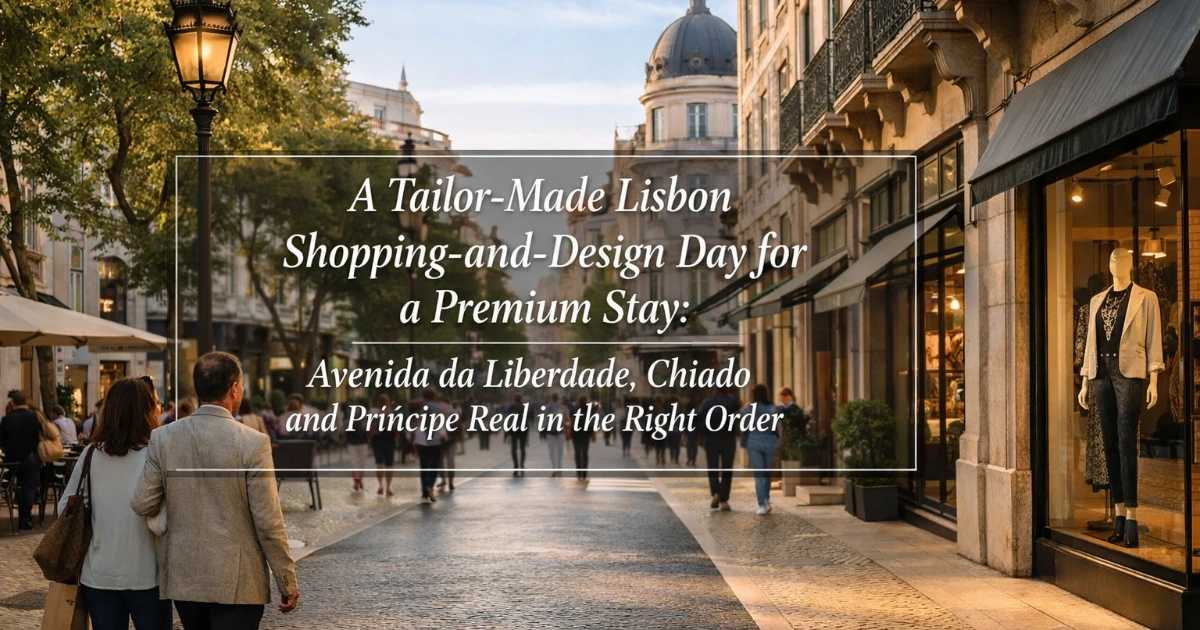
A Tailor-Made Lisbon Shopping-and-Design Day for a Premium Stay: Avenida da Liberdade, Chiado and Príncipe Real in the Right Order
Updated
For a premium Lisbon shopping-and-design day, put Avenida da Liberdade first, Chiado second, and Príncipe Real last, with a hotel pause after the Avenida if you are buying seriously. That order works because the city’s easiest luxury-brand browsing sits on a broad, relatively legible boulevard, while the more rewarding Portuguese design browsing asks you to slow down on narrower Chiado streets before climbing the Chiado-to-Príncipe Real uphill hinge. The exception is a traveler based in Príncipe Real who wants café, atelier and concept-store wandering more than luxury-brand efficiency; they can reverse the morning and end downhill in Chiado instead. Lisbon does not punish bad shopping taste as much as it punishes bad sequence: the same three districts can feel curated or tiring depending on when you climb, when you carry parcels, and whether you leave your evening intact.
The thesis is simple but very Lisbon-specific: the best shopping day is not the one with the most stops; it is the one that treats Avenida da Liberdade as the efficient purchasing spine, Chiado as the design-and-context middle, and Príncipe Real as the late-day browse that earns the uphill effort. This is where a private route, such as Lisbon Shopping Private Tours, is less about someone pointing at stores and more about protecting rhythm, interpreting Portuguese style, and deciding when to stop before the day turns into errands.
A non-obvious planning cue: Baixa-Chiado is not just a metro name; it is a vertical decision. Approaching from the Baixa side gives you flatter downtown movement, while surfacing high near Largo do Chiado places you closer to Rua Garrett but already partway into the slope system that continues toward Bairro Alto and Príncipe Real. That small choice can decide whether the middle of the day feels smooth or as though every short detour has acquired a gradient.
The ranked ladder: the right order for a Lisbon shopping-and-design day
The best sequence is Avenida da Liberdade, then Chiado, then Príncipe Real, because it moves from efficient purchasing to layered browsing to atmospheric late-day wandering without forcing the hardest climb too early or carrying bags over cobbles for too long.
- 1. Avenida da Liberdade first: use the morning for luxury-brand clarity, hotel-adjacent purchases, easy taxi access, and a clean decision point before the city becomes warmer and busier. This is the district for visitors who want to compare, buy, adjust sizing, arrange returns, or keep the shopping portion disciplined.
- 2. Chiado second: move here when you are ready for design context, bookshops, Portuguese labels, architecture, cafés, and a more urban Lisbon texture. Chiado is not as effortless as the Avenida, but it rewards attention in a way a pure luxury corridor does not.
- 3. Príncipe Real last: finish here only when the group still has appetite for a hill, slower browsing, gardens, concept-store energy, and a more residential sense of taste. It suits couples, returning travelers, and style-conscious visitors who do not want the day to end in a mall-like rhythm.
This ladder is not based on prestige. It is based on five practical criteria: where walking is easiest, where purchases create the most logistical drag, where browsing benefits from a guide’s taste calibration, where heat and cobbles become noticeable, and where the day should release you into the evening. A high-end stay in Lisbon often fails at the edges: too much climbing before lunch, too many “just one more” stops after Chiado, or a late return from Príncipe Real when everyone still needs to dress for dinner.
The most common mistake is treating these three districts as equal shopping zones and trying to zigzag among them. Avenida da Liberdade, Chiado and Príncipe Real are close enough on a map to look casual, but they ask different things from the body. The Avenida wants linear movement. Chiado wants short, attentive loops. Príncipe Real wants an uphill commitment. Once you understand that, the day stops feeling like a scatter of shops and starts behaving like a composed route.
For travelers still deciding whether to sleep in one of these areas, the related neighborhood decision is different from the shopping-day decision. A base that is ideal for evenings may not be the best place to begin a shopping route. Use Chiado, Avenida da Liberdade or Príncipe Real: Where to Stay in Lisbon for a Comfort-First Trip for the hotel question; this article is about the order of a single polished day.
Why this order works in real Lisbon conditions
This order works because it saves the most friction-heavy movement for the moment when you have chosen it deliberately, not when the day has already been overstuffed. Lisbon’s central shopping map is compact, but compact is not the same as flat, shaded, or parcel-friendly. Calçada portuguesa looks beautiful underfoot and can feel unforgiving after a few hours of browsing, especially with dress shoes, sandals, a stroller, or anyone managing knee or back sensitivity.
The city does something very specific to the body. It adds effort in small increments: a curb here, a polished cobbled stretch there, a sunny crossing near Baixa, a slope from Chiado toward Bairro Alto, then the final lift toward Príncipe Real. None of these is dramatic in isolation. The problem is accumulation. By late afternoon, a group that began with cheerful “we can walk it” energy may be negotiating who carries bags, who wants a café, and why a six-minute route feels longer than it looked on the phone.
The city also affects the mood. A strong Lisbon shopping day should feel like a sequence of discoveries with enough air between them. A weak one becomes transactional: enter, browse, decide, repeat, climb, complain, rush back. Couples lose the pleasure of wandering when one person becomes the route manager and the other becomes the bag carrier. Families lose patience when the adult shopping blocks are placed after the children are already tired. Celebration travelers lose the sense of occasion when a day designed to feel special ends with everyone overheated and late for dinner.
That is why the Avenida-first structure matters. You front-load the district where choices can be clearer and where a hotel return near Avenida da Liberdade is often easiest for guests staying around the boulevard, Restauradores, or the lower edge of the city center. You then move into Chiado with lighter hands and a more editorial eye. Only after that should you decide whether Príncipe Real is still worth the climb or whether a refined café pause, a final design stop, and an early evening are the better luxury.
The counterintuitive correction is that the most glamorous district is not automatically the best emotional center of the day. Avenida da Liberdade can be the most efficient start precisely because it is less whimsical. It gives the day discipline. Chiado and Príncipe Real then supply the personality, but they are more enjoyable when they are not carrying the burden of every practical purchase.
Avenida da Liberdade is for efficient luxury intent, not atmospheric wandering
Avenida da Liberdade should lead the day when the group has any serious purchasing intent, because it is the easiest place to make decisions without immediately fighting Lisbon’s hill pattern. The avenue runs between Praça dos Restauradores and Marquês de Pombal, and its broad central rhythm gives travelers more room to pause, compare and regroup than the tighter streets around Chiado.
For premium travelers, the value here is not simply that the area is associated with luxury. The value is that it lets the day begin with clarity. A couple looking for one major purchase, a small group comparing sizes, or a celebration traveler planning a special gift can handle that decision before lunch, before heat has built up, and before the group has started mixing shopping with sightseeing. Visit Lisboa’s page for Associação Avenida da Liberdade (https://www.visitlisboa.com/en/places/associacao-avenida-da-liberdade) is useful as a narrow official reference point for the avenue’s role as a district of shops, hotels, restaurants and services; the planning judgment is that those services matter most at the start of the day, not after several hours on foot.
Avenida da Liberdade versus Chiado is the central contrast of the route. The Avenida is better for efficiency, brand comparison, hotel proximity and parcel management. Chiado is better for Portuguese design, street texture, cafés, literary and cultural context, and browsing that benefits from explanation. Confusing those roles leads to a worse day. If you expect Chiado to behave like a luxury boulevard, it may feel fragmented. If you expect the Avenida to deliver the best small-scale Lisbon atmosphere, it may feel too linear. Let each district do the job it does best.
The boulevard is also the place where a guide can help most by narrowing rather than expanding choices. Premium travelers often arrive with a half-formed list: one international brand, one Portuguese-made object, a gift for someone at home, and a desire not to lose half a day. The right support is not a store parade. It is a decision filter: which stops match the traveler’s taste, which categories are better handled in Chiado or Príncipe Real, and which “maybe” stops should be removed before the day bloats.
There is one important caveat. If nobody in the group is buying at the high end and the day is really about Portuguese design, cafés, architecture and atmosphere, do not let Avenida da Liberdade consume the prime morning. Walk a small portion, understand its role, and move on. Premium does not mean spending the most time where the price points are highest. It means spending time where the payoff matches your purpose.
Chiado is the design-and-context block, and a car usually weakens it
Chiado should sit in the middle of the day because it turns shopping into Lisbon context rather than a purely commercial exercise. This is where the route should slow down: Rua Garrett, Largo do Chiado, the transition toward Praça Luís de Camões, the edges dropping toward Baixa, and the cultural layer around museums, cafés, bookshops, and design references all reward a walking pace.
Premium spend does not help inside compact Chiado browsing blocks: a car is slower than walking and removes the street-level context that makes the area worthwhile. This is the sentence many high-end Lisbon itineraries need. Chauffeur support can be excellent for returns, cross-city transfers, older guests, heat management and a late-day escape. It is not the right tool for crawling through short Chiado streets where the useful distance is between doorways, corners, façades and cafés.
For design-minded travelers, Chiado’s advantage is that it can connect the object to the city. A guide can explain why certain materials, graphic choices, ceramics, textiles, books, packaging, or contemporary Portuguese labels feel different from the more internationalized luxury language of the Avenida. The point is not to claim that every stop is artisanal or unique. The point is to help the traveler read Lisbon taste more accurately: when something is genuinely local, when it is simply well merchandised, and when the best purchase is actually not a purchase but a better understanding of the city’s design vocabulary.
Baixa matters here because it sits just below Chiado and can either sharpen or dilute the day. A quick design reference around the lower grid can be useful, especially if you want to connect shopping to Lisbon’s rebuilt downtown logic after the 1755 earthquake. But dropping too far into Baixa for generic retail can flatten the day. The lower streets are practical and central; they are not where a premium shopping-and-design day should drift without a reason.
One useful cultural anchor is the MUDE Design Museum (https://mude.pt/design-museum/), which belongs in the planning conversation not because every shopping day needs a museum stop, but because it gives design travelers a direct way to frame Portuguese and international design in the city center. Before building the day around a specific exhibition or opening pattern, confirm details on the official site. For this itinerary, MUDE is best treated as an optional context stop: valuable for returning travelers and design professionals, skippable for a group whose real goal is a relaxed private shopping route.
The wrong way to do Chiado is to over-schedule it. Three or four considered stops plus a café pause will usually beat eight loosely connected stops. Chiado has enough texture that the spaces between destinations matter. The group should be able to notice tiles, window displays, old shopfront rhythms, and the shift toward Bairro Alto without feeling dragged from one transaction to the next.
Príncipe Real belongs after Chiado, unless it is your emotional center
Príncipe Real should usually come after Chiado because its charm is tied to slower browsing and a higher, more residential mood that feels best once the practical shopping has been handled. It is not the district to rush through with a group that is already carrying multiple bags and negotiating dinner timing.
The Chiado-to-Príncipe Real uphill hinge is the decisive piece of the route. From the Chiado and Praça Luís de Camões area, the movement toward Bairro Alto and onward to Príncipe Real asks for a real climb, even if the map makes it look like a short urban connection. The hinge is not just about fitness. It changes the emotional temperature of the day. When taken at the right moment, it feels like Lisbon unfolding upward. When taken too late, too hot, or too heavily loaded, it feels like a planning error.
Príncipe Real’s payoff is mood, taste and decompression. Around Praça do Príncipe Real, Rua Dom Pedro V and the Rua da Escola Politécnica edge, browsing tends to feel less like “shopping district” behavior and more like an edited neighborhood walk. This is why it suits couples and returning travelers especially well. The district gives a premium day a softer final note, provided the group has not been forced to earn it through unnecessary fatigue.
Bairro Alto is the caution zone between Chiado and Príncipe Real. It is historically rich and atmospheric, but using it as a shopping shortcut can backfire if the group is already tired or if the route turns into a tangle of side streets. The solution is not to avoid Bairro Alto entirely. The solution is to treat the transition with intention: choose the line, avoid unnecessary loops, and keep the late-afternoon goal clear.
The exception is a traveler staying in Príncipe Real or one whose central interest is contemporary Portuguese lifestyle browsing rather than luxury purchasing. In that case, begin with a late breakfast or coffee near Príncipe Real, browse while the group is fresh, then descend toward Chiado. This reverses the energy curve and can be lovely for a couple on a second or third Lisbon visit. It is less effective for a first-time group that wants to buy on the Avenida, see Chiado properly, and still arrive at dinner without a long uphill return.
The hour-by-hour flow that keeps the day polished
A polished Lisbon shopping day should feel like three controlled acts, not an open-ended retail crawl. Use the times as a rhythm rather than a rigid schedule, because actual stops depend on interests, hotel location, weather, and whether purchases need to be returned or held.
Morning: Avenida da Liberdade for decisions and easy returns
Start on or near Avenida da Liberdade in the morning, ideally after breakfast rather than after a long sightseeing block. Keep the first stage focused: high-end fashion, jewelry, accessories, one special gift, or a short list of brands the traveler already cares about. This is not the moment to wander without criteria. Decide what the Avenida is meant to solve, and stop when it has solved it.
If guests are staying near the boulevard, this is also the cleanest moment for a hotel return. Parcels can be dropped, a jacket changed, and the group can decide whether the day is still a true shopping day or should soften into design browsing. The hotel return near Avenida da Liberdade is not a luxury flourish; it is a routing tool that prevents purchases from occupying everyone’s hands and attention for the rest of the day.
Late morning: transfer into Chiado without turning the route into a taxi hop
Move from the Avenida toward Chiado once the practical purchasing work is complete. Depending on the group, this may be a short transfer or a guided walk through the Restauradores and Baixa edges. The key is not to overcomplicate the move. A private guide should use the transition to explain the district shift: boulevard to downtown, international luxury to Portuguese urban texture, broad pavements to narrower browsing.
This is also where travelers often overestimate how much a car will improve things. A car can help move between districts, especially in heat or with mobility needs. It cannot make Chiado’s best browsing more efficient once you are there. The useful unit in Chiado is the small walking loop.
Lunch or café reset: keep it close to the route
Place the food break close to the route rather than chasing a distant reservation. This article is not a restaurant guide, and the point is not to build the day around a famous table. The point is to choose a pause that preserves the shape of the afternoon. A long cross-town lunch can break the shopping-and-design thread; a well-placed Chiado or nearby café pause can make the day feel lighter and shorter.
For food-and-wine travelers, the right move is restraint. Do not combine a serious shopping morning, a long lunch, Chiado browsing, Príncipe Real, and a major dinner unless the group has unusually high stamina. Lisbon rewards lingering, but too much lingering in the wrong place creates a late-day squeeze.
Afternoon: Chiado first, then decide on Príncipe Real
Use early afternoon for the Chiado design block. This is when a guide’s judgment can be most valuable: not more stops, but better interpretation and fewer false leads. The browsing should have a point of view, whether that is Portuguese design, books and paper, home objects, contemporary labels, or a gift strategy for people at home.
After Chiado, make a conscious decision about Príncipe Real. Do not go simply because it was on the original list. Check the group’s energy, weather, footwear, parcel load and evening plans. If the day still has lift, climb toward Príncipe Real. If not, finish with a final Chiado pause and return to the hotel. Cutting Príncipe Real is better than arriving there irritated.
Late afternoon: Príncipe Real as the soft landing, not the forced finale
Príncipe Real works best as a soft landing. Browse fewer places, pause around the garden, notice the shift in scale, and let the day become more personal. This is where couples often recover the atmosphere that a purely commercial morning cannot provide. It is also where small groups can split briefly: one person browses, another sits, another takes photographs, and the guide keeps the route from unraveling.
The exit matters. A late-day return from Príncipe Real to a hotel near Avenida da Liberdade can be simple with the right plan and annoying without one. Do not spend the final twenty minutes debating whether to walk downhill, call a car, or squeeze in one more stop. Decide before fatigue makes the decision for you.
When chauffeur support earns its cost, and when walking wins
Chauffeur support earns its cost on a Lisbon shopping day when it removes logistical drag without interrupting the walking texture that makes the districts worthwhile. The best use is not door-to-door movement between every stop. The best use is selective: hotel pickup, Avenida purchasing, parcel return, a comfortable transfer into the next act, and a clean late-afternoon exit if the group ends high in Príncipe Real.
It helps most for celebration travelers, older guests, families with tired children, visitors in warmer months, anyone managing mobility limits, and groups planning to add Colares or Sintra to the same day. If the day begins with shopping and then continues to wine country, the coast, or a Sintra-area add-on, car support changes the day from awkward to coherent. Without it, parcels, timing, and the mental load of exits can start to dominate the experience.
It is unnecessary inside the tightest Chiado browsing blocks. A private car waiting nearby may be useful as a safety net, but using it for micro-hops will usually slow the day down. Lisbon’s premium comfort is not achieved by refusing to walk; it is achieved by knowing which walks are worth doing and which transfers should be handled for you.
For a deeper citywide view of this decision, compare this shopping-specific logic with Is a Chauffeured Lisbon Day Worth It for a High-End City Stay?. For this particular route, the answer is narrower: use chauffeur support for the edges, parcels, hotel returns and add-ons; preserve walking for Chiado and the best parts of Príncipe Real. Orange Donut Tours can also build the day with Luxury Chauffeured Lisbon Private Tour support when the group’s comfort, purchases or onward plan justify it.
The natural private-tour value appears when the day stops being a list of shops and becomes a designed sequence. A guide can calibrate taste, read the group’s energy, explain why Portuguese design differs from international luxury retail, decide when to leave a district, and coordinate a hotel return near Avenida da Liberdade before the rest of the day is swallowed by bags. When you want that kind of route rather than a generic shopping walk, Tailor-Made Private Tours of Lisbon can shape the half day or full day around your hotel, interests, mobility and evening plans. Inquire now
How to tailor the same sequence for couples, families and returning travelers
The sequence should stay mostly the same, but the emphasis changes by traveler type. A good private day is not identical for a honeymoon couple, a family with teenagers, and a returning traveler who has already seen Belém, Alfama and the major viewpoints.
For couples: preserve the emotional arc
Couples should use Avenida da Liberdade for one clear shared purpose, then let Chiado and Príncipe Real carry the atmosphere. The mood-preserving decision is to avoid turning the day into competitive browsing, where one person’s interests dominate while the other waits. A guide can help by alternating categories: one fashion or accessory stop, one design or book stop, one café pause, one neighborhood transition.
The mood-killing mistake is leaving Príncipe Real until the moment when both people are hungry, hot, carrying parcels, and trying to make a dinner reservation. If romance is part of the trip, late-day friction is the enemy. The most elegant choice may be to stop before the last district, return to the hotel, and keep the evening unhurried.
For families and small groups: reduce the number of unanimous decisions
Families and small groups should not require everyone to care about every stop. The route works better when the guide creates short, clear segments: the adults handle Avenida decisions, the group takes a reset, Chiado adds cultural context, and Príncipe Real becomes optional rather than compulsory. Teenagers may respond better to design, sneakers, graphics, books, or contemporary Portuguese style than to a sequence of luxury-brand doors. Older relatives may enjoy the route more if they are not asked to stand through every browsing decision.
The practical rule is to avoid long stretches where non-shoppers are merely waiting. In Lisbon, waiting usually means standing on uneven pavement, hovering near a doorway, or negotiating a narrow sidewalk. Build in seated pauses before people ask for them.
For returning travelers: let Príncipe Real gain weight
Returning travelers can give Príncipe Real more prominence, especially if they already understand central Lisbon and do not need the Avenida to anchor the day. They may also enjoy a more design-led route that touches Chiado, edges into Bairro Alto, and climbs toward Príncipe Real with fewer formal shopping goals. The route becomes less about acquisition and more about taste, city texture and conversation.
Even then, do not overload it. Returning travelers are often the most vulnerable to overconfidence because Lisbon feels familiar. Familiarity does not flatten the hills or make late-afternoon cobbles kinder. A shorter, sharper route still wins.
What to cut first if the day starts to sprawl
Cut the least personal district first, not the least famous one. If the trip is becoming crowded, the right cut depends on the purpose of the day: remove Avenida da Liberdade if nobody is buying at the luxury level, remove Príncipe Real if the group is already tired or dinner matters, and remove lower Baixa retail if it is only being added because it is nearby.
A dedicated shopping day is not worth a slot in Lisbon if your main priority is monuments, viewpoints and one or two Portuguese gifts. In that case, fold a single design or shopping stop into a broader first-day or Chiado walk and spend the dedicated day on Belém, Alfama, Sintra, Colares or another priority that cannot be handled in passing.
The stop-forcing rule is this: do not force all three districts if the day has already produced one meaningful purchase, one strong design discovery, and one good café or hotel pause. That is enough. Lisbon is a city where the excess stop often costs more in energy than it returns in pleasure.
Also cut any far-flung retail detour that exists only because someone saved it on a map. Premium Lisbon planning is not a scavenger hunt. If a stop is not close to the day’s sequence, not distinctive enough to justify a transfer, and not matched to the traveler’s taste, it should not survive the edit.
The final decision is the evening. A shopping-and-design day should hand the evening back to you. If the group wants a serious dinner, Fado, a private celebration, or simply a composed return to the hotel, end the shopping route earlier than your theoretical stamina allows. The best luxury in Lisbon is often not one more stop; it is arriving back with time, energy and the sense that the day was chosen rather than consumed.
FAQ
What is the best order for Avenida da Liberdade, Chiado and Príncipe Real on a Lisbon shopping day?
The best order is Avenida da Liberdade first, Chiado second and Príncipe Real last. This keeps luxury purchasing and parcel logistics early, places Portuguese design browsing in the middle, and saves Príncipe Real’s uphill atmosphere for the moment when the group can choose it deliberately.
Is Avenida da Liberdade better than Chiado for premium shopping?
Avenida da Liberdade is better for efficient luxury-brand intent, while Chiado is better for Portuguese design context, cafés, books, cultural texture and slower browsing. The stronger day usually uses both, but it gives each district a different job.
Should we use a chauffeur for a Lisbon shopping-and-design day?
Use a chauffeur for hotel pickup, parcel returns, comfort in heat, mobility needs, late-day exits, or a Colares or Sintra add-on. Do not use a car for short Chiado browsing hops, where walking is faster, more atmospheric and more useful.
Is Príncipe Real worth adding after Chiado?
Príncipe Real is worth adding if the group still has energy for the Chiado-to-Príncipe Real uphill hinge and wants concept-store browsing, cafés, gardens and a more residential design mood. Skip it if parcels, heat, footwear or dinner timing are already creating pressure.
Can this Lisbon shopping route work as a half day?
Yes, but a half day should be edited. Choose Avenida da Liberdade plus Chiado for efficient buying and design context, or Chiado plus Príncipe Real for a more atmospheric Portuguese-style route. Trying to do all three in a short window usually makes the day feel rushed.
Where should we pause or reset during the day?
The best reset is either a hotel return near Avenida da Liberdade after serious purchases or a café pause in or near Chiado before the climb toward Príncipe Real. A pause should reduce parcel load, heat load or decision fatigue, not pull the group far off route.
When is a dedicated Lisbon shopping day not worth it?
A dedicated shopping day is not worth it if you only want a few souvenirs, have a first-time monuments-heavy itinerary, or are already short on time for Belém, Alfama, Sintra or a food-and-wine day. In that case, include one or two targeted design stops inside a broader private route.
If you’re interested in any private tours of Lisbon, please reach out to us.


 So if you are looking for the absolute best in Lisbon & surroundings with authentic local fully-licensed native guides whose English you can actually understand and with an exclusive and amazingly fun itinerary













