Best Lisbon Sunset Sailing Tours for Couples and Small Groups
Updated
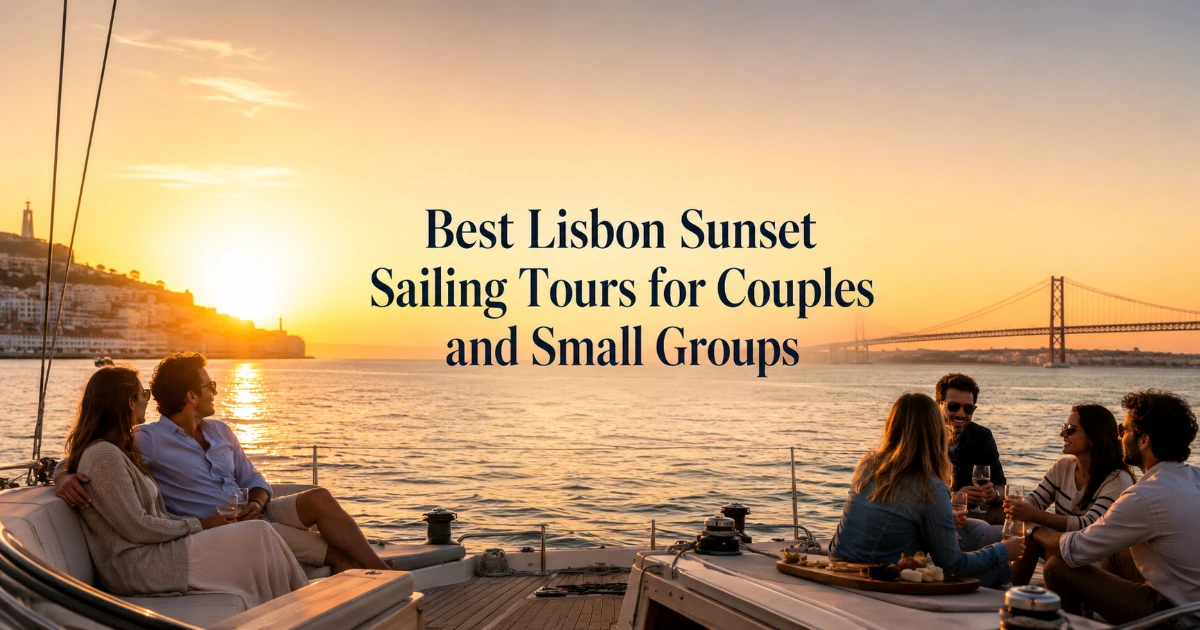
To avoid the usual sunset-sail regret, choose a private or near-private Tagus sail from Belém or Alcântara, timed so the boat is under way before the bridge light peaks. That works in real Lisbon conditions because it avoids the hill fatigue, tram crowding, and late uphill returns that can flatten an evening; even the Alfama slope above the tram corridor matters, because a beautiful pre-sail viewpoint there can become a sweaty transfer reset before dinner. The clearest exception is a larger celebration group that wants music, cocktails, and deck space more than conversation; they may be happier on a private catamaran or motor yacht than on a classic sailboat. Lisbon sunset sailing is not about escaping the city: it is about using the Tagus as the one place where Lisbon stops negotiating with your legs.
The best Lisbon sunset sailing tours for couples and small groups are decided less by price than by mood control. A good boat matters, but the better question is whether the format lets you talk, see the 25 de Abril Bridge without fighting for rail space, drink something you actually want, and return to dinner without turning the last hour into logistics. For travelers already considering private tours in Lisbon, the sail should behave like the calm hinge of the day, not a bolted-on activity.
Best Lisbon sunset sailing tours for couples: the ranked ladder
The winning format is the one that keeps the Tagus in charge while removing avoidable friction around boarding, privacy, drinks, and the post-sail return. The overvalued default most readers should reconsider is the viewpoint-first plan: racing from a hilltop miradouro to the marina sounds romantic, but the transfer often steals the exact ease you booked the boat to create. If the sail is the main event, let the river have the best light and let the city views come from the deck.
1. Private sailboat from Belém or Alcântara: best for couples who want the river, not a party
A private sailboat is the strongest choice for couples, anniversaries, proposals, and two-to-six-person groups who want conversation to survive the evening. The format works because it makes the boat feel like a private room with moving scenery: the bridge, the low riverfront, the Belém monuments, and the western light do the work. The crew can keep commentary light, pour drinks without staging a performance, and adjust the feel of the sail to the people on board.
- Mood: intimate, slower, and better for couples who want the evening to feel unhurried.
- Group size: strongest for two to six guests, especially when not everyone wants the same level of movement on deck.
- Route value: excellent when the sail catches the 25 de Abril Bridge, Belém, and the widening river rather than lingering too long near the marina.
- Drink logic: best when drinks are simple and well timed, not when the boat tries to become a floating bar.
This is the format we would choose first for a romantic Lisbon sunset cruise when the travelers care more about atmosphere than spectacle. It is also the easiest to fold into tailor-made Lisbon planning, because the sail can be placed after a lighter private day rather than after a maximal sightseeing push.
2. Private catamaran or motor yacht: best for groups that want space and a lower movement threshold
A private catamaran or motor yacht is the better answer when the group includes older relatives, children, guests who prefer steadier deck space, or celebration travelers who want music and more room to stand. The mood changes: it becomes more social, less hushed, and often easier for a group to circulate without interrupting the crew. For six to twelve guests, that can be worth the upgrade.
- Mood: more convivial and practical, especially for birthdays, family gatherings, and small incentive groups.
- Group size: best when a sailboat would make people choose between sitting still and crowding the rail.
- Route value: strong if the boat still follows the sunset geometry instead of selling size as the main attraction.
- Drink logic: better for groups that want a fuller drinks setup, but only if service stays calm rather than club-like.
The tradeoff is romance. A larger boat can be more comfortable, but it rarely feels more personal for two people. If the goal is a quiet anniversary, bigger is not automatically better.
3. Small shared sunset sail: best value when privacy is not the emotional point
A small shared sail can be the right value choice when the travelers are relaxed about other guests, do not need a custom tone, and mainly want the river at golden hour. It can also suit a first-night plan when you want something memorable without committing the evening to a full private design. The risk is not safety or scenery; the risk is group chemistry. One loud table, one delayed boarding party, or one over-scripted drinks routine can change the whole mood.
- Mood: pleasant when the group is compatible, thin when the deck feels crowded or too social.
- Group size: works for couples who are not marking an occasion and for friends who do not mind sharing space.
- Route value: good when the itinerary still reaches the bridge and western light at the right moment.
- Drink logic: often adequate, but rarely the reason to book.
Choose shared only when savings matter more than controlling the evening. If the trip is a honeymoon, milestone birthday, family reunion, or proposal, the private premium usually buys something real: not luxury theater, but quiet control.
4. Viewpoint-first plus boat later: the option to cut before it cuts into the night
The viewpoint-first plan is the one we would trim first. It looks persuasive on paper because Lisbon has famous viewpoints and the river has sunset boats, but sequencing both often creates too much movement at the worst moment. If you climb or transfer to a miradouro, wait for photos, then descend to the water, the boat becomes the second queue of the evening rather than the release.
- Mood: restless if the viewpoint is treated as mandatory before the sail.
- Group size: especially hard on families and mixed-age groups because everyone pays the same time tax.
- Route value: weaker when the best light is spent between hill, car, and marina.
- Drink logic: irrelevant if boarding begins with everyone hot, hurried, or thirsty.
Our editorial no: do not force a hilltop viewpoint before a Tagus sunset sail unless the boat is clearly secondary. If the sail is the reason you booked the evening, the deck is the viewpoint.
Why the Tagus changes the whole evening
The Tagus is the right stage for a Lisbon sunset because it gives the city distance, air, and a clean sightline that the hills do not. From the water, Lisbon stops feeling like a sequence of climbs and starts reading as layers: the Alfama ridge, the Baixa grid, the Praça do Comércio riverfront, the bridge, and Belém’s low monuments. That is why the best tours do not need to over-narrate. They need to time the route so the river does not become background to drinks service or a rushed photo sequence.
The practical consequence is simple. A sunset sail should reduce walking load, queue drag, and transfer resets, not add another logistics chapter to the day. If you spend the afternoon crossing from Chiado to Alfama, then back down to a central pickup, then west toward the marina, the evening will feel chopped into pieces. If you design the day around the river, the sail becomes a clean handoff: light sightseeing, hotel pause, marina, deck, dinner. That difference is felt in the body before it is noticed in the itinerary.
Lisbon makes this more important than it would be in a flatter city. Cobbled descents ask for attention, tram corridors can crowd at precisely the hour visitors are trying to move, and the late return to a hotel above Baixa-Chiado can feel longer than the map suggests. The point is not that Lisbon is hard; it is that the city rewards restraint. A couple that arrives at the marina cool, unrushed, and already a little hungry will experience the same sail differently from a couple that has just chased three viewpoints and a tram photo.
The river also changes the trip mood. On land, Lisbon evenings can become performative: one more overlook, one more tile facade, one more narrow street before dinner. On the Tagus, the plan simplifies. You sit, the city moves slowly, and the group has permission to stop optimizing. For a romantic experience, that permission is often the upgrade.
Where to board: Belém, Alcântara, or a central quay?
The best boarding area is usually the one that makes the hour before and after the sail calm, not the one that appears closest on a map. Belém and Alcântara often win because they sit near the river scenes that travelers want from a sunset sail: the bridge, the western light, the low waterfront, and the broad turn of the Tagus. Central quays can be convenient, but convenience only counts if it does not create a noisy transfer or a rushed return.
Belém works when the day is already leaning west
Belém is the most natural pairing when you want the sail to feel connected to a calmer daytime route. A private Belém morning around Jerónimos, the riverfront, and pastry timing can set the day on the same geographic line as the evening, especially if you leave a hotel pause between the two. Travelers who want that west-side rhythm can use our private Belém morning guide to keep the monuments from turning into a crowd-heavy prelude.
The advantage is continuity. Belém gives you a riverfront mental map before you board: Padrão dos Descobrimentos, the wide path near the water, the line toward the bridge, and the sense of Lisbon opening west. That makes the sail feel like an elegant continuation rather than a separate excursion. The downside is dinner placement. If your restaurant is deep in Chiado, Príncipe Real, or Alfama, build the return intentionally or the calm of the water will dissolve in the final transfer.
Alcântara works when the bridge is the visual hinge
Alcântara is a strong base when the 25 de Abril Bridge is central to the evening. The area near the docks gives you a practical starting point for a route that can move quickly into the bridge light, then open toward Belém or angle back toward the city depending on wind, timing, and operator practice. It is not the prettiest pre-sail wandering zone for every traveler, but it can be the most efficient one.
The consequence is time discipline. If the meeting point is near Alcântara, do not turn the pre-sail period into a long roam around LX Factory, a late snack, and a casual stroll to the boat unless the operator has built that sequence clearly. The charm of the area can tempt travelers into treating the marina arrival as flexible. It should not be. Sunset sails work because the boat is moving when the light changes, not because everyone eventually reaches the pontoon.
Central quays work when your hotel and dinner sit close to the river
A central boarding point can suit travelers staying near Baixa, Chiado, or the river edge, especially if the dinner plan stays low rather than climbing back into a high neighborhood. Praça do Comércio and Cais do Sodré can make the city feel close and immediate. For a first-night sail after an overnight flight, that can be reassuring.
The caution is that central convenience can hide river compromise. A boat that spends too much time in the central stretch may deliver Lisbon views but miss the more satisfying western rhythm of bridge, Belém, and open light. This is where the route matters more than the pickup. Ask what the sail is trying to catch: the bridge hour, the Belém sweep, the city skyline, or simply “sunset on the river.” Those are not the same experience.
How to choose by mood, group size, drinks, route, and value
The clearest way to choose a Lisbon sunset sail is to name the mood before choosing the boat. “Romantic,” “celebratory,” “family-friendly,” and “good value” point to different formats, and the wrong one can make an otherwise beautiful evening feel slightly off.
For couples, privacy beats a bigger boat
Couples should prioritize a private sailboat, a quiet crew style, and a route that gives them time under the bridge light without turning the experience into a photo shoot. The mood-preserving decision is to keep the sail as the first real evening event after a pause, not as the reward after a heavy touring day. The mood-killing mistake is squeezing the sail between an uphill neighborhood walk and a formal dinner reservation with no room for the return.
A private boat also lets small preferences matter. One traveler can stay seated with a glass while the other steps forward for photos. The crew can talk when asked and recede when not needed. Music can be low or absent. These are not minor details for couples; they decide whether the evening feels like a shared memory or another scheduled product.
For families and mixed-age groups, steadiness matters more than romance
Families and mixed-age groups should judge the boat by seating, movement, shade before departure, and how easy it is for everyone to stay comfortable without constant management. A catamaran or motor yacht may serve them better than a more charming sailboat, especially when children, grandparents, or hesitant sailors are involved. This is not about lowering the experience; it is about choosing the format that avoids making one person’s discomfort the group’s main memory.
Lisbon adds a second layer here. If the day already includes cobblestones, museum standing, or a long Belém morning, the sail should not demand more endurance. A group that boards with snacks handled, layers packed, and seating expectations clear will enjoy the same route more than a group that treats the boat as a place where logistics magically disappear.
For celebration travelers, decide whether you want atmosphere or volume
Celebration travelers should decide whether the occasion wants elegance or energy. A proposal, anniversary, or small birthday dinner usually benefits from quiet timing and a private sailboat. A reunion, incentive group, or milestone birthday with several couples may need a larger deck, stronger drinks service, and a crew comfortable managing a social group.
The mistake is booking the most festive-looking option without asking what it will do to conversation. If the boat is loud, the seating scattered, and the drinks service the central feature, the river becomes decoration. That can be exactly right for one group and completely wrong for another. The best format is the one that lets the occasion feel intentional rather than merely upgraded.
For food-and-wine travelers, do not overbuy the drinks package
Food-and-wine travelers often overvalue the boat’s drinks list. A better bottle can be pleasant, but the Tagus is not the place to stage a serious tasting. Wind, motion, temperature, and the short window of sunset all work against concentration. If wine matters, let the sail be the aperitif and build the culinary weight before or after it with a proper food route or dinner plan.
That is where a Lisbon evening can become especially good. A light sail can lead into a refined dinner, or a daytime food route can leave the sunset free for air and distance. If your trip is organized around taste as much as scenery, pair the river with a separate culinary plan rather than asking one boat to do everything. Our Lisbon food-and-wine day guide is a better place to make the wine decision.
The best day-flow for a Lisbon sunset sailing tour
The best day-flow keeps the land portion lighter than you think and gives the boat the cleanest hour of the evening. A sunset sail is not difficult to add; it is difficult to add gracefully after a full Lisbon day. The river rewards travelers who stop before they are tired.
Morning: put Belém or one low-route highlight before lunch
If the sail departs from the western side, a Belém morning is the most coherent daytime pairing. Jerónimos, the riverfront, and the monument axis all sit in the same visual language as the evening sail. What you should not do is treat Belém as the start of a day that also includes Alfama, Graça, Bairro Alto, a shopping detour, and then a boat. That is not a richer day; it is a day that asks the sunset to repair overplanning.
If you prefer the historic core, keep it low and selective. Baixa, Chiado, and one carefully chosen climb can work. Several climbs cannot. The city gives a lot back to travelers who stop while they still have appetite for the evening.
Afternoon: build in a hotel pause or a low riverfront reset
The afternoon should create room, not prove ambition. A hotel pause before the sail lets travelers change shoes, collect a layer, drink water, and leave unnecessary bags behind. This is especially important for couples headed to a good dinner later. Arriving at the marina already dressed for the night may sound efficient, but it can make the boat feel precious and the deck feel limiting. Dress for the river first, then polish the dinner plan around it.
A low riverfront reset can work if the hotel is inconvenient, but avoid turning it into a long walk in direct sun or wind. The best pre-sail hour is almost boring: no queue, no climb, no complicated shopping pickup, no last-minute tram ride. That calm is not wasted time. It is the condition that lets the sail feel expensive in the right way.
Boarding: protect the first fifteen minutes
The first fifteen minutes shape the whole sail. If guests are late, thirsty, carrying too much, or still negotiating dinner timing, the best light starts while the group is not mentally on the boat yet. Arrive early enough that boarding is not the story. Use the restroom before the marina, keep bags minimal, and make sure the crew knows whether the priority is romance, family comfort, photos, or drinks.
This is also where private planning earns its keep. A guide or planner who understands the whole day can keep the afternoon from drifting, align transfers, and prevent the sail from becoming an isolated booking with no relationship to the rest of the itinerary.
After the sail: choose dinner by return ease, not just reputation
After the sail, the dinner should match the return path. A high-profile restaurant can be the right move, but only if the timing and transfer are clean. Do not let a beautiful sail end with everyone checking maps, climbing toward a late table, and losing the calm they just found on the water. For restaurant logistics that can change, direct sources matter: when a restaurant provides an official PDF (https://belcanto.pt/uploads/Belcanto_FAQ_EN_Abr25.pdf), read that instead of relying on secondhand summaries; when a restaurant manages reservations through its official site (https://www.fiftysecondsexperience.com/en/reservations/), let that shape the timing rather than a generic “sunset plus dinner” package.
For a culinary evening, compare the sail with the dinner rather than treating both as separate indulgences. A restaurant such as Marlene, on MICHELIN Guide (https://guide.michelin.com/us/en/lisboa-region/lisboa/restaurant/marlene), asks for a different after-sail rhythm than a relaxed riverfront table. If the dinner is the anchor, keep the sail shorter and cleaner. If the river is the anchor, choose a dinner that does not punish a slightly windblown, happy return. Our fine-dining shortlist can help you decide which kind of evening you are actually building.
What to skip when the trip is getting too full
Skip the pre-sail hill chase first. It is the easiest element to romanticize and the first one to damage the evening. Lisbon’s viewpoints are wonderful when they belong in the day, but they are not mandatory before a boat. If your group is already seeing Alfama, Graça, or Bairro Alto on another day, let the sunset sail carry the view instead of duplicating the effort.
The second thing to trim is the oversized drinks promise. More bottles, more courses, and more staged service do not necessarily make a short sail better. The Tagus is the feature. Drinks should support the hour, not compete with it. A glass served at the right moment is worth more than a menu that needs explaining while the bridge light is changing.
The third thing to trim is the after-sail climb. An uphill return can undo the whole mood, especially for older guests, children, or couples trying to keep the night elegant. If the dinner or hotel sits high, plan the transfer before boarding. If that sounds too fussy, choose a lower dinner or keep the evening nearer the river. The point is not to avoid Lisbon’s hills altogether; it is to stop pretending they disappear after dark.
Where premium spend earns its place, and where it does not
Paying more earns its place when it buys privacy, better timing, steadier group fit, cleaner transfers, and the freedom to make the sail match the evening rather than the operator’s default. A private boat is not valuable because it sounds luxurious; it is valuable because no stranger can change the tone, no shared group can delay the start, and no preset script has to dominate the route. For couples and small groups, that control can be the difference between a pleasant outing and the memory that defines the Lisbon stay.
Premium spend also earns its place when it protects mixed needs. A family with grandparents may need a steadier boat and clearer boarding plan. A celebration group may need more deck space and drinks service. A couple marking a milestone may need a quieter crew style and a return that leads directly into dinner. These are real differences because they change how people behave during the hour, not because they sound impressive on a proposal.
Premium spend does not earn its cost when it only buys a larger boat for two people on the same exposed route, a more complicated drinks list, or a longer post-sunset float after the city has gone flat and everyone is thinking about dinner. It also cannot buy calmer wind, guarantee the exact color of the sky, or make a crowded shared deck feel intimate. Spend on control and sequence, not on decorative extras.
Once the river slot, group fit, and dinner cadence are clear, the remaining work is coordination: who meets you, where the day should lighten, when the transfer should happen, and how the evening should land. Orange Donut Tours can shape that around a private Lisbon day, a Belém-to-river sequence, or a celebration plan that does not make the sunset carry too much. Inquire now.
How a private guide changes the sail without turning it into a lecture
A private guide changes a Lisbon sunset sailing tour by protecting the before-and-after, not by talking over the river. The best use of expertise is usually upstream of the boat: choosing the right neighborhood to visit earlier, deciding whether Belém belongs before the sail, avoiding a late Alfama descent, and making sure the group reaches the marina with energy still intact. The guide’s job is to make the boat feel effortless, not to convert the deck into a classroom.
For travelers who want context, a short pre-sail walk can work well when it is placed low and close to the river. A guide can explain why the Tagus shaped Lisbon’s maritime identity, how Belém’s monuments sit in relation to the water, and why the bridge changes the visual scale of the city. But that context should sharpen what you see from the boat; it should not compete with the moment everyone came for.
This is where Lisbon differs from a city where the river is simply a transport corridor. Here, the Tagus gives relief from the hills and a slower way to understand the city’s shape. A good private plan uses that relief deliberately. If your day includes Alfama or Bairro Alto, use a guide to decide whether those hills belong before the sail, after the sail, or on a different evening altogether. The answer may be different for a couple than for a family group, and that is exactly why private design is useful.
For a broader evening decision, compare the river with other after-dark bases rather than stacking them. The river can be the calm choice, Alfama can be the intimate old-city choice, and Bairro Alto can be the higher-energy choice; forcing all three into one night usually makes each one weaker. Our Lisbon evening plan explains how to choose the after-dark base without turning the night into a transfer exercise.
Final verdict: let the deck be the viewpoint
The best Lisbon sunset sailing tour for couples is a private sailboat timed around the western light and followed by an easy dinner return. The best option for small groups is a private catamaran or motor yacht when space, steadiness, and celebration energy matter more than hush. The best value option is a small shared sail only when privacy is not part of the reason you are booking.
The decision is not whether the Tagus is beautiful at sunset. It is. The decision is whether your boat, route, drinks, group size, and return plan let the river simplify the evening. Choose the format that removes the most friction from the hours around sunset, and the sail will feel like Lisbon becoming easier rather than Lisbon becoming another thing to manage.
FAQ
What is the best Lisbon sunset sailing tour for couples?
The best choice for couples is usually a private sailboat from Belém or Alcântara, timed so the boat reaches the bridge and western light before sunset peaks. It gives privacy, conversation, and a calmer mood than a shared deck.
Is a private sunset sail in Lisbon worth it?
A private sunset sail is worth it when the evening is romantic, celebratory, or part of a carefully paced trip. It is less about exclusivity and more about controlling the tone, timing, route, and return to dinner.
Should we choose Belém, Alcântara, or central Lisbon for boarding?
Belém and Alcântara usually work best when you want the bridge, western light, and broad Tagus views. A central boarding point is useful when your hotel or dinner is near the river, but the route still needs to reach the best light.
Are shared Lisbon sunset sailing tours good for small groups?
Shared sunset sails can be good value for relaxed travelers who do not need privacy. They are weaker for proposals, anniversaries, family milestones, or any group that wants the evening’s mood to stay predictable.
What should we do before a Lisbon sunset sail?
Keep the pre-sail plan low and light. A Belém morning, a hotel pause, or a simple riverfront reset works better than a hilltop viewpoint chase that leaves everyone rushed before boarding.
Can a Lisbon sunset sailing tour work with children or older parents?
Yes, but choose the boat by comfort rather than romance. A steadier private catamaran or motor yacht can be better for children, older parents, and mixed-age groups than a smaller sailboat with limited movement space.
Should we combine a Lisbon sunset sail with fine dining?
Yes, if the transfer is clean and the dinner timing does not rush the boat. If dinner is the anchor, keep the sail concise; if the river is the anchor, choose a dinner that accepts a relaxed post-sail rhythm.
What should we skip if our Lisbon day is already full?
Skip the pre-sail hilltop viewpoint first. The boat is already the viewpoint, and cutting the climb usually protects the mood, the walking load, and the dinner return better than adding one more famous stop.
If you’re interested in any private tours of Lisbon, please reach out to us.


 So if you are looking for the absolute best in Lisbon & surroundings with authentic local fully-licensed native guides whose English you can actually understand and with an exclusive and amazingly fun itinerary













