The 1922 Cante Jondo Contest in Granada: Falla, Lorca and Flamenco at the Alhambra

Updated
A rescue mission that became a spectacle
On the night of 13 June 1922, a project conceived as the rescue of an endangered, intimate art met a crowd that a contemporary newspaper account placed at about four thousand people. They sat in the Plaza de los Aljibes, inside the Alhambra precinct, beneath a temporary setting of bright hangings, copper and shawls. The organizers wanted the audience to hear old forms of Andalusian song without the theatrical habits they believed were disfiguring them. Yet almost everything about the occasion was theatrical: the monumental site, the invited writers and musicians, the visual direction of Ignacio Zuloaga, the competitive format and the press attention surrounding two June nights.
That contradiction is not a flaw to be edited out of the story. It is the most useful way into it. The 1922 Concurso de Cante Jondo mattered because an intellectual campaign to conserve song became a modern public construction of heritage. Manuel de Falla, Federico García Lorca and their collaborators did not simply discover a pure survival and place it before neutral listeners. They selected categories, wrote an origin story, recruited performers, established rules, chose a symbolically charged Granada setting and taught an audience how the music should be valued. At the same time, the singers, guitarists and dancers who appeared in and around the contest refused to fit neatly inside that design. Their repertories, careers and stage choices exposed flamenco as a living field of memory, technique, commerce, family transmission and reinvention.
The defensible reading, therefore, lies between celebration and dismissal. The contest was neither a transparent recovery of an unchanged ancient voice nor merely an elite appropriation with no benefit to flamenco. It was a consequential act of mediation. It raised cante jondo within Spanish and international cultural debate, preserved documents and sound traces, and gave Granada a durable place in flamenco memory. It also attached authority to a narrow distinction between supposedly primitive cante and later flamenco forms, a distinction that should be read as the organizers’ 1922 theory rather than as an uncontested map of the art.
This article isolates that argument rather than treating the contest as one colorful episode in a general music itinerary. For the broader relationship among Falla, Lorca, the Alhambra and Sacromonte, Granada through music beyond a performance-night narrative provides the parent context. Here, the question is tighter: what exactly did the organizers think they were saving, what did Granada make the event mean, and what survives when later archives and flamenco culture retell it?
Who organized the contest, and what did they say was in danger?
The familiar shorthand of “Falla and Lorca” is useful but incomplete. The institutional history begins with a group of artists and cultural figures led by Manuel de Falla, Federico García Lorca, the painter Ignacio Zuloaga and Miguel Cerón, working through Granada’s Centro Artístico and seeking municipal support. The Fundación Archivo Manuel de Falla’s documented anniversary account identifies those four at the head of the petition to Granada City Council and summarizes the declared goal as the renaissance, conservation and purification of ancient, primitive song. The contest took place on 13 and 14 June 1922 in the Plaza de los Aljibes.
Each word in that program deserves attention. “Renaissance” implied that something of high value had fallen from a former condition and could be restored. “Conservation” treated repertory and style as vulnerable cultural inheritance. “Purification” was more interventionist: it assumed that valid old forms could be separated from corrupting additions. The campaign was thus not only protective. It was taxonomic and corrective. Its leaders intended to decide which sounds represented the deepest stratum of Andalusian song and which belonged to a commercial, theatrical or fashionable surface.
The threat named most forcefully by Lorca was forgetting. In his lecture at the Centro Artístico on 19 February 1922, months before the contest, he warned that elderly singers were dying with repertories that had not been securely transmitted. He also attacked the popularity of the couplé and the public stereotype that reduced deep song to tavern disorder, caricatured cries and a tourist-ready image of Spain. The rescue campaign therefore worked on two fronts: recover endangered musical knowledge and change the social status of the people and forms associated with it.
That second ambition helps explain why the project attracted composers, painters, poets, critics and international guests. Falla and Lorca did not argue that cante jondo should be protected only because it was quaint or local. They presented it as a source of modern artistic possibility. Lorca linked it to the work of Albéniz, Granados, Falla and Debussy; Falla’s musical authority gave the classification scholarly weight for the audience of the time. Popular tradition was being claimed as material through which modern culture could renew itself.
There is an asymmetry inside that defense. Educated cultural brokers were speaking publicly for singers whose knowledge they described as endangered. Their advocacy could confer prestige, funding and attention, but it could also turn practitioners into evidence for a theory designed elsewhere. The contest’s historical interest comes from watching both processes occur together. The organizers needed living singers to validate the “ancient” repertory, while the singers entered a stage whose rules and meanings had already been written in pamphlets, lectures, petitions and press campaigns.
The theory was staged before the singers arrived
The contest began intellectually before it began musically. Lorca’s February lecture did not merely praise emotional depth; it prepared listeners to distinguish cante jondo from what the organizers called flamenco. The Instituto Andaluz del Flamenco’s analysis of the lecture records the hierarchy he presented. The seguiriya occupied the central position, with polos, martinetes, carceleras and soleares treated as related forms. Malagueñas, granaínas, rondeñas and peteneras were placed in a later or different category, described as flamenco rather than belonging to the oldest core.
For a present-day reader, the important point is not to memorize that list as a timeless taxonomy. It is to see classification doing cultural work. By locating value in a “primitive” layer, the organizers could argue that the repertory preceded mass entertainment, contained an austere emotional truth and required rescue from theatrical embellishment. The category of cante jondo was being sharpened so that the contest could have a mission. Without a boundary, there could be no purification; without a danger narrative, there could be no urgency.
Lorca’s language also reveals the modernist imagination behind the event. He described a voice that exceeded tempered musical notation, moved through microtonal inflection and seemed closer to natural cries than to polished concert singing. He repeated theories of distant Eastern and Indian origins, of Andalusian foundations and of a decisive Gitano contribution. Those ideas were persuasive in 1922 because they linked antiquity, alterity and artistic renewal. They should not be repeated today as settled music history. They belong to the intellectual evidence of the contest: a record of how Falla and Lorca made depth audible to their contemporaries.
This distinction protects the subject from two opposite simplifications. One is romantic belief: the assumption that the contest opened a sealed chamber and recovered an untouched ancestral music. The other is cynical reduction: the claim that because its origin theories and purity language are contestable, the event had no serious cultural effect. In fact, the theory mattered precisely because it shaped institutions, audiences and later arguments. It helped move flamenco from a stigmatized or exoticized social category toward recognition as an art worthy of archives, scholarship and major public presentation, even while it carried the biases of its makers.
The lecture also matters for understanding Lorca’s subsequent reputation. His poetic response to cante jondo was not a neutral transcription of singers’ knowledge. It was an imaginative translation, informed by Falla’s theories and by Lorca’s own symbolism of roads, wounds, water, night and lament. A literary traveler can therefore read the 1922 campaign in two registers at once: as cultural advocacy and as the making of Lorca’s poetic language. A source-led Lorca route through Granada is most useful when it keeps those registers connected but not confused.
Granada was not a backdrop; it was part of the proof
The contest’s geography formed an argument of its own. Its preparations moved through several Granadas: the institutional city of the Centro Artístico; the antiquarian and archival city of Casa de Castril and Casa de los Tiros; the social flamenco world of the Albaicín; the modern hospitality and performance space of the Alhambra Palace Hotel; the garden setting of the Carmen de los Mártires, where Zuloaga’s exhibition was installed; and, finally, the monumental plateau of the Plaza de los Aljibes. The sequence joined local sociability, artistic modernism, tourism, historical memory and civic display.
Universo Lorca’s reconstruction of the preparations is especially revealing. It describes preliminary selection sessions, pre-contest gatherings in the Albaicín and a night that brought La Niña de los Peines, Antonio Chacón, La Malena, La Macarrona, Manuel Torre and the organizers into the same social orbit. It also records a 7 June presentation at the Alhambra Palace Hotel where Antonio Gallego Burín read from Falla’s text, guitar music was played, Lorca offered an advance from the work later published as Poema del cante jondo, and Andrés Segovia appeared.
These scenes complicate any clean division between intellectuals and flamenco artists. The campaign was directed by cultural elites, but it was not conducted at a distance from performers. Singers, dancers, guitarists, painters, journalists and writers met in overlapping spaces. The social life around the contest carried repertory and reputation as powerfully as the official rules did. A gathering in the Albaicín and a formal presentation in a hotel theater belonged to the same cultural operation, even though they addressed different audiences and used different codes.
The originally intended site, the Plaza de San Nicolás, would have placed the contest within the Albaicín, looking across toward the Alhambra. Moving it to the Plaza de los Aljibes reversed that relation. Instead of staging song in a lived hill neighborhood beneath the monument’s gaze, the organizers installed it inside the monument’s outer precinct. The change followed rising expectations and the need for greater capacity, but it also altered the symbolic ownership of the occasion. Cante jondo would no longer be heard merely as neighborhood practice. It would be presented as heritage at Granada’s most internationally legible site.
That relocation is one reason the contest cannot be understood through performers alone. Place amplified the preservation thesis. The Alhambra offered historical depth, visual authority and a ready association with a layered Andalusian past. Yet the monument’s meanings were themselves products of centuries of reuse, romantic representation, restoration and tourism. To place a supposedly primitive song there was to make two complex inheritances appear to authenticate one another. Granada’s past lent gravity to the music; the music, in turn, made the Alhambra seem acoustically connected to an enduring Andalusian essence.
What the Plaza de los Aljibes added to the event
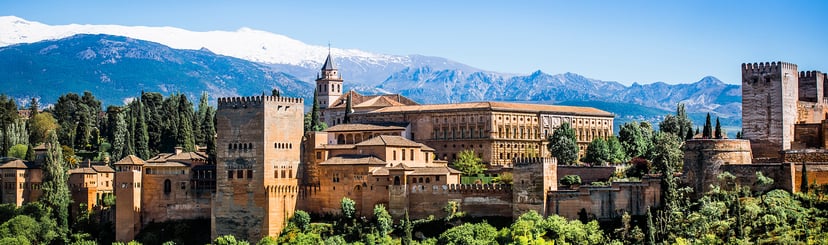
The Plaza de los Aljibes is an open space between the Alcazaba and the palatial zone. It is not an intimate cave, domestic patio or café. Its scale permits assembly, and its location places an audience within the Alhambra without enclosing it in the most decorated palace interiors. For the contest, that openness became a stage on which a local form could be addressed to a civic and international public.
Zuloaga’s scenography made the transformation explicit. Bright fabrics, metal objects and shawls brought domestic and vernacular references into the plaza, while lighting was designed for an intense, almost incendiary impression against the Alhambra. The audience was also invited to participate visually through romanticized dress suggestions, while formal evening wear was discouraged. This was not archaeological reconstruction. It was a consciously composed image of Andalusia, mixing nineteenth-century costume memory, avant-garde artistic direction, folk objects and a medieval monument.
The result is best described as staged symbolism rather than simple decoration. Zuloaga helped turn the audience into part of the scene and the site into part of the claim. The event’s visual language said that deep song belonged neither to an undignified tavern stereotype nor to conventional elite ceremony. It would occupy a third space: ceremonially elevated, aesthetically designed and presented as rooted in the people. That solution was powerful because it appeared to reconcile prestige with popular origin. It was also unstable because the reconciliation depended on who controlled the image.
Rain on the second night sharpened the gap between ideal design and material event. The carefully produced plaza became a crowded outdoor venue exposed to weather. The detail matters because it prevents the contest from hardening into a flawless heritage tableau. Its historical reality included uneven performances, jokes, press exaggeration, audience impatience and practical disorder. The myth of a solemn revelation was created from an occasion that was also social, comic and contingent.
For a visitor standing in the plaza today, the useful question is not “where exactly was the singer?” unless a reliable plan or image can answer it. The stronger question is what the move to this space did to the music’s public meaning. A second Alhambra visit organized around that kind of question can be more revealing than another general circuit; a second Alhambra visit built around a chosen interpretive theme explains why focus changes what the monument yields.
The first evening: when the theory met actual voices
The documented first evening demonstrates how quickly the organizers’ categories became porous. Ramón Gómez de la Serna introduced the occasion in his own literary register. The young Manuel Ortega Juárez, later famous as Manolo Caracol, sang seguiriyas and then saetas described in the contemporary account as modern. Frasquito Yerbabuena sang soleares. Diego Bermúdez, known as El Tenazas, appeared with Ramón Montoya and moved through polo, caña, soleares and seguiriyas. La Macarrona and her group danced tangos and alegrías. Manuel Torre sang a classical seguiriya; other performers contributed dance, song and instruction; Antonio Chacón, although president of the jury, eventually sang as well.
The sequence is reconstructed by Universo Lorca’s account of the opening night, drawing on contemporary chronicles. It is valuable not because every journalist was impartial or every anecdote can be accepted without qualification, but because the named repertory and roles reveal the event’s mixed ecology. Contestants appeared beside contracted artists. A juror crossed into performance. Guitar accompaniment linked singers to major professional technique. Dance forms that did not sit neatly inside the narrowest definition of cante jondo were part of the evening’s success.
El Tenazas became the emblem the rescue campaign seemed to desire: an elderly singer, associated with an earlier repertory, returning to public attention with styles that listeners treated as repositories of memory. Yet even he was not an untouched rural informant. He had performed professionally decades before. His authority came from a career, from remembered versions, from bodily technique and from the dramatic contrast between visible age and vocal force. The contest turned that biography into evidence of survival.
Caracol supplied the opposite temporal image. He was young and capable of moving between the organizers’ prized seguiriya and saetas heard as modern. Later fame makes it tempting to read his appearance as the discovery of a fully formed star, but the more revealing point is that the contest placed future development beside retrospective recovery. The same program that sought old forms also rewarded a singer whose career would unfold through twentieth-century flamenco theater, recording and popular culture.
Placed together, El Tenazas and Caracol created an irresistible narrative of transmission from old age to youth. It would be too easy, however, to treat them as symbolic props. Each singer made choices in repertory, vocal execution and professional life that exceeded the meanings assigned by organizers and press. The event did not simply pass a fixed tradition from one generation to another. It exposed tradition as selection: what a singer remembers, what a guitarist supports, what a jury recognizes, what an audience applauds and what later institutions preserve.
Other named participants make the same point. Manuel Torre brought the authority of a major professional singer. La Macarrona’s dance connected the cante-centered mission to a broader flamenco stage world. Ramón Montoya’s accompaniment made clear that guitar was not a neutral frame but an interpretive art. Chacón embodied a particularly striking contradiction: a celebrated professional asked to judge a search for supposedly unspoiled nonprofessional knowledge, then drawn by the audience into singing. The boundary between expert corruption and expert guardianship could not hold for even one evening.
Repertoire was evidence, but the categories were arguments
“What was sung?” and “what did the organizers believe the songs proved?” are different questions. The first can be approached through programs, press accounts, prize records and later recordings. The second requires reading the pre-contest texts. Falla and Lorca used repertory to support a historical hierarchy. The seguiriya, caña, polo, martinete, carcelera and soleá were valued for austerity, melodic character, perceived age and distance from fashionable stage manner. Other forms were treated as later developments, even when they were deeply rooted in Andalusian practice and artistically demanding.
A source-critical reading separates three layers:
- The organizers’ core: forms they classified as cante jondo and presented as the deepest surviving stratum of Andalusian song.
- The event’s performed field: the wider combination of contest pieces, guest appearances, guitar playing, dance, saeta, granaína and other material that audiences actually encountered.
- Later flamenco understanding: the changing scholarship, artist lineages, recordings and institutional classifications through which those forms are now heard.
Confusing the layers leads to bad history. To repeat the 1922 classification as objective fact erases a century of research and flamenco practice. To ignore it because it is dated erases the intellectual engine of the contest. The hierarchy shaped the rules, the listening habits encouraged in advance and the reputations made afterward. It is part of what happened, even where it is no longer persuasive.
The language of purity also requires care. In music, styles change through contact, adaptation and performance. A singer’s version can carry traces of teachers, local schools, professional circuits, recording technologies and personal invention. The contest’s desire to remove theatrical display did not reveal a repertory without history; it favored one kind of historical change over another. Ornament associated with concert display could be rejected, while a version understood as old or severe could be rewarded. “Purity” named an aesthetic preference and a cultural politics, not a condition that can be measured outside interpretation.
There was nevertheless a real preservation problem behind the rhetoric. Repertories transmitted largely through people can be lost when singers die, when work contexts change or when younger performers cannot sustain a livelihood in less fashionable forms. The organizers were right to recognize vulnerability. Their limitation was to imagine that rescue required fixing a single authentic core. What can be preserved more honestly is a documented plurality: versions, names, places, techniques, relationships and disagreements.
This is why the post-contest recordings associated with Falla are so important and so easy to misuse. They offer sound evidence connected to participants and repertory, but they are not a transparent recording of the two nights in the Plaza de los Aljibes. They were made after the contest at Barcelona’s Casa Odeón through Falla’s mediation, according to the Fundación Archivo Manuel de Falla. A recording captures a performance under new technical and commercial conditions. It preserves a voice while also creating another historical event.
Three readings of the contest, and what each one misses
The successful rescue
The celebratory reading begins with outcomes. The contest brought unusual public attention to cante jondo, enlisted leading artists and intellectuals, rewarded singers, encouraged documentation and produced an afterlife in recordings, exhibitions and scholarship. It challenged the contempt that associated flamenco with moral disorder or disposable entertainment. Its dates, site and protagonists remain central reference points, and Granada still uses the contest to narrate its relationship to flamenco modernity.
This reading has strong evidence, but it becomes too smooth when it says the music was “saved” in two nights. Public recognition, transmission and documentation require durable relationships, not only a spectacular launch. More fundamentally, flamenco did not survive because intellectuals granted it life. Artists, families, local communities, aficionados and professional circuits had already been carrying and changing it. The contest altered recognition; it did not create the tradition it praised.
The elite appropriation
A critical reading emphasizes power. Cultural authorities defined the acceptable repertory, filtered performers through selection, located authenticity in age and social marginality, and presented living people as vessels of a timeless essence. The Alhambra and Zuloaga’s visual program aestheticized that claim for a prestigious audience. Theories of primitive or Eastern origin could exoticize Gitano and Andalusian musicians even while celebrating them. The professional world was treated as a possible contaminant, although professionals supplied expertise, accompaniment, prestige and much of the evening’s artistic force.
This critique is necessary, especially when modern travel writing is tempted to repeat “soul,” “purity” and “ancient voice” without evidence. Yet appropriation alone does not explain why artists participated, competed, accepted prizes, performed around the rules or later incorporated the contest into flamenco memory. Practitioners were not mute raw material. Nor does the critique account for the genuine change in public legitimacy that advocacy helped produce. Power was unequal, but cultural action still moved in more than one direction.
The modernist intervention
A third reading sees the event as an avant-garde construction: a deliberate collision of old repertory with new art, literary performance, cubist graphics, curated display and international cultural networks. This account explains why Lorca’s poetry, Falla’s composition, Manuel Ángeles Ortiz’s visual language, Zuloaga’s scenography and the Alhambra setting belong to the same story. The contest was not trying to return society to a premodern world. It was using selected tradition to make modern Spanish art.
This reading best captures the productive contradiction, but it can shift attention back toward famous intellectuals and away from the singers. The modernist encounter only existed because performers possessed repertory, style and authority that the organizers could not manufacture. A balanced interpretation therefore keeps all three readings active. The rescue was consequential, the power imbalance was real, and the modernist invention was artistically fertile. None is sufficient alone.
What the contest preserved beyond a winner’s story
Popular retellings often collapse the event into El Tenazas, Caracol, Lorca and Falla. The archive is richer. It includes petitions, correspondence, regulations, posters, newspaper reports, photographs, caricatures, costume ideas, instruments, later sound recordings and memories from participants and witnesses. These materials do not simply illustrate a settled narrative. They show disagreement over venue, money, eligibility, repertory, aesthetics and legacy. The contest survives as a documentary field because its organizers generated paper and publicity around an art often imagined as resistant to writing.
The difference between document and event is crucial. A newspaper chronicler may heighten crowd size or drama. A photograph frames the scene but cannot recover sound. A later memoir may preserve a vivid detail while reshaping chronology. A recording made after the contest carries voices but not the plaza’s acoustics, weather or audience. A poster expresses an intended identity rather than the full social composition of the program. Specialist interpretation does not eliminate these gaps; it makes them visible and asks what each source can support.
The Fundación Archivo Manuel de Falla’s later exhibitions have presented original documents alongside sound testimony connected to the contest. That pairing is particularly useful because it resists treating theory and performance as separate worlds. Falla’s notes and institutional correspondence show the designed campaign; recordings show singers making musical decisions within and beyond that design. Neither source type should dominate. Texts explain the mission, while voices expose what the mission could not fully contain.
Lorca’s archive and institutional memory add another layer. His February lecture, the advance reading of Poema del cante jondo and his later literary reputation encourage audiences to hear the contest through poetry. That can deepen the emotional and intellectual context, but it can also make Lorca the apparent author of a world he encountered through artists and through Falla’s theories. A responsible literary route names the mediation: Lorca transformed cante into imagery; he did not replace the singer’s art with a poem.
Granada’s flamenco memory similarly extends beyond 1922. Sacromonte, the Albaicín, professional stages, peñas, teaching, archives and contemporary artists carry different histories and social conditions. The contest is one hinge in that larger field, not its origin point. A present-day performance cannot be treated as a reenactment of the Plaza de los Aljibes, and the 1922 event should not be used as a stamp of authenticity for every Granada flamenco setting. The decision about when Sacromonte belongs in a Granada stay is stronger when based on context and purpose rather than on the promise of proximity to an imagined unchanged past.
How Granada’s institutions have reframed the legacy
Centenary commemoration made the archive itself part of the story. The Patronato de la Alhambra y Generalife’s catalogue page for the centenary exhibition describes a project of roughly 230 photographs, paintings, drawings, documents, ceramics, posters, correspondence, instruments, costumes and audiovisual records, organized across seven thematic areas. The range matters more than the number. It demonstrates that the contest cannot be reconstructed from a program and a few famous portraits. It sits at the intersection of music, visual art, literature, municipal action, collecting, performance and monument culture.
The exhibition’s framing also reveals how interpretation changes. The 1922 organizers spoke of renaissance, conservation and purification. A century later, the Alhambra’s curatorial language emphasized complexity, transverse connections, tradition and innovation, and the event’s role in elevating flamenco as art. That shift is not merely polite modernization. It reflects a broader move from searching for one pure origin toward studying networks, representations and multiple archives.
Later institutional memory can still produce its own heroic simplifications. An anniversary naturally favors a coherent story and memorable protagonists. The remedy is not to reject commemoration but to read its choices. Which objects are placed together? Are singers’ biographies given the same weight as correspondence among intellectuals? Does the exhibition distinguish contemporary reporting from later legend? Are women visible as dancers, singers, organizers, witnesses and image-makers, or mainly as scenic presence? Does the Gitano contribution appear as living agency or as evidence for someone else’s theory?
Those questions show why the contest remains generative. It is an archive of flamenco, but also an archive of how institutions make flamenco legible. The Plaza de los Aljibes gave the art monumental visibility in 1922; the Palace of Charles V gave the event museological visibility a century later. Both settings authorize a narrative, and both require the visitor to ask what has been selected, enlarged or left at the edge.
The most valuable legacy is therefore not a final answer about whether the contest succeeded. It is a set of evidence through which changing generations can test the claims of rescue, authenticity and cultural ownership. Granada holds enough of that evidence in connected institutions and places to support a rigorous visit, provided the sequence does not collapse archive, monument, neighborhood and live performance into one seamless myth.
A source-led way to read the contest in Granada
A culturally serious visit benefits from moving through questions rather than collecting loosely related stops. The sequence below is editorial judgment, not a claim about current access or opening arrangements. Its purpose is to connect documented sites and institutions in an order that clarifies the 1922 argument.
Begin with the written campaign
Start with Falla and Lorca as advocates before approaching them as icons. Read the petitioning language, the February lecture and the stated distinction between cante jondo and flamenco. Note the verbs: rescue, conserve, purify, define, exalt. Ask who had the authority to use them and what evidence the organizers offered. This gives later places an intellectual frame and prevents the Alhambra setting from turning immediately into atmosphere.
Use the Plaza de los Aljibes as a problem of scale
In the plaza, reconstruct only what the evidence supports: two June nights, a large public, temporary scenography, rain, named performers and a carefully prepared cultural message. Then consider the unrealized alternative of Plaza de San Nicolás. The move explains how capacity and symbolism converged. A neighborhood-facing setting became a monument-facing statement, and the contest’s claim expanded from Granada initiative to international cultural occasion.
Return to the Albaicín as social evidence
The Albaicín matters not because it can supply a timeless “authentic quarter,” but because documented preparations and gatherings reveal relationships among performers and organizers beyond the formal stage. This is where the city corrects the event program. Professional artists, local social spaces, late-night exchange and the original venue plan show that flamenco knowledge moved through networks that no contest rule could contain.
Place Sacromonte after, not inside, the 1922 story
Sacromonte belongs to Granada’s wider flamenco geography, but the contest should not be retroactively turned into a Sacromonte performance narrative. Treat the hill as a connected history with its own communities, forms of display, tourism pressures and artistic continuities. The analytical bridge is not “this is what the contest sounded like.” It is “how did Granada’s different flamenco settings negotiate intimacy, livelihood, audience and representation before and after public heritage recognition?”
End with a live art, not a historical reenactment
A present performance is most illuminating when allowed to be contemporary. Listen for form, compás, accompaniment, individual style and the relation between prepared structure and improvisational decision. Do not demand that a singer prove the organizers’ origin theory or reproduce El Tenazas. The contest’s deepest lesson is that preservation and invention were already entangled in 1922. Living flamenco should not be asked to stop changing in order to validate an archive.
This sequence is where specialist guiding has material value. The difficulty is not getting from one Granada landmark to another; it is keeping four kinds of evidence distinct while showing their connections: the organizers’ texts, the documented event, later archival framing and contemporary flamenco practice. A guide who can identify which claim comes from which source can prevent the Alhambra, Lorca and Sacromonte from merging into a single romantic story.
Why the 1922 contest still changes how Granada is heard
The contest did not preserve a single object. It changed the conditions under which a field of practice could be discussed. Cante jondo entered a monumental civic space with intellectual sponsorship and international attention. Singers who carried remembered repertories were presented as cultural authorities, even when the format constrained how that authority appeared. Modern artists found creative energy in the encounter. Archives later gathered the traces, and institutions repeatedly reframed the occasion for new publics.
Its contradictions are part of that achievement. The campaign denounced theatrical falsification through an intensely theatrical event. It sought noncommercial authenticity while relying on professional artists, prizes, publicity and recording. It elevated Gitano and Andalusian contributions while filtering them through theories created by socially powerful intermediaries. It looked backward for ancient forms while helping produce modern flamenco heritage. The contest’s meaning survives because none of those tensions has disappeared from cultural presentation.
For flamenco and literary travelers, the reward is not the comfort of deciding that Falla and Lorca were either heroic saviors or naïve meddlers. It is the ability to see how advocacy, aesthetics and power operated together. Their errors do not cancel their seriousness; their seriousness does not make their categories final. El Tenazas, Caracol, Manuel Torre, La Macarrona, Chacón, Montoya and the other performers are not supporting characters in an intellectual pageant. They are the evidence that the art could answer back.
That leaves an open question at the center of any Granada visit: when culture is moved from social practice into archive, museum and monument, what must be protected, and what must remain free to change? A tailored sequence through the relevant texts, the Plaza de los Aljibes, the Albaicín and a carefully contextualized live performance can hold that question without forcing a single verdict. For specialist planning, private tours in Granada shaped around documented cultural context can connect the places in a bespoke order. Inquire now
If you’re interested in any private tours of Granada, please reach out to us.



 So if you are looking for the absolute best in Granada & surroundings with authentic local fully-licensed native guides whose English you can actually understand and with an exclusive and amazingly fun itinerary













